License

I have written an e-book, Does the Bible Really Say That?, which is free to anyone. To download that book, in several formats, go here.
Creative Commons License
The posts in this blog are licensed under a Creative Commons Attribution-NonCommercial-ShareAlike 3.0 Unported License. You can copy and use this material, as long as you aren't making money from it. If you give me credit, thanks. If not, OK.
Showing posts with label Canada. Show all posts

Wednesday, March 22, 2017

Sunspots 618


Things I have recently spotted that may be of interest to someone else:


Christianity: (And Politics) Christianity Today on how Hispanics, including some legally in the US, are now afraid to attend church (and for some valid reasons.)

Christianity Today also reports that recent executive orders are cutting off efforts to evangelize Muslims in the U. S. So is the attitude of white evangelical Christians, who are far more likely to fear Muslims and support the attempted travel bans than is the population at large.

Christianity Today discusses the importance of contemporary worship, and even defines it.


Finance: Listverse reports on 10 typos that led to some really awful consequences.

Health: The New York Times reports that, in Canada, people with cystic fibrosis live, on average, 10 years longer than they do in the US. The difference is mostly due to better insurance in Canada. The same report indicates that Canadians live about 2 years longer than Americans do.

Politics: (And Science) General Mattis, the newly installed US Secretary of Defense, believes that climate change is a real threat that our military needs to take seriously.

Shepard Smith, of Fox News, stated that that network had "no evidence of any kind that the now president of the United States was surveilled at any time in any way, full stop.”

Science: (And politics, unfortunately) The Weather Channel on why scientists believe that humans are contributing to climate change.

Wired warns us that the bananas many of us like to eat may soon be gone, because of the way we concentrate large agriculture on just "the best" types of plant.

FiveThirtyEight assesses the possibility of reproduction while in space, and finds that it's probably difficult or impossible for higher animals, based on very little research.

Wired has posted an amazing 4+ minute video of the surface of Mars. A longer video covers much the same material, but with on-screen captioning, so you can tell what you are seeing.


Image source (public domain)

Wednesday, March 09, 2016

Sunspots 564

Things I have recently spotted that may be of interest to someone else:

Christianity: Christianity Today has an article on how the author learned to love her menstrual period.

Relevant tells us a number of things that the Church is not, such as a political institution, a stronghold against the world, or a building.

Computing: Gizmo's Freeware provides an annotated list of the best free games for Windows computers. (Many of these games are also available for iOs and Android information appliances.)

Gizmo's also tells us about a site which offers 600 different free music streams.

The Environment: Climate change denial is alive and well, according to this report on beliefs about global climate change in the states that voted on March 1, Super Tuesday.

Health: National Public Radio reports on why we are more likely to snack if we haven't had enough sleep.

Humor: (and politics) There is a web site, encouraging US citizens to move to Cape Breton Island if Donald Trump wins the US Presidency. There are details on how to go about this. That's in Nova Scotia, by the way.

(or something) FiveThirtyEight reports that many parents don't want their children to be born on February 29th.

Politics: NPR analyzes why Republicans have won so many Congressional seats, but have had trouble winning the Presidency. (And the reverse.)

First Things looks at the Super Tuesday exit polls, and finds that Donald Trump really didn't do well among evangelical voters. The article also points out that not all evangelicals are Republican. Indeed.

Science: (and music) Christianity Today (!) discusses perfect pitch.

Listverse suggests that we need 10 major advances in technology before we send anyone to Mars.

Listverse also comments on 10 ways that playing video games affects the brain.


Image source (public domain)

Wednesday, April 11, 2012

Sunspots 361

Things I have recently spotted that may be of interest to someone else:

Science: National Public Radio on the possible bad consequences of the record warm weather that most of us have been having.


Politics:  (Sort of) The Canadian government will stop minting pennies this year, according to the National Post.

Computing: An assessment and comparison of free digital image editors.

Image source (public domain)

Monday, April 24, 2006

My Presidential Platform

I've decided to run. My platform has one plank. Here it is: Healthcare in the U. S. should be outsourced to Canada.

Why do I suggest this? Because, as I understand it, all Canadians get their healthcare paid for by the government, that is, by taxes. Let's get them to include U. S. citizens and approved aliens in their program. Over 40 million U. S. citizens aren't covered now, and this is a huge problem for them, and for those of us who care about the plight of others.

I recognize that there are some large problems with my proposal. Now, before our health insurance companies have me assassinated, read on. I'll tell you what I think the main problems are, and how I propose dealing with them.

First, some people in the U. S. don't think that Canada's healthcare is as good as theirs. That may be true. It may not. All the Canadians I've ever heard of who know something about our "system" prefer theirs to ours, and will go to considerable lengths, if living in the U. S., to keep their Canadian coverage. But there's another argument on my side. That's the people in the U. S. who do not have health insurance. Whatever the faults of the Canadian system, almost none of these people have better health care than the Canadians. Adding them to the mix means that the U. S. "system" is considerably worse than that of our neighbors to the North.

Second, there's the matter of paying the Canadians for taking over our "system," or, rather, giving us a real system. How can we do that?

Well I have several suggestions. First, a frivolous one. We could just say that we'll not worry about how much it's going to cost. Our current administration and Congress seem to have already taken that attitude toward various matters, such as the war in Iraq, the prescription drug plan for seniors, earmarks in the transportation bill, and cleaning up after hurricanes. We can just spend it.

Let's try another one. We can increase taxes. No one wants to do that, of course, but think. The biggest part of the cost of an automobile made in the U. S. is health care. (The last I knew, healthcare was also the largest expense of the South Carolina District of my church. Not evangelism, not missions, not church building, but healthcare. There was something wrong with that picture.*) If auto companies, and many others, were freed from the burden of providing health care for employees and retirees, they could cut costs, compete much better with other companies from countries where businesses don't provide healthcare directly to their personnel. (This should help the trade deficit.) They should be able to pay more in taxes than they do now, and still come out ahead. Similarly, U. S. consumers should be able to pay more taxes, because they will have to pay less for goods and services that they buy. With the increased tax rates, we can pay the Canadians. Besides, the increased profits that companies could make would mean increased taxes without raising the rates.

A secondary benefit of my plan, which would free companies from being responsible for the health care of their employees, is that they should be better able to provide retirement benefits.

We could phase out the prescription drug program for seniors, which was enacted with the stipulation that the program could not negotiate with drug companies for lower prices. (I wonder who wanted that in, and I wonder why our Congresspersons put it in?) That would save money.

Another way to save money is on prescription drugs. Some U. S. entities (including, I believe, a city or two) are already getting drugs for their plans from Canada, because they are cheaper.

While we're at that, most people could increase their productivity, because they wouldn't be trying to decide what insurance plan to get, or filling out red tape to get reimbursed, etc. That would make more taxes more palatable.

There are other benefits to my program. Retired Canadians could now spend twelve months a year, if they chose, in Florida, Arizona, and other places, since they would be getting their health care from the same source as in, say, New Brunswick. These people would add to the U. S. economy.

Third, how could the Canadians take all this on? Well, it would be unrealistic to suppose that they could do so, at least not all at once. We would need to phase the program in. The U. S. health insurance companies, who would face the prospect of being phased out (except for the wealthy who might choose to take out insurance to pay for items the Canadian system might not) would get contracts to help with the transition, and the Canadians would be offered their offices, their equipment, and their personnel, or as much of these as would be needed, for the purpose of administering their plan in the U. S.

Fourth, why should the Canadians take this on? Well, having so many more customers/clients/whatever should lead to some economies of scale, so healthcare would be cheaper for Canadians if they would do this.

Fifth, and probably the most serious objection, is that some things in the U. S. would change radically, at least for some people. Drug manufacturing, hospital ownership, and insurance company stocks, for instance, would be affected. Well, OK. We've had things like that happen before. To solve critical problems, changes usually have to be made, and they usually hurt someone. The messy "system" the U. S. has now, especially with so many not being covered by health insurance, is a critical problem. Let's solve it.

Thanks for reading.

P. S. I'm not really going to run. Anyone who wants to use my platform idea is welcome to it. Thanks for reading!


*Local pastor's salaries were paid by the local church, but healthcare insurance was paid by the District.
When I say that there was something wrong with that picture, what was wrong wasn't that the health insurance of pastors and other employees of the church was paid for. That was our scriptural responsibility, as I understand it.

On August 10, 2009, I posted on the current situation in Healthcare in the US, pointing out several problems, and their causes.

Saturday, July 16, 2005

Stratford, Ontario

My wife and I found Stratford, Ontario, by accident. We celebrated our 25th anniversary, some years ago, with a trip to New Brunswick. On the way back to Michigan, we drove into Stratford, looking for a night's lodging. The next day, we discovered that Stratford is a beautiful city in the summer, with flowers everywhere, and is also home to the Stratford Festival. At the time, we supposed that this, whatever it was, was a week or so of Shakespeare. It actually lasts from April through November, and includes a dozen or so plays, some by Shakespeare, some not. We went back later, with our younger daughter, and saw Camelot for the first time there. Our older daughter and son-in-law joined us for Fiddler on the Roof another year. All of us, except our grandson, had been there at least once before 2005. Now he has, too.

Some of you may have seen Renaissance Man, a movie in which Danny DeVito builds character in some army recruits by teaching them Shakespeare. Part of the movie is a visit to the Stratford Festival.

There's a lot more to Stratford than plays.

There are backstage tours and play-related seminars. There are art shows. There are flowers. Stratford, and other towns in the area, have hanging baskets on their downtown streets. Homes apparently vie with each other to have the most beautiful outdoor displays. One of our Bed & Breakfasts, the Avon and John, has outstanding grounds. (There's a small picture of them on the web page. If you go there, don't forget that prices are in Canadian money.) There's a park, a mile or so long, along the Avon River, flowing through the city, which can be walked. One year we walked it two or three days. That was the year we saw Victor Garber walking along, too. There are swans, ducks of various types, geese, and seagulls, some of these with young, swimming in, flying over, and begging along the River. There are many restaurants, bookstores, and shops in the downtown area, which is within walking distance of many B&Bs, as are the three theaters. There are three ice cream shops within a couple of blocks. Did I mention that there are flowers?

There are scenic towns nearby, too. I'll mention just one, St. Mary's.

We enjoyed Stratford, and hope to visit yet again. Thanks for reading.

Friday, July 15, 2005

Travel Summary: Ohio, Michigan, Ontario

Lest there be any doubt, I claim no expertise in all of the areas listed in the title. All I can write about is my own experience.

My wife and I travelled to this area, and within it, for a few days in late June and early July. (We have done this several times previously) The previous post indicates the reasons. We are grateful to God for safety, and enjoyed our travel. Near Knoxville, TN, a pickup truck lost a clothes dryer in the freeway. A larger truck swerved to avoid hitting it, and came into our lane. I was able to avoid a collision. I don't know if everyone suddenly confronted with that clothes dryer in the road was also able to. I hope so.
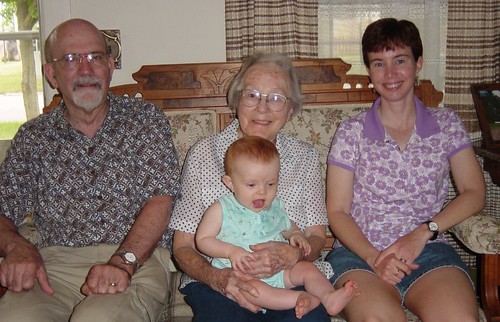
Four generations
This is me, my mother, holding our grandson, and his mother, taken in my mother's house in Michigan. I don't recall what he was looking at.

My only other post on travel was on a much more limited scale.

Ontario is large
A word about Ontario. Probably most of my few readers are US citizens, and from the South, and have little experience with this Canadian Province. Ontario is large. It is adjacent to much of New York State, and continues along, and above, the US border all the way West to Minnesota. Its area is not as great as that of Alaska, but it is roughly ten times as large as Ohio, for example. Ontario borders on all of the Great Lakes except Lake Michigan. Toronto, the largest Canadian city, and Ottawa, the Canadian capital, are in Ontario. It's big, and has a lot of variety.

Travelling to Canada
US residents travelling to Canada should take birth certificates or passports (within a year or so, passports may be required--they aren't now) for re-entry into the US. US customs apparently looks at documentation for all persons entering the country. Canadian customs asks questions, but, in our experience, doesn't usually require documentation. Generally, transportation of alcoholic beverages, firearms, and live plants across the border are restricted, and you may be asked about these and other items in your possession when you cross, in either direction, or about what you have purchased. Under some circumstances, you can get a refund on tax on purchases in Canada when crossing back into the US.

It's probably a good idea to have your auto insurance company give you documentation of coverage for Canada before driving there. Ours, at least, will do so, free. I don't know what happens if you need to see a doctor in Canada.

Flatness
Much of Ohio and Michigan, and the area of Toronto adjacent to the lower part of Michigan, are flat.

The Interstate highway system requires traffic exchanges, so that one road can go over or under the Interstate. In order to do this, it was necessary to create artifical hills. Often, this also resulted in the creation of artificial lakes and ponds, from which the hills were dug. You can see many of these in Michigan and Ohio (and elsewhere). I suppose that ecologists have studied these artificial bodies of water. If not, someone should. Many of them are beautiful. You can often see that they are used for fishing or swimming. The fish, if any, must have been introduced by humans on purpose.

To us, at least, flatness makes it harder to stay alert when driving.

Agriculture
The flatness of the land is advantageous to farmers, making plowing, planting, harvesting and cultivation easier. The soil in this area is usually good. There's a lot of farmland.

I was struck by the prevalence of members of the pea and grass families. We saw many fields, but only a few of these had crops other than corn, wheat (both grasses) alfalfa, and soybeans (both peas). My wife thinks she saw sugar cane growing near Findlay, Ohio, and is probably correct in her diagnosis, but sugar cane, too, is a grass. We did see a field of asparagus near Stratford, ON, but much of this area of North American is planted in grasses and peas.

Flowers
Many flowers, as well as trees and animals, are found throughout much of North America. We hear mourning doves here in South Carolina, and have heard them in California. They are found in Michigan and Ontario, too. So are flowers, such as Queen Anne's lace and trumpet vine. Biology doesn't usually follow political boundaries, and, if it does, it's becaus the boundaries follow features of the land and water.

Beauty
There are many homes that are a century or so old in towns and farms in Ohio and Michigan. Often these have character and are quite attractive.

Farmhouses and houses in towns in this section of Canada tend to be two or three stories tall, and brick veneered. Canadian homes and towns use flowers a lot. Canadian towns are, to us, more attractive than most small towns in the US. They don't seem as likely to have ugly areas.

Fast Food
Tim Horton's is apparently the most popular fast food chain in Eastern Canada. (There are nearly 1400 in Ontario, including four in Stratford, a town of about 30,000. There are some in the US) They are open around the clock, and serve coffee, muffins and doughnuts, cookies, sandwiches, salads and soup, as well as other items. They have more items than, say, McDonald's.

Thanks for reading. I expect to post about Stratford, ON, next.

Thursday, July 14, 2005

Travel Hiatus over

In my last post, I declared a travel hiatus.


For the present, that hiatus is over.

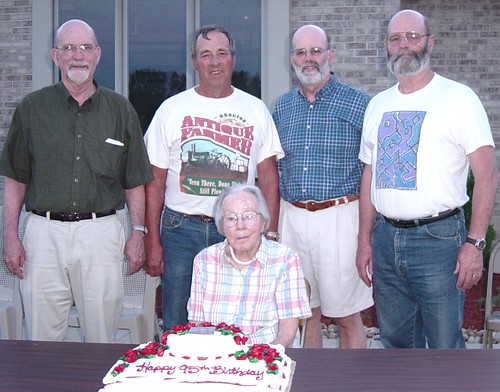
Brothers, Mother and cake
My brothers, my mother, and I, July 05

(A larger version of the above picture is available to Flickr members--click on it, and select the larger size--or from me, if you ask for it. Flickr membership is free)

One of my brothers suggested, many months ago, that my parents' descendants get together in the area of my mother's home, in Southern Michigan, over the July 4th weekend. It was a good idea--thanks! One reason was to celebrate our mother's 95th birthday, which was actually two months earlier.

My mother, my three brothers and their wives, and eight of our ten combined children, most of them with spouses, plus our grandson, who is my mother's only great-grandchild, and some cousins, were able to get together for meals, showing slides, church--the three brothers present sung together, and fireworks. There were other activities. Our daughters, for example, decided to go canoeing with one of my brothers and one of our sons-in-laws. It was our younger daughters' first canoe trip, and, among other things, she and my brother overturned, and she lost her glasses. These were replaced the next day, and she seemed to enjoy the experience.

My wife took her turn in being responsible for a meal, and she and I and our offspring shopped for it. I bought some jicama, which I introduced to a brother, a sister-in-law, and my mother, while I was preparing it as a salad ingredient. They all said, as did the Wikipedia, that it was like apple in texture. Another brother, who has lived in Venezuela and Costa Rica for extended periods, was already familiar with it. The meal, of course, was excellent, and not because of the jicama, as were the other meals we had together.

My wife, our daughters and one son-in-law, and our grandson, then drove to Stratford, Ontario, where we met our other son-in-law, who had been unable to attend the gathering in Michigan. Our second son-in-laws' brother and his girlfriend, and his parents, were also in Stratford. We enjoyed five nights together with various combinations of extended family.

We are now back at home, where we expect to stay for several days. There is to be more travel later.

One comment on lodging: Our daughters are big fans of Bed and Breakfast lodgings. My wife and I had never, until this trip, experienced such. Like most things, they have plusses and minuses. Speaking from our meager experience, namely five different rooms in three B&B's in two municipalities, in two countries, one plus is breakfast. One minus is, so far, Internet access. There was none available in these establishments, not even dial-up. (My wife would say that this is also a plus!)

One of my funniest (to me, anyway, and I can say this, because I didn't write most of it) posts was an attempt to find out, from my ISP, if I could access the Internet from Stratford, Ontario. Yes, I did, but from the excellent connection available in the Stratford Public Library, not directly through my ISP, because of lack of connection in the B&Bs.

God willing, I will post about travel to the area in general, and Stratford as a travel destination, soon, then will return to more usual fare--books I have read, etc.

Thanks for reading.

Thursday, June 23, 2005

I hope this doesn't hurt US-Canadian relations

I had what I thought was a simple question for my ISP. It didn't turn out that way:

First, I tried e-mail.

First e-mail:
* Name: Martin LaBar
* Issue: General Info on [ISP] Services
* Detailed Issue: Other
* Message Body: I have activated 800 number access on our account.
What 800 number do I dial when in Stratford, Ontario? Thanks.

Relevant portion of response:
Dear Martin LaBar,

Thank you for contacting us.

We understand that you are inquiring about the 800 number to dial from Stanford and Ontario.

Please be informed that, you can use the following 800 number to access internet from anywhere in US

. . .

Once the service is activated, you may start using the 800 access numbers at any time.

800 service is billed at a rate of $6.00 per hour ($0.10 per minute) surcharge is added to your regular dial-up account charges for all calls using the Service in the United States. Calls are billed in 1 minute increments, with a 30 second minimum.

If you need any further assistance, please let us know.

Sonny N 3713
[ISP] Electronic Customer Support
[ISP], Inc.

So I tried again:
For your information, STRATFORD (not Stanford--see my original query . . .) ONTARIO is in CANADA, not the United States (it's North of most of the US).
What number, if any, can I use to access dial-up from there? I don't need, nor do I expect to get, DSL from there.

Thanks.


Reply 2:
Dear Martin Labar,

Thank you for your reply.

We sincerely apologize for the miscommunication.

We understand that you are inquiring about the access numbers for Stratford and Ontario, to use the dial up services there.

We are sorry to inform you that, we are unable to find the access numbers for the cities, Stratford and Ontario.

However, in order for us to assist you in finding the nearest access number, please provide the following details:

1. Your phone number including area code.
2. The city where you live.
3. Surrounding cities.
4. The current access number you dial to connect to [ISP].

So I e-mailed again:
Let's try this one more time. I live in South Carolina, which is a State in the United States. I am planning on taking a trip to Stratford, a town in the Province of Ontario, which is in Canada. Canada is a country separate from the U. S. What phone number can I use to access [ISP] with my laptop from Stratford, Ontario, Canada?

Thank you.

Reply3
Dear Martin Labar,

Thank you for contacting us.

We sincerely apologize for the confusion.

We understand that you are inquiring for access number for Stratford, which is located in the Canadian State of Ontario.

We are sorry to inform you that, we are unable to find access number for the City of Stratford.

However, you can find the access number of its near by cities and use that number to have dial up internet access at Stratford.

You can also locate an [ISP] access number of the near by cities for your area(i.e., Stratford), by visiting the following link:

So I gave up, and tried chatting:

'Anthony M' says: Thank you for contacting [ISP name] LiveChat, how may I help you today?
[me]: We will be travelling to Stratford, Ontario, Canada, and taking our laptop. Is there an 800 number I can access from that city? If so, what is it, please? Thanks.
Anthony M: I understand that you wish to know about the 800 number for few cities.
[me]: I want to know if there are any 800 numbers for Canada, a country adjacent to the US.
Anthony M: I am sorry to inform you that there are no 800 numbers for canada.
[me]: OK. Thanks.
Anthony M: You are most welcome.
Anthony M: I appreciate your understanding.
Anthony M: Is there anything else I may assist you with today?

[me]: No. Thanks.
Anthony M: You're welcome and thank you for using [ISP name] LiveChat. Should you need further assistance, please feel free to contact us again.
Anthony M: Bye.


Except for eliminating some boilerplate, and hiding the ISP's name, and our own e-mail address, this is a verbatim transcript of interchanges on June 18, 2005.

I am reasonably sure that "Sonny M." and "Anthony M." are pseudonyms for tech support workers from Asia, who, apparently, are even more ignorant of geography than most U. S. residents. (I hope!) I don't care if my ISP gets its tech workers from Mars, as long as they are reasonably competent. Being competent in geography is probably too much to ask. I see that I didn't continue to ask "Sonny M." about 800 service, which I should have. I'm not at all sure that I got a correct answer from "Anthony M."

I hope this doesn't hurt US-Asian relations, or Asian-Canadian relations.