License

I have written an e-book, Does the Bible Really Say That?, which is free to anyone. To download that book, in several formats, go here.
Creative Commons License
The posts in this blog are licensed under a Creative Commons Attribution-NonCommercial-ShareAlike 3.0 Unported License. You can copy and use this material, as long as you aren't making money from it. If you give me credit, thanks. If not, OK.
Showing posts with label travel. Show all posts

Monday, November 10, 2025

Sunspots 991


Ken Schenck has been writing an up-to-date version of C. S. Lewis's Screwtape Letters. Here is the 23rd chapter.

A Conversation writer discusses maps created for her stories by Ursula  K. Le Guin, arguably the most importaant writer of fantastic literature in the past several decades.

The New Republic reports that obese people may not be allowed to get a US Visa.

Sunday, October 18, 2009

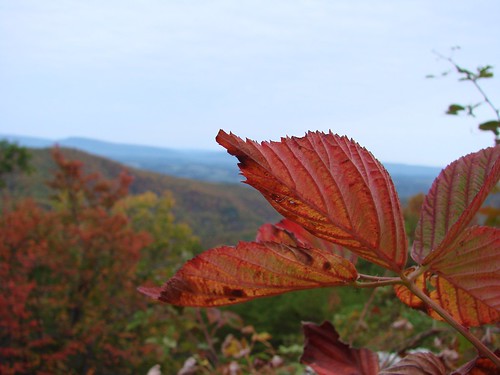
Blackberry leaves with Virginia mountains in the distance

Blackberry leaf, autumn, Blue Ridge Parkway

This photo was taken from just off the Blue Ridge Parkway, between Buena Vista and Montebello, Virginia, three years ago today. The leaves in the right foreground are blackberry leaves. In the distance, of course, are some of the Virginia mountains.

The photo is a live link to our Flickr photostream, and, if you click on it, you should go to the photo's own page. There's an icon above the photo, saying that you can see more sizes, including higher resolution versions of this photo. The photo is natural color.

Thanks for looking. Isn't God a great artist?

Thursday, June 18, 2009

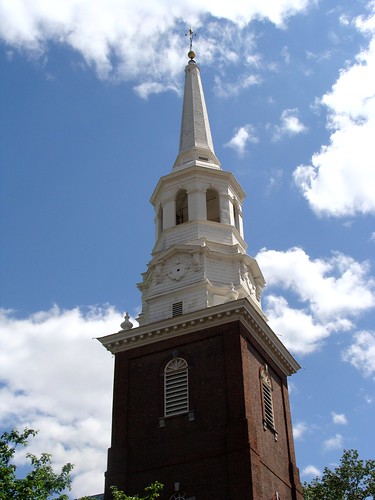
Christ Church, Philadelphia

Christ Church, steeple

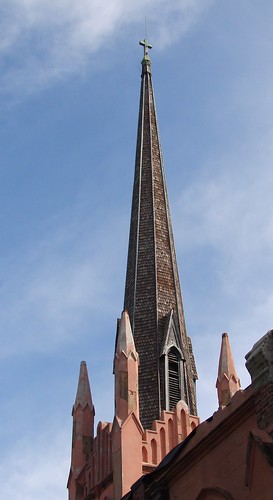
The photo above shows the steeple of Christ Church, Philadelphia, Pennsylvania, USA, arguably the most important church in the history of the US. The congregation, originally part of the Anglican Church, which became a congregation in 1695, built their first building on this site in 1696. From 1727-1744, a new building, the one shown, was constructed around the first one. The steeple you see contains building materials from the first church, which was torn down when it was possible to use the larger building for worship.

Fifteen signers of the Declaration of Independence attended this church, including Benjamin Franklin. Betsy Ross and George Washington also attended the church. There is a chandelier hanging from the ceiling of the church, with candles. We were told, when we visited the place, that the chandelier was lit for the wedding of Sarah Franklin, Benjamin Franklin's daughter, and that it was lit in May, 2009, for a current wedding. An active congregation meets in the building.

In 1785, the Episcopal church began in this building. We were told that the first African-American pastor of a major denomination was ordained to the ministry in this church.


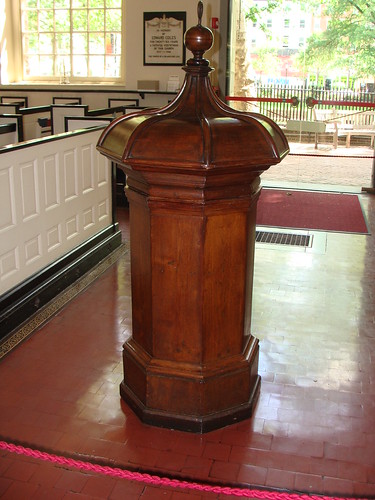
The beautiful object above is the baptismal font of Christ Church. (You can see the rope, to keep tourists from touching it, in the foreground.) We were told that it is about 600 years old, and was sent from England in the early years of the church, for "as long as needed," when the church was still an Anglican one. William Penn, the founder of Pennsylvania, was baptized in the font as a baby, in England. (Penn was not an Episcopalian in later life, but a Quaker. He was born in 1644.)

We enjoyed our travel to, and in, the Philadelphia area last month.

Monday, January 29, 2007

Trinity Episcopal Church, Abbeville, SC

Steeple, Trinity Episcopal church, Abbeville, SC, built 1859

We recently took a day trip through some of upstate South Carolina, including Abbeville and Laurens, SC., and other places.

This is a photo of the steeple of Trinity Episcopal Church, in Abbeville, South Carolina, USA, which, according to the link in the previous sentence, was both the birthplace and the deathbed of the Confederacy, the Southern side of the U. S. Civil war. The church was built in 1859. The congregation originated in 1842. A sign in front of the building says that the confederate army wanted to use the metal of the church's bell for weapons.

Unfortunately, the church seems to be neglected. There was a bulletin about a service, over a month old, in a sign at the front. If you look carefully, you can see some loose shingles, or something, in the steeple. There were patches of discoloration/decay all over the walls. (I believe you can get to the Flickr page for this photo, if you click on the photo itself. There's an "all sizes" link just above the photo on that page, and you can click on that, and select a larger size to see more detail.) It's too bad that this building needs repair and care. The Bible says that the church is God's people, not buildings, but buildings are still important in worship.

A Flickr member says that there was a committee to renovate the church, but nothing seems to have come of that, yet, anyway.

Although not necessary, steeples are common on top of Christian houses of worship. I believe the reason is that architects have thought of them as symbolizing pointing toward heaven. This one has a cross, which is the most common Christian symbol, on top of the steeple.

Thanks for reading.
Monday, July 31, 2006

Yet another travel hiatus

We plan to be away for a little over two weeks, and I don't expect to have time to post much, or, perhaps, enough time to read your posts as well as they deserve (if at all). I hope to post Sunspots, and installments of Diary of an Old Soul, during that time.

Thanks for reading.

Friday, May 19, 2006

Isn't God a great artist?

red rocks 3

Psalm 111:2 Great are the works of the Lord, studied by all who delight in them. 3 Full of splendor and majesty is his work, and his righteousness endures forever. (ESV)

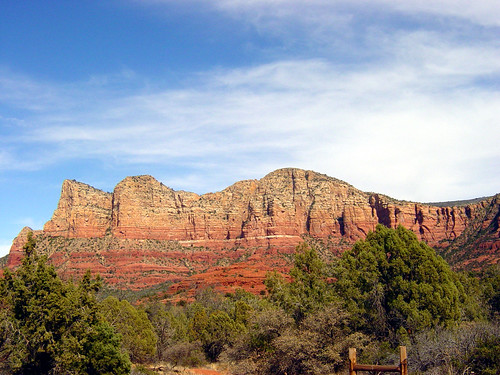
Taken in the redrock (or maybe red rock) country, near Sedona, Arizona, an area where the greatness of God's works is spectacular. For a larger size, or more photos, click on the photo above. The greatness of his works is also visible in small, common things.

Thanks for reading, and looking!

Part two, featuring a much smaller landscape, is here.

Thursday, May 04, 2006

Mall Walking


walk distance marker
Originally uploaded by Martin LaBar.


My wife and I are mall walkers. As this article says, walking in a mall has several advantages, including safety, access to restrooms, and protection from the weather. (There are also disadvantages, such as access to food, hard surfaces, mind-numbing music, and having to drive several miles to get there.)

Most of us mall walkers are retired. Most of us don't move too fast. In spite of this, you can usually spot a fellow mall walker easily. Female mall walkers usually don't have purses/pocketbooks. Walkers head for an exit, but pivot and don't go out. Most walkers keep up a steady pace.

There are some vigorous and/or young mall walkers. Some walkers, some of them mall employees, walk on their lunch hour.

Mall walking has opened our eyes to some facets of human existence that we didn't know about. A substantial portion of mall walkers are handicapped in some way. We have seen people walking with walkers and Oxygen tanks. We have seen others that can't go very far before they have to sit down, and others that have to hold someone's hand while moving. We salute these brave souls, fighting against the ills of the flesh, usually losing, but fighting. Sometimes winning.

Merchants also seem to spot mall walkers easily. Those standing in the doorways and soliciting business usually ignore mall walkers. They tolerate us, even if we occasionally get in the way of real customers going between stores. They even make things convenient for us, as the photo above, taken in the Sunland Park Mall, El Paso, Texas, shows. Mall walkers are encouraged. Most malls open the outside doors early, to accomodate mall walkers before the stores open.

We also observe the merchants. Some of them we don't envy. Thank you, Lord, that I never had to sit or stand, hour after hour, waiting for the rare person who was interested in my merchandise! Thank you, also, that I'm able to walk.

Thanks for reading. My next post is on walking in the Bible.

Sunday, February 26, 2006

Goodbye (headed back)

Good-bye!

Psalm 20:1 May the Lord answer you in the day of trouble! May the name of the God of Jacob protect you! 2 May he send you help from the sanctuary and give you support from Zion! 3 May he remember all your offerings and regard with favor your burnt sacrifices! Selah

4 May he grant you your heart's desire and fulfill all your plans! (ESV)

This is our prayer (one of them, anyway) for our grandson. It has been our privilege to assume part of his care for four months, while his mother was on duty six hours away, and his father took several extended trips with his work. His mother has been transferred back to a location near their home, and we feel that it is time to go back to South Carolina.

We will miss our daughter and son-in-law, their church, the Southern California weather, the plants, their church, and, especially, our grandson.

God help them, and help us, as we travel, and re-adjust to life back in upstate South Carolina, including, of course, our church.

I don't expect to post anything for a couple of weeks or so, except for one Sunspots, on Wednesday, March 1, God (and web connections) willing. I probably won't have time to read your blogs, either. Keep up the good work.

God bless you.

Tuesday, January 03, 2006

Under a big rock

under huge rock, Cloudland Canyon State Park, Georgia

1 I love you, O Lord, my strength.
2 The Lord is my rock and my fortress and my deliverer, my God, my rock, in whom
I take refuge, my shield, and the horn of my salvation, my stronghold.
3 I call upon the Lord, who is worthy to be praised, and I am saved from my
enemies.
Psalm 18, ESV
(The publishers of the English Standard Version of the Bible allow quotation
and citation in this manner)

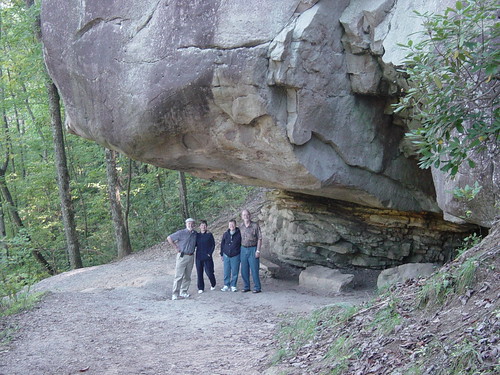
Us, with a brother and sister-in-law, under a rock, on our way to the bottom of Cloudland Canyon, in Cloudland Canyon State Park, near Rising Fawn, Georgia, in mid-October. We all enjoyed the occasion very much. Thanks to some nice person who took the photo for us. For larger version of this photo, click on it.

Thursday, December 29, 2005

Thoughts on Yosemite and John Muir

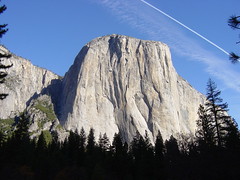
El Capitan

The photo above is of El Capitan, taken in Yosemite National Park, California


Yosemite National Park is amazing and unique. It is no wonder that John Muir was so enchanted with the area. The park contains redwoods, waterfalls, rivers, and spectacular cliffs. The most popular area is in a valley, surrounded by cliffs on both sides.

Shortly after the park was established, Congress allowed its Hetch Hetchy valley to be dammed, for water for San Francisco. This was a blow to Muir, and deprived us, according to him, of more spectacular scenery.

John Muir was a scientist who did much of his scientific work in nature. He wasn't a college professor, nor did he work as a researcher for the government, or for some company, on a regular basis. He observed, and he wrote. He didn't just describe, he taught (he was said to be especially good at teaching children about nature in ways they could understand) and he advocated. One of the things he advocated most strongly was the establishment of Yosemite. Muir was a Christian, and probably one of those who really do communicate with God in natural surroundings on a regular basis.

This is the next-to-last sentence of Muir's The Yosemite:
These temple destroyers, devotees of ravaging commercialism, seem tohave a perfect contempt for Nature, and, instead of lifting their eyesto the God of the mountains, lift them to the Almighty Dollar.

Here's a paragraph from his The Mountains of California:

In the morning everything is joyous and bright, the delicious purple ofthe dawn changes softly to daffodil yellow and white; while the sunbeamspouring through the passes between the peaks give a margin of gold toeach of them. Then the spires of the firs in the hollows of the middleregion catch the glow, and your camp grove is filled with light. Thebirds begin to stir, seeking sunny branches on the edge of the meadowfor sun-baths after the cold night, and looking for their breakfasts,every one of them as fresh as a lily and as charmingly arrayed.Innumerable insects begin to dance, the deer withdraw from the openglades and ridge-tops to their leafy hiding-places in the chaparral, theflowers open and straighten their petals as the dew vanishes, every pulse beats high, every life-cell rejoices, the very rocks seem totingle with life, and God is felt brooding over everything great and small.

We recently visited part of the park. The area is, indeed, beautiful. There are redwood trees, the spectacular valley, equally spectacular mountains, and some beautiful water features. Yosemite is not far, an hour's drive or so, from Fresno, CA, a city of roughly half million. Fresno is in the San Joaquin Valley, which is both one of most intensely farmed areas in the U. S., and also one of the most heavily polluted and transformed from its natural state. Why didn't Muir try to preserve more of this valley? Perhaps because it was flat, therefore less attractive than the mountains. Perhaps Muir knew that trying to preserve this area would have been a losing battle, more difficult than preserving Yosemite.

Muir's activity wasn't confined to the West. He was born in Scotland, but emigrated to Wisconsin as a boy, with his family, and lived and worked in the Eastern part of the U. S. Several of his works are available from Project Gutenberg. His Thousand-Mile Walk to the Gulf is available from the Sierra Club. He walked from Louisville, KY, to Florida.

Saturday, September 10, 2005

Travel West, 2

There's another feature of traveling west, namely the people. The Southwest, of course, has lots of Hispanics, but it was a pleasant eye-opener for a person like me, who has always lived East of the Mississippi, to see so many Japanese- and Chinese- (and probably other varieties) Americans in California, Washington, and Oregon. We also saw lots of Native Americans. Thanks in part to the Indian Gaming Act, which provides special status for casinos owned by tribes, there are tribes, with visible presences, that most people have never heard of. (See here for a picture of such a casino--there are many.) There is also Native American influence in place names. Seattle, WA, is named for a chief. I suspect that Puyallup and Enumclaw, WA, and lots of other places, have names relating to Native Americans.

The Gaming Act didn't produce the tribes, of course, but it gave many of them a reason to come together, so that they could profit from a vice shared, evidently, by lots of other people. It's too bad that we couldn't have found some other way to put tribes in business. It appears that the Indians haven't always been the main ones to profit from the casinos. There is, no doubt, an awful human cost to some patrons of these casinos, whatever their ethnicity.

The people we saw, whatever their ethnicity, are people, just like us. I had the opportunity to converse with some Native Americans while we were jointly waiting for a ferry. The conversation, with me, and between them, could have been identical if all of us had been of purely European ancestry. We flew back East across the aisle from an Asian-American couple with a small girl, and their parenting issues, and solutions, were just the same as anyone else's would have been. We're all in this together, and Christ died for all of us.

Friday, September 09, 2005

Travel West

We flew to Southern California by way of Chicago. Two impressions from the flight:

1) The mid-West (Indiana, Illinois, Iowa, Ohio) is pretty flat. That often makes for good farming. You don't have to be far from Chicago to see farm-land.

2) There are huge chunks of land in the southwest (AZ, NM, CO, CA) where there's no sign of human habitation or vegetation as far as the eye can see. An occasional line indicates a seldom-used road, and there may be houses and plants, maybe even trees, too small to see from a few kilometers up, but there aren't many. This area, although seemingly barren land, is beautiful. There are textures and geological features all over the place. Most of it isn't flat. If you've never done it, get a window seat (I always let my wife have those, but I can see over her) on a commercial flight over this area, during the day, so you can see, and spend a quarter of an hour or more just looking out.

Some observations (based on a few days near San Diego, CA, and a few days driving around Washington and Oregon--I'm not an expert):
The West isn't the East. One aspect of that is mountains. There are lots of high mountains in CA, WA, and OR--mountains that have glaciers on them. This creates ecological niches (such as for mountain goats, but also for less obvious organisms) that don't exist in Eastern North America.
Another aspect, related to the first, is the prevalence of conifers, cone-bearing trees like pines, firs, hemlocks, redwoods, spruce and others, in the West. A couple from Seattle who were familiar with South Carolina and Virginia told us that the leaf changes in the autumn were much less showy in the West. The reason is that most of the trees are not deciduous--they don't lose their leaves in the fall. Conifers tend to be taller, and perhaps closer together, than deciduous trees.
Organisms are different. In the East, there are blue jays, noisy but showy birds. We saw no such bird in the West. We did see other jays, including Steller's Jay, a noisy bird that is also blue, but clearly different.

Why the desert in so much of the Southwest? Climate is always a complex matter, but the simple answer is ocean currents, prevailing winds, and mountains. The California Current is cold. Prevailing winds, in this area, blow from West to East. Hence the air coming onto the land usually warms up as it comes onto Southern California. Warm air holds more moisture than cold. Air cooled by moving over the California Current does not pick up a lot of moisture. When it comes over the usually warmer land, it warms, so becomes able to hold even more moisture, hence there is seldom rain in Southen California. The mountains (considerably higher than those in Eastern North America) cause the air to rise, and as it rises, it cools, and so it can hold less water than when it first came to land. As a result, it may dump moisture it can no longer hold. Then when this air comes down on the Eastern side of these mountains, it warms up again, and so holds more water, so it seldom rains in Arizona, New Mexico, and Nevada.

Even though San Diego, Los Angeles, and other Southwestern cities are in deserts, they are green. They are green because they are artificially watered. Where does this water come from? It comes from the water in the ground, or from rivers elsewhere in North American. The water table in most of the Southwest is dropping, and, if something isn't done, eventually there will be little or no water underground to tap. This problem, like others that experts know exist, is one that is only going to get worse, and that not enough is being done about. If a brave politician should tell us about this problem (or some of the others coming in the future), he or she probably would not be elected. We don't want to hear about trouble, and tend to "shoot the messenger."

For pictures of some Southern California plants, check out the Walk in Southern California set in our photos on Flickr. It also shows that, if not watered, this area is desert--rocks, bare soil, and a few hardy plants. For photos from Oregon and Washington, including mountains, check out the Washington & Oregon Trip set. If you like a particular photo, and want to see it at highest quality, click on it. There is an All Sizes icon above the picture, which allows access to the highest resolution.

Thanks for reading.

Note: I added the next-to-last link, on water problems, nearly 12 hours after the original posting.

Tuesday, September 06, 2005

Travel hiatus over

Thank God, we have returned home, although we enjoyed our trip immensely. (You can see some of the photographic highlights here.)

Two thoughts came to me while travelling.

One: We were not reluctant to talk to total strangers about interesting sights, and some of the strangers, like the man who told my wife that there was a gray whale in the ocean at a wayside where we stopped, felt the same way. Why am I so reluctant to tell others about Christ?

Two: We tried to get as close as possible to sights, driving, walking, or climbing so that we could see (and sometimes smell and hear). We drove several miles along mountain roads, with few barricades, to get a better view of Mount St. Helens, for example. Why am I so reluctant to get closer to God?

We thank our children, who gave us the impetus, did most of the planning and financing, for us to take a retirement trip to Washington and Oregon, where we had never been before. We also enjoyed staying with a daughter, her husband, and our grandson. I expect to say more about this trip in future posts, and also to comment on most or all of the books mentioned in the most recent post. I also note that I was, back over a month ago, planning to do some more things. Will probably get around to most of them. Thanks for reading this far!

Friday, August 05, 2005

Travel hiatus coming

Our daughters (and their husbands) are staking us to most of a retirement trip to various parts of Western North America. We expect to be gone for about a month, God willing. I don't plan to post during this trip. I didn't do so during our last one. I expect to check (and maybe even answer some) e-mail, and occasionally check my blog subscriptions, perhaps including yours, if you have a blog.

Those who may check this blog after early September will probably see, not necessarily in that order, a response to Bonnie's comment on this post. I also hope to post on a book by Patricia A. McKillip, and expect to post a few pictures from our trip. I have in mind a few suggestions for changing basketball rules.

I plan to take along, and read: some of the Hyperion quartet by Dan Simmons; a book on British poet John Keats, who is almost a major character in the Hyperion books; Till We Have Faces by C. S. Lewis; The Case for a Creator by Strobel, a graduation gift (to me!) from a student; The Biblical Jubilee and the Struggle for Life by Kinsler and Kinsler; The Christian's Secret of a Happy Life, by Smith, and my Bible.

Thanks for reading.

Saturday, July 16, 2005

Stratford, Ontario

My wife and I found Stratford, Ontario, by accident. We celebrated our 25th anniversary, some years ago, with a trip to New Brunswick. On the way back to Michigan, we drove into Stratford, looking for a night's lodging. The next day, we discovered that Stratford is a beautiful city in the summer, with flowers everywhere, and is also home to the Stratford Festival. At the time, we supposed that this, whatever it was, was a week or so of Shakespeare. It actually lasts from April through November, and includes a dozen or so plays, some by Shakespeare, some not. We went back later, with our younger daughter, and saw Camelot for the first time there. Our older daughter and son-in-law joined us for Fiddler on the Roof another year. All of us, except our grandson, had been there at least once before 2005. Now he has, too.

Some of you may have seen Renaissance Man, a movie in which Danny DeVito builds character in some army recruits by teaching them Shakespeare. Part of the movie is a visit to the Stratford Festival.

There's a lot more to Stratford than plays.

There are backstage tours and play-related seminars. There are art shows. There are flowers. Stratford, and other towns in the area, have hanging baskets on their downtown streets. Homes apparently vie with each other to have the most beautiful outdoor displays. One of our Bed & Breakfasts, the Avon and John, has outstanding grounds. (There's a small picture of them on the web page. If you go there, don't forget that prices are in Canadian money.) There's a park, a mile or so long, along the Avon River, flowing through the city, which can be walked. One year we walked it two or three days. That was the year we saw Victor Garber walking along, too. There are swans, ducks of various types, geese, and seagulls, some of these with young, swimming in, flying over, and begging along the River. There are many restaurants, bookstores, and shops in the downtown area, which is within walking distance of many B&Bs, as are the three theaters. There are three ice cream shops within a couple of blocks. Did I mention that there are flowers?

There are scenic towns nearby, too. I'll mention just one, St. Mary's.

We enjoyed Stratford, and hope to visit yet again. Thanks for reading.

Friday, July 15, 2005

Travel Summary: Ohio, Michigan, Ontario

Lest there be any doubt, I claim no expertise in all of the areas listed in the title. All I can write about is my own experience.

My wife and I travelled to this area, and within it, for a few days in late June and early July. (We have done this several times previously) The previous post indicates the reasons. We are grateful to God for safety, and enjoyed our travel. Near Knoxville, TN, a pickup truck lost a clothes dryer in the freeway. A larger truck swerved to avoid hitting it, and came into our lane. I was able to avoid a collision. I don't know if everyone suddenly confronted with that clothes dryer in the road was also able to. I hope so.

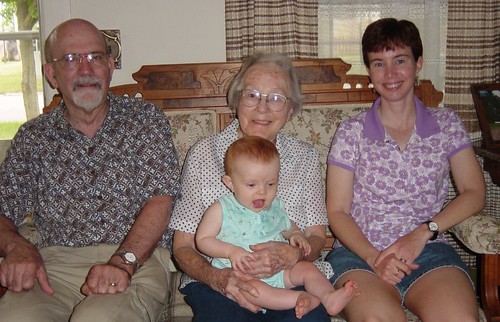
Four generations
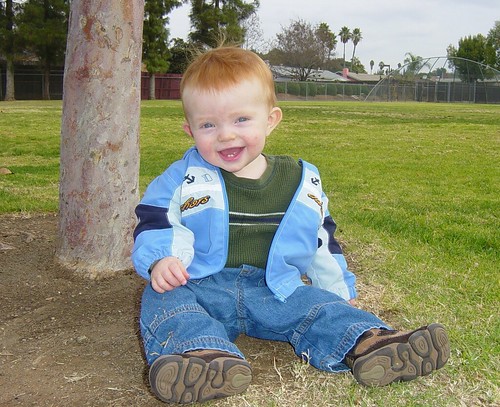
This is me, my mother, holding our grandson, and his mother, taken in my mother's house in Michigan. I don't recall what he was looking at.

My only other post on travel was on a much more limited scale.

Ontario is large
A word about Ontario. Probably most of my few readers are US citizens, and from the South, and have little experience with this Canadian Province. Ontario is large. It is adjacent to much of New York State, and continues along, and above, the US border all the way West to Minnesota. Its area is not as great as that of Alaska, but it is roughly ten times as large as Ohio, for example. Ontario borders on all of the Great Lakes except Lake Michigan. Toronto, the largest Canadian city, and Ottawa, the Canadian capital, are in Ontario. It's big, and has a lot of variety.

Travelling to Canada
US residents travelling to Canada should take birth certificates or passports (within a year or so, passports may be required--they aren't now) for re-entry into the US. US customs apparently looks at documentation for all persons entering the country. Canadian customs asks questions, but, in our experience, doesn't usually require documentation. Generally, transportation of alcoholic beverages, firearms, and live plants across the border are restricted, and you may be asked about these and other items in your possession when you cross, in either direction, or about what you have purchased. Under some circumstances, you can get a refund on tax on purchases in Canada when crossing back into the US.

It's probably a good idea to have your auto insurance company give you documentation of coverage for Canada before driving there. Ours, at least, will do so, free. I don't know what happens if you need to see a doctor in Canada.

Flatness
Much of Ohio and Michigan, and the area of Toronto adjacent to the lower part of Michigan, are flat.

The Interstate highway system requires traffic exchanges, so that one road can go over or under the Interstate. In order to do this, it was necessary to create artifical hills. Often, this also resulted in the creation of artificial lakes and ponds, from which the hills were dug. You can see many of these in Michigan and Ohio (and elsewhere). I suppose that ecologists have studied these artificial bodies of water. If not, someone should. Many of them are beautiful. You can often see that they are used for fishing or swimming. The fish, if any, must have been introduced by humans on purpose.

To us, at least, flatness makes it harder to stay alert when driving.

Agriculture
The flatness of the land is advantageous to farmers, making plowing, planting, harvesting and cultivation easier. The soil in this area is usually good. There's a lot of farmland.

I was struck by the prevalence of members of the pea and grass families. We saw many fields, but only a few of these had crops other than corn, wheat (both grasses) alfalfa, and soybeans (both peas). My wife thinks she saw sugar cane growing near Findlay, Ohio, and is probably correct in her diagnosis, but sugar cane, too, is a grass. We did see a field of asparagus near Stratford, ON, but much of this area of North American is planted in grasses and peas.

Flowers
Many flowers, as well as trees and animals, are found throughout much of North America. We hear mourning doves here in South Carolina, and have heard them in California. They are found in Michigan and Ontario, too. So are flowers, such as Queen Anne's lace and trumpet vine. Biology doesn't usually follow political boundaries, and, if it does, it's becaus the boundaries follow features of the land and water.

Beauty
There are many homes that are a century or so old in towns and farms in Ohio and Michigan. Often these have character and are quite attractive.

Farmhouses and houses in towns in this section of Canada tend to be two or three stories tall, and brick veneered. Canadian homes and towns use flowers a lot. Canadian towns are, to us, more attractive than most small towns in the US. They don't seem as likely to have ugly areas.

Fast Food
Tim Horton's is apparently the most popular fast food chain in Eastern Canada. (There are nearly 1400 in Ontario, including four in Stratford, a town of about 30,000. There are some in the US) They are open around the clock, and serve coffee, muffins and doughnuts, cookies, sandwiches, salads and soup, as well as other items. They have more items than, say, McDonald's.

Thanks for reading. I expect to post about Stratford, ON, next.

Thursday, July 14, 2005

Travel Hiatus over

In my last post, I declared a travel hiatus.


For the present, that hiatus is over.

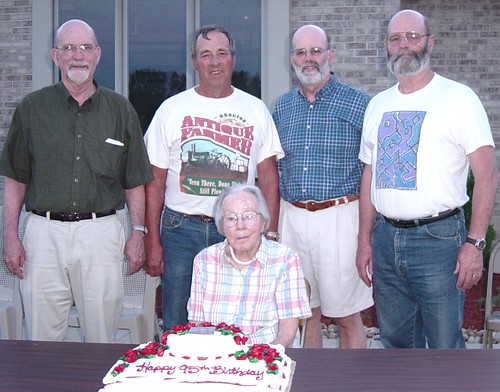
Brothers, Mother and cake
My brothers, my mother, and I, July 05

(A larger version of the above picture is available to Flickr members--click on it, and select the larger size--or from me, if you ask for it. Flickr membership is free)

One of my brothers suggested, many months ago, that my parents' descendants get together in the area of my mother's home, in Southern Michigan, over the July 4th weekend. It was a good idea--thanks! One reason was to celebrate our mother's 95th birthday, which was actually two months earlier.

My mother, my three brothers and their wives, and eight of our ten combined children, most of them with spouses, plus our grandson, who is my mother's only great-grandchild, and some cousins, were able to get together for meals, showing slides, church--the three brothers present sung together, and fireworks. There were other activities. Our daughters, for example, decided to go canoeing with one of my brothers and one of our sons-in-laws. It was our younger daughters' first canoe trip, and, among other things, she and my brother overturned, and she lost her glasses. These were replaced the next day, and she seemed to enjoy the experience.

My wife took her turn in being responsible for a meal, and she and I and our offspring shopped for it. I bought some jicama, which I introduced to a brother, a sister-in-law, and my mother, while I was preparing it as a salad ingredient. They all said, as did the Wikipedia, that it was like apple in texture. Another brother, who has lived in Venezuela and Costa Rica for extended periods, was already familiar with it. The meal, of course, was excellent, and not because of the jicama, as were the other meals we had together.

My wife, our daughters and one son-in-law, and our grandson, then drove to Stratford, Ontario, where we met our other son-in-law, who had been unable to attend the gathering in Michigan. Our second son-in-laws' brother and his girlfriend, and his parents, were also in Stratford. We enjoyed five nights together with various combinations of extended family.

We are now back at home, where we expect to stay for several days. There is to be more travel later.

One comment on lodging: Our daughters are big fans of Bed and Breakfast lodgings. My wife and I had never, until this trip, experienced such. Like most things, they have plusses and minuses. Speaking from our meager experience, namely five different rooms in three B&B's in two municipalities, in two countries, one plus is breakfast. One minus is, so far, Internet access. There was none available in these establishments, not even dial-up. (My wife would say that this is also a plus!)

One of my funniest (to me, anyway, and I can say this, because I didn't write most of it) posts was an attempt to find out, from my ISP, if I could access the Internet from Stratford, Ontario. Yes, I did, but from the excellent connection available in the Stratford Public Library, not directly through my ISP, because of lack of connection in the B&Bs.

God willing, I will post about travel to the area in general, and Stratford as a travel destination, soon, then will return to more usual fare--books I have read, etc.

Thanks for reading.

Thursday, June 30, 2005

Travel Hiatus, perhaps

We are traveling to Michigan, to see most of my parents' family, and, after that, to Ontario, for some vacation with our own family, until mid-July, more or less. I may not be able to post for much of this time, or may not choose to.

Comfort for declining years:

Isaiah 46:3 Hearken unto me, O house of Jacob, and all the remnant of the house of Israel, that have been borne [by me] from their birth, that have been carried from the womb; Isa 46:4 and even to old age I am he, and even to hoar hairs will I carry [you]; I have made, and I will bear; yea, I will carry, and will deliver. (ASV)


Thanks for checking!

Thursday, April 07, 2005

Greenwood to North Augusta on US Hwy 25

My wife and I like to travel. We don't feel that we have to see something exciting, or something that attracts lots of other people. We do like to see things that interest us, but it doesn't necessarily take much--a hawk on a tree will do it.

On March 4th of this year, we spent the night in Augusta, GA. Part of our trip was on US 25, from Greenwood, SC, to North Augusta, SC. A few years ago, I taught some Saturday morning classes in North Augusta, and we had traveled this route several times before. There are no big tourist attractions. Our highway map using shows no cities, towns, or villages at all. Nonetheless, let me tell you some of what we saw.

Not too far out of Greenwood is a small farm. The house is brick veneer. That's not unusual. The outbuildings are also all brick veneer, too. That is unusual.

Upstate South Carolina, where we live, is a rapidly growing area. My wife grew up there, and traveling roads that she used to take, she often remarks that she remembers when there were no houses, or no shops, along this route. Now there are. Well, this area isn't growing visibly. There are still lots of pastures. There are still lots of wood lots, some being harvested. Fire ants infest most of the pastures, and their hills sprout up along the road like the waste earth from little strip mines. There are occasional ponds. Once in a while we have seen a great blue heron in one.

A few miles further on, there is a brick wall on either side of the road, perpendicular to the roadway, as if the road is entering an estate. Then, a mile or so further on, there is another pair. Apparently, someone started to develop this land, and wanted to advertise the development with these brick gates. For whatever reason, nothing seems to have come of this, as there are no buildings or driveways at all between the boundaries.

Our trip was made more interesting by "Walter Edgar's Journal," a weekly radio program from the State public radio network. This week, it was on growing rice like that grown in South Carolina many years ago.

Edgefield, SC, is about two-thirds of the way to Augusta. The town advertises itself as having been home to ten governors. Clearly, its sons have made their mark on the state, and even the nation. The last governor to come from Edgefield, we believe, was J. Strom Thurmond, who went on to become the Dixiecrat candidate for President, and was in the US Senate for longer than anyone else in the history of the country. He finally retired, to the Edgefield hospital, where they had a special room for him. He didn't live there long, dying a few months later. He wasn't the last politician from Edgefield to go to Washington. Butler Derrick, US Congressman for 10 years, during the last quarter of the previous century, was from Edgefield.

There is something called the National Wild Turkey Federation a little South of Edgefield. We do have wild turkeys in South Carolina, and there must be some near Edgefield.

Greer, South Carolina, and the surrounding area, near the Northern part of I-85, is known as the peach capital of the South. There is even a water tower with a giant peach, appropriately colored, and with a stem and one leaf, near Gaffney. However, there is also a peach industry between Edgefield and North Augusta.

The closer you get to Augusta, the more sand is found in the soil.

US 25 turns right at a little hamlet named Trenton. Right after the turn, there is a section of the road lined with pecan trees on both sides. Pecan trees are quite common in the South, but this is the only place I know of where they are planted along the road on both sides. (I was unable to find a good picture of leafless pecan trees. Like most trees, they have a characteristic shape. I should have taken one myself.)

After that, there is a large flower wholesaler on the right.

Just outside of North Augusta, perhaps two miles from the intersection with I-20, there is an amazing community. One travels along, seeing occasional small homes or businesses. Then, all at once, you are in a housing development. On each side of the road, there are nice brick houses (someone else was struck by these). Interspersed among them are roughly equal numbers of mobile homes, a strange juxtaposition. Once we drove among these homes, and asked a woman, who was out walking, about this practice. She told us that the people simply lived in mobile homes until they could afford to build. There's a Catholic church in the development. Although there are Catholics in South Carolina, they are a minority, but there are Catholic symbols in front of almost every house in this area. Another interesting thing about these houses is that the windows are darkened. You can't see anything but blinds, or sheets. All the windows seem to be covered from the inside. This area is known as Murphy Village.

The most interesting thing about these houses, however, is that most or all of the people living in this group of houses are Irish Travellers. (Word doesn't like the spelling with 2 l's, but that seems to be the way this particular term is spelled.) (See links in the previous paragraph for a little more information on these people. There are some of them still in Ireland, apparently, and they probably live in other places in North America.)

* * * *

On April 12th, 2005, an editorial in the Greenville News (SC) complained about wasteful government spending, listing nearly $500,000 spent on the National Wild Turkey Foundation as one such example.

Thanks for reading.