License

I have written an e-book, Does the Bible Really Say That?, which is free to anyone. To download that book, in several formats, go here.
Creative Commons License
The posts in this blog are licensed under a Creative Commons Attribution-NonCommercial-ShareAlike 3.0 Unported License. You can copy and use this material, as long as you aren't making money from it. If you give me credit, thanks. If not, OK.
Showing posts with label Genealogy. Show all posts

Saturday, July 04, 2026

Sunspots 1001


CNN and other outlests are reporting on possible dangers from the geological faults in Southern California.

Gizmodo reports on research on laughter. There are two kinds of laughter. One spontaneous and one not so  much.

BioLogos has an article about the apparent long lives of people in Genesis.

MSN, and other outlets, report that Pope Leo has excommunicated priests who reject some of the changes proposed and adopted during the 20th Century.

The flag seen in "the dawn's early light" near Baltimore, which was under attack by the British, was real. Here's more on Francis Scott Key who wrote what we now know as the "Star Spangled Banner." Key freed at least some of his slaves.

Gismodo reports that dust from the Sahara Desert is blowing across the Atlantic to North America.

Saturday, February 09, 2019

Using your DNA to explore your ancestry -- beware

I've recently read a great book entitled A Brief History of Everyone Who Ever Lived: The Human Story Retold Through Our Genes, by Adam Rutherford. It's about using DNA for anthropological purposes, such as finding the relationship between humans and Neanderthals. (You and I have Neanderthal DNA.) Rutherford says that the companies who tell people that they are 24% Cherokee, or whatever, are on a par with the horoscopes in the newspaper.

There are many reasons for this. One of them is that humans are all related. One evidence for that is  that many pieces of DNA are shared between various ethnic groups.

Another lesson, repeatedly told, is that the concept of race has no genetic basis. Again, we are all related. By this, Rutherford means that two people from different locations in Africa are likely to have less common DNA than either one of them and someone from, say, Belgium, have in common.

It's impossible to do justice to the book in this brief post. It is readable by people without strong backgrounds in science.

Note this passage from the Bible: Acts 17:26 He made from one blood every nation of men to dwell on all the surface of the earth, having determined appointed seasons, and the boundaries of their dwellings, 27 that they should seek the Lord, if perhaps they might reach out for him and find him, though he is not far from each one of us.

Thanks for reading.

Friday, June 16, 2006

From Perez to Solomon, how many years?

I've got a question about one of the genealogies in the Bible. Here it is:

1 Chronicles 2:5 The sons of Perez: Hezron and Hamul. 6 The sons of Zerah: Zimri, Ethan, Heman, Calcol, and Dara, five in all. 7 The son . . . of Carmi: Achan, the troubler of Israel, who broke faith in the matter of the devoted thing; 8 and Ethan's son was Azariah. 

9 The sons of Hezron that were born to him: Jerahmeel, Ram, and Chelubai. 10 Ram fathered Amminadab, and Amminadab fathered Nahshon, prince of the sons of Judah. 11 Nahshon fathered Salmon, . . . Salmon fathered Boaz, 12 Boaz fathered Obed, Obed fathered Jesse. (ESV) (The ellipses represent references to footnotes that don't affect this discussion.)

Let me list the generations in the line I'm concerned about: Perez, Hezron, Ram, Amminadab, Nahshon, Salmon, Boaz, Obed, Jesse. Jesse was the father of David, who was the father of Solomon. That's eleven generations, including Perez, one of Judah's sons, and Solomon.

So what's the question? Here it is: Is this list complete?

Why do I ask? Here's why. In 1 Kings 6:1, we are told that Solomon began to build the temple in the 480th year after the Israelites returned from Egypt. Exodus 12:40-41 tells us that the Israelites lived in Egypt for 430 years. This means that at least one of these 11 people was alive during each year of a span of more than 910 years. (Perez must have been born in Canaan, before the departure for Egypt, according to Genesis 38. Clearly Solomon was born before he assumed the kingship, and before he started having the temple built. He lived for a number of years after the building of the temple started, as he reigned for 40 years.) Let's say that one or more of these 11 were alive during a span of at least 946 years, and probably several years longer than that. That's 946 divided by 11, or 86 years, per generation, not per life. Generation length, of course, doesn't consider the overlap between, say, Jesse and David. In other words, these 11 men either must have lived a century or more each, or the genealogy given is not complete. There are scholars who know the Bible, and take it very seriously, as the Word of God, and believe that at least some of the genealogies are not meant to be used for chronological purposes, but were meant to show the main characters in lines of descent, with some names being omitted. There is scriptural evidence that names were omitted in some genealogies. It seems that this part of the genealogy in the Bible probably is one of those that has names omitted.
Any thoughts? Thanks for reading.

Here's a discussion of the genealogies in Genesis, and elsewhere in the Bible, by a Bible scholar.

This post was edited on October 17, 2018 

Here's a post, noting some other occasions where the Bible, itself, indicates that people have been left out of the supposed genealogies.

Tuesday, January 10, 2006

Ussher's chronology

I received an e-mail query, asking if I had a copy of Ussher's chronology on file. I don't, and hadn't really thought about having one, before the query. (For any who don't know, Ussher believed that the earth was created in 4004 B.C., based mainly on his interpretation of the genealogies in the Bible.)

I did some research on-line, and haven't discovered any such file. Perhaps some reader has, and can point me to one? If so, please do.

I did find what seem to be excellent Wikipedia articles on the Ussher-Lightfoot Calendar (Lightfoot also published a chronology at about the same time as Ussher.) and on Ussher, himself. Answers in Genesis has an article on Ussher, which indicates that that organization has re-published Ussher's history, and offers it for sale. I hoped that Project Gutenberg had re-published something by Ussher, but they have not. (He seems to have written entirely in Latin.)

As the Wikipedia articles indicate, there is considerable controversy over Ussher's date of 4004 B. C. for the age of the earth. Conservative, Bible-believing scholars of the 19th and early 20th centuries did not believe that the genealogies used in Genesis could legitimately be put to the purpose of determining dates. Neither did Francis Schaeffer, and many others, in the 20th century. However, there are Bible scholars living today who disagree, and think that they were meant to be so used.

The most complete Ussher's chronology I have ever seen is in a bible given me by my maternal grandmother, over a half-century ago. It has dates, based on Ussher's chronology, for many biblical events, as part of its center-column reference system. I don't know if all these dates were based on Ussher's work.

*  *  *  *  *
On February 9, 2015, I added the material in parenthesis to the first paragraph.  Thanks for reading!

Monday, April 04, 2005

Mrs. Cain? Inbreeding in the Old Testament

My friend, April, asked about how a good God would allow early humans to marry close relatives, which is, later in Scripture, prohibited. Ish responded to her, saying, basically, that the problem with incest is that close relatives would be more likely to have the same bad recessive genes, but that Adam and Eve were presumably created with a perfect genotype, so this wouldn't have been as big a problem for their immediate descendants. I agree, but wish to expand upon this idea.

It's probably best to distinguish between incest and inbreeding, but there is not a clear distinction. Incest, sexual relations between close relatives, has been frowned on by most societies. The Old Testament bans some specific sexual relationships, quite a few, in fact, in Leviticus 18. (At least in the NIV, it doesn't say it's banning marriage, but sex. I suppose that banning sex between, say, brother and sister would also prohibit marriage between them, but I'm not certain of that.) Inbreeding is a more general term. Inbreeding, to a geneticist, occurs when offspring are born to parents who are more closely related to each other than the general population is. There is a statistic, known as the inbreeding coefficient, which can be calculated.

Presumably, Adam and Eve were created with a perfect genotype. The Fall probably would have allowed mutations, gradually putting bad genes into the gene pool. This is consistent with the ages given in Genesis--they gradually got shorter and shorter, as would be expected as more deleterious genes came into the gene pool.

If they had perfect genes (no recessive bad ones) then inbreeding wouldn't matter, genetically, at least.

There are reasons other than genetics that make incest (or close inbreeding) bad, but the first humans would have had no choice, if they were the only possible mates for each other. Cain, and Seth, and maybe Abel, would have had to marry their sisters.

Were the first humans the only possible mates for each other? Probably.

However, there is the legend of Lilith (which is extra-biblical) who was another wife to Adam. George MacDonald wrote fantasy in the 19th century. C. S. Lewis was influenced by his writing. In MacDonald's Lilith, Adam, Eve, and Lilith are all characters. If there was another wife, then it would be possible to marry half-siblings, rather than siblings.

Genesis says:
Gen 6:1 And it came to pass, when men began to multiply on the face of the ground, and daughters were born unto them, Gen 6:2 that the sons of God saw the daughters of men that they were fair; and they took them wives of all that they chose. Gen 6:4 The Nephilim were in the earth in those days, and also after that, when the sons of God came unto the daughters of men, and they bare children to them: the same were the mighty men that were of old, the men of renown. (ASV, which is public domain)

Some interpret this as meaning that angels and humans married, although most seem to doubt this, for a number of reasons. This verse, of course, is not until Genesis 6, by which time Cain, Seth, and other generations of humans would have already had to marry somebody. There are other interpretations, such as that Seth's descendants married Cain's, and no one seems to know for sure what it means.

Madeleine L'Engle, Christian fantasy writer, wrote Many Waters (I don't usually link to Amazon, but they allow searching inside the book.) which supposes that humans of Noah's time could mate with demons, apparently basing this idea on the text above.

In Tolkien's Middle-Earth, there were three marriages (maybe four--see the article on Half-elven in the Encyclopedia of Arda) between elves and humans, and Eärendil, Elrond, Arwen and Aragorn were among the descendants of such unions. Tolkien didn't think of elves as like angels, but they were clearly different than humans. Maiar were more like angels. Melian (See entry under her name in the Encyclopedia of Arda) was of the Maiar, and married Thingol, an elf. They had a daughter, Lúthien. In C. S. Lewis' Narnia books, King Caspian married a star's daughter, and they had a son, Rilian.

Some believers think that God took pre-humans already in existence (Neanderthals?) and gave them souls. If that is what Genesis means, then presumably there could have been matings between humans and pre-humans.

Some ancient societies apparently did allow, and encourage, incest, at least in their royal families.

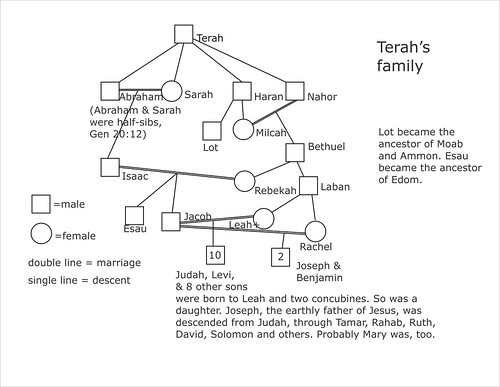
Abraham and Sarah were half-sibs, and Isaac and Jacob both married relatives. See the chart below (It should be possible to see larger versions of these charts by using either of them as a link, which will transfer you to Flickr. In Flickr, which doesn't require any password for such uses, you can click on the Down Arrow, to the right of the page, to download a graphic. That lets you see, or download, larger versions of the graphic.

Terah's family
There was marriage between relatives in David's family, also:


As to incest being evil, it is now. That doesn't mean that it was always evil. God had a different set of expectations for the Jews than He does for Christians. He at least allowed polygamy in some of His closest followers (although it often led to serious family trouble) in the Old Testament, but there doesn't seem to be even a mention of it in the New.

What about the question of inbreeding

A God who is capable of creation from nothing shouldn't have had any problems with giving Adam and Eve perfect genes, so that if Seth married a sister, it wouldn't have had bad genetic consequences. Even if Eve was created literally from Adam's flesh, He could have given them different sets of genes, so that apparent inbreeding wouldn't have mattered. I would guess that Eve at least had a second X chromosome, whereas Adam had only one, so that their genes were partly different.

This is all speculation, of course. The Bible doesn't name Cain's wife, Seth's wife, or Abel's wife (if he had one) let alone where they came from.

* * * *
This material was modified or added on April 6th, 2005:

The charts above are free for use, provided that any republication also allows free use by others. You can probably get a larger size through Flickr -- the two charts are links to the original charts, on my Flickr photostream. If I have made any errors in the charts, I'd appreciate knowing it. Leave a comment. Thanks.

October 17, 2007: I modified the charts, mostly adding more people, and making the chart of David's family more useful for general Bible study. I haven't checked to see if April's and Ish's web pages, that I referred to in the beginning of this post, are still available.

February 1, 2014: I modified the chart of David's family slightly, and changed the font size of the post. 

October 20, 2014: I modified the chart of Terah's family.

Thanks for reading and looking!