In a previous post, I briefly discussed, in relation to a book by Kitty Ferguson, what modern physics says about the unpredictability of sub-atomic particles. This fundamental uncertainty may be a way for God to act without being detected:
Let's say that God wants to alter my consciousness in a certain way (so as to communicate a message to me) or to alter the course of a disease. If we assume determinism, then either God couldn't do it, or God would have to, at least temporarily, suspend natural causal determinism in order to do it. This alternative depends on whether we think of determinism as true independently of God or as an order established by God, and hence subject to cancellation at God's pleasure. But on quantum theory there is no such problem. The relevant physical laws only provide for a large probability or one outcome rather than another in a given situation. And the highly improbable can sometimes happen without violating probability laws. Hence God can, consistent with quantum theory, do something to bring about a physically improbable outcome in one or more instances without any violation of physical law. And even if these interventions are all on the sub-atomic level, they can, if properly chosen (and presumably God would be in a position to do so), snowball so as to make a difference to macroscopic states of affairs. Hence, divine activity that makes specific differences at particular times and places is quite consistent with a quantum theory of physical causality. Perhaps God designed the universe to operate in accordance with probabilistic laws so as to give room for God to enter the process as an agent. William P. Alston, "Divine Action, Human Freedom, and the Laws of Nature," pp. 185-206 in Quantum Cosmology and the Laws of Nature: Scientific Perspectives on Divine Action, 2nd edition, ed. by Robert John Russell, Nancey Murphy and C. J. Isham. (Vatican City State: Vatican Observatory, 1996) Quote is from pp. 188-9.
Note that I said "may." As a matter of fact, Alston, the author, says that he does not believe that it is necessary to invoke quantum indeterminacy to explain God's action. He believes that God's occasional action is compatible with physics at not only the micro level, but at the macro level. I, too, suppose that God is quite capable of acting on quarks and neutrinos, but also on mountains and planets. Believing that God operates only on things we don't understand is a dangerous type of theology known as "God of the gaps." If God is God, He is God not only of things we can't explain or predict, but of things that we can. As a friend of mine once said, "God is not just the God of eternity. He is also the God of 2 + 2." The danger of such a belief is that, as we think we understand more and more, we push God more and more into irrelevancy, in our own minds. Just because we think we understand, say, the orbits of the planets, does not mean that God had nothing to do with them, anymore than understanding how, say, a kitchen range works doesn't mean that someone (or a lot of someones) didn't originally invent them.
I expect to continue the series with more direct musings on Ferguson's book in the near future. Thanks for reading.
Musings on science, the Bible, and fantastic literature (and sometimes basketball and other stuff).
God speaks to us through the Bible and the findings of science, and we should listen to both types of revelation.
The title is from Psalm 84:11.
The Wikipedia is usually a pretty good reference. I mostly use the World English Bible (WEB), because it is public domain. I am grateful.
License
I have written an e-book, Does the Bible Really Say That?, which is free to anyone. To download that book, in several formats, go here.

The posts in this blog are licensed under a Creative Commons Attribution-NonCommercial-ShareAlike 3.0 Unported License. You can copy and use this material, as long as you aren't making money from it. If you give me credit, thanks. If not, OK.
The posts in this blog are licensed under a Creative Commons Attribution-NonCommercial-ShareAlike 3.0 Unported License. You can copy and use this material, as long as you aren't making money from it. If you give me credit, thanks. If not, OK.
Showing posts with label God of the gaps. Show all posts
Showing posts with label God of the gaps. Show all posts
Saturday, July 10, 2010


Thursday, February 21, 2008
I believe that the universe was designed intelligently, but I don't believe in the Intelligent Design movement
My wife asked me, "What is your problem with Intelligent Design?" I am trying to post my answer, more or less as I gave it to her.
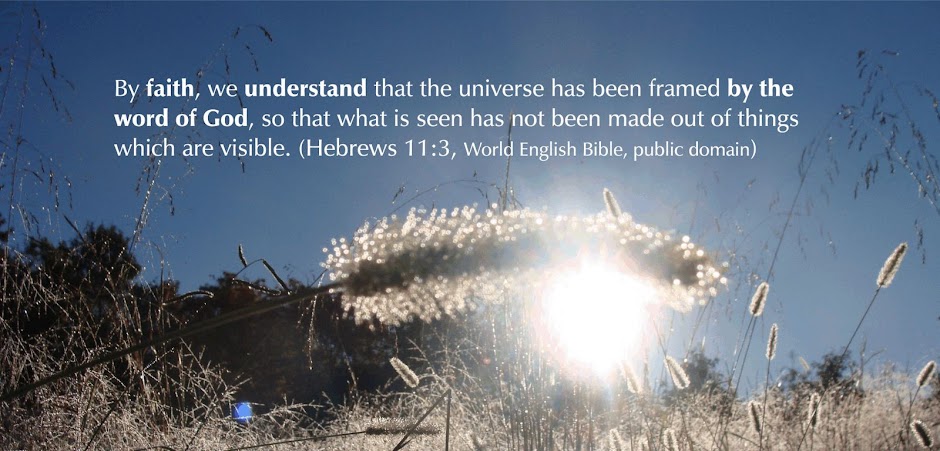
I believe that the universe, the earth, living things, and humans are here because they were planned by an omnipotent, omniscient, eternal God. I can't prove this. People much smarter than I, with larger audiences, have not been able to make a knock-down argument for this proposition. Hebrews 11:3 implies that I comprehend this by faith. Some people do not believe in such a God. Not surprisingly, they see the same evidence that I do, and come to different conclusions. The converse is true of me and my fellow believers, of course. In other words, I believe in an intelligent designer.
Over the last twenty years or so, a movement has grown up. It calls itself the Intelligent Design movement (ID). I have problems with it, and a lot of other people, some of them Christians, also do. (Here's a recent example of a Christian who has such problems. He has said some of the same things I am, and more.) Why do we have problems with such a group? Here are some of the reasons.
1) ID claims that it is possible to scientifically prove that God designed things. On the face of it, that would be extremely difficult, especially for biological phenomena. An IDer may say (one, Michael Behe, did) that blood clotting is so complicated that it couldn't have come about through random mutation and natural selection. However, even if such an origin couldn't be fully proposed when Behe wrote his book, this isn't a knock-down proof of ID. It is always possible that a plausible path for the origin of blood clotting mechanisms by natural selection will be found. That's what has happened to most or all of the "proofs" in Behe's book.
Being as generous as possible, the number of peer-reviewed scientific articles showing scientific evidence for ID can be counted on one hand. The less generous would say that it would take five less fingers than that. (Behe himself, in his testimony in the Kitzmiller case, agreed that, at the time, there was only one. To be fair, he also said that there were few, if any, peer-reviewed articles showing that what he calls irreducibly complex structures could have arisen by natural selection.)
I believe that the proof for an intelligent designer is not a scientific matter at all. It's a religious or philosophical matter. (ID has also made it political.) Trying to prove God's design in a laboratory is like trying to fry eggs in the shower while the water is running. It's not an appropriate place to do this, it won't work, and it may mess up the shower.
[Added April 18, 2009: Here's an e-mail exchange between a person who doubts ID, and Casey Luskin, a prominent ID advocate. Luskin fails to come up with experimental evidence for ID, and the doubter points out how difficult, if not impossible, such evidence would be to obtain.]
2) ID claims that it is scientific, not religious. A recent court case (presided over by a church-going Republican judge, if that matters) denied this. And no wonder. The Discovery Institute, the most important ID institution, published the "Wedge Document," which lays out ID's strategy. One of the "Governing Goals" is "To replace materialistic explanations with the theistic understanding that nature and human beings are created by God.” (p. 15 of the document from the previous link.) If that isn't religious, I'm not sure what is.
A statement of the Discovery Institute's Science Education Policy, published in June, 2009, uses the phrases "scientific theory of design," and "scientific debate over design," both referring to ID. (This paragraph added August 7, 2009.)
Why claim to be scientific, not religious? I'm afraid that the answer is to deceive. The court case cited in the previous paragraph was over an attempt to have ID included in public school science classes. If ID is religious, it doesn't belong in a science class.
(Added March 2, 2009. See here for a discussion of the lack of scientific evidence for ID.)
Lest there be any doubt, I believe that God did design nature, and human beings.
3) ID is often presented (to conservative religious publics -- it was not presented this way in the court case) as compatible with young-earth creationism, when it isn't. When the South Carolina state legislature considered legislation that would have opened the door to presenting ID as an alternative scientific theory, at least one legislator hoped, apparently encouraged by IDers, that this would mean teaching that the earth was only a few thousand years old. But the leaders of the ID movement have said that they believe that the earth is probably very old, and two of the main young-earth creationist organizations have severely criticized ID. (See here for documentation.)
Again, this tactic is deceptive.
God doesn't need these sorts of defense.
I thank my wife for the questions. Thanks for reading.
4) ID comes close to, or does, advocate God-of-the-gaps theology. That sort of theology is dangerous, because it restricts the activity of God to things we can't explain. The problem with that is that the more we think we understand, the less room there is for God, which is nonsense. If there is a God, He did things we can explain, or think we can, as well as things we can't. (This point was added on July 3, 2010.)
* * * * *
April 18, 2008. On this date, I modified the introductory portion of this post. There were no changes past the first paragraph.
June 2, 2008. On this date, I became aware of Behe's testimony about peer-reviewed articles in the Kitzmiller case, and added the parenthesis to the second paragraph under point 1).
February 28, 2009. I added a link to a post explaining my problems with Young-Earth Creationism.
October 29, 2015. I recently commented on a post from a person related to, or sympathetic to, the Discovery Institute, who said "We don't have a single example of a mutation resulting in a net gain of information. Not one." That claim is false, or misleading. There are are cases where mutation has been shown to have added new functions.
I believe that the universe, the earth, living things, and humans are here because they were planned by an omnipotent, omniscient, eternal God. I can't prove this. People much smarter than I, with larger audiences, have not been able to make a knock-down argument for this proposition. Hebrews 11:3 implies that I comprehend this by faith. Some people do not believe in such a God. Not surprisingly, they see the same evidence that I do, and come to different conclusions. The converse is true of me and my fellow believers, of course. In other words, I believe in an intelligent designer.
Over the last twenty years or so, a movement has grown up. It calls itself the Intelligent Design movement (ID). I have problems with it, and a lot of other people, some of them Christians, also do. (Here's a recent example of a Christian who has such problems. He has said some of the same things I am, and more.) Why do we have problems with such a group? Here are some of the reasons.
1) ID claims that it is possible to scientifically prove that God designed things. On the face of it, that would be extremely difficult, especially for biological phenomena. An IDer may say (one, Michael Behe, did) that blood clotting is so complicated that it couldn't have come about through random mutation and natural selection. However, even if such an origin couldn't be fully proposed when Behe wrote his book, this isn't a knock-down proof of ID. It is always possible that a plausible path for the origin of blood clotting mechanisms by natural selection will be found. That's what has happened to most or all of the "proofs" in Behe's book.
Being as generous as possible, the number of peer-reviewed scientific articles showing scientific evidence for ID can be counted on one hand. The less generous would say that it would take five less fingers than that. (Behe himself, in his testimony in the Kitzmiller case, agreed that, at the time, there was only one. To be fair, he also said that there were few, if any, peer-reviewed articles showing that what he calls irreducibly complex structures could have arisen by natural selection.)
I believe that the proof for an intelligent designer is not a scientific matter at all. It's a religious or philosophical matter. (ID has also made it political.) Trying to prove God's design in a laboratory is like trying to fry eggs in the shower while the water is running. It's not an appropriate place to do this, it won't work, and it may mess up the shower.
[Added April 18, 2009: Here's an e-mail exchange between a person who doubts ID, and Casey Luskin, a prominent ID advocate. Luskin fails to come up with experimental evidence for ID, and the doubter points out how difficult, if not impossible, such evidence would be to obtain.]
2) ID claims that it is scientific, not religious. A recent court case (presided over by a church-going Republican judge, if that matters) denied this. And no wonder. The Discovery Institute, the most important ID institution, published the "Wedge Document," which lays out ID's strategy. One of the "Governing Goals" is "To replace materialistic explanations with the theistic understanding that nature and human beings are created by God.” (p. 15 of the document from the previous link.) If that isn't religious, I'm not sure what is.
A statement of the Discovery Institute's Science Education Policy, published in June, 2009, uses the phrases "scientific theory of design," and "scientific debate over design," both referring to ID. (This paragraph added August 7, 2009.)
Why claim to be scientific, not religious? I'm afraid that the answer is to deceive. The court case cited in the previous paragraph was over an attempt to have ID included in public school science classes. If ID is religious, it doesn't belong in a science class.
(Added March 2, 2009. See here for a discussion of the lack of scientific evidence for ID.)
Lest there be any doubt, I believe that God did design nature, and human beings.
3) ID is often presented (to conservative religious publics -- it was not presented this way in the court case) as compatible with young-earth creationism, when it isn't. When the South Carolina state legislature considered legislation that would have opened the door to presenting ID as an alternative scientific theory, at least one legislator hoped, apparently encouraged by IDers, that this would mean teaching that the earth was only a few thousand years old. But the leaders of the ID movement have said that they believe that the earth is probably very old, and two of the main young-earth creationist organizations have severely criticized ID. (See here for documentation.)
Again, this tactic is deceptive.
God doesn't need these sorts of defense.
I thank my wife for the questions. Thanks for reading.
4) ID comes close to, or does, advocate God-of-the-gaps theology. That sort of theology is dangerous, because it restricts the activity of God to things we can't explain. The problem with that is that the more we think we understand, the less room there is for God, which is nonsense. If there is a God, He did things we can explain, or think we can, as well as things we can't. (This point was added on July 3, 2010.)
* * * * *
April 18, 2008. On this date, I modified the introductory portion of this post. There were no changes past the first paragraph.
June 2, 2008. On this date, I became aware of Behe's testimony about peer-reviewed articles in the Kitzmiller case, and added the parenthesis to the second paragraph under point 1).
February 28, 2009. I added a link to a post explaining my problems with Young-Earth Creationism.
October 29, 2015. I recently commented on a post from a person related to, or sympathetic to, the Discovery Institute, who said "We don't have a single example of a mutation resulting in a net gain of information. Not one." That claim is false, or misleading. There are are cases where mutation has been shown to have added new functions.
Subscribe to:
Posts (Atom)