License

I have written an e-book, Does the Bible Really Say That?, which is free to anyone. To download that book, in several formats, go here.
Creative Commons License
The posts in this blog are licensed under a Creative Commons Attribution-NonCommercial-ShareAlike 3.0 Unported License. You can copy and use this material, as long as you aren't making money from it. If you give me credit, thanks. If not, OK.
Showing posts with label quantum mechanics. Show all posts

Friday, August 22, 2025

Sunspots 987


Quanta magazine on the 100 birthday of quantum mechanics.

Gizmodo analyzes the results of DOGE's activity. There wasn't much money actually saved.

MSN and other outlets report on a study of the singing patterns of leopard seals. They are a lot like nursery rhymes.

MSN a nd other sources report that a man stayed under water for almost a half hour, after ingesting pure Oxygen.

National Public Radio reports on a push to stop using the common Mercator projection map, which expands the apparent size of geographic features near the poles, and seriously downsizes the appearance of the African continent.

Thanks for reading.

Friday, March 23, 2012

Do physical laws explain the origin of everything?

Physicists have been looking for a "Theory of Everything" for a long time. No such theory has been universally accepted, to this point.

A recent book, A Universe From Nothing: Why There Is Something Rather Than Nothing, by Lawrence M. Krauss, begins by stating that the author is no fan of a supernatural creator. (p. xi) Then, it goes on to say that "The purpose of this book is simple. I want to show how modern science . . . can address and is addressing the question of why there is something rather than nothing." (p. xiii) And there is an afterword by Richard Dawkins, no less, who congratulates Krauss on his answer to the question of the subtitle, and also writes that
We may not understand quantum theory (heaven knows, I don't), but a theory that predicts the real world to ten decimal places cannot in any straightforward sense be wrong. Theology not only lacks decimal places: it lacks even the smallest hint of connection with the real world.

I found it most interesting that Dawkins referred to heaven, which, he says, he doesn't believe in. But never mind. The New York Times published a review of Krauss's book, which review mentions Dawkins, as well. The author of the review does not question the laws of quantum mechanics, which Krauss believes explain our very existence. But he does write: 
But the laws have no bearing whatsoever on questions of where the elementary stuff came from, or of why the world should have consisted of the particular elementary stuff it does, as opposed to something else, or to nothing at all.
In other words, Krauss has not really explained nearly as much as he, nor Dawkins, think that he has.

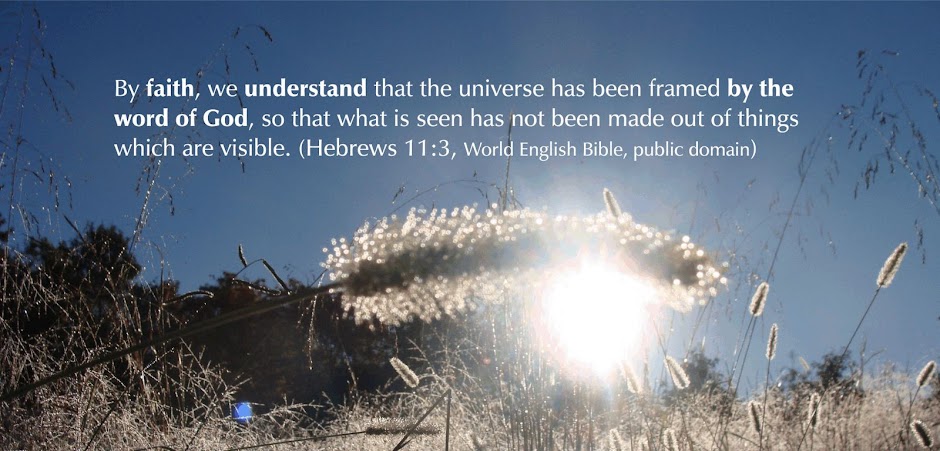
Nor, says the review, do the laws explain why those very laws exist. (Krauss has no such explanation, either, and says so.) In other words, we still do not know, from a scientific standpoint, why there is something, rather than nothing. I don't think we ever will. As the writer of Hebrews put it: 11:3 By faith, we understand that the universe has been framed by the word of God, so that what is seen has not been made out of things which are visible. (World English Bible, public domain) By faith, not by experiment. Dawkins and Krauss have faith, but it's a faith that there is no meaning, no purpose, to the existence of the universe. Those of us who believe in a supernatural Creator believe that they are wrong, but we can't prove it.

I have previously written on the weirdness of modern physics, here and here.

Thanks for reading.

Tuesday, January 25, 2011

Quantum entanglement -- sending information through time

I remember something about the discovery of lasers. The impression was that such devices were large, expensive, and confined to physics labs. Not only that, but they had to do with experimental manipulation of light. How could such a phenomenon be practical? How things have changed! This computer has a laser in its CD/DVD reader/writer, and laser use is very common in North America. There are almost certainly more functioning lasers in North America than there are people in the US, Mexico and Canada.

Perhaps the same development and harnessing of technology will take place concerning quantum entanglement. What is quantum entanglement? The simple explanation is that it means that two particles, separated by large distances, and not physically connected, can, nonetheless, be connected. (See my previous post on the strangeness of quantum physics, in other ways.) This is, I believe, a truthful explanation, as far as it goes, but it does not go very far in explaining what quantum entanglement is all about. I haven't found any simple explanations of quantum entanglement. There is a Wikipedia article on the subject, and the Stanford Encyclopedia of Philosophy has an article, too. Neither is exactly simple.

The applications of quantum entanglement seem to be, eventually, these: communication over long distances, more efficient storage of information. A recent article in Wired indicates that there may be another, even weirder application, namely communication with the past or the present. Not time travel. (The Wired article's explanation of quantum entanglement is intermediate between my sentence, in the previous paragraph, and the Wikipedia.)

Thanks for reading!

Saturday, July 10, 2010

God and quantum indeterminacy

In a previous post, I briefly discussed, in relation to a book by Kitty Ferguson, what modern physics says about the unpredictability of sub-atomic particles. This fundamental uncertainty may be a way for God to act without being detected:

Let's say that God wants to alter my consciousness in a certain way (so as to communicate a message to me) or to alter the course of a disease. If we assume determinism, then either God couldn't do it, or God would have to, at least temporarily, suspend natural causal determinism in order to do it. This alternative depends on whether we think of determinism as true independently of God or as an order established by God, and hence subject to cancellation at God's pleasure. But on quantum theory there is no such problem. The relevant physical laws only provide for a large probability or one outcome rather than another in a given situation. And the highly improbable can sometimes happen without violating probability laws. Hence God can, consistent with quantum theory, do something to bring about a physically improbable outcome in one or more instances without any violation of physical law. And even if these interventions are all on the sub-atomic level, they can, if properly chosen (and presumably God would be in a position to do so), snowball so as to make a difference to macroscopic states of affairs. Hence, divine activity that makes specific differences at particular times and places is quite consistent with a quantum theory of physical causality. Perhaps God designed the universe to operate in accordance with probabilistic laws so as to give room for God to enter the process as an agent. William P. Alston, "Divine Action, Human Freedom, and the Laws of Nature," pp. 185-206 in Quantum Cosmology and the Laws of Nature: Scientific Perspectives on Divine Action, 2nd edition, ed. by Robert John Russell, Nancey Murphy and C. J. Isham. (Vatican City State: Vatican Observatory, 1996) Quote is from pp. 188-9.

Note that I said "may." As a matter of fact, Alston, the author, says that he does not believe that it is necessary to invoke quantum indeterminacy to explain God's action. He believes that God's occasional action is compatible with physics at not only the micro level, but at the macro level. I, too, suppose that God is quite capable of acting on quarks and neutrinos, but also on mountains and planets. Believing that God operates only on things we don't understand is a dangerous type of theology known as "God of the gaps." If God is God, He is God not only of things we can't explain or predict, but of things that we can. As a friend of mine once said, "God is not just the God of eternity. He is also the God of 2 + 2." The danger of such a belief is that, as we think we understand more and more, we push God more and more into irrelevancy, in our own minds. Just because we think we understand, say, the orbits of the planets, does not mean that God had nothing to do with them, anymore than understanding how, say, a kitchen range works doesn't mean that someone (or a lot of someones) didn't originally invent them.

I expect to continue the series with more direct musings on Ferguson's book in the near future. Thanks for reading.

Wednesday, May 19, 2010

Sunspots 261

Things I have recently spotted that may be of interest to someone else:


Science:Entanglement (the notion that two originally closely connected particles can somehow remain connected when separated across long distances) is one of the many weird aspects of quantum mechanics. Wired reports that some scientists believe that this property may allow migrating birds to see magnetic fields.

Wired also reports that scientists who have studied fights between ravens say that the birds can act as if they are consoling the losers.

Politics:
(or Education) A New York Times book review (you may need to obtain a free password to read this periodical) says that Diane Ravitch, once Assistant Secretary of Education under President George H. W. Bush, and a strong advocate of school choice and of standardized testing as a measuring instrument, has written a book in which she now says that neither school choice nor standardized tests have done much, if any, good.


Image source (public domain)

Monday, April 06, 2009

The weirdness of physics, part 1

A recent book review in the New York Times, of The Age of Entanglement*, (Knopf, 2009) by Louisa Gilder, reminded me yet again of the seeming weirdness of what physics tells us about how God made things the way they are.
*This link is to the first chapter of the book.

What do I mean? Or what did God do?

Well, for starters, there was Isaac Newton's discovery: The moon falls continuously, but keeps changing the direction of its fall, so that it continues its orbit around the earth. Or, to put it another way, gravity is an attractive force between any two objects that have mass. What's weird about that? Well, how can something keep falling, but never hit the earth? And how can there be an attractive force between two objects, when they aren't attached to each other in any way? As the Wikipedia, March 28, 2009, puts it, "Newton's postulate of an invisible force able to act over vast distances led to him being criticised for introducing occult agencies" into science. In other words, his proposal was weird. But it can be demonstrated experimentally.

And then came Einstein. He did away with Newton's force at a distance, replacing it with curved space-time. Space and time make up a four-dimensional whole, and the presence of a mass causes warps in this structure, which, in turn, make objects appear to be falling, often falling toward each other. Weirder. But it can be demonstrated experimentally. One of the side products of Einstein's thought, for good and bad, is nuclear energy, as found in nuclear power plants and weapons.

Einstein also initiated quantum mechanics. Quantum mechanics, among its other weird explanations for how nature works, tells us that an object has both wave-like and particle-like properties at the same time. Electrons can "tunnel" through barriers by just appearing on the other side of the barrier, at random, without ever having existed in any part of the barrier. An electron can travel through a tiny slit and appear at more than one place on the other side. Weirder still. These ideas can be demonstrated experimentally. They are also of great practical importance. The computer you are reading this on would not be possible without some applications of these ideas.

There are some other ideas in atomic physics that strain credulity, but are not directly attributable to Einstein. One of these is the Heisenberg uncertainty principle. This principle tells us that it is impossible to measure both the position and momentum of a sub-atomic particle accurately. Measuring one of them very closely causes uncertainty in the other property. This means that, to humans, at least, some things are unknowable in principle.

Einstein, though he started quantum mechanics, was not comfortable with all of the implications. In particular, he was uncomfortable about the notion of entanglement. (Note the book title in the first sentence.) Entanglement suggests that two particles, that are produced by the same event, remain somehow linked, no matter how far apart they travel. Weirder still! This idea, like the others, has been tested experimentally, and found, so far, to be correct.

Isn't God wonderful! How much else don't we know about the way things are? How little do we understand that we think we do? Only He knows.

Thanks for reading. God willing, There is a second part to this post.
Thursday, May 17, 2007

Quantum physics requires that minds be non-physical

In a recent article in First Things, "Faith and Quantum Physics," Stephen M. Barr argues that quantum physics, one of the most non-common sense, and also one of the most successful, theories of modern science, requires that human minds be non-physical. As Barr points out, he is not the first to say this -- other prominent thinkers have done so. He also points out that some of the opposition to the seeming weirdness of quantum physics is because of exactly this conclusion.

Barr's argument goes like this:

Predictions of any kind, made as statements of probability, such as, for example, which party will win the U. S. Presidential election of 2004, are meaningless unless they predict a measurable actual outcome. There was an election, and the Republicans won, however that happened, and whatever has become of it. Quantum physics makes predictions about physical systems, in the form of mathematical equations. (There are no equations in Barr's article) But these are usually measured by laboratory devices, which are, themselves, physical systems, and the same mathematical equations apply to them, and are only predictions. Says Barr:
And this leads to the remarkable conclusion of this long train of logic: As long as only physical structures and mechanisms are involved, however complex, their behavior is described by equations that yield only probabilities-and once a mind is involved that can make a rational judgment of fact, and thus come to knowledge, there is certainty. Therefore, such a mind cannot be just a physical structure or mechanism completely describable by the equations of physics.

There is more in Barr's article, for sure. He also says that quantum physics is more congenial to Judeo-Christianity than it is to Buddhism, and that quantum physics presents strong arguments against determinism, or, in other words, for free choice. He finally examines the different philosophical views that are used to explain the findings of quantum physics, and comes down as in favor of the approach of Neils Bohr, although he understands that Bohr's thinking had some weak spots.

It is refreshing, but should not be surprising, that a physicist states that a great scientific theory provides evidence that a mind is not simply a material object, and that such minds make real choices. After all, God's revelation includes the natural world, as well as the Bible.

Thanks for reading.