License

I have written an e-book, Does the Bible Really Say That?, which is free to anyone. To download that book, in several formats, go here.
Creative Commons License
The posts in this blog are licensed under a Creative Commons Attribution-NonCommercial-ShareAlike 3.0 Unported License. You can copy and use this material, as long as you aren't making money from it. If you give me credit, thanks. If not, OK.
Showing posts with label Mathematics. Show all posts

Friday, June 21, 2024

Sunspots 965

Things I have spotted that may be of interest to others:


Scientific American discusses tattoo ink. We don't really know what's in it. 

Scientific American also discusses the discovery of irrational numbers. We don't know that history very well.

Science Friday and other outlets report that elephants have names for other elephants.

NPR reports that some woodpeckers peck on metal to make a lot of noise, and explains why they do this.

Wednesday, March 29, 2023

Sunspots 929

Things I have recently spotted that may be of interest to others*:


Christianity: An article in Christianity Today, which argues, with lots of evidence, that Christianity and Democracy are not inextricably linked.

Computing: Gizmodo on getting calls that fake the voice of a loved one, or a friend. Deepfaking.

Environment: Gizmodo reports that more electricity was produced from renewable sources than from coal, in the US in 2022.

Food: Gizmodo reports on using a 3'D printer to make cheesecake.

Health: NPR reports on a study that shows that life expectancy is shortening in the US, and many other countries are doing significantly better.

Politics: A Conversation writer discusses the importance of the protests in Israel.

Science: NPR reports on a girl with half a brain. Really.

Gizmodo reports on a newly discovered 13-sided tile.

Thanks for reading.

Wednesday, March 27, 2019

Sunspots 721


Things I have recently spotted that may be of interest to someone else:


Computing: PC Magazine tells us about some ways to use Google Calendar that you probably don't know about. (Anyone with a Google account and an internet connection can use Google Calendar.)

Gizmodo reports on the sophistication of various methods of phishing. Scary.

Your Android device may have anti-virus software that is not as good as it should be.

Gizmodo reports that t he CEO of AT&T apparently got a robocall while he was giving a presentation.

Education: (and Finance, and Politics) The Associated Press reports that some Republican state legislators, and governors, have suddenly become supporters of public schools.

Humor: (or something) Listverse tells us 10 interesting things about horses.


Politics: S. E. Cupp examines the field of Democratic candidates for President. She concludes that only Oprah Winfrey (who isn't running) can beat the President.

Catherine Rampell discusses socialism, and analyzes the President's warnings about it.

Science: There is no Nobel Prize in mathematics, but Gizmodo reports that a woman has won the equivalent Abel prize, and discusses her contributions.


The graphic used in these posts is from NASA, hence, I believe, it is public domain.
Thanks for looking!

Wednesday, August 26, 2015

Sunspots 535

Things I have recently spotted that may be of interest to someone else:


Christianity: Relevant tells us that private communion shouldn't be a chore, and makes some suggestions to make it more interesting. They suggest communion through food, among other things.

Stephen L. Corey points out that God created, or at least allowed, people who are not exactly male or female.

Computing: Gizmo's Freeware on privacy (or not -- some leaks can be fixed) in Windows 10.

Education: National Public Radio reports on how public schools in the US are neglecting the smartest kids.

Science: National Public Radio reports on research linking our leanness, or lack thereof, to our gut bacteria.

NPR also reports on very low-frequency communication sounds made by elephants.

Wired reports that Pluto's atmosphere seems to be being renewed. Its gravity is too weak to hold it as well as the earth holds ours.

Wired also explains why water gets stale when left out overnight.

Wired also reports on an on-line database of mathematical sequences, and the man who has maintained this database for 50 years. (Examples: 1, 1, 2, 3, 5, 8, 13, 21, 34 . . ., the Fibonacci sequence, or 1, 2, 3, 5, 7, 11, 13, 17, 19, 23, 29 . . ., the prime numbers.) There are many, many more of these sequences in the database.


Image source (public domain)

Tuesday, June 19, 2012

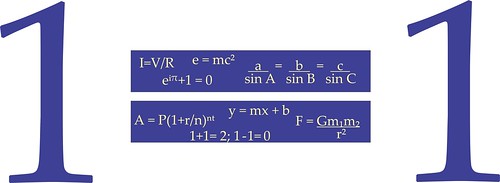
Some important equations

Equals sign, or one equals one: equations.
In the graphic above, there are ten important equations, some apparently simple, some not so simple.


Equal: Agreeing in quantity, size, quality, degree, value, etc.; having the same magnitude, the same value, the same degree, etc. - from Webster's Unabridged Dictionary, Project Gutenberg, public domain

The equals sign, which we now take for granted, was first used in 1557, by a Welsh mathematician named Robert Recorde. (See the Wikipedia article on the equals sign.)

Equations used are these: three equations from “simple” arithmetic; Ohm’s law; Einstein’s energy/mass equivalence equation; Euler’s equation; the law of Sines; An equation for compound interest; Slope-intercept formula for a straight line; Newton’s law of universal gravitation.

The largest equation in the graphic, from "simple arithmetic" illustrates one of the main ideas of arithmetic, namely that a thing is equal to itself. Another one uses a zero, which symbol and concept we now take for granted. Zero was invented in India in the 9th century AD. Euler's equation, also known as Euler’s identity, relates perhaps the most important constants of mathematics, e, pi and i, the square root of minus one. There are other ways of representing compound interest, depending on the situation, but the equation used will cover many of them. The law of Sines has been used in astronomy, to measure distances of bodies within the solar system from the earth.

Two of the most important statements in English that use the word equal are:

Philippians 2:6 Who, being in the form of God, thought it not robbery to be equal with God: 7 But made himself of no reputation, and took upon him the form of a servant, and was made in the likeness of men: (King James version)

and

We hold these truths to be self-evident, that all men are created equal, that they are endowed by their Creator with certain unalienable Rights, that among these are Life, Liberty and the pursuit of Happiness. - U. S. Declaration of Independence (I know. At the time, all men weren’t considered equal, and women weren’t included. But it was, and is, a great idea.)

Thanks for looking, and, perhaps, thinking. The graphic is a link to a Flickr page, where larger sizes of it should be available.

Tuesday, January 15, 2008

"What Have You Changed Your Mind About?" pt. 2

I continue comments on Edge's "World Question" issue, which question is the same as my title. See here for the first part of this series.

This page contains, as its last entry, an essay on the reality of the soul, by Todd Feinberg. Feinberg believes that there is such a thing as a soul, which is not the same thing as the brain. He indicates why he now believes as he does. Feinberg does not believe this for religious reasons -- he does not believe in the persistence of the soul after death.

On this page, the first entry, by Keith Devlin, considers one of the most fundamental questions underlying mathematics, namely, whether math is invented or discovered. He now believes the former. (Not everyone agrees!)

On the same page, David Dalrymple raises some fundamental questions about how computers are designed, using an analogy with a business.

Tor Nørretranders points out that our body isn't a stable thing. "98 percent of the atoms in the body are replaced every year," he writes.

And Helen Fisher discusses what she calls "the four-year itch" -- that is, more divorces occur after four years of marriage than at any other point. (Her data is from many societies, not just North American.) She speculates about how natural selection might have brought this about.

Thanks for reading!

Wednesday, October 03, 2007

Sunspots 128


Things I have recently spotted that may be of interest to someone else:

Humor: The Onion on fig newton ads.

The Onion on a remarkable development in Vice President Dick Cheney's attitude.

Science: (or something) I read, in the latest American Bible Society Record, that there are new languages appearing. They mentioned two: a new combination of Arabic and French, and a Polish-related street gang language. Bible translations are being prepared in both of these, and many others.

"California State University Professor Mike Orkin points out that if a person drives ten miles to buy a [lottery] ticket, he or she is about sixteen times more likely to get killed in a car crash on the way than to win the jackpot." Sean B. Carroll, The Making of the Fittest: DNA and the Ultimate Forensic Record of Evolution . New York: Norton, 2006. pp.41-2

Politics: An "Issue Tracker" from the Washington Post. The web page lists 17 major party presidential candidates, and has links to press coverage on the issues. If, for example, you want to know how Sam Brownback and the budget have been covered, or made the news, you can click on Brownback, then on the Economy and Budget issue category. If, on the other hand, you want to know who has received news coverage because of their stand on the environment, you move the mouse over Environment, and see that, currently, Duncan Hunter has received no news coverage about that, and Hilary Clinton has seen the most. The page, it says, can be added to your own web page or MySpace page. You can go to the candidate's official web sites (which usually, or always) have something about their positions on various issues, by clicking on this related page.

Can you name more than four members of the U. S. President's Cabinet? (Apparently even the White House webmaster can't name all of them . . .) I got four of them.

Computing: C-Net on how the bad people use information on social networks like MySpace, FaceBook, or LinkedIn to attack corporations, or even governments. This phenomenon is known as Spear Phishing.

Christianity: On the use of words for "up" and "down" in the book of Jonah. This week's Christian Carnival is here. For information on these Carnivals, go here.

Thanks for reading! Keep clicking away.

Image source (public domain)

Wednesday, March 14, 2007

Life of Pi: Ecumenism on a grand scale

Today is 3/14, which inspires some people to celebrate pi day on this date. Pi, the ratio between the circumference and the diameter of a circle, begins with 3.14. It goes on from there forever, because it is an irrational number, meaning that it can't be expressed as a ratio between two numbers. The Wikipedia article on Pi, or π, is the only such article I remember that has an animated graphic.


Life of Pi
, Booker Prize-winning novel by Yann Martel, is only slightly about mathematics. I'll spoil the plot, because the book's cover gives it away, anyway. A 16-year-old Indian boy, Pi Patel, survives a shipwreck. So does a large tiger. The two of them coexist on a lifeboat for several months.

Patel claims to be a Christian, a Hindu, and a Muslim, all at the same time, which, besides giving most readers some pause, is upsetting to his three spiritual guides. I can't speak for the Hindu or Muslim beliefs and practices presented, but Patel and Martel seem to comprehend Christianity, and faith in general:
I'll be honest about it. It's not atheists who get stuck in my craw, but agnostics. Doubt is useful for a while.We must all pass through the Garden of Gethsemane. If Christ played with doubt, so must we. If Christ spent an anguished night in prayer, if He burst out from the Cross, "My God, my God, why have you forsaken me?" then surely we are also permitted doubt. But we must move on. To choose doubt as a philosophy of life is akin to choosing immobility as a means of transportation. p. 28.

And about the beginning of Pi's conversion to Christianity:
He . . . told me a story. Or rather, since Christians are so fond of capital letters, a Story.

And what a story. The first thing that drew me in was disbelief. What? Humanity sins but it's God's Son who pays the price? p. 53.

Martel also has some definite statements to make about animal behavior. Interesting statements. For example:
Whatever the reason for wanting to escape, sane or insane, zoo detractors should realize that animals don't escape to somewhere but from something. Something within their territory has frightened them -- the intrusion of an enemy, the assault of a dominant animal, a startling noise -- and set off a flight reaction. The animal flees, or tries to. p. 41.

I won't give away any more of the plot than I did in the first paragraph, other than to say that I think the period on the lifeboat lasted too long for my taste.

A good read. I'm not sorry I read the book.

Thanks for reading.

Friday, September 22, 2006

The problem with dying

". . . Do you know what the worst bit about dying is?"
"Tell me, Gran."
"You never get to see how it all turns out."
- Jasper Fforde, Lost in a Good Book: A Thursday Next Novel (New York: Viking, 2002) p. 136. Thursday Next, talking to her grandmother.

Some other miscellaneous quotes:

"I'll tell you what love is," I told her. "It is blind devotion, unquestioning self-humilation, utter submission, trust and belief against yourself and against the whole world, giving up your whole heart and soul to the smiter!" - Jasper Fforde, Lost in a Good Book: A Thursday Next Novel (New York: Viking, 2002) p. 350. Thursday Next talking to Miss Havisham (from Great Expectations by Dickens).

"Isn't it odd how much fatter a book gets when you've read it several times?" Mo had said when, on Meggie's last birthday, they were looking at all her dear old books again. "As if something were left between the pages every time you read it. Feelings, thoughts, sounds, smells . . . and then, when you look at the book again many years later, you find yourself there, too, a slightly younger self, slightly different, as if the book had preserved you like a pressed flower . . . both strange and familiar." Inkspell, by Cornelia Funke (translated from the German by Anthea Bell) New York: Scholastic, 2005, p. 47

When you don't have anything new to say, and what you've been saying in the past no longer has much plausibility, you have three choices. You can shut up. For conservative commentators, this is inconceivable, not to mention financially ruinous. You can re-examine your premises. This is not the conservative style. Or you can pump up the volume. - Timothy Noah, "Coulterized Conservatives," Slate, September 6, 2006 (The same thing could be said about lots of people, of all sorts of persuasions)

There are three types of people: those who count precisely and those who don't. Edward B. Burger & Michael Starbird, Coincidences, Chaos, and All That Math Jazz: Making Light of Weighty Ideas. New York: Norton, 2005. Quote is from p. 79.


Thanks for reading.

Thursday, June 08, 2006

Living in two dimensions

I read Flatland: A Romance of Many Dimensions (New York: Penguin, 1998. Originally London: Seeley & Co., 1884, by Edwin Abbott Abbott) a few decades ago, but had mostly forgotten the content. One of my daughters recently gave me a copy, which I read and enjoyed.

The premise is that the author, who describes himself as A. Square, is living in a universe of only two dimensions. He describes various aspects of such a world, such as gravitation, how you would be able to tell a circle from a square, if you were looking at what, to us, would be the edge of two silhouettes, and so on. Quite imaginative work. Although the subtitle includes "Romance," there's no real love in the book.

Here's definition 3 of romance, from the Free Online Dictionary: a. A long medieval narrative in prose or verse that tells of the adventures and heroic exploits of chivalric heroes: an Arthurian romance. b. A long fictitious tale of heroes and extraordinary or mysterious events, usually set in a distant time or place. c. The class of literature constituted by such tales.

This book is a romance in the second sense.

Perhaps the best part of the book is an experience of a three-dimensional world, after which the protagonist tries, and fails, to convince his fellow Flatlanders that such a thing is possible. (He also tries, and fails, to persuade his three-dimensional mentor, clearly an intelligent being, that a four-dimensional world might be possible.) Although Abbott almost certainly couldn't have known it, Einstein's physics considered time to be a fourth dimension, and string theory suggests that the universe may have 10 or more dimensions.

This edition had a good introduction by Alan Lightman. Lightman compared Abbott to Lewis Carroll, who, like Abbott, wrote about mathematics. (Carroll is, of course, famous for his fantastic writing.) Lightman suggests, plausibly, that Abbott was writing some social satire, especially about the sexes in Flatland. (Women were straight lines, men geometric shapes.) Lightman also said that Abbott was a pioneer in thinking, and probably the book has been important in the development of scientific thought. A 1920 article on Einstein's physics referred to the book, he says.

Writes Lightman:

For me, the importance of the second part of Flatland lies not in its literal geometrical and dimensional discussion, but in its more shrouded warning of too much complacency in the scientific enterprise -- and, by extension, all of life. (p. xii)

Scientists, around the time Abbott wrote Flatland, and for a number of years afterward, thought that science knew about everything there was to know. They were wrong. They are now, if they think such.

Thanks for reading! Live in as many dimensions as you can.