License

I have written an e-book, Does the Bible Really Say That?, which is free to anyone. To download that book, in several formats, go here.
Creative Commons License
The posts in this blog are licensed under a Creative Commons Attribution-NonCommercial-ShareAlike 3.0 Unported License. You can copy and use this material, as long as you aren't making money from it. If you give me credit, thanks. If not, OK.
Showing posts with label energy. Show all posts

Saturday, August 31, 2024

God's creativity

Let us be thankful for God's wisdom, creativity and imagination. He thought of many things: information, beauty of form, sound, color, smell and taste; physical laws and constants, elementary particles and the structures that are made of them; life, diversity, and natural selection; communication, humor; faith, generosity, innocence. He let us live in a good, diverse, and well-planned world, with energy, oxygen, water, organic compounds, and other elements and compounds we need to live.

More could be said. The universe's creation involved the Father, Son and Spirit, working together.

Wednesday, March 29, 2023

Sunspots 929

Things I have recently spotted that may be of interest to others*:


Christianity: An article in Christianity Today, which argues, with lots of evidence, that Christianity and Democracy are not inextricably linked.

Computing: Gizmodo on getting calls that fake the voice of a loved one, or a friend. Deepfaking.

Environment: Gizmodo reports that more electricity was produced from renewable sources than from coal, in the US in 2022.

Food: Gizmodo reports on using a 3'D printer to make cheesecake.

Health: NPR reports on a study that shows that life expectancy is shortening in the US, and many other countries are doing significantly better.

Politics: A Conversation writer discusses the importance of the protests in Israel.

Science: NPR reports on a girl with half a brain. Really.

Gizmodo reports on a newly discovered 13-sided tile.

Thanks for reading.

Friday, June 17, 2022

Water, Hydrogen, and Oxygen, and where we get our energy


The above equation is a simple way of showing what happens during photosynthesis. There are more detailed ways to show it. Photosynthesis is a complicated process, or processes. But, at its heart, it may be summarized simply.

As you know, there's a lot of water on the earth. As you also know, water consists of two elements, Hydrogen and Oxygen. As you may not know, the energy you need is intimately connected to water. I'm using energy to type this, and you are using energy to move your eyes as you read it. What's that got to do with water?

Our food comes from photosynthesis. Green plants absorb light, and produce various molecules that we use as food, such as starches, sugars, several vitamins, and proteins.

 Light energy is used to split water, and the Hydrogen split off is then available for the manufacture of Carbon-containing molecules, like glucose, food molecules, which can be stored, broken down to release energy, or moved to parts of the organism where they are needed. Some of the need is to release energy. Most foods you buy at a grocery store, or a restaurant, come with a calorie number. That number indicates the amount of energy you would expect to get if you ate and digested that food. The energy comes from energy-storing molecules, like glucose. The Carbon-containing molecules, which have Hydrogen added to the Carbon, may also be used to produce important molecules like enzymes, vitamins, hormones and proteins. (Oxygen, Nitrogen, Sulfur and other elements may be added to a Carbon-based structure.)

Organic molecules, like glucose, will burn. Burning uses Oxygen to carry on combustion. There is a process, used by nearly all organisms, called cellular respiration. That process also uses Oxygen to create water, and, in the process, releases energy for use in our cells. So, putting it very simply, photosynthesis uses light energy to break water, and cellular respiration puts water back together, and releases energy.

I'm bald-headed. So lots of light hits my head. My cells, like yours, have lots of water. So why doesn't that light, on my scalp cells, split water and make glucose? The answer is that various helping molecules, molecular tools, as it were, are necessary for photosynthesis to occur. These include chlorophyll and several enzymes, which I don't have in my scalp cells.

Isn't God great? Thanks for reading.


Thursday, November 19, 2020

Let there be light! I'm thankful for the electromagnetic spectrum

Genesis 1:1 In the beginning, God created the heavens and the earth. 2 The earth was formless and empty. Darkness was on the surface of the deep and God’s Spirit was hovering over the surface of the waters. 3 God said, “Let there be light,” and there was light. 


There is controversy over whether Genesis 1 is to be taken as a sequential account of the creation, or should be interpreted in some other way, and over when and how long creation took place. Lets put those matters aside. They dont really matter for the topics of this post. The first reported created act (although the creation of the earth seems to have come first) is bringing light about. Thats important.

Light is important. The main source of usable energy on earth is light. Energy from light drives the water cycle. Light is absorbed by green plants, and almost all of the food we eat exists because of that. Light makes it possible for us to perceive where we are, where we are going, and who and what is around us. Light makes it possible for us to work, and to play. Without light, reading would be difficult or impossible. Except for those unfortunates of us who are blind, we live in a world perceived and navigated because light is present.

The Bible doesnt say let there be an electromagnetic spectrum. Such a term wouldnt have made sense to the ancient Israelis, and doesnt make sense to a lot of us today. See here for more about that spectrum. But I will say that visible light is a rather small part of a range of energy forms, ranging from gamma rays, X-rays and ultra-violet to infrared, microwaves and radio waves. The people living when Genesis was written, and when it became a part of their culture, had no way of detecting these other forms, or appreciating their importance. However, whenever and however light came to be, this whole family of energy must have accompanied it. I dont know about you, but I use WiFi every day. Im not sure whether my phone uses 5G or not, but, whether it does, or not, its using part of the electromagnetic spectrum to help me communicate.

I had a chest X-ray a few weeks ago. That part of the electromagnet spectrum allows us, as it were, to see parts of our bodies that we can't see with ordinary light.

We open our blinds frequently. This is partly so we can see our surroundings. It is also to help heat our home without adding to the utility bill. Light is reflected -- thats how we see, as light is reflected off of whatever we are looking at, and comes back, going through our pupils and striking our retinas. But it is also absorbed, for example by green plants that carry on photosynthesis. Some of the absorption is manifest in that light energy is converted to heat energy, which, when radiated, is another part of the electromagnetic spectrum. Without heat derived from the suns light, the earth would be uninhabitably cold.

Some other Biblical thoughts about the electromagnetic spectrum. Heres a quotation from 1 Timothy: “6:16 He alone has immortality, dwelling in unapproachable light, whom no man has seen, nor can see: to whom be honor and eternal power. Amen.” Unapproachable light? Yes, there is that, physically. We cant be exposed to parts of the electromagnetic spectrum, in any great amount, or for any great length of time, without suffering damage, or even death. Is the scripture talking about the electromagnetic spectrum, as physicists measure it, or is this symbolic of Gods great holiness and power? Or is it both? I dont know.

John 8:12 Again, therefore, Jesus spoke to them, saying, “I am the light of the world. [Perhaps referring to Isaiah 60:1] He who follows me will not walk in the darkness, but will have the light of life.” Christ, Himself, illuminates, warms, communicates. He is truly the light of the world. (See John 1:1-9.)

Finally, Revelation 22:4 They will see his face, and his name will be on their foreheads. 5 There will be no night, and they need no lamp light or sun light; for the Lord God will illuminate them. They will reign forever and ever. I don’t pretend to understand this, but its part of the Bible.

Thanks for reading. Image modified from Pixabay. Scripture in this color, from the World English Bible.

Tuesday, May 07, 2019

Is the sun important to us? Absolutely

Why is the sun important to us?
 

For starters, the gravitational attraction of the sun holds the earth in a stable orbit, which is necessary for our very existence as living beings on this planet.

The sun is a giant source of energy. Einstein pointed out the relationship between energy and mass, in his famous e = m c-squared equation. Every second, thousands of tons of mass are turned into energy, by the sun. The process involves four Hydrogen nuclei fusing into a Helium nucleus, which has a little less mass than the Hydrogen nuclei. This fusion wouldn’t be possible without the extreme temperature in the core of the sun – millions of degrees. Temperature is a measurement of the velocity of molecules. At absolute zero, all motion ceases. In the core of the sun, the velocity of particles is so high that they can overcome natural forces of mutual repulsion, hence slamming together and fusing nuclei.


In case you didn’t know, the c in Einstein’s equation is the velocity of light, a large number, and it’s squared. That means that a little bit of mass can be converted to a lot of energy.


What happens to the sun’s radiated energy? Most of it goes off into space, perhaps eventually hitting something. The sun is about 93,000,000 miles away from us. Think of a giant sphere, with a diameter that large. The sun’s radiated energy goes off evenly in all directions. The earth occupies only a very small fraction of the surface of that imaginary sphere. But that very small fraction gets hit by a tiny bit of the sun’s emitted energy, and that is very important to us.


Energy from the sun keeps the earth at a temperature compatible with human, and other, life. It is possible that there is life elsewhere in the solar system, but not likely. Either conditions would be too hot for life, or too cold, in most planets and planetary moons, such as the moons of Saturn.
 

Energy from the sun, in the form of light, makes it possible for us to perceive the world around us, using vision. Most insects, most vertebrates, and some other animals use vision, which would be impossible without light from the sun. (Some animals can see types of light that we can’t, but that statement still applies.) We can perceive the world around us in other ways, to be sure, but vision is arguably more important than the other senses we have.

Energy from the sun makes the seasons possible, and also makes various critically important earthly phenomena, such as the water cycle, possible. Energy from the sun makes erosion and weathering of rocks possible.


Energy from the sun, in the form of light, makes photosynthesis possible. Essentially all of the food energy we take in came directly or indirectly from photosynthesis. In photosynthesis, light is captured by green plants, who use it to produce sugars and various other organic substances, that we need to build ourselves, and to release energy to keep us going.


Is the sun important to us? Absolutely. Yes, that’s the right word – absolutely.


Perhaps St. Paul was speaking of the critical importance of light, when, under the inspiration of the Holy Spirit, he wrote “1 Timothy 6:15b who is the blessed and only Ruler, the King of kings, and Lord of lords; 16 who alone has immortality, dwelling in unapproachable light; whom no man has seen, nor can see: to whom be honor and eternal power. Amen. (World English Bible, public domain.)

Monday, December 01, 2014

I'm thankful for Oxygen

Thankful for Oxygen

I'm thankful for Oxygen. You should be, too.

Oxygen is found in most of the important molecules in our bodies. Water, proteins, DNA, fats, carbohydrates, vitamins, hormones, and others. That, alone, would be cause for gratitude. But there's more.

Oxygen, well, oxidizes. So? Oxidation means that Oxygen has the power to combine with other atoms and give off energy in the process. Some such reactions are slow -- rusting of iron, for instance. But some are rapid. Fire is an oxidation reaction. (The sun is not on fire, in this sense. There's very little oxygen in it, and the energy from the sun comes from another source.)

Most of us burn gasoline in our cars. Gasoline is mostly a mixture of hydrocarbons, a molecule, for instance, such as octane, with eight Carbons and eighteen Hydrogens. When a mixture of octane and Oxygen is ignited, the resulting products are carbon dioxide and water. The production of water in this way releases energy, which is used to cause gas to expand, thus moving the pistons, which motion, with the proper apparatus, causes the wheels of the automobile to turn.

In living things, a somewhat similar process takes place, not in the cylinders, but in tiny energy converters called mitochondria. The process is called cellular respiration, and the reason we require Oxygen, and breathe air to get it, is because Oxygen is needed in our mitochondria, so that energy may be released. Red blood cells use hemoglobin to carry Oxygen from our lungs to all the cells in our bodies. Each cell uses that Oxygen to release energy.

Fuel, in this case food, is oxidized rapidly, and the energy given off is used to produce adenosine triphosphate. Most of the energy given off comes from the oxidation of Hydrogen, which produces water, one of the byproducts of the processes taking place in the mitochondria. The other byproduct is carbon dioxide. To summarize, food is oxidized, releasing energy and giving off carbon dioxide and water. There are a few living things that use different methods to get energy. Yeasts, for example, use a different process. But even green plants, which make their own food by photosynthesis, need to carry on cellular respiration when it is dark, in order to provide themselves with energy, which means that they need Oxygen.

Fire is important to humans. It has many uses -- in manufacturing, in providing light and heat. Fire requires Oxygen. The atmosphere is about 21% Oxygen. It has been suggested that that is enough so that Oxygen is readily available for breathing, and to keep fires burning, but that if the amount of Oxygen was much higher, fires would become harder to put out.

Here's a statement about the significance of fire as part of the worship of the Israelites:
Leviticus 6:12 The fire on the altar shall be kept burning on it, it shall not go out; and the priest shall burn wood on it every morning: and he shall lay the burnt offering in order upon it, and shall burn on it the fat of the peace offerings. 13 Fire shall be kept burning on the altar continually; it shall not go out. (World English Bible, public domain)

God appeared to Moses in the form of a burning bush, and to the Israelites as a column of fire. Were these fires caused by oxidation, or was this some supernatural appearance of fire? We don't know.

We need Oxygen, for many of the molecules that allow us to live, for fire, and to provide our own bodies with usable energy. I believe, but cannot prove, that God designed Oxygen so that this would be possible. It can't be disproved, either. Thanks for reading!

Thursday, November 27, 2014

I'm thankful for Adenosine

Thankful for adenosine

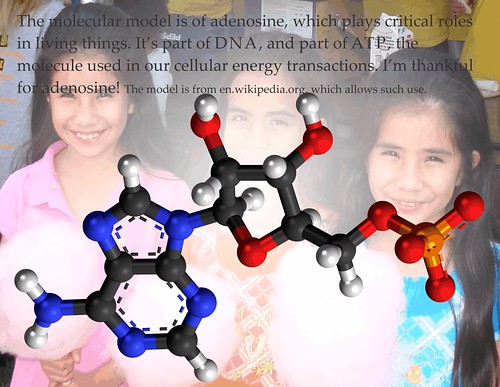
I'm thankful for adenosine. You should be, too. Adenosine plays some critical roles in our lives. The graphic above shows a molecular model, found in the Wikipedia article on adenosine. (Such use of the graphic is allowed.) The black spheres represent Carbon atoms, the red, Oxygen, the black, Nitrogen, the white, Hydrogen, and the yellow-orange sphere represents Phosphorus. The rods represent covalent bonds. The dotted lines indicate some movement of some of the electrons. Adenosine is also known as adenine monophosphate (AMP). The Phosphorus on the right, with its attached four Oxygens, is a phosphate. The hexagon and pentagon, on the left, are Adenine, a Nitrogen base. The middle part is deoxyribose, a 5-Carbon sugar.

It is pretty well known that DNA uses Nitrogen bases A, C, G and T to make up our hereditary code. The A stands for Adenine. However, A is connected to a 5-Carbon sugar, Deoxyribose, and to a phosphate, in actual DNA. (C, G and T are also so connected.) The actual genetic code is the sequence of AT, TA, CG and GC pairs, in the double helix, but there wouldn't be a double helix without the deoxyribose and the phosphate.

I used a photo of three girls to represent heredity. I'm not sure how they are related, but I think that two of them are identical twins. In any case, even if one of them is a cousin, rather than a sibling, they clearly share some external characteristics. These characteristics are largely determined by the common DNA that they got from their parents. You may not have thought of it, but the heredity-determining ability of DNA is important, even if you don't have any children. The left half of your body gets the same DNA as the right, the top as the bottom, etc. That's important to make us what we are. Besides, all of us have parents, living or dead.

Adenosine has another important function. It is the raw material for ATP, adenosine triphosphate. ATP has two more phosphates attached to it, in addition to the one in adenosine (AMP).

In most automobiles, the energy stored in gasoline is released, a little at a time, in the cylinders. That's a much better way of using the chemical energy of gasoline than causing an explosion in the gas tank would be! In a similar way, energy from food, say a sugar molecule, is captured, temporarily, in several ATP molecules, which can be transported within the cell. (One part of such capturing is glycolysis.) When energy is needed, for example to make a hormone, ATP is turned back into Adenosine/AMP, as the high-energy bonds that held the two additional phosphates are broken. It sounds complicated, and it is, but is works, and it's a good thing it does! So the energy from food is divided into ATPs, and these are used, a little of the energy at a time.

Because adenosine, and other important molecules, have Carbon, Hydrogen, Oxygen, Nitrogen and Phosphorus in them, living things all need such elements. They need other elements, too, especially Sulfur, which is found in proteins.

I'm convinced that God knew about adenosine, and how it would work, and planned for this. I can't prove it, and it can't be disproved, either. Thanks for reading.

Tuesday, December 03, 2013

I'm thankful for nuclear fusion

I’m thankful for nuclear fusion, the process by which the sun, and other stars, transform mass into energy. In the sun’s case, this is through 4 Hydrogen nuclei (protons) fusing into a Helium nucleus. About 0.7% of the mass involved is turned into energy. The reaction is not going on very fast. Scientists estimate that, at present rates, it would take about 10 billion years to exhaust the sun’s supply of Hydrogen. To put it another way, a human body at rest gives off more energy than the same volume of the sun’s material does. But the sun is so large that it gives off enough energy to heat our planet, over 90 million miles from it, losing about 5 million tons of mass per second. (Most of the sun’s energy goes out into space without striking anything in the solar system.) Without nuclear fusion, we wouldn’t be here. Our planet would be frozen, and there would be no light for green plants to convert to food. Although I’m very thankful for nuclear fusion, I’m sorry that we have, sort of, harnessed nuclear fusion, and that Hydrogen bombs exist.

See here for my main reference. Thanks for reading!

Thursday, May 30, 2013

God's creativity

God's creativity

God is unimaginably creative.

John 1, Colossians 1, and other passages indicate that God the Son was and is the chief agent in creation, and in sustaining it.

So what did God create?
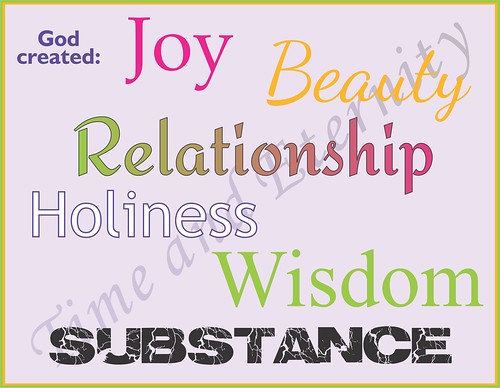
1. Substance (including energy, which is a type of substance – e = mc2).
Matter and energy are creations of God. He is outside of His created universe, and made it come to be from nothing. However, He can and does enter it, as shown in the miracles of the Old Testament, the Incarnation of God the Son, and the presence of God the Holy Spirit. Ken Schenck, in this post, points out that God created the nothing, too. It wouldn't have been there without God.

It is possible that all the types of sub-atomic particles, or even each and every such particle, all the elements, all the types of heavenly bodies, the earth itself, and the kinds of living things, were brought into being by individual creative acts. It is also possible that God’s planning was so extensive and complete that He created matter so that most or all of these things emerged, over time, as a result of the Big Bang. Either way shows God’s limitless intelligence and creativity, (See here for information on the suitability of sub-atomic particles for the existence of the universe.) and we don’t need to know which of these (or both) has been true.

Satan probably has no power to create any kind of substance, but he can make use of created things.

2. Time/Eternity
Substance has been created in time, which is another of God's creations. Since that is true, God is not in time, but outside of it, in eternity -- God can experience the past, present and future. Or, perhaps, God created eternity, too. All of the entities shown in the graphic play out in time, and in eternity. I'm not clear as to whether eternity is just time stretched out infinitely into the past and the future, or whether time somehow exists in eternity, and it doesn't matter what I think. I'll leave that question to God.

Satan apparently existed before the creation of substance, but probably not eternally into the past. Humans, and satan and other beings are going to exist eternally into the future.

3. Beauty
All beauty, imagined* or existent, of pattern, appearance, sound, and form, either:
was created by God;
is a natural emergence from what God created;
is based on what God brought forth;
or is possible because He gave humans the ability to be sub-creators.
(J. R. R. Tolkien, who was a Christian, used the word sub-creation about the fantastic worlds created by himself and others.)

*“Imagined,” because, for example, Beethoven was so deaf by the time his great Ninth Symphony was performed that he could not hear it, and had not heard it, except in his head, while he was composing it. Similar processes of imagination occur during writing, painting, and other creative arts, and also in the sciences, even in sports. Newton imagined his Law of Universal Gravitation – he didn’t develop this from experiments. That Law’s simplicity is one of many scientific phenomena that scientists sometimes say possess beauty, because of their simplicity (at least to the scientists!) and explanatory power:
F = (g x m1 x m2)/r2
The scientific search for patterns in elementary particles, and for broadly applicable formulas and laws (such as the so-called theory of everything, or the “God particle”) is motivated by a belief that there is an underlying pattern and beauty in the way things are. Einstein, who was not a believer in a personal God, sometimes spoke as if there was a God who had arranged things in the way that they were, understandable, describable, and relatively simple.

Richard Feynman, Nobel laureate, said: What is it about nature that lets this happen, that it is possible to guess from one part what the rest is going to do? That is an unscientific question: I do not know how to answer it, and therefore I am going to give an unscientific answer. I think it is because nature has a simplicity and therefore a great beauty. Seeking New Laws, pp. 143-167, in Richard Feynman, The Character of Physical Law, New York: Modern Library, 1994. Quote is from p. 167. I have read most of Feynman's popular writing, and seen no evidence that he believed in God at all.

Naismith imagined a game involving tossing a ball into peach baskets.

Satan probably has no power to create beauty of any kind, although he can mimic God’s good creation, and can use beauty as an evil force. (Pornography, for example.) Perhaps Satan, as an angel, had creative powers that humans don’t. We don’t know. Satan apparently can imagine events that have not happened yet, or that might never happen.

4. Relationship
The power to form relationships with other sentient, responsive beings is possible because God made it so.
A human who is incapable of establishing relationships with others, or who does not want to do so, is abnormal. Humans are constructed so that we form and maintain relationships with others, from birth to death.
God also desires relationships. The Three Persons of the Trinity apparently have a relationship with one another. God wants to have a relationship with us. This is not possible, or not nearly fully possible, unless the sin problem is fixed. God loves us so much that He took care of the sin problem for us – we couldn’t do that. In the life of Christ, in 1 Corinthians 13, and elsewhere, the proper foundation for relationships is laid out. It is unselfish, Christ-like love. (Agape love.) Humans, and, to some extent, animals, have some capacity to communicate, to empathize, to imagine how to increase the well-being of others, and to do so. These all contribute to the ability to form relationships. God wants us to use this ability to bring others to a relationship with Him.

Satan is incapable of forming a proper relationship with anyone. We aren’t, either, without accepting Christ’s sacrifice for sin, and following His Lordship and example.

5. Joy
God is responsible for joy. We can, and should, be joyful in comprehending and experiencing beauty and relationship, even substance. God made humor and laughter possible. We should joy in contemplating God’s creativity and goodness. “Joyful, joyful, we adore Thee” (based on Beethoven's Ninth Symphony) is found in many hymnals.

Satan has lost any capacity for joy that he had originally, and wants to drive joy out of the world.

6. Holiness
Holiness is the opposite of evil and sin. Evil and sin are the absence of holiness. God is holy, and good, and His creation started out that way. He wants us to be holy, and totally good, too, and will eventually transform created things so that they, too, are finally and eternally good. Because God is holy and good, He cannot abide sin. Our relationship with Him should be such that we stop sinning, or at least do it less frequently, and become more and more holy – more and more living a life for God, and others, and less and less living for ourselves.

Satan is unholiness personified. Fallen, unredeemed humans are also unholiness personified.

7. Wisdom

Wisdom is “The ability to discern or judge what is true, right, or lasting; insight.” (The Free Dictionary). In other words, to have wisdom is to act correctly on the things you know. God allows us to have knowledge, to know things, but merely knowing things is not the same thing as wisdom. Children know a lot, but they are often not wise. Presumably Satan also knows a lot, but he has unwisely rejected God’s authority.
 
Thanks for reading, and thanks to my wife for suggestions.

This is the version of November 1, 2014, somewhat modified from previous versions.

Wednesday, March 14, 2012

Sunspots 357

Things I have recently spotted that may be of interest to someone else:

Science: National Public Radio reports that scientists at Fermilab believe they have evidence for the postulated Higgs boson, the so-called "God particle."

Wired reports on the possibility that worker bees may have personalities.


Politics: (sort of) National Public Radio says that the U.S. is approaching energy independence, and not because of the efforts of big oil, or the policies of Mr. Obama (or any other President).

Christianity: Ken Schenck says that sermons don't have to be based on scripture, and he has a good example to back up this claim -- the Apostle Paul.

Image source (public domain)

Thursday, March 01, 2007

Hydrogen is NOT a practical source of energy

Hydrogen is not, repeat, not, a practical source of energy. The reason is plainly laid out in a recent article in The New Atlantis.

As the author says, almost all of the Hydrogen on earth is combined with some other element, and the only way Hydrogen can serve as a source of energy is if it is not so combined. In order to free it, it is necessary to apply energy, and, because of the second law of thermodynamics, it takes more energy to separate the Hydrogen from, say, Oxygen, than we would get back by re-combining the two in, say, an automobile.

The chemistry in what follows is simplified greatly.

Hydrogen + Oxygen gives off energy. Lots of it. But you have to have the reactants to carry out this equation.

Just in case anyone hasn't thought of it, it also takes energy to obtain energy from petroleum -- it must be found, tapped, shipped, refined, and stored. But we get more energy from petroleum than it takes us to do all of this. The reason is because the Hydrogen in hydrocarbons does not need to be free in order to serve as a fuel. It's the same Hydrogen, but combining Oxygen with the Hydrogen in hydrocarbons gives off energy. Not as much as if free Hydrogen were combined with Oxygen, but, with hydrocarbons, we don't have to free it. The fuel + Oxygen reaction gives off energy. Hydrogen in hydrocarbons is in a form that can combine with Oxygen without being freed first. Photosynthesis, done freely for us by plants, using the energy of the sun's light, combines Hydrogen with Carbon to make organic matter, which was the source of hydrocarbons and other fossil fuels.

Hydrogen, like gasoline, can be a carrier of energy -- stored until needed. But the article claims that it isn't even very good at that. (See also the Wikipedia article on the Hydrogen Economy.)

There are probably some uses of Hydrogen fuel cells that would be practical. But they won't solve our energy problems.

Hydrogen, used another way, might solve our fuel problems. That would be in a fusion reactor, a tamed Hydrogen bomb. We don't seem to be very close to making that practical yet, and, so far, we aren't using ordinary Hydrogen, but a heavy isotope thereof, in such reactors (and also in Hydrogen bombs.)

Thanks for reading.