License

I have written an e-book, Does the Bible Really Say That?, which is free to anyone. To download that book, in several formats, go here.
Creative Commons License
The posts in this blog are licensed under a Creative Commons Attribution-NonCommercial-ShareAlike 3.0 Unported License. You can copy and use this material, as long as you aren't making money from it. If you give me credit, thanks. If not, OK.
Showing posts with label water. Show all posts

Wednesday, November 02, 2022

Sunspots 908

Things I have recently spotted that may be of interest to others*:


Environment: Gizmodo reports that an analysis of what we are doing to control climate change is not doing enough.

Finances: (or something) a Conversation writer tells us about sports betting: who's doing it, and what are the effects on better and society.

Health: Gizmodo reports on a study by the CDC, which indicates that alcohol consumption is involved in 1 of every 8 deaths in the US.

Politics: The Conversation reports on a study that indicates that women on news channels are treated differently than men. (MSNBC, CNN and Fox News were studied.)

Science: A writer for The Conversation tells us that a large majority of Americans say that they trust scientists.

Gizmodo reports on research indicating that cats can tell if a voice is their "owners'," and also pay more attention when the owner is  speaking to the cat.

Naturalis historia argues that studying water, or where water used to be, on Mars shows that Mars is much more than a few thousand years old.

*I try not to include items that require a password or fee to view.

Thanks for reading.

Friday, June 17, 2022

Water, Hydrogen, and Oxygen, and where we get our energy


The above equation is a simple way of showing what happens during photosynthesis. There are more detailed ways to show it. Photosynthesis is a complicated process, or processes. But, at its heart, it may be summarized simply.

As you know, there's a lot of water on the earth. As you also know, water consists of two elements, Hydrogen and Oxygen. As you may not know, the energy you need is intimately connected to water. I'm using energy to type this, and you are using energy to move your eyes as you read it. What's that got to do with water?

Our food comes from photosynthesis. Green plants absorb light, and produce various molecules that we use as food, such as starches, sugars, several vitamins, and proteins.

 Light energy is used to split water, and the Hydrogen split off is then available for the manufacture of Carbon-containing molecules, like glucose, food molecules, which can be stored, broken down to release energy, or moved to parts of the organism where they are needed. Some of the need is to release energy. Most foods you buy at a grocery store, or a restaurant, come with a calorie number. That number indicates the amount of energy you would expect to get if you ate and digested that food. The energy comes from energy-storing molecules, like glucose. The Carbon-containing molecules, which have Hydrogen added to the Carbon, may also be used to produce important molecules like enzymes, vitamins, hormones and proteins. (Oxygen, Nitrogen, Sulfur and other elements may be added to a Carbon-based structure.)

Organic molecules, like glucose, will burn. Burning uses Oxygen to carry on combustion. There is a process, used by nearly all organisms, called cellular respiration. That process also uses Oxygen to create water, and, in the process, releases energy for use in our cells. So, putting it very simply, photosynthesis uses light energy to break water, and cellular respiration puts water back together, and releases energy.

I'm bald-headed. So lots of light hits my head. My cells, like yours, have lots of water. So why doesn't that light, on my scalp cells, split water and make glucose? The answer is that various helping molecules, molecular tools, as it were, are necessary for photosynthesis to occur. These include chlorophyll and several enzymes, which I don't have in my scalp cells.

Isn't God great? Thanks for reading.


Wednesday, October 28, 2020

Sunspots 804

 Things I have recently spotted that may be of interest to someone else:


Christianity: (and Politics) John Piper, an important evangelical, explains, without mentioning names, why he won't be voting for Donald Trump.

The editor of Christianity Today, on white male evangelical supremacy, and the history that led us to this point.

Computing: (And Christianity) Christianity Today reports on young TikTok evangelists.

Education: Listverse tells us some interesting facts about mountains.

Environment: Gizmodo reports that a feasible method to break down polyethylene plastic has been found.

Philosophy:  The Society of Catholic Scientists argues that human minds cannot be completely explained by physics and chemistry.

Science: Gizmodo reports on a beetle that can withstand being run over by an automobile.

The Scientist reports that previously unknown salivary glands have been found in us humans.

The Scientist also reports that water (frozen) has been found on the moon.

The graphic used in these posts is from NASA, hence, it is free to use like this.

Thanks for looking!

Tuesday, January 07, 2020

The Firmament of Genesis 1:7

 
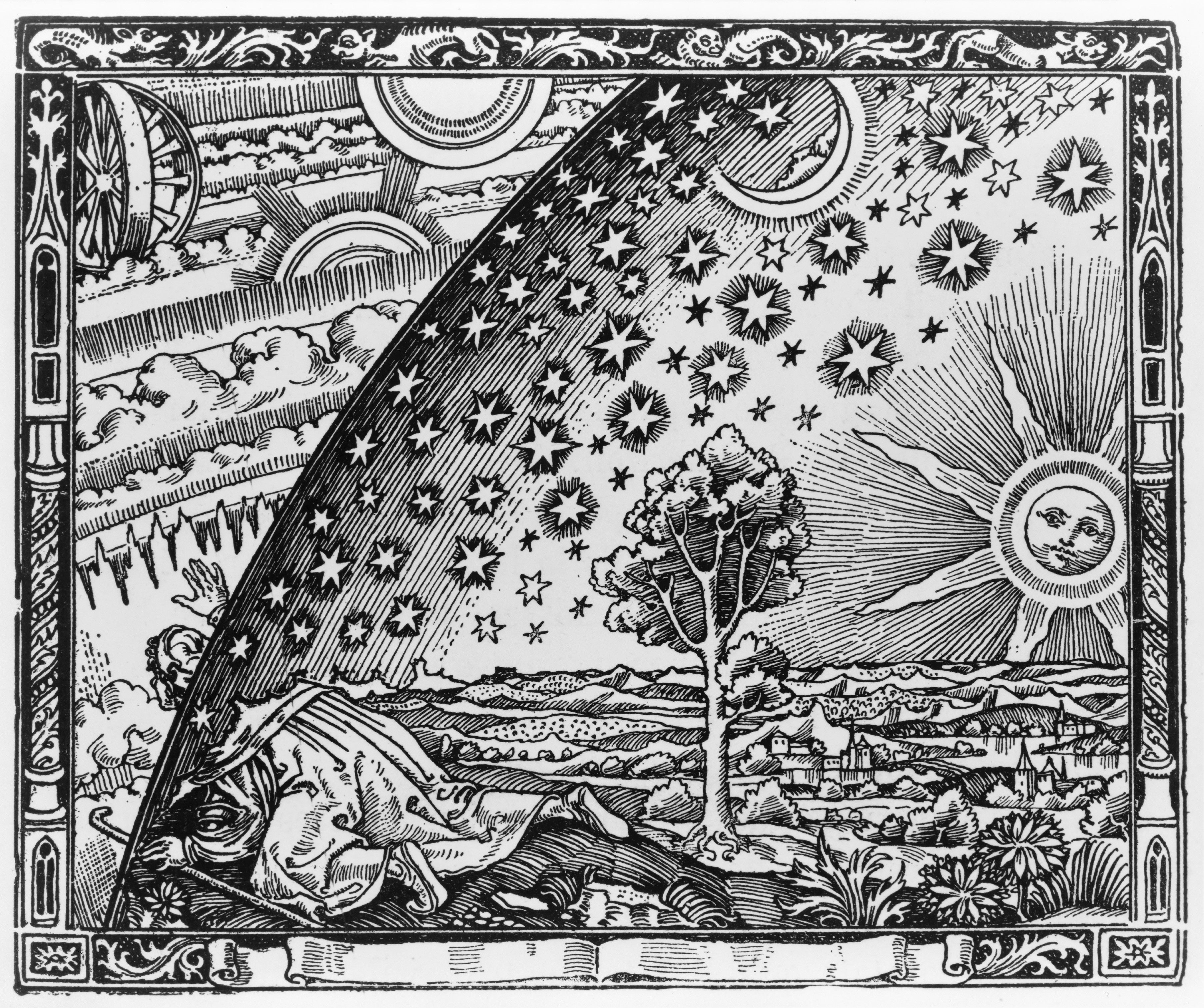
The image above was located by an advanced Google image search, which search specified that the results could be used, even modified, without violating copyright. It shows the firmament as a dome over the earth, with stars and moon fixed in the firmament. 

In biblical cosmology, the firmament is the structure above the atmosphere of Earth, conceived as a vast solid dome.[1] According to the Genesis creation narrative, God created the firmament to separate the "waters above" the earth from the "waters below" the earth.[2] The word is anglicized from the Latin firmamentum, which appears in the Vulgate, a late-4th-century Latin translation of the Bible.


Some public domain comments on "firmament," which word was used in the King James Version of the Bible:
Genesis 1:6 And God said, Let there be a firmament in the midst of the waters, and let it divide the waters from the waters.
7 And God made the firmament, and divided the waters which were under the firmament from the waters which were above the firmament: and it was so.
8 And God called the firmament Heaven. And the evening and the morning were the second day.

Other versions use "expanse," and "vault," and probably other words.

Matthew Henry's commentary says this:
The command of God concerning it: Let there be a firmament, an expansion, so the Hebrew word signifies, like a sheet spread, or a curtain drawn out. This includes all that is visible above the earth, between it and the third heavens: the air, its higher, middle, and lower, regions-the celestial globe, and all the spheres and orbs of light above: it reaches as high as the place where the stars are fixed, for that is called here the firmament of heaven (v. 14, 15), and as low as the place where the birds fly, for that also is called the firmament of heaven, v. 20. When God had made the light, he appointed the air to be the receptacle and vehicle of its beams, and to be as a medium of communication between the invisible and the visible world; for, though between heaven and earth there is an inconceivable distance, yet there is not an impassable gulf, as there is between heaven and hell. This firmament is not a wall of partition, but a way of intercourse. See Job 26:7; 37:18; Ps. 104:3; Amos 9:6.

John Calvin's commentary says this: The work of the second day is to provide an empty space around the circumference of the earth, that heaven and earth may not be mixed together. For since the proverb, 'to mingle heaven and earth,' denotes the extreme of disorder, this distinction ought to be regarded as of great importance. Moreover, the word "rakia" comprehends not only the whole region of the air, but whatever is open above us: as the word heaven is sometimes understood by the Latins. Thus the arrangement, as well of the heavens as of the lower atmosphere, is called "rakia" without discrimination between them, but sometimes the word signifies both together sometimes one part only, as will appear more plainly in our progress. I know not why the Greeks have chosen to render the word [indecipherable], which the Latins have imitated in the term, "firmamentum"; for literally it means expanse. And to this David alludes when he says that 'the heavens are stretched out by God like a curtain,' (Psalm 104:2.) If any one should inquire whether this vacuity did not previously exist, I answer, however true it may be that all parts of the earth were not overflowed by the waters; yet now, for the first time, a separation was ordained, whereas a confused admixture had previously existed. Moses describes the special use of this expanse, to divide the waters from the waters from which word arises a great difficulty. For it appears opposed to common sense, and quite incredible, that there should be waters above the heaven. Hence some resort to allegory, and philosophize concerning angels; but quite beside the purpose. For, to my mind, this is a certain principle, that nothing is here treated of but the visible form of the world. He who would learn astronomy, and other recondite arts, let him go elsewhere.

Robert Jamieson says:
6. firmament--an expanse--a beating out as a plate of metal: a name given to the atmosphere from its appearing to an observer to be the vault of heaven, supporting the weight of the watery clouds. By the creation of an atmosphere, the lighter parts of the waters which overspread the earth's surface were drawn up and suspended in the visible heavens, while the larger and heavier mass remained below. The air was thus "in the midst of the waters," that is, separated them; and this being the apparent use of it, is the only one mentioned, although the atmosphere serves other uses, as a medium of life and light.  

Interesting. The Bible was written in accord with the way contemporary people viewed the universe, and, at least in Henry's case, commented on from a related viewpoint.

Added June 17, 2022: This post shows that Answers in Genesis, the most prominent Young-Earth Creation organization, does not believe that there is, or was, a firmament.

Thanks for reading.

Friday, November 29, 2019

30 days of science-oriented Thanksgiving, 2019


Thanks to God for:
1) Light: I'm thankful for light. It's significance is emphasized, as it was the first thing mentioned as created, in the Genesis story. We depend on it so much, and take it for granted -- at least I do.

2) I'm thankful not only for light, but that light is part of the electromagnetic spectrum, meaning that light appears in a range of colors, visible in rainbows and in other ways, and also in mixtures of these colors, such as brown, which doesn't appear in the rainbow. They say that some animals have no color vision. TVs used to be black-and-white only. I'm glad that we can see colors.

3) I’m thankful that light can be reflected. Without reflection, I couldn’t see myself in the bathroom mirror. I couldn’t back my car up safely. I couldn’t see colorful trees reflected in bodies of water. Without reflection, I couldn’t see the moon, which reflects the sun’s light. Telescopes and microscopes use reflection to help us see wonders that we couldn’t’ see without reflection.

4) I’m thankful for a special use of reflected light – reading print. The white part of a printed page (or sign, or food label, or our credit card, or whatever) reflects more light than the dark part – the words. I know that much reading today is not of this sort. I’m reading this as I type because the computer screen emits light, except where the letters are. But we still depend a lot on reading print.

5) I’m thankful for refraction. Refraction means that light is bent as it goes from one medium, like air, into another, like glass or water. Without refraction, I couldn’t see. My eye lenses refract light so that it can be focused on my retina. My glasses refract light, assisting my eye lenses, so that I can see close up. Different colors of light are refracted differently, thus making rainbows possible.

6) I’m thankful for water, the only common substance that can exists in solid, liquid and gaseous form under ordinary conditions. It’s also the only common substance that has a solid that floats on its liquid. Without these properties, the oceans would be solid ice, and we wouldn’t ever get rained on.

7) I’m thankful that water is able to dissolve many other substances. The ancient alchemists were said to be searching for some wondrous things, including the “philosopher’s stone,” that would turn things into gold, and the “universal solvent,” that would dissolve anything. As someone said a long time ago, water is the nearly universal solvent. It can combine with other substances, especially acids, to dissolve even more things. Some geological features are the result of mildly acid water dissolving rocks. Consider, in us: our blood, a solution of many substances in water, carries Oxygen, Carbon Dioxide, hormones, enzymes, antibodies, red and white blood cells, food particles, Nitrogen waste, food waste, and other items, in our blood stream and body fluids, which are all mostly water.

8) I’m thankful that light is a form of energy. Much of the sun’s energy, that keeps the earth warm enough to be livable, has come to earth in the form of light. Light energy can be absorbed, and does various things, many of them important, after such absorption. One such thing is illustrated by the brick wall on the west side of our house. After a sunny afternoon, the bricks have absorbed energy, and feel warm. Light energy, turned to heat, melts snow and ice.

9) I’m thankful for Carbon. Carbon atoms can connect with as many as four other atoms. This makes complicated molecules, like protein, DNA, steroids, cellulose, and many more, possible. If, for example, Carbon could connect with only two other atoms, nothing more complicated than a long chain would be possible. We are called Carbon-based life forms for a good reason. Carbon is an abundant element, and its atoms are light, so some Carbon compounds can enter the air, and, for example, make molecules that we can smell. Coffee, anyone?

10) I’m thankful for what is arguably the most important process on earth – photosynthesis. Light energy is captured by green plants and used to turn Carbon Dioxide and water into food molecules. Food is something we eat that gives us energy (which is measured in calories). Most likely, all the food you have consumed in the past year came from photosynthesis in some green plant. Thank God!

11) I’m thankful for carbohydrates. They are made of Carbon, Hydrogen and Oxygen, and their names usually end in “ose,” as in glucose, fructose, cellulose, and more. Starches are complex carbohydrates. Some of us eat too much carbohydrate, and expand, as a consequence. But we need energy to live, and carbohydrates are a good source of food energy. Cellulose is taken in in the form of fiber, and we should eat fiber, too. Some carbohydrates such as sucrose, common table sugar, taste sweet. I like it, more than I should.

12) I’m thankful for my sense organs. Our tongue and nose can detect certain molecules, apparently because of their 3-dimensional shape. Sugar molecules have a distinctive shape. Sugar molecules fit into sweet-detecting sense structures in the tongue which detect that shape, and these structures send a message to the brain: “that was sweet!” Scientists have figured out how to make sugar substitutes, which have a shape that activates the same sensors, and cause the same message to go to the brain. Sugar substitutes are usually indigestible, or don’t turn into as many calories as sugar, hence you may gain less weight from eating or drinking them than from the equivalent food/drink with sugar in it.

The senses of taste detects various chemicals that touch the tongue. The sense of smell detects molecules that come to the nose through the air. I’m thankful for the smell of coffee, even though I don’t drink it, and for lots of other smell-producing materials. When I was in college, my nose was cauterized to stop frequent nosebleeds. As a result, I don’t have much sense of smell. Be thankful for yours!

13) I’m thankful for deoxyribose, a 5-Carbon sugar that is an essential part of DNA – in fact, DNA is named for it: Deoxyribose Nucleic Acid. As surely you know, your heredity is carried from generation to generation by DNA. It’s also carried from cell to cell in your body. The trillions of cells in your body all came from a single fertilized egg. Most of your cells have the same DNA, with some exceptions. Occasionally you may see someone with two different iris colors, or with strange patches of skin or hair. But these are rare. Your left side mostly mirrors your right. Be thankful for your heredity, and that it’s all the same throughout your body, except for occasional mutations.

In addition to deoxyribose, DNA contains Nitrogen bases and Phosphate. I’m thankful for them, too.

14) I’m thankful for cellulose. Cellulose is a complex carbohydrate, made of hundreds, or more, of glucose molecules strung together. Plants use it as structural material in their cell walls. Since it is structural, it has numerous uses. We get fiber in our diet mostly from plant cell walls in our food. Cotton and linen fibers contain cellulose, so most of us are clothed with this, some of the time. Paper, including cardboard, includes cellulose. Cellulose is the most common constituent of wood, which is used in structures and implements of many kinds, as well as being a fuel.

Without cellulose, there would be no trees, with all the joy, majesty, and utility that they bring. No forests, no leaves falling.

15) I’m thankful for Silicon, an element. It’s the second most abundant element in the earth’s crust, behind Oxygen. In the earth’s crust – the rocks, dirt, etc., that we can access fairly easily with a shovel or a drill – Silicon is almost always in combination with some other elements, like Oxygen or Aluminum. Quartz is mostly Silicon Dioxide. Quartz, mica, feldspar, and other materials make up granite, one of the most common types of rock on earth. Mica and feldspar also contain Silicon. Minerals containing Silicon make up about 90% of the earth’s crust.

16) As yesterday, I’m again thankful for Silicon. Here’s the Wikipedia: “The most widely used silicon device is the MOSFET (metal-oxide-silicon field-effect transistor), which has been manufactured in larger numbers than any other device in history.” In other words, the computer I’m typing this on, and all the devices that could read this, use Silicon-based transistors, in order to do their jobs.

17) I’m thankful for sand. Many sands are mostly Silicon Dioxide. SiO2 sand is the main constituent of glass. Can you imagine life without glass? Touchscreens on smartphones and similar devices contain glass. So do many glasses that people wear. Then there are windows, and drinking glasses, and lots of other stuff. (Some sands, for example from corals, are mostly Calcium Carbonate, but most sands are Silicon Dioxide.) The Wikipedia lists a couple of dozen or so uses for sand.

18) You are breathing it right now, even though you can’t smell it or see it. What is it? Nitrogen, which I’m very thankful for. Nitrogen gas makes up about 80% of the earth’s atmosphere. Oxygen is the second most common gas in the atmosphere. Without that Nitrogen, an increase in Oxygen would mean that fires would spread more rapidly and be more devastating and dangerous.

19) I’m thankful for Nitrogen. DNA, the heredity molecule, has a Nitrogen-containing base in each unit, which means that we probably have trillions of Nitrogen bases in our bodies. The Nitrogen bases, ACGT, make up the genetic code. Nitrogen is also part of every amino acid. Amino acids make up protein, and, of course, we need protein for structure, for making up enzymes, and for other things. Life, as we know it, would be impossible without DNA, its close relative, RNA, ATP, and amino acids. Each of these contains Nitrogen.

20) I’m thankful for Nitrogen-fixing bacteria. We need Nitrogen, which is part of many of the most important molecules in living things. But, even though most of what we breathe is Nitrogen gas, we can’t use that to make amino acids or RNA. We have to get Nitrogen in what we eat. Some bacteria in the soil, often in special structures on the roots of members of the pea family, such as peas, beans, peanuts, alfalfa, clover, and many more, can take Nitrogen from the air in the soil. The plants that they are growing with can access this Nitrogen. Members of the pea family are good sources of Nitrogen, in the form of protein. We can get Nitrogen from other kinds of food, especially food high in protein, but, in most cases, such Nitrogen was first captured by bacteria in the nodules on the roots of plants.

21) I’m thankful for Hydrogen. There are more atoms of Hydrogen than of any other element in the universe. Hydrogen is part of water, which is enough to make it very important, but there’s more. Hydrogen is part of almost all of the molecules of living things, such as carbohydrates, steroids, proteins, lipids, DNA, RNA, ATP and more. It also is part of Hydrocarbons, which we use to make plastics, and burn as fuel in our automobiles. It’s easy to ignore Hydrogen. It doesn’t seem to be the central part of any of these important types of molecule. But it’s there, in all of them. Life would not be possible without it.

22) I’m thankful, again, for Hydrogen. Almost all of the energy we use depends on it. Why? Because there are processes in the sun that take Hydrogen, and fuse it together into Helium, releasing energy in the process. (Hydrogen bombs, if ever used, would engage in similar processes.) Energy released by this nuclear fusion escapes into space, some of it in the form of light, and a small part of it hits the earth, warming it, and providing energy for the food manufacturing processes of photosynthesis.

23) I’m thankful for Oxygen. Oxygen reacts easily. We can see the results in flames, and in rust (which is oxidized iron). Because this is true, living things use it to access energy from the food they make, in photosynthesis, or the food they eat. They oxidize this food, which results in the production of Carbon Dioxide and water, and the release of energy. This oxidation is slower, and much less destructive, than ordinary burning. (Most foods can be burned, giving off energy in a different way.) When we exercise, we need Oxygen, so that we can release energy stored in our bodies. That’s why we may gasp and pant after running, for example – we need Oxygen to replenish our accessible energy.

There are some organisms (you won’t find them in zoos) that get their food, and access the energy from it, in different ways.

24) I’m thankful for Oxygen. Besides the fact that we need to breathe it, Oxygen is part of the essentially all of chemicals that living things are made of. Most living things, including us, are mostly water. Water is a combination of Hydrogen and Oxygen. Besides that, DNA, RNA, ATP, starch, sugar, fats, hormones, vitamins, proteins, and more, all have Oxygen as part of their structures.

25) I’m thankful for metabolism. The rest of this post was extracted from the Wikipedia: “Metabolism … is the set of life-sustaining chemical reactions in organisms. The three main purposes of metabolism are: the conversion of food to energy to run cellular processes; the conversion of food/fuel to building blocks for proteins, lipids, nucleic acids, and some carbohydrates; and the elimination of nitrogenous wastes. These enzyme-catalyzed reactions allow organisms to grow and reproduce, maintain their structures, and respond to their environments. (The word metabolism can also refer to the sum of all chemical reactions that occur in living organisms, including digestion and the transport of substances into and between different cells, in which case the above described set of reactions within the cells is called intermediary metabolism or intermediate metabolism).”

26) I’m thankful for enzymes. Enzymes are proteins that speed up chemical reactions, such as the ones in metabolism (see yesterday’s post). In effect, they make these chemical reactions possible. Without enzymes, they wouldn’t take place at all, or they would be so slow that they wouldn’t do us any good. Enzymes help convert food to useful energy, help convert food molecules to the more complex molecules necessary for life, such as proteins, hormones, DNA and RNA. They help eliminate nitrogenous wastes. They are necessary in the formation of new cells, as when an embryo grows, or an older person replaces dead cells, such as skin cells.

27) I’m thankful for the parts of my body that produce digestive enzymes. The salivary glands produce enzymes that digest starch, breaking it down to sugar. (Chew on a cracker for a few minutes. It will probably begin to taste sweet.) There are enzymes in the stomach that help break down food molecules. These enzymes require an acid environment, in order to work. The pancreas and the liver produce enzymes that help digest food molecules. If food wasn’t digested, it wouldn’t do us any good. We would get just as much good from eating sand as from eating turkey.

28) I’m thankful for Sulfur. It’s one of the more prevalent elements in my body, after Carbon, Hydrogen, Oxygen, Nitrogen, Calcium, and maybe Potassium. Amino acids make up proteins. Proteins can be enzymes, or part of our structure (hair is mostly protein) or perform other functions, such as fighting infection. Two of the amino acids that make up proteins, cysteine and methionine, contain Sulfur. Cysteines bonded together help to give hair, and other body parts, their structure. If hair is burnt, there’s a bad smell, which is mostly due to Sulfur.
Sulfur is a necessary part of sulfuric acid, which is used in making fertilizer, and used in some kinds of batteries. Sulfur is used as a fungicide and pesticide. Some of the most important antibiotics contain Sulfur. Sulfur is necessary for life on this planet.

29) I’m thankful for Sodium. Sodium is part of common table salt, Sodium Chloride. We need Sodium in order to live. However, too much Sodium can lead to high blood pressure, and, if it’s really too much, even to death. Salt is used as a preservative. Sodium is used to manufacture chlorophyll, which is used in photosynthesis, the basic food-making process that we all depend on. Sodium is necessary for the functioning of the nervous system. As you read this, Sodium is migrating across the membranes of your nerve cells, making perception of what you are reading, and thought about it, possible. Yellow colors in fireworks are due to Sodium.

30) I’m thankful for Phosphorus. Phosphorus is an essential part of DNA and RNA, the molecules that carry our genetic code, and help to express it. It’s also part of ATP (Adenosine Triphosphate) which is used in the processes that release energy from food. Our cell membranes contain Phosphorus. It’s no wonder that almost all fertilizers contain Phosphorus.

Many matches contain Phosphorus.

I could have been thankful for Potassium, Calcium, Chlorine, Iron, and other elements of the periodic table, but will stop here. Thanks for reading.
Wednesday, September 18, 2019

Sunspots 746


Things I have recently spotted that may be of interest to
someone else:

Christianity: Relevant on the most neglected spiritual discipline. (You should be able to figure out what that is.)


Computing: Gizmo's Freeware evaluates a browser add-in that extracts text from photos, .PDF files, and other on-line stuff.

Education: Grammarphobia discusses the use of the word "scrub." (Note: that word is used in computing, as well as in floor care.)

Environment: (or something) Listverse tells us about 10 beautiful and bizarre natural features.

Catherine Rampell attacks the Trump administration's recent roll=back of clean water regulations, and questions the supposed growth-causing effect of the general roll-back of regulations, and also points out that at least some industries don't want environmental regulations affecting them rolled back.

Earther asks, and answers the question: "when will we run out of water?"
 
Finance: (or something) Changes are coming to the Amish in Pennsylvania, says NPR.

History: Michael Gerson says that the Founders, like Jefferson should have known that slavery was wrong -- there were those that spoke out against it in their time.

Politics: Relevant reports that President Trump accidentally insulted the pastor of a church in Kentucky. The pastor responded, saying that "Your heart must be in a dangerous place to have such a consistent flow of defamation and disrespect towards so many." He also suggested that Trump exercise more self-control, and that he try to be humble and apologize more.

FiveThirtyEight charts the most recent Democratic debate.


Science: Catherine Rampell tells us about some of the ways that the Trump administration is trying to downplay the importance of measurable facts. The recent flap over a weather report is just one such episode.

The Scientist, and other outlets, report that an electric eel, packing a walloping 860 Volts, has been discovered.

Sports: High tech in baseball: FiveThirtyEight discusses how being able to measure the spin of a thrown or batted ball may be affecting home run frequency.

The graphic used in these posts is from NASA, hence, it is free to use like this.

Thanks for looking!

Wednesday, January 30, 2019

Sunspots 713

Things I have recently spotted that may be of interest to someone else:


Christianity: A Relevant writer tells us about four ways in which the modern church is not like the early church.

A Christianity Today writer reminds us that the New Testament uses "in Christ" to describe salvation.


Humor: (or something) Jalopnik reports on a 2019 Chevrolet Silverado made of Legos.


Politics: Michael Gerson on the Trumpification of the pro-life movement.

S. E. Cupp considers Alexandria Ocasio-Cortez.

Relevant reports that four women who left water in the desert for immigrants may go to jail.


The graphic used in these posts is from NASA, hence, I believe, it is public domain.
Thanks for looking!

Wednesday, August 01, 2018

Sunspots 688


Things I have recently spotted that may be of interest to someone else:


Christianity: A female Christianity Today writer, who had a homosexual relationship in the past, discusses how to deal with other women in a homosexual relationship, with compassion.


Computing: Gizmodo on what Chromebook computers can and can't do, as compared to the more expensive Apple and Windows devices.

Gizmodo also warns about letting our information appliances get too hot.

And Gizmodo reports that face recognition software from Amazon wrongly indicated that 28 member of the US Congress (out of 535) were criminals. Furthermore, errors were more likely for non-white members.

Health: Gizmodo, and other sources, say we don't apply sunscreen correctly.

National Public Radio tells us that, in most cases, tap water is just as good for us as filtered or bottled water, or better, and it's better for the environment.

Humor: The Wikipedia reported that US Senator Orrin Hatch has died. He hasn't.

Science: The BBC says that because of a recent heatwave, some amazing archaeological features have been discovered in the UK.

The BBC also reports on that after-the-rain smell. (Thanks to one of my brothers for these two links!)

Thanks for looking!

Image source (public domain)

Thursday, December 14, 2017

Christ's first miracle

John 2:His mother said to the servants, “Whatever he says to you, do it.” Now there were six water pots of stone set there after the Jews’ way of purifying, containing two or three metretes* apiece. Jesus said to them, “Fill the water pots with water.” So they filled them up to the brim. He said to them, “Now draw some out, and take it to the ruler of the feast.” So they took it. When the ruler of the feast tasted the water now become wine, and didn’t know where it came from (but the servants who had drawn the water knew), the ruler of the feast called the bridegroom 10 and said to him, “Everyone serves the good wine first, and when the guests have drunk freely, then that which is worse. You have kept the good wine until now!” 11 This beginning of his signs Jesus did in Cana of Galilee, and revealed his glory; and his disciples believed in him. 
*text note:  2 to 3 metretes is about 20 to 30 U. S. Gallons, or 75 to 115 liters.

John tells us that this was Christ's first miracle (not counting those miracles He did before He came to earth as a human.) Some other versions of the Bible use "miracle," rather than "sign." I have used the public domain World English Bible.

Christ’s first miracle wasn’t overthrowing the Romans, or bringing anyone back to life, or forgiving someone’s sins, or feeding lots of people, or healing someone. It was helping someone out of a jam, which was probably their own fault. They should have planned better, or ordered more wine in advance. This doesn't mean that Christ will always get us out of self-inflicted jams, but, sometimes, He surely does! He's our Friend, after all.

How did He do this? We don't know, of course. Perhaps he did it by adjusting the molecules of water, somehow, which isn’t surprising, when we remember that He created water in the first place.

Thanks for reading!

Wednesday, August 26, 2015

Sunspots 535

Things I have recently spotted that may be of interest to someone else:


Christianity: Relevant tells us that private communion shouldn't be a chore, and makes some suggestions to make it more interesting. They suggest communion through food, among other things.

Stephen L. Corey points out that God created, or at least allowed, people who are not exactly male or female.

Computing: Gizmo's Freeware on privacy (or not -- some leaks can be fixed) in Windows 10.

Education: National Public Radio reports on how public schools in the US are neglecting the smartest kids.

Science: National Public Radio reports on research linking our leanness, or lack thereof, to our gut bacteria.

NPR also reports on very low-frequency communication sounds made by elephants.

Wired reports that Pluto's atmosphere seems to be being renewed. Its gravity is too weak to hold it as well as the earth holds ours.

Wired also explains why water gets stale when left out overnight.

Wired also reports on an on-line database of mathematical sequences, and the man who has maintained this database for 50 years. (Examples: 1, 1, 2, 3, 5, 8, 13, 21, 34 . . ., the Fibonacci sequence, or 1, 2, 3, 5, 7, 11, 13, 17, 19, 23, 29 . . ., the prime numbers.) There are many, many more of these sequences in the database.


Image source (public domain)