License

I have written an e-book, Does the Bible Really Say That?, which is free to anyone. To download that book, in several formats, go here.
Creative Commons License
The posts in this blog are licensed under a Creative Commons Attribution-NonCommercial-ShareAlike 3.0 Unported License. You can copy and use this material, as long as you aren't making money from it. If you give me credit, thanks. If not, OK.
Showing posts with label decomposition. Show all posts

Thursday, July 30, 2015

Death, Life, and 1 Corinthians 15

Dogwood leaves and flower bud - death and life -going on hiatus 
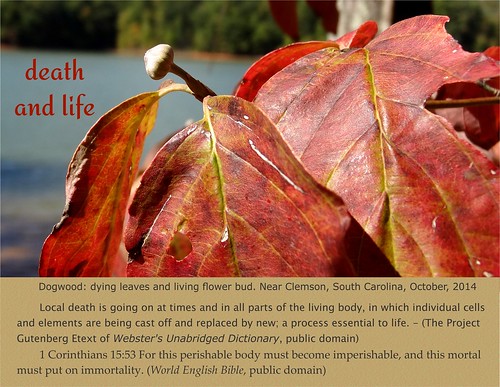
The graphic above should is an attempt to portray 1 Corinthians 15:53, which says "For this perishable body must become imperishable, and this mortal must put on immortality." The leaves were dying when the photo was taken. The flower bud was ready to wait for 5 or 6 months to wake up and open.

In preparing the graphic, I came across a most relevant statement in a public domain dictionary: "Local death is going on at all times, and in all parts of the living body, in which individual cells and elements are being cast off and replaced by new; a process essential to life." Indeed! Even biologists often don't attach enough significance to the work of decomposer organisms, such as fungi.

Paul (and other Biblical sources) teach that there will be a physical resurrection -- believers will have some sort of physical body, superior to the ones we now have. Christ already has such a body. I don't have a clue as to what that will be like, and you don't, either, although your ideas may be better than mine.

The plant was a dogwood tree, growing near Clemson, South Carolina. That's Lake Hartwell in the background.

Thanks for looking, and reading.

Monday, March 31, 2014

microrganisms and the Bible

Microorganisms, such as bacteria, yeasts and protozoa are very important. (So are viruses, but they aren't exactly alive, and won't be considered in this post.) Among other things that they do, they make Nitrogen available to other living things. (Nitrogen is an essential part of DNA, RNA, and proteins, so living things have to have it.) They help decompose dead things, so that the material they are made of can be used by other organisms, including humans. They cause diseases, including malaria, perhaps the disease that has killed more people than any other. They assist in various important processes, such as the production of ensilage (aka silage), the production of alcohol, and the manufacture of yogurt. They make it possible for bread to rise. Microorganisms living in our intestines also help us break down material, and some of them help us fight off certain diseases. The germs living in our intestines produce some vitamins for us.

In spite of their critical importance, microorganisms are not mentioned in the Bible at all. This is not surprising, since yeasts weren't discovered until 1680, and weren't believed to be living things until later, and bacteria weren't discovered until 1683. Protozoa were also discovered in the 1680's.

If there were six days of creation activity by God, on which day were the microorganisms created? The Bible doesn't say, of course, but the best guess for bacteria and yeasts is the third day, when the dry land, and land plants, appeared. (Genesis 1 doesn't mention plants living under water at all, and, if there were six days of creation, we don't know when they appeared, either.) As for protozoa, perhaps they were created on the fifth day, with water animals and birds.

Note -- Genesis 1 does not mention flying insects. Perhaps they were lumped in with the birds.

Were bacteria, and other microorganisms, important before the Fall? Again, we don't know. It is possible that decomposition took place before the Fall, and it is possible that bacteria helped the first humans digest their food. But maybe, before the Fall, decomposition didn't take place, and/or humans were able to digest their food without assistance. My guess is that defecation did take place before the Fall, and that decomposition bacteria would have been important then, but that's just a guess. Some scholars believe that animal death occurred before the Fall. (See here.)

I have posted on a related topic, mentioning most of the ideas above, a few years ago, here.

Thanks for reading.