License

I have written an e-book, Does the Bible Really Say That?, which is free to anyone. To download that book, in several formats, go here.
Creative Commons License
The posts in this blog are licensed under a Creative Commons Attribution-NonCommercial-ShareAlike 3.0 Unported License. You can copy and use this material, as long as you aren't making money from it. If you give me credit, thanks. If not, OK.
Showing posts with label Bible. Show all posts

Sunday, January 18, 2026

What did New Testament Christians pray for?

 I've been blogging for quite a while, perhaps too long.

This link leads to my most important post, which considers prayer in the New Testament church. It's a little long, but most of it is quoted scripture. To summarize, "each other" is the answer to the question of the title of this post.

Forgive me, Lord, for not being a better example of this kind of prayer. Thanks for reading!

Monday, January 24, 2022

Answers in Genesis's 7 C's of History, revisited

The graphic above is from Answers in Genesis (AiG) on-line materials. It represents a 4th C, confusion. I believe getting permission for its use is not needed, as I am using a little bit of their post in criticism of AiG.

In a previous post, I commented on the 7 C's of History, a structure by AiG, used to organize human history. The post notes that nearly half of the Bible is not covered by any of these 7 supposedly main points -- Abraham, Moses, nearly all prophecy, the Psalms, and more of the Bible, in Genesis 12 through Malachi are not mentioned.

It is also true that their 4th point, "Confusion," the story of the Tower of Babel, occurs in only one chapter of the Bible, Genesis 11. So far as I can discover, that story is not referred to at all, anywhere else in scripture.

This is remarkable. A supposedly Bible-based organization leaves out large parts of the Bible, including some pretty important ones, and puts in one story that is not referred to in the New Testament at all, and is found in only one chapter of the Old Testament. Bible-based? Sort of.

Thanks for reading.

Wednesday, December 15, 2021

Sunspots 862

Things I have recently spotted that may be of interest to others*:


Christianity: Christianity Today reports on a survey that indicates that most Americans don't believe that Christ existed before His birth.

Relevant on why many Christians do not follow the Biblical mandate to care for the poor.

Environment: Gizmodo summarizes the ways in which oil companies have controlled our thinking and actions.

NPR reports that temperature records have recently been broken, all over the earth.

Finances: Gizmodo describes a study that indicates that Lego sets are a better investment than gold or stocks.

Health: Gizmodo reports that a court decision has caused county health departments in Missouri to stop all work, and all restrictions, related to COVID.

Politics: FiveThirtyEight analyzes Donald Trump's endorsements. He's endorsing more people earlier, and, in some cases, endorsed Republican challengers to a Republican incumbent.

Science: Astronomers have discovered a very large planet in a nearby solar system, according to Gizmodo.

The graphic used in these posts is from NASA, hence, it is free to use like this.

*I try not to include items that require a password or fee to view.

Thanks for reading.


Wednesday, June 09, 2021

Sunspots 836

Things I have recently spotted that may be of interest to others:


Christianity: Relevant discusses the five most commonly used (and misused) Bible verses.

Computing: Relevant also discusses the harmful effects of pornography on females.

Gizmodo discusses the too-useful iPhone. They more one relies on it, for example to pay for purchases, or to start a car, the worse it is to lose it or have it malfunction.

Health: NPR reports that a new kind of COVID vaccine may be ready for use soon.

The FDA has approved a new drug that is supposed to help Alzheimer's patients. But maybe it really doesn't, and it costs a lot. See also here for Gizmodo's take on this situation.

Politics: NPR reports on how the 2nd Amendment to the US constitution hasn't been friendly to blacks.

Science: Gizmodo reports that scientists have been successful in teaching blind people to echolocate (bats use echos to find things).

The graphic used in these posts is from NASA, hence, it is free to use like this.

Thanks for looking!

Wednesday, January 20, 2021

Sunspots 816

Things I have recently spotted that may be of interest to someone else:


Christianity: Russell Moore, a Southern Baptist official, on the insurrection at the Capitol last week.

He Lives says that Uzzah, Ananias and Sapphira were not punished. An interesting idea.

Christianity Today on the bible used in incoming President Biden's inauguration.

Computing: (And politics) Gizmodo reports on "industrialized information," in other words, pumping out what's usually false or misleading stuff  as a business, or using such entities. It's growing. One of the worst offenders: Michael Bloomberg's unsuccessful run for President.

Environment: The Trump administration has enacted a rule that makes it easier for fossil fuel companies to pollute, according to Gizmodo.

And they have rolled back regulations that expected more efficiency in water heaters and gas furnaces.

And they have given a green light to a company that wants to mine on land considered sacred by the Apaches.

On the good news side, Gizmodo reports that a wolverine was photographed in Yellowstone National Park, and wolverines have also been seen at Mount Rainier National Park, for the first time in 100 years.

Ethics: Christianity Today considers three ethical questions related to COVID vaccines, and concludes that these should be taken.

Politics: Politico has a thorough article on 30 things that the Trump administration accomplished. My view is that some of them were for the good, some not. Yours probably would be the same, although perhaps we might differ on specifics.

Science: LiveScience on why it's so hard to swat a fly.

Gizmodo reports on the discovery of electric eels hunting in groups, something like wolves.

The graphic used in these posts is from NASA, hence, it is free to use like this.

Thanks for looking!

Wednesday, June 03, 2020

Sunspots 783

Things I have recently spotted that may be of interest to someone else:


Christianity: Christianity Today was not pleased by President Trump's photo-op with a Bible in front of a church in the Washington D. C. area.

Computing: Gizmodo describes a system that allows you to send large files without signing in being required by the sender or recipient.

Gizmo's Freeware has published an extensive guide to keyboard shortcuts for Windows 10 and various apps.


Environment: Gizmodo reports on a study, which shows that the size of the earth's forests is declining, and, also, the size, and age, of trees in those forests are also getting less. These changes have serious environmental effects.

Gizmodo reports on a study that indicates that 500 species of land vertebrates are close to extinction.


Health: FiveThirtyEight considers why COVID-19, a respiratory disease, affects hearts and brains.


Politics: FiveThirtyEight discusses President Trump's complaints about voting by mail.

Gizmodo reports that a lawsuit, claiming that major social media companies have conspired to suppress conservative views, was dismissed by a court. (President Trump was not part of this legal dispute.)

Twitter has reacted to a tweet by President Trump (and an identical one from the White House) saying that, if there is looting, the National Guard, or other military or police, should shoot them.

FiveThirtyEight reports that killings by police, in our largest cities, have become somewhat less common, although the total number of killings by police has not gone down recently.

FiveThirtyEight also reports that escalation of force by police, in protest situations, causes the situation to get worse.

Science: Gizmodo discusses cicadas (a large brood has recently emerged from 17 years underground.)


Science reports on how carnivorous plants probably evolved their meat-eating tendencies.


Sports: FiveThirtyEight says that Cynthia Cooper, now known as Cynthia Cooper-Dyke, is the best women's pro basketball player of all time. I recall watching her play on TV, and have no disagreement with that assessment. See here for more.


The graphic used in these posts is from NASA, hence, it is free to use like this.


Thanks for looking!

Wednesday, February 26, 2020

Sunspots 769


Things I have recently spotted that may be of interest to
someone else:

Christianity: Christianity Today discusses polyamory among professing Christians.


Christianity Today also has a good article on why the Old Testament continues to be important.

CT has also posted information on 20 African-American heroes and heroines of faith.

Computing: (and Politics) Gizmodo reports that Twitter has taken action against some pro-Bloomberg accounts, for publishing pro-Bloomberg spam.
  Humor: (and Computing) A Gizmodo writer has found women's pants with pockets large enough to hold a smartphone.


Politics: (And Christianity) Russell Moore, head of the Southern Baptist Ethics and Religious Liberty Commission, has been an outspoken critic of President Trump. Authorities in the church are apparently going to study the question of whether Moore's positions have hurt the denomination financially, according to Relevant. In a later post, Relevant reports that the ERLC board has instructed Moore not to comply with such an inquiry, at least not at present.

Joel Edmund Anderson asks us to not be hyper-partisan, in any direction.

Science: The Scientist reports on recent discoveries in human anatomy. You would think that we already knew all there is to know about our structure. Not so. For example, there's a bone that I don't think you have heard of.

The Scientist also reports on the use of artificial intelligence to discover new antibiotics.

NPR reports on the terrible locust plague in Africa.

NPR, and other outlets, report that Katherine Johnson, one of the African-American mathematicians who worked on the manned space program, has died. (The movie, Hidden Figures, was based on the critical work of these women.)

Sports: Sabrina Ionescu, who plays basketball for Oregon, had quite a day on February 24th. She was one of the speakers at the memorial service for Kobe Bryant, and also became the only college basketball player, male or female, to score 2000+ career points, give out 1000+ assists, and collect 1000+ rebounds. She got the qualifying rebound on the 24th, against Stanford.

The graphic used in these posts is from NASA, hence, it is free to use like this.

Thanks for looking!

Tuesday, February 11, 2020

Ken Ham/Answers in Genesis ignores much of the Bible: revising Ham's 7 C's

Answers in Genesis has posted a way of looking at history, by Ken Ham and Stacia McKeever. They hang human history on 7 C's, as follows:
Creation
Corruption
Catastrophe
Confusion
Christ
Cross
Consummation

In their discussion, each of these C's has scripture describing that particular event, or stage.

Others have noted -- I can't remember who -- that since Confusion is about the story of the Tower of Babel, which is in Genesis 11, and the next stage is Christ, their scheme leaves out almost the entirety of the Old Testament.

No Abraham, no plagues of Egypt, no Moses, no Exodus, no Mount Sinai, no Ten Commandments, no Tabernacle, no system of celebration and sacrifices, no prophets, no wisdom literature, no Psalms, no David, no Solomon, no Temple, and much more -- you get the idea. More than half the Bible left out!

Bible scholars are by no means unanimous on the dates and geographic extent of events in Genesis, but by the reckoning of Answers in Genesis, the Tower of Babel (Confusion) was in 2242 BC. (Or 2246 BC.) Thus, about 2240 years of the history of life on earth are ignored in the 7 C scheme. Answers in Genesis says that creation took place in 4004 BC. So their scheme leaves out about 37% of what they believe to have been earth's history, and more than half of the times, and most of the events, covered by the Bible. Amazing, for a Bible-based organization.

I propose, for those who want a C scheme, an 8th C -- Covenant, between Confusion and Christ, and that the scripture associated with this be taken from Genesis 12 through Malachi. Captivity would also fit in.

There is, no doubt, some value in the 7 C's scheme, even if one doesn't agree with the dates put forth by Answers in Genesis, or their ideas on the geographic extent of the Flood. But there's a lot of God's revelation left out.

On January 25, 2022, I added this:
Not only does the 7 C's scheme leave out some important scriptures and people, but it includes a minor story, that of the tower of Babel. That story occurs in only one chapter of Genesis, and, so far as I can determine, is not referred to anywhere else in the Bible.

Thanks for reading! (The title was revised on May 31, 2022)

Tuesday, January 07, 2020

The Firmament of Genesis 1:7

 
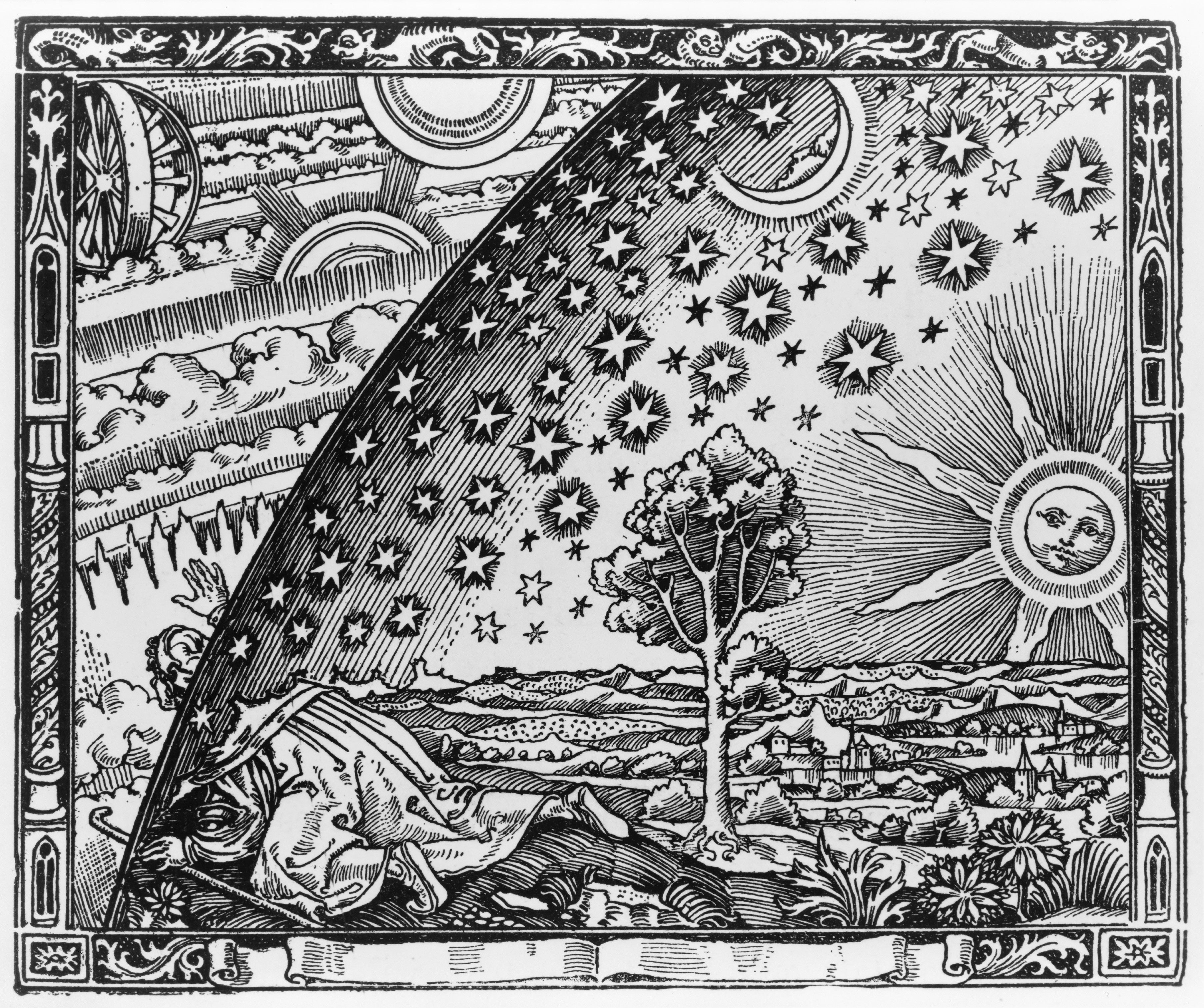
The image above was located by an advanced Google image search, which search specified that the results could be used, even modified, without violating copyright. It shows the firmament as a dome over the earth, with stars and moon fixed in the firmament. 

In biblical cosmology, the firmament is the structure above the atmosphere of Earth, conceived as a vast solid dome.[1] According to the Genesis creation narrative, God created the firmament to separate the "waters above" the earth from the "waters below" the earth.[2] The word is anglicized from the Latin firmamentum, which appears in the Vulgate, a late-4th-century Latin translation of the Bible.


Some public domain comments on "firmament," which word was used in the King James Version of the Bible:
Genesis 1:6 And God said, Let there be a firmament in the midst of the waters, and let it divide the waters from the waters.
7 And God made the firmament, and divided the waters which were under the firmament from the waters which were above the firmament: and it was so.
8 And God called the firmament Heaven. And the evening and the morning were the second day.

Other versions use "expanse," and "vault," and probably other words.

Matthew Henry's commentary says this:
The command of God concerning it: Let there be a firmament, an expansion, so the Hebrew word signifies, like a sheet spread, or a curtain drawn out. This includes all that is visible above the earth, between it and the third heavens: the air, its higher, middle, and lower, regions-the celestial globe, and all the spheres and orbs of light above: it reaches as high as the place where the stars are fixed, for that is called here the firmament of heaven (v. 14, 15), and as low as the place where the birds fly, for that also is called the firmament of heaven, v. 20. When God had made the light, he appointed the air to be the receptacle and vehicle of its beams, and to be as a medium of communication between the invisible and the visible world; for, though between heaven and earth there is an inconceivable distance, yet there is not an impassable gulf, as there is between heaven and hell. This firmament is not a wall of partition, but a way of intercourse. See Job 26:7; 37:18; Ps. 104:3; Amos 9:6.

John Calvin's commentary says this: The work of the second day is to provide an empty space around the circumference of the earth, that heaven and earth may not be mixed together. For since the proverb, 'to mingle heaven and earth,' denotes the extreme of disorder, this distinction ought to be regarded as of great importance. Moreover, the word "rakia" comprehends not only the whole region of the air, but whatever is open above us: as the word heaven is sometimes understood by the Latins. Thus the arrangement, as well of the heavens as of the lower atmosphere, is called "rakia" without discrimination between them, but sometimes the word signifies both together sometimes one part only, as will appear more plainly in our progress. I know not why the Greeks have chosen to render the word [indecipherable], which the Latins have imitated in the term, "firmamentum"; for literally it means expanse. And to this David alludes when he says that 'the heavens are stretched out by God like a curtain,' (Psalm 104:2.) If any one should inquire whether this vacuity did not previously exist, I answer, however true it may be that all parts of the earth were not overflowed by the waters; yet now, for the first time, a separation was ordained, whereas a confused admixture had previously existed. Moses describes the special use of this expanse, to divide the waters from the waters from which word arises a great difficulty. For it appears opposed to common sense, and quite incredible, that there should be waters above the heaven. Hence some resort to allegory, and philosophize concerning angels; but quite beside the purpose. For, to my mind, this is a certain principle, that nothing is here treated of but the visible form of the world. He who would learn astronomy, and other recondite arts, let him go elsewhere.

Robert Jamieson says:
6. firmament--an expanse--a beating out as a plate of metal: a name given to the atmosphere from its appearing to an observer to be the vault of heaven, supporting the weight of the watery clouds. By the creation of an atmosphere, the lighter parts of the waters which overspread the earth's surface were drawn up and suspended in the visible heavens, while the larger and heavier mass remained below. The air was thus "in the midst of the waters," that is, separated them; and this being the apparent use of it, is the only one mentioned, although the atmosphere serves other uses, as a medium of life and light.  

Interesting. The Bible was written in accord with the way contemporary people viewed the universe, and, at least in Henry's case, commented on from a related viewpoint.

Added June 17, 2022: This post shows that Answers in Genesis, the most prominent Young-Earth Creation organization, does not believe that there is, or was, a firmament.

Thanks for reading.
Friday, December 27, 2019

Environmental Stewardship in the Bible, re-post

Two Days late for Earth Day - Environmental stewardship

We have God-given responsibilities to non-human organisms
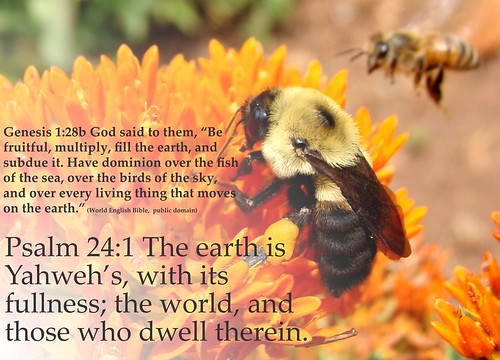
Genesis 1:26-28 seems to indicate clearly that humans were placed in charge of the non-human world. Psalm 8:6 reiterates that idea. Psalm 24:1 indicates that even though we are, in some sense, in charge, the world, and the things in it, are God’s. So does Psalm 50:10,11.* The story of Noah seems to indicate that, at one point, humans were directly responsible for the lives of many kinds of animals. Genesis 7:2-5, 14-16, Proverbs 12:10 and Proverbs 27:23 all have to do with caring for animals.

God seems to care not just for animals in general, but for kinds of animals. Psalms 104:24-25 praises God for the diversity of His creation, and His creatures. Since this explicitly includes the wide variety of ocean animals, it doesn’t seem possible that this praise is meant to be only because of their usefulness to humans. Genesis 7:3, 14-16 indicate God’s concern that the different kinds of animals would be preserved. Genesis 8:1 says that God had not forgotten Noah or the animals. Noah and his family were God’s agents in this care, of course, but they were God-directed agents. It would seem reasonable to argue that in our day, we also have responsibilities to the kinds of animals that exist in our time.

Does God care for individual non-human organisms? Perhaps. The question seems to be addressed in Matthew 10:29, which says that even individual sparrows do not fall without God’s knowledge. (Two verses later, Christ stated that the twelve were of more value than many sparrows. However, He didn’t say that sparrows were valueless.)

Does God’s care, and the care that humans are supposed to have, mean that we must refrain from killing animals deliberately? Apparently not. Jesus certainly condoned fishing (John 21:6Matthew 17:27Luke 5:4). He ate (Luke 24:36-43), and probably fished (John 21:9) even after His resurrection. Peter's vision, after the resurrection, and after Pentecost, used eating meat as a sign that God does not show favoritism (Acts 11:1-18). Paul referred disparagingly to people who forbid eating meat (I Timothy 4:1-3). There are no explicit commands forbidding the consumption of all meat in the Bible. This is not to say that the Bible condones killing of animals wantonly. That would be contradictory to benign dominion. Nor does the Bible condone consumption of animal flesh (or any other kind of food) selfishly, or to excess. But we are allowed to kill non-human organisms for cause, at least. Such causes include killing an animal because it threatens a human (Exodus 21:29), killing for meat (Genesis 9:2-3Leviticus 11:1-22) and killing an animal for its skin (Genesis 3:21). Exodus 12:21-23 and 12:46, and Mark 14:12, indicate clearly that the Passover, one of the most important ceremonies of the Jews, and the last ceremony Jesus performed with His disciples, involved eating meat. The Bible is very clear that humans and animals are not equals. Christ came in human form, principally to redeem humans, although the effects of redemption will be felt through all of creation. We have dominion over animals, not the reverse. That dominion implies responsible use, including research and killing for good cause. (Nothing in this paragraph rules out the practice of vegetarianism. Some Christians may decide, or God may reveal to them, that they shouldn't eat meat. But they cannot prove that Scripture demands that Christians don't eat meat.)

Does God’s care extend to plants? To non-living entities? (The Bible, like present-day people, is more concerned with some kinds of animals than others. There is little, if any, mention of mollusks in scripture, for instance.) The Bible mentions God’s care of plants (Psalm 104:16Matthew 6:30). It also states that everything He created was initially good (Genesis 1:31) and that creation as a whole, not just humans, groans, waiting for restoration (Romans 8:22). It is true that the Bible does not dwell on plants nearly as much as on animals. The creation of plants gets only one phrase in the Genesis account, whereas the creation of animals gets several. There is no mention of God’s concern for plants during the flood, nor are certain kinds of plants declared unclean in the Mosaic dietary laws. All this means that the Hebrews, like ourselves, were more interested in animals than in plants. Perhaps it means that God is also more interested.
From the above, we conclude that God’s care extends beyond humans, certainly to animals. Scripture is less explicit about God’s care for plants, and even less so about His care for rocks, streams, and clouds. However, there seems no reason to expect God to condone wanton destruction of any kind. If God cares for non-human creations, and we are responsible for His creation, then it behooves us to care for non-human creations as well. Proverbs 12:10 says that good people care for their domestic animals, and bad people are cruel to theirs. Caring for animals is usually consistent with caring for plants, or for rocks, streams and clouds. II Chronicles 36:21 tells us that the 70 years that the Israelites were to spend in captivity was not an arbitrary figure. God chose that because his people did not care for the land as he instructed them to. Jeremiah 2:7 and Habakkuk 2:17 condemn the Israelites because they hadn’t taken care of their land.

New Testament teaching on care of the environment
Most of the usual teaching on what the Bible says about care of the environment is from the Old Testament. However, there are two passages from the New Testament that also argue that we should be caring carefully for the environment. They are indirect, but their urgency is important. 
Romans 1:20 tells us that observing and learning about nature are part of God’s revelation to humans. (So does Psalm 19:1-4). If that is so, isn’t that another reason to try to preserve nature as well as we can? The Bible is one of the ways that God reveals Himself to us. For a long time, Christians have believed that the Bible should be translated into the language people are most familiar with, so that that revelation may be as clear as possible. Similarly, it would seem that God's revelation through nature should be as clear as possible. A person is more likely to see God in a pristine stream than in a polluted river. Probably seeing bison herds roam freely in Western North America gave people a glimpse of one aspect of God’s power and majesty that they can’t really get now. Therefore, helping to preserve nature in as good a condition as we can is one way to bring people to a saving knowledge of Christ. Not the most direct way, and probably not the most effective, for many people, but it is still a way to do this.
 
Colossians 1:15-20 says, of Christ, that “in Him all things hold together.” (ESV -- other versions have similar language.) That passage also says that He is working to reconcile all things to Himself, and working to make peace through the blood of the cross. As Christians, we believe that it is our duty to be His instruments in reconciling sinners to Christ, and to help Him in the ministry of making peace. In fact, 2 Corinthians 5:18-19, tell us that:  18 But all things are of God, who reconciled us to himself through Jesus Christ, and gave to us the ministry of reconciliation; 19 namely, that God was in Christ reconciling the world to himself, not reckoning to them their trespasses, and having committed to us the word of reconciliation. 
Doesn’t it follow that we should also participate in Christ’s work of sustaining “all things,” including endangered species and ecosystems or biological communities? (I realize that there are other places in the New Testament where reconciliation and peacemaking are mentioned, or implied, and this is probably the only one that mentions Christ's sustaining work. But that doesn't mean that His sustaining work can be dismissed, or that we have no responsibility to be His instruments in doing it.)

What must we do when our responsibilities seem to conflict?
One response is to ask, do they ever really conflict? We believe that our responsibilities do, in fact, appear to conflict, in these matters, and in others. As fallen, finite beings, we do not always interpret God’s directions correctly. We certainly do not know enough to always judge correctly. If we did possess the ability to decide correctly in all cases, perhaps God’s demands on us would never even seem to conflict. However, we can’t, and they do seem to conflict. Perhaps, this being a fallen world, they actually conflict.
The Bible does not present a formal hierarchy of principles to guide our behavior, in matters of environmental ethics, or in other matters. It does not tell us how to choose when, for instance, a decision we make will lead to either 5 minutes of misery for each of 2000 people, or 3 days of misery for a single individual. It does not tell us what to do when bringing a field under cultivation will help to feed hungry people, but also will kill native plants, deprive animals of homes, and use petroleum resources. As fallen beings in a fallen world, it is probably too much to expect that all our decisions will be correct.

Here are some attempts at principles which may be of help in making decisions about environmental matters:
This world is temporary. Temporal concerns of any kind should be carefully weighed against eternal values. The fossil record indicates that more species have become extinct than are now alive, and usually not because humans caused the extinction. This doesn’t excuse us from trying to save the organisms that live in our time, of course.

We should recognize that environmental concerns are sometimes overstated, not prioritized, or controversial. Some would have us believe that humans are choking to death and swimming in carcinogens. This is overstatement. The atmosphere may not be as clear as it ought to be, and we may indeed be exposed to cancer-causing substances, but people in North America are living longer than ever before. It seems certain that we can’t cure every ill, environmental or otherwise. Is it more important to try to stop global warming, to save the California condor, or to cut down on our consumption of fossil fuels? Is the cost, or risk, from pollution to landfills from disposable diapers more or less than the pollution to water from washing non-disposable ones? No one seems to know the answers. Solutions are not prioritized. We must be careful not to act precipitously just because someone has a concern.

Selfishness is wrong. Most North Americans seem to subconsciously believe that we are somehow entitled to more possessions than people in other parts of the world. Such a life style contributes to environmental degradation. It may also deprive people in other parts of the world, or future generations, of resources. It may mean that our church, and other charitable causes, do not have funds that we could well afford to give. We may not personally be able to change the way the world works very much. We can change it a little, and we should. We can avoid conspicuous consumption, we can avoid wanting things simply because they are newer than the things we already have. We can participate in recycling, even if it requires some effort on our part. We can think carefully about every purchase we make.
Isaiah 5:8-10 is a warning to the Hebrews. It tells them that God doesn’t condone selfishness in material things, including use of land. It predicts that the land will stop yielding enough, as God’s punishment for selfishness.

Knowledge is necessary. We are in God’s image. Part of the reflection of the omniscient God in us is the desire for knowledge. The Bible speaks approvingly of Solomon’s knowledge of the natural world (I Kings 4:32-33). We should learn to appreciate the world as God made it, and this requires knowledge of it. Knowledge is also necessary for wise alleviation of our own mistakes.

Unselfish love is a scriptural requirement. This unselfish love ought to color our relationships with others in every area, certainly including our environmental activities. It is not clear that we can, or ought, to have a relationship of unselfish love with non-human organisms, but it would seem consistent with God’s expectation of us that we act unselfishly toward non-human organisms.
We need guidance from God. All our important decisions need His help. Even with this guidance, we don’t always agree. God may well want some of us to be deeply involved in helping crisis pregnancies, but others to try to help clean up the environment. This doesn’t mean that both groups can’t assist in both efforts, but God may give our lives different emphases.

Having stated these principles, we realize anew that it is difficult to apply them to cases. In many cases, all we can say is “God help us.”

The Bible does not rule out the use of current technology, and the development of new technology
Since the development and use of technology has often been related to use of valuable resources, or contributed to greater “efficiency” in despoiling the landscape, we certainly need to be careful in developing and using technology, for our own sake, as well as that of the landscape. Is technology anti-God? The answer to that question seems to be “it depends.”
There are three biblical passages that indicate reasons why particular technological development may be wrong.
First, worshiping the results of our technology is clearly wrong, as well as just plain stupid (Isaiah 44:9-20).

Second, pride in our accomplishments is wrong (Daniel 4:30-32).

Third, supposing that there are no limits to human ability is wrong (Genesis 11:5-9).

On the other hand, there are biblical reasons for supposing that technological development is not always wrong, and, in fact, can sometimes glorify God. Noah’s ark, the tabernacle, and the temple, were technological constructs, and God gave instructions for the building of each of them. In fact, in the building of the temple, and other projects completed during the reign of Solomon, there was apparently extensive use of resources. Solomon sent 10,000 workers to Lebanon to cut down cedar trees each month (I Kings 5:14), in addition to the servants of King Hiram who helped them. They may have worked there for as long as seven (I Kings 6:38) or even twenty years (II Chronicles 8:1). All this was at least allowed by God, and some of it was directed by Him. Jeremiah 22:6 contains an amazing statement. This verse says that God finds the royal palace at Jerusalem as beautiful as the mountains of Lebanon. It would seem that technological development, by and of itself, is not wrong, although it may be done for wrong reasons, or with the wrong attitude.
Part of the image of God in humans is the desire to create things. The fact that we can create and use technology has certainly lead to some unfortunate consequences, such as deaths and injuries in highway accidents. However, it may also lead to some fortunate consequences, such as our being able to alleviate some of the consequences of our own mistakes of the past, or even some of the consequences of the fall.


+  +  +  +  +

April 23, 2011:

On an earlier date, links to all the scripture referenced in this post, using the English Standard Version, were added. (See here for the ESV policy on copyright.) The section on New Testament teaching on care of the environment was inserted on this date. It had been part of a previous post. That post is still on-line. I have not removed any of the comments from the previous version of this post.

Thanks for reading!

*Added October 15, 2014: More scripture on God's ownership, and our stewardship: Jeremiah 27:5 ‘I have made the earth, the men, and the animals that are on the surface of the earth by my great power and by my outstretched arm. I give it to whom it seems right to me. 6 Now I have given all these lands into the hand of Nebuchadnezzar the king of Babylon, my servant. I have also given the animals of the field to him to serve him. (World English Bible, public domain) 

Added April 20, 2017: E. Stephen Burnett has written a fine blog post on how care of the current earth relates to the New Earth.

Added December 27, 2019: Nancy Sleeth, in Relevantdemolishes some objections some Christians raise (such as "It's all going to be destroyed in the end, so why care for earth?")

This post originally appeared on April 22, 2006. I have re-posted it, after reading Sleeth's article. To see comments prior to December 2019, use the link in the previous sentence. Thanks for reading.

Wednesday, November 27, 2019

Sunspots 756

Things I have recently spotted that may be of interest to someone else:

The Arts: The Scientist has posted photos of art made by placing microorganisms on a culture dish

Christianity: (and politics) Christianity Today reports on the favorite verses of the Democratic candidates for President.

Christianity Today also reviews a book on Christianity being compatible with socialism.

Relevant reports on an interview with Pete Buttigieg, about the Bible.

Relevant also has a tribute to Fred Rogers, of Mr. Rogers' Neighborhood.
Computing: (And politics) Rolling Stone has an article about how Russians really operate in the social media universe. (It's probably not the way you think.)

Politics: Five Thirty Eight analyzes the reaction to the November 20th debate between Democratic candidates for President.

(or something) A Utah woman has been charged with a crime because she took her shirt off in her own home, according to NPR.

Science: Gizmodo tells us how bees escape when they fall into water.

Mosquitoes are being infected with bacteria, then released, as a way to combat some mosquito-borne virus diseases, according to NPR.

Gizmodo reports on research on brain function in persons who have had half of their brains removed. Function was remarkably good.


The graphic used in these posts is from NASA, hence, it is free to use like this.
 
Thanks for looking!

Wednesday, August 21, 2019

Sunspots 742


Things I have recently spotted that may be of interest to someone else:


Christianity: Christianity Today reports that Bibles which are mostly printed in China and exported to the US, will not be subject to tariffs.
Relevant points out four Bible verses that are too often used out of context.
He Lives on why it makes no sense to bear arms in church to protect against gun violence there.


Computing: National Public Radio reports that lots of people, especially teens, are addicted to the Internet in South Korea, and what the government is doiong about it.

Education: Listverse explains why 10 common objects have the shape that they do. (Why airplane windows are rounded, for example.)

Environment: (and Christianity) Christianity Today considers the matter of whether Christian businesspeople should be concerned about the environment.


Food: NPR discusses the pros and cons of grass-fed versus feed lot fed beef.

NPR reports that our banana supply is at risk.

Politics: Michael Gerson doesn't like many of the words used in the President's discourse, but thinks objecting to his language, but ignoring his attacks on human dignity, is hypocritical and short-sighted.

NPR discusses the remarkable power of the Senate majority leader, Mitch McConnell.

Internet watchdog Snopes has discussed a study on how people believe in the truth of satire.

Science: Gizmodo reports that a young woman had a "twin" growing inside her body.

The graphic used in these posts is from NASA, hence, it is free to use like this.
Thanks for looking!

Tuesday, August 06, 2019

The 12 most important Bible passages


Here's a list of the 12 most important Bible passages. You can probably suggest others!

Matthew 5-7: The Sermon on the Mount
Beatitudes, 5:2-12 (“blessed are . . .)
The importance of unselfish love, and of proper motives, 5:21-48 (Not just doing something wrong, but our desire to do it is sinful.)
On prayer and fasting, 6:4-18 (Includes the Lord’s prayer)
Golden Rule, 7:12 (“do unto others . . .”)
We will be known by our fruit, 7:15-29
Matthew 22:36-40: The two greatest commandments.
Matt 28:18-20, Acts 1:7-8: Christ says that the gospel must be spread. (I cheated -- this is two passages.)
John 1: Christ is God, and He was the chief instrument in creation (“In the beginning was the Word . . .”)
John 3: Jesus and Nicodemus (“For God so loved the world …”)
John 13:34-14:41: Love one another, the Holy Spirit promised. Includes “I am the way . . .”, “I will send the Comforter,” and “whatever you ask in my name.”
John 17: Christ’s prayer for believers
Acts 2: Pentecost – the coming of the Holy Spirit
1 Corinthians 13: True, unselfish, Christ-like love (“the greatest of these is love”)
1 Corinthians 15: The importance of the resurrection
Galatians 5:19-26: The fruits of the Spirit contrasted with the fruits of the flesh
Philippians 2: Christ, humble servant
Hebrews 11: Faith (Now faith is …”)

Thanks for reading. Know these passages.