License

I have written an e-book, Does the Bible Really Say That?, which is free to anyone. To download that book, in several formats, go here.
Creative Commons License
The posts in this blog are licensed under a Creative Commons Attribution-NonCommercial-ShareAlike 3.0 Unported License. You can copy and use this material, as long as you aren't making money from it. If you give me credit, thanks. If not, OK.
Showing posts with label 1 Corinthians 15. Show all posts

Thursday, July 30, 2015

Death, Life, and 1 Corinthians 15

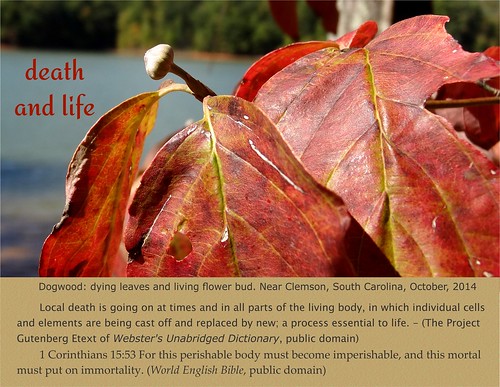
Dogwood leaves and flower bud - death and life -going on hiatus 
The graphic above should is an attempt to portray 1 Corinthians 15:53, which says "For this perishable body must become imperishable, and this mortal must put on immortality." The leaves were dying when the photo was taken. The flower bud was ready to wait for 5 or 6 months to wake up and open.

In preparing the graphic, I came across a most relevant statement in a public domain dictionary: "Local death is going on at all times, and in all parts of the living body, in which individual cells and elements are being cast off and replaced by new; a process essential to life." Indeed! Even biologists often don't attach enough significance to the work of decomposer organisms, such as fungi.

Paul (and other Biblical sources) teach that there will be a physical resurrection -- believers will have some sort of physical body, superior to the ones we now have. Christ already has such a body. I don't have a clue as to what that will be like, and you don't, either, although your ideas may be better than mine.

The plant was a dogwood tree, growing near Clemson, South Carolina. That's Lake Hartwell in the background.

Thanks for looking, and reading.

Sunday, September 07, 2014

Does the Bible really say that? Excerpt from my book, 51


What about the bodily existence of believers, after death? There are some hints about this in scripture, especially in 1 Corinthians 15:

1 Corinthians 15:35 But someone will say, “How are the dead raised?” and, “With what kind of body do they come?” 36 You foolish one, that which you yourself sow is not made alive unless it dies. 37 That which you sow, you don’t sow the body that will be, but a bare grain, maybe of wheat, or of some other kind. 38 But God gives it a body even as it pleased him, and to each seed a body of its own. 39 All flesh is not the same flesh, but there is one flesh of men, another flesh of animals, another of fish, and another of birds. 40 There are also celestial bodies, and terrestrial bodies; but the glory of the celestial differs from that of the terrestrial. 41 There is one glory of the sun, another glory of the moon, and another glory of the stars; for one star differs from another star in glory. 42 So also is the resurrection of the dead. The body is sown perishable; it is raised imperishable. 43 It is sown in dishonor; it is raised in glory. It is sown in weakness; it is raised in power. 44 It is sown a natural body; it is raised a spiritual body. There is a natural body and there is also a spiritual body.
45 So also it is written, “The first man, Adam, became a living soul.” The last Adam became a life-giving spirit. 46 However that which is spiritual isn’t first, but that which is natural, then that which is spiritual. 47 The first man is of the earth, made of dust. The second man is the Lord from heaven. 48 As is the one made of dust, such are those who are also made of dust; and as is the heavenly, such are they also that are heavenly. 49 As we have borne the image of those made of dust, let’s also bear the image of the heavenly. 50 Now I say this, brothers, that flesh and blood can’t inherit God’s Kingdom; neither does the perishable inherit imperishable.
51 Behold, I tell you a mystery. We will not all sleep, but we will all be changed, 52 in a moment, in the twinkling of an eye, at the last trumpet. For the trumpet will sound, and the dead will be raised incorruptible, and we will be changed. 53 For this perishable body must become imperishable, and this mortal must put on immortality. 54 But when this perishable body will have become imperishable, and this mortal will have put on immortality, then what is written will happen: “Death is swallowed up in victory.”

Paul seems to be describing a physical body, although he uses the term “spiritual body”. The NIV Study Bible (Zondervan, 1995) says this, in a note on verses 42-44:
. . . the apostle says that in the case of the resurrection of the dead, God will take the perishable, dishonorable, weak (and sinful) body – “a natural body” characterized by sin – and in the resurrection make it an imperishable, glorious, powerful body. “Spiritual body” does not mean a nonmaterial body but, from the analogies, a physical one similar to the present natural body organizationally, but radically different in that it will be imperishable, glorious and powerful, fit to live eternally with God.

When Jesus appeared to the twelve, on one occasion, He told Thomas to touch Him:
John 20:27 Then he said to Thomas, “Reach here your finger, and see my hands. Reach here your hand, and put it into my side. Don’t be unbelieving, but believing.”
28 Thomas answered him, “My Lord and my God!”

Thomas didn’t seem to have done so, but apparently he could have, and this, of course, indicates that the body of Jesus, after resurrection, was present in physical form, and was not merely a spirit. Jesus invited the twelve to share breakfast with Him in John 21. He sat at the evening meal with the two disciples in Emmaus in Luke 24. It is not clear as to whether or not He ate and drank in either of these episodes, but it seems to be at least possible that He did so. If He did eat or drink, again, this would be evidence of a physical body, and, as Paul says in 1 Corinthians 15, we will be like Jesus, the last Adam.

I conclude that Jesus had, upon His resurrection, a glorified, but physical, body, and that He still has this, and that believers will also have a glorified physical body.


The above material is an excerpt from my self-published e-book, Does the Bible Really Say That?, which may be obtained free of charge, or purchased from Amazon for $0.99, which is the lowest price Amazon lets an author set. Scripture quotations are from the World English Bible, which is in the public domain.

The previous post in this series, on the topic of the idea of a new heaven and new earth, is here. God willing, the next post in this series will continue with the appendix to the book. Thanks for reading.


A recent post, not from the book, considered this topic a little more thoroughly.

Saturday, April 19, 2014

The Resurrection: What it did and does

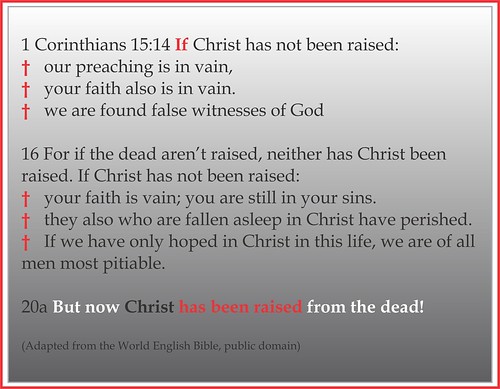
1 Corinthians 15 bullets

The graphic above is an attempt to illustrate, as a bullet chart, part of what Paul said about the importance of the resurrection, in 1 Corinthians 15.

For more on what the New Testament says about the resurrection, see here. For what N. T. Wright said about the believability of the resurrection, see here.

Thanks for reading, and looking.

Monday, April 01, 2013

The Resurrection, Superstition, and the Second Law of Thermodynamics

Maple leaf on concrete
Death and the Second Law of Thermodynamics (The photo above is of a maple leaf. This post is not an April Fool joke!)

Ephesians 1:18b . . . that you may know what is the hope of his calling, and what are the riches of the glory of his inheritance in the saints, 19 and what is the exceeding greatness of his power toward us who believe, according to that working of the strength of his might 20 which he worked in Christ, when he raised him from the dead, and made him to sit at his right hand in the heavenly places, 21 far above all rule, and authority, and power, and dominion, and every name that is named, not only in this age, but also in that which is to come.  

The definitions of life and death are complex, and philosophical as well as biological. Generally, living things are in a constant battle with the second law of thermodynamics. So long as they can obtain enough energy, they win this battle. They can build themselves. They build themselves as non-random, ordered objects. Living things do this, however, only at the expense of order in the universe at large. We can expend energy to build, but, when we do, we are unbuilding something else -- we are causing entropy to increase. However, when we do so, we are taking energy from somewhere else.

For example, we can straighten the back seat of our car, or the dining room table. We change disorder to order. But, to do so, we must use energy that we have taken in in the food we eat, or, perhaps, electrical energy to run various cleaning devices. Starch, say, is an ordered food molecule, containing usable stored energy. Breaking it down changes the combinations molecules of starch into less ordered molecules of carbon dioxide and water, releasing energy in the process, and giving off wasted energy. Disorder arises through almost all natural processes, because of the unbending second law of thermodynamics. The only way to stave off that disorder is by having a source of energy to draw on. However, drawing such energy for use is related to increased disorder somewhere else. For example, the sun is gradually becoming more disordered.

One of the things that happens as a result of death is that the ability of a living thing to stave off the inexorable increase of entropy is gone. Death leads to decay. As Polkinghorne puts it:
In our present world, change and decay are built into the fabric of the universe. The processes by which genetic mutations produce new forms of life are the processes by which cells become cancerous. Death is the necessary cost of life. In fact, a theological defense of the existence of physical evil is that it is not gratuitous but the inescapable price of an evolutionary world, free to make itself within the independence its Creator has granted to it. John C. Polkinghorne, Serious Talk: Science and Religion in Dialogue. Harrisburg, PA: Trinity Press International, 1995, p. 107.

Not only does death lead to decay, but this decay is, in the practical sense, irreversible. If I had the money, and offered some famous research institution a trillion dollars if they could bring one dead maple leaf back to life, I wouldnt lose my money. It is not humanly possible to reverse the decay in a dead organism, or part of an organism, and bring it back to life. The second law of thermodynamics makes that impossible.

The resurrection, of course, is miraculous, any way you want to look at it. It wasn’t, or isn’t, humanly possible. (That doesnt mean that it didnt happen!) We cannot reverse the effects of the second law on a dead leaf, much less a dead human. No wonder Paul called resurrection power immeasurable in Ephesians 1:19-20. God’s promise is that Christians have this power working in us.

Superstition?
The biology text I am currently using says this: The irrational belief that actions that are not logically related to a course of events can influence its outcome is called superstition. . . . different narratives, legends, fairy tales, and epics from all around the globe exist to help people understand the world around them. These stories explain everything from birth and death to disease and healing. (Jay Phelan, What is Life? Second Edition. New York: Freeman, 2013, pp. 5-6. Emphasis in original.) To be fair, Phelan is not particularly attacking religious belief here, but casts a wider net, including, among other things, the ritualistic actions of baseball players.

Phelan goes on to say that there are truths in religion that the scientific method doesn't reveal to us, and that these are based on personal faith, traditions, and mythology. (p. 6. Phelan put quotation marks around truths,” implying, I think, that hes not sure that they are truths.)

Phelan is mostly right. Beliefs that are not logically related to a course of events are sometimes believed to cause things that they dont. I classify the belief that vaccinations cause autism as one such superstition. There are religious beliefs that seem superstitious to me, and, no doubt, many of mine seem superstitious to, say, a Buddhist.

The resurrection, I claim (and Im not nearly the first!), is an event that there is evidence for. Of course some of my belief in the resurrection is based on personal faith, traditions, and perhaps even mythology. But I submit that there is evidence for the resurrection. In 1 Corinthians 15, Paul says: 3 For I delivered to you first of all that which I also received: that Christ died for our sins according to the Scriptures, 4 that he was buried, that he was raised on the third day according to the Scriptures, 5 and that he appeared to Cephas, [Peter] then to the twelve. 6 Then he appeared to over five hundred brothers at once, most of whom remain until now, but some have also fallen asleep. 7 Then he appeared to James, [the half-brother of Christ] then to all the apostles, 8 and last of all, as to the child born at the wrong time, he appeared to me also. In other words, there were hundreds of people, in Pauls day, who had seen the living, resurrected Christ. Thats evidence.

There is other evidence for the resurrection. How else can we explain the transformation of Peter from a coward who didnt acknowledge that he was one of Christ's followers to a bold public speaker, proclaiming the gospel? How else can we explain the growth of the church? How else can I explain how a young lady of my acquaintance, with little interest in the things of God, living in sin with her boyfriend, and their child, had her life turned around, began attending church with her boyfriend and child, reconciled with her estranged mother, and was married to the boyfriend after the morning service on Super Bowl Sunday, 2013? (I know a similar story, about another young lady who married her boyfriend after church service in another place on the next Sunday. Both new wives said that they wanted to show others a life consistent with their faith. Both are living transformed lives.) I credit the power of the resurrection for these and other stories of transformation, and claim that such changes are evidence for the reality of the resurrection. I cannot prove, to the satisfaction of a confirmed atheist, that these events, in the First Century and the Twenty-First, are logically related to the Resurrection, but I submit that they are evidence for such a logical relationship.

Thanks for reading!

Friday, December 07, 2012

I'm afraid I've won the "War on Christmas"

I think I've won the war on Christmas. I shouldn't have. I should have lost it, and let the Christ of Christmas be the winner in my life. I'm not speaking of the "war on Christmas" that some people are. I'm speaking of another, more important one, the real one.

. . . Christmas itself has now far outstripped Easter in popular culture as the real celebratory center of the Christian year -- a move that completely reverses the New Testament's emphasis. We sometimes try, in hymns, prayers, and sermons, to build a whole theology on Christmas, but it can't in fact sustain such a thing. N. T. Wright, Surprised by Hope: Rethinking Heaven, the Resurrection, and the Mission of the Church. New York: HarperOne, 2008, p. 23.

The War on Christmas, in most people's minds.

Every year, at about this time, we hear about the so-called "War on Christmas." The Wikipedia even has an article on "Christmas Controversy."

To quote the Wikipedia: "Modern-day controversy occurs mainly in western countries such as the United States, Canada, and to a lesser extent the United Kingdom and Ireland, and usually stems from a contrast between the holiday's significant social and economic role in these countries and its strong association with Christianity in an increasingly multiculturally sensitive and religiously diversifying society." Let me consider three of the reasons that some Christians say that there is such a war.

1) Some uninformed people object to the use of Xmas, believing that that is minimizing Christ, for whom Christmas was named. However, Xmas has been a common way  of representing Christ's name in written form. The X comes from the Greek letter chi, which looks like an X, and is the first letter of the word for Christ in Greek, which is Χριστός (Christos). See the Wikipedia article on that Greek letter for more. The labarum, which uses chi and rho, the second letter in the Greek word for Christ, plus a cross, to represent Christ, is an important symbol in some churches.

2) Some Christians, and some others, believe that manger scenes, or crèches, should be displayed by city or other local governments. Other people object, on the grounds that doing that is a violation of the Constitutional separation of Church and State, and the courts have generally agreed with them.

There should be separation of Church and state, such that local, state, and national governments should not officially recognize Wiccan, Christian, Muslim, Hindu, Buddhist, or any other religion's special days. (We do have an official Christmas holiday in this country, and I'm not advocating doing away with that. Even people of other faiths usually seem to enjoy and celebrate the Christmas holiday, at least as a day off. Recognizing Christmas by a national holiday is a longstanding tradition, even though it is, after all, a recognition, by government, of a Christian special day. But let's not go further.)

Back to government recognition of Christmas, or not. Fighting for manger scenes at Christmas time seems like a strange battle. We don't know when Christ was born, not even the exact year, let alone the month and the day.

Besides that, manger scenes are usually inaccurate. There is no Biblical evidence that the shepherds who came to visit Christ stayed very long, and that their visit overlapped with that of the wise men. Almost no Bible scholars think that the wise men came while the shepherds were there. Except for the fact that there were three gifts mentioned, there's no evidence that there were three wise men, or astrologers. Perhaps there were two, or a dozen. It may have been three, but we aren't sure. There's no suggestion, in the Bible, that they came from three different races. The Bible does not say that they came on camels. Perhaps they did, but there's no solid evidence for it.

The current Pope has even gone so far as to point out that there is no evidence that there were any animals in the stable where Christ was born. (The Vatican uses animals in its nativity scenes, and the Pope concedes that Christians, including Catholics, aren't going to stop including them.)

There is no good reason why a church, or a private individual or organization, cannot display a manger scene at Christmas, or on the Fourth of July, for that matter. But Christians shouldn't try to get the government to sponsor an inaccurate symbol to be displayed at what may be the wrong time of year.

3) There are also complaints when "Christmas cards" have no reference to Christmas, or when someone says, or writes, "Happy Holidays," rather than "Merry Christmas."

It's certainly true that these things happen. But should those who hold Christ, and His name, to be deeply significant, be offended? I'm not sure that we should. Commerce, in North America, takes Thanksgiving, Black Friday, Cyber Monday, and all the other days through December 24 as serious shopping times. Jobs depend on selling lots of stuff. There is music played over the speaker systems in stores, and on the radio. We expect to hear "Jingle Bell Rock," "I'm Dreaming of a White Christmas," "The Christmas Song," "Here Comes Santa Claus," and the like, most of them have nothing to do with the birth of Christ. Some do, of course, such as "Silent Night." "Little Drummer Boy" has a little to do with Christ's birth, but drums, as we think of them, weren't developed until centuries after Christ's birth. (Here's one list of the greatest "Christmas" songs. Many of them don't mention Christ.) Santa Claus, not Christ, is the main attraction in most Christmas parades. We expect to see, if we wish, various TV programs dealing with the season, such as one about Rudolph, or Frosty, or the Grinch. The latter, at least, acknowledges the importance of a spirit of generosity, but the TV program about that green creature makes no mention of the birth of Christ, and the others usually don't, either.

We should be generous all year. There's nothing wrong with giving so-called "Christmas presents," but I suspect that, even in the family celebrations of most believers, we don't connect doing that with the gifts that the wise men brought to Jesus, or with Christ's gift of freedom from sin, other than, perhaps, reading part of Luke 2. Most of the symbols associated with Christmas have a life of their own, independent of any connection with the birth of Christ. It is possible to connect most of them with His life, and some of us try to, but sometimes the connection is pretty tenuous, and is easy to forget. Can you tell me what the color red, or Christmas trees, have to do with Christ's birth? I can't.

What am I saying? I'm saying that, in fact, a month or so of the calendar is largely dedicated, not to the birth of Christ, but to increasing sales for the year, to displaying traditional symbols, to greeting others, and giving to other people. Most giving to others, co-workers, the poor, or our own families, is not much connected to Christ's birth. It's just a seasonal habit, and much of it is commercially driven, or because we want to take an income tax deduction, or because we want to feel good about ourselves. Giving to others, in the right spirit, is a good thing, but most of it, in December, is not directly related to Christ's birth. It's no wonder that some people, and some businesses, use "Happy Holidays," rather than "Merry Christmas." And "Merry Christmas" is not about Christ's birth, either. Being merry is about gifts, and families, Christmas bonuses, and days off. A more appropriate exclamation would be "Blessed Christmas," if we mean it. Almost all of us, including those of us who claim to be followers of Christ, spend more time, money, and thought on addressing cards, selecting, wrapping, giving and receiving presents, eating with others, wondering if it will snow, traveling, and listening to, or watching, traditional material in the media than we do thinking about the significance of the birth of Christ. Why blame Walmart or ESPN or whoever, when they say "Happy Holidays?"

The real war on Christmas.

There's nothing intrinsically wrong with taking part in many of the customs of the culture in which we live, associated with the time period between late November and early January. That is, unless doing so turns us into selfish whiners with too much to do to be really generous and loving to others, or into crabs, complaining because we can't find the perfect gift, or because someone else doesn't share our family or church traditions. But taking part in these things should not take up most of our attention. They need to be kept in perspective, eternal perspective.

Christ, the creator and sustainer of the universe, came from heaven, at our great need. He came to develop as an embryo in Mary's womb, to be born, to live as a great teacher, die as a sinless sacrifice for our sins, and come back from death to prove that He had accomplished that task. If I forget that, or fail to emphasize it in my own thoughts, I've won the war on Christmas, the wrong one, when I should have lost it.

If my life, my thoughts, and my words don't make the accomplishment of Christ more important than Christmas traditions, or my hobbies, my job (or lack thereof), my team, my political agenda, my family and friends, or even my church, then I've won the war on Christmas, and Christmas has lost it, as far as my own personal battleground is concerned. Christmas has lost this war because I don't keep the truth of Christ's accomplishment as the most important thing in my head, year round. My mind is not on Christmas, and what it really means. It's on peripheral things.

John 1:1 In the beginning was the Word, and the Word was with God, and the Word was God. 2 The same was in the beginning with God. 3 All things were made through him. Without him was not anything made that has been made. 4 In him was life, and the life was the light of men. 5 The light shines in the darkness, and the darkness hasn’t overcome it. 6 There came a man, sent from God, whose name was John*. 7 The same came as a witness, that he might testify about the light, that all might believe through him. 8 He was not the light, but was sent that he might testify about the light. 9 The true light that enlightens everyone was coming into the world.
10 He was in the world, and the world was made through him, and the world didn’t recognize him. 11 He came to his own, and those who were his own didn’t receive him. 12 But as many as received him, to them he gave the right to become God’s children, to those who believe in his name: 13 who were born not of blood, nor of the will of the flesh, nor of the will of man, but of God. 14 The Word became flesh, and lived among us. We saw his glory, such glory as of the one and only Son of the Father, full of grace and truth.  *John the Baptist

1 Corinthians 15:20 But now Christ has been raised from the dead. He became the first fruits of those who are asleep. 21 For since death came by man, the resurrection of the dead also came by man. 22 For as in Adam all die, so also in Christ all will be made alive. (World English Bible, public domain)


Thanks for reading. God help me, and you. Blessed Christmas!

*  *  *  *

I added the quotation from N. T. Wright on January 2, 2013.
Monday, April 09, 2012

The importance of the resurrection

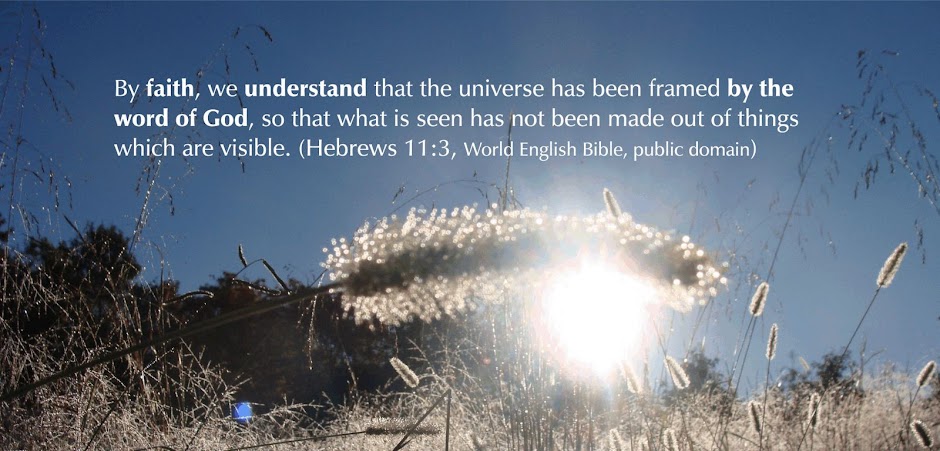
I can't add to that, but I need to repeat it.

It is impossible to overemphasize the importance of the resurrection. See Acts 2:24, 32; Acts 17:18; 1 Corinthians 15, and elsewhere, for Biblical grounds for that statement.

Thanks for reading.

Friday, November 28, 2008

Hugh Ross puts his faith on the line

In his book, Creation as Science: A Testable Model Approach to End the Creation/Evolution Wars (Colorado Springs: NavPress, 2006), Hugh Ross says that he tells audiences that he "would let go of my Christian Faith" if he discovered that it did not have a factual foundation. This usually shocks most of his listeners, but, says Ross, a faith based on falsehood is not a faith worth keeping. As he points out, Paul, in 1 Corinthians 15 and elsewhere, went to considerable length to show that Christianity does have a factual foundation. Ross is the founder of Reasons to Believe.

In a previous post, I quoted David Snoke, author of A Biblical Case for an Old Earth (Grand Rapids, MI: Baker Books, 2006), as saying almost exactly the same thing.

Thanks for reading.