License

I have written an e-book, Does the Bible Really Say That?, which is free to anyone. To download that book, in several formats, go here.
Creative Commons License
The posts in this blog are licensed under a Creative Commons Attribution-NonCommercial-ShareAlike 3.0 Unported License. You can copy and use this material, as long as you aren't making money from it. If you give me credit, thanks. If not, OK.
Showing posts with label protein. Show all posts

Wednesday, December 05, 2018

Sunspots 705


Things I have recently spotted that may be of interest to someone else:

Education: A Scientific American writer argues that STEM education and the other liberal arts are all essential.

Ethics: (and Science) A Chinese scientist, who says he altered genes in two baby girls, while they were embryos, has faced lots of outcry, on ethical grounds, and because what he did was not generally perceived to have been wise. For more on this matter, also from NPR, see here. Gizmodo reports that the Chinese government has shut down these experiments. Scientific American asks some important questions about this episode.

Food: NPR tells us how much protein we need, and whether or not we are likely to be getting it.

Politics: NPR says that the number of unauthorized immigrants is the lowest in a decade.

Relevant reports that more white evangelical Christians believe that climate change is real, than the percentage of Republicans who do.

FiveThirtyEight provides a chart, showing that the Mueller investigation, far from being a fruitless "witch hunt," has resulted in more indictments and pleas over a shorter time than any like investigation since Watergate.

Listverse tells us about 10 important episodes in the career of the late President George H. W. Bush.

Science: Earther on possible ways to protect coral reefs through technological intervention.

Gizmodo reports on a female albatross, in the wild, who is at least 69 years old, and raised a chick last year, and has laid an egg this year.

Gizmodo, and other outlets, report that some spiders feed their young with a milk-like substance.


The graphic used in these posts is from NASA, hence, I believe, it is public domain. 

Thanks for looking!

Monday, November 12, 2012

I'm thankful for the Fabaceae (pea family)

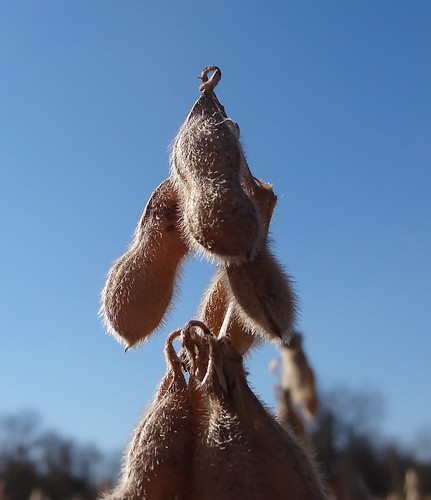
Soybean pods Abbeville Co, SC, sooc
Soybean pods (legumes) against a November sky. Abbeville County, South Carolina.


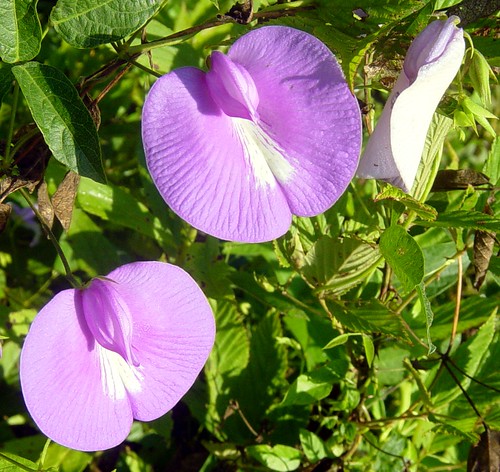
Purple wild peas
Purple flower of wild pea plant, Pickens County, South Carolina. (Both photos are links to the originals, in my Flickr photostream.)

The photos above are of just two representatives of the enormous, and enormously important, pea family, also known as legumes, or Fabaceae. Why are they important? Let me count the ways. Rather, let me list just some of the members of this family:

peanuts
soybeans
beans (many kinds)
peas (many kinds)
clover (many kinds)
alfalfa
carob
licorice

Peanuts and soybeans are important crops. According to this source, we exported $16 billion worth of soybeans and soybean products in a recent year. See here for the Wikipedia article section on soybean use. Uses include oil, tofu, edamame, and many other food uses. Peanuts are also noted for having many uses, including, of course, peanut butter. See here for the Wikipedia reference. Beans and peas, of many kinds, are eaten in many ways. Alfalfa and clover are important cattle food. Clover is used as an ornamental, too.

One reason that the members of this family are so important in human diets is that the family is rich in protein. One reason for that is that the plants have nodules on their roots, where Nitrogen-fixing bacteria live, in a mutually beneficial association with the peas, beans, etc. There is some gaseous Nitrogen in the air, and there is air in the soil, usually. The bacteria take some of this Nitrogen, and change it into amino acids, which are the building blocks of protein. Glycine is one of the amino acids. Glycine is also the scientific name of soybeans. Since we must have protein for almost every biological function -- it's essential for all of our cells -- having a source of protein is critical for human diets, and members of the pea family are good sources of protein. Vegetarians, and people who can't afford to eat meat, generally eat beans and peas and other members of the pea family as protein sources.

It is probable that Daniel and his friends persuaded the Babylonian officials to let them eat members of the pea family, as part of their diet, rather than the meats the rest of the trainees ate. The Prodigal Son was probably feeding carob pods to the pigs. Carob is used to make a chocolate substitute.

I'm thankful to God for the bounty of the pea family! Thanks for reading.

Wednesday, October 24, 2012

Sunspots 389

Things I have recently spotted that may be of interest to someone else:

Science: Thekidshouldseethis.com is a blog of cool videos, related to science, that, as the title indicates, the kids (and probably you) should see.

Todd's blog reports that changing a protein slightly doesn't necessarily mean that it won't function -- in other words, all mutations are not bad. Furthermore, there is evidence, in the experiments he reports on, that a protein can take on a new function. (Note -- Todd is a Young-Earth Creationist.)

Politics:  Wired has a page that lets you check on who is contributing to political candidates. (Some contributions are anonymous.) I discovered that my Congressperson's largest named contributor was something called the American Crystal Sugar Company Political Action Committee.

The Billy Graham Evangelistic Association has removed Mormons (Latter-Day Saints) from their list of cults, apparently for political purposes.

Christianity: Heart, Mind, Soul and Strength asks why Christ gave the Great Commission, and how it should be treated.

Image source (public domain)