Musings on science, the Bible, and fantastic literature (and sometimes basketball and other stuff).
God speaks to us through the Bible and the findings of science, and we should listen to both types of revelation.
The title is from Psalm 84:11.
The Wikipedia is usually a pretty good reference. I mostly use the World English Bible (WEB), because it is public domain. I am grateful.
License
The posts in this blog are licensed under a Creative Commons Attribution-NonCommercial-ShareAlike 3.0 Unported License. You can copy and use this material, as long as you aren't making money from it. If you give me credit, thanks. If not, OK.
Monday, November 07, 2022
Tuesday, March 30, 2021
"calculated the dust of the earth in a measuring basket..." - God and nature in Isaiah 40
"calculated the dust of the earth in a measuring basket..." - Isaiah 12:2b. (Scripture from the World English Bible, public domain.)
Isaiah 40 is probably best known for verses 30-31:
30 Even the youths faint and get
weary,
and the young men utterly fall;
31 but those who wait for Yahweh will renew their strength.
They will mount up with wings like eagles.
They will run, and not be weary.
They will walk, and not faint.
This passage is partly, or completely, poetic -- it uses figurative language. We don't expect to fly like birds, even if we do wait for Yahweh.
There's more non-literal language in this chapter. Consider the verse which is the source of the title of this post:
12 Who has measured the waters in the hollow of his hand,
and marked off the sky with his span,
and calculated the dust of the earth in a measuring basket,
and weighed the mountains in scales,
and the hills in a balance?
Here is more poetic wording:
11 He will feed his flock like a shepherd.
He will gather the lambs in his arm,
and carry them in his bosom.
He will gently lead those who have their young.
and
22 It is he who sits above the circle of the earth,
and its inhabitants are like grasshoppers;
who stretches out the heavens like a curtain,
and spreads them out like a tent to dwell in,
23 who brings princes to nothing,
who makes the judges of the earth meaningless.
23 They are planted scarcely.
They are sown scarcely.
Their stock has scarcely taken root in the ground.
He merely blows on them, and they wither,
and the whirlwind takes them away as stubble.
and
26 Lift up your eyes on high,
and see who has created these,
who brings out their army by number.
He calls them all by name.
by the greatness of his might,
and because he is strong in power,
not one is lacking.
All of these not-literal passages refer to nature. Nature was, and should be, important to believers. In this one chapter, we have more than one section of nature-related material:
putting forth non-human creatures as a goal to aspire to, and/or as divinely designed;
an admonition that God understands the natural world, and we are just not capable of that;
care for animals as an illustration of God's care for His people;
God's sovereignty, even over the heavenly bodies;
God as creator.
Nature is not the main theme of Isaiah. Here's a quotation from the Wikipedia article on the book of Isaiah:
The book can be read as an extended meditation on the destiny of Jerusalem into and after the Exile. ... Isaiah speaks out against corrupt leaders and for the disadvantaged, and roots righteousness in God's holiness rather than in Israel's covenant.
But, although it's not part of Isaiah's main message, nature has always been important to God. Here, the emphasis is not on caring for nature, or on nature's beauty and diversity, but on God's greatness, and His sovereignty over nature. The ancient Hebrews could probably distinguish a few thousand stars (more than all too many of us can see with the naked eye, looking directly at the sky) in the heavens that they saw. (They believed that the stars were held by a firmament. We now believe that there isn't any such thing, but God is just as much in charge of spatial objects as if there was. See also this post.) They could not have imagined stars of various colors, sizes, and age, or double stars, or asteroids, or billions of galaxies, and the other entities that we can see today. But God could imagine them, and, as Isaiah says, he brings them out by number, and knows the names of each of them.
God also understands geology better than the best scientists of our, or any future time. He calculates the very dust -- not a single grain of silt, mud or soil is unseen by God, or not understood by Him.
Thanks for reading!
Thursday, June 27, 2019
Multi-worlds universes and God's sovereignty
Travis Perry, writing on the Speculative Faith blog, has considered the possibility that the choices we make create alternative universes, and the question of whether God could have allowed such a situation. If there were such alternate universes, would, or could, there be a unique Bible for each? Or at least, for each major moral choice -- for example, a world where Adam and Eve never fell, or one where the Jewish authorities accepted the Gospel?
Perry doesn't believe in the many-worlds interpretation, but his thoughts are interesting.
Thanks for reading. Read Perry.
Monday, November 07, 2016
God's Sovereignty, the US Presidential election, and more important matters
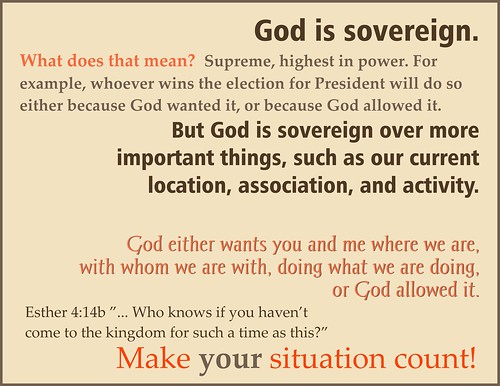
The poster above was created to remind me that God is sovereign -- things are as they are either because God wanted them that way, or because He allowed them. That's true whether Mrs. Clinton or Mr. Trump, or someone else, wins the Presidential election that is supposed to end a too-long campaign season tomorrow. It's true no matter who wins the US Senate, or any other offices, local and state-wide. It's true no matter how various referendums may turn out.
From the Project Gutenberg 1913 Webster's Dictionary, public domain, the following definition: "...The quality or state of being sovereign, or of being a sovereign; the exercise of, or right to exercise, supreme power; dominion; sway; supremacy; independence ..."
For me, the bottom line is not about the election, or who will win the Super Bowl, or any of millions of other things that I cannot influence at all, or cannot influence very much (I did vote). The important question is "what am I doing, in service to God and others, with the situation I am in?" See Esther 4:14b, which says "Who knows if you haven't come to the kingdom for such a time as this?" (World English Bible, public domain)
I posted this to my Flickr photostream (The poster above is a link to a larger version, there) yesterday. A fellow user commented, to the effect that "Didn't God give us free will?" A good question.
I believe He did. I don't consider myself adequate to explain free will, but at least part of the reason many Christians believe that there is such a thing is that John 3:16 says that whosoever will may believe in Him. Another reason is that our intuition tells us that we have free choice, at least in some matters. But, as the Wikipedia article on "Free will" puts it, "The notions of free will and predestination are heavily debated among Christians." I believe in both free will and God's sovereignty.
For more on God's sovereignty, see here. This excellent post points out seven scriptural references that indicate God's sovereignty. It does not include any reference to Psalm 104, which indicates that God controls the supplies of the needs of the natural world. No doubt there are other passages that could have been included.
Thanks for reading. Do what you can, in your situation.
Sunday, December 20, 2015
Excerpts from Orthodoxy, by G. K. Chesterton, 52
This, as I say, is the lightest and most evident case. The assumption that there is something in the doubt of miracles akin to liberality or reform is literally the opposite of the truth. If a man cannot believe in miracles there is an end of the matter; he is not particularly liberal, but he is perfectly honourable and logical, which are much better things. But if he can believe in miracles, he is certainly the more liberal for doing so; because they mean first, the freedom of the soul, and secondly, its control over the tyranny of circumstance. Sometimes this truth is ignored in a singularly naïve way, even by the ablest men. For instance, Mr. Bernard Shaw speaks with hearty old-fashioned contempt for the idea of miracles, as if they were a sort of breach of faith on the part of nature: he seems strangely unconscious that miracles are only the final flowers of his own favourite tree, the doctrine of the omnipotence of will. Just in the same way he calls the desire for immortality a paltry selfishness, forgetting that he has just called the desire for life a healthy and heroic selfishness. How can it be noble to wish to make one’s life infinite and yet mean to wish to make it immortal? No, if it is desirable that man should triumph over the cruelty of nature or custom, then miracles are certainly desirable; we will discuss afterwards whether they are possible.
Orthodoxy, first published in 1908, by G. K. Chesterton, is in the public domain, and available from Project Gutenberg. The previous post in this series is here. Thanks for reading! Read Chesterton.

