
Musings on science, the Bible, and fantastic literature (and sometimes basketball and other stuff).
God speaks to us through the Bible and the findings of science, and we should listen to both types of revelation.
The title is from Psalm 84:11.
The Wikipedia is usually a pretty good reference. I mostly use the World English Bible (WEB), because it is public domain. I am grateful.
License
I have written an e-book, Does the Bible Really Say That?, which is free to anyone. To download that book, in several formats, go here.

The posts in this blog are licensed under a Creative Commons Attribution-NonCommercial-ShareAlike 3.0 Unported License. You can copy and use this material, as long as you aren't making money from it. If you give me credit, thanks. If not, OK.
Showing posts with label Hillary Clinton. Show all posts
Monday, November 07, 2016
God's Sovereignty, the US Presidential election, and more important matters
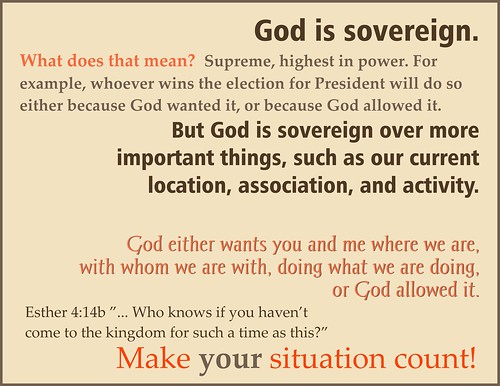
The poster above was created to remind me that God is sovereign -- things are as they are either because God wanted them that way, or because He allowed them. That's true whether Mrs. Clinton or Mr. Trump, or someone else, wins the Presidential election that is supposed to end a too-long campaign season tomorrow. It's true no matter who wins the US Senate, or any other offices, local and state-wide. It's true no matter how various referendums may turn out.
From the Project Gutenberg 1913 Webster's Dictionary, public domain, the following definition: "...The quality or state of being sovereign, or of being a sovereign; the exercise of, or right to exercise, supreme power; dominion; sway; supremacy; independence ..."
For me, the bottom line is not about the election, or who will win the Super Bowl, or any of millions of other things that I cannot influence at all, or cannot influence very much (I did vote). The important question is "what am I doing, in service to God and others, with the situation I am in?" See Esther 4:14b, which says "Who knows if you haven't come to the kingdom for such a time as this?" (World English Bible, public domain)
I posted this to my Flickr photostream (The poster above is a link to a larger version, there) yesterday. A fellow user commented, to the effect that "Didn't God give us free will?" A good question.
I believe He did. I don't consider myself adequate to explain free will, but at least part of the reason many Christians believe that there is such a thing is that John 3:16 says that whosoever will may believe in Him. Another reason is that our intuition tells us that we have free choice, at least in some matters. But, as the Wikipedia article on "Free will" puts it, "The notions of free will and predestination are heavily debated among Christians." I believe in both free will and God's sovereignty.
For more on God's sovereignty, see here. This excellent post points out seven scriptural references that indicate God's sovereignty. It does not include any reference to Psalm 104, which indicates that God controls the supplies of the needs of the natural world. No doubt there are other passages that could have been included.
Thanks for reading. Do what you can, in your situation.
Labels:
Donald Trump,
election,
Esther 4:14,
God's sovereignty,
Hillary Clinton,
Politics,
service
Wednesday, October 12, 2016
Sunspots 595
Things I have recently spotted that may
be of interest to someone else: Christianity: First Things reports on a study of beliefs among evangelicals, and finds that all too many such believe that their own interpretation of the Bible is the final authority, as opposed to the interpretation of the church at large.
Computing: Gizmo's Freeware reminds us that it's a good idea to run the free Malicious Software Removal Tool regularly on Windows computers, and tells us how to do it. I just did, and it took less than 5 minutes and didn't find anything, thank God!
Newsweek claims that neither of the major candidates for President knows as much about computers and the Internet as he or she should, considering the importance of this topic.
Finance: FiveThirtyEight asks what is wrong (if anything) with insider trading?
Health: Scientific American has a brief report on the likelihood that the types of microbes in breast tissue may increase, or decrease, the likelihood of breast cancer.
Humor: (or something) Listverse tells us about 10 things you can legally do, if you are in the right country. (Sample -- marry a dog.)
(actually, 10 bizarre accidents that have recently killed people.
the reverse of humor.) Listverse reports on
Politics: (and computing) Newsweek reports that the Bush Administration "lost" 22 million e-mails during President Bush's tenure in office, including during the time of the decision to go to war, under some under highly suspicious circumstances, used a private server (belonging to the Republican National Committee!) and stonewalled Congress on what was in those e-mails, and what happened to them. This by no means excuses Mrs. Clinton's mistake (or whatever you want to call it), but what the Bush White House did may have been just as bad, or much worse.
Leonard Pitts muses about the death (by a gunshot) of a 6-year-old boy, who lived less than an hour from me, and points out that we get all worked up over deaths caused by foreign terrorists (there have been "only" 71, since 9/1/2001) and hardly even notice over 30,000 deaths a year, all too many of them innocent children, killed by guns wielded by citizens.
Christianity Today blasts both Presidential candidates, but also blasts all too many evangelicals who have supported Mr. Trump. "What Trump is, everyone has known and has been able to see for decades, let alone the last few months."
Science: National Public Radio tells us that video chats are good for small children's development.
Image source (public domain)
Wednesday, September 28, 2016
Sunspots 593
Things I have recently spotted that may
be of interest to someone else:
Christianity: A Relevant contributor, who used to be sexually active, has been celibate for three years.
Another Relevant contributor has written an essay on how to cope with lust after you are married.
Computing: (and Politics) Donald Trump, Jr., is not the only politician (or helper of one) accused of violating copyright, but he is one who has done so recently, according to National Public Radio. He used a Flickr photo, which is here, and is labelled "all rights reserved." I am a member of Flickr, but have not reserved all rights to my photos.
Health: National Public Radio reports on a doctor who confessed, years after the fact, to lying to protect another doctor in a malpractice case. The report suggests that such happenings are not rare, or not rare enough.
NPR also reports that life spans are no longer continuing to lengthen, and why.
History: You've probably seen, heard, and read about the National Museum of African American History and Culture. If you haven't, you should have.
Politics: National Public Radio has posted a transcript of the first Presidential debate, interspersed with fact checking.
The New York Times reports that, even after Mr. Trump's announcement affirming it, a significant number of citizens don't believe that President Obama was born in the U. S. (The number has gone down.)
Listverse has posted 10 dark secrets of Hillary Clinton, and 10 dark secrets of Donald Trump. God help us!
Science: An article on how archaeologists can study what dead people ate, from Listverse.
For all the uproar (sometimes) about genetic engineering of food crops, there have been few examples used commercially. One of these, making corn resistant to rootworms, is starting to fail -- the rootworms are evolving into having resistance. (Scientists predicted this would happen, but the seed companies didn't listen to them.) Another source of a resistance gene has been found.
Image source (public domain)
Christianity: A Relevant contributor, who used to be sexually active, has been celibate for three years.
Another Relevant contributor has written an essay on how to cope with lust after you are married.
Computing: (and Politics) Donald Trump, Jr., is not the only politician (or helper of one) accused of violating copyright, but he is one who has done so recently, according to National Public Radio. He used a Flickr photo, which is here, and is labelled "all rights reserved." I am a member of Flickr, but have not reserved all rights to my photos.
Health: National Public Radio reports on a doctor who confessed, years after the fact, to lying to protect another doctor in a malpractice case. The report suggests that such happenings are not rare, or not rare enough.
NPR also reports that life spans are no longer continuing to lengthen, and why.
History: You've probably seen, heard, and read about the National Museum of African American History and Culture. If you haven't, you should have.
Politics: National Public Radio has posted a transcript of the first Presidential debate, interspersed with fact checking.
The New York Times reports that, even after Mr. Trump's announcement affirming it, a significant number of citizens don't believe that President Obama was born in the U. S. (The number has gone down.)
Listverse has posted 10 dark secrets of Hillary Clinton, and 10 dark secrets of Donald Trump. God help us!
Science: An article on how archaeologists can study what dead people ate, from Listverse.
For all the uproar (sometimes) about genetic engineering of food crops, there have been few examples used commercially. One of these, making corn resistant to rootworms, is starting to fail -- the rootworms are evolving into having resistance. (Scientists predicted this would happen, but the seed companies didn't listen to them.) Another source of a resistance gene has been found.
Image source (public domain)
Labels:
archaeology,
celibacy,
debate,
Donald Trump,
genetic engineering,
Hillary Clinton,
life span,
links,
lust,
malpractice,
Politics,
sex,
skittles
Saturday, July 30, 2016
Wired on science at the recent political conventions
Wired has recently published two articles on science at the two recent US political conventions.
In the first article, there is an analysis, presented in easy-to-follow chart form, of how often various scientific and medical terms were mentioned in speeches. The result? Roughly even. You probably won't be surprised to note that Democratic speakers were more likely to mention "climate" and "climate change," or that Republican speakers were more likely to mention "energy" and "oil." Three Republican speakers used scientific terms that Democrats didn't mention at all.
The article says that the purpose of the conventions is not to talk about science, but points out that, in many cases, solutions, or at least partial solutions, to our problems are often found by applying the findings of science. The author was disappointed that more attention wasn't given to funding science, and talking about scientific priorities.
In the second article, the writer takes Hillary Clinton to task for saying "I believe in science." Why? Because, the author says, science is not a belief system. It is a way of finding things out. Clinton was using shorthand for something like "I believe that climate change is occurring, and that humans can do things to slow this down, or stop it, while my opponent claims that the climate is not changing." But that shorthand could be, and is, taken wrongly, and this leads to attempts to use scientific findings in ways that they should not be.
After a discussion of the mainstream position of scientists on climate change, and a rather sympathetic discussion of why some people might doubt the scientific findings on that subject, the article says:
To reinforce the idea of science as something you can believe or not believe, to force Americans into “pro-science” and “anti-science” camps, robs science of its power. It changes the practice of science from a method for understanding into a dangerous political weapon.
Unfortunately, both parties seem to use dangerous political weapons, and most of them have little to do with scientific findings.
Thanks for reading.
In the first article, there is an analysis, presented in easy-to-follow chart form, of how often various scientific and medical terms were mentioned in speeches. The result? Roughly even. You probably won't be surprised to note that Democratic speakers were more likely to mention "climate" and "climate change," or that Republican speakers were more likely to mention "energy" and "oil." Three Republican speakers used scientific terms that Democrats didn't mention at all.
The article says that the purpose of the conventions is not to talk about science, but points out that, in many cases, solutions, or at least partial solutions, to our problems are often found by applying the findings of science. The author was disappointed that more attention wasn't given to funding science, and talking about scientific priorities.
In the second article, the writer takes Hillary Clinton to task for saying "I believe in science." Why? Because, the author says, science is not a belief system. It is a way of finding things out. Clinton was using shorthand for something like "I believe that climate change is occurring, and that humans can do things to slow this down, or stop it, while my opponent claims that the climate is not changing." But that shorthand could be, and is, taken wrongly, and this leads to attempts to use scientific findings in ways that they should not be.
After a discussion of the mainstream position of scientists on climate change, and a rather sympathetic discussion of why some people might doubt the scientific findings on that subject, the article says:
To reinforce the idea of science as something you can believe or not believe, to force Americans into “pro-science” and “anti-science” camps, robs science of its power. It changes the practice of science from a method for understanding into a dangerous political weapon.
Unfortunately, both parties seem to use dangerous political weapons, and most of them have little to do with scientific findings.
Thanks for reading.
Labels:
belief,
Hillary Clinton,
Politics,
science,
scientific method
Subscribe to:
Posts (Atom)

