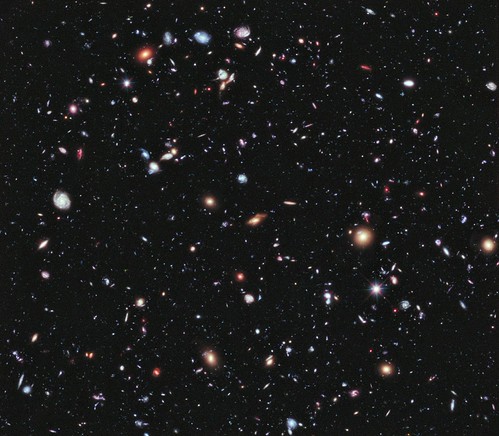
What does the photo show? It shows a small part of the sky out there,
and about 5,500 galaxies, some nearer and/or larger, some smaller and/or
further away. The
Wikipedia article on galaxies
indicates that the smallest ones have about ten million stars apiece, and the
largest ones have about ten million times ten million stars each, which is
about 10 times as many stars in each one as the dollar amount of the
national debt.
Clearly, there are a lot of stars out there! How many of these have
planets? Obviously, we don't know, but, most likely, many millions of
planets, some of them suitable for earth-type living things, are out
there. The furthest galaxies in the picture are said to be over 13 billion light years away, which means that it took over 13 billion years for light from them to reach NASA's instruments.
I am a
member of Flickr, a sort of hybrid between photography, a blog, and a social network. Members post photos, and other members can subscribe to those photos, which means that they can see, if they choose, all the photos published by such other members. I have been a subscriber to
NASA's photostream for a few years, and there are often interesting, beautiful, or spectacular shots posted from current work. (See
here for NASA's policy on use of their photographs, which allows use such as this.) Non-members, including you, can see Flickr photos without needing a password. The graphic above is also a link to the photo on Flickr, with
description. Larger sizes
are available, at least to other Flickr members. See
here for a fuller explanation of the picture.
In addition to the above photo, which was assembled from years of data collection by orbiting telescopes, recent photos have included various weather phenomena, as seen by satellites, shots of equipment used, or soon to be used, by NASA, and a satellite photo of the result of the attack on the World Trade Center on September 11, 2001.
I have previously posted on related topics, including "
extraterrestrial religion," "
numbering the stars," and "
God's complexity." I don't know whether there are other intelligent beings in the universe, and, if there are, whether they need salvation from sin or not. I believe that, should there be or have been such, God's plan includes their salvation, in ways we might, or might not, understand. It is likely, it seems to me, that Christ's death on the cross, on earth, and His subsequent resurrection, was sufficient atonement for all the intelligent beings that have ever sinned, whatever they might have looked like, or look like now, and whatever planet they lived on, or live on now, including me and you.
Thanks for reading.

 Things I have recently spotted that may
be of interest to others:
Things I have recently spotted that may
be of interest to others: 


