License

I have written an e-book, Does the Bible Really Say That?, which is free to anyone. To download that book, in several formats, go here.
Creative Commons License
The posts in this blog are licensed under a Creative Commons Attribution-NonCommercial-ShareAlike 3.0 Unported License. You can copy and use this material, as long as you aren't making money from it. If you give me credit, thanks. If not, OK.
Showing posts with label greatest commandment. Show all posts

Thursday, June 20, 2024

Ten Commandments in classrooms?

A state legislature has required that the Ten Commandments be displayed in all public school classrooms.

Leaving aside questions of separation of church and state, another question arises. Why the enthusiasm for posting the Ten Commandments, rather than the Golden Rule (Matthew 7:12a) Therefore, whatever you desire for men to do to you, you shall also do to them,? or the two Greatest Commandments?

Matthew 22:35 One of them, a lawyer, asked him a question, testing him. 36 “Teacher, which is the greatest commandment in the law?” 37 Jesus said to him, “‘You shall love the Lord your God with all your heart, with all your soul, and with all your mind.’ [Deuteronomy 6:5] 38 This is the first and great commandment. 39 A second likewise is this, ‘You shall love your neighbor as yourself.’ [Leviticus 19:18] The whole law and the prophets depend on these two commandments.” (This episode is also reported in Mark 12:28-33)

Friday, June 04, 2021

Can a fencepost keep the Ten Commandments?

Here are the ten commandments, as given in Deuteronomy (they are also in Exodus 20):

Deuteronomy 5:7 “You shall have no other gods before me.

5:8 “You shall not make an engraved image for yourself, any likeness of what is in heaven above, or what is in the earth beneath, or that is in the water under the earth: 5:9 you shall not bow down yourself to them, nor serve them; for I, Yahweh, your God, am a jealous God, visiting the iniquity of the fathers on the children, and on the third and on the fourth generation of those who hate me; 5:10 and showing loving kindness to thousands of those who love me and keep my commandments.

5:11 “You shall not take the name of Yahweh your God in vain: for Yahweh will not hold him guiltless who takes his name in vain.

5:12 “Observe the Sabbath day, to keep it holy, as Yahweh your God commanded you. 5:13 You shall labor six days, and do all your work; 5:14 but the seventh day is a Sabbath to Yahweh your God, in which you shall not do any work, you, nor your son, nor your daughter, nor your male servant, nor your female servant, nor your ox, nor your donkey, nor any of your livestock, nor your stranger who is within your gates; that your male servant and your female servant may rest as well as you. 5:15 You shall remember that you were a servant in the land of Egypt, and Yahweh your God brought you out of there by a mighty hand and by an outstretched arm: therefore Yahweh your God commanded you to keep the Sabbath day.

5:16 “Honor your father and your mother, as Yahweh your God commanded you; that your days may be long, and that it may go well with you, in the land which Yahweh your God gives you.

5:17 “You shall not murder.

5:18 “Neither shall you commit adultery.

5:19 “Neither shall you steal.

5:20 “Neither shall you give false testimony against your neighbor.

5:21 “Neither shall you covet your neighbor’s wife; neither shall you desire your neighbor’s house, his field, or his male servant, or his female servant, his ox, or his donkey, or anything that is your neighbor’s.” (World English Bible, public domain)

Not to belittle these, in any way, but there's a serious omission, namely that the Ten don't really get to my heart, my attitude. In other words, it seems to me that a fencepost could keep the Ten Commandments, except for the "honor your father and your mother" part. That seems to require some action. The rest could be passively obeyed. They seldom, if ever, are, but it seems possible. The Old, and the New Testaments make up for this with emphasis on the heart, the attitude:

Matthew 22:36 “Teacher, which is the greatest commandment in the law?”

37 Jesus said to him, “‘You shall love the Lord your God with all your heart, with all your soul, and with all your mind.’ 38 This is the first and great commandment. 39 A second likewise is this, ‘You shall love your neighbor as yourself.’ 40 The whole law and the prophets depend on these two commandments.” Jesus quoted from Deuteronomy 6:5 and Leviticus 19:18. If I truly love God, and my neighbor (including my family, my co-workers, and my on-line friends) I will keep the Great Commandments, and, therefore, keep the Ten Commandments. (Except possibly keeping the Sabbath -- that may have been modified by Christ and Paul. Maybe not.) I won't be a fencepost, but will actively love God, and others.

Thanks for reading.

Monday, March 05, 2018

Perhaps people should post the greatest commandments, not the Ten Commandments?


Greatest Commandments: summary of the Law

The Greatest Commandments. (Or the greatest attitudes to have!)

The Ten Commandments have often been posted in people's yards, and other places. But I've never seen these two commandments, to unselfishly love God, and other people, in anyone's yard, nor seen a movement to post them in courtrooms, even though the Bible says that they are the greatest commandments.

With the attitudes needed to keep these two great commandments, keeping the Ten Commandments will take care of itself. I hope I have these attitudes.

Lest there be any doubt, I have nothing against the Ten Commandments!

For another post on this topic, see here.

Thanks for reading, and looking.

Tuesday, May 02, 2017

What scriptures to post in courtrooms, on lawns, etc.

"For some reason, the most vocal Christians among us never mention the Beatitudes (Matthew 5). But, often with tears in their eyes, [they] demand that the Ten Commandments be posted in public buildings. And of course, that's Moses, not Jesus. I haven't heard one of them demand that the Sermon on the Mount, the Beatitudes, be posted anywhere.
"Blessed are the merciful" in a courtroom? "Blessed are the peacemakers" in the Pentagon? Give me a break!”
― Kurt Vonnegut, A Man Without a Country (source)

Vonnegut, probably not a believer himself, had a point.

Some people have deeply committed themselves toward placing the Ten Commandments in courtrooms, or in or next to other public buildings. See Roy Moore for a widely publicized example.

Why do people do this? I can only speculate. Some, no doubt, believe that the Ten Commandments are a foundation for our laws. Some want to honor God. Some are probably desiring to see the Commandments posted for their own political advantage. Some want the U. S. to be an explicitly Christian nation. There are probably other reasons. On the other hand, government often sees posting of the Ten Commandments as putting one religion ahead of another, and has banned the practice.

The Ten Commandments, with the exception of the Command to honor one's parents, are warnings against sins of commission -- don't commit adultery, don't give false testimony in court, don't worship idols, don't want other people's possessions, etc. Sins of commission are, generally, easy to spot. Either I have stolen from someone, or I haven't. So, laws against things are often easier to enforce than laws for things. But there are also sins of omission. Things that we should do, but don't. Let's look at some other possibilities for posting publicly, as Vonnegut suggested.

How about the Beatitudes?
Matthew 5:3 “Blessed are the poor in spirit,
for theirs is the Kingdom of Heaven.
4 Blessed are those who mourn,
for they shall be comforted.
5 Blessed are the gentle,
for they shall inherit the earth.
6 Blessed are those who hunger and thirst after righteousness,
for they shall be filled.
7 Blessed are the merciful,
for they shall obtain mercy.
8 Blessed are the pure in heart,
for they shall see God.
9 Blessed are the peacemakers,
for they shall be called children of God.
10 Blessed are those who have been persecuted for righteousness’ sake, for theirs is the Kingdom of Heaven.

(Text notes in the World English Bible indicate that the first three of these are based on the Old Testament: 5:3 on Isaiah 57:15 and 66:2, 5:4 on Isaiah 61:2 and 66:10,13, and 5:4 on Psalm 37:11. So Vonnegut isn't completely correct about the source of the Beatitudes. But, mostly, he is. It was Jesus.)

The Beatitudes are not mostly about not doing things, but about doing things, or about our attitude: being merciful, making peace, hungering after righteousness, etc. We may respect, honor, and try to follow the standard of the Beatitudes, but we don't make laws commanding people to be pure in heart, or to be gentle, and, if we did, they would be most difficult to enforce. But maybe it would be a good idea to post these in courtrooms, except that doing so would tend to violate them -- it might not be making peace, or being gentle.

There are some other candidates for such posting, if it were allowed.
One such is the Golden Rule, which, like the Beatitudes, comes from the Sermon on the Mount:
Matthew 7:12 Therefore whatever you desire for men to do to you, you shall also do to them; for this is the law and the prophets.

Here's another, from the Old Testament:
Micah 6:8 He has shown you, O man, what is good.
What does Yahweh require of you, but to act justly,
to love mercy, and to walk humbly with your God?

That doesn't come from Moses, but would presumably, not be offensive to Jews or Muslims, or Christians. But it's similar to the Beatitudes, in that it's about out attitudes, not about things we shouldn't do.

And then there's St. Paul, in Galatians 5:22 But the fruit of the Spirit is love, joy, peace, patience, kindness, goodness, faith, 23 gentleness, and self-control. Against such things there is no law. The Fruit of the Spirit is, again, about our attitudes. And, instead of outlawing various behaviors, it, as it were, inlaws them. The Fruit of the Spirit is not from the Law of Moses, but it is compatible with it. Read on:

In Matthew 22, Jesus stated the two most important commandments:
37 Jesus said to him, “ ‘You shall love the Lord your God with all your heart, with all your soul, and with all your mind.’ (Deuteronomy 6:5) 38 This is the first and great commandment. 39  A second likewise is this, ‘You shall love your neighbor as yourself.’ (Leviticus 19:18) 40 The whole law and the prophets depend on these two commandments.”
These two are also not so much about what we shouldn't do, but about what we should. And they are from the Mosaic Law, as quoted by Jesus. People who want to put signs in their front yard, or on their wall, or even in a courtroom, should consider these alternatives!

Thanks for reading!

Sunday, September 13, 2015

Ideas on how to love God


Ideas on How to Love God
Mark 12:28-31 tells us that the most important commandment is to love God.

In Luke’s description of what was probably the same event, Jesus explicitly affirmed that answer (World English Bible, public domain):
Luke 10:25 Behold, a certain lawyer stood up and tested him, saying, “Teacher, what shall I do to inherit eternal life?”
26 He said to him, “What is written in the law? How do you read it?”
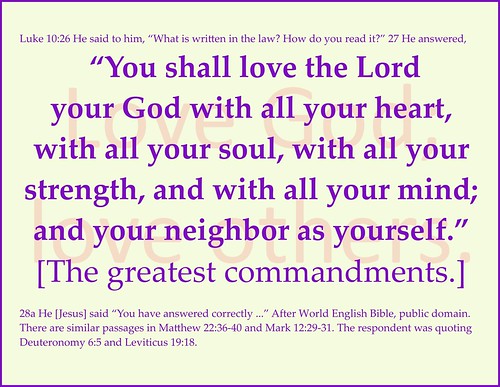
27 He answered, “You shall love the Lord your God with all your heart, with all your soul, with all your strength, and with all your mind; [Deuteronomy 6:5] and your neighbor as yourself. [Leviticus 19:18]” 28 He [Jesus] said to him, “You have answered correctly. Do this, and you will live.” [All these “loves” are agape love.]

So how do we love God?

One way, Jesus said, is to follow His teachings, or commandments. See John 14:15-24. Most of those teachings are in the Sermon on the Mount, Matthew 5-7. See also the “Great Commission,” of Matthew 28:18-20.

An on-line search led to many articles on the subject. Here are some of their suggestions on how to Love God: 1) be thankful, including for things we don’t like. 2) trust God 3) put God first 4) be committed 5) be humble 6) spend time in prayer.

Some other ideas: If I really love someone, I will pay attention to what they say, even if I don’t like it, or it’s repetitive. If I really love someone, I want to be in their company. If I really love someone, I want the best for them -- I want them to be thought well of. May I feel that way about God the Father, Son and Holy Spirit.

George Croly expressed love for God in a great poem, “Spirit of God, Descend Upon my Heart”: The hymn says:
Hast Thou not bid me love Thee, God and King?
All, all Thine own, soul, heart and strength and mind.
I see Thy cross; there teach my heart to cling:
O let me seek Thee, and O let me find!

Teach me to love Thee as Thine angels love,
One holy passion filling all my frame;
The kindling of the heaven descended Dove,
My heart an altar, and Thy love the flame.

Sunday, June 08, 2014

Does the Bible really say that? Excerpt from my book, 38


What are Christ’s commandments?

Many of them are found in the Sermon on the Mount (Matthew 5-7). Some of the commands in that Sermon are to keep our motives pure – don’t even want to commit adultery or murder; be reconciled to others, and forgive them; turn the other cheek; love even your enemies; don’t draw attention to your good deeds; don’t be anxious about worldly possessions; judge yourselves before judging others; beware of false prophets.

The Golden Rule is found in Matthew 7:12 “Therefore whatever you desire for men to do to you, you shall also do to them; for this is the law and the prophets.”

Christ also told us to live the summary of the Old Testament Law:

Matthew 22:37 Jesus said to him, “‘You shall love the Lord your God with all your heart, with all your soul, and with all your mind.’ 38 This is the first and great commandment. 39 A second likewise is this, ‘You shall love your neighbor as yourself.’ 40 The whole law and the prophets depend on these two commandments.”

Note – Here is the first of the two commandments, in context:
Deuteronomy 6:4 Hear, Israel: Yahweh is our God. Yahweh is one. 5 You shall love Yahweh your God with all your heart, with all your soul, and with all your might. 6 These words, which I command you today, shall be on your heart; 7 and you shall teach them diligently to your children, and shall talk of them when you sit in your house, and when you walk by the way, and when you lie down, and when you rise up. 8 You shall bind them for a sign on your hand, and they shall be for frontlets between your eyes. 9 You shall write them on the door posts of your house, and on your gates. 10 It shall be, when Yahweh your God brings you into the land which he swore to your fathers, to Abraham, to Isaac, and to Jacob, to give you, great and goodly cities, which you didn’t build, 11 and houses full of all good things, which you didn’t fill, and cisterns dug out, which you didn’t dig, vineyards and olive trees, which you didn’t plant, and you shall eat and be full; 12 then beware lest you forget Yahweh, who brought you out of the land of Egypt, out of the house of bondage. 13 You shall fear Yahweh your God; and you shall serve him, and shall swear by his name. 14 You shall not go after other gods, of the gods of the peoples who are around you; 15 for Yahweh your God among you is a jealous God; lest the anger of Yahweh your God be kindled against you, and he destroy you from off the face of the earth. 16 You shall not tempt Yahweh your God, as you tempted him in Massah. 17 You shall diligently keep the commandments of Yahweh your God, and his testimonies, and his statutes, which he has commanded you. 18 You shall do that which is right and good in Yahweh’s sight; that it may be well with you, and that you may go in and possess the good land which Yahweh swore to your fathers, 19 to thrust out all your enemies from before you, as Yahweh has spoken.

The second part of what Jesus said is taken from Leviticus, which is more inclusive than the part quoted in Matthew 22:39:

Leviticus 19:17 “‘You shall not hate your brother in your heart. You shall surely rebuke your neighbor, and not bear sin because of him.
18 “‘You shall not take vengeance, nor bear any grudge against the children of your people; but you shall love your neighbor as yourself. I am Yahweh.
33 “‘If a stranger lives as a foreigner with you in your land, you shall not do him wrong. 34 The stranger who lives as a foreigner with you shall be to you as the native-born among you, and you shall love him as yourself; for you lived as foreigners in the land of Egypt. I am Yahweh your God.

In Mark 12:14-19, Jesus commanded His listeners to honor the government, including paying taxes. We should remember that this was an occupying government, and its head was a Roman pagan emperor.

There is an implied command, sometimes called The Great Compassion, to help unfortunate people:

Matthew 25:34 Then the King will tell those on his right hand, ‘Come, blessed of my Father, inherit the Kingdom prepared for you from the foundation of the world; 35 for I was hungry, and you gave me food to eat. I was thirsty, and you gave me drink. I was a stranger, and you took me in. 36 I was naked, and you clothed me. I was sick, and you visited me. I was in prison, and you came to me.’
37 “Then the righteous will answer him, saying, ‘Lord, when did we see you hungry, and feed you; or thirsty, and give you a drink? 38 When did we see you as a stranger, and take you in; or naked, and clothe you? 39 When did we see you sick, or in prison, and come to you?’
40 “The King will answer them, ‘Most certainly I tell you, because you did it to one of the least of these my brothers, you did it to me.’

There are other commands, but one more, often called The Great Commission, is found in the last words of Matthew’s gospel:
Matthew 28:19 Go, and make disciples of all nations, baptizing them in the name of the Father and of the Son and of the Holy Spirit, 20a teaching them to observe all things that I commanded you. Behold, I am with you always, even to the end of the age.

The above material is an excerpt from my self-published e-book, Does the Bible Really Say That?, which may be obtained free of charge, or purchased from Amazon for $0.99, which is the lowest price Amazon lets an author set. Scripture quotations are from the World English Bible, which is in the public domain.

The previous post in this series, on the characteristics of a true Christian, is here. God willing, the next post in this series will continue the topic of this post, discussing Christ's commandments. Thanks for reading.