It is no secret ("Build a wall!") that the Trump administration believes that too many people are entering the country, both illegally and legally. Attorney General Jeff Sessions has been a cabinet officer that has tried to slow down, or stop, such immigration, with apparent enthusiasm. The Trump administration has drastically cut the number of refugees that will be accepted, and is in the process of deporting previously admitted refugees.
The US Conference of Catholic Bishops, and the Southern Baptist Convention, the largest Protestant body in the US, have both recently passed resolutions rebuking the Trump administration, especially for separating young children and their parents at the borders. Other Christians, in groups, and as individuals, have also done so. (See here for Franklin Graham's recent statement.) As they should have, such rebukes have been based on the Bible.
Attorney General Sessions has reacted. His argument is that the Bible teaches that we should obey, and enforce, the law, for the good of the overall society, implying that the recent resolutions of religious bodies and individuals, supporting immigrants and refugees, are not really based on the Bible, but that his actions and policies are.
Really? Consider:
1) In general, Sessions is right. We need to enforce traffic laws, and put bank robbers in jail, for the good of society. But some laws, and/or the penalties for violating them, are unjust. Laws that supported the institution of slavery were unjust, for example. Many people, including some Republicans in Congress, believe that laws that require young children to be separated from their parents are unjust, and even violate basic human rights. President Trump commuted the sentence of Alice Marie Johnson, who was serving a life sentence for a minor drug offense. As far as I know, he didn't say that her sentence was unjust, but perhaps a belief that it was influenced his decision.
2) Some laws are subordinate to higher, and more important, laws. If my wife is desperately ill, and I violate speed limits to get her to the emergency room, I wouldn't expect to be charged with speeding. In fact, if an officer knew what was going on, I would expect that officer to precede me to the hospital with siren and lights on.
It is true that the Bible generally indicates that we should obey the law. See Romans 13:1-5, and 1 Peter 2:13-17. But some laws are more important than others. In dialog with the religious rulers of His day, Jesus and these rulers said that the most important laws from the Old Testament were the two great commandments, namely to love God, and to love other people.
3) The Bible gives directions about how to treat immigrants, aliens and refugees, with kindness and generosity. See here for several Biblical statements on such matters. One such direction was that the Israelites were to provide sanctuary for refugees from another nation, and a nation which had sometimes gone to war with them.
Sorry, Mr. Sessions. You aren't acting and speaking Biblically on this issue.
Note: In many cases, law enforcement personnel must choose which laws to enforce. There are so many laws, covering so many aspects of life, and limited resources to enforce with, that it would be impossible to discover violations of all laws, and punish the law-breakers. The Justice Department, and other branches of the current administration, appear to have chosen to rigorously enforce laws relating to immigration, while other types of laws are not. All administrations have to make such choices, but which laws are attended to says something important about the law-enforcers.
Thanks for reading.

Musings on science, the Bible, and fantastic literature (and sometimes basketball and other stuff).
God speaks to us through the Bible and the findings of science, and we should listen to both types of revelation.
The title is from Psalm 84:11.
The Wikipedia is usually a pretty good reference. I mostly use the World English Bible (WEB), because it is public domain. I am grateful.
License
I have written an e-book, Does the Bible Really Say That?, which is free to anyone. To download that book, in several formats, go here.

The posts in this blog are licensed under a Creative Commons Attribution-NonCommercial-ShareAlike 3.0 Unported License. You can copy and use this material, as long as you aren't making money from it. If you give me credit, thanks. If not, OK.
The posts in this blog are licensed under a Creative Commons Attribution-NonCommercial-ShareAlike 3.0 Unported License. You can copy and use this material, as long as you aren't making money from it. If you give me credit, thanks. If not, OK.
Showing posts with label law. Show all posts
Showing posts with label law. Show all posts
Friday, June 15, 2018


Monday, March 05, 2018
Perhaps people should post the greatest commandments, not the Ten Commandments?
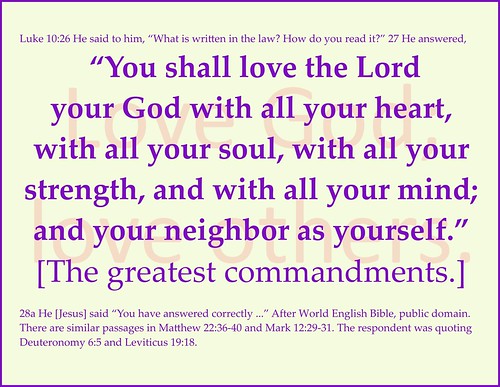
The Greatest Commandments. (Or the greatest attitudes to have!)
The Ten Commandments have often been posted in people's yards, and other places. But I've never seen these two commandments, to unselfishly love God, and other people, in anyone's yard, nor seen a movement to post them in courtrooms, even though the Bible says that they are the greatest commandments.
With the attitudes needed to keep these two great commandments, keeping the Ten Commandments will take care of itself. I hope I have these attitudes.
Lest there be any doubt, I have nothing against the Ten Commandments!
For another post on this topic, see here.
Thanks for reading, and looking.
Tuesday, October 11, 2011
Sunspots 335

Sports: National Public Radio reports that the Women's NBA league has improved in attendance and TV viewing, but is not exactly a great success.
Christianity: (Or Judaism) Heart, Mind, Soul and Strength has posted a list of the categories of the commandments found in the first five books of the Bible. (For example, of over 600 laws found there, 14 had to do with business practices.) That wasn't her main purpose, which was to deal with worship.
From the same blog -- a fine piece on what worship pleases God, and what doesn't.
Image source (public domain)
Sunday, June 06, 2010
Three different kinds of Old Testament Law
I confess. I have a Facebook account, and most days, I post a verse or two from my daily Bible reading.
Recently, I posted Proverbs 16:8 Better is a little with righteousness
than great revenues with injustice. (ESV)
A commenter asked me which injustices the Bible was talking about in Deuteronomy 22.
I attempted an answer, thus:
Thanks, . . .
As I understand it, the Old Testament has three kinds of law, and they generally are not identified as such, namely Civic (such as how to divide the land between the tribes), Ceremonial (such as how to offer sacrifices) and Moral (such as the Ten Commandments, which are, I believe, all reaffirmed in some way in the New Testament. Civic and Ceremonial laws are not required of Christians, according to several parts of the New Testament. The Moral law is.
The first part of Deuteronomy 22 strikes me as mostly Civic -- how to get along with your neighbors, although it might be considered to be applications of the Golden Rule of Matthew 7:12, which seems to me to be a moral requirement for Christians. (It's sometimes hard to apply, because we don't always know what would be good for our neighbors, or for us.) I doubt if you were referring to the first part.
The second part of Deuteronomy 22 is various sexual prohibitions. They strike me as applications of the moral commandment of God to avoid sexual immorality.
As I see it, most of Deuteronomy 22 is not about injustices. Justice is important to God, therefore to us, but purity, integrity, and uprightness are also important -- in other words, living a life that pleases God. Although there are some injustices in Deuteronomy 22, such as raping a young woman in a field, much of that chapter is about living a life that pleases God. In other words, that one verse that I quoted doesn't cover all of what God wants us to be.
We can't live a life that pleases God without strongly desiring to do so, and we also can't do that without God's help. We cannot do this in our own strength.
I hope that answers your question. Others might have a better answer.
* * * *
Actually, it turns out that the commenter was accusing God of injustice, but that's another story.
Recently, I posted Proverbs 16:8 Better is a little with righteousness
than great revenues with injustice. (ESV)
A commenter asked me which injustices the Bible was talking about in Deuteronomy 22.
I attempted an answer, thus:
Thanks, . . .
As I understand it, the Old Testament has three kinds of law, and they generally are not identified as such, namely Civic (such as how to divide the land between the tribes), Ceremonial (such as how to offer sacrifices) and Moral (such as the Ten Commandments, which are, I believe, all reaffirmed in some way in the New Testament. Civic and Ceremonial laws are not required of Christians, according to several parts of the New Testament. The Moral law is.
The first part of Deuteronomy 22 strikes me as mostly Civic -- how to get along with your neighbors, although it might be considered to be applications of the Golden Rule of Matthew 7:12, which seems to me to be a moral requirement for Christians. (It's sometimes hard to apply, because we don't always know what would be good for our neighbors, or for us.) I doubt if you were referring to the first part.
The second part of Deuteronomy 22 is various sexual prohibitions. They strike me as applications of the moral commandment of God to avoid sexual immorality.
As I see it, most of Deuteronomy 22 is not about injustices. Justice is important to God, therefore to us, but purity, integrity, and uprightness are also important -- in other words, living a life that pleases God. Although there are some injustices in Deuteronomy 22, such as raping a young woman in a field, much of that chapter is about living a life that pleases God. In other words, that one verse that I quoted doesn't cover all of what God wants us to be.
We can't live a life that pleases God without strongly desiring to do so, and we also can't do that without God's help. We cannot do this in our own strength.
I hope that answers your question. Others might have a better answer.
* * * *
Actually, it turns out that the commenter was accusing God of injustice, but that's another story.
Friday, December 23, 2005
Reaction to the Intelligent Design Court Decision, 2
I didn't anticipate posting about Intelligent Design again today, but (for me) I received a landslide of comments (4) to my yesterday's post. So I'm posting again. Some of this is written because of those comments, which I appreciate so much.
1) The central message of Christianity is Christ's redemption. Since that has to be accepted on faith, it isn't surprising that believing in God's creative action also requires faith, not scientific proof (Hebrews 11:3). (The New Testament emphasizes the creative activity of God the Son, not God the Father or God the Holy Spirit. See the first chapters of John and Colossians.)
2) I have read Darwin's Black Box, even used it as a text once. Michael Behe's thesis is interesting, and he may even be correct, but his book is not proof, in my opinion. It attempts to show that some aspects of living things are too complex to have arisen by natural selection, but saying that, and proving it, are two different things. At least some of his examples of specified complexity have been explained, since he wrote the book, without invoking a Designer. (Which can be one problem with Intelligent Design. If you say that anything that you can't explain the origin of was done by God, then if you find an explanation, it seems to make God smaller. God is responsible for the things we think we can explain, as well as those we can't. He is responsible for 2 + 2, as well as infinity.)
3) Behe is right about this:
Many people, including many important and well-respected scientists, just don't want there to be anything beyond nature. they don't want a supernatural being to affect nature, no matter how brief or constructive the interaction may have been. In other words, like young-earth creationists, they bring an a priori philosophical commitment to their science that restricts what kinds of explanations they will accept about the physical world. Michael J. Behe, Darwin's Black Box: The Biochemical Challenge to Evolution. New York: The Free Press, 1996, p. 243. Emphasis in original.
Those who "don't want there to be anything beyond nature" have done some unscientific things. I don't doubt that there are universities and public schools where science teachers (and perhaps others) say, in so many words, or imply, that science has proved that there is no God. It hasn't, and it can't. Statements like that should be just as unconstitutional as requiring prayer in public schools.
4) Prayer can be practiced, even on public school campuses in the U. S., by voluntary groups, but not as part of a State-mandated educational program. Intelligent Design could be studied and discussed in the same way. Unlike many, I am opposed to letting prayer and other religious practices be required by the public schools. So is the Supreme Court. I have two reasons for this opposition. First, if, say, prayer were required, this would mean that some teachers who are not believers could be leading it. Second, this would open the door for other faiths to have the same privilege, out of fairness, or if their religion became the majority in a school district.
5) One problem with stating whether or not one believes in "evolution" is that the word has so many different meanings. If it means "Change in a population, over time, in response to the environment," which is usually called "natural selection" and is what Darwin's theory was written about, he was right. Natural selection has occurred, for example in humans--if all humans came from one stock, there have been changes and divergence, just as would be expected from natural selection at work. Natural selection also explains insect resistance to insecticides and bacterial resistance to antibiotics very well. As far as I know, all scientists, including those who are young-earth creationists accept the validity of natural selection. These latter would say, however, that there hasn't been enough time for natural selection to have produced all the varieties of living things, but that much of this variety was specially created, or designed, by God in the beginning.
However, if by "evolution," is meant that there is no purpose in the universe, that's a different matter. There is no scientific evidence proving that, and Christians must reject it. "Naturalism" is a term often used to mean that there is no purpose in the universe, or at least excluding God from explanations. It contrasts with "supernaturalism."
There are various other meanings to "evolution."
Thanks for taking the time to read.
Merry Christmas.
Thursday, December 22, 2005
Reaction to the Intelligent Design Court Decision
This week, a U. S. District Judge ruled that the teaching of Intelligent Design in a school district in Pennsylvania was unconstitutional. This statement summarizes the ruling: "our conclusion today is that it is unconstitutional to teach ID as an alternative to evolution in a public school science classroom."
The Judge, apparently a church-going Republican, also said:
To be sure, Darwin's theory of evolution is imperfect. However, the fact that a scientific theory cannot yet render an explanation on every point should not be used as a pretext to thrust an untestable alternative hypothesis grounded in religion into the science classroom or to misrepresent well-established scientific propositions.
My judgment is that the Judge was correct. The school board (most of whom have not been re-elected) wanted ID taught for religious reasons, and requiring that something that promotes a particular creed in the public schools should not be done. (I wouldn't want, say, Wiccan teaching in my grandson's school.)
However, that being said, if science (or other classes) teach that there is no purpose to the universe, and that living things are here solely by chance, that would also be religious doctrine, and should also be disallowed in the classroom. Proving (or disproving) such statements is outside the purview of science, although some scientists make statements like that. At least some, probably a lot, of the motivation to fight the teaching of ID has been based on such naturalistic beliefs.
I believe that we would all be better off if what is meant by "evolution" were clearly spelled out when it is discussed. Are we talking about the origin of the universe (which is outside the field of biology, and has nothing directly to do with Darwin) or about the origin of humans, or about changes like those in bacteria, selected by exposure to antibiotics?
Lest there be any doubt, I personally believe that God did, at some level or levels, design things so that the universe, and living things, including humans, are as they are. I am not sure when God did this, nor how. I am not sure how many times God may have done this.
Although I believe this, I don't believe that it is scientifically possible to prove that God did any of this. Hebrews 11:3 tells us that we understand how things began by faith. (Others, Michael Behe for one, believe that it is possible.)
I also believe that natural selection works, much as Darwin described it, and that organisms have changed over time. That does not necessarily mean that everything taught as fact in biology textbooks is true.
The most important thing about Genesis 1 is not when, or how. It is Who.
The Judge, apparently a church-going Republican, also said:
To be sure, Darwin's theory of evolution is imperfect. However, the fact that a scientific theory cannot yet render an explanation on every point should not be used as a pretext to thrust an untestable alternative hypothesis grounded in religion into the science classroom or to misrepresent well-established scientific propositions.
My judgment is that the Judge was correct. The school board (most of whom have not been re-elected) wanted ID taught for religious reasons, and requiring that something that promotes a particular creed in the public schools should not be done. (I wouldn't want, say, Wiccan teaching in my grandson's school.)
However, that being said, if science (or other classes) teach that there is no purpose to the universe, and that living things are here solely by chance, that would also be religious doctrine, and should also be disallowed in the classroom. Proving (or disproving) such statements is outside the purview of science, although some scientists make statements like that. At least some, probably a lot, of the motivation to fight the teaching of ID has been based on such naturalistic beliefs.
I believe that we would all be better off if what is meant by "evolution" were clearly spelled out when it is discussed. Are we talking about the origin of the universe (which is outside the field of biology, and has nothing directly to do with Darwin) or about the origin of humans, or about changes like those in bacteria, selected by exposure to antibiotics?
Lest there be any doubt, I personally believe that God did, at some level or levels, design things so that the universe, and living things, including humans, are as they are. I am not sure when God did this, nor how. I am not sure how many times God may have done this.
Although I believe this, I don't believe that it is scientifically possible to prove that God did any of this. Hebrews 11:3 tells us that we understand how things began by faith. (Others, Michael Behe for one, believe that it is possible.)
I also believe that natural selection works, much as Darwin described it, and that organisms have changed over time. That does not necessarily mean that everything taught as fact in biology textbooks is true.
The most important thing about Genesis 1 is not when, or how. It is Who.
Subscribe to:
Posts (Atom)