License

I have written an e-book, Does the Bible Really Say That?, which is free to anyone. To download that book, in several formats, go here.
Creative Commons License
The posts in this blog are licensed under a Creative Commons Attribution-NonCommercial-ShareAlike 3.0 Unported License. You can copy and use this material, as long as you aren't making money from it. If you give me credit, thanks. If not, OK.
Showing posts with label Acts 14:17. Show all posts

Monday, February 04, 2013

Scriptural Principles that Relate to Science

Here are some scriptural principles that relate to science:

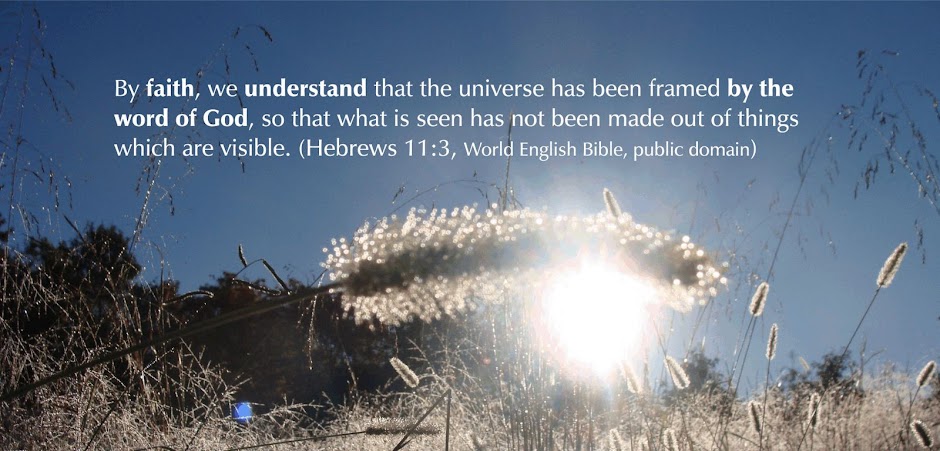
1. God is creator. There is no unassailable proof of this statement. The Bible, itself, does not attempt to prove it. It assumes it. The Bible starts out by saying that God created, in Genesis 1:1 In the beginning, God created the heavens and the earth. (All Bible quotations are from the World English Bible, which is in the public domain, and are in this color.) The Bible says that the best evidence that God is creator is our faith. (Hebrews 11:3 By faith, we understand that the universe has been framed by the word of God, so that what is seen has not been made out of things which are visible.) The Bible further points out that the principal agent in creation was God the Son:
John 1:1 In the beginning was the Word, and the Word was with God, and the Word was God. 2 The same was in the beginning with God. 3 All things were made through him. Without him was not anything made that has been made.

Colossians 1:14 in whom we have our redemption, the forgiveness of our sins; 15 who is the image of the invisible God, the firstborn of all creation.16 For by him all things were created, in the heavens and on the earth, things visible and things invisible, whether thrones or dominions or principalities or powers; all things have been created through him, and for him. 17 He is before all things, and in him all things are held together.

Christians have several views about the timing, and other details, of how things began. However, the most fundamental truth is that God created. Genesis 1:1 does not tell us why, when, or how God created. It does tell us that there was a Who involved in creation. There are people who believe that there is nothing but nature. They are called Naturalists. In other words, they do not believe that there is anything supernatural. To them, there is, and was, no Who. The Bible begins by assuming that that is a wrong belief. It does not attempt to prove this, except by telling us what God is like. (Some Christians mistakenly think that the idea of a Big Bang is a theory that claims that there is no God, or that claims there was no God involved in creation. That view is mistaken. A belief in the Big Bang can be compatible with belief in God as creator.)

Creation was called good, in Genesis 1. This does not necessarily mean that it was good in the sense that it is useful to humans. Goodness in God’s view is more important than usefulness to us!

Psalm 104:24 Yahweh, how many are your works!
In wisdom have you made them all.
The earth is full of your riches.
There is the sea, great and wide,
in which are innumerable living things,
both small and large animals. 
In this passage, we read about the marvelous diversity of creation. Humans have never yet seen many of the organisms that are alive on earth today, let alone found uses for them. They are still important, because God made them, or allowed them to come into existence.

2. God sustains the natural world. Colossians 1:16-17 (above) and Hebrews 1:3a (His Son is the radiance of his glory, the very image of his substance, and upholding all things by the word of his power) indicate that God not only created, but that Christ is presently involved in holding things together, including your body and the monitor you are reading this on. Do we understand this? No, and we aren’t capable of understanding it. God is omnipotent and omniscient. We aren’t. But we do understand, from these passages, that God, especially God the Son, has not gone away and left the world. He is sustaining it now.

3. Humans have responsibility for the world around them. Humans were put in charge of God’s “very good” creation.
Genesis 1:26 God said, “Let us make man in our image, after our likeness: and let them have dominion over the fish of the sea, and over the birds of the sky, and over the livestock, and over all the earth, and over every creeping thing that creeps on the earth.” 28 God blessed them. God said to them, “Be fruitful, multiply, fill the earth, and subdue it. Have dominion over the fish of the sea, over the birds of the sky, and over every living thing that moves on the earth.”

Since the Fall, there have been problems with the natural world, but scripture teaches that it is still important to God, so it should be to us, as well:
Psalm 24:1 The earth is Yahweh’s, with its fullness;
the world, and those who dwell therein.

Psalm 50:10 For every animal of the forest is mine,
and the livestock on a thousand hills.
11 I know all the birds of the mountains.
The wild animals of the field are mine.
[God speaking] 


The Israelites were supposed to take care of their land by letting it lie fallow every seventh year:
Leviticus 25:3 You shall sow your field six years, and you shall prune your vineyard six years, and gather in its fruits; 4 but in the seventh year there shall be a Sabbath of solemn rest for the land, a Sabbath to Yahweh. You shall not sow your field or prune your vineyard. 5 What grows of itself in your harvest you shall not reap, and you shall not gather the grapes of your undressed vine. It shall be a year of solemn rest for the land.

Their failure to obey this command was one reason for their captivity:
II Chronicles  36:20 He carried those who had escaped from the sword away to Babylon, and they were servants to him and his sons until the reign of the kingdom of Persia, 21 to fulfill Yahweh’s word by Jeremiah’s mouth, until the land had enjoyed its Sabbaths. As long as it lay desolate, it kept Sabbath, to fulfill seventy years. [“He” is the king of the Chaldeans.]

Proverbs 12:10a says “A righteous man respects the life of his animal.”

4. God is revealed to us through nature. Here are Bible passages that say that we ought to learn something of what God is, and how God works, through a study of nature.

Job 12:7 “But ask the animals, now, and they will teach you;
the birds of the sky, and they will tell you.
8 Or speak to the earth, and it will teach you.
The fish of the sea will declare to you.
9 Who doesn’t know that in all these,
Yahweh’s hand has done this,
10 in whose hand is the life of every living thing,
and the breath of all mankind?


Psalm 19:1 The heavens declare the glory of God.
The expanse shows his handiwork.
Day after day they pour out speech,
and night after night they display knowledge.
There is no speech nor language,
where their voice is not heard.
Their voice has gone out through all the earth,
their words to the end of the world. 

Acts 14:17 Yet he didn’t leave himself without witness, in that he did good and gave you rains from the sky and fruitful seasons, filling our hearts with food and gladness.

Romans 1:20 For the invisible things of him since the creation of the world are clearly seen, being perceived through the things that are made, even his everlasting power and divinity; that they may be without excuse.

Revelation of God though nature includes knowledge gained through science. Some of the greatest scientists of all time, like Johannes Kepler, have believed that God is revealed through nature:
I give thanks to Thee, O Lord Creator, Who hast delighted me with Thy makings and in the works of Thy hands have I exulted. Behold! now, I have completed the work of my profession, having employed as much power of mind as Thou didst to me; to the men who are going to read those demonstrations I have made manifest the glory of Thy works . . .
From The Harmonies of the World by Johannes Kepler, 1619, translated by Charles Glenn Wallis. (The Great Books, Chicago: Encyclopedia Brittanica, 1952, volume 16, Ptolemy, Copernicus, Kepler, p. 1080.)

Science is not God’s only, or main, means of revelation. (Others include the Bible, our consciences, the Holy Spirit in our lives, the church -- those who believe in Christ as savior and Lord, and, most importantly, the incarnation of Jesus Christ.) But it is one means. Properly understood, scientific findings and scripture do not conflict. However, humans don’t completely understand either scientific or scriptural revelation.

5. God is a God of order. The Bible begins with a portrayal of God’s orderliness in creation. Literal or not, the description in Genesis 1 describes order and sequence. The Ten Commandments, the covenants established with Abraham, and with the Israelites, and God’s promise, (Genesis 8:22) after Noah’s flood, declare that God is a God of order. Some historians of science have written that, without the Judeo-Christian concept of God as a God of order, the development of science would have been impossible. (There were other influences, including Greek and Arab thought, in the development of science, so that science is not a strictly Judeo-Christian enterprise, but it developed among countries where most of the people were at least nominally believers.) There were some technological developments in China before similar ones in Europe, but science doesn’t seem to have developed there as a discipline, perhaps because this sense of order wasn’t part of the prevailing world-view there at that time.

6. The responsibility that humans have for nature (principle 3, above) includes responsibility to learn how it works.
Psalm 111:2 Yahweh’s works are great,
pondered by all those who delight in them

There is delight in such learning (See also principle 4) and it is our responsibility, as good stewards, to learn about God’s works. Some individuals are specially gifted in the area of learning about God’s creation -- in other words, God gives some gifts that help people be scientists.

In a previous post, I listed some scientific principles that tell us about God.

Thanks for reading!

Sunday, September 19, 2010

How does God reveal Himself to humans?

God’s revelation is of two types: Special and General. Special Revelation is through Christ. General Revelation, through other means, does not necessarily tell us about the necessity for salvation. General Revelation may reveal various attributes of God, such as His power, majesty, omniscience, omnipresence, and eternal existence.

God reveals many things, including His attributes, His love, His holiness, how He wants us to act, and guidance in specific situations. How does He do this? Here is a partial list:

  1. Through Christ (Hebrews 1:2)
  2. Through the Bible (2 Timothy 3:16)
  3. By the Holy Spirit (John 16:8-15)
  4. Through nature (Romans 1:20, Psalm 19:1-4, and also Psalm 97:6, Acts 14:17)
  5. By our conscience (Romans 2:15)
  6. Through history (1 Corinthians 10:6-13)
  7. In answer to prayer (1 Kings 18:36-39)
  8. By angels, and in visions and dreams (Matthew 2:19-21)
  9. Through miracles and providence (Exodus 4:1-5)
  10. Through the church (Acts 15:22-29)
  11. Through human creations (“I know three people who overcame temptations to atheism through the music of Johann Sebastian Bach.” - Peter Kreeft; “To him, art was God’s gift to make the earth bearable. Poetry and music were not luxuries, but necessities.” - David, McCasland, Oswald Chambers: Abandoned to God. The Life Story of the Author of My Utmost for His Highest. Grand Rapids, MI: Discovery House, 1993, p. 39; Jeremiah 22:6; Philippians 4:8)

Sources include Wikipedia articles on Revelation of God, and on Revelation. See also Peter Kreeft, “12 Ways to Know God, and also Twenty Arguments for the Existence of God.”

Please note that no single verse, or a few verses, should be taken as a firm basis for any doctrine. I have expanded item 11 more than the others, because the Biblical evidence is less direct.

Thanks for reading.

Wednesday, December 24, 2008

Science and the Bible

Some Christians reject science, in general, as anti-God. Although the charge is not without some foundation, it is an oversimplification, at best, and short-sighted and unbiblical.
Why an oversimplification? Because many important scientists, from, say, Copernicus through Francis Collins, head of the US human genome project, have been believers.

Why short-sighted? Because rejecting scientific findings unnecessarily alienates potential followers of Christ. "If they are so wrong about the science, why should they be right about salvation?"

Why unbiblical? Because God reveals Himself in more than one way, according to the Bible itself. Psalm 19:1-4 tells us that God is revealed through nature, which means that scientific findings can tell us something of God's nature and power. Romans 1 says: "20 For his invisible attributes, namely, his eternal power and divine nature, have been clearly perceived, ever since the creation of the world, in the things that have been made. So they are without excuse." (ESV, which version allows quotation for uses such as this, if properly cited.) Does that mean that scientists are always right? Of course not. There was a time, in the previous century, when the scientific consensus was that genes were made of protein, not DNA. That was wrong. Scientists have made other mistakes, and will continue to make some. But that doesn't mean that consensus science should be rejected out of hand. It's usually right, and its findings are part of God's revelation to us. Mistakes have been made, and will be made, in the interpretation of the Bible, too. That doesn't mean that we should ignore it. The Bible is always right, and our understanding of it usually is.

If both are properly understood, there should be no conflict between the Bible and scientific findings. (I realize that our understanding of both is imperfect, at best.)

This is the fourth anniversary of this blog. Thanks for reading!

*  *  *  *  *

Note added, January 26, 2012: Acts 14 also indicates that God has revealed Himself through nature:
14 But when the apostles, Barnabas and Paul, heard of it, they tore their clothes, and sprang into the multitude, crying out, 15 “Men, why are you doing these things? We also are men of like passions with you, and bring you good news, that you should turn from these vain things to the living God, who made the sky and the earth and the sea, and all that is in them; 16 who in the generations gone by allowed all the nations to walk in their own ways. 17 Yet he didn’t leave himself without witness, in that he did good and gave you rains from the sky and fruitful seasons, filling our hearts with food and gladness.”(World English Bible, public domain)

Saturday, March 17, 2007

What I believe about origins

Some time ago, someone asked me what I believed about origins. What the individual wanted was to see which of several categories of belief I fell into. I didn't exactly answer him on that, and I'm sure I told him more than he wanted to hear, but here's part of my answer.

Then, yesterday, a commenter was surprised that I didn't think purposeless chance was the main creative agent.

So I'm posting this on St. Patrick's Day, even though it's not particularly green.

What do I believe?
1) I believe that God was involved in the planning and execution of the origin of matter, the universe, and life.
2) I believe that the Son had the most important role in this (John 1, and other scriptures, teach this), but the Father and the Holy Spirit must have also been involved.
3) I believe that the Son not only created, but that He somehow is maintaining things. (Colossians 1:14-17)
4) I believe that things changed, due to a deliberate sin by human beings, such that God's original plan is not now completely expressed. How much the Fall has changed things, I'm not sure. Probably a lot. Christ came to redeem us, and the rest of creation, from the effects of that sin.
5) I believe that God's design allowed for emergent properties, that is, for example, Carbon was created so that life, as we know it, could be based on it, when life appeared.
6) I believe that God's design for life was comprehensive enough that He allowed what appear to us to be chance processes to work in carrying it out. However, He may also be actually selecting and directing which sperms succeed, which spores germinate, etc.
7) I believe that God somehow created humans specially. We are especially in His image, we have dominion over other living things, and Christ appeared on earth in human form.

* * * * *
Added July 23, 2007: See here for more on the topic of item 7.
8) I'm not sure exactly what the "image of God" means. I believe that all of God's creation, such as a stone, has some of the image of the creator in it. We have more of it than stones, of course. Presumably the image includes things like the capacity to love, to reason, to communicate, and to create (on a much smaller scale). Perhaps the soul (whatever that is) is God's image in us.
9) I don't know if there are living things on other planets or not. The Bible is silent on the subject, and proving that there are such living things wouldn't bother me. (It is impossible to scientifically prove that there aren't living things on some other planet.) The same holds true for alternate universes. God is big enough to be the God of all the universes, however many there are. We only know of one for sure, though, and of one place in it where there is life.
10) I believe that God used the Big Bang to begin the universe as we know it, and that the Bible does not rule this out. Furthermore, I believe that science has no good explanation for what caused the Big Bang, or came before it, while Christianity and Judaism do have such an explanation -- God planned and created the Big Bang.
11) I believe that I don't have all the answers on this subject, and don't think anyone else does, either.
12) I believe that the most commonly held theories, or at least the ones that are heard about most, namely young-earth creationism (YEC) and intelligent design (ID), are not the same. There are serious differences between them.
13) I believe that God has revealed Himself to us in several ways, including through the Bible, the church, and the work of the Holy Spirit, and that of our own consciouses, in our lives, and also through nature. (Psalm 19, Acts 14:17, Romans 1:20) I believe that we, fallen beings that we are, can and do make mistakes in our interpretation of all of these revelations, but that, nonetheless, they are all legitimate.
14) I believe that God did deliberately design the natural world. (He included the capacity for chance processes, such as natural selection, as part of the design, so that they influence the way living things appear.) However, I don't believe that it is possible to prove (or disprove) God's creative activity in the past (or in the present, for that matter) scientifically. Hebrews 11:3 seems to indicate this.
15) I believe that demanding that the public schools teach that science has proved that YEC, or ID, are true, is a serious mistake, not least because there is no such proof.
16) I believe that science has not, and can not, rule out God's creative activity, in at least the following: the origin of the universe, the origin of living things, the origin of human beings. Scientists (and others) may sincerely doubt that God did any or all of these things, but they have no right to claim that science has ruled them out. It hasn't. No public school or university class, or textbook, should make such claims, and, if such claims are made, they should be strongly fought.
17) I believe that some people, perhaps well-meaning, perhaps not, have screamed loud and long about some view of origins, (usually YEC, but, lately, also ID) and gotten many Christians, or the world at large, to believe that all Christians believe as they do. This is most unfortunate. I believe that some intelligent people have been lost to the kingdom because of militant YEC views.
18) I believe that Christians can legitimately hold any of several views on origins, including YEC or ID, but also others, and should respect the right of other Christians to hold differing views, and welcome them into fellowship. There are a number of views, all held by Christians, and all of them have strengths, and all of them have weaknesses. The only view that all Christians must reject is the naturalistic view, namely that we are here solely because of purposeless chance. If the Bible means anything, this view is false.
19) I believe that many students who are home-schooled, or who attend private Christian schools, are being seriously short-changed, because they are taught that YEC, or ID, is what the Bible teaches, or even what science has proved. They should also be presented with a fair view of other interpretations. Not only are they being short-changed, but future generations of Christian leaders are being misled, and, in turn, misleading others.

Addendum, July 19, 2007: As this post indicates, the Bible tells us that God created because of His love.

Addendum, January 27, 2012: I added some labels/tags, and one bible verse.

Addendum, December 20, 2012: Here's a link to a post from BioLogos on the impossibility of disproving the existence of God. (We can't prove it scientifically, either.)

Addendum, January 29, 2013: I added point 10, above, and modified point 15.

Addendum, April 8, 2015: I made three minor editorial changes.

Addendum, May 26, 2016: I have discovered a consensus statement on origins, produced by some prominent Christian scientists with different views on the matter, but which they all agree on. I agree with them. (The consensus statement is followed by a listing of points that they don't agree on.)

Thanks for reading.

Tuesday, April 12, 2005

Scriptural Principles that Relate to Science

In a previous post, I list some scientific principles that tell us about God.
Here are some scriptural principles that relate to science:
1. God is creator. There is no unassailable proof of this statement. The Bible, itself, does not attempt to prove it. It just starts out by saying that God created. Genesis 1:1 doesn’t say how, or why, or when, just who. The Bible, itself, says that the best evidence that God is creator is our faith (Hebrews 11:3). The Bible further points out that the principal agent in creation was God the Son (John 1:1-5, Colossians 1:16-17.)
Christians have several views about the timing, and other details, of how things began. However, the most fundamental truth is that God created.
Creation was called good as it was, not good as a tool for humans. Psalm 104:24-5 speaks of the marvelous diversity of creation. Humans have never yet seen many of the organisms that are alive on earth today, let alone found uses for them. They are still important, because God made them.
2. God sustains the natural world. Colossians 1:16-17 and Hebrews 1:3 indicate that God not only created, but that Christ is presently involved in holding things together, including your body and the monitor you are reading this on. Do we understand this? No, and we aren't capable of understanding it. God is omnipotent and omniscient. We aren’t.
3. Humans have some responsibility for the world around them. Humans were put in charge of God's "very good" creation. (Genesis 1:26, 28). Since the Fall, there have been problems with the natural world, but scripture teaches that it is still important to God, (Psalm 24:1, Psalm 50:10-11) so it should be to us, as well. The Israelites were supposed to take care of their land by letting it lie fallow every seventh year (Leviticus 25:4-7), and their failure to obey this command was one reason for their captivity (II Chronicles 36:21). Proverbs 12:10 says that a righteous man cares for the needs of his animal.
4. God is revealed to us through nature. Psalm 19:1-4, Acts 14:17, and Romans 1:20 say that we can learn something of what God is, and how God works, through a study of nature. In other words, through science. Some of the greatest scientists of all time, like Johannes Kepler, have believed this:
I give thanks to Thee, O Lord Creator, Who hast delighted me with Thy makings and in the works of Thy hands have I exulted. Behold! now, I have completed the work of my profession, having employed as much power of mind as Thou didst to me; to the men who are going to read those demonstrations I have made manifest the glory of Thy works . . .
From The Harmonies of the World by Johannes Kepler, 1619, translated by Charles Glenn Wallis. (The Great Books, Chicago: Encyclopedia Brittanica, 1952, volume 16, Ptolemy, Copernicus, Kepler, p. 1080.)
Science is not God’s only, or main, means of revelation. (Others include the Bible, our consciences, the Holy Spirit in our lives, and, most importantly, the incarnation of Jesus Christ.) But it is one means. Properly understood, scientific findings and scripture do not conflict. However, humans don't completely understand either scientific or scriptural revelation.
5. God is a God of order. The Bible begins with a portrayal of God’s orderliness in creation. Literal or not, the description describes order and sequence. The Ten Commandments, the covenants established with Abraham, and with the Israelites, and God’s promise, in Genesis 8:22, after Noah’s flood, declare that God is a God of order. Some historians of science have written that, without the Judeo-Christian concept of God as a God of order, the development of science would have been impossible. (There were other influences, including Greek and Arab thought, in the development of science.) There were some technological developments in China before similar ones in Europe, but science doesn’t seem to have developed there as a discipline, perhaps because this sense of order wasn’t part of the prevailing world-view there at that time.
6. The responsibility that humans have for nature (principle 3, above) includes responsibility to learn how it works.
Psalm 111:2 Great are the works of the Lord,
studied by all who delight in them. (ESV)
There is delight in such learning (See also principle 4) and it is our responsibility, as good stewards. Some individuals are specially gifted in the area of learning about God's creation -- in other words, God gives some gifts that help people be scientists.

Creative Commons License

This work is licensed under a Creative Commons License. My purpose is not to restrict use, but to prevent anyone else from restricting the use of this material by copyrighting it. Other uses are welcome!

* * * * *

On April 15, 2005, I fixed a link in this post (I hope). Thanks, John Dekker!

On May 15, 2007, I added principle 6.

On January 27, 2012, I added a scripture reference, and some tags.