License

I have written an e-book, Does the Bible Really Say That?, which is free to anyone. To download that book, in several formats, go here.
Creative Commons License
The posts in this blog are licensed under a Creative Commons Attribution-NonCommercial-ShareAlike 3.0 Unported License. You can copy and use this material, as long as you aren't making money from it. If you give me credit, thanks. If not, OK.
Showing posts with label Colossians 1:16-17. Show all posts

Monday, July 26, 2021

Hebrews 2 on Christ and creation

Hebrews 1:1 God, having in the past spoken to the fathers through the prophets at many times and in various ways, 1:2 has at the end of these days spoken to us by his Son, whom he appointed heir of all things, through whom also he made the worlds. 1:3 His Son is the radiance of his glory, the very image of his substance, and upholding all things by the word of his power … (World English Bible, public domain)

If you ask the average believer to tell you which of the three persons of the Trinity was most important in creation, most of them will say that it was the Father. The passage above, and others, such as John 1:1-3, indicate that the correct answer to that question is the Son.

Hebrews 1 also indicates that the role of the Son was not confined to getting things started, but also is sustaining - "upholding all things by the word of his power ...." Christ, God the Son, seems to be holding the universe, and the subatomic particles in my brain, together. How? I don't know. Colossians 1:16-17 reinforces that idea. Praise to the Son, redeemer, creator and sustainer!

Friday, October 03, 2014

"What's with all the talk about religion? I thought this was a scientific web site?"

The title of this post is taken from a comment posted a day or so ago, on a post on why living things have cells. You can see the comment following that post.

The title poses two fair questions. I attempted a brief answer in my response to that comment, but let me muse further.

Why all the talk about religion?

I believe in a Creator, a powerful God who created the universe, after an amazing divine plan, and who still is involved in the universe today. (Colossians 1:16 For by him all things were created, in the heavens and on the earth, things visible and things invisible, whether thrones or dominions or principalities or powers; all things have been created through him, and for him. 17 He is before all things, and in him all things are held together. St. Paul used the present tense in verse 17.)

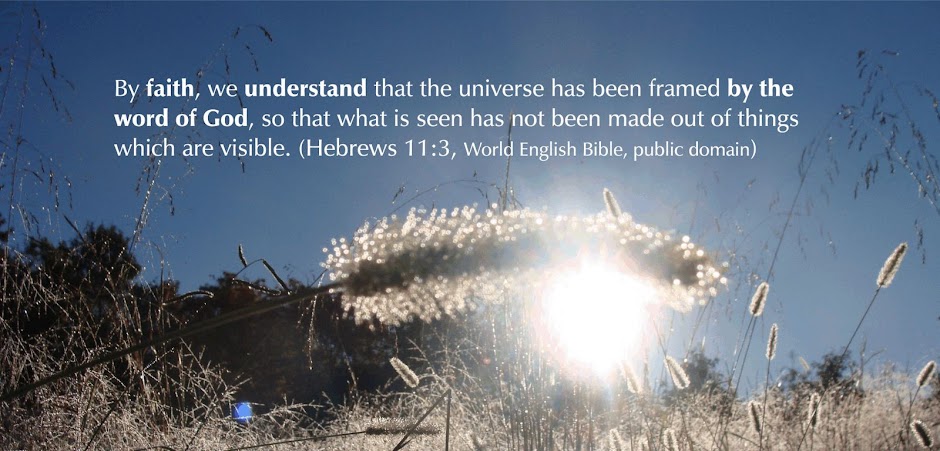
Although it is not possible to prove God's existence scientifically -- see the verse in the graphic at the top of the page, which tells us that we understand God's creative power by faith -- it is not possible to disprove it, either. Prominent atheists, such as Richard Dawkins and Stephen Hawking, have tried, but have not done so, and Dawkins has not claimed to have presented a knock-down proof for God's non-existence. If there is even a possibility that the universe, and we ourselves, are the result of a divine plan of some sort, that possibility must be taken seriously.

Like great scientists of the past (and present) such as Johannes Kepler, Robert Boyle, Francis Collins, and others, lots of them, I believe that all the things scientists can study are present because of a Creator, who initially began the universe, probably with the Big Bang, or just before the Big Bang, and established it with the processes, laws and physical constants that scientists have been finding out about for centuries, and which processes, laws and constants make the earth a place where we can live. I also believe, as indicated in the verses quoted above, that God the Son is presently involved in maintaining the universe. Like those great scientists, responsible for much of the foundations of astronomy, chemistry, and sequencing the human genome, respectively, I believe that God is important, and doing or studying science without acknowledging Him is like building a house without a foundation.

I thought this was a scientific web site?

Well, yes and no. It's a blog, wherein I discuss all sorts of things that have been, or are of interest to me, such as, for example, why living things have cells, or the color green, or whether there are signs that one is, or is not a believer, or the writing of Connie Willis, award-winning science fiction author.

Some of the posts relate to science, some do not.

Thanks for reading.

Monday, February 04, 2013

Scriptural Principles that Relate to Science

Here are some scriptural principles that relate to science:

1. God is creator. There is no unassailable proof of this statement. The Bible, itself, does not attempt to prove it. It assumes it. The Bible starts out by saying that God created, in Genesis 1:1 In the beginning, God created the heavens and the earth. (All Bible quotations are from the World English Bible, which is in the public domain, and are in this color.) The Bible says that the best evidence that God is creator is our faith. (Hebrews 11:3 By faith, we understand that the universe has been framed by the word of God, so that what is seen has not been made out of things which are visible.) The Bible further points out that the principal agent in creation was God the Son:
John 1:1 In the beginning was the Word, and the Word was with God, and the Word was God. 2 The same was in the beginning with God. 3 All things were made through him. Without him was not anything made that has been made.

Colossians 1:14 in whom we have our redemption, the forgiveness of our sins; 15 who is the image of the invisible God, the firstborn of all creation.16 For by him all things were created, in the heavens and on the earth, things visible and things invisible, whether thrones or dominions or principalities or powers; all things have been created through him, and for him. 17 He is before all things, and in him all things are held together.

Christians have several views about the timing, and other details, of how things began. However, the most fundamental truth is that God created. Genesis 1:1 does not tell us why, when, or how God created. It does tell us that there was a Who involved in creation. There are people who believe that there is nothing but nature. They are called Naturalists. In other words, they do not believe that there is anything supernatural. To them, there is, and was, no Who. The Bible begins by assuming that that is a wrong belief. It does not attempt to prove this, except by telling us what God is like. (Some Christians mistakenly think that the idea of a Big Bang is a theory that claims that there is no God, or that claims there was no God involved in creation. That view is mistaken. A belief in the Big Bang can be compatible with belief in God as creator.)

Creation was called good, in Genesis 1. This does not necessarily mean that it was good in the sense that it is useful to humans. Goodness in God’s view is more important than usefulness to us!

Psalm 104:24 Yahweh, how many are your works!
In wisdom have you made them all.
The earth is full of your riches.
There is the sea, great and wide,
in which are innumerable living things,
both small and large animals. 
In this passage, we read about the marvelous diversity of creation. Humans have never yet seen many of the organisms that are alive on earth today, let alone found uses for them. They are still important, because God made them, or allowed them to come into existence.

2. God sustains the natural world. Colossians 1:16-17 (above) and Hebrews 1:3a (His Son is the radiance of his glory, the very image of his substance, and upholding all things by the word of his power) indicate that God not only created, but that Christ is presently involved in holding things together, including your body and the monitor you are reading this on. Do we understand this? No, and we aren’t capable of understanding it. God is omnipotent and omniscient. We aren’t. But we do understand, from these passages, that God, especially God the Son, has not gone away and left the world. He is sustaining it now.

3. Humans have responsibility for the world around them. Humans were put in charge of God’s “very good” creation.
Genesis 1:26 God said, “Let us make man in our image, after our likeness: and let them have dominion over the fish of the sea, and over the birds of the sky, and over the livestock, and over all the earth, and over every creeping thing that creeps on the earth.” 28 God blessed them. God said to them, “Be fruitful, multiply, fill the earth, and subdue it. Have dominion over the fish of the sea, over the birds of the sky, and over every living thing that moves on the earth.”

Since the Fall, there have been problems with the natural world, but scripture teaches that it is still important to God, so it should be to us, as well:
Psalm 24:1 The earth is Yahweh’s, with its fullness;
the world, and those who dwell therein.

Psalm 50:10 For every animal of the forest is mine,
and the livestock on a thousand hills.
11 I know all the birds of the mountains.
The wild animals of the field are mine.
[God speaking] 


The Israelites were supposed to take care of their land by letting it lie fallow every seventh year:
Leviticus 25:3 You shall sow your field six years, and you shall prune your vineyard six years, and gather in its fruits; 4 but in the seventh year there shall be a Sabbath of solemn rest for the land, a Sabbath to Yahweh. You shall not sow your field or prune your vineyard. 5 What grows of itself in your harvest you shall not reap, and you shall not gather the grapes of your undressed vine. It shall be a year of solemn rest for the land.

Their failure to obey this command was one reason for their captivity:
II Chronicles  36:20 He carried those who had escaped from the sword away to Babylon, and they were servants to him and his sons until the reign of the kingdom of Persia, 21 to fulfill Yahweh’s word by Jeremiah’s mouth, until the land had enjoyed its Sabbaths. As long as it lay desolate, it kept Sabbath, to fulfill seventy years. [“He” is the king of the Chaldeans.]

Proverbs 12:10a says “A righteous man respects the life of his animal.”

4. God is revealed to us through nature. Here are Bible passages that say that we ought to learn something of what God is, and how God works, through a study of nature.

Job 12:7 “But ask the animals, now, and they will teach you;
the birds of the sky, and they will tell you.
8 Or speak to the earth, and it will teach you.
The fish of the sea will declare to you.
9 Who doesn’t know that in all these,
Yahweh’s hand has done this,
10 in whose hand is the life of every living thing,
and the breath of all mankind?


Psalm 19:1 The heavens declare the glory of God.
The expanse shows his handiwork.
Day after day they pour out speech,
and night after night they display knowledge.
There is no speech nor language,
where their voice is not heard.
Their voice has gone out through all the earth,
their words to the end of the world. 

Acts 14:17 Yet he didn’t leave himself without witness, in that he did good and gave you rains from the sky and fruitful seasons, filling our hearts with food and gladness.

Romans 1:20 For the invisible things of him since the creation of the world are clearly seen, being perceived through the things that are made, even his everlasting power and divinity; that they may be without excuse.

Revelation of God though nature includes knowledge gained through science. Some of the greatest scientists of all time, like Johannes Kepler, have believed that God is revealed through nature:
I give thanks to Thee, O Lord Creator, Who hast delighted me with Thy makings and in the works of Thy hands have I exulted. Behold! now, I have completed the work of my profession, having employed as much power of mind as Thou didst to me; to the men who are going to read those demonstrations I have made manifest the glory of Thy works . . .
From The Harmonies of the World by Johannes Kepler, 1619, translated by Charles Glenn Wallis. (The Great Books, Chicago: Encyclopedia Brittanica, 1952, volume 16, Ptolemy, Copernicus, Kepler, p. 1080.)

Science is not God’s only, or main, means of revelation. (Others include the Bible, our consciences, the Holy Spirit in our lives, the church -- those who believe in Christ as savior and Lord, and, most importantly, the incarnation of Jesus Christ.) But it is one means. Properly understood, scientific findings and scripture do not conflict. However, humans don’t completely understand either scientific or scriptural revelation.

5. God is a God of order. The Bible begins with a portrayal of God’s orderliness in creation. Literal or not, the description in Genesis 1 describes order and sequence. The Ten Commandments, the covenants established with Abraham, and with the Israelites, and God’s promise, (Genesis 8:22) after Noah’s flood, declare that God is a God of order. Some historians of science have written that, without the Judeo-Christian concept of God as a God of order, the development of science would have been impossible. (There were other influences, including Greek and Arab thought, in the development of science, so that science is not a strictly Judeo-Christian enterprise, but it developed among countries where most of the people were at least nominally believers.) There were some technological developments in China before similar ones in Europe, but science doesn’t seem to have developed there as a discipline, perhaps because this sense of order wasn’t part of the prevailing world-view there at that time.

6. The responsibility that humans have for nature (principle 3, above) includes responsibility to learn how it works.
Psalm 111:2 Yahweh’s works are great,
pondered by all those who delight in them

There is delight in such learning (See also principle 4) and it is our responsibility, as good stewards, to learn about God’s works. Some individuals are specially gifted in the area of learning about God’s creation -- in other words, God gives some gifts that help people be scientists.

In a previous post, I listed some scientific principles that tell us about God.

Thanks for reading!

Friday, September 21, 2012

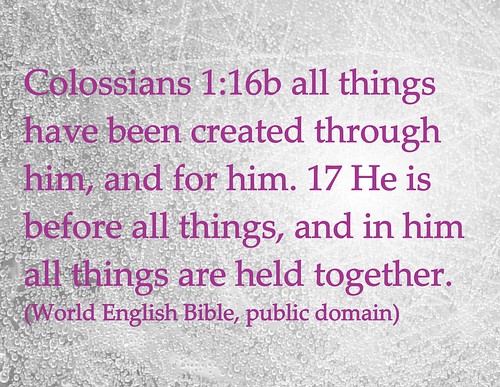
Colossians 1:16-17 poster

Colossians 1:16-17
A poster, attempting to portray Colossians 1:16-17, which says that "all things have been created through him, and for him. He is before all things, and in him all things hold together." (World English Bible, public domain)

This, as I see it, means two important things, for Christians. One is that God the Son was the most important agent of creation, whenever and however that occurred, and the other is that God hasn't gone off and left the universe alone -- it is continuously being held together. Don't ask me how.

I chose what I hope is a royal purple color for the text. I chose a spider web for the background, because it illustrates things being held together. I tweaked it a little in Corel Draw.

Thanks for looking, and reading. The graphic serves as a link to a larger version, posted to Flickr.

Friday, July 06, 2012

The Higgs boson -- what it is, etc.

I'm not a nuclear physicist, but this week's landmark discovery (apparently) of the Higgs boson deserves some mention by me. So does the work of the many scientists and other workers who made this event possible.

Here's an article by Reuters, explaining what the Higgs boson/field is all about. Here's another article from Reuters, about the announcement of the discovery. Here's an article from the Christian Science Monitor, including a photo of Peter Higgs, and a 3 minute 27 video explaining the particle/field. And, of course, there's a Wikipedia article.

Physicists cannot explain why there is a universe at all, or why it has the properties we have found. There is nothing in this discovery that eliminates or rules out the activity of God. As Colossians 1 puts it, "in him all things hold together." ("Him" is Christ.)

Thanks for reading. It's more than the Higgs field that holds the universe (and you and me) together.

Friday, May 11, 2012

Dembski and Falk: Is Darwin Theologically Neutral? Falk's position

There has recently been an exchange of views between some Southern Baptist theologians, and members of the BioLogos Foundation, on the question posed by the title. I have posted on the views of William Dembski, a Southern Baptist theologian, and a prominent member of the Intelligent Design movement (ID), expressed in two posts, which was published on the BioLogos blog, and on responses to those views, from Todd C. Wood, a young-earth creationist whose views I admire and respect, which were published independently on his own blog. The last post in this series was here. It has links to the previous posts, and related matters.

I now turn to the response of Darrel Falk, president of the BioLogos Foundation, whose views on origins are often called evolutionary creationism. Like Dembski, Falk first puts forth his own position. There is a second part to Falk's response, in which he sets forth some disagreement with Dembski, and I hope to muse about that at a later date.

Falk shares considerable common ground with Dembski. But he parts ways with him on the matter of God's activity. ID advocates argue that God's activity, in the development of living things, including humans, must have involved a number of supernatural, miraculous acts, and that, furthermore, in principle, it is possible for scientific analysis to show that such miraculous acts were necessary. Falk disagrees, in at least two important ways.

First, Falk does believe in the miraculous, events which are not explicable by science, not ordinary natural activity. (Christ's incarnation and resurrection are two such.) But he claims that God's activity is not usually what we would call miraculous, and, furthermore, that God's ordinary activity is necessary for the maintenance of the universe. He writes:

The Law of Gravity, for example, is not something that God set up in the beginning, thereafter recusing himself from further involvement and exiting from the scene. Instead, the Law of Gravity works as it does because of the ongoing activity of God’s Spirit in the universe. So consistent is that activity that it can be described mathematically through scientific analysis. If God ceased to be active, however, then not only would the matter of this universe no longer function in a way which enables a mathematical description of gravity, matter itself would cease to exist.

Falk goes on to say this:

Put another way, the activity of God is not restricted to that which we call the supernatural; it is all God’s activity. It is just that some aspects of God’s activity are so consistently repeatable that we can develop laws which describe the regularity of the divine activity which “holds” and “sustains” the universe. This latter type of activity is no less magnificent just because God does it continuously.

He cites Hebrews 1:3 and Colossians 1:17 in support of his position. (Unfortunately, he gives the reference as Colossians 1:16, not 1:17, but he quotes 1:17)

Second, Falk says that we are too prone to think miracles were necessary, when perhaps they weren't:

Given the many examples of supernatural activity in Scripture, we human beings tend to expect that for something as special as creation of stars or new species, supernatural activity would have been required. But we cannot derive this from the scriptural account and, therefore, it is wise not to second-guess how God might have worked based on the Scriptures. . . . When the Psalmist describes the heavens as being the work of his fingers (Psalm 8:3), this does not negate astronomy’s description of the regular and ongoing processes that give rise to stars in God’s universe. Those processes are natural, but they are every bit as much God’s activity as if he were to take huge balls of matter and miraculously fashion sparkling stars with his hands.

I believe that Falk is correct on these two points, and that I have been guilty of confusing miracles with ordinary activity at times. I wish that Dembski had responded to this post, but, as far as I know, he has not.

Thanks for reading. Read Falk.

Friday, March 16, 2012

Water into wine

John 2:1 The third day, there was a marriage in Cana of Galilee. Jesus’ mother was there. 2 Jesus also was invited, with his disciples, to the marriage. 3 When the wine ran out, Jesus’ mother said to him, “They have no wine.”
4 Jesus said to her, “Woman, what does that have to do with you and me? My hour has not yet come.”
5 His mother said to the servants, “Whatever he says to you, do it.” 6 Now there were six water pots of stone set there after the Jews’ way of purifying, containing two or three metretes* apiece. 7 Jesus said to them, “Fill the water pots with water.” They filled them up to the brim. 8 He said to them, “Now draw some out, and take it to the ruler of the feast.” So they took it. 9 When the ruler of the feast tasted the water now become wine, and didn’t know where it came from (but the servants who had drawn the water knew), the ruler of the feast called the bridegroom, 10 and said to him, “Everyone serves the good wine first, and when the guests have drunk freely, then that which is worse. You have kept the good wine until now!” 11 This beginning of his signs Jesus did in Cana of Galilee, and revealed his glory; and his disciples believed in him. 
*2 to 3 metretes is about 20 to 30 U. S. Gallons, or 75 to 115 liters. (From the World English Bible, public domain.)
This is a remarkable story. Only John's gospel tells it. There doesn't seem to be any suggestion that this is to be taken any other way than as a history of something that Jesus did. Therefore, there are two possibilities. Either John (or someone else) made this up, or it really happened. I believe in the truth of the Bible, so I reject the first possibility. If it really happened, it was some sort of miracle.

I say some sort, because, of course, John didn't tell us exactly what Jesus did, presumably because he, John didn't know. What, then, did Jesus do? I certainly don't know, either. But I can muse about it.

Verse 6 apparently means that the capacity of these water pots was about 100 liters, not that they were filled with water already. It doesn't completely rule out that there was some water in one or more of these pots. Verse 7 indicates that the servants filled these pots, perhaps from the village well. Apparently, as the water was poured, the contents of the pots became wine.

How did Jesus do this? We don't know, of course, but however and whatever He did, it was miraculous.

The chemical formula for alcohol (ethanol -- there are many kinds of alcohol. Ethanol is the kind in alcoholic beverages) is C2H5OH. The chemical formula for water is H2O. There are no carbon atoms in pure water, and, even if the water was impure, with some carbon atoms in it, they wouldn't be expected to be  incorporated into molecules of ethanol. Somehow, Jesus either created ethanol molecules, or transformed water molecules into ethanol. Such feats are beyond our ability, even today. (It is possible, I suppose, that Jesus, instead, acted on the taste buds and nasal passages of the ruler of the feast, and the other guests, but the text doesn't suggest that, and, even if it happened, it would be as miraculous as creating, or transforming, molecules.)
Some people of past times, including the alchemists of the West, believed that there is a philosopher's stone, that has the power to produce gold by transformation of other elements. Elements generally don't change into other elements, but this does happen, through some kinds of radioactive decay, and it is possible for humans to use nuclear reactions to change some types of elements into others. (See the Wikipedia article on Nuclear transmutation.) But don't expect to go to your friendly neighborhood university physics department and expect that they are capable of transforming hydrogen or oxygen atoms into carbon atoms, or water molecules into ethanol molecules. This is just not possible. (It is believed that several hydrogen atoms, through a long and involved processes, can be transformed into a carbon atom, in the heart of stars.)

How is wine made, normally? The process is carried out by yeast organisms, which require sugar to work on, and contain the appropriate enzymes for breaking the sugar down and making ethanol and carbon dioxide from it. (See Wikipedia article on ethanol fermentation) That normal process is remarkable enough that I consider the ability of yeasts to carry it out to be similar to a miracle, although it is a natural process -- somehow God has made it possible for it to be carried out, apparently with no divine intervention. But Colossians 1:16-17 indicate that Christ somehow sustains the universe at present, including sustaining yeasts, grapes, and ethanol fermentation:
16 For by him all things were created, in the heavens and on the earth, things visible and things invisible, whether thrones or dominions or principalities or powers; all things have been created through him, and for him. 17 He is before all things, and in him all things are held together.
There is more to wine than ethanol and water. There is a science, or art, of wine tasting, which I know very little about, but there are numerous chemicals in wine, besides ethanol and water, and the ruler of the feast must have detected a pleasing mixture of these, and ethanol, in what he tasted. Jesus would have had to create other substances, besides ethanol, in this wine.

I confess that I started thinking about this subject yesterday, and decided to write this post without checking the approximately 2,000 posts already published in this blog. I just now discovered that I had already posted on this miracle. However, I decided to go ahead and publish this post, which is a little more extensive.

Thanks for reading.

Saturday, February 05, 2011

Russell's teapot

Some time ago, a commenter mentioned Russell's Teapot, and suggested that the idea was pertinent to a post of mine. (See Pete D's first comment on this post.) I had never heard of Russell's Teapot, although I had heard of Bertrand Russell, and I failed to look the matter up right away, which I should have done. I have now done so, and am musing on the topic.

The Wikipedia article on the subject quotes Russell's original statement. Russell's point was that claiming that there is a God, with no scientific proof of His existence, is no more legitimate than claiming that there is a teapot, too small to detect with instruments of any kind, orbiting the sun.

But that's not all. Russell said "since my assertion cannot be disproved, it is an intolerable presumption on the part of human reason to doubt it. . ." I would claim, and I am not alone, that there is a God, but that I cannot advance any scientific proof of His existence. I claim that I have subjective evidence from personal experience; from observing that sin is in the world, yet most people think that sin and evil is somehow unnatural and wrong; and from the Bible, that God exists. I do not claim that it is not legitimate to doubt God's existence. The validity of my personal experience can be questioned. Sometimes I question it myself. Perhaps our notion that the world is somehow spoiled is mistaken. It is possible that the Bible is a fabrication. In other words, the sentence quoted at the beginning of this paragraph does not apply to my belief, or to that of many other Christians. Just because something cannot be disproved, does not mean that it is not legitimate to doubt its existence.

For example, A could assert that witches can fly. B could respond that she has never seen a witch fly, and even doubt that witches exist. A could counter by asking B to prove that witches do not exist. B could respond that witches have not been found under various circumstances. A could, in that case, respond that there are other circumstances, which B has not experienced, in which witches do exist, and fly. It is not possible for B to examine all possible circumstances, but it is still reasonable for B to doubt that witches can fly.

I don't argue, and I don't think many Christians do, that the fact that Russell cannot disprove God's existence is an important reason for believing in God. I do think that the inability to disprove God's existence is a defense of belief in God. Not a strong one, but a defense. I agree that there is no scientific proof of God's existence. But, as I said, I believe that there are other kinds of proofs of that existence, and that it is not necessary to have scientific proof of His existence for me, and others, to believe in God. There are some things that a significant number of important mainstream scientists believe, that, so far, at least, lack scientific proof. These include the existence of the Higgs boson, and of universes that are parallel to our own, and string theory.

Hebrews 11:3 says: "By faith, we understand that the universe has been framed by the word of God, so that what is seen has not been made out of things which are visible." Verse 6, of the same chapter, says "Without faith it is impossible to be well pleasing to him, for he who comes to God must believe that he exists, and that he is a rewarder of those who seek him." (WEB -- I'm using the WEB because it is public domain. I can't link directly to a verse in that Bible, because the web site uses frames.) As I understand it, and I may be wrong on more than one level, God offers humans the choice as to whether or not to believe. There is enough evidence, to an honest seeker, to bring about belief, but the evidence must be accepted by faith. Thomas didn't have to feel Christ's wounds to know that he was looking at the Resurrected Lord.

My understanding is that the things that happen in the world, which are the province of science, such as the doings of cells and ecosystems and galaxies and quarks and chemical reactions and photosynthesis and tectonic plates and water drops, are expressions of God Himself. In Psalm 19:1, David wrote:
"The heavens declare the glory of God.
The expanse shows his handiwork."
and in Romans 1:20, Paul said: "For the invisible things of him since the creation of the world are clearly seen, being perceived through the things that are made, even his everlasting power and divinity; that they may be without excuse." And it isn't just that God is revealed through the existence of created things. As Colossians 1 puts it: "16 For by him all things were created, in the heavens and on the earth, things visible and things invisible, whether thrones or dominions or principalities or powers; all things have been created through him, and for him. 17 He is before all things, and in him all things are held together." (WEB) God, mostly God the Son, made things as they are, and so that they work the way they do. He intimately binds up the test tube, the spectrophotometer, the computer recording the data, the scientist herself, and the means of communicating the results. It's no wonder that the experimenter will not find evidence for God in an experiment.


I also see that there is a sin problem in the world, and in me, and that God alone offers a satisfactory solution, namely the sacrificial death of the incarnated Son of God, validated by His resurrection.


Unfortunately, one thing that helps to keep some people from finding faith in God is that some of us who claim to be Christians don't always live a life consistent with the unselfish teaching of Christ.


One of Russell's great efforts, in collaboration with Whitehead, was "an attempt to derive all mathematical truths from a well-defined set of axioms and inference rules in symbolic logic." In other words, to prove the legitimacy of mathematics beyond any possible doubt. That attempt, though heroic, failed, with the discovery of Gödel's incompleteness theorems. It is not possible to prove the legitimacy of mathematics beyond any possible doubt. But I use mathematics, and I believe that it is right to do so.

The two, putting math on a completely logical and systematic foundation, and arguing that belief in the existence of God does not make sense, are not the same thing, and not exactly comparable. But, I believe, both efforts were and are futile, even for a man as brilliant as the late Lord Russell.

Thanks for reading. I thank Pete D. for his comment.

Sunday, October 25, 2009

Colossians 1:16-17 poster

Hiatus coming - Colossians 1:16-17 poster
(For ESV copyright and usage information, see here.)

The passage speaks for itself. However, I have previously posted about the implications for Christian stewardship of the environment.

Thanks for reading and looking.

Thursday, July 16, 2009

Additional Biblical reasons for environmental stewardship

I have previously posted on "Environmental Stewardship in the Bible," and, in fact, this is one of what I consider to be one of my most significant posts (out of about 1,200!). I freely confess that the Biblical reasons for trying to keep the environment around us in as good a condition as we can were mostly, maybe totally, not original.

In this post, I wish to put forward two new arguments from the Bible, in favor of trying to preserve endangered species, and endangered ecosystems or communities. As far as I know, they are original. Perhaps that is so because they aren't very good reasons. I don't know.

Psalm 19:1-4 and Romans 1:20 tell us that observing and learning about nature are part of God’s revelation to humans. If that is so, isn’t that another reason to try to preserve nature as well as we can? The Bible is one of the ways that God reveals Himself to us. For a long time, Christians have believed that the Bible should be translated into the language people are most familiar with, so that that revelation may be as clear as possible. Similarly, it would seem that God's revelation through nature should be as clear as possible. A person is more likely to see God in a pristine stream than in a polluted river. Probably seeing bison herds roam freely in Western North America gave people a glimpse of one aspect of God’s power and majesty that they can’t really get now. Therefore, helping to preserve nature in as good a condition as we can is one way to bring people to a saving knowledge of Christ. Not the most direct way, and probably not the most effective, for many people, but it is still a way to do this.

2) Colossians 1:15-20 says, of Christ, that “in Him all things hold together.” (ESV -- other versions have similar language. See here for the ESV policy on electronic use of this version of the Bible.) That passage also says that He is working to reconcile all things to Himself, and that He is working to make peace through the blood of the cross. As Christians, we believe that it is our duty to be His instruments in reconciling sinners to Christ, and to help Him in the ministry of making peace. In fact, 2 Corinthians 5:18-19, tell us that:  18 But all things are of God, who reconciled us to himself through Jesus Christ, and gave to us the ministry of reconciliation; 19 namely, that God was in Christ reconciling the world to himself, not reckoning to them their trespasses, and having committed to us the word of reconciliation.

Doesn’t it follow that we should also participate in Christ’s work of sustaining “all things,” including endangered species and ecosystems or biological communities? (I realize that there are other places in the New Testament where reconciliation and peacemaking are mentioned, or implied, and this is probably the only one that mentions Christ's sustaining work. But that doesn't mean that His sustaining work can be dismissed, or that we have no responsibility to be His instruments in doing it.)

What do you think?

Thanks for reading. (This post was edited on October 16, 2009. I attempted to enhance the arguments, without changing them. On September 26, 2013, I added the quotation from 2 Corinthians, and the introduction to it.)

Saturday, March 17, 2007

What I believe about origins

Some time ago, someone asked me what I believed about origins. What the individual wanted was to see which of several categories of belief I fell into. I didn't exactly answer him on that, and I'm sure I told him more than he wanted to hear, but here's part of my answer.

Then, yesterday, a commenter was surprised that I didn't think purposeless chance was the main creative agent.

So I'm posting this on St. Patrick's Day, even though it's not particularly green.

What do I believe?
1) I believe that God was involved in the planning and execution of the origin of matter, the universe, and life.
2) I believe that the Son had the most important role in this (John 1, and other scriptures, teach this), but the Father and the Holy Spirit must have also been involved.
3) I believe that the Son not only created, but that He somehow is maintaining things. (Colossians 1:14-17)
4) I believe that things changed, due to a deliberate sin by human beings, such that God's original plan is not now completely expressed. How much the Fall has changed things, I'm not sure. Probably a lot. Christ came to redeem us, and the rest of creation, from the effects of that sin.
5) I believe that God's design allowed for emergent properties, that is, for example, Carbon was created so that life, as we know it, could be based on it, when life appeared.
6) I believe that God's design for life was comprehensive enough that He allowed what appear to us to be chance processes to work in carrying it out. However, He may also be actually selecting and directing which sperms succeed, which spores germinate, etc.
7) I believe that God somehow created humans specially. We are especially in His image, we have dominion over other living things, and Christ appeared on earth in human form.

* * * * *
Added July 23, 2007: See here for more on the topic of item 7.
8) I'm not sure exactly what the "image of God" means. I believe that all of God's creation, such as a stone, has some of the image of the creator in it. We have more of it than stones, of course. Presumably the image includes things like the capacity to love, to reason, to communicate, and to create (on a much smaller scale). Perhaps the soul (whatever that is) is God's image in us.
9) I don't know if there are living things on other planets or not. The Bible is silent on the subject, and proving that there are such living things wouldn't bother me. (It is impossible to scientifically prove that there aren't living things on some other planet.) The same holds true for alternate universes. God is big enough to be the God of all the universes, however many there are. We only know of one for sure, though, and of one place in it where there is life.
10) I believe that God used the Big Bang to begin the universe as we know it, and that the Bible does not rule this out. Furthermore, I believe that science has no good explanation for what caused the Big Bang, or came before it, while Christianity and Judaism do have such an explanation -- God planned and created the Big Bang.
11) I believe that I don't have all the answers on this subject, and don't think anyone else does, either.
12) I believe that the most commonly held theories, or at least the ones that are heard about most, namely young-earth creationism (YEC) and intelligent design (ID), are not the same. There are serious differences between them.
13) I believe that God has revealed Himself to us in several ways, including through the Bible, the church, and the work of the Holy Spirit, and that of our own consciouses, in our lives, and also through nature. (Psalm 19, Acts 14:17, Romans 1:20) I believe that we, fallen beings that we are, can and do make mistakes in our interpretation of all of these revelations, but that, nonetheless, they are all legitimate.
14) I believe that God did deliberately design the natural world. (He included the capacity for chance processes, such as natural selection, as part of the design, so that they influence the way living things appear.) However, I don't believe that it is possible to prove (or disprove) God's creative activity in the past (or in the present, for that matter) scientifically. Hebrews 11:3 seems to indicate this.
15) I believe that demanding that the public schools teach that science has proved that YEC, or ID, are true, is a serious mistake, not least because there is no such proof.
16) I believe that science has not, and can not, rule out God's creative activity, in at least the following: the origin of the universe, the origin of living things, the origin of human beings. Scientists (and others) may sincerely doubt that God did any or all of these things, but they have no right to claim that science has ruled them out. It hasn't. No public school or university class, or textbook, should make such claims, and, if such claims are made, they should be strongly fought.
17) I believe that some people, perhaps well-meaning, perhaps not, have screamed loud and long about some view of origins, (usually YEC, but, lately, also ID) and gotten many Christians, or the world at large, to believe that all Christians believe as they do. This is most unfortunate. I believe that some intelligent people have been lost to the kingdom because of militant YEC views.
18) I believe that Christians can legitimately hold any of several views on origins, including YEC or ID, but also others, and should respect the right of other Christians to hold differing views, and welcome them into fellowship. There are a number of views, all held by Christians, and all of them have strengths, and all of them have weaknesses. The only view that all Christians must reject is the naturalistic view, namely that we are here solely because of purposeless chance. If the Bible means anything, this view is false.
19) I believe that many students who are home-schooled, or who attend private Christian schools, are being seriously short-changed, because they are taught that YEC, or ID, is what the Bible teaches, or even what science has proved. They should also be presented with a fair view of other interpretations. Not only are they being short-changed, but future generations of Christian leaders are being misled, and, in turn, misleading others.

Addendum, July 19, 2007: As this post indicates, the Bible tells us that God created because of His love.

Addendum, January 27, 2012: I added some labels/tags, and one bible verse.

Addendum, December 20, 2012: Here's a link to a post from BioLogos on the impossibility of disproving the existence of God. (We can't prove it scientifically, either.)

Addendum, January 29, 2013: I added point 10, above, and modified point 15.

Addendum, April 8, 2015: I made three minor editorial changes.

Addendum, May 26, 2016: I have discovered a consensus statement on origins, produced by some prominent Christian scientists with different views on the matter, but which they all agree on. I agree with them. (The consensus statement is followed by a listing of points that they don't agree on.)

Thanks for reading.

Tuesday, April 12, 2005

Scriptural Principles that Relate to Science

In a previous post, I list some scientific principles that tell us about God.
Here are some scriptural principles that relate to science:
1. God is creator. There is no unassailable proof of this statement. The Bible, itself, does not attempt to prove it. It just starts out by saying that God created. Genesis 1:1 doesn’t say how, or why, or when, just who. The Bible, itself, says that the best evidence that God is creator is our faith (Hebrews 11:3). The Bible further points out that the principal agent in creation was God the Son (John 1:1-5, Colossians 1:16-17.)
Christians have several views about the timing, and other details, of how things began. However, the most fundamental truth is that God created.
Creation was called good as it was, not good as a tool for humans. Psalm 104:24-5 speaks of the marvelous diversity of creation. Humans have never yet seen many of the organisms that are alive on earth today, let alone found uses for them. They are still important, because God made them.
2. God sustains the natural world. Colossians 1:16-17 and Hebrews 1:3 indicate that God not only created, but that Christ is presently involved in holding things together, including your body and the monitor you are reading this on. Do we understand this? No, and we aren't capable of understanding it. God is omnipotent and omniscient. We aren’t.
3. Humans have some responsibility for the world around them. Humans were put in charge of God's "very good" creation. (Genesis 1:26, 28). Since the Fall, there have been problems with the natural world, but scripture teaches that it is still important to God, (Psalm 24:1, Psalm 50:10-11) so it should be to us, as well. The Israelites were supposed to take care of their land by letting it lie fallow every seventh year (Leviticus 25:4-7), and their failure to obey this command was one reason for their captivity (II Chronicles 36:21). Proverbs 12:10 says that a righteous man cares for the needs of his animal.
4. God is revealed to us through nature. Psalm 19:1-4, Acts 14:17, and Romans 1:20 say that we can learn something of what God is, and how God works, through a study of nature. In other words, through science. Some of the greatest scientists of all time, like Johannes Kepler, have believed this:
I give thanks to Thee, O Lord Creator, Who hast delighted me with Thy makings and in the works of Thy hands have I exulted. Behold! now, I have completed the work of my profession, having employed as much power of mind as Thou didst to me; to the men who are going to read those demonstrations I have made manifest the glory of Thy works . . .
From The Harmonies of the World by Johannes Kepler, 1619, translated by Charles Glenn Wallis. (The Great Books, Chicago: Encyclopedia Brittanica, 1952, volume 16, Ptolemy, Copernicus, Kepler, p. 1080.)
Science is not God’s only, or main, means of revelation. (Others include the Bible, our consciences, the Holy Spirit in our lives, and, most importantly, the incarnation of Jesus Christ.) But it is one means. Properly understood, scientific findings and scripture do not conflict. However, humans don't completely understand either scientific or scriptural revelation.
5. God is a God of order. The Bible begins with a portrayal of God’s orderliness in creation. Literal or not, the description describes order and sequence. The Ten Commandments, the covenants established with Abraham, and with the Israelites, and God’s promise, in Genesis 8:22, after Noah’s flood, declare that God is a God of order. Some historians of science have written that, without the Judeo-Christian concept of God as a God of order, the development of science would have been impossible. (There were other influences, including Greek and Arab thought, in the development of science.) There were some technological developments in China before similar ones in Europe, but science doesn’t seem to have developed there as a discipline, perhaps because this sense of order wasn’t part of the prevailing world-view there at that time.
6. The responsibility that humans have for nature (principle 3, above) includes responsibility to learn how it works.
Psalm 111:2 Great are the works of the Lord,
studied by all who delight in them. (ESV)
There is delight in such learning (See also principle 4) and it is our responsibility, as good stewards. Some individuals are specially gifted in the area of learning about God's creation -- in other words, God gives some gifts that help people be scientists.

Creative Commons License

This work is licensed under a Creative Commons License. My purpose is not to restrict use, but to prevent anyone else from restricting the use of this material by copyrighting it. Other uses are welcome!

* * * * *

On April 15, 2005, I fixed a link in this post (I hope). Thanks, John Dekker!

On May 15, 2007, I added principle 6.

On January 27, 2012, I added a scripture reference, and some tags.