License

I have written an e-book, Does the Bible Really Say That?, which is free to anyone. To download that book, in several formats, go here.
Creative Commons License
The posts in this blog are licensed under a Creative Commons Attribution-NonCommercial-ShareAlike 3.0 Unported License. You can copy and use this material, as long as you aren't making money from it. If you give me credit, thanks. If not, OK.
Showing posts with label ecology. Show all posts

Thursday, April 24, 2014

The Bible and protecting the environment

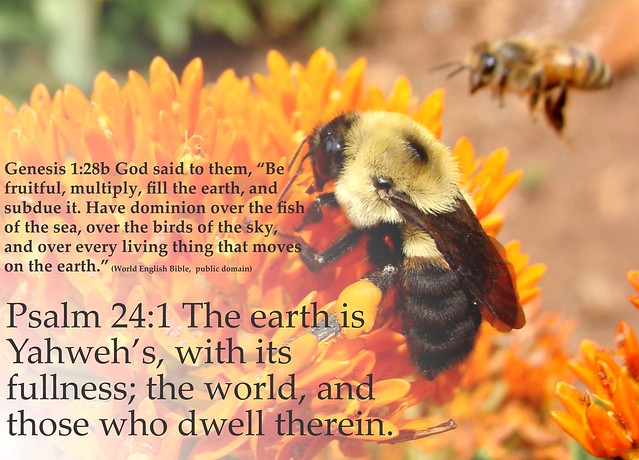
Two Days late for Earth Day - Environmental stewardship This blog didn't have any Earth Day post this year. Sorry. The above graphic is an attempt to make up for that failure. But, just as Christ is risen every day of the year, the earth should be cared for every day of the year.

For an essay on what the Bible says about caring for the environment, and it says a lot, see here.

Thanks for looking!

Wednesday, April 22, 2009

Holmes Rolston, III

Holmes Rolston, III, (See also his web pages at Colorado State University, which are extensive, and include course syllabi, many of his publications, and some video of lectures that he has given.) is arguably the most important figure in the development of environmental ethics, the study of what we should and should not do with the organisms, landscape, communities, bodies of water, geological features, and atmosphere around us. I recently had the privilege of reviewing Saving Creation: Nature and Faith in the Life of Holmes Rolston, III, by Christopher J. Preston. (San Antonio, TX: Trinity University Press, 2009) The book told Rolston's story quite well, covering his professional life, and his personal life, where it fit. (Rolston is still alive.)

I knew of Rolston as an environmental ethicist. He wrote the first paper in the first issue of the journal, Environmental Ethics, which said, in part:
We need wild nature in much the same way that we need the other things in life which we appreciate for their intrinsic rather than their instrumental worth, somewhat like we need music or art, philosophy or religion, literature or drama. But these are human activities, and our encounter with nature has the additional feature of being our sole contact with worth and beauty independent of human activity. We need friends not merely as our instruments, but for what they are in themselves, and, moving one order beyond this, we need wild nature precisely because it is a realm of values which are independent of us. Wild nature has a kind of integrity, and we are the poorer if we do not recognize it and enjoy it. Holmes Rolston III, "Can and Ought We to Follow Nature," Environmental Ethics 1:7-30, Spring, 1979. Quote is from pages 22-23. This paper was the first one in the initial issue of this journal. (Also found here)

I went to a conference on environmental ethics with a philosophy professor from my university, at the University of Georgia, in 1981. Rolston was there. We spoke with him. My friend, more perceptive than I, guessed that Rolston had been a Presbyterian pastor. He was exactly right. Rolston's first professional post was as a pastor in a Presbyterian church in Virginia. He had an undergraduate degree in physics from Davidson College (and once saw Albert Einstein close up, although he didn't speak to him), and a seminary degree from Union Theological Seminary, followed by a doctorate from New College, Edinburgh, Scotland.

Preston's book reminded me of something that I had forgotten. I had read Rolston's Science and Religion: A Critical Survey (Philadelphia: Temple University Press, 1987) about twenty years ago. I had forgotten that it is a powerful plea for a cooperative relationship between science and Christianity. Like Ian G. Barbour's When Science Meets Religion: Enemies, Strangers, or Partners (HarperSanFrancisco, 2000), Rolston believes that science and Christianity should be compatible. Rolston argued for a view of God as being involved in the suffering that goes along with the struggles of life, including for non-human creatures. Clearly a believer, he wrote:
When one is caught in the anguish of the struggle, as in a fight against disease, insanity, infertility, or moral evil, one may still cry out for strength and meaning to the strong son of God, beyond all recourse to biochemistry, beyond all description of the evolutionary struggle. (p. 145)

Preston's biography describes how Rolston found that he wasn't connecting as well with his parishioners as he might have wished. He perhaps, showed too much of his intellect and education to them. At any rate, he pursued an academic career, eventually ending up at Colorado State University in the Department of Philosophy, where he has been based since 1968.

Preston's subtitle indicates what the author believes, namely that Rolston has integrated his study of nature (he is an accomplished naturalist, as well as a philosopher) with his faith. He says that Rolston early saw, however, that he would need to put forth ideas that would be acceptable in a secular world, and he did that, achieving such prominence that he was asked to author that first article in Environmental Ethics.

Rolston had influence outside of academic circles. He participated, with his writing, in acting to preserve the environment in certain conflicts in Virginia, and also in the West.

The answers in environmental ethics are not always obvious, or are controversial. How important is it to preserve a species from extinction? Can feeding human beings from the land used by that species override our stewardship responsibilities? How important is it to preserve wilderness in close to its pristine state? Can we do so? Why should we? Rolston has made important contributions to our thinking about environmental stewardship, and other areas.

One of Rolston's most lyrical works is his essay, "The Pasqueflower," in Natural History, April 1979, pages 6-16. (Also available here.) Rolston has often seen pasqueflowers blooming through the snow in the mountain west. Natural History is a secular publication, not a religious one. But Rolston included this statement:
Perhaps it may not be so fanciful but rather entirely realistic that this pasqueflower should in its limited and natural way come to serve as a symbol for what Jesus in his unlimited, supernatural way represents to the Christian mind, a hint of the release of life from the powers that would suppress it. The pasqueflower is of a piece with the rose of Sharon, which blooms in the desert, and the shoot budding out of the stump of Jesse, for here we have an earthen gesture of the powers of resurgent life. (p. 14)

He deserves the honors that he has received.

Thanks for reading. Read Rolston.

This being Earth Day, you may wish to read my own post, from 2006, on "Environmental Stewardship in the Bible."

Monday, November 26, 2007

"No more sea" -- is John the Revelator telling the whole story?

John begins his description of the new heavens and new earth with this statement: "And I saw a new heaven and a new earth: for the first heaven and the first earth were passed away; and there was no more sea." (Revelation 21:1, KJV) This verse has intrigued me for a long time. Is God really going to create a new habitation for humans without the watery environment that covers three-quarters of the earth? If so, why?

I cannot read God's mind, of course. I am also aware that interpreting Revelation is a tricky business. But it sounds as if John meant exactly what he said, and perhaps he did. Possibly there will be no sea, no waves, no tides, no whales, no plankton, no kelp, no sea horses, no sponges in (or around?) the new habitation of mankind with the heavenly beings.

This has always (dare I say it?) disappointed me. I like the ocean, and ocean life. Some have suggested that John wrote this because he was imprisoned on an island, with no escape, surrounded by the sea. But would God allow his Word to be so influenced by the dislike of one man? I doubt it. I just don't know why that verse is in Revelation.

The Old Testament has a couple of passages that seem to modify the picture of a new, sea-less cosmos. One of these is Genesis 1. In verse 10, Genesis says: God called the dry land Earth, and the waters that were gathered together he called Seas. And God saw that it was good. (ESV)

In verses 20-23, it says: 20 And God said, “Let the waters swarm with swarms of living creatures, and let birds fly above the earth across the expanse of the heavens.” 21 So God created the great sea creatures and every living creature that moves, with which the waters swarm, according to their kinds, and every winged bird according to its kind. And God saw that it was good. 22 And God blessed them, saying, “Be fruitful and multiply and fill the waters in the seas, and let birds multiply on the earth.” 23 And there was evening and there was morning, the fifth day. (ESV) The description of the fifth day (whatever a day is, in this context) concludes, also, with the phrase about God seeing what he had created as good. So the sea, and the creatures in it, were originally declared to be good.

I recently found another passage that seems to relate, namely Ezekiel 47:6-12:
6 And he said to me, “Son of man, have you seen this?”
Then he led me back to the bank of the river. 7 As I went back, I saw on the bank of the river very many trees on the one side and on the other. 8 And he said to me, “This water flows toward the eastern region and goes down into the Arabah, and enters the sea;* when the water flows into the sea, the water will become fresh. 9 And wherever the river goes, every living creature that swarms will live, and there will be very many fish. For this water goes there, that the waters of the sea may become fresh; so everything will live where the river goes. 10 Fishermen will stand beside the sea. From Engedi to Eneglaim it will be a place for the spreading of nets. Its fish will be of very many kinds, like the fish of the Great Sea. 11 But its swamps and marshes will not become fresh; they are to be left for salt. 12 And on the banks, on both sides of the river, there will grow all kinds of trees for food. Their leaves will not wither, nor their fruit fail, but they will bear fresh fruit every month, because the water for them flows from the sanctuary. Their fruit will be for food, and their leaves for healing.” (ESV) *a text note says that the sea in question is the Dead Sea.
So, in this passage, apparently also describing the way things will be after Christ's second coming -- and, also, as prophecy, tricky to interpret -- there will be a sea, with water-dwelling creatures in it.

The Blueletter Bible has commentaries. Two of them bear on this verse. David Guzik says that, to the Hebrews, the sea represented evil, or God's enemies, and cites Psalm 89:9 and Isaiah 57:20 as proof of this. He also says that the sea has already appeared in Revelation, in 13:1, where the beast comes from the sea, and 20:13, as a place holding the dead. A. R. Fausset says this: The sea is the type of perpetual unrest. Hence our Lord rebukes it as an unruly hostile troubler of His people. . . . As the physical corresponds to the spiritual and moral world, so the absence of sea, after the metamorphosis of the earth by fire, answers to the unruffled state of solid peace which shall then prevail.

If I understand them correctly (and they understand Revelation correctly) John was not speaking literally.
Based on the probable symbolic use of the sea by John, on its original goodness, and Ezekiel's statements about the Dead Sea, perhaps there will be some sort of sea in the new heavens and new earth. We'll see, I hope.


Thanks for reading.

* * * *

See this post for more on this topic.

* * * * 
Added February 2, 2015:

In this post, Bible scholar John Walton says, about the Final Kingdom, ". . . there’ll be no sea, which is the place of non-order in the ancient world.

Added November 18, 2015:

In this post, Tim Reddish writes about disorder and order (he agrees with Walton) in the ancient world, and claims that God left chaos in the created world on purpose.

Saturday, October 27, 2007

County size in California vs. South Carolina

A little geography, gentle reader.

Much has been made of the recent fires in San Diego County and other California counties, and I certainly have no desire to complain about such coverage -- we have family members living there. However, perhaps some South Carolina readers, and other readers from the eastern US, may not realize that counties are not the same sorts of things in all parts of the US.

San Diego County
has a large geographic area, namely 4,526 square miles/11,721 square kilometers. In contrast, the combined area of Pickens, Oconee, Greenville, Laurens, Abbeville, Greenwood, and Anderson counties of South Carolina is 4,436 square miles. San Diego County is not the largest county in the US, or in California. Counties in the western US tend to be larger. Although the population of San Diego County is nearly 3,000,000, which is the third largest population of any county in the US, much of the large area is relatively unpopulated. Many of the fires in that county are in such relatively unpopulated areas.

Some are warning that development of such areas is asking for trouble -- fires have apparently been part of the chaparral ecosystem for a long time, and the recently developed areas, left to themselves, would mostly be chaparral.

Just as the southeastern part of the US is subject to coastal hurricanes, and some parts of the US are at risk for earthquakes, some of the US is at risk for wildfires. There doesn't seem to be much that we can do about this. We live in a fallen world, and we humans are in tension with the communities where we live and move, and this tension will, if anything, become larger as we expect to own more and more possessions, and as there are more and more of us.

God help us all!

Thanks for reading.