George R. R. Martin is perhaps the best-selling author of fantastic literature of the last 25 years. His most popular work is a series, still incomplete, entitled “A Song of Ice and Fire.” That series is the basis for the popular HBO TV series, “Game of Thrones.” Martin has won several awards for his writing.
I try to deal with important works of fantastic literature in this blog, although I haven’t tried to touch on vampire literature. Some years ago, I decided not to cover Martin’s work. My reason was that it didn’t affirm anything. Although there were sympathetic characters, their fate was often terrible, and there were some extremely evil characters, who seemed to be unpunished. (I’m sure that the series hasn’t suffered because I’m not following it!)
Two recent articles, not by me, bear on this matter.
The first is an excellent blog post by Elizabeth Moon, who has won awards in fantastic literature herself. Although it doesn’t directly consider Martin's creation, what triggered Moon’s post was a review of Martin’s work. Moon points out that there is a difference between moral complexity and moral ambiguity, and that although, say, Tolkien’s characters experienced moral complexity, what should have been done was clear. (See here for a discussion of Galadriel, for example.) But, says Moon, we are coming to the point where there's a lot of moral ambiguity:
“Moral ambiguity requires that there be no general good and bad–a
chaotic, or amoral, universe–a universe in which the concepts of good
and evil are absent, immaterial, and have no effect on characters’ motivation.”
As indicated above, I haven’t read all of Martin’s series, but Moon has succinctly put my unease about the series into words.
A recent article in Christianity Today points out the same thing I saw in my earlier post -- nothing is affirmed. (I claim no great wisdom here. It’s easy to get Martin’s world view, or at least that part of it.)
As the article puts it: “For Martin, realistic means his characters are complex, ‘gray,’ and
morally ambiguous. There are no heroes in Martin’s books like there are
in The Lord of the Rings. There is no echo of Calvin's description of
human beings as ‘glorious ruins’ — broken, but still able to bear the
Image of God. Martin's image focuses on the ruin, not the glory.”
Thanks for reading. Don’t read George R. R. Martin, or watch the series. Or, if you do, do so carefully.

Musings on science, the Bible, and fantastic literature (and sometimes basketball and other stuff).
God speaks to us through the Bible and the findings of science, and we should listen to both types of revelation.
The title is from Psalm 84:11.
The Wikipedia is usually a pretty good reference. I mostly use the World English Bible (WEB), because it is public domain. I am grateful.
License
I have written an e-book, Does the Bible Really Say That?, which is free to anyone. To download that book, in several formats, go here.

The posts in this blog are licensed under a Creative Commons Attribution-NonCommercial-ShareAlike 3.0 Unported License. You can copy and use this material, as long as you aren't making money from it. If you give me credit, thanks. If not, OK.
The posts in this blog are licensed under a Creative Commons Attribution-NonCommercial-ShareAlike 3.0 Unported License. You can copy and use this material, as long as you aren't making money from it. If you give me credit, thanks. If not, OK.
Thursday, April 04, 2013


Wednesday, April 03, 2013
Sunspots 412
Things I have recently spotted that may
be of interest to someone else:

Christianity: R. C. Sproul's The Truth of the Cross (Orlando: Reformation Trust Publishing, 2008) "I wonder whether Jesus was even aware of the nails and the thorns. He was overwhelmed by the outer darkness. On the cross, He was in hell, totally bereft of the grace and the presence of God, utterly separated from all blessedness of the Father. He became a curse for us so that we one day will be able to see the face of God."
Health: The New York Times reports on a Centers for Disease Control recommendation that babies should not be fed solid food until they are six months old.
Politics: (and maybe computing) A CNN opinion piece, arguing that unlocking your cell phone should not be a crime. (It is!)
Science: Wired discusses the possibility, and the sense, or lack thereof, of reviving the extinct Passenger Pigeon, using some tricks with DNA.
Image source (public domain)
Christianity: R. C. Sproul's The Truth of the Cross (Orlando: Reformation Trust Publishing, 2008) "I wonder whether Jesus was even aware of the nails and the thorns. He was overwhelmed by the outer darkness. On the cross, He was in hell, totally bereft of the grace and the presence of God, utterly separated from all blessedness of the Father. He became a curse for us so that we one day will be able to see the face of God."
Health: The New York Times reports on a Centers for Disease Control recommendation that babies should not be fed solid food until they are six months old.
Politics: (and maybe computing) A CNN opinion piece, arguing that unlocking your cell phone should not be a crime. (It is!)
Science: Wired discusses the possibility, and the sense, or lack thereof, of reviving the extinct Passenger Pigeon, using some tricks with DNA.
Image source (public domain)
Tuesday, April 02, 2013
An atheist philosopher concludes that materialism or naturalism doesn't explain everything, and can't
A splendid article (i. e., one that agrees with many of my biases), by one Andrew Ferguson, has been published in The Weekly Standard. The article is about a book by Thomas Nagel, prominent philosopher, and, by his own testimony, an atheist, who believes in the importance of natural selection, and an old earth. (The writer of the article agrees with Nagel on these points.) But the book's title is Mind and Cosmos: Why the Materialist Neo-Darwinian Conception of Nature Is Almost Certainly False. (If you need a refresher on materialism, here is the Wikipedia article on that subject.)
What the article in The Weekly Standard says that Nagel has done is to resurrect common sense. Here are two examples, quoted from Ferguson:
"Materialism . . . is a premise of science, not a finding."
"Reductive materialism doesn’t account for the 'brute facts' of existence—it doesn’t explain, for example, why the world exists at all, or how life arose from nonlife. Closer to home, it doesn't plausibly explain the fundamental beliefs we rely on as we go about our everyday business: the truth of our subjective experience, our ability to reason, our capacity to recognize that some acts are virtuous and others aren't. These failures, Nagel says, aren't just temporary gaps in our knowledge, waiting to be filled in by new discoveries in science. On its own terms, materialism cannot account for brute facts. Brute facts are irreducible, and materialism, which operates by breaking things down to their physical components, stands useless before them. 'There is little or no possibility,' he writes, 'that these facts depend on nothing but the laws of physics.'" [emphasis in original]
Science has not, and cannot, disprove the existence of a Creator.
Thanks for reading. Read Ferguson!
What the article in The Weekly Standard says that Nagel has done is to resurrect common sense. Here are two examples, quoted from Ferguson:
"Materialism . . . is a premise of science, not a finding."
"Reductive materialism doesn’t account for the 'brute facts' of existence—it doesn’t explain, for example, why the world exists at all, or how life arose from nonlife. Closer to home, it doesn't plausibly explain the fundamental beliefs we rely on as we go about our everyday business: the truth of our subjective experience, our ability to reason, our capacity to recognize that some acts are virtuous and others aren't. These failures, Nagel says, aren't just temporary gaps in our knowledge, waiting to be filled in by new discoveries in science. On its own terms, materialism cannot account for brute facts. Brute facts are irreducible, and materialism, which operates by breaking things down to their physical components, stands useless before them. 'There is little or no possibility,' he writes, 'that these facts depend on nothing but the laws of physics.'" [emphasis in original]
Science has not, and cannot, disprove the existence of a Creator.
Thanks for reading. Read Ferguson!
Monday, April 01, 2013
The Resurrection, Superstition, and the Second Law of Thermodynamics

Death and the Second Law of Thermodynamics (The photo above is of a maple leaf. This post is not an April Fool joke!)
Ephesians 1:18b . . . that you may know what is the hope of his calling, and what are the riches of the glory of his inheritance in the saints, 19 and what is the exceeding greatness of his power toward us who believe, according to that working of the strength of his might 20 which he worked in Christ, when he raised him from the dead, and made him to sit at his right hand in the heavenly places, 21 far above all rule, and authority, and power, and dominion, and every name that is named, not only in this age, but also in that which is to come.
The definitions of life and death are complex, and philosophical as well as biological. Generally, living things are in a constant battle with the second law of thermodynamics. So long as they can obtain enough energy, they win this battle. They can build themselves. They build themselves as non-random, ordered objects. Living things do this, however, only at the expense of order in the universe at large. We can expend energy to build, but, when we do, we are unbuilding something else -- we are causing entropy to increase. However, when we do so, we are taking energy from somewhere else.
For example, we can straighten the back seat of our car, or the dining room table. We change disorder to order. But, to do so, we must use energy that we have taken in in the food we eat, or, perhaps, electrical energy to run various cleaning devices. Starch, say, is an ordered food molecule, containing usable stored energy. Breaking it down changes the combinations molecules of starch into less ordered molecules of carbon dioxide and water, releasing energy in the process, and giving off wasted energy. Disorder arises through almost all natural processes, because of the unbending second law of thermodynamics. The only way to stave off that disorder is by having a source of energy to draw on. However, drawing such energy for use is related to increased disorder somewhere else. For example, the sun is gradually becoming more disordered.
One of the things that happens as a result of death is that the ability of a living thing to stave off the inexorable increase of entropy is gone. Death leads to decay. As Polkinghorne puts it:
In our present world, change and decay are built into the fabric of the universe. The processes by which genetic mutations produce new forms of life are the processes by which cells become cancerous. Death is the necessary cost of life. In fact, a theological defense of the existence of physical evil is that it is not gratuitous but the inescapable price of an evolutionary world, free to make itself within the independence its Creator has granted to it. John C. Polkinghorne, Serious Talk: Science and Religion in Dialogue. Harrisburg, PA: Trinity Press International, 1995, p. 107.
Not only does death lead to decay, but this decay is, in the practical sense, irreversible. If I had the money, and offered some famous research institution a trillion dollars if they could bring one dead maple leaf back to life, I wouldn’t lose my money. It is not humanly possible to reverse the decay in a dead organism, or part of an organism, and bring it back to life. The second law of thermodynamics makes that impossible.
The resurrection, of course, is miraculous, any way you want to look at it. It wasn’t, or isn’t, humanly possible. (That doesn’t mean that it didn’t happen!) We cannot reverse the effects of the second law on a dead leaf, much less a dead human. No wonder Paul called resurrection power “immeasurable” in Ephesians 1:19-20. God’s promise is that Christians have this power working in us.
Superstition?
The biology text I am currently using says this: “The irrational belief that actions that are not logically related to a course of events can influence its outcome is called superstition. . . . different narratives, legends, fairy tales, and epics from all around the globe exist to help people understand the world around them. These stories explain everything from birth and death to disease and healing.” (Jay Phelan, What is Life? Second Edition. New York: Freeman, 2013, pp. 5-6. Emphasis in original.) To be fair, Phelan is not particularly attacking religious belief here, but casts a wider net, including, among other things, the ritualistic actions of baseball players.
Phelan goes on to say that there are “truths” in religion that the scientific method doesn't reveal to us, and that these are based on “personal faith, traditions, and mythology.” (p. 6. Phelan put quotation marks around “truths,” implying, I think, that he’s not sure that they are truths.)
Phelan is mostly right. Beliefs that are not logically related to a course of events are sometimes believed to cause things that they don’t. I classify the belief that vaccinations cause autism as one such superstition. There are religious beliefs that seem superstitious to me, and, no doubt, many of mine seem superstitious to, say, a Buddhist.
The resurrection, I claim (and I’m not nearly the first!), is an event that there is evidence for. Of course some of my belief in the resurrection is based on personal faith, traditions, and perhaps even mythology. But I submit that there is evidence for the resurrection. In 1 Corinthians 15, Paul says: 3 For I delivered to you first of all that which I also received: that Christ died for our sins according to the Scriptures, 4 that he was buried, that he was raised on the third day according to the Scriptures, 5 and that he appeared to Cephas, [Peter] then to the twelve. 6 Then he appeared to over five hundred brothers at once, most of whom remain until now, but some have also fallen asleep. 7 Then he appeared to James, [the half-brother of Christ] then to all the apostles, 8 and last of all, as to the child born at the wrong time, he appeared to me also. In other words, there were hundreds of people, in Paul’s day, who had seen the living, resurrected Christ. That’s evidence.
There is other evidence for the resurrection. How else can we explain the transformation of Peter from a coward who didn’t acknowledge that he was one of Christ's followers to a bold public speaker, proclaiming the gospel? How else can we explain the growth of the church? How else can I explain how a young lady of my acquaintance, with little interest in the things of God, living in sin with her boyfriend, and their child, had her life turned around, began attending church with her boyfriend and child, reconciled with her estranged mother, and was married to the boyfriend after the morning service on Super Bowl Sunday, 2013? (I know a similar story, about another young lady who married her boyfriend after church service in another place on the next Sunday. Both new wives said that they wanted to show others a life consistent with their faith. Both are living transformed lives.) I credit the power of the resurrection for these and other stories of transformation, and claim that such changes are evidence for the reality of the resurrection. I cannot prove, to the satisfaction of a confirmed atheist, that these events, in the First Century and the Twenty-First, are logically related to the Resurrection, but I submit that they are evidence for such a logical relationship.
Thanks for reading!
Sunday, March 31, 2013
It is impossible to overemphasize the importance of the Resurrection!
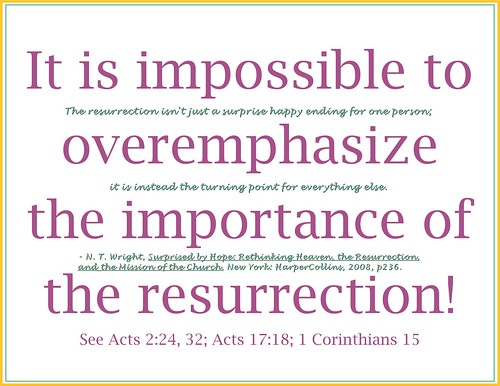
"The resurrection isn't just a surprise happy ending for one person; it is instead the turning point for everything else." - N. T. Wright, Surprised by Hope: Rethinking Heaven, the Resurrection, and the Mission of the Church. New York: HarperCollins, 2008, p236.
1 Corinthians 15:17 If Christ has not been raised, your faith is vain; you are still in your sins. 18 Then they also who are fallen asleep in Christ have perished. 19 If we have only hoped in Christ in this life, we are of all men most pitiable.
20 But now Christ has been raised from the dead. He became the first fruits of those who are asleep. 21 For since death came by man, the resurrection of the dead also came by man. 22 For as in Adam all die, so also in Christ all will be made alive. (World English Bible, public domain)
Wednesday, March 27, 2013
Sunspots 411
Things I have recently spotted that may
be of interest to someone else:
The Arts: (Sort of) From Wired: the preview of a new Star Trek movie.
Christianity: Christianity Today has a discussion about Francis Chan and other radical pastors/authors.
Speculative Faith has a fine post on the resurrection.

Humor: I'm pretty sure that an introvert prepared this chart, distinguishing introverts from extroverts.
Politics: NPR reports on how the number of Americans on disability is growing, in spite of the Americans with Disabilities Act, and why. Most of it is not pretty. Disability, for some people who aren't really disabled, is a way of getting support when they can't find work. State governments have an incentive to get more people on disability, because it's a Federal program. Some parents have an incentive to have their children stay on disability, because, as long as they are, the parents get support. I should add that there are people out there who are genuinely disabled, and helping them should be part of the safety net.
Science: Wired has posted a stunning NASA photo of Mercury.
Image source (public domain)
The Arts: (Sort of) From Wired: the preview of a new Star Trek movie.
Christianity: Christianity Today has a discussion about Francis Chan and other radical pastors/authors.
Speculative Faith has a fine post on the resurrection.
Humor: I'm pretty sure that an introvert prepared this chart, distinguishing introverts from extroverts.
Politics: NPR reports on how the number of Americans on disability is growing, in spite of the Americans with Disabilities Act, and why. Most of it is not pretty. Disability, for some people who aren't really disabled, is a way of getting support when they can't find work. State governments have an incentive to get more people on disability, because it's a Federal program. Some parents have an incentive to have their children stay on disability, because, as long as they are, the parents get support. I should add that there are people out there who are genuinely disabled, and helping them should be part of the safety net.
Science: Wired has posted a stunning NASA photo of Mercury.
Image source (public domain)
Sunday, March 24, 2013
Prayer Born of Compassion, part 4
Paul was wonderfully interested in the religious welfare of his Jewish brethren, was concerned over them, and his heart was strangely warmed with tender compassion for their salvation, even though mistreated and sorely persecuted by them. In writing to the Romans, we hear him thus express himself:
“I say the truth in Christ, I lie not, my conscience also bearing me witness in the Holy
Ghost, that I have great heaviness and continual sorrow in my heart; for I could wish that
myself were accursed for my brethren, my kinsmen according to the flesh.”
What marvellous compassion is here described for Paul’s own nation! What wonder that a little later on he records his desire and prayer:
“Brethren, my heart’s desire and prayer to God for Israel is that they might be saved.”
- From The Essentials of Prayer, by E. M. Bounds.
Although E. M. Bounds died in 1913, this book was first published in 1925, by an admirer of the author's life. Bounds was known for praying from four until seven each morning.
This post is one of a series, taken from The Essentials of Prayer, by Bounds. Found through the Christian Classics Ethereal Library, here. The Essentials of Prayer is in the public domain. The previous post in the entire series on the book is here. Thanks for reading. Read this book, and, more importantly, practice, prayer.
“I say the truth in Christ, I lie not, my conscience also bearing me witness in the Holy
Ghost, that I have great heaviness and continual sorrow in my heart; for I could wish that
myself were accursed for my brethren, my kinsmen according to the flesh.”
What marvellous compassion is here described for Paul’s own nation! What wonder that a little later on he records his desire and prayer:
“Brethren, my heart’s desire and prayer to God for Israel is that they might be saved.”
- From The Essentials of Prayer, by E. M. Bounds.
Although E. M. Bounds died in 1913, this book was first published in 1925, by an admirer of the author's life. Bounds was known for praying from four until seven each morning.
This post is one of a series, taken from The Essentials of Prayer, by Bounds. Found through the Christian Classics Ethereal Library, here. The Essentials of Prayer is in the public domain. The previous post in the entire series on the book is here. Thanks for reading. Read this book, and, more importantly, practice, prayer.
Saturday, March 23, 2013
Beethoven's Ninth Symphony, celebrating the fall of the Berlin Wall
I recently heard, on Performance Today, the fourth movement of Beethoven's Ninth Symphony,
performed near the Berlin Wall, on Christmas Day, 1989,
by musicians from East and West Germany, as well as from the US,
Russia, and elsewhere in Europe, under the direction of Leonard
Bernstein. The Wall had not yet been destroyed, but, for the first time in decades, East and West Germans were allowed to cross between the divided halves of the city, beginning in November, 1989. This performance may be seen on YouTube: part one; part two. The text Beethoven used was from a poem by Schiller. Schiller used "Freude," (Joy), but Bernstein had "Freiheit," (Freedom) substituted for it. "Joyful, joyful, we adore Thee," found in many hymnals, is adapted from the Fourth Movement. See here and here for reports of the concert.
Beethoven was almost totally deaf when he wrote this symphony. According to accounts, he thought he was conducting the orchestra and chorus, but the musicians were instructed not to give him their full attention. The alto soloist turned him around to the audience when the first performance was over, so that Beethoven could see the crowd's reaction. The relaxation of the iron grip of communism in what was the Eastern Bloc was apparently precipitated by Christians in Hungary and elsewhere. It is possible that Mikhail Gorbachev, who was the leader of the Soviet Union, which controlled the Eastern Bloc, at the time of these events, was himself a Christian.
Thanks for reading. Listen, and watch.
Beethoven was almost totally deaf when he wrote this symphony. According to accounts, he thought he was conducting the orchestra and chorus, but the musicians were instructed not to give him their full attention. The alto soloist turned him around to the audience when the first performance was over, so that Beethoven could see the crowd's reaction. The relaxation of the iron grip of communism in what was the Eastern Bloc was apparently precipitated by Christians in Hungary and elsewhere. It is possible that Mikhail Gorbachev, who was the leader of the Soviet Union, which controlled the Eastern Bloc, at the time of these events, was himself a Christian.
Thanks for reading. Listen, and watch.
Wednesday, March 20, 2013
Sunspots 410
Things I have recently spotted that may be of interest to someone else:

Image source (public domain)
Health: (or something) I have learned a new term, benevolent
sexism, from an article in Prevention.
Science: The Independent reports on the
great variety of planets
orbiting stars other than our own sun. A couple of them
apparently have a density less than that of styrofoam, to name one bizarre possibility.
Sports: Congratulations to Vivian Stringer, coach of the Rutgers Women's Basketball team, on her 900th win.
Politics: (and computing) Wired takes on the thorny issue of who owns devices such as a cell phone. Legally, it usually isn't the person paying for it.
Computing: Google Reader has announced that it's
going away. (I have used it a lot for several years.) Gizmo's Freeware has an article on 6
free alternatives. I'm going with Feedly, but there are others. (P. S. I can't seem to get Blogger to remove the bold from this item, no matter what I do to the HTML. Sigh.)
Christianity: Ken
Schenck, who ought to know, posted "Ten
Common Mistakes about the New Testament." He then got rebutted,
by Weekend Fisher. A most interesting conversation.
An interesting post --
a Bible study -- on the question "Can
The Devil Influence The Spirit Through Music?"
Image source (public domain)
Tuesday, March 19, 2013
Does God control the weather, or is it due to natural causes?
The answer, of course, is both.
The BioLogos forum has a most interesting discussion of that question, which relates to origins. It’s well worth reading. This relates to the writings of Ian Barbour on possible relationships between Christianity and science.
Read the BioLogos Forum.
The BioLogos forum has a most interesting discussion of that question, which relates to origins. It’s well worth reading. This relates to the writings of Ian Barbour on possible relationships between Christianity and science.
Read the BioLogos Forum.
Monday, March 18, 2013
How to be saved
I believe in a God who wants
everyone to become a Christian.
The Bible uses the word “saved” for this, sometimes. There are other words, too, such as redeemed and believer. What word is used doesn’t matter. Being sorry for what we’ve done wrong, asking forgiveness, and believing that Christ’s death paid the price for our misdeeds does matter.
Romans 3:23 for all have sinned, and fall short of the glory of God; 24 being justified freely by his grace through the redemption that is in Christ Jesus; 25a whom God sent to be an atoning sacrifice, through faith in his blood
That passage says a lot:
1) I am a sinner by nature.
2) I cannot fix this problem.
3) The problem can be fixed, through receiving, by faith, Christ’s sacrifice. Receiving includes being sorry for the bad things I have done, admitting that I am a sinner, and need help. Part of what I should have faith in is Christ’s resurrection, which proved that His sacrifice for sin was acceptable.
There is nothing I can do to earn salvation. It is provided freely, but I must desire it, and believe that Christ’s sacrifice pays the penalty for my sin (which penalty is eternal death, according to Romans 6:23)
Salvation doesn’t come because I have cleaned up my life. I don’t need to clean up my life to be saved. We can’t clean it up as it really should be, without supernatural help, which mostly comes after salvation. I don’t need to join a church, although doing so is usually a good idea. Joining a church, of itself, will not take care of the problem of sin, unless it’s accompanied by belief in the effectiveness of Christ’s sacrifice. No human action will fix my sin problem. I need to believe in Christ’s payment, already made, for my sin.
Salvation may or may not be accompanied by feelings. But we must not demand or expect that we feel some special way -- some people don’t. And we must not rely on feelings. We can fool ourselves into believing all sorts of things about our feelings. Feelings are temporary. I love my wife, and often I feel that strongly. But sometimes I don’t feel it so strongly. I must still act as if I love her, and believe that I do, regardless of the feeling of the moment. The same is true of salvation.
There are some things that God will help me to do, once I have been saved. These include:
1) Confession of my belief to others. Joining a church, and being baptized, are important forms of confession, but, they won’t save us. In most cases, we also need to tell other people about our choice.
Romans 10:9 that if you will confess with your mouth that Jesus is Lord, and believe in your heart that God raised him from the dead, you will be saved. 10 For with the heart, one believes unto righteousness; and with the mouth confession is made unto salvation.
2) Taking Jesus as Lord. This is referred to in the quotation immediately above. It means following Christ’s teachings, as we understand them, and trying to understand them better, by studying the Bible, and being around experienced, victorious Christians. It means not doing what I want, when I know that it would conflict with what Christ wants.
3) Being baptized. Jesus instructed his disciples, in his last words to them, as recorded in Matthew, to baptize new believers, in the name of the Father, the Son, and the Holy Spirit. There are a number of occasions in Acts where new Christians were baptized soon after receiving Christ as savior, and we need to continue with that pattern.
4) Associate with other believers. (Hebrews 10:25) In most cases, this means joining a church, attending that church’s services, and otherwise participating in the life of the church. Unfortunately, there are some organizations that call themselves churches that do not follow the teachings of Christ, in important ways. For example, they may not speak of the need to be sorry for sin, or of the necessity of following Jesus as Lord. If in doubt, ask God to guide you to a church that honors Him. This is not an excuse for church-shopping. All churches, being made up of humans, have some problems. So it is pointless to look for a perfect church. Look for one that honors Christ and His teachings, and helps you to learn more about His teachings, by what the church teaches, and what it shows in actions.
5) As opportunity allows, try to gently and lovingly persuade other people of their need for salvation.
6) Remind yourself of what you believe, and learn more of what Christians believe, on a regular basis, by personal prayer, Bible reading and study, as well as church participation. (Here’s a post on “What Christians Believe.”) Personal prayer, devotional reading, and study should take place at least daily, in most cases. You should find other books, beside the Bible, to be helpful, but don’t leave the Bible out.
New Christians should use a Bible version which has language easy to understand.
What happens if we fail, knowing that we have not done what Christ wants us to do? We ask forgiveness, and help in doing better, or not doing badly, and go on in our Christian life.

To summarize: Ask Christ to forgive your sins, and make you a new person, with a relationship with God. Believe that He can do this, as evidenced by what the Bible says about Him, and by changes you may have seen in the lives of others. Confess this belief, and your intention, with God’s help, to lead a new life.
Become Discipled -- start, and continue, good habits of prayer, Bible reading, learning how Christians are supposed to act, and telling others of your experience.
Thanks for reading. Much more could, and has, been said on this topic, by others. This is a re-do of a previous post.
For more information, see this post on the evidence that one is a Christian.
The Bible uses the word “saved” for this, sometimes. There are other words, too, such as redeemed and believer. What word is used doesn’t matter. Being sorry for what we’ve done wrong, asking forgiveness, and believing that Christ’s death paid the price for our misdeeds does matter.
Romans 3:23 for all have sinned, and fall short of the glory of God; 24 being justified freely by his grace through the redemption that is in Christ Jesus; 25a whom God sent to be an atoning sacrifice, through faith in his blood
That passage says a lot:
1) I am a sinner by nature.
2) I cannot fix this problem.
3) The problem can be fixed, through receiving, by faith, Christ’s sacrifice. Receiving includes being sorry for the bad things I have done, admitting that I am a sinner, and need help. Part of what I should have faith in is Christ’s resurrection, which proved that His sacrifice for sin was acceptable.
There is nothing I can do to earn salvation. It is provided freely, but I must desire it, and believe that Christ’s sacrifice pays the penalty for my sin (which penalty is eternal death, according to Romans 6:23)
Salvation doesn’t come because I have cleaned up my life. I don’t need to clean up my life to be saved. We can’t clean it up as it really should be, without supernatural help, which mostly comes after salvation. I don’t need to join a church, although doing so is usually a good idea. Joining a church, of itself, will not take care of the problem of sin, unless it’s accompanied by belief in the effectiveness of Christ’s sacrifice. No human action will fix my sin problem. I need to believe in Christ’s payment, already made, for my sin.
Salvation may or may not be accompanied by feelings. But we must not demand or expect that we feel some special way -- some people don’t. And we must not rely on feelings. We can fool ourselves into believing all sorts of things about our feelings. Feelings are temporary. I love my wife, and often I feel that strongly. But sometimes I don’t feel it so strongly. I must still act as if I love her, and believe that I do, regardless of the feeling of the moment. The same is true of salvation.
There are some things that God will help me to do, once I have been saved. These include:
1) Confession of my belief to others. Joining a church, and being baptized, are important forms of confession, but, they won’t save us. In most cases, we also need to tell other people about our choice.
Romans 10:9 that if you will confess with your mouth that Jesus is Lord, and believe in your heart that God raised him from the dead, you will be saved. 10 For with the heart, one believes unto righteousness; and with the mouth confession is made unto salvation.
2) Taking Jesus as Lord. This is referred to in the quotation immediately above. It means following Christ’s teachings, as we understand them, and trying to understand them better, by studying the Bible, and being around experienced, victorious Christians. It means not doing what I want, when I know that it would conflict with what Christ wants.
3) Being baptized. Jesus instructed his disciples, in his last words to them, as recorded in Matthew, to baptize new believers, in the name of the Father, the Son, and the Holy Spirit. There are a number of occasions in Acts where new Christians were baptized soon after receiving Christ as savior, and we need to continue with that pattern.
4) Associate with other believers. (Hebrews 10:25) In most cases, this means joining a church, attending that church’s services, and otherwise participating in the life of the church. Unfortunately, there are some organizations that call themselves churches that do not follow the teachings of Christ, in important ways. For example, they may not speak of the need to be sorry for sin, or of the necessity of following Jesus as Lord. If in doubt, ask God to guide you to a church that honors Him. This is not an excuse for church-shopping. All churches, being made up of humans, have some problems. So it is pointless to look for a perfect church. Look for one that honors Christ and His teachings, and helps you to learn more about His teachings, by what the church teaches, and what it shows in actions.
5) As opportunity allows, try to gently and lovingly persuade other people of their need for salvation.
6) Remind yourself of what you believe, and learn more of what Christians believe, on a regular basis, by personal prayer, Bible reading and study, as well as church participation. (Here’s a post on “What Christians Believe.”) Personal prayer, devotional reading, and study should take place at least daily, in most cases. You should find other books, beside the Bible, to be helpful, but don’t leave the Bible out.
New Christians should use a Bible version which has language easy to understand.
What happens if we fail, knowing that we have not done what Christ wants us to do? We ask forgiveness, and help in doing better, or not doing badly, and go on in our Christian life.
To summarize: Ask Christ to forgive your sins, and make you a new person, with a relationship with God. Believe that He can do this, as evidenced by what the Bible says about Him, and by changes you may have seen in the lives of others. Confess this belief, and your intention, with God’s help, to lead a new life.
Become Discipled -- start, and continue, good habits of prayer, Bible reading, learning how Christians are supposed to act, and telling others of your experience.
Thanks for reading. Much more could, and has, been said on this topic, by others. This is a re-do of a previous post.
For more information, see this post on the evidence that one is a Christian.
Sunday, March 17, 2013
Prayer Born of Compassion, part 3
But compassion has not alone to do with the body and its disabilities and needs. The soul’s distressing state, its needs and danger all appeal to compassion. The highest state of grace is known by the infallible mark of compassion for poor sinners. This sort of compassion belongs to grace, and sees not alone the bodies of men, but their immortal spirits, soiled by sin, unhappy in their condition without God, and in imminent peril of being forever lost. When compassion beholds this sight of dying men hurrying to the bar of God, then it is that it breaks out into intercessions for sinful men.
The Prophet Jeremiah declares this about God, giving the reason why sinners are not consumed by His wrath:
“It is of the Lord’s mercies we are not consumed, because his compassion fail not.”
And it is this Divine quality in us which makes us so much like God. So we find the Psalmist describing the righteous man who is pronounced blessed by God: “He is gracious and full of compassion, and righteous.”
And as giving great encouragement to penitent praying sinners, the Psalmist thus records some of the striking attributes of the Divine character: “The Lord is gracious and full of compassion, slow to anger, and of great mercy.”
It is no wonder, then, that we find it recorded several times of our Lord while on earth that “he was moved with compassion.” Can any one doubt that His compassion moved Him to pray for those suffering, sorrowing ones who came across His pathway?
- From The Essentials of Prayer, by E. M. Bounds.
Although E. M. Bounds died in 1913, this book was first published in 1925, by an admirer of the author's life. Bounds was known for praying from four until seven each morning.
This post is one of a series, taken from The Essentials of Prayer, by Bounds. Found through the Christian Classics Ethereal Library, here. The Essentials of Prayer is in the public domain. The previous post in the entire series on the book is here. Thanks for reading. Read this book, and, more importantly, practice, prayer.
The Prophet Jeremiah declares this about God, giving the reason why sinners are not consumed by His wrath:
“It is of the Lord’s mercies we are not consumed, because his compassion fail not.”
And it is this Divine quality in us which makes us so much like God. So we find the Psalmist describing the righteous man who is pronounced blessed by God: “He is gracious and full of compassion, and righteous.”
And as giving great encouragement to penitent praying sinners, the Psalmist thus records some of the striking attributes of the Divine character: “The Lord is gracious and full of compassion, slow to anger, and of great mercy.”
It is no wonder, then, that we find it recorded several times of our Lord while on earth that “he was moved with compassion.” Can any one doubt that His compassion moved Him to pray for those suffering, sorrowing ones who came across His pathway?
- From The Essentials of Prayer, by E. M. Bounds.
Although E. M. Bounds died in 1913, this book was first published in 1925, by an admirer of the author's life. Bounds was known for praying from four until seven each morning.
This post is one of a series, taken from The Essentials of Prayer, by Bounds. Found through the Christian Classics Ethereal Library, here. The Essentials of Prayer is in the public domain. The previous post in the entire series on the book is here. Thanks for reading. Read this book, and, more importantly, practice, prayer.
Saturday, March 16, 2013
Free e-book available -- Does the Bible Really Say That?
The above graphic is the cover of a free e-book. To know more about the background text used in that cover, you can use the graphic as a link.
During 2012, it was my privilege to lead a small group, at my church, on the theme of “Does the Bible really say that?”
Since then, much of that material has found its way into an ebook, or e-book, of the same title. As of March 13, 2013, this book is ready to distribute, free to anyone who wants it. If you wish, you may distribute the book to others.
The topics covered, some in more depth than others, some with a rather firm conclusion, some not, are as follows:
►The culture of Bible times and understanding the Bible
►Genres of Biblical literature
►Was praying for sinners important in the early church? What are the types of prayer, and what did the early church pray for?
►Must the husband always be the spiritual leader in a home?
►Must marriage ceremonies be conducted in church?
►Is homosexuality the worst sexual sin?
►Is prophecy easy to understand? How certain is prophecy about the tribulation, the rapture and the anti-Christ?
►Can a believer lose her salvation? What does the Bible say about the characteristics of believers?
►Do we go to heaven immediately upon death? Do resurrected believers have a body?
Some of the material in the book was previously posted to this blog, and I thank all readers and commenters.
The World English Bible, which is in the public domain, is quoted extensively, which is fitting, since what the Bible has to say is more important than what I have to say. Besides being in the public domain, the language is mostly understandable to 21st-century readers. (No believeth, hath, thee, etc.)
The book is available as a Word document (a little over 100 pages, with quite a bit of space, and in 13-point type) as an .html file, as a .PDF file, as a Kindle document, and as an epub file (the Barnes & Noble Nook uses such files, as do some other e-readers.)There are links to all five of these formats on this page.
Thanks for reading!
Thursday, March 14, 2013
Homeschoolers wanting texts that teach evolution
According to a recent article in The Atlantic, there are homeschooling evangelical Christian parents who are disgusted with some of the science texts written for the homeschool market -- texts that teach that the earth is only a few thousand years old, and also teach that anyone who rejects that idea rejects God.
Interesting, indeed. I suspect that such people are a small minority.
Going into the world with a dogmatic view that the earth is only a few thousand years old has consequences. One consequence is that telling someone who needs Christ that that’s what the Bible says, when they have good reason to believe that it’s false, is likely to make them doubt what the Bible says about the need for salvation from sin, and Christ’s offer of redemption. If the Bible is wrong about geology (it’s not, but it doesn’t really say for sure that the earth is only 10,000 years old!) then how can it be trusted about sin and salvation?
See here for more on Young-Earth Creationism.
Thanks for reading.
Interesting, indeed. I suspect that such people are a small minority.
Going into the world with a dogmatic view that the earth is only a few thousand years old has consequences. One consequence is that telling someone who needs Christ that that’s what the Bible says, when they have good reason to believe that it’s false, is likely to make them doubt what the Bible says about the need for salvation from sin, and Christ’s offer of redemption. If the Bible is wrong about geology (it’s not, but it doesn’t really say for sure that the earth is only 10,000 years old!) then how can it be trusted about sin and salvation?
See here for more on Young-Earth Creationism.
Thanks for reading.
Wednesday, March 13, 2013
Sunspots 409

Health: An article on healthy
snacking, and which says that snacking helps you lose weight, in AZSCentral.
Science: Fire
ants can sting. I knew that, from experience. But NPR reports
that there are people who are allergic to the bites, which can be life-threatening. There's also a link to a news report that a South
Carolina high school football game was postponed because there were too many fire ant nests on the field. (See here
for my own photo of a fire ant nest.)
NPR also reports on a very
scary "superbug," a bacterial type that is resistant to almost
everything, and can pass that resistance on to other types of bacteria.
Scientists have been
able to get human glial cells (see Wikipedia
article on those) to grow
in mouse brains, according to a report by NPR. These mice acted
normally, as far as could be determined, but were able to learn much more quickly.
NPR also reports that bees
like caffeine, and that it helps their memory.
Monday, March 11, 2013
Chart: how essential are various Christian beliefs?
Someone named C. Michael Patton, whom I don’t know, has posted a chart, with accompanying text, on seven different levels of Christian belief. These range from essential for all Christians to Not Important and Pure Speculation (even though some Christians believe these things). I think that the chart, and the lists of items, are pretty well done, although all the commenters don’t think so.
Thanks for reading. Read Patton.
Thanks for reading. Read Patton.
Sunday, March 10, 2013
Prayer Born of Compassion, part 2
Compassion is not blind. Rather we should say, that compassion is not born of blindness. He who has compassion of soul has eyes, first of all, to see the things which excite compassion. He who has no eyes to see the exceeding sinfulness of sin, the wants and woes of humanity, will never have compassion for humanity. It is written of our Lord that “when he saw the multitudes, he was moved with compassion on them.” First, seeing the multitudes, with their hunger, their woes and their helpless condition, then compassion. Then prayer for the multitudes. Hard is he, and far from being Christlike, who sees the multitudes, and is unmoved at the sight of their sad state, their unhappiness and their peril. He has no heart of prayer for men.
Compassion may not always move men, but is always moved toward men. Compassion may not always turn men to God, but it will, and does, turn God to man. And where it is most helpless to relieve the needs of others, it can at least break out into prayer to God for others. Compassion is never indifferent, selfish, and forgetful of others. Compassion has alone to do with others. The fact that the multitudes were as sheep having no shepherd, was the one thing which appealed to our Lord’s compassionate nature. Then their hunger moved Him, and the sight of the sufferings and diseases of these multitudes stirred the pity of His heart.
- From The Essentials of Prayer, by E. M. Bounds.
Although E. M. Bounds died in 1913, this book was first published in 1925, by an admirer of the author's life. Bounds was known for praying from four until seven each morning.
This post is one of a series, taken from The Essentials of Prayer, by Bounds. Found through the Christian Classics Ethereal Library, here. The Essentials of Prayer is in the public domain. The previous post in the entire series on the book is here. Thanks for reading. Read this book, and, more importantly, practice, prayer.
Compassion may not always move men, but is always moved toward men. Compassion may not always turn men to God, but it will, and does, turn God to man. And where it is most helpless to relieve the needs of others, it can at least break out into prayer to God for others. Compassion is never indifferent, selfish, and forgetful of others. Compassion has alone to do with others. The fact that the multitudes were as sheep having no shepherd, was the one thing which appealed to our Lord’s compassionate nature. Then their hunger moved Him, and the sight of the sufferings and diseases of these multitudes stirred the pity of His heart.
- From The Essentials of Prayer, by E. M. Bounds.
Although E. M. Bounds died in 1913, this book was first published in 1925, by an admirer of the author's life. Bounds was known for praying from four until seven each morning.
This post is one of a series, taken from The Essentials of Prayer, by Bounds. Found through the Christian Classics Ethereal Library, here. The Essentials of Prayer is in the public domain. The previous post in the entire series on the book is here. Thanks for reading. Read this book, and, more importantly, practice, prayer.
Thursday, March 07, 2013
Hate speech and homosexuality
Christianity Today recently published an article by Albert Mohler, in which Mohler said that Tim Tebow, football player and evangelical Christian, recently canceled a speaking engagement at a large Baptist church. At least part of the reason he did seems to have been that the pastor of that church has been vocal about his belief that homosexual behavior is sinful. Mohler quotes a CBS Sports employee as saying that that pastor has been “guilty of serial hate speech.”
This
episode raises the possibility that a Christian may be prosecuted, even jailed,
for saying something consistent with the Bible, and without hating anyone. And
the prosecution might be for hate speech.
Why
do I say this?
I believe
that homosexual activity (not homosexual tendency) is sinful.
Is the
previous sentence hate speech? Maybe.
It shouldn’t be hate speech. Christians should not hate homosexuals, gossips, or
axe murderers. We should hate the things they do, and wish that they would
stop, but it is possible to love them, anyway. Ask any parent if it isn’t
possible to love the person, but not love all of their actions! Christ didn’t
approve of the way Zacchaeus used his position as a tax collector to cheat
people, but He loved Zacchaeus.
Of course, it is possible that
statements about homosexuals are founded on hate, whether expressed or not. Some
of the motivation behind attempts to label homosexuals as particularly sinful,
or to oppose the legalization of homosexual marriage, may be due to hate.
That’s not the Christian way.
In the bold sentence, at the
beginning of the short paragraph above, I said that homosexual sexual activity
is sinful. If I understand my heart, that wasn’t hate speech. It was a fact,
based on what the Bible says. If I say that stealing cars for a living is
sinful, that’s not hate speech. It’s a fact, based on the Ten Commandments.
Opposition to marriage between homosexuals, or to homosexual sexual activity,
isn’t hate speech, morally, unless it is said, or written, with hateful
motives, no matter what is or isn’t politically correct, and no matter what the law says.
The Westboro Baptist Church says, on
its web site, that “God hates fags.”
There’s no doubt of their motives -- their URL is www.godhatesfags.com. That’s hate
speech. God doesn’t hate fags, any more than he hates people who make
statements like that. Both need repentance and redemption.
Saying homosexual activity is sinful
doesn’t need to, and shouldn’t mean that the person who made it hates
homosexuals. But it may be a different matter under the law. The Wikipedia article on hate
speech says this:
In law, hate speech is any speech,
gesture or conduct, writing, or display which is forbidden because it may
incite violence or prejudicial action against or by a protected individual or
group, or because it disparages or intimidates a protected individual or group.
The law may identify a protected individual or a protected group by disability,
ethnicity, gender, gender identity, nationality, religion, race, sexual
orientation, . . . or other characteristic
As I understand it, if the Wikipedia
is correct, the bold statement above may, indeed, be hate speech under the law.
It may disparage or intimidate homosexuals. That wasn’t my intention, but never
mind.
Any Christian (or anyone else) should
be able to say that sexual activity between homosexuals is sinful, in a loving
manner, without it being labeled hate speech, no matter what the laws about
hate speech may say. If saying such means that a person can be charged with a
crime, well, so be it. Believers have been imprisoned for all sorts of “crimes”
in the past, and, if Christ tarries, will be in the future. It should be a mark
of honor to carefully state one’s convictions, in a Christ-like manner,
especially if there is danger of being punished for it.
Thanks for reading. See here for a previous post on homosexuality.
Wednesday, March 06, 2013
Sunspots 408

Science: Chimpanzees and humans are often claimed to have DNA which is over 90% similar, or identical. A recent analysis claims that the similarity, or identity, is, rather, on the order of 60-70%.
A 37 second video in the Huffington Post on the creation of knots with water -- you have to read the description to see what's going on.
Reports in TGDaily and elsewhere that the Arctic icecap is expected to be so reduced (or gone) that ships could sail across the North Pole within 50 years.
Politics: NPR
on
the President's message about the sequester, and on Speaker
Boehner's. There's plenty of blame to go around.
Computing: (Actually, Photography) A
5 minute 42 second video from the BBC, showcasing entries to their garden
photography of the year contest. The entries are broader, being
from nature in general, not always obviously from gardens.
Image source (public domain)
Tuesday, March 05, 2013
More than "Love your neighbor" - Leviticus 19
“Love your neighbor as yourself” is well-known. Jesus said that it was one of the two greatest commandments, and the scribe he was talking to seemed to agree with him, in Mark 12:28-34, and elsewhere in the Gospels.
The context isn’t as well known. Here’s more of Leviticus 19:
16 “‘You shall not go up and down as a slanderer among your people.
“‘You shall not endanger the life of your neighbor. I am Yahweh.
17 “‘You shall not hate your brother in your heart. You shall surely rebuke your neighbor, and not bear sin because of him.
18 “‘You shall not take vengeance, nor bear any grudge against the children of your people; but you shall love your neighbor as yourself. I am Yahweh.”
And more: 33 “‘If a stranger lives as a foreigner with you in your land, you shall not do him wrong. 34 The stranger who lives as a foreigner with you shall be to you as the native-born among you, and you shall love him as yourself; for you lived as foreigners in the land of Egypt. I am Yahweh your God.” (Quoting from the World English Bible, public domain)
That’s amazing, considering what the Old Testament Israelites were told to do to some of the people of the land. Thanks for reading.
The context isn’t as well known. Here’s more of Leviticus 19:
16 “‘You shall not go up and down as a slanderer among your people.
“‘You shall not endanger the life of your neighbor. I am Yahweh.
17 “‘You shall not hate your brother in your heart. You shall surely rebuke your neighbor, and not bear sin because of him.
18 “‘You shall not take vengeance, nor bear any grudge against the children of your people; but you shall love your neighbor as yourself. I am Yahweh.”
And more: 33 “‘If a stranger lives as a foreigner with you in your land, you shall not do him wrong. 34 The stranger who lives as a foreigner with you shall be to you as the native-born among you, and you shall love him as yourself; for you lived as foreigners in the land of Egypt. I am Yahweh your God.” (Quoting from the World English Bible, public domain)
That’s amazing, considering what the Old Testament Israelites were told to do to some of the people of the land. Thanks for reading.
Sunday, March 03, 2013
Prayer Born of Compassion, part 1
We speak here more particularly of spiritual compassion, that which is born in a renewed heart, and which finds hospitality there. This compassion has in it the quality of mercy, is of the nature of pity, and moves the soul with tenderness of feeling for others. Compassion is moved at the sight of sin, sorrow and suffering. It stands at the other extreme to indifference of spirit to the wants and woes of others, and is far removed from insensibility and hardness of heart, in the midst of want and trouble and wretchedness. Compassion stands besides sympathy for others, is interested in them, and is concerned about them.
That which excites and develops compassion and puts it to work, is the sight of multitudes in want and distress, and helpless to relieve themselves. Helplessness especially appeals to compassion. Compassion is silent but does not remain secluded. It goes out at the sight of trouble, sin and need. Compassion runs out in earnest prayer, first of all, for those for whom it feels, and has a sympathy for them. Prayer for others is born of a sympathetic heart. Prayer is natural and almost spontaneous when compassion is begotten in the heart. Prayer belongs to the compassionate man.
There is a certain compassion which belongs to the natural man, which expends its force in simple gifts to those in need, not to be despised. But spiritual compassion, the kind born in a renewed heart, which is Christly in its nature, is deeper, broader and more prayerlike. Christly compassion always moves to prayer. This sort of compassion goes beyond the relief of mere bodily wants, and saying, “Be ye warmed—be ye clothed.” It reaches deeper down and goes much farther.
- From The Essentials of Prayer, by E. M. Bounds.
Although E. M. Bounds died in 1913, this book was first published in 1925, by an admirer of the author's life. Bounds was known for praying from four until seven each morning.
This post is one of a series, taken from The Essentials of Prayer, by Bounds. Found through the Christian Classics Ethereal Library, here. The Essentials of Prayer is in the public domain. The previous post in the entire series on the book is here. Thanks for reading. Read this book, and, more importantly, practice, prayer.
That which excites and develops compassion and puts it to work, is the sight of multitudes in want and distress, and helpless to relieve themselves. Helplessness especially appeals to compassion. Compassion is silent but does not remain secluded. It goes out at the sight of trouble, sin and need. Compassion runs out in earnest prayer, first of all, for those for whom it feels, and has a sympathy for them. Prayer for others is born of a sympathetic heart. Prayer is natural and almost spontaneous when compassion is begotten in the heart. Prayer belongs to the compassionate man.
There is a certain compassion which belongs to the natural man, which expends its force in simple gifts to those in need, not to be despised. But spiritual compassion, the kind born in a renewed heart, which is Christly in its nature, is deeper, broader and more prayerlike. Christly compassion always moves to prayer. This sort of compassion goes beyond the relief of mere bodily wants, and saying, “Be ye warmed—be ye clothed.” It reaches deeper down and goes much farther.
- From The Essentials of Prayer, by E. M. Bounds.
Although E. M. Bounds died in 1913, this book was first published in 1925, by an admirer of the author's life. Bounds was known for praying from four until seven each morning.
This post is one of a series, taken from The Essentials of Prayer, by Bounds. Found through the Christian Classics Ethereal Library, here. The Essentials of Prayer is in the public domain. The previous post in the entire series on the book is here. Thanks for reading. Read this book, and, more importantly, practice, prayer.
Wednesday, February 27, 2013
Sunspots 407

Humor: (or something) The BBC reports that many
Swedish babies and
toddlers are put outside for their mid-day naps, even in the winter.
Science: National Public Radio reports that
dolphins can, and do, use
names to identify each other.
Wired tells us that at least some of the seemingly impossible things that Spider-Man does can be done, or are in development.
Sports: This is going way too far! The University of Alabama has offered an 8th grader a football scholarship, according to Sports Illustrated.
Computing: Gizmo's Freeware has a list of the best
apps for Windows 8 (computers or tablets).
Gizmo's also has an article on two web sites designed to help you delete on-line accounts (Facebook, etc.) quickly.
Christianity: A web page on the
plant described in the parable of the mustard seed, found in Mark
4:30-32.
Image source (public domain)
Sunday, February 24, 2013
Prayer and a Definite Religious Standard, part 6
A Scriptural standard of religion includes a clear religious experience. Religion is nothing if not experimental. Religion appeals to the inner consciousness. It is an experience if anything at all, and an experience in addition to a religious life. There is the internal part of religion as well as the external. Not only are we to “work out our salvation with fear and trembling,” but “it is God that worketh in us to will and do of His good pleasure.” There is a “good work in you,” as well as a life outside to be lived. The new birth is a definite Christian experience, proved by infallible marks, appealing to the inner consciousness. The witness of the Spirit is not an indefinite, vague something, but is a definite, clear inward assurance given by the Holy Spirit that we are the children of God. In fact everything belonging to religious experience is clear and definite, bringing conscious joy, peace and love. And this is the Divine standard of religion, a standard attained by earnest, constant prayer, and a religious experience kept alive and enlarged by the same means of prayer.
An end to be gained, to which effort is to be directed, is important in every pursuit in order to give unity, energy and steadiness to it. In the Christian life, such an end is all important. Without a high standard before us to be gained, for which we are earnestly seeking, lassitude will unnerve effort, and past experience will taint or exhale into mere sentiment, or be hardened into cold, loveless principle.
We must go on. “Therefore, leaving the principles of the doctrine of Christ, let us go on unto perfection.” The present ground we occupy must be held by making advances, and all the future must be covered and brightened by it. In religion, we must not only go on. We must know where we are going to. This is all important. It is essential that in going on in religious experience, we have something definite in view, and strike out for that one point. To ever go on and not to know to which place we are going, is altogether too vague and indefinite, and is like a man who starts out on a journey and does not have any destination in view. It is important that we lose not sight of the starting point in a religious life, and that we measure the steps already trod. But it is likewise necessary that the end be kept in view and that the steps necessary to reach the standard be always in the eye.
- From The Essentials of Prayer, by E. M. Bounds.
Although E. M. Bounds died in 1913, this book was first published in 1925, by an admirer of the author's life. Bounds was known for praying from four until seven each morning.
This post is one of a series, taken from The Essentials of Prayer, by Bounds. Found through the Christian Classics Ethereal Library, here. The Essentials of Prayer is in the public domain. The previous post in the entire series on the book is here. Thanks for reading. Read this book, and, more importantly, practice, prayer.
An end to be gained, to which effort is to be directed, is important in every pursuit in order to give unity, energy and steadiness to it. In the Christian life, such an end is all important. Without a high standard before us to be gained, for which we are earnestly seeking, lassitude will unnerve effort, and past experience will taint or exhale into mere sentiment, or be hardened into cold, loveless principle.
We must go on. “Therefore, leaving the principles of the doctrine of Christ, let us go on unto perfection.” The present ground we occupy must be held by making advances, and all the future must be covered and brightened by it. In religion, we must not only go on. We must know where we are going to. This is all important. It is essential that in going on in religious experience, we have something definite in view, and strike out for that one point. To ever go on and not to know to which place we are going, is altogether too vague and indefinite, and is like a man who starts out on a journey and does not have any destination in view. It is important that we lose not sight of the starting point in a religious life, and that we measure the steps already trod. But it is likewise necessary that the end be kept in view and that the steps necessary to reach the standard be always in the eye.
- From The Essentials of Prayer, by E. M. Bounds.
Although E. M. Bounds died in 1913, this book was first published in 1925, by an admirer of the author's life. Bounds was known for praying from four until seven each morning.
This post is one of a series, taken from The Essentials of Prayer, by Bounds. Found through the Christian Classics Ethereal Library, here. The Essentials of Prayer is in the public domain. The previous post in the entire series on the book is here. Thanks for reading. Read this book, and, more importantly, practice, prayer.
Subscribe to:
Posts (Atom)