Thursday, March 31, 2005

Living wills, advanced directives

By faith Joseph, when he died, made mention of the departing of the children of Israel; and gave commandment concerning his bones. (Hebrews 11:22, KJV, which is public domain)

If nothing else, the Schiavo case has increased the number of people making living wills. Unfortunately, that won't entirely solve the problems that such documents are meant to forestall.

Are existing statements about care in extreme circumstances always followed? Here the answer seems clear: "No." Living wills and advance directives are not always followed. Angela Fagerlin and Carl E. Schneider, in "Enough: The Failure of the Living Will, (.PDF document)" in the March-April 2004 issue of the Hastings Center Report, a periodical which is devoted to issues of medical ethics, (pp. 30-42) argue that advance directives are not effective, for five reasons: 1) they may be made out well in advance, and have been forgotten, or impossible to find (for example in the office of a lawyer who is not aware that the person has been hospitalized) 2) the contents may be vague, or not seen as applying to a particular situation 3) doctors and families are reluctant to conclude that the patient has actually reached the point where a previous decision to refuse treatment should be invoked 4) the family may not follow the advanced directive 5) studies indicate that a majority of patients, given the actual situation, would not follow their own advanced directive.

From a post by the Evangelical Outpost:

Note: Being pro-life also means bearing the responsibility for the decisions about what care and measures should be taken at the end of one's own life. Because God allows us to make choices in our lives, we should take the initiative to communicate to our families our own wishes and desires. The Center for Bioethics and Human Dignity offers an Advance Directive Kit ($12) that contains an Advanced Directive Form and an 80 page booklet on End of Life Decisions (the enclosed form can be copied for every member of the family). Before I began working at the Center I never gave much thought to the issue. But the Schiavo case has made me realize the necessity of taking such precautions. It's a simple, inexpensive step you can take to ensure peace of mind for both you and your own loved ones.

In "3 all-too-common flaws of living wills," an advisor from MSN MoneyCentral suggests the following:

"Draft a durable power of attorney." She says this is superior to a living will.

"Explore your feelings about end-of-life care." Think about what kind of care you think you would want, under various circumstances.

"Talk about what you want--and keep talking." She means to keep discussing what you would want, so that others hear it, and because your perspective will probably change as your circumstances do.

P. S. For what it's worth, I personally do not want to be maintained, if diagnosed as being in a persistent vegetative state. This includes provision of food and water, if other than by normal ingestion through the mouth.

I do not want to be maintained on other means of invasive and non-natural means of life support for an extended period, if there is no reasonable hope of recovery of cortical function.

Wednesday, March 30, 2005

Kiln People by David Brin

David Brin's Kiln People was published by Tom Doherty Associates in 2002. It's a long book, nearly 600 pages. I got it for Christmas, for which I am grateful. The central premise is that there is a method which allows a person's consciousness, personality, or soul to be implanted into a temporary body (more than one at a time, in fact). The original person remains alive and independent, and the experiences of the temporary can be integrated into the memory and experience of the original. This doesn't have to happen--the original may choose not to absorb the memories, or the temporary body may suffer an accident, and not return before degrading. One unique aspect of the story is that the central character is in more than one story line at the same time, as the original and copies of himself. Even though the book is fiction, it is difficult to read it without examining some important and fundamental issues. What is a human being? Should techniques to accomplish such things be developed, or prohibited? Would it be ethical to produce a temporary body solely for the purpose of trying risky things, experiments, or for thrills? For use in combat?

The plot involves the possibility of a sort of immortality, if a copy can produce a new copy.

The book is full of various wordplays on xerox and ditto, such as "ditective" for a temporay agent produced by a sleuth.

The Kiln part of the title is because the temporary bodies are, sort of, baked from clay in a kiln. They decay after 24 hours or so, into slurry, which can be used in making new temporary bodies. The tycoon who owns the dittoing process is named Kaolin.

Here are some quotes:

What happens to the soul of a ditto who loses his salvation--who never gets to inload back into the "real" self who made him? . . . For that matter, what happens when your original dies? Some religions think there's a final transfer, loading your entire lifestream into God, in much the same way your golems pour their memories back into you at the end of each day. But despite fervent yearnings--and well-funded private research--no one's ever found proof of such transfer to some higher-level archetype being. (pp. 108-109.)

There is a ditto religion. A "preacher" of that religion, himself a ditto, hence temporary, speculates about the possibility of some part of a ditto being united with God. "Does heaven have a place for us, as well? If it doesn't, well, maybe it ought to." (p. 102)

Watching "cut-rate" copies doing hard manual labor, the protagonist wonders:

Squinting at the scene one way, I glimpsed a science fiction nightmare worse than Fritz Lang's Metropolis--slaves and prols laboring for distant masters before toppling to an early death, preordained and unmourned. Squint another way, and it seemed marvelous! a world of free citizens, extending tiny portions of themselves--easily expendable bits--to take turns doing all the necessary drudgery, so everyone can spend their organic lifetimes playing or studying. Which was true? (p. 326)

Brin has a web site, with two chapters of the book available. He also has a blog.

Tuesday, March 29, 2005

Low In The Grave He Lay

LOW IN THE GRAVE HE LAY (Public Domain)

Words & Music: Robert Lowry, 1874

Low in the grave He lay, Jesus my Savior, Waiting the coming day, Jesus my Lord!

Refrain

Up from the grave He arose, With a mighty triumph o’er His foes, He arose a Victor from the dark domain, And He lives forever, with His saints to reign. He arose! He arose! Hallelujah! Christ arose!

Vainly they watch His bed, Jesus my Savior; Vainly they seal the dead, Jesus my Lord!

Refrain

Death cannot keep its Prey, Jesus my Savior; He tore the bars away, Jesus my Lord!

Refrain

Monday, March 28, 2005

Temptations in Narnia: Dawn Treader

Edmund and Lucy, and their insufferable cousin, Eustace Scrubb, are called to Narnia, where they join King Caspian on a voyage (in progress) to the East, to try to find seven Narnian lords who had been loyal to him.

Eustace is tempted to be a general nuisance, proud of his own attitude. He succumbs, in the first part of the book.

Governor Gumpas has yielded to the temptation to be a petty tyrant, and to doubt that there is such a person as the real King of Narnia.

Eustace is tempted, and succumbs, to think of himself as special. One symptom is that he attempts to get water above the amount of his ration.

The rest of the crew are tempted to think "That's what he deserved," when Eustace becomes a dragon.

Eustace eventually, after being a dragon for several days, repents, and Aslan changes him back to human form. Edmund speaks comfortingly to him:

"That's all right," said Edmund. "Between ourselves, you haven't been as bad as I was on my first trip to Narnia. You were only an ass, but I was a traitor." C. S. Lewis, The Voyage of the Dawn Treader, New York: Collier Books, 1980. p. 91.

Coriakin, the magician who had been a star, did something that he shouldn't have, or failed to do something that he should have. He was punished by being put in charge of the Dufflepuds. He was tempted to impatience with them, and to not trying to educate them to maturity.

Lucy was tempted to say a spell that would have made her unnaturally beautiful. This may have been Envy. Lucy was also tempted, a short time later, to say a spell that would let her hear what others were saying about her. She yielded to this temptation, then wished that she hadn't:

"I will say the spell," said Lucy. "I don't care. I will." She said I don't care because she had a strong feeling that she mustn't.

But when she looked back at the opening words of the spell, there in the middle of the writing, where she felt quite sure there had been no picture before, she found the great face of a lion, of the Lion, Aslan himself, staring into hers. It was painted such a bright gold that it seemed to be coming towards her out of the page; and indeed she never was sure quite afterwards that it hadn't really moved a little. At any rate she knew the expression on his face quite well. He was growling and you could see most of his teeth. She became horribly afraid and turned over the page at once.

A little later she came to a spell which would let you know what your friends thought about you. Now Lucy had wanted very badly to try the other spell, the one that made you beautiful beyond the lot of mortals. So she felt that to make up for not having said it, she really would say this one. And all in a hurry, for fear her mind would change, she said the words (nothing will induce me to tell you what they were.) C. S. Lewis, The Voyage of the Dawn Treader, New York: Collier Books, 1980. pp. 130-131.

Three of the Narnian Lords were tempted to quarrel, and do so, on Ramandu's Island.

Caspian is tempted to leave the Dawn Treader, breaking his word, and neglecting his duty, in order to go on a quest that he knows is not for him. He takes steps to carry out this plan, but is dissuaded by the others, and, finally, by Aslan. He seems to be showing Pride.

You may be interested in the web site of the forthcoming Narnia movie. It has cover art for all seven Narnia books, by four different artists, the first chapter of each of the books, and a timeline of the books (which is partly speculation, of course, as Lewis didn't explicitly indicate dates).

This post is out of sequence. I thought I had posted it earlier, but obviously hadn't. Thank God for backed up files! Here is the first post in the series.

Sunday, March 27, 2005

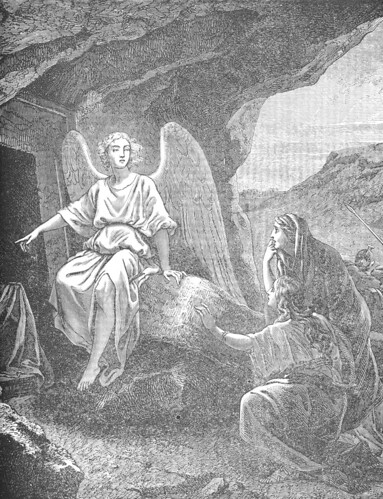
Angel at Empty Tomb

Angel at tomb

I scanned this picture from an old Bible story book, Half Hours With the Bible: New Testament, Being a Consecutive Arrangement of the Narrative and Other Portions of the Holy Scriptures, New York: Clifton Publishing Company, which I got from my parents. The publication date isn't given, but there is an inscription on a flyleaf, dated "Dec 25th 1898." Hence the picture should be public domain, and I offer it as such, if anyone is interested. If you desire the same picture, in higher resolution, leave a comment at the end of this post, including the words "Angel at Empty Tomb." The artist isn't indicated.

Blessed Easter!


Creative Commons License

This work is licensed under a Creative Commons License.


Saturday, March 26, 2005

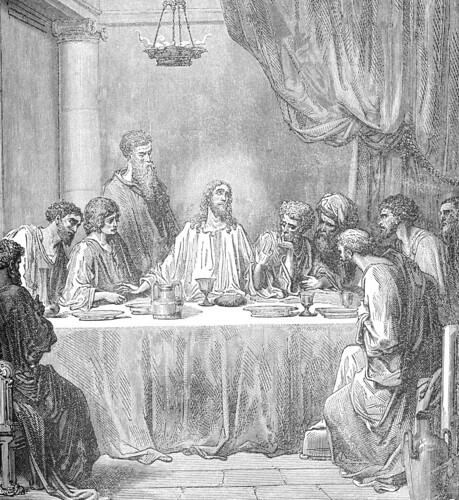
Last Supper Woodcut

Last Supper

This doesn't exactly coincide with events of Holy Week for this day. Sorry.

I scanned this picture from an old Bible story book, Half Hours With the Bible: New Testament, Being a Consecutive Arrangement of the Narrative and Other Portions of the Holy Scriptures, New York: Clifton Publishing Company, which I got from my parents. The publication date isn't given, but there is an inscription on a flyleaf, dated "Dec 25th 1898." Hence the picture should be public domain, and I offer it as such, if anyone is interested. The artist isn't indicated. If you are interested in a higher resolution version of this image, leave a comment at the end of the post, and include the words "Last Supper Woodcut," and I'll see if I can work out a way to send it to you without posting your or my e-mail address.


Creative Commons License

This work is licensed under a Creative Commons License.


Friday, March 25, 2005

Colors: Black

Black is the most common color word in English. According to Wordcount, it is the 356th most common word, between "care" and "book," which is the 357th most common word.

There are only 18 verses in the Bible that have this word, considerably less than for some of the color words in previous posts. These include references to the sky when stormy, or when God is angry, to human and horse hair, and to human skin when exposed to the sun.

Easton's Bible Dictionary: "Colour"

The subject of colours holds an important place in the Scriptures. . . .

Black, applied to the hair ( Lev 13:31; Sgs 5:11), the complexion ( Sgs 1:5), and to horses ( Zec 6:2,6). The word rendered "brown" in Gen 30:32 ( R.V., "black") means properly "scorched", i.e., the colour produced by the influence of the sun's rays. "Black" in Job 30:30 means dirty, blackened by sorrow and disease. The word is applied to a mourner's robes ( Jer 8:21; 14:2), to a clouded sky ( 1Ki 18:45), to night ( Mic 3:6; Jer 4:28), and to a brook rendered turbid by melted snow ( Job 6:16). It is used as symbolical of evil in Zec 6:2, 6 and Rev 6:5. It was the emblem of mourning, affliction, calamity ( Jer 14:2; Lam 4:8; 5:10).

A couple of items on color that I haven't gotten in in previous posts:
The Astronomy Picture of the Day for Feb 27, 2005, is a spectrum of the sun, spread out more than we are used to seing.

More on color and fantastic literature:
Jack Vance is one of the great writers of fantastic fiction. He has won two Hugo awards, and has written for over four decades. He is distinguished by his baroque use of words, and by his imagination. Some of his magical realms have colors that human eyes don't normally see. (Of course Vance can't describe them!) One of his novels, Alastor: Marune, is set on a planet with four suns, orange, blue, red and green. Vance wrote that the citizens' moods and behavior changed, depending on which combination of suns were in the sky. A Vance fan, Eric Halsey, has created a free downloadable software program that shows the 16 color combinations of these four suns. (Warning: file is several megabytes in size. The link is to a page that describes the program. It has a link to download it.) (The previous parenthesis, and the sentence preceding it, were modified on Jan 10, 2007, because of a comment by tap (see below). I thank him.)

My post on Indigo mentioned Whitelaw as a word about as common as Indigo (which isn't very common). Turns out Whitelaw is the name of a town in the UK.

Back to black
Black isn't exactly a color, even though there are black crayons, and black paint. Black is the absence of other colors. If all light is absorbed, the result is black. A black hole is a dense space object that has gravity so strong that the resulting bending of space prevents light from escaping. We can't see a black hole with a telescope, because no light comes from it.

No humans, or any other objects we can see, are pure black. They may be dark, but if they were black, we couldn't see them, because they wouldn't reflect any light. Fantastic writer Gene Wolfe invented a fabric, fuligin, used in his Torturer series, that could not be seen. (Note added Jan 9, 2007: Wolfe says that he didn't invent any words in his Torturer series, more commonly known as the Book of the New Sun.)

Black is often used to symbolize death, despair, or sin. I am posting this on the anniversary of a black day for the disciples. Black has quite a few unhappy connotations. (Think Black Death, for example.) In Tolkien's Ring books, the bad characters often were black, or wore black. (Black breath was a sickness produced by the ringwraiths, and Mordor was referred to as the black land. Sauron was the dark lord.) It is unfortunate that some of these negative connotations have been associated with dark-skinned people.

Sin is sometimes described as black, needing the crimson blood of Christ to cleanse, and make us white.

This, so far as I know, ends my series on colors, which began February 14th of 2005, with a post on red. Thanks to anyone who has read this one, or any or all of the others!

Modifications, noted above, were made to this post on January 9th and 10th, 2007. No other changes have been made to the original post, hence I have kept the original date.

Thursday, March 24, 2005

Temptations in Narnia: The Last Battle

This ends my series on temptations, or moral choices, in the Narnia books, which began with this post. I believe my desire is to go "further up and further in," or "Further in and higher up!" (Both expressions are used in the book.) I am so glad to have had an excuse to read these books yet again.

Peter Chattaway has written that the Narnia books are, in some senses, not only Christian, but Pagan. He is correct in this--Bacchus, fauns, tree spirits and other such beings appear--and quotes C. S. Lewis, himself, to the effect that paganism was pre-Christian--pagans could be converted. Now to some temptations:

Puzzle the Donkey is tempted to not question what he is doing, on the grounds that he isn't very smart. Therefore, he is marginally complicit in putting forth a false Aslan. Shift the Ape is mainly responsible, and yields to the temptation to disguise Puzzle as Aslan, probably because of greed, one of the seven deadly sins. (He wants more nuts, oranges, and bananas, and a more luxurious life.) Later, Puzzle comes to see that he, too is partly responsible: "I see now," said Puzzle, "that I really have been a very bad donkey. I ought never to have listened to Shift. I never thought things like this would begin to happen. - C. S. Lewis, The Last Battle, New York: Macmillan, 1956, p. 79.

G. K. Chesterton wrote a poem, "The Donkey," which I mention because of Puzzle, and which is related to Holy Week. Here's a much more recent posting on a King and a Donkey, by Ish.

When the Ape sets up a false Aslan, the animals are confused. One of the confusions is that the Ape, and the Calormenes that are complicit with him, claim that the awful Calormene deity, Tash, and Aslan, the good Lion, are the same. The animals are tempted to believe this. Ginger, the Cat, yields to the temptation to disbelieve in either deity, and at least some of the Calormenes also do not believe in their own god.

The dwarfs are tempted, like Ginger, to believe that there is no god, nor any Aslan. They succumb to this temptation, and, like Uncle Andrew, in The Magician's Nephew, succeed in making themselves stupider.

Jill, like many of us, and, I think, Lewis himself, is tempted to wish that things would just go on as they were. The Unicorn, Jewel, replies: "Nay, sister," answered Jewel, "all worlds draw to an end; except Aslan's own country." (p. 84)

Susan Pevensie has yielded to temptation, and is "no longer a friend of Narnia." (p. 126)

All the inhabitants of Narnia had to come up to a great door into Aslan's country, and look into his face. Some of them went on into Aslan's country. Some of them disappeared into his great shadow, did not go through the door, and were never seen again. This wasn't exactly a moral choice, but, it seems, the result of the moral choices made before this time.

Emeth, the Calormene, finds out that his choice to serve the god Tash with honor and fairness was actually a moral choice to serve Aslan. He tells his story:
". . . But the Glorious One bent down his golden head and touched my forehead with his tongue and said, Son, thou art welcome. But I said, Alas, Lord, I am no son of Thine but the servant of Tash. He answered, Child, all the service thou has done to Tash, I account as service done to me. Then . . . I overcame my fear and questioned the Glorious One and said, Lord, is it then true, as the Ape said, that thou and Tash are one? The Lion growled so that the earth shook . . . and said, it is false. Not because he and I are one, but because we are opposites, I take to me the services which thou hast done for him, for he and I are of such different kinds that no service which is vile can be done to me, and none which is not vile can be done to him. . . . But I said also . . ., [yet] I have been seeking Tash all my days. Beloved, said the Glorious One, unless thy desire had been for me wouldst not have sought so long and so truly. For all find what they truly seek." - C. S. Lewis, The Last Battle, New York: Macmillan, 1956, p.156-157.

Finally, to those who have chosen to follow Aslan, there is great reward. They begin to spend eternity in Aslan's country:

. . . but the things that began to happen after that were so great and beautiful that I cannot write them. And for us this is the end of all stories, and we can most truly say that they all lived happily ever after. But for them it was only the beginning of the real story. All their life in this world and all their adventures in Narnia had only been the cover and the title page: now at last they were beginning Chapter One of the Great Story, which no one on earth has read: which goes on for ever: in which every chapter is better than the one before. pp. 173-4.

Wednesday, March 23, 2005

Blood Sacrifices

Both the Old and New Testaments, or Covenants, required a blood sacrifice. The author of Hebrews speaks about this:

Hebrews 9:11 But when Christ appeared as a high priest of the good things that have come, then through the greater and more perfect tent (not made with hands, that is, not of this creation) 12 he entered once for all into the holy places, not by means of the blood of goats and calves but by means of his own blood, thus securing an eternal redemption. 13 For if the blood of goats and bulls, and the sprinkling of defiled persons with the ashes of a heifer, sanctify for the purification of the flesh, 14 how much more will the blood of Christ, who through the eternal Spirit offered himself without blemish to God, purify our conscience from dead works to serve the living God.

15 Therefore he is the mediator of a new covenant, so that those who are called may receive the promised eternal inheritance, since a death has occurred that redeems them from the transgressions committed under the first covenant. 16 For where a will is involved, the death of the one who made it must be established. 17 For a will takes effect only at death, since it is not in force as long as the one who made it is alive. 18 Therefore not even the first covenant was inaugurated without blood. 19 For when every commandment of the law had been declared by Moses to all the people, he took the blood of calves and goats, with water and scarlet wool and hyssop, and sprinkled both the book itself and all the people, 20 saying, “This is the blood of the covenant that God commanded for you.” 21 And in the same way he sprinkled with the blood both the tent and all the vessels used in worship. 22 Indeed, under the law almost everything is purified with blood, and without the shedding of blood there is no forgiveness of sins.

23 Thus it was necessary for the copies of the heavenly things to be purified with these rites, but the heavenly things themselves with better sacrifices than these. (ESV)

It is possible to obtain quite a bit of blood from an animal, or a human, without loss of life. The sacrifices mentioned above were more than mere blood sacrifices. They required that the sacrificial animal, or Christ, be killed.

Why a blood sacrifice? I'm not sure, but will speculate.

Blood is the life, according to the Old Testament. (Genesis 9:4, Leviticus 17:11, 14, Deuteronomy 12:23.) What does that mean? Much, maybe all, of the meaning is religious or symbolic. However, there are biological ways in which blood is life, too:

Blood carries Oxygen and food molecules to the body, thus giving life in an even more fundamental way than breathing. Blood also carries metabolic waste products to the kidneys, which remove them. This is also a requirement for life. Without this function, we would die in our poisonous metabolic byproducts.

Blood carries hormones, signals from one part of the body to another. It also contains antibodies, molecules which fight off infections. It has white blood cells, which also defend us. It carries molecules which can clot, plugging holes in our skin or blood vessels.

Perhaps for these reasons, blood has been used as a sacrifice for sin. In the New Testament, Christ's blood also paid the price necessary to defeat death, itself.

Here's a fictional treatment of this:

And there, on the golden gravel of the bed of the stream, lay King Caspian, dead, with the water flowing over him like liquid glass. His long white beard swayed in it like water-weed. And all three stood and wept. Even the Lion wept: great Lion-tears, each tear more precious than the Earth would be if it was a single solid diamond. . . .
"Son of Adam," said Aslan, "go into that thicket and pluck the thorn that you will find there, and bring it to me."
Eustace obeyed. The thorn was a foot long and sharp as a rapier.
"Drive it into my paw, son of Adam," said Aslan. . . .
"Must I?" said Eustace.
"Yes," said Aslan.
Then Eustace set his teeth and drove the the thorn into the Lion's paw. And there came out a great drop of blood, redder than all the redness that you have ever seen or imagined. And it splashed into the stream over the dead body of the King. . . . And the dead King began to be changed. His white beard turned to grey, and from grey to yellow, and got shorter and vanished altogether; and his sunken cheeks grew round and fresh, and the wrinkles were smoothed, and his eyes opened, and his eyes and lips both laughed, and suddenly he leaped up and stood before them--a very young man, or a boy. . . . And he rushed to Aslan and flung his arms as far as they would go round the huge neck; and he gave Aslan the strong kisses of a King, and Aslan gave him the wild kisses of a Lion. -C. S. Lewis, The Silver Chair, New York: Macmillan, 1953, pp. 203-4.

On Feb 11, 2007, I changed the scripture version used from the KJV to the ESV, and deleted Numbers 35:33, deciding that, although its in the Bible, it is not pertinent to the topic of this post. I also added emphasis to the word "blood" as it occurs in the quotation of Hebrews 9.

Tuesday, March 22, 2005

Temptations in Narnia: The Magician's Nephew

This book is about a time before the Pevensie children were born. Digory Kirke, who grows up to become the professor, in The Lion, the Witch, and the Wardrobe, has an Uncle who is a bad magician, a mother who is dying, and a new friend, Polly. Uncle Andrew has been dabbling at magic to transport people between worlds. He is too cowardly to test it himself, and tricks Digory and Polly into testing it for him.

Polly is tempted when Uncle Andrew calls her "a very attractive young lady." She is probably from 10 to 14 years old. This appeals to her pride, one of the seven deadly sins, or her vanity.

Uncle Andrew is tempted to use the children for his own purposes, regardless of any consequences to them. Is he really tempted, in that he has a choice in the matter? I'm not sure. He may be so far gone that he automatically makes bad choices.

Uncle Andrew is tempted by pride, one of the seven deadly sins, to consider himself above all rules:

"Oh, I see. You mean that little boys ought to keep their promises. Very true: most right and proper, I'm sure, and I'm very glad you have been taught to do it. But of course you must understand that rules of that sort, however excellent they may be for little boys--and servants--and women--and even people in general, can't possibly be expected to apply to profound students and great thinkers and sages. . . ."

"All it means," [Digory] said to himself, "is that he thinks he can do anything he likes to get anything he wants." - C. S. Lewis, The Magician's Nephew, New York: Macmillan, 1955, p. 16-17.

He is also tempted, by pride, to sacrifice guinea pigs, Digory, Polly, or anything else, to achieve his goals. When Digory and Polly meet the witch, she has the same kinds of thoughts.

Digory and Polly, in the Wood Between the Worlds, are tempted to explore a world other than their own, just because they can. They do so. They almost forgot to mark their way back. They are tempted to quarrel over almost forgetting this, and do so.

Digory is tempted, apparently out of an insatiable curiosity, to strike the bell in Charn that releases the spell that has kept the witch-queen, Jadis, in a state of suspended animation for a long time, perhaps millenia. This results, eventually, in Jadis coming to our world, London in the early part of the 20th century. It also results in Digory and Polly sending the witch to another world, Narnia, to get her out of London. This is good for our world, but a terrible evil for Narnia. Uncle Andrew, a cab-driver and his horse are inadvertently brought to this world, too.

The witch had been tempted to destroy every living thing on her planet, so that she could survive. She yielded to this temptation:

". . . Then I spoke the Deplorable Word. A moment later I was the only living thing beneath the sun."

"But the people?" gasped Digory.

"What people, boy?" asked the Queen.

"All the ordinary people," said Polly, "who'd never done you any harm. And the women, and the children, and the animals."

"Don't you understand?" said the Queen . . . "I was the Queen. They were all my people. What else were they there for but to do my will."

"It was rather hard luck on them, all the same," said he.

"I had forgotten that you are only a common boy. How should you know about reasons of State? You must learn, child, that what would be wrong for you or for any of the common people is not wrong in a great Queen such as I. . . ." - C. S. Lewis, The Magician's Nephew, New York: Macmillan, 1955, pp. 54-55.

Uncle Andrew is tempted not to believe that Aslan is a rational, moral being, able to speak. He yields to this temptation:

Now the trouble about trying to make yourself stupider than you really are is that you very often succeed. Uncle Andrew did. He soon did hear nothing but roaring in Aslan's song. Soon he couldn't have heard anything else even if he had wanted to. And when at last the Lion spoke and said, "Narnia awake," he didn't hear any words: he heard only a snarl. - C. S. Lewis, The Magician's Nephew, New York: Macmillan, 1955, pp. 112-113.

Digory is tempted to get an apple from the garden of the phoenix in a way that he shouldn't. He is also tempted by the promise of immortality which might come from eating such an apple. The witch does yield to this temptation. Digory doesn't. Because he doesn't, Narnia is protected from the witch for many years, his mother is healed of a fatal illness, and the Wardrobe, which is one of the gateways that connects the two worlds, is eventually built from a tree which grew from the core of the apple that cured Digory's mother.

Monday, March 21, 2005

O Sacred Head, Now Wounded

In honor of Holy Week, and J. S. Bach's birthday, 1685 (Also our younger son-in-law's, quite a few years later).

O sacred Head, now wounded, with grief and shame weighed down,
Now scornfully surrounded with thorns, Thine only crown;
How pale Thou art with anguish, with sore abuse and scorn!
How does that visage languish, which once was bright as morn!

What Thou, my Lord, hast suffered, was all for sinners’ gain;
Mine, mine was the transgression, but Thine the deadly pain.
Lo, here I fall, my Savior! ’Tis I deserve Thy place;
Look on me with Thy favor, vouchsafe to me Thy grace.

Men mock and taunt and jeer Thee, Thou noble countenance,
Though mighty worlds shall fear Thee and flee before Thy glance.
How art thou pale with anguish, with sore abuse and scorn!
How doth Thy visage languish that once was bright as morn!

Now from Thy cheeks has vanished their color once so fair;
From Thy red lips is banished the splendor that was there.
Grim death, with cruel rigor, hath robbed Thee of Thy life;
Thus Thou hast lost Thy vigor, Thy strength in this sad strife.

My burden in Thy Passion, Lord, Thou hast borne for me,
For it was my transgression which brought this woe on Thee.
I cast me down before Thee, wrath were my rightful lot;
Have mercy, I implore Thee; Redeemer, spurn me not!

What language shall I borrow to thank Thee, dearest friend,
For this Thy dying sorrow, Thy pity without end?
O make me Thine forever, and should I fainting be,
Lord, let me never, never outlive my love to Thee.

My Shepherd, now receive me; my Guardian, own me Thine.
Great blessings Thou didst give me, O source of gifts divine.
Thy lips have often fed me with words of truth and love;
Thy Spirit oft hath led me to heavenly joys above.

Here I will stand beside Thee, from Thee I will not part;
O Savior, do not chide me! When breaks Thy loving heart,
When soul and body languish in death’s cold, cruel grasp,
Then, in Thy deepest anguish, Thee in mine arms I’ll clasp.

The joy can never be spoken, above all joys beside,
When in Thy body broken I thus with safety hide.
O Lord of Life, desiring Thy glory now to see,
Beside Thy cross expiring, I’d breathe my soul to Thee.

My Savior, be Thou near me when death is at my door;
Then let Thy presence cheer me, forsake me nevermore!
When soul and body languish, oh, leave me not alone,
But take away mine anguish by virtue of Thine own!

Be Thou my consolation, my shield when I must die;
Remind me of Thy passion when my last hour draws nigh.
Mine eyes shall then behold Thee, upon Thy cross shall dwell,
My heart by faith enfolds Thee. Who dieth thus dies well.

Words: Attributed to Bernard of Clairvaux, 1153 (Salve caput cruentatum); translated from Latin to German by Paul Gerhardt, 1656 (O Haupt voll Blut und Wunden), and from Latin to English James W. Alexander, 1830. (My source: The Cyberhymnal)

Music: “Passion Chorale,” Hans L. Hassler, 1601; harmony by Johann S. Bach, 1729

Sunday, March 20, 2005

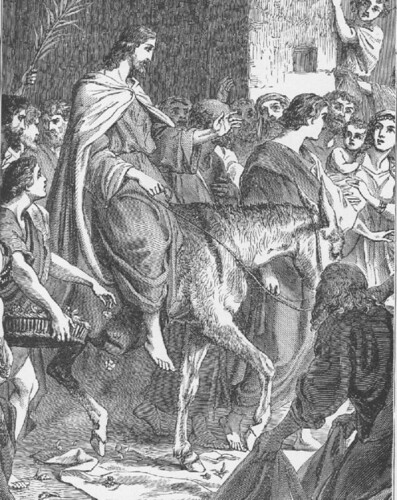
Triumphal Entry

Triumphal entry

I scanned this picture from an old Bible story book, Half Hours With the Bible: New Testament, Being a Consecutive Arrangement of the Narrative and Other Portions of the Holy Scriptures, New York: Clifton Publishing Company, which I got from my parents. The publication date isn't given, but there is an inscription on a flyleaf, dated "Dec 25th 1898." Hence the picture should be public domain, and I offer it as such, if anyone is interested. The artist isn't indicated.


Creative Commons License

This work is licensed under a Creative Commons License.


Saturday, March 19, 2005

Sunspots 2

John Dekker tells me that "Hapax legomena" (One of the curious blog names I mentioned in Sunspots 1) refers to words in a text which only occur once in that text.

* * * * *

John C. Dvorak, computer commentator extraordinaire, says that actual number of active bloggers isn't as large as many people think. He has some other interesting thoughts, in his "Conformism in the High-Tech Era."

* * * * *

Our older daughter informs me, correctly, that I erred in the post on temptations in The Horse and His Boy. It's Hwin, not Whin. Sorry.


Friday, March 18, 2005

Embryonic stem cells without embryos?

An essay, "Eggs alone," in the March 10, 2005 issue of Nature states that normal human females begin their reproductive period with about a million eggs. Ann A. Kiessling, the author, who is at the Harvard Institutes of Medicine, says that the vast majority of these eggs, about 20,000 per year, "die in the ovary." (Volume 434:145--Nature is not freely available on the Internet, but the essay can be obtained here for a fee, and should be available in all university libraries. Nature is among the most important scientific periodicals in English. The original Watson and Crick paper was published there, for instance.)

Some ovarian growths may come from eggs which develop without fertilization. (Such growths occur naturally.) Teratomas, the author says, have some differentiated tissues, indicating that, if they indeed come from unfertilized eggs, such eggs, or the tissue developing from them, might work as if they were human embryonic stem cells. (This article, from eMedicine, indicates that parthenogenesis, or the development of an unfertilized egg, is the most likely cause of such growths, which agrees with Kiessling.) There would be no destruction of human embryos involved in using these as stem cells. As she writes, we would, however, be exchanging "the moral dilemma of using human embryos for obtaining stem cells with the moral dilemma of collecting eggs from the ovaries of women for therapeutic instead of reproductive purposes."

She further writes that, as far as she can see, there would be no moral problems with using such eggs for therapy on the woman who is carrying them, and suggests Type 1 diabetes or spinal-cord injuries as two such applications for therapy from self-derived cells. As she points out, few persons object to storing your own blood for later use in a surgical procedure, and she sees use of egg cells derived from your own body as morally equivalent. It remains to be seen whether this sort of treatment is possible, and would be effective. I would be amazed if there were no moral objections to this, or any other procedure involving human eggs.

Thursday, March 17, 2005

Cal Thomas on Global Warming

A recent column by Cal Thomas (who is an evangelical, I believe) says:

Do evangelicals have time on their hands because they've finished the mission to "go and make disciples of all nations"? Is this not a great enough commission that "global warming" and a host of other "issues" must be added to make evangelicals contemporary and relevant?

Thomas is referring to recent publicity over a position paper, "For the Health of the Nation," from the National Association of Evangelicals, and criticizes two officials of that organization, and Ron Sider, by name. He goes on to write:

Look at past efforts of religious activists — left and right — and note their limited success when the focus has been on transforming culture, rather than converting hearts.

Thomas is correct in believing that the primary business of Christians is to "go and make disciples," and he is also correct that Christians have sometimes ignored this in favor of peripheral causes. Trying to stop global warming, he says, "distracts and dilutes the primary calling of evangelicals." However, there are differences of opinion on whether various causes are issues, or "issues." There are differences of opinion as to whether global warming is a serious threat.

Thomas has taken positions on embryonic stem cell research and the Schiavo case (and other issues). Many evangelicals have taken the same positions that he has on these. Did Thomas criticize them for their activism? Where is his consistency? Are opposition to embryonic stem cell research or trying to thwart the wishes of Michael Schiavo ways of "making disciples?"

Surely Thomas would not have us go back to the days of slavery? Much of the opposition to that awful institution was from evangelical Christians, in spite of supposedly Bible-based justifications of slavery. Christians involved themselves in a social cause while following God's will.

There is a scriptural basis for trying to protect the environment, perhaps as good as those for abolishing slavery or for taking a stand on the Schiavo case. Genesis 1 says that God put humans in charge of other creatures, and the earth itself. The Babylonian captivity of the Israelites was for seventy years, because they had disobeyed God's command to let their land lie fallow every seventh year for 490 years (II Chronicles 36:21). Psalm 24:1 says that the earth is still God's, not ours. God had Noah build a boat large enough for many animals. Matthew 10:29 says that God knows about the death of sparrows. There are other Bible passages which also indicate that we are to be stewards of the earth, taking as good care of it as possible.

Thomas is entitled to his opinion on global warming. Christians can, and will, disagree about the significance of various perceived threats to the environment. But to imply that Christians shouldn't be concerned about the environment is a mistake.

* * * * *

Note added March 19. The Evangelical Ecologist has posted a similar statement here.

Wednesday, March 16, 2005

Colors: White

White light isn't exactly colored light. It is a mixture of all the other colors of the rainbow, at least in theory. White surfaces and objects reflect most colors of light, thus seeming to reflect white light. So white isn't exactly a color, but I'm including it in this series. White is the second most common color word in English.

For anyone who read my other posts on colors (here's the first) I am not going to include white text, as I did for red, orange, yellow, etc.

Easton's Bible Dictionary, available through the Blueletter Bible, says the following, in its article on "Colour": White occurs as the translation of various Hebrew words. It is applied to milk ( Gen 49:12), manna ( Exd 16:31), snow ( Isa 1:18), horses ( Zec 1:8), raiment ( Ecc 9:8). Another Hebrew word so rendered is applied to marble ( Est 1:6), and a cognate word to the lily ( Sgs 2:16). A different term, meaning "dazzling," is applied to the countenance ( Sgs 5:10).

White occurs 75 times in 66 different Bible verses. It is used to describe animal skin color, the effects of leprosy, fabric, snow, cleansing, fields ready to harvest, a white stone given to believers, and a few other items. Revelation has more use of the word than any other in the New Testament.

In our culture, white is often used as a symbol of purity. Brides are supposed to wear white for this reason. One reason that we associate it with purity--it's not the only one--is that snow, after it has cleaned out the acid and particles in the air, is clean and white. There are Christian songs that speak of cleansing, and becoming "Whiter than Snow."

Besides snow, some other important substances are white, including cotton fibers (usually), salt, sugar, milk (usually) and the white of eggs. Part of the visible human eye is white, as are our teeth, ideally. There are white flowers, and white rocks, and white domestic animals. Wild animals in snowy parts of the earth are often white, at least during snow season. Clouds are white, unless they are too thick for much light to get through, or unless tinted red by sunlight near the time of sunset or sunrise.

White blood cells are a vital part of our body's defenses. White matter is part of our brain.

In sports, it is common to mark boundaries in white, and to use white balls, or the equivalent (although not in all sports). In team sports in the U. S., the home team often wears white. (If anyone can tell me why, I'd appreciate knowing.)

Part of the appeal of the bald eagle as a symbol, in the United States, is because of its white head.

Unfortunately, it is possible that prejudice toward dark-skinned persons may be partly because of the symbolic uses, above. Except for albinos, however, no human is really white, which makes preference for white skin seem especially irrational.

White is symbolic in fantastic literature. In Tolkien's Middle-Earth, you can pretty well tell how a race, or an individual, is going to act, based on how dark they are. Generally, the lighter, the better. Gandalf started out as Gandalf the Grey, and Saruman was Saruman the White, but Saruman fell under the influence of the Dark Lord, and became Saruman of Many Colors, while Gandalf fell to his apparent death in Moria, and came back as Gandalf the White. The White Tree was one of the symbols of the kings of Gondor.

The White Witch in C. S. Lewis' Narnia books was not good, but evil. Through the Looking-Glass has white and black chess-pieces. In Ursula K. Le Guin's Earthsea books, most of the characters were meant to be dark-skinned. A recent TV movie adaptation mostly changed that, which understandably upset Le Guin.

White is a common last name. There was a Supreme Court Justice named Byron (Whizzer) White. Some variations are also common, such as Weiss, which is white in German. There are several fairly common last names that include White, such as Whiteside and Weissman.

Since I began these posts on colors, on Feb 14th, I have read some about how we see color. Mr. I was an artist who had become color-blind after an auto accident, and was a patient of Oliver Sacks. He also could not dream or think in color after the accident. Sacks writes that he discussed the case with Francis Crick, among others, and that:

His retinal cones were still reacting to light of different wavelengths, and his primary visual cortex (an area which has been named V1) was registering this information, but it was clear that this wavelength discrimination was not in itself sufficient for the experience of color. The actual perception of color had to be constructed, and constructed by an additional process in another part of the visual cortex.

The experience of white, then, depends, first, upon the effect of white light on sensory cells in the retina. It also depends on additional activity of the brain.

My job, and yours, is to reflect the light, all the light, from the purest Source. May we do so.

Tuesday, March 15, 2005

Sunspots 1

Katherine Fedor, at K's Cafe: The 30 Second Blog, has nailed a lot of us again, and in probably less than 30 seconds. She begins: "Opening my laptop is practically lethal to whatever else I'm doing. It's like diving into the deep, dark chasms at the bottom of the ocean. There's almost no return. . . ."

Don't tell my wife. You don't have to.

* * * * *
Ish commented, wanting to know what the point of cataloging the temptations in the Narnia books might be. Good question. My answer is threefold:
1) Moral choices are usually the most important parts of a story, and temptations, by definition, are moral choices. Consider, for example, Frodo's choice to take the ring to Mordor, and Galadriel's choice not to take the ring when Frodo offered it.
2) The first word in the description of my blog is "musings." One reference says that musing is "a calm lengthy intent consideration." It doesn't say there has to be a point or purpose! Sorry. Sometimes, for me, there probably isn't.
3) I wanted an excuse to re-read the books.

Thanks, Ish.

* * * * *
How creative we can be! Here are some interesting titles for blogs:

Not Crunchy, Pseudo-Polymath, Revenge of Mr Dumpling, Hapax Legomena (I haven't a clue what that means, but the blogger spends a lot of time discussing classic--as in centuries old--Christianity), The Adventures of the Absent Minded Albino, Dignan's 75 Year Plan, Doggie's Breakfast, Unbeknown Paedobaptist, The Duchy of Burgundy Carrots, and The Wildebeest's Wardrobe.


Monday, March 14, 2005

Temptations in Narnia: Horse & His Boy

Shasta, Aravis, Bree and Whin all want to leave Calormene and escape to Narnia. (Bree and Whin are talking Narnian horses who have been captured and have worked in Calormene, without revealing their abilities.) Shasta was found in a boat by a fisherman, who has been hard on him. Aravis is escaping an arranged marriage with an old, ugly man. (Shasta and Aravis are perhaps 15 or so. Both are human.) The four set out for Narnia. They are separated, but eventually get back together, and finally make it to Narnia.

Aravis, Shasta and Bree (who has been a warhorse of a Calormene nobleman) are tempted to pride, and succumb to it. Each of them wants to look good. Bree is afraid that he will look bad in comparison to free Narnian horses. Shasta tries to strike up grand airs. Aravis looks down on Shasta.

Aravis and Shasta quarrel frequently.

Aravis has no concern for a slave girl, whom she drugs, so that she can escape. Aslan punishes her by scratching her in an amount equal to the suffering caused by a lashing of the slave girl.

Shasta steals some supplies, so that the four of them can travel through Tashbaan

Susan, Edmund and Tumnus plan to deceive the Calormenes, in order to escape Tashbaan.

Over and over, Bree is tempted to pride, one of the seven deadly sins.

Rabadash, the Calormene prince, may have lusted (one of the seven deadly sins) after Queen Susan of Narnia. He set out to war on Archenland, without a provocation, and planned to do the same to Narnia, itself. This was probably avarice, one of the seven deadly sins. He was also wrathful, another deadly sin, when he was defeated by the troops of Archenland and Narnia. Aslan struck at his pride, by turning him into a donkey. He was never tempted to leave Tashbaan again, after he was miraculously restored to his human form in front of a large crowd of people, believing Aslan, who told him that he would become a donkey permanently if he left it. Aslan warns him:

"Rabadash," said Aslan. "Take heed. Your doom is very near, but you may still avoid it. Forget your pride (what have you to be proud of?) and your anger (who has done you wrong?) and accept the mercy of these good kings." C. S. Lewis, The Horse and His Boy, New York: Collier, 1954. p. 208.

Sunday, March 13, 2005

Science and the Bible link

David Mobley, at A Physicist's Perspective (you can read his blog, in spite of the title) has expanded on a theme I touched on here, neither of us being aware of the other. Many others have said the same things, namely that God created some people to do science, science can glorify God, and that, properly understood, science and scripture shouldn't conflict.

Orual and Eugene Peterson

I was going to delete the subscription to my Bloglines search for "C. S. Lewis," after seeing another depressing list of a couple dozen hits, most of which weren't (to me) worth reading. But I won't yet. This morning's search turned up an autobiographical testimony of a young man whose repentance and redemption came, in part, because he identified with Orual of Lewis' Till We Have Faces. His blog also led me to an interview with Eugene H. Peterson, who says, among a lot of other things, that "I think relevance is a crock. I don't think people care a whole lot about what kind of music you have or how you shape the service. They want a place where God is taken seriously, where they're taken seriously, where there is no manipulation of their emotions or their consumer needs."

Jaspax, the author of the autobiography cited above, who was raised as a charismatic, also posted a link to something called The Icon Faq, a scripture-based defense of the use of icons in Orthodox religion. Charismatic and Orthodox Christianity are both foreign to me!

This wasn't what I was going to post today, but never mind . . .

Friday, March 11, 2005

Colors: Gold and Silver

The Wikipedia has an article on silver as a color. (There is also one about it as a metal, of course.) The article says that its shine is what makes this color unique. It isn't just a gray. It also says that silver color ". . . cannot be reproduced by a simple solid color, because the shiny effect is due to the material's brightness varying with the surface angle to the light source." In art, therefore, metallic paints are used for silver. Gold does not get an article as a color. The Wikipedia article on gold as a metal says what we already know, namely that gold is a shiny yellow color. The shiny effect presumably is similar to silver's. The same article says something that's probably not well known, namely that gold can be "black, ruby, or purple when finely divided."

One of the 16 standard VGA colors is silver, but, as you can see it's a dull gray, with no luster. (I can see this in FrontPage, which I use to draft these posts. There's a drop-down box with 16 colors, and one of them is named silver. The same is true in other Office applications.) I'm not going to put any gold color on this page. It just wouldn't work. (I did try to add color to my other Colors posts, beginning with Red.)

The word, gold, occurs in 361 verses in the Bible. All but one are about the metal. There are 61 verses with golden. All of these refer to the metal.

Silver occurs in 282 verses. In all of these, the reference is to metal.

There are 164 verses with both silver and gold, 4 with both silver and golden. Clearly, there's a lot in the Bible about these precious metals.

This is the only Bible verse that I could find that comes close to referring to either of these as a color: Psalm 68:13 says: "Though ye have lien among the pots, [yet shall ye be as] the wings of a dove covered with silver, and her feathers with yellow gold." Even this verse may not have meant to refer to colors, but to metal. The idea seems to be that God can turn Cinderella (lying among blackened pots) to a princess.

The word, gold, does occur as a color in popular use. Goldilocks is one example. The story has also been told as Silverhair. (See here for a page on the naming of this tale.) C. S. Lewis wrote The Silver Chair. Senior citizens are sometimes called silverhaired, or are referred to as being in their golden years. Sharon Shinn, one of my favorite fantasy authors, wrote Heart of Gold, about a race of people who were gold colored. Galadriel, the most important elf in J. R. R. Tolkien's Lord of the Rings books, probably was named for her golden hair, which was characteristic of her family. The Ring, itself, may have been made of gold, but, if so, it had properties that ordinary gold does not. As in the Bible, the main use of the word gold (and silver) in our culture is as a precious metal, valuable, shiny, and easily workable.

Gold, Silver, and Golden occur occasionally as last names. So do Goldblum, Goldberg, Goldsmith, Silverberg, and other variations. Robert Silverberg is an important author of fantastic fiction. See here for my page (not post, at least not yet) on some of his works.

These posts are not about metals, but colors. Nonetheless, I quote Lamentations 4:1: "How is the gold become dim! [how] is the most fine gold changed! the stones of the sanctuary are poured out in the top of every street."
Also James 5:3 "Your gold and silver is cankered; and the rust of them shall be a witness against you, and shall eat your flesh as it were fire. Ye have heaped treasure together for the last days."
Gold doesn't become dim, and neither metal can be cankered, but God was using these statements to show that purity is not necessarily permanent.

Peter compared the Christian life to the purifying of gold by heat: 1 Peter 1:7: "That the trial of your faith, being much more precious than of gold that perisheth, though it be tried with fire, might be found unto praise and honour and glory at the appearing of Jesus Christ:"

I'm planning future posts on white and black.

I hope that I shine, because I am pure.

Thursday, March 10, 2005

From other sources

From a missionary's e-mail, a prayer request, which, for me, was also a serious challenge: "As my plate is getting fuller, please pray that my time alone with the Lord will not be compromised. This is the most important element of my life in [Country X], in [City Y], SC, anywhere I live. It is so easy for me to get wrapped up in ministry preparations as Martha did and forget that sitting at the feet of Jesus is the best option. Pray that I am found at the feet of Jesus more than at the 'act' of ministry."

K's Cafe has a splendid parody of Habakkuk 3:17-19, which begins:

"Though there are spiders in the toilet
and cockroaches in the garage,"

Ish, of The Path, deserves a wider audience, and not just because this post, "A Life of Service: Musing on the small things done for God" re