License

I have written an e-book, Does the Bible Really Say That?, which is free to anyone. To download that book, in several formats, go here.
Creative Commons License
The posts in this blog are licensed under a Creative Commons Attribution-NonCommercial-ShareAlike 3.0 Unported License. You can copy and use this material, as long as you aren't making money from it. If you give me credit, thanks. If not, OK.
Showing posts with label environmental stewardship. Show all posts

Wednesday, February 01, 2023

Sunspots 921

Things I have recently spotted that may be of interest to others*:


Christianity: The Conversation reports that evangelical Christians used to support protecting the environment, but that most of them no longer do so.

Environment: Gizmodo discusses the environmental effects of allowing grazing on federal lands in the West.

Gizmodo also reports that Exxon and Chevron made their largest profits ever, and are still bad for the environment.

Finances: Condominium owners in Texas may be forced to sell, according to NPR.

Science: Gizmodo reports on "rubble pile" asteroids.

Gizmodo also reports on the best ocean photography of the year.

*I try not to include items that require a password or fee to view.

Thanks for reading. 

Wednesday, March 02, 2022

Sunspots 873

Things I have recently spotted that may be of interest to others*:


Christianity: Relevant argues that protecting the environment should be basic to Christian theology and behavior. For a more thorough discussion of this topic, see my post, here:

Joel Edmund Anderson on what a true Christian world-view is.

Education: Grammarphobia answers the question "who invented the question mark?"

Environment: The Supreme Court has come closer to shutting down the Dakota Access Pipeline, according to Gizmodo.

Politics: FiveThirtyEight discusses right-wing responses to the attack on Ukraine. Some right-wingers support Russia, some do not.

Grammarphobia discusses the name change from Kiev to Kyiv.

The graphic used in these posts is from NASA, hence, it is free to use like this.

*I try not to include items that require a password or fee to view.

Thanks for reading.

Wednesday, January 05, 2022

Sunspots 865

Things I have recently spotted that may be of interest to others*:


Computing
: Gizmodo tells us that an 8K TV may not show a picture any better than a 4K one.

Environment: Listverse discusses wildlife bridges, which are supposed to make it much less dangerous for animals to move around in populated areas.

Health: (and Politics) Gizmodo describes the worst COVID lies on Fox News, 2021.

Science: Gene editing has worked, on a case of sickle-cell anemia, according to NPR.

Gizmodo reports on the discovery of parasite eggs in a toilet used about 2700 years ago.

The graphic used in these posts is from NASA, hence, it is free to use like this.

*I try not to include items that require a password or fee to view.

Thanks for reading.

Saturday, October 09, 2021

New Testament teaching on care of the environment

New Testament teaching on care of the environment
Most of the usual teaching on what the Bible says about care of the environment is from the Old Testament. However, there are two passages from the New Testament that also argue that we should be caring carefully for the environment. They are indirect, but their urgency is important. 
Romans 1:20 tells us that observing and learning about nature are part of God’s revelation to humans. (So does Psalm 19:1-4). If that is so, isn’t that another reason to try to preserve nature as well as we can? The Bible is one of the ways that God reveals Himself to us. For a long time, Christians have believed that the Bible should be translated into the language people are most familiar with, so that that revelation may be as clear as possible. Similarly, it would seem that God's revelation through nature should be as clear as possible. A person is more likely to see God in a pristine stream than in a polluted river. Probably seeing bison herds roam freely in Western North America gave people a glimpse of one aspect of God’s power and majesty that they can’t really get now. Therefore, helping to preserve nature in as good a condition as we can is one way to bring people to a saving knowledge of Christ. Not the most direct way, and probably not the most effective, for many people, but it is still a way to do this.
 
Colossians 1:15-20 says, of Christ, that “in Him all things hold together.” (ESV -- other versions have similar language.) That passage also says that He is working to reconcile all things to Himself, and working to make peace through the blood of the cross. As Christians, we believe that it is our duty to be His instruments in reconciling sinners to Christ, and to help Him in the ministry of making peace. In fact, 2 Corinthians 5:18-19, tells us that:  18 But all things are of God, who reconciled us to himself through Jesus Christ, and gave to us the ministry of reconciliation; 19 namely, that God was in Christ reconciling the world to himself, not reckoning to them their trespasses, and having committed to us the word of reconciliation. 
Doesn’t it follow that we should also participate in Christ’s work of sustaining “all things,” including endangered species and ecosystems or biological communities? (I realize that there are other places in the New Testament where reconciliation and peacemaking are mentioned, or implied, and this is probably the only one that mentions Christ's sustaining work. But that doesn't mean that His sustaining work can be dismissed, or that we have no responsibility to be His instruments in doing it.)

This post was taken, as is, from a longer post on what the Bible says about environmental stewardship. 

Monday, July 27, 2020

Christian stewardship of the environment, from the New Testament


Romans 1:20 For the invisible things of him since the creation of the world are clearly seen, being perceived through the things that are made, even his everlasting power and divinity, that they may be without excuse.

Psalm 19:1-3 The heavens declare the glory of God. The expanse shows his handiwork. Day after day they pour out speech, and night after night they display knowledge. There is no speech nor language, where their voice is not heard.


God’s revelation should be as clear as possible. Christians have translated the Bible into many languages, revised translations so that they speak more clearly, and created and updated church music, so that it fits the culture better. Nature also speaks of God. The message of God through nature should be as clear – free of extinction, pollution and destruction – as we can make it. Unfortunately, we are gradually degrading God’s revelation through nature. For example, a third of the people on earth can’t see the Milky Way now, because of “light pollution.”


Colossians 1 describes Christ, and his mission, which includes reconciliation, and holding things together:
17 He is before all things, and in him all things are held together. 18 He is the head of the body, the assembly, who is the beginning, the firstborn from the dead, that in all things he might have the preeminence. 19 For all the fullness was pleased to dwell in him, 20 and through him to reconcile all things to himself by him, whether things on the earth or things in the heavens, having made peace through the blood of his cross.


Christ holds things together, and reconciles all things to himself.

 
2 Corinthians 5 indicates that believers are to carry out Christ’s ministry of reconciliation: 18 But all things are of God, who reconciled us to himself through Jesus Christ, and gave to us the ministry of reconciliation; 19 namely, that God was in Christ reconciling the world to himself, not reckoning to them their trespasses, and having committed to us the word of reconciliation. (scripture from the World English Bible, public domain)


If believers are responsible for helping Christ in reconciliation, aren’t we also responsible for helping Him to hold all things together? (Which means, in part, caring for the environment.) See also Psalm 24:1, Genesis 1:28, 31, Psalm 104:24-5 and more. This post considers what the Old Testament says about our responsibility to care for the environment.

Wednesday, March 04, 2020

Sunspots 770


Things I have recently spotted that may be of interest to someone else:


Christianity: Christianity Today has posted an annotated list of important African-American theologians.


And a Christianity Today writer discusses her same-sex attraction.


Relevant reports that church membership is related to age -- older people are more likely to be members, and that a substantial minority of Christians are going to more than one church.


Computing: Gizmo's Freeware points us to thousands of sounds that can be used freely.
 
Environment: (And Christianity) A good article in Relevant on why Christians care for the environment.Health: Joel Duff has been thinking about the so-called Corona virus, and doubts that the US response is sufficient.

Politics: Relevant reports on a study that shows President Trump's popularity is significantly less among women.

Science: There's an article in New Scientist, stating that earth has acquired another moon, which is about the size of a car.

The graphic used in these posts is from NASA, hence, it is free to use like this.

Thanks for looking!

Wednesday, January 01, 2020

Sunspots 761


Things I have recently spotted that may be of interest to someone else:


Christianity: (or something) NPR reports on how a couple who moved into a neighborhood recently had a deaf child, and the neighbors, who had all lived there a long time, have decided to learn sign language.

N. T. Wright on how most Christians have the wrong idea about heaven.

Christianity Today, and other outlets, report that a Chinese pastor has been sentenced to 9 years in prison.

Computing: Gizmodo reports on what people wanted most to know in the Wikipedia.

Gizmodo also reports that anti-robocalling legislation has been approved by Congress, and signed by President Trump. Gizmodo also guesses that it will help some, but maybe not enough.


Education: CBS News reports that Princeton University has honored lunchroom, and other non-professorial workers, by hanging their portraits.


Environment: A Relevant article on why Christians should care for the environment.

Health: A woman with sickle-cell anemia has been treated with her own cells, modified with CRISPR. The results are promising.
 
Politics: Relevant reports that white evangelicals are further from the mainstream in their attitudes concerning immigration than they are on abortion.

The graphic used in these posts is from NASA, hence, it is free to use like this.

Thanks for looking!

Friday, December 27, 2019

Environmental Stewardship in the Bible, re-post

Two Days late for Earth Day - Environmental stewardship

We have God-given responsibilities to non-human organisms
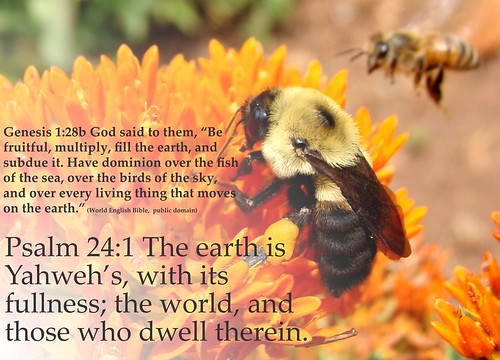
Genesis 1:26-28 seems to indicate clearly that humans were placed in charge of the non-human world. Psalm 8:6 reiterates that idea. Psalm 24:1 indicates that even though we are, in some sense, in charge, the world, and the things in it, are God’s. So does Psalm 50:10,11.* The story of Noah seems to indicate that, at one point, humans were directly responsible for the lives of many kinds of animals. Genesis 7:2-5, 14-16, Proverbs 12:10 and Proverbs 27:23 all have to do with caring for animals.

God seems to care not just for animals in general, but for kinds of animals. Psalms 104:24-25 praises God for the diversity of His creation, and His creatures. Since this explicitly includes the wide variety of ocean animals, it doesn’t seem possible that this praise is meant to be only because of their usefulness to humans. Genesis 7:3, 14-16 indicate God’s concern that the different kinds of animals would be preserved. Genesis 8:1 says that God had not forgotten Noah or the animals. Noah and his family were God’s agents in this care, of course, but they were God-directed agents. It would seem reasonable to argue that in our day, we also have responsibilities to the kinds of animals that exist in our time.

Does God care for individual non-human organisms? Perhaps. The question seems to be addressed in Matthew 10:29, which says that even individual sparrows do not fall without God’s knowledge. (Two verses later, Christ stated that the twelve were of more value than many sparrows. However, He didn’t say that sparrows were valueless.)

Does God’s care, and the care that humans are supposed to have, mean that we must refrain from killing animals deliberately? Apparently not. Jesus certainly condoned fishing (John 21:6Matthew 17:27Luke 5:4). He ate (Luke 24:36-43), and probably fished (John 21:9) even after His resurrection. Peter's vision, after the resurrection, and after Pentecost, used eating meat as a sign that God does not show favoritism (Acts 11:1-18). Paul referred disparagingly to people who forbid eating meat (I Timothy 4:1-3). There are no explicit commands forbidding the consumption of all meat in the Bible. This is not to say that the Bible condones killing of animals wantonly. That would be contradictory to benign dominion. Nor does the Bible condone consumption of animal flesh (or any other kind of food) selfishly, or to excess. But we are allowed to kill non-human organisms for cause, at least. Such causes include killing an animal because it threatens a human (Exodus 21:29), killing for meat (Genesis 9:2-3Leviticus 11:1-22) and killing an animal for its skin (Genesis 3:21). Exodus 12:21-23 and 12:46, and Mark 14:12, indicate clearly that the Passover, one of the most important ceremonies of the Jews, and the last ceremony Jesus performed with His disciples, involved eating meat. The Bible is very clear that humans and animals are not equals. Christ came in human form, principally to redeem humans, although the effects of redemption will be felt through all of creation. We have dominion over animals, not the reverse. That dominion implies responsible use, including research and killing for good cause. (Nothing in this paragraph rules out the practice of vegetarianism. Some Christians may decide, or God may reveal to them, that they shouldn't eat meat. But they cannot prove that Scripture demands that Christians don't eat meat.)

Does God’s care extend to plants? To non-living entities? (The Bible, like present-day people, is more concerned with some kinds of animals than others. There is little, if any, mention of mollusks in scripture, for instance.) The Bible mentions God’s care of plants (Psalm 104:16Matthew 6:30). It also states that everything He created was initially good (Genesis 1:31) and that creation as a whole, not just humans, groans, waiting for restoration (Romans 8:22). It is true that the Bible does not dwell on plants nearly as much as on animals. The creation of plants gets only one phrase in the Genesis account, whereas the creation of animals gets several. There is no mention of God’s concern for plants during the flood, nor are certain kinds of plants declared unclean in the Mosaic dietary laws. All this means that the Hebrews, like ourselves, were more interested in animals than in plants. Perhaps it means that God is also more interested.
From the above, we conclude that God’s care extends beyond humans, certainly to animals. Scripture is less explicit about God’s care for plants, and even less so about His care for rocks, streams, and clouds. However, there seems no reason to expect God to condone wanton destruction of any kind. If God cares for non-human creations, and we are responsible for His creation, then it behooves us to care for non-human creations as well. Proverbs 12:10 says that good people care for their domestic animals, and bad people are cruel to theirs. Caring for animals is usually consistent with caring for plants, or for rocks, streams and clouds. II Chronicles 36:21 tells us that the 70 years that the Israelites were to spend in captivity was not an arbitrary figure. God chose that because his people did not care for the land as he instructed them to. Jeremiah 2:7 and Habakkuk 2:17 condemn the Israelites because they hadn’t taken care of their land.

New Testament teaching on care of the environment
Most of the usual teaching on what the Bible says about care of the environment is from the Old Testament. However, there are two passages from the New Testament that also argue that we should be caring carefully for the environment. They are indirect, but their urgency is important. 
Romans 1:20 tells us that observing and learning about nature are part of God’s revelation to humans. (So does Psalm 19:1-4). If that is so, isn’t that another reason to try to preserve nature as well as we can? The Bible is one of the ways that God reveals Himself to us. For a long time, Christians have believed that the Bible should be translated into the language people are most familiar with, so that that revelation may be as clear as possible. Similarly, it would seem that God's revelation through nature should be as clear as possible. A person is more likely to see God in a pristine stream than in a polluted river. Probably seeing bison herds roam freely in Western North America gave people a glimpse of one aspect of God’s power and majesty that they can’t really get now. Therefore, helping to preserve nature in as good a condition as we can is one way to bring people to a saving knowledge of Christ. Not the most direct way, and probably not the most effective, for many people, but it is still a way to do this.
 
Colossians 1:15-20 says, of Christ, that “in Him all things hold together.” (ESV -- other versions have similar language.) That passage also says that He is working to reconcile all things to Himself, and working to make peace through the blood of the cross. As Christians, we believe that it is our duty to be His instruments in reconciling sinners to Christ, and to help Him in the ministry of making peace. In fact, 2 Corinthians 5:18-19, tell us that:  18 But all things are of God, who reconciled us to himself through Jesus Christ, and gave to us the ministry of reconciliation; 19 namely, that God was in Christ reconciling the world to himself, not reckoning to them their trespasses, and having committed to us the word of reconciliation. 
Doesn’t it follow that we should also participate in Christ’s work of sustaining “all things,” including endangered species and ecosystems or biological communities? (I realize that there are other places in the New Testament where reconciliation and peacemaking are mentioned, or implied, and this is probably the only one that mentions Christ's sustaining work. But that doesn't mean that His sustaining work can be dismissed, or that we have no responsibility to be His instruments in doing it.)

What must we do when our responsibilities seem to conflict?
One response is to ask, do they ever really conflict? We believe that our responsibilities do, in fact, appear to conflict, in these matters, and in others. As fallen, finite beings, we do not always interpret God’s directions correctly. We certainly do not know enough to always judge correctly. If we did possess the ability to decide correctly in all cases, perhaps God’s demands on us would never even seem to conflict. However, we can’t, and they do seem to conflict. Perhaps, this being a fallen world, they actually conflict.
The Bible does not present a formal hierarchy of principles to guide our behavior, in matters of environmental ethics, or in other matters. It does not tell us how to choose when, for instance, a decision we make will lead to either 5 minutes of misery for each of 2000 people, or 3 days of misery for a single individual. It does not tell us what to do when bringing a field under cultivation will help to feed hungry people, but also will kill native plants, deprive animals of homes, and use petroleum resources. As fallen beings in a fallen world, it is probably too much to expect that all our decisions will be correct.

Here are some attempts at principles which may be of help in making decisions about environmental matters:
This world is temporary. Temporal concerns of any kind should be carefully weighed against eternal values. The fossil record indicates that more species have become extinct than are now alive, and usually not because humans caused the extinction. This doesn’t excuse us from trying to save the organisms that live in our time, of course.

We should recognize that environmental concerns are sometimes overstated, not prioritized, or controversial. Some would have us believe that humans are choking to death and swimming in carcinogens. This is overstatement. The atmosphere may not be as clear as it ought to be, and we may indeed be exposed to cancer-causing substances, but people in North America are living longer than ever before. It seems certain that we can’t cure every ill, environmental or otherwise. Is it more important to try to stop global warming, to save the California condor, or to cut down on our consumption of fossil fuels? Is the cost, or risk, from pollution to landfills from disposable diapers more or less than the pollution to water from washing non-disposable ones? No one seems to know the answers. Solutions are not prioritized. We must be careful not to act precipitously just because someone has a concern.

Selfishness is wrong. Most North Americans seem to subconsciously believe that we are somehow entitled to more possessions than people in other parts of the world. Such a life style contributes to environmental degradation. It may also deprive people in other parts of the world, or future generations, of resources. It may mean that our church, and other charitable causes, do not have funds that we could well afford to give. We may not personally be able to change the way the world works very much. We can change it a little, and we should. We can avoid conspicuous consumption, we can avoid wanting things simply because they are newer than the things we already have. We can participate in recycling, even if it requires some effort on our part. We can think carefully about every purchase we make.
Isaiah 5:8-10 is a warning to the Hebrews. It tells them that God doesn’t condone selfishness in material things, including use of land. It predicts that the land will stop yielding enough, as God’s punishment for selfishness.

Knowledge is necessary. We are in God’s image. Part of the reflection of the omniscient God in us is the desire for knowledge. The Bible speaks approvingly of Solomon’s knowledge of the natural world (I Kings 4:32-33). We should learn to appreciate the world as God made it, and this requires knowledge of it. Knowledge is also necessary for wise alleviation of our own mistakes.

Unselfish love is a scriptural requirement. This unselfish love ought to color our relationships with others in every area, certainly including our environmental activities. It is not clear that we can, or ought, to have a relationship of unselfish love with non-human organisms, but it would seem consistent with God’s expectation of us that we act unselfishly toward non-human organisms.
We need guidance from God. All our important decisions need His help. Even with this guidance, we don’t always agree. God may well want some of us to be deeply involved in helping crisis pregnancies, but others to try to help clean up the environment. This doesn’t mean that both groups can’t assist in both efforts, but God may give our lives different emphases.

Having stated these principles, we realize anew that it is difficult to apply them to cases. In many cases, all we can say is “God help us.”

The Bible does not rule out the use of current technology, and the development of new technology
Since the development and use of technology has often been related to use of valuable resources, or contributed to greater “efficiency” in despoiling the landscape, we certainly need to be careful in developing and using technology, for our own sake, as well as that of the landscape. Is technology anti-God? The answer to that question seems to be “it depends.”
There are three biblical passages that indicate reasons why particular technological development may be wrong.
First, worshiping the results of our technology is clearly wrong, as well as just plain stupid (Isaiah 44:9-20).

Second, pride in our accomplishments is wrong (Daniel 4:30-32).

Third, supposing that there are no limits to human ability is wrong (Genesis 11:5-9).

On the other hand, there are biblical reasons for supposing that technological development is not always wrong, and, in fact, can sometimes glorify God. Noah’s ark, the tabernacle, and the temple, were technological constructs, and God gave instructions for the building of each of them. In fact, in the building of the temple, and other projects completed during the reign of Solomon, there was apparently extensive use of resources. Solomon sent 10,000 workers to Lebanon to cut down cedar trees each month (I Kings 5:14), in addition to the servants of King Hiram who helped them. They may have worked there for as long as seven (I Kings 6:38) or even twenty years (II Chronicles 8:1). All this was at least allowed by God, and some of it was directed by Him. Jeremiah 22:6 contains an amazing statement. This verse says that God finds the royal palace at Jerusalem as beautiful as the mountains of Lebanon. It would seem that technological development, by and of itself, is not wrong, although it may be done for wrong reasons, or with the wrong attitude.
Part of the image of God in humans is the desire to create things. The fact that we can create and use technology has certainly lead to some unfortunate consequences, such as deaths and injuries in highway accidents. However, it may also lead to some fortunate consequences, such as our being able to alleviate some of the consequences of our own mistakes of the past, or even some of the consequences of the fall.


+  +  +  +  +

April 23, 2011:

On an earlier date, links to all the scripture referenced in this post, using the English Standard Version, were added. (See here for the ESV policy on copyright.) The section on New Testament teaching on care of the environment was inserted on this date. It had been part of a previous post. That post is still on-line. I have not removed any of the comments from the previous version of this post.

Thanks for reading!

*Added October 15, 2014: More scripture on God's ownership, and our stewardship: Jeremiah 27:5 ‘I have made the earth, the men, and the animals that are on the surface of the earth by my great power and by my outstretched arm. I give it to whom it seems right to me. 6 Now I have given all these lands into the hand of Nebuchadnezzar the king of Babylon, my servant. I have also given the animals of the field to him to serve him. (World English Bible, public domain) 

Added April 20, 2017: E. Stephen Burnett has written a fine blog post on how care of the current earth relates to the New Earth.

Added December 27, 2019: Nancy Sleeth, in Relevantdemolishes some objections some Christians raise (such as "It's all going to be destroyed in the end, so why care for earth?")

This post originally appeared on April 22, 2006. I have re-posted it, after reading Sleeth's article. To see comments prior to December 2019, use the link in the previous sentence. Thanks for reading.

Wednesday, October 16, 2019

Sunspots 750

Things I have recently spotted that may be of interest to someone else:

The Arts: The History Blog reports that a painting by Agnolo Bronzini is being shown publicly for the first time in about five centuries.


Christianity: Christians can disagree, but they should observe these principles.

Todd Wood reflects on the forbidden fruit.

A Relevant writer tells us why Christians should care for the environment, even though the present earth may be drastically changed.


Education: Grammarphobia discusses the matter of being hoist by one's own petard.

Finance: Catherine Rampell points out that the deficit is getting much larger.

Politics: Relevant reports that a recent Fox news poll indicates that white evangelicals support for impeachment of President Trump is growing.

Relevant also reports that a female Kurdish official, who supported Kurdish Christians, has been executed by forces allied with the Turks.

FiveThirtyEight analyzes loss of Republican support for President Richard Nixon.

NPR has posted a timeline of events, some of which you probably didn't know about, related to Ukraine, Rudy Giuliani, and other matters related to the impeachment inquiry.

Joe Biden, and his son, or others, may or may not have been involved in corruption of some sort. But President Trump's record on corruption isn't exactly a great one, say reports by NPR, here and here.

FiveThirtyEight on where to find anti-Trump Republicans.


Science: Science News and other outlets tell us about the discovery of lots of new, small moons orbiting Saturn.

The graphic used in these posts is from NASA, hence, it is free to use like this.
Thanks for looking!

Wednesday, January 09, 2019

Sunspots 710


Things I have recently spotted that may be of interest to someone else:


Christianity: (and Sports) Relevant reports that a Chicago Bears kicker did not make a field goal that would have won the game, but thanked God, anyway.

Education: NPR reports on poor reading scores, which are widespread, and a fundamental reason for them -- educators aren't using scientific findings on learning to read. In some places, this is being remedied.

Food: (and Health) Gizmodo reports that millions of Americans think they have a food allergy, but don't.

Health: NPR reports that increases in drug prices are primarily due to drug company attempts to make more money, rather than research costs.

Humor: (or Food) A sculpture, constructed of a half ton* of butter, has been produced in Pennsylvania, according to NPR.

Politics: NPR reports that the acting Secretary of the Interior may be worse than his predecessor at protecting the environment.

(or possibly, humor) A few days ago, President Trump said that he knew more about drones than anyone. The Washington Post has compiled a list of things the President claims to know more about than anyone else. The list also includes people (not him) that Mr. Trump says are the world expert on various topics.

It's almost that time again, I'm afraid. But FiveThirtyEight analyzes Presidential primary debates, and finds that they are important.

Science: Gizmodo tells us (with pictures) that some hummingbird species have beaks specialized for aggression toward rivals.

(and food) NPR reports on granary weevils, insects that have been eating our stored grain throughout human history.

Scientific American on how the part of the border wall already built is damaging habitat and migration routes for animals, and how adding to the wall will make things worse.


The graphic used in these posts is from NASA, hence, I believe, it is public domain. 

Thanks for looking!

*When this was posted, I had carelessly said a half-pound of butter, not a half ton. I thank one of my brothers for bringing this error to my attention.

Wednesday, July 25, 2018

Sunspots 687


Things I have recently spotted that may be of interest to someone else:

The Arts: (and astronomy) Gizmodo has posted some stunning astronomical photos.

Computing: (and politics) Gizmodo writes about President Trump's charge that whoever broke into the Democratic National Committee's e-mail could be found, if the server involved was available, and his implication that, somehow, the server wasn't provided to the FBI.


Education: Grammarphobia on the use (and misuse) of "should" and "would," in Downton Abbey and elsewhere.

Ethics: A Council on Bioethics, in the UK, has concluded that allowing gene modification, even in germline cells (where the modification may be passed on to future generations, should not be completely prohibited.

Health: The new head of the Environmental Protection (?) Agency has presided over a rollback of coal ash requirements.

New Scientist reports that cell phones do not cause cancer.

(or something) A store to nap in has opened in New York City, according to Relevant.

Politics: FiveThirtyEight looks at the life expectancy of each of the current Supreme Court justices, including the recent nominee.

Gizmodo reports that a Microsoft official says that the Russians have targeted candidates running for office in the 2018 US elections.

Science: Scientific American reports on what we know about planets orbiting other stars. We know a lot more than we did a few years ago, and our solar system is rather odd.

Gizmodo reports that we really don't remember what happened when we were younger than 42 months old, or so, but we often think that we do.

(and politics, unfortunately) FiveThirtyEight tells us what global climate change is doing now. Too much.

Sports: Dirk Nowitzki and the Dallas Mavericks have agreed to a contract for Nowitzki's 21st year with the same team, a record for the National Basketball Association.

Thanks for looking!

Image source (public domain)

Wednesday, July 18, 2018

Sunspots 686


Things I have recently spotted that may be of interest to someone else:


Computing: Gizmodo reports that internet filters are not effective in keeping children from viewing pornography.

Gizmodo also reports on privacy concerns for those of us who have smart TVs.

Health: Scientific American reports that the Environmental Protection Agency wants to drastically curtail the use of scientific and medical evidence it uses in producing or modifying regulations.

The New York Times reports that administrative costs related to health care are very high in the US, probably mostly because of the complexity of the health care "system."

Listverse discusses the bacteria in our guts.

Humor: (or something) Gizmodo reports, with photos, on a man who let the fingernails on his left hand grow for 66 years.

(or something) Scientific American discusses the fear and joy of riding a roller coaster.


Politics: Gizmodo reports on the newly appointed acting chief of the Environmental Protection Agency, Andrew Wheeler.

To the surprise of many, the chair of the Federal Communications Commission has serious doubts about allowing Sinclair broadcasting to add more TV stations, according to Gizmodo.

Analysis of the falsehoods President Trump tells.

Science: Listverse tells us about 10 amazing extinct animals. Not Tyrannosaurus, or saber-tooths, but even more impressive beasts.

Thanks for looking!

Image source (public domain)

Wednesday, May 02, 2018

Sunspots 675


Things I have recently spotted that may be of interest to someone else:


Christianity: Benjamin L. Corey gives some good advice about coming through life's trials with a softer, not harder, heart.

A Christianity Today writer tells us about true hospitality.

Relevant says that the record of the US on taking refugees is shameful and unChristian. (We've taken 11 refugees from Syria in 2017. No refugee, out of thousands previously admitted, has perpetrated a terrorist act in the US.)

Christianity Today reports on a Pew Research poll, examining what people mean when they say that they believe in God.

Politics: Mick Mulvaney, director of the Consumer Financial Protection Bureau, has acted again to protect financial institutions from scrutiny, rather than protecting consumers from being ripped off. Sigh.

For the first time ever, the Chaplain of the US House of Representatives has been fired, according to NBC and other outlets.

Science: Gizmodo and Scientific American discuss the Environmental Protection Agency's declaration that burning wood is Carbon neutral.

New Scientist reports that the ability to grow human brain tissue in labs raises lots of ethical issues.

New Scientist also reports that horses can remember whether you smiled or frowned at them the last time they saw you.

Thanks for looking!

Image source (public domain)

Wednesday, September 06, 2017

Sunspots 642


Things I have recently spotted that may be of interest to someone else:


The Arts: (Sort of) SmokyMountans.com has a fall foliage prediction map, for the entire United States. As of September 1, there are only a few regions which are expected to have even minimal color, namely, a part of New England, some of the Rockies, and Michigan's northern Upper Peninsula, and Northern Minnesota.

Christianity: (or, at least, good behavior) A CNN crew stopped what they were doing to rescue some people during the Houston flood.

An article on burdens pastors face, and which they often can't tell anyone about.

Listverse has an article on the excruciating types of suffering induced by crucifixion.


Food: (and hurricanes) FEMA uses the Waffle House Index to measure the impact of large storms. How Waffle House (almost always) keeps open.

Health: Listverse suggests that 10 different types of parasite could be infected me (or you) right now.

Humor: (Or geography!) Relevant reports on a couple who have visited all 645 Cracker Barrel restaurants in the US.
 

Politics: Scientific American details how the Trump administration is acting in ways that damage our National Park System, and National Monuments.

A statement from a retired official of my own church, The Wesleyan Church, on ending DACA, in The Huffington Post.

Science: Listverse reports on 10 strange planets (all outside the solar system).

Wired reports that fire ants have been clumping together and floating around, in the wake of Hurricane Harvey. Scientific American on the same subject.

Listverse reports on strange caterpillars, including one that jumps (video included) and one with hair that looks like that of the current US President.

Scientific American on the many possible "sexes," that is, people with more or less sex chromosomes than most of us, or with various anatomical aberrations, such as indeterminate sex organs, and more.

Sports: (And Christianity) A Southern Baptist minister and denominational official, who is a football fan, warns that football can take the place of God, in Relevant.


Image source (public domain)

Friday, April 21, 2017

The New Earth and caring for the environment we have now

Tomorrow is Earth Day. E. Stephen Burnett has written a fine blog post, with plenty of scriptural material, on how care of the current earth relates to the New Earth.

You may also want to read my own post, more extensive, but not on the New Earth, about what the Bible says about environmental stewardship.

Thanks for reading. Read Burnett!

Wednesday, February 22, 2017

Sunspots 614

Things I have recently spotted that may be of interest to someone else:


Christianity: Christianity Today reports on a survey, which indicates that all major religious groups, except evangelicals, are more well-liked than they were a few years ago.

A Christianity Today writer tells us how boring church services changed his life, for the good.


Computing: Gizmo's Freeware lists the best Android Apps.

Gizmo's also rates the best free media players.

Education: (and History, and Humor) Listverse describes 10 absent-minded professors.

Health: (sickness, in this case) Relevant reports that sexual exploitation of children, including on-line abuse, is a major industry in the Philippines.

Humor: (or something) Listverse reports on 10 things that humans have seen only once. Events related to astronomy, warfare, and medicine, and more, are included.

Literature: E. Stephen Burnett on how to resurrect Christian fiction.

Science: National Public Radio reports that the deepest oceans are deeply polluted.

Nature reports that perhaps we have discovered a new continent: Zealandia.


Image source (public domain)

Tuesday, December 27, 2016

Christ and Creation video.

I have created a PowerPoint presentation on "Christ and Creation."  This post may be of some value to others, but is designed to supplement that video.

There are some links in the presentation, which can't be accessed from the video. Those links are given below:

Essay on environmental stewardship of God's creation.

Genesis 2:4 in Hebrew, showing the use of yowm.

Discussion on the interpretation of the creation story, as given in the Bible.

Geological evidence does not support a young earth.

Glen Morton asked young-earth creationist geologists if they applied young-earth geology to their jobs.

This presentation is also available below, although I am not happy with how it looks in this web page, and I have added two summary slides since originally posting this page.

If you want the presentation, in PowerPoint format, leave me your e-mail address in a comment, or in some other way, and I'll send the file to you.

Friday, June 17, 2016

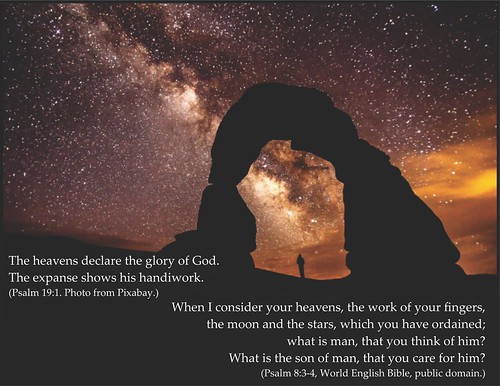
We can't see the Milky Way anymore


God revealed through the Milky Way

National Public Radio, and other news sources, have reported on a study which indicates that most North Americans (and others) cannot see the Milky Way, the galaxy that we are part of, because there is too much artificial light (light pollution) in the sky. That’s too bad, for two reasons, at least.

One reason that it’s too bad is aesthetic. The Milky Way is beautiful. Although it’s not extremely bright, it covers so much of the sky that, when visible, it’s the most obvious feature of the heavens above us. If we can’t see it, we are deprived of one of the most beautiful and majestic aspects of the creation. For comparison, consider your favorite wild flower, or wild bird, or mountain, and suppose that, for some reason, you were never going to see this flower or bird or mountain again. You would be deprived, of some of the beauty that inspires and comforts you, and that’s too bad.

The second reason is that the observation of nature is one of the ways that God is revealed to us. (It’s not the only one, or the most important, but it’s one way.) Because the Bible says so.

Psalm 8 tells us that we should praise God, and also indicates that considering the heavens informs us about our place in the creation:

1 Yahweh, our Lord, how majestic is your name in all the earth!
You have set your glory above the heavens!
3 When I consider your heavens, the work of your fingers,
the moon and the stars, which you have ordained;
4 what is man, that you think of him?
What is the son of man, that you care for him?
5 For you have made him a little lower than the angels,
and crowned him with glory and honor.
6 You make him ruler over the works of your hands.
You have put all things under his feet:

Psalm 97 repeats the first theme:
The heavens declare his righteousness.
All the peoples have seen his glory.

Psalm 19 explicitly says that nature reveals God to us:
1 The heavens declare the glory of God.
The expanse shows his handiwork.
2 Day after day they pour out speech,
and night after night they display knowledge.
3 There is no speech nor language,
where their voice is not heard.
4a Their voice has gone out through all the earth,
their words to the end of the world. 

Such statements are not confined to the Old Testament. Here’s a part of Romans 1:
20 For the invisible things of him since the creation of the world are clearly seen, being perceived through the things that are made, even his everlasting power and divinity, that they may be without excuse.

So, if we can’t see the Milky Way, we are a little less able to worship God, to understand His redemptive work, and to know our place in creation.

Am I advocating turning off all streetlights, or prohibiting driving after dark? No. That’s not my call, and I often use lights at night, sometimes in what I hope is God’s work. But I should realize that, by indiscriminate use of light, I am cutting myself, and others, off from part of my understanding of God. The Passenger Pigeon, once the most common bird in North America, became extinct a little over 100 years ago, due to human activity. We can no longer see huge, majestic flocks of these creatures, and so are also, by that lack, deprived of some once available knowledge of God’s power and majesty. The American Bison, and some rhino species, are not yet extinct, but we are never going to see them in the magnificent numbers that people once did, and the rhinos, at least, may really become extinct. Too bad.

We live in a fallen world, and, environmentally speaking, it seems to become less like God gave it to us by the day. As Paul said, in Romans 8:
19 For the creation waits with eager expectation for the children of God to be revealed. 20 For the creation was subjected to vanity, not of its own will, but because of him who subjected it, in hope 21 that the creation itself also will be delivered from the bondage of decay into the liberty of the glory of the children of God. 22 For we know that the whole creation groans and travails in pain together until now.

Thanks for reading. Look for the Milky Way!

The photo is from Pixabay, which allows such use.

Friday, April 22, 2016

The New Testament teaches that Christians should be stewards of the environment.

Psalm 19:1-4 and Romans 1:20 tell us that observing and learning about nature are part of God’s revelation to humans. If that is so, isn’t that a reason to try to preserve nature as well as we can?

The Bible is one of the ways that God reveals Himself to us. Christians believe that the Bible should be translated into the language people are most familiar with, so that that revelation may be as clear as possible. Similarly, it would seem that God’s revelation through nature should be as clear as possible. A person is more likely to see God in a beautiful clear stream than in a polluted river, or in a clear sky than in a smog-filled atmosphere. Seeing bison herds roam freely in Western North America, or immense flocks of passenger pigeons, gave people a glimpse of aspects of God’s power and majesty that they can’t get now. Helping to preserve nature in as good a condition as we can is one way to bring people to a saving knowledge of Christ. Not the most direct way, and perhaps not the most effective, but it is still a way to do this.
 
Colossians 1:15-20 says, of Christ, that “in Him all things are held together.” That passage also says that He is working to reconcile all things to Himself, and that He is working to make peace through the blood of the cross. As Christians, we believe that it is our duty to be His instruments in reconciling sinners to Christ, and to help Him in the ministry of making peace. 2 Corinthians 5:18-19 tells us that: 18 But all things are of God, who reconciled us to himself through Jesus Christ, and gave to us the ministry of reconciliation; 19 namely, that God was in Christ reconciling the world to himself, not reckoning to them their trespasses, and having committed to us the word of reconciliation.

(Hebrews 1:3 also tells us that Christ is holding all things together.)  
Christians believe they should participate in Christ’s work of reconciliation. Shouldn’t they also participate in His work of holding all things together, including endangered species, ecosystems and biological communities?

What do you think? (See here for Old Testament teaching on environmental stewardship. There is lots of it!)

Thanks for reading. This post was modified from this one.

Thursday, April 16, 2015

Why educated people should know something about science

An acquaintance of mine, a frequent blogger, is Dean of a Seminary, for a Christian university. He posts on lots of different topics. But he rather surprised me, a couple of days ago, by defending the teaching of science and math in a university curriculum. This was a preemptive strike at those who say (sometimes loudly and frequently) "Why should we have to learn this? We'll never use it."

It shouldn't have surprised me, because Professor Schenck, I happen to know, began his college career as a chemistry major at the school where I taught until my retirement. He was called to the ministry while in college, and changed majors.

So why should science and math be included in a college curriculum, even for music, art, and English majors? Here's what he said, with some brief commentary by me:

1. Knowledge in science and math is based on evidence. Scientists and mathematicians are not supposed to claim to have discovered something without giving good evidence for what they are claiming. Unfortunately, some people seem to think that "Because I said so," or "Because that is what I want to believe," is good enough. It shouldn't be a way of establishing "truth."

2. "This may sound mean, but one of the most important functions of math and science in a curriculum is to confront us with how stupid we are. In America, everyone thinks their opinion is as valuable as anyone else's." - To me, this is a re-statement of point 1.

3. Studying science and math help us understand how the world works.

Schenck went on to say that he understood that Christian colleges need to be very careful in dealing with certain matters, by which he meant origins, and Young-Earth Creationism. Some of their constituents, including donors, Board members, students, and some faculty, may believe that YEC is the only valid Christian belief, and stop giving, enrolling, or teaching, if a faculty member of a Christian college is bold enough to claim that there may be alternatives.

Here are two additional reasons for studying science and math in college. They are mostly expansions of point 3:
4. Educated people should have some idea of how dependent on the natural world we are, and also that we need to take care of it. In fact, we have a God-given duty to do so. We are absolutely dependent on photosynthesis, radiation from the sun, the properties of water, Hydrogen, Carbon and Oxygen, and a lot of other things.

5. Educated people should have some idea of how large the universe is, how old it appears to be, and how small cells, molecules and atoms are. They should also have some idea of the diversity of life, and the variety of materials that the universe is made of, and the many types of objects found in the universe.

Thanks for reading!