John 2:5 His mother said to the servants, “Whatever he says to you, do it.” 6 Now there were six water pots of stone set there after the Jews’ way of purifying, containing two or three metretes* apiece. 7 Jesus said to them, “Fill the water pots with water.” So they filled them up to the brim. 8 He said to them, “Now draw some out, and take it to the ruler of the feast.” So they took it. 9 When
the ruler of the feast tasted the water now become wine, and didn’t
know where it came from (but the servants who had drawn the water knew),
the ruler of the feast called the bridegroom 10 and
said to him, “Everyone serves the good wine first, and when the guests
have drunk freely, then that which is worse. You have kept the good wine
until now!” 11 This beginning of his signs Jesus did in Cana of Galilee, and revealed his glory; and his disciples believed in him.
*text note: 2 to 3 metretes is about 20 to 30 U. S. Gallons, or 75 to 115 liters.
John tells us that this was Christ's first miracle (not counting those miracles He did before He came to earth as a human.) Some other versions of the Bible use "miracle," rather than "sign." I have used the public domain World English Bible.
Christ’s first miracle wasn’t overthrowing the Romans, or bringing anyone back to life, or forgiving someone’s sins, or feeding lots of people, or healing someone. It was helping someone out of a jam, which was probably their own fault. They should have planned better, or ordered more wine in advance. This doesn't mean that Christ will always get us out of self-inflicted jams, but, sometimes, He surely does! He's our Friend, after all.
How did He do this? We don't know, of course. Perhaps he did it by adjusting the molecules of water, somehow, which isn’t surprising, when we remember that He created water in the first place.
Thanks for reading!
Musings on science, the Bible, and fantastic literature (and sometimes basketball and other stuff).
God speaks to us through the Bible and the findings of science, and we should listen to both types of revelation.
The title is from Psalm 84:11.
The Wikipedia is usually a pretty good reference. I mostly use the World English Bible (WEB), because it is public domain. I am grateful.
License
I have written an e-book, Does the Bible Really Say That?, which is free to anyone. To download that book, in several formats, go here.

The posts in this blog are licensed under a Creative Commons Attribution-NonCommercial-ShareAlike 3.0 Unported License. You can copy and use this material, as long as you aren't making money from it. If you give me credit, thanks. If not, OK.
The posts in this blog are licensed under a Creative Commons Attribution-NonCommercial-ShareAlike 3.0 Unported License. You can copy and use this material, as long as you aren't making money from it. If you give me credit, thanks. If not, OK.
Showing posts with label transformation. Show all posts
Showing posts with label transformation. Show all posts
Thursday, December 14, 2017


Monday, April 01, 2013
The Resurrection, Superstition, and the Second Law of Thermodynamics
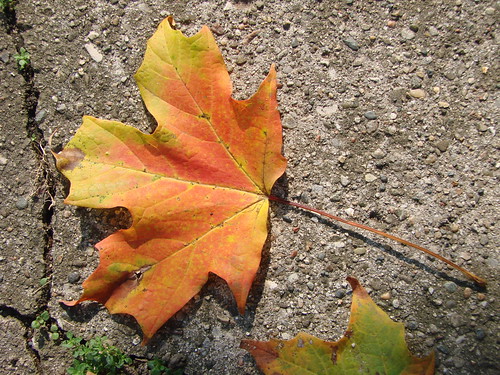
Death and the Second Law of Thermodynamics (The photo above is of a maple leaf. This post is not an April Fool joke!)
Ephesians 1:18b . . . that you may know what is the hope of his calling, and what are the riches of the glory of his inheritance in the saints, 19 and what is the exceeding greatness of his power toward us who believe, according to that working of the strength of his might 20 which he worked in Christ, when he raised him from the dead, and made him to sit at his right hand in the heavenly places, 21 far above all rule, and authority, and power, and dominion, and every name that is named, not only in this age, but also in that which is to come.
The definitions of life and death are complex, and philosophical as well as biological. Generally, living things are in a constant battle with the second law of thermodynamics. So long as they can obtain enough energy, they win this battle. They can build themselves. They build themselves as non-random, ordered objects. Living things do this, however, only at the expense of order in the universe at large. We can expend energy to build, but, when we do, we are unbuilding something else -- we are causing entropy to increase. However, when we do so, we are taking energy from somewhere else.
For example, we can straighten the back seat of our car, or the dining room table. We change disorder to order. But, to do so, we must use energy that we have taken in in the food we eat, or, perhaps, electrical energy to run various cleaning devices. Starch, say, is an ordered food molecule, containing usable stored energy. Breaking it down changes the combinations molecules of starch into less ordered molecules of carbon dioxide and water, releasing energy in the process, and giving off wasted energy. Disorder arises through almost all natural processes, because of the unbending second law of thermodynamics. The only way to stave off that disorder is by having a source of energy to draw on. However, drawing such energy for use is related to increased disorder somewhere else. For example, the sun is gradually becoming more disordered.
One of the things that happens as a result of death is that the ability of a living thing to stave off the inexorable increase of entropy is gone. Death leads to decay. As Polkinghorne puts it:
In our present world, change and decay are built into the fabric of the universe. The processes by which genetic mutations produce new forms of life are the processes by which cells become cancerous. Death is the necessary cost of life. In fact, a theological defense of the existence of physical evil is that it is not gratuitous but the inescapable price of an evolutionary world, free to make itself within the independence its Creator has granted to it. John C. Polkinghorne, Serious Talk: Science and Religion in Dialogue. Harrisburg, PA: Trinity Press International, 1995, p. 107.
Not only does death lead to decay, but this decay is, in the practical sense, irreversible. If I had the money, and offered some famous research institution a trillion dollars if they could bring one dead maple leaf back to life, I wouldn’t lose my money. It is not humanly possible to reverse the decay in a dead organism, or part of an organism, and bring it back to life. The second law of thermodynamics makes that impossible.
The resurrection, of course, is miraculous, any way you want to look at it. It wasn’t, or isn’t, humanly possible. (That doesn’t mean that it didn’t happen!) We cannot reverse the effects of the second law on a dead leaf, much less a dead human. No wonder Paul called resurrection power “immeasurable” in Ephesians 1:19-20. God’s promise is that Christians have this power working in us.
Superstition?
The biology text I am currently using says this: “The irrational belief that actions that are not logically related to a course of events can influence its outcome is called superstition. . . . different narratives, legends, fairy tales, and epics from all around the globe exist to help people understand the world around them. These stories explain everything from birth and death to disease and healing.” (Jay Phelan, What is Life? Second Edition. New York: Freeman, 2013, pp. 5-6. Emphasis in original.) To be fair, Phelan is not particularly attacking religious belief here, but casts a wider net, including, among other things, the ritualistic actions of baseball players.
Phelan goes on to say that there are “truths” in religion that the scientific method doesn't reveal to us, and that these are based on “personal faith, traditions, and mythology.” (p. 6. Phelan put quotation marks around “truths,” implying, I think, that he’s not sure that they are truths.)
Phelan is mostly right. Beliefs that are not logically related to a course of events are sometimes believed to cause things that they don’t. I classify the belief that vaccinations cause autism as one such superstition. There are religious beliefs that seem superstitious to me, and, no doubt, many of mine seem superstitious to, say, a Buddhist.
The resurrection, I claim (and I’m not nearly the first!), is an event that there is evidence for. Of course some of my belief in the resurrection is based on personal faith, traditions, and perhaps even mythology. But I submit that there is evidence for the resurrection. In 1 Corinthians 15, Paul says: 3 For I delivered to you first of all that which I also received: that Christ died for our sins according to the Scriptures, 4 that he was buried, that he was raised on the third day according to the Scriptures, 5 and that he appeared to Cephas, [Peter] then to the twelve. 6 Then he appeared to over five hundred brothers at once, most of whom remain until now, but some have also fallen asleep. 7 Then he appeared to James, [the half-brother of Christ] then to all the apostles, 8 and last of all, as to the child born at the wrong time, he appeared to me also. In other words, there were hundreds of people, in Paul’s day, who had seen the living, resurrected Christ. That’s evidence.
There is other evidence for the resurrection. How else can we explain the transformation of Peter from a coward who didn’t acknowledge that he was one of Christ's followers to a bold public speaker, proclaiming the gospel? How else can we explain the growth of the church? How else can I explain how a young lady of my acquaintance, with little interest in the things of God, living in sin with her boyfriend, and their child, had her life turned around, began attending church with her boyfriend and child, reconciled with her estranged mother, and was married to the boyfriend after the morning service on Super Bowl Sunday, 2013? (I know a similar story, about another young lady who married her boyfriend after church service in another place on the next Sunday. Both new wives said that they wanted to show others a life consistent with their faith. Both are living transformed lives.) I credit the power of the resurrection for these and other stories of transformation, and claim that such changes are evidence for the reality of the resurrection. I cannot prove, to the satisfaction of a confirmed atheist, that these events, in the First Century and the Twenty-First, are logically related to the Resurrection, but I submit that they are evidence for such a logical relationship.
Thanks for reading!
Saturday, November 13, 2010
Metamorphosis
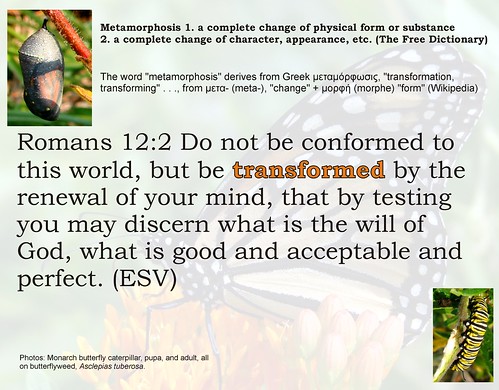
(The graphic is a link to the original, in my Flickr photostream. Larger sizes should be available there.)
The word here translated as "transformed" is, as you can see, closely related to the processes named metamorphosis. Actually, insects have two kinds of metamorphosis. Grasshoppers, and many others, just get larger and more mature, occasionally shedding their old skin/exoskeleton, after they hatch out of the egg. This is known as incomplete metamorphosis. Butterflies, and many others, have four distinct stages, namely the egg, the caterpillar or grub, the pupa or chrysalis, and the adult. This complete metamorphosis seems to be closer to what Paul is telling us to do. The caterpillar and the butterfly are not very obviously connected to each other, based on their appearance and behavior. But they are connected. The adult comes from the caterpillar, through the pupa. But the adult is a more graceful, freer, more beautiful creature, and it also can reproduce, unlike the caterpillar. I suppose that, if you asked a caterpillar if it wanted to become a pupa, and just sit there silent, without eating, for days, weeks, or months, it would refuse. Yet, I suppose that if you could ask a butterfly if it wanted to go back to being a caterpillar, it would quickly refuse. Similarly, God wants us to be transformed into beings that try do do His will, not ours. It's not very appealing. We want to direct our own lives. But it's best for us, ultimately -- and I'm speaking about here on earth, not some heavenly pie in the sky -- it's more freeing to do what God wants, by choice, than to do what our unredeemed selves want to do.
The word here translated as "transformed" is also used in Matthew's and Mark's accounts of the transfiguration of Jesus, early in His ministry, witnessed by Peter, James and John. The only other use of the word in the Bible is in 2 Corinthians 3:18 "But we all, with unveiled face beholding as in a mirror the glory of the Lord, are transformed into the same image from glory to glory, even as from the Lord, the Spirit." (WEB)
Note that God's desire for our butterfly selves is that we be transformed into creatures that reflect God's glory. Note also that the tense is present -- God wants this, and it is possible, in this life.
Make it so! Thanks for reading, and looking.
Subscribe to:
Posts (Atom)