Musings on science, the Bible, and fantastic literature (and sometimes basketball and other stuff).
God speaks to us through the Bible and the findings of science, and we should listen to both types of revelation.
The title is from Psalm 84:11.
The Wikipedia is usually a pretty good reference. I mostly use the World English Bible (WEB), because it is public domain. I am grateful.
License

The posts in this blog are licensed under a Creative Commons Attribution-NonCommercial-ShareAlike 3.0 Unported License. You can copy and use this material, as long as you aren't making money from it. If you give me credit, thanks. If not, OK.
Thursday, January 18, 2018
Augustine: God is the Enlightener
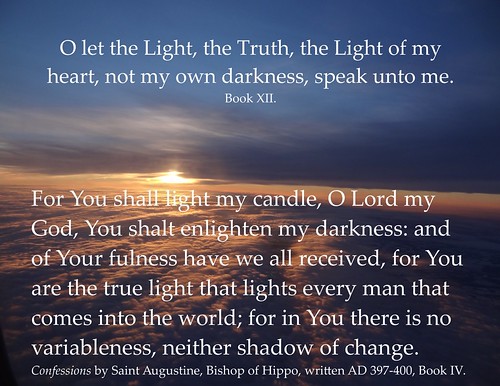
The above is an attempt to illustrate two quotations from Augustine of Hippo, requesting God to enlighten him, and responding that God will do this.
Augustine was apparently referring, in part, to James 1:16 Don’t be deceived, my beloved brothers. 17 Every good gift and every perfect gift is from above, coming down from the Father of lights, with whom can be no variation, nor turning shadow. (World English Bible, public domain.)
Thanks for looking. The graphic above also serves as a link to a post on Flickr, which can be seen at a larger size.
Tuesday, February 23, 2016
Augustine on Miracles, from The City of God
Saturday, October 03, 2015
Augustine on God's goodness
I used a triangle to represent the Trinity, and the apex is colored gold for God's royalty and sovereignty. The apex is also the point furthest from the dark area at the bottom. Don't take the graphic, with its symbolism as anything but a feeble attempt to represent something -- the symbols are imperfect, and imperfectly arranged.
Mark has a related passage: 10:17 As he was going out into the way, one ran to him, knelt before him, and asked him, “Good Teacher, what shall I do that I may inherit eternal life?”
18 Jesus said to him, “Why do you call me good? No one is good except one—God. ..." I'm not sure why Jesus seemed to leave Himself, God in flesh, out of the goodness group.
Thanks for looking!
Monday, April 16, 2012
Blaise Pascal on Thomas Aquinas, St. Augustine, and supposed conflicts between science and scripture
to be referred. If it relate to a supernatural truth, we must judge of it neither by the senses nor by reason, but by Scripture and the decisions of the Church. Should it concern an unrevealed truth and something within the reach of natural reason, reason must be its proper judge. And if it embrace a point of fact, we must yield to
the testimony of the senses, to which it naturally belongs to take cognizance of such matters.
follows that there must be an agreement between these two sources of knowledge. And as Scripture may be interpreted in different ways, whereas the testimony of the senses is uniform, we must in these matters adopt as the true interpretation of Scripture that view which corresponds with the faithful report of the senses. "Two things," says St. Thomas, "must be observed, according to the doctrine of St. Augustine: first, That Scripture has always one true sense; and secondly, That as it may receive various senses, when we have
discovered one which reason plainly teaches to be false, we must not persist in maintaining that this is the natural sense, but search out another with which reason will agree.
it is not our duty, says that saint, obstinately to defend the literal sense of that passage; another meaning must be sought, consistent with the truth of the fact, such as the following, "That the phrase great light, as applied to the moon, denotes the greatness of that luminary merely as it appears in our eyes, and not the magnitude of its body considered in itself."
If the position which you maintain be true, show it, or else ask no man to believe it -- that would be to no purpose. Not all the powers on earth can, by the force of authority, persuade us of a point of fact, any more than they can alter it; for nothing can make that to be not which really is.
There are some thinkers, who, with good intentions, believe that, whenever there is a seeming conflict between the meaning of some scripture, and evidence from science, the latter should automatically be rejected. As an extreme case, there are those who claim that the earth is the center of the solar system, and the universe. This flies in the face of the evidence from science, going back to Galileo. It is, as St. Thomas put it, not only a mistake scientifically to claim that geocentrism is correct, but asserting that it is can make Christianity "contemptible."
The conclusions of scientists are sometimes overturned -- for example, relativity has modified Newton's picture of the solar system. And we do not always really know what the Bible means to say. But, that being understood, the three evidences, senses, reason, and faith, are all of importance, and, if applicable, must always be considered.
Thanks for reading!

Thursday, May 24, 2007
St. Augustine, Exegesis, and Origins
As Brown says, "Augustine is perhaps the most important thinker amongst church fathers on creation in Genesis." (p. 135) (See here for Wikipedia article on St. Augustine.)
One reason Brown has written this article is that Augustine gets misquoted, or quoted out of context. Another reason is that the very important issue of when the earth, and its inhabitants, were created, remains just that, an important issue.
It is not possible to summarize all that Brown says about Augustine in the space usually allotted to a blog post, and without plagiarizing Brown. Let me put it this way -- Augustine does not fall readily into any of the categories of beliefs on origins that come readily to mind in the present day (such as young-earth creationism, day-age belief, and the like) and he believed that Genesis 1 could be interpreted in more than one way.
People concerned about exegesis, about Augustine, and about origins owe it to themselves to read Brown's article.
Thanks for reading this post.
Monday, April 16, 2007
What was God doing before the Big Bang, and St. Augustine
He was preparing Hell for people who ask such questions.
For example, the last page (before the Epilogue) of Simon Singh's Big Bang: The Origin of the Universe (New York: Harper Collins, 2004) says this, and attributes the origin to St. Augustine. (Singh acknowledges, of course, that Augustine didn't know anything about the Big Bang, and that he wrote about the origin of the universe more generally.) Singh is not the first person to say this.
Unfortunately, this is a misreading of Augustine. Here's what he really said:
Lo, are they not full of their old leaven, who say to us, "What was God doing before He made heaven and earth? For if (say they) He were unemployed and wrought not, why does He not also henceforth, and for ever, as He did heretofore? For did any new motion arise in God, and a new will to make a creature, which He had never before made, how then would that be a true eternity, where there ariseth a will, which was not? For the will of God is not a creature, but before the creature; seeing nothing could be created, unless the will of the Creator had preceded. The will of God then belongeth to His very Substance. And if aught have arisen in God's Substance, which before was not, that Substance cannot be truly called eternal. But if the will of God has been from eternity that the creature should be, why was not the creature also from eternity?" (Confessions, public domain, Book XI) Augustine, as I understand him, saw such a question as an attack on God's omnipotence and eternity, and argued, in the last part of his Confessions, not just in the paragraph quoted above, that God is outside time, so the question has no meaning.
If you do a search on the phrase "What was God doing before He made heaven and earth" you will see that the misreading is widespread.
Thanks for reading.
Thursday, September 07, 2006
St. Augustine and Kent Hovind
I'm going to make some general observations about these three posts, and Dr. Hovind. I have four issues with posts of this type (that is, using Hovind to argue that young-earth creationism is true).
Claiming that young-earth creationism is the only valid Christian belief is a mistake. This is true whether it's Hovind, me, or anyone else. Christians disagree on origins! This post says that requiring belief in young-earth creationism for church membership would have excluded "Justin Martyr, Irenaeus, Clement of Alexandria, Augustine, Thomas Aquinas, Charles Hodge, Benjamin Warfield, Gleason Archer, Francis Schaeffer."
To name only one other Christian view of origins, Intelligent Design has gotten a lot of attention over the last decade, and many Christians have embraced it enthusiastically. However, it isn't the same thing as young-earth creationism, which shows that there is more than one Christian view. (Here's a web page, identifying six different views of origins, five held by at least some Christians, and attempting to point out their strengths and weaknesses in a fair manner.)
Hovind does not present convincing evidence. I can't say that none of his evidence is convincing, since I haven't seen it all, but I examined "articles" on his web site. You can see what I found, and why I say that his evidence is not convincing, in the last part of this post. Here's a web page, pointing out a number of problems with Hovind's work.
Hovind does not have scientific credentials. There is a Wikipedia article about him, which describes his educational history in some detail. The facts presented there indicate that Hovind's doctorate is from an institution of questionable academic reputation, and is not in science. This has not been disputed. (Anyone can contribute to the Wikipedia. Articles may be disputed. When they are, Wikipedia shows this. Here's an example of an article which is partly in dispute. Presumably, if the article was seriously incorrect, Hovind or a staffer would have disputed it.)
The truth is the truth, whether presented by scientists or non-scientists, but Hovind seems to be presenting himself as if he did have scientific credentials when he doesn't, and that looks like deception.
Hovind is in some legal trouble, and is rather far out politically. (See the same Wikipedia article for details, which are not in dispute.) Even one of the posters who seemed to believe that his stuff was the greatest ever commented that he was a little far out in some areas. Again, this doesn't make what he says false, and could be the result of persecution, but it could also mean that he has been doing some things with his taxes that he shouldn't have.
All this, of course, does not prove that young-earth creationism is false. It may be false, and it may be true. I wish to concern myself here only with Dr. Hovind. It seems to me (and I am certainly not alone) that Dr. Hovind's work offers no reliable support for young-earth creationism. Using it, therefore, not only does not help the cause of young-earth creationism, but gives it an unnecessary black eye. It is as if, say, Bill Clinton were invoked as a spokesman for the sanctity of marriage, George Bush for pacifism, or Barry Bonds for drug-free athletics. Answers in Genesis, one of the most important young-earth creationist organizations, has criticized Hovind*.
As to St. Augustine, he had something to say about being careful about origins apologetics:
Usually, even a non-Christian knows something about the earth, the heavens, and the other elements of this world, about the motion and orbit of the stars and even their size and relative positions, about the predictable eclipses of the sun and moon, the cycles of the years and the seasons, about the kinds of animals, shrubs, stones, and so forth, and this knowledge he holds to as being certain from reason and experience. Now, it is a disgraceful and dangerous thing for an infidel to hear a Christian, presumably giving the meaning of Holy Scripture, talking non-sense on these topics; and we should take all means to prevent such an embarrassing situation, in which people show up vast ignorance in a Christian and laugh it to scorn. The shame is not so much that an ignorant individual is derided, but that people outside the household of the faith think our sacred writers held such opinions, and, to the great loss of those for whose salvation we toil, the writers of our Scripture are criticized and rejected as unlearned men. If they find a Christian mistaken in a field which they themselves know well and hear him maintaining his foolish opinions about our books, how are they going to believe those books in matters concerning the resurrection of the dead, the hope of eternal life, and the kingdom of heaven, when they think their pages are full of falsehoods on facts which they themselves have learnt from experience and the light of reason? Reckless and incompetent expounders of holy Scripture bring untold trouble and sorrow on their wiser brethren when they are caught in one of their mischievous false opinions and are taken to task by those who are not bound by the authority of our sacred books. For then, to defend their utterly foolish and obviously untrue statements, they will try to call upon Holy Scripture for proof and even recite from memory many passages which they think support their position, although “they understand neither what they say nor the things about which they make assertion.” St. Augustine, The Literal Meaning of Genesis. vol. 1, Ancient Christian Writers., vol. 41. Translated and annotated by John Hammond Taylor, S.J. New York: Paulist Press, 1982. My source was here.
Thanks for reading.
* * * * *
Addendum, September 10, 2010:
*Answers in Genesis has modified their criticism of the www.drdino.com website, based on changes in it. See here for their republication of their criticism, with modification included. I don't believe that the original article criticizing Hovind remains on the web, but my impression is that they have republished it, with a disclaimer. My impression, based on some examination of the Hovind web site on this date, is that at least some of the uses of invalid arguments for young-earth creationism have been corrected. This, of course, neither proves or disproves young-earth creationism.
Kent Hovind has been imprisoned for tax evasion. See the Wikipedia article on him.
Saturday, July 15, 2006
Quotes on origins*, 1
…unfortunately, large numbers of well-intentioned lay Christians have been convinced by popular creationist writers and lecturers that one can in an evening master some obvious commonsense facts that expose the utter silliness of evolution--facts that despite their complete obviousness even to people with no science background at all have allegedly somehow totally eluded those with Ph. D.'s in geology and biology. Del Ratzsch, The Battle of Beginnings: Why Neither Side is Winning the Creation-Evolution Debate. Downers Grove, Ill: InterVarsity Press, 1996, p. 82.
Usually, even a non-Christian knows something about the earth, the heavens, and the other elements of this world, about the motion and orbit of the stars and even their size and relative positions, about the predictable eclipses of the sun and moon, the cycles of the years and the seasons, about the kinds of animals, shrubs, stones, and so forth, and this knowledge he holds to as being certain from reason and experience. Now, it is a disgraceful and dangerous thing for an infidel to hear a Christian, presumably giving the meaning of Holy Scripture, talking non-sense on these topics; and we should take all means to prevent such an embarrassing situation, in which people show up vast ignorance in a Christian and laugh it to scorn. The shame is not so much that an ignorant individual is derided, but that people outside the household of the faith think our sacred writers held such opinions, and, to the great loss of those for whose salvation we toil, the writers of our Scripture are criticized and rejected as unlearned men. If they find a Christian mistaken in a field which they themselves know well and hear him maintaining his foolish opinions about our books, how are they going to believe those books in matters concerning the resurrection of the dead, the hope of eternal life, and the kingdom of heaven, when they think their pages are full of falsehoods on facts which they themselves have learnt from experience and the light of reason? Reckless and incompetent expounders of holy Scripture bring untold trouble and sorrow on their wiser brethren when they are caught in one of their mischievous false opinions and are taken to task by those who are not bound by the authority of our sacred books. For then, to defend their utterly foolish and obviously untrue statements, they will try to call upon Holy Scripture for proof and even recite from memory many passages which they think support their position, although “they understand neither what they say nor the things about which they make assertion.” St. Augustine, The Literal Meaning of Genesis. vol. 1, Ancient Christian Writers., vol. 41. Translated and annotated by John Hammond Taylor, S.J. New York: Paulist Press, 1982. My source was here.
If biology remains only biology, it is not to be feared. Much of the fear that does exist is rooted in the notion that God is in competition with nature, so that the more we attribute to one the less we can attribute to the other. That is false. The greater the powers and potentialities in nature, the more magnificent must be nature’s far-sighted Author, that God whose “ways are unsearchable” and who “reaches from end to end ordering all things mightily.” Richard Dawkins famously called the universe “a blind watchmaker.” If it is, it is miracle enough for anyone; for it is incomparably greater to design a watchmaker than a watch. We need not pit evolution against design, if we recognize that evolution is part of God’s design. Stephen M. Barr, "The Miracle of Evolution," First Things 160 (February 2006): 30-33
For the scientist who has lived by his faith in the power of reason, the story ends like a bad dream. He has scaled the mountains of ignorance; he is about to conquer the highest peak; as he pulls himself over the final rock, he is greeted by a band of theologians who have been sitting there for centuries. Robert Jastrow, God and the Astronomers, New York: Warner Books, 1978, pp. 105-106. (Jastrow, apparently not a Christian, was writing about the Big Bang theory, which, when the evidence for it appeared, was a shock to many cosmologists, who believed that the universe had been in a steady state forever. Not so!)
*I use "origins" because "evolution" is generally used by scientists to refer to the results of natural selection. The Big Bang, for example, has nothing to do with natural selection. It does have to do with origins. Some people, usually Christians, mean "atheism" or "materialism" (by which I'm not referring to the desire to accumulate things) when they say "evolution."
You may want to see my flow chart on origins. For more quotes on origins, see this post, and this one.
Thanks for reading!