A blogger has posted a readable, but detailed account, of the conversion of C. S. Lewis, arguably the most important Christian writer of the 20th Century, to Christianity, and to belief in Christ as savior. J. R. R. Tolkien played a role in the conversion of Lewis.
Thanks for reading. Read Lewis (and/or Tolkien!)
Musings on science, the Bible, and fantastic literature (and sometimes basketball and other stuff).
God speaks to us through the Bible and the findings of science, and we should listen to both types of revelation.
The title is from Psalm 84:11.
The Wikipedia is usually a pretty good reference. I mostly use the World English Bible (WEB), because it is public domain. I am grateful.
License
I have written an e-book, Does the Bible Really Say That?, which is free to anyone. To download that book, in several formats, go here.

The posts in this blog are licensed under a Creative Commons Attribution-NonCommercial-ShareAlike 3.0 Unported License. You can copy and use this material, as long as you aren't making money from it. If you give me credit, thanks. If not, OK.
The posts in this blog are licensed under a Creative Commons Attribution-NonCommercial-ShareAlike 3.0 Unported License. You can copy and use this material, as long as you aren't making money from it. If you give me credit, thanks. If not, OK.
Showing posts with label conversion. Show all posts
Showing posts with label conversion. Show all posts
Monday, September 26, 2016


Wednesday, July 06, 2016
Sunspots 581
Things I have recently spotted that may
be of interest to someone else:

Christianity: Cal Thomas, a Christian, and a politically conservative columnist, who interviewed Mr. Trump a few weeks before Dobson's statement, is skeptical of his reported conversion.
A columnist in Relevant argues that when Jesus said that the poor will always be with you, He didn't mean that we shouldn't do something about them, or, really, that poverty was a necessary condition.
Health: National Public Radio reports on the use of virtual reality (VR) in seriously incapacitated patients, who seem to be responding well to VR.
NPR also reports on various kinds of gifts to doctors by drug companies and device makers, which, unfortunately, may influence those doctors to prescribe treatments that aren't in the patient's best interest. Hospitals in Southern states are most likely to have such influences.
Wired tells us that it's OK, healthwise, anyway, to eat boogers.
Politics: Wired on how the Benghazi report is presented, and interpreted, in accord with our pre-existing biases.
Sports: FiveThirty Eight (and other sources) argues that Pat Summitt, recently deceased Tennessee women's basketball coach, was the greatest college women's basketball coach of all time. Others have gone further, and said that she was the greatest college basketball coach, period.
Image source (public domain)
Christianity: Cal Thomas, a Christian, and a politically conservative columnist, who interviewed Mr. Trump a few weeks before Dobson's statement, is skeptical of his reported conversion.
A columnist in Relevant argues that when Jesus said that the poor will always be with you, He didn't mean that we shouldn't do something about them, or, really, that poverty was a necessary condition.
Health: National Public Radio reports on the use of virtual reality (VR) in seriously incapacitated patients, who seem to be responding well to VR.
NPR also reports on various kinds of gifts to doctors by drug companies and device makers, which, unfortunately, may influence those doctors to prescribe treatments that aren't in the patient's best interest. Hospitals in Southern states are most likely to have such influences.
Wired tells us that it's OK, healthwise, anyway, to eat boogers.
Politics: Wired on how the Benghazi report is presented, and interpreted, in accord with our pre-existing biases.
Sports: FiveThirty Eight (and other sources) argues that Pat Summitt, recently deceased Tennessee women's basketball coach, was the greatest college women's basketball coach of all time. Others have gone further, and said that she was the greatest college basketball coach, period.
Image source (public domain)
Monday, March 18, 2013
How to be saved
I believe in a God who wants
everyone to become a Christian.
The Bible uses the word “saved” for this, sometimes. There are other words, too, such as redeemed and believer. What word is used doesn’t matter. Being sorry for what we’ve done wrong, asking forgiveness, and believing that Christ’s death paid the price for our misdeeds does matter.
Romans 3:23 for all have sinned, and fall short of the glory of God; 24 being justified freely by his grace through the redemption that is in Christ Jesus; 25a whom God sent to be an atoning sacrifice, through faith in his blood
That passage says a lot:
1) I am a sinner by nature.
2) I cannot fix this problem.
3) The problem can be fixed, through receiving, by faith, Christ’s sacrifice. Receiving includes being sorry for the bad things I have done, admitting that I am a sinner, and need help. Part of what I should have faith in is Christ’s resurrection, which proved that His sacrifice for sin was acceptable.
There is nothing I can do to earn salvation. It is provided freely, but I must desire it, and believe that Christ’s sacrifice pays the penalty for my sin (which penalty is eternal death, according to Romans 6:23)
Salvation doesn’t come because I have cleaned up my life. I don’t need to clean up my life to be saved. We can’t clean it up as it really should be, without supernatural help, which mostly comes after salvation. I don’t need to join a church, although doing so is usually a good idea. Joining a church, of itself, will not take care of the problem of sin, unless it’s accompanied by belief in the effectiveness of Christ’s sacrifice. No human action will fix my sin problem. I need to believe in Christ’s payment, already made, for my sin.
Salvation may or may not be accompanied by feelings. But we must not demand or expect that we feel some special way -- some people don’t. And we must not rely on feelings. We can fool ourselves into believing all sorts of things about our feelings. Feelings are temporary. I love my wife, and often I feel that strongly. But sometimes I don’t feel it so strongly. I must still act as if I love her, and believe that I do, regardless of the feeling of the moment. The same is true of salvation.
There are some things that God will help me to do, once I have been saved. These include:
1) Confession of my belief to others. Joining a church, and being baptized, are important forms of confession, but, they won’t save us. In most cases, we also need to tell other people about our choice.
Romans 10:9 that if you will confess with your mouth that Jesus is Lord, and believe in your heart that God raised him from the dead, you will be saved. 10 For with the heart, one believes unto righteousness; and with the mouth confession is made unto salvation.
2) Taking Jesus as Lord. This is referred to in the quotation immediately above. It means following Christ’s teachings, as we understand them, and trying to understand them better, by studying the Bible, and being around experienced, victorious Christians. It means not doing what I want, when I know that it would conflict with what Christ wants.
3) Being baptized. Jesus instructed his disciples, in his last words to them, as recorded in Matthew, to baptize new believers, in the name of the Father, the Son, and the Holy Spirit. There are a number of occasions in Acts where new Christians were baptized soon after receiving Christ as savior, and we need to continue with that pattern.
4) Associate with other believers. (Hebrews 10:25) In most cases, this means joining a church, attending that church’s services, and otherwise participating in the life of the church. Unfortunately, there are some organizations that call themselves churches that do not follow the teachings of Christ, in important ways. For example, they may not speak of the need to be sorry for sin, or of the necessity of following Jesus as Lord. If in doubt, ask God to guide you to a church that honors Him. This is not an excuse for church-shopping. All churches, being made up of humans, have some problems. So it is pointless to look for a perfect church. Look for one that honors Christ and His teachings, and helps you to learn more about His teachings, by what the church teaches, and what it shows in actions.
5) As opportunity allows, try to gently and lovingly persuade other people of their need for salvation.
6) Remind yourself of what you believe, and learn more of what Christians believe, on a regular basis, by personal prayer, Bible reading and study, as well as church participation. (Here’s a post on “What Christians Believe.”) Personal prayer, devotional reading, and study should take place at least daily, in most cases. You should find other books, beside the Bible, to be helpful, but don’t leave the Bible out.
New Christians should use a Bible version which has language easy to understand.
What happens if we fail, knowing that we have not done what Christ wants us to do? We ask forgiveness, and help in doing better, or not doing badly, and go on in our Christian life.

To summarize: Ask Christ to forgive your sins, and make you a new person, with a relationship with God. Believe that He can do this, as evidenced by what the Bible says about Him, and by changes you may have seen in the lives of others. Confess this belief, and your intention, with God’s help, to lead a new life.
Become Discipled -- start, and continue, good habits of prayer, Bible reading, learning how Christians are supposed to act, and telling others of your experience.
Thanks for reading. Much more could, and has, been said on this topic, by others. This is a re-do of a previous post.
For more information, see this post on the evidence that one is a Christian.
The Bible uses the word “saved” for this, sometimes. There are other words, too, such as redeemed and believer. What word is used doesn’t matter. Being sorry for what we’ve done wrong, asking forgiveness, and believing that Christ’s death paid the price for our misdeeds does matter.
Romans 3:23 for all have sinned, and fall short of the glory of God; 24 being justified freely by his grace through the redemption that is in Christ Jesus; 25a whom God sent to be an atoning sacrifice, through faith in his blood
That passage says a lot:
1) I am a sinner by nature.
2) I cannot fix this problem.
3) The problem can be fixed, through receiving, by faith, Christ’s sacrifice. Receiving includes being sorry for the bad things I have done, admitting that I am a sinner, and need help. Part of what I should have faith in is Christ’s resurrection, which proved that His sacrifice for sin was acceptable.
There is nothing I can do to earn salvation. It is provided freely, but I must desire it, and believe that Christ’s sacrifice pays the penalty for my sin (which penalty is eternal death, according to Romans 6:23)
Salvation doesn’t come because I have cleaned up my life. I don’t need to clean up my life to be saved. We can’t clean it up as it really should be, without supernatural help, which mostly comes after salvation. I don’t need to join a church, although doing so is usually a good idea. Joining a church, of itself, will not take care of the problem of sin, unless it’s accompanied by belief in the effectiveness of Christ’s sacrifice. No human action will fix my sin problem. I need to believe in Christ’s payment, already made, for my sin.
Salvation may or may not be accompanied by feelings. But we must not demand or expect that we feel some special way -- some people don’t. And we must not rely on feelings. We can fool ourselves into believing all sorts of things about our feelings. Feelings are temporary. I love my wife, and often I feel that strongly. But sometimes I don’t feel it so strongly. I must still act as if I love her, and believe that I do, regardless of the feeling of the moment. The same is true of salvation.
There are some things that God will help me to do, once I have been saved. These include:
1) Confession of my belief to others. Joining a church, and being baptized, are important forms of confession, but, they won’t save us. In most cases, we also need to tell other people about our choice.
Romans 10:9 that if you will confess with your mouth that Jesus is Lord, and believe in your heart that God raised him from the dead, you will be saved. 10 For with the heart, one believes unto righteousness; and with the mouth confession is made unto salvation.
2) Taking Jesus as Lord. This is referred to in the quotation immediately above. It means following Christ’s teachings, as we understand them, and trying to understand them better, by studying the Bible, and being around experienced, victorious Christians. It means not doing what I want, when I know that it would conflict with what Christ wants.
3) Being baptized. Jesus instructed his disciples, in his last words to them, as recorded in Matthew, to baptize new believers, in the name of the Father, the Son, and the Holy Spirit. There are a number of occasions in Acts where new Christians were baptized soon after receiving Christ as savior, and we need to continue with that pattern.
4) Associate with other believers. (Hebrews 10:25) In most cases, this means joining a church, attending that church’s services, and otherwise participating in the life of the church. Unfortunately, there are some organizations that call themselves churches that do not follow the teachings of Christ, in important ways. For example, they may not speak of the need to be sorry for sin, or of the necessity of following Jesus as Lord. If in doubt, ask God to guide you to a church that honors Him. This is not an excuse for church-shopping. All churches, being made up of humans, have some problems. So it is pointless to look for a perfect church. Look for one that honors Christ and His teachings, and helps you to learn more about His teachings, by what the church teaches, and what it shows in actions.
5) As opportunity allows, try to gently and lovingly persuade other people of their need for salvation.
6) Remind yourself of what you believe, and learn more of what Christians believe, on a regular basis, by personal prayer, Bible reading and study, as well as church participation. (Here’s a post on “What Christians Believe.”) Personal prayer, devotional reading, and study should take place at least daily, in most cases. You should find other books, beside the Bible, to be helpful, but don’t leave the Bible out.
New Christians should use a Bible version which has language easy to understand.
What happens if we fail, knowing that we have not done what Christ wants us to do? We ask forgiveness, and help in doing better, or not doing badly, and go on in our Christian life.
To summarize: Ask Christ to forgive your sins, and make you a new person, with a relationship with God. Believe that He can do this, as evidenced by what the Bible says about Him, and by changes you may have seen in the lives of others. Confess this belief, and your intention, with God’s help, to lead a new life.
Become Discipled -- start, and continue, good habits of prayer, Bible reading, learning how Christians are supposed to act, and telling others of your experience.
Thanks for reading. Much more could, and has, been said on this topic, by others. This is a re-do of a previous post.
For more information, see this post on the evidence that one is a Christian.
Wednesday, December 19, 2012
Sunspots 397

Humor: (Not exactly, but I don't have a "Food"
category.) A small
Georgia town has two fruitcake companies, according to a National
Public Radio report on fruitcake, and what is in it, and what it's good for.
Science: A study
of porcupine quills may help produce better injection needles and
surgical wound repair, according to National Public Radio.
The Arts: The World has a report on languages
created for works of fantasy literature. You can hear Ursula K. Le
Guin, discussing her splendid The
Dispossessed, and see a weather report in one of Tolkien's
elvish languages.
A fine blog post, with photographs, giving a biography of J. R. R. Tolkien.
Christianity:
Kerry i am took
a walk with a Haitian man, with no common language, with amazing
consequences.
Image source (public domain)
Saturday, August 11, 2012
Evidence for being a Christian: What the Bible says
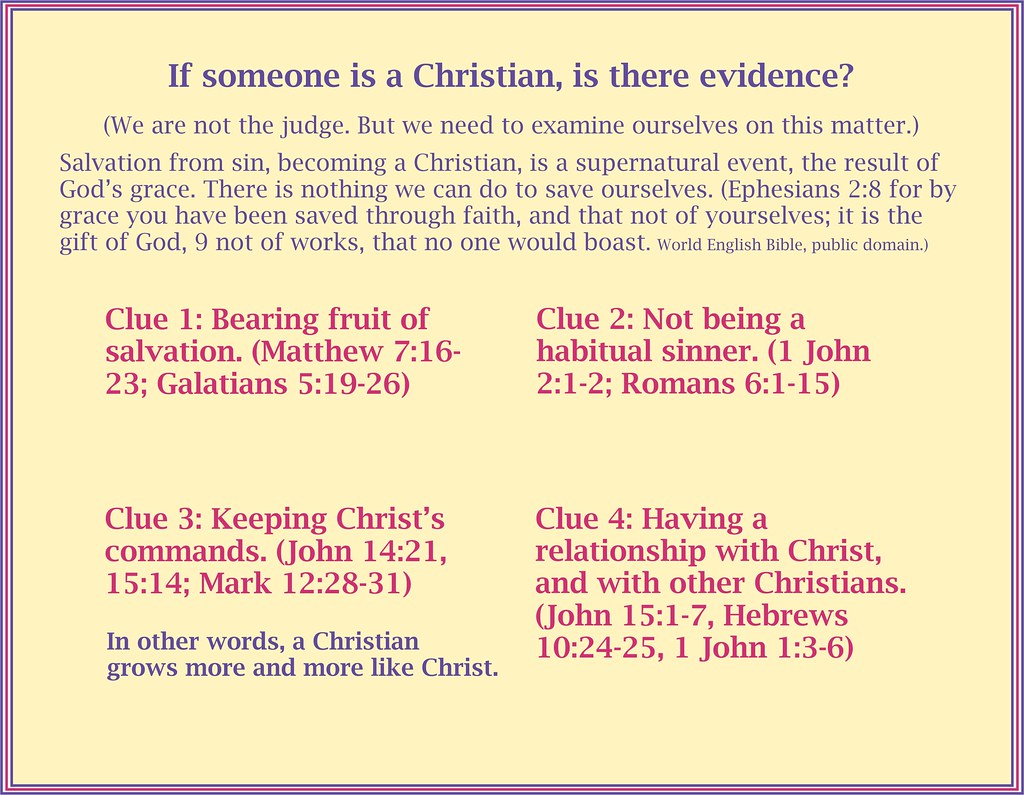
(The graphic above is a link to a larger version, which you are free to use for non-commercial purposes.)
Who is saved?
We cannot save ourselves, and the church cannot save us.
Salvation from sin is a supernatural event, the result of God’s grace. We can ask forgiveness for sin, and accept Christ’s atoning sacrifice, and the power of the resurrection. We need to do these things. But salvation is God’s work in us. (Ephesians 2:8 for by grace you have been saved through faith, and that not of yourselves; it is the gift of God, 9 not of works, that no one would boast. (Scripture quotations from the World English Bible, public domain)
Furthermore, raising our hands, saying a prayer, kneeling at a mourner’s bench, shaking a preacher’s hand, testifying to being saved, being baptized, having our names on a church roll do not and cannot save us, in and of themselves. (There is nothing wrong with these acts, or similar ones, and most converts ought to do most or all of them, especially baptism, but they don’t save us.) In other words, no one is saved because she thinks she is, or because he joined the church 15 years ago. If she or he is saved, it is because of God’s forgiveness. Whether we are saved or not is ultimately a question that only God can really answer. I once heard a Southern Baptist pastor say that about 50% of the people on the rolls of his church weren’t really saved. Why did he say that? Because, although they had participated in one or more of the acts listed above, they showed no evidence of salvation. (Southern Baptists are by no means alone in this!)
A person who is saved bears fruit of salvation
Matthew 13:18 “Hear, then, the parable of the farmer. 19 When anyone hears the word of the Kingdom, and doesn’t understand it, the evil one comes, and snatches away that which has been sown in his heart. This is what was sown by the roadside. 20 What was sown on the rocky places, this is he who hears the word, and immediately with joy receives it; 21 yet he has no root in himself, but endures for a while. When oppression or persecution arises because of the word, immediately he stumbles. 22 What was sown among the thorns, this is he who hears the word, but the cares of this age and the deceitfulness of riches choke the word, and he becomes unfruitful. 23 What was sown on the good ground, this is he who hears the word, and understands it, who most certainly bears fruit, and produces, some one hundred times as much, some sixty, and some thirty.”
Matthew 7:16 By their fruits you will know them. Do you gather grapes from thorns, or figs from thistles? 17 Even so, every good tree produces good fruit; but the corrupt tree produces evil fruit. 18 A good tree can’t produce evil fruit, neither can a corrupt tree produce good fruit. 19 Every tree that doesn’t grow good fruit is cut down, and thrown into the fire. 20 Therefore by their fruits you will know them. 21 Not everyone who says to me, ‘Lord, Lord,’ will enter into the Kingdom of Heaven; but he who does the will of my Father who is in heaven. 22 Many will tell me in that day, ‘Lord, Lord, didn’t we prophesy in your name, in your name cast out demons, and in your name do many mighty works?’ 23 Then I will tell them, ‘I never knew you. Depart from me, you who work iniquity.’
John 15:1 “I am the true vine, and my Father is the farmer. 2 Every branch in me that doesn’t bear fruit, he takes away. Every branch that bears fruit, he prunes, that it may bear more fruit. 3 You are already pruned clean because of the word which I have spoken to you. 4 Remain in me, and I in you. As the branch can’t bear fruit by itself, unless it remains in the vine, so neither can you, unless you remain in me. 5 I am the vine. You are the branches. He who remains in me, and I in him, the same bears much fruit, for apart from me you can do nothing. 6 If a man doesn’t remain in me, he is thrown out as a branch, and is withered; and they gather them, throw them into the fire, and they are burned. 7 If you remain in me, and my words remain in you, you will ask whatever you desire, and it will be done for you.
Jesus does not explain what “fruit” is. But He calls it “good fruit,” and says that we must remain in Him in order to produce it. The fruit is probably two related things: influencing people to be converted, and the Fruits of the Spirit, described in Galatians 5, which also describes bad fruit:
Galatians 5:19 Now the deeds of the flesh are obvious, which are: adultery, sexual immorality, uncleanness, lustfulness, 20 idolatry, sorcery, hatred, strife, jealousies, outbursts of anger, rivalries, divisions, heresies, 21 envy, murders, drunkenness, orgies, and things like these; of which I forewarn you, even as I also forewarned you, that those who practice such things will not inherit the Kingdom of God.
22 But the fruit of the Spirit is love, joy, peace, patience, kindness, goodness, faith, 23 gentleness, and self-control. Against such things there is no law. 24 Those who belong to Christ have crucified the flesh with its passions and lusts. 25 If we live by the Spirit, let’s also walk by the Spirit. 26 Let’s not become conceited, provoking one another, and envying one another.
A person who is saved is not a
habitual sinner.
(Note: To some people, sin is anything short of perfection – to them, honest mistakes, and
memory lapses, are sin. However, I am using a more restrictive definition, from
the Free Dictionary:
1. A transgression of a religious or moral law, especially when
deliberate.
2. Theology
a. Deliberate disobedience to the known will of God. b. A condition of estrangement from God resulting from such disobedience.
We should remember that there are sins of omission – things that we should do, but don’t – as well as sins of commission. See James 4:17 and Matthew 25:40-25.
Newly
saved people don't instantly become mature Christians. The Holy Spirit
works to develop us. Even mature Christians may newly realize some sin
as He reveals it to them. Psalm 86:11a Teach me your way, Yahweh.)
1 John 2:1 My little children, I write these things to you so that you may not sin. If anyone sins, we have a Counselor with the Father, Jesus Christ, the righteous. 2 And he is the atoning sacrifice for our sins, and not for ours only, but also for the whole world.
Romans 6:1 What shall we say then? Shall we continue in sin, that grace may abound? 2 May it never be! We who died to sin, how could we live in it any longer? 3 Or don’t you know that all we who were baptized into Christ Jesus were baptized into his death? 4 We were buried therefore with him through baptism to death, that just as Christ was raised from the dead through the glory of the Father, so we also might walk in newness of life. 5 For if we have become united with him in the likeness of his death, we will also be part of his resurrection; 6 knowing this, that our old man was crucified with him, that the body of sin might be done away with, so that we would no longer be in bondage to sin. 7 For he who has died has been freed from sin. 8 But if we died with Christ, we believe that we will also live with him; 9 knowing that Christ, being raised from the dead, dies no more. Death no more has dominion over him! 10 For the death that he died, he died to sin one time; but the life that he lives, he lives to God. 11 Thus consider yourselves also to be dead to sin, but alive to God in Christ Jesus our Lord. 12 Therefore don’t let sin reign in your mortal body, that you should obey it in its lusts. 13 Also, do not present your members to sin as instruments of unrighteousness, but present yourselves to God, as alive from the dead, and your members as instruments of righteousness to God. 14 For sin will not have dominion over you. For you are not under law, but under grace. 15 What then? Shall we sin, because we are not under law, but under grace? May it never be!
A person who is saved follows Christ’s commandments.
John 14:21
One who has my commandments, and keeps them, that person is one who loves me.
One who loves me will be loved by my Father, and I will love him, and will
reveal myself to him.”
23 Jesus
answered him, “If a man loves me, he will keep my word. My Father will love
him, and we will come to him, and make our home with him. 24 He who doesn’t
love me doesn’t keep my words.
John 15:14 You are my friends, if you do whatever I command you.
1 John 1:3 This is how we know that we know him: if we keep his commandments. 4 One who says, “I know him,” and doesn’t keep his commandments, is a liar, and the truth isn’t in him. 5 But whoever keeps his word, God’s love has most certainly been perfected in him. This is how we know that we are in him: 6 he who says he remains in him ought himself also to walk just like he walked.
Matthew 7:24 “Everyone therefore who hears these words of mine, and does them, I will liken him to a wise man, who built his house on a rock. 25 The rain came down, the floods came, and the winds blew, and beat on that house; and it didn’t fall, for it was founded on the rock. 26 Everyone who hears these words of mine, and doesn’t do them will be like a foolish man, who built his house on the sand. 27 The rain came down, the floods came, and the winds blew, and beat on that house; and it fell—and great was its fall.”
What are Christ’s commandments?
Many of them are found in the Sermon on the Mount (Matthew 5-7). Some of the commands in that Sermon are to keep our motives pure – don’t even want to commit adultery or murder; be reconciled to others, and forgive them; turn the other cheek; love even your enemies; don’t draw attention to your good deeds; don’t be anxious about worldly possessions; judge yourselves before judging others; beware of false prophets. He also told us to live the summary of the Old Testament Law:
Matthew 22:37 Jesus said to him, “‘You shall love the Lord your God with all your heart, with all your soul, and with all your mind.’ 38 This is the first and great commandment. 39 A second likewise is this, ‘You shall love your neighbor as yourself.’ 40 The whole law and the prophets depend on these two commandments.”
In Mark 12:14-19, Jesus commanded His listeners to honor the government, including paying taxes. We should remember that this was an occupying government, and its head was a Roman pagan emperor.
There are other commands, but one more is found in the last words of Matthew’s gospel: Matthew 28:19 Go, and make disciples of all nations, baptizing them in the name of the Father and of the Son and of the Holy Spirit, 20 teaching them to observe all things that I commanded you. Behold, I am with you always, even to the end of the age.” Amen.
A person who is saved continues in a relationship with Christ, and seeks the fellowship of other Christians.
John 15:1-7 (quoted above) uses the phrase “remain in me” or equivalent, seven times.
John 17:20 Not for these only do I pray, but for those also who believe in me through their word, 21 that they may all be one; even as you, Father, are in me, and I in you, that they also may be one in us; that the world may believe that you sent me. 22 The glory which you have given me, I have given to them; that they may be one, even as we are one; 23 I in them, and you in me, that they may be perfected into one; that the world may know that you sent me, and loved them, even as you loved me.
Hebrews 10:24 Let us consider how to provoke one another to love and good works, 25 not forsaking our own assembling together, as the custom of some is, but exhorting one another; and so much the more, as you see the Day approaching.
There are about 20 occurrences of groups of Christians being together in Acts. (See here.) Sometimes they met to worship, sometimes as a prayer meeting, sometimes to consider policy or doctrine. It was Paul’s practice to establish churches wherever he went as a missionary. Christ refers to seven churches in Revelation.
To summarize the evidences given above for being a Christian, a Christian becomes more and more like Christ. The Holy Spirit works in the life of a believer to bring these things about.
My conclusion is that as long as we remain in good relationship with God, we will keep Christ’s commandments, our lives will bear fruit, and we will not lose our salvation. Perhaps I ought to stop there, but the original question still remains. There are at least two views of the answer, both with Biblical support, but the question, and its answers, are trivial beside the more important question – am I saved now? Unfortunately, some people, who don't follow Christ's commandments, who do not have a relationship with Christ, who are persistent and unrepentant sinners, and whose lives show the wrong kind of fruit, are deluded by Satan into thinking that they are saved when they are not.
Thanks for reading!
Added October 26, 2012: You may want to see this post, on the warning passages in the book of Hebrews.
Added June 9, 2015: Neither the chart, nor the above discussion, consider baptism as evidence that one is a Christian. In Acts, baptism was perhaps the most important sign of being converted. Jesus commanded the church to baptize new believers. It's important! But what the chart and discussion are really about is ongoing evidence, up-to-date evidence. Baptism, for most believers, is a one-time event. The four evidences above are about our continuing life in Christ.
Tuesday, July 24, 2012
Is there evidence of conversion?
Is there evidence of conversion? I believe so. It's not up to me to judge, and the person I need to be most concerned about is me, not someone else, but here's some of what the Bible says on the subject:
Matthew 13:18 “Hear, then, the parable of the farmer. 19 When anyone hears the word of the Kingdom, and doesn’t understand it, the evil one comes, and snatches away that which has been sown in his heart. This is what was sown by the roadside. 20 What was sown on the rocky places, this is he who hears the word, and immediately with joy receives it; 21 yet he has no root in himself, but endures for a while. When oppression or persecution arises because of the word, immediately he stumbles. 22 What was sown among the thorns, this is he who hears the word, but the cares of this age and the deceitfulness of riches choke the word, and he becomes unfruitful. 23 What was sown on the good ground, this is he who hears the word, and understands it, who most certainly bears fruit, and produces, some one hundred times as much, some sixty, and some thirty.” (Scripture quotations from the World English Bible, public domain)
Matthew 7:16 By their fruits you will know them. Do you gather grapes from thorns, or figs from thistles? 17 Even so, every good tree produces good fruit; but the corrupt tree produces evil fruit. 18 A good tree can’t produce evil fruit, neither can a corrupt tree produce good fruit. 19 Every tree that doesn’t grow good fruit is cut down, and thrown into the fire. 20 Therefore by their fruits you will know them. 21 Not everyone who says to me, ‘Lord, Lord,’ will enter into the Kingdom of Heaven; but he who does the will of my Father who is in heaven. 22 Many will tell me in that day, ‘Lord, Lord, didn’t we prophesy in your name, in your name cast out demons, and in your name do many mighty works?’ 23 Then I will tell them, ‘I never knew you. Depart from me, you who work iniquity.’
John 15:1 “I am the true vine, and my Father is the farmer. 2 Every branch in me that doesn’t bear fruit, he takes away. Every branch that bears fruit, he prunes, that it may bear more fruit. 3 You are already pruned clean because of the word which I have spoken to you. 4 Remain in me, and I in you. As the branch can’t bear fruit by itself, unless it remains in the vine, so neither can you, unless you remain in me. 5 I am the vine. You are the branches. He who remains in me, and I in him, the same bears much fruit, for apart from me you can do nothing. 6 If a man doesn’t remain in me, he is thrown out as a branch, and is withered; and they gather them, throw them into the fire, and they are burned. 7 If you remain in me, and my words remain in you, you will ask whatever you desire, and it will be done for you.
Jesus does not explain what “fruit” is. But He calls it “good fruit,” and says that we must remain in Him in order to produce it. The fruit is probably two related things: influencing people to be converted, and the Fruits of the Spirit, described in Galatians 5, which also describes bad fruit:
Galatians 5:19 Now the deeds of the flesh are obvious, which are: adultery, sexual immorality, uncleanness, lustfulness, 20 idolatry, sorcery, hatred, strife, jealousies, outbursts of anger, rivalries, divisions, heresies, 21 envy, murders, drunkenness, orgies, and things like these; of which I forewarn you, even as I also forewarned you, that those who practice such things will not inherit the Kingdom of God.
22 But the fruit of the Spirit is love, joy, peace, patience, kindness, goodness, faith, 23 gentleness, and self-control. Against such things there is no law. 24 Those who belong to Christ have crucified the flesh with its passions and lusts. 25 If we live by the Spirit, let’s also walk by the Spirit. 26 Let’s not become conceited, provoking one another, and envying one another.
A person who is saved is not a habitual sinner.
(Note: To some people, sin is anything short of perfection – to them, honest mistakes, and memory lapses, are sin. However, I am using a more restrictive definition, from the Free Dictionary:
1. A transgression of a religious or moral law, especially when deliberate.
2. Theology
a. Deliberate disobedience to the known will of God.
b. A condition of estrangement from God resulting from such disobedience.We should remember that there are sins of omission – things that we should do, but don’t – as well as sins of commission. See James 4:17 and Matthew 25:40-25.)
1 John 1:1 My little children, I write these things to you so that you may not sin. If anyone sins, we have a Counselor with the Father, Jesus Christ, the righteous. 2 And he is the atoning sacrifice for our sins, and not for ours only, but also for the whole world.
Romans 6:1 What shall we say then? Shall we continue in sin, that grace may abound? 2 May it never be! We who died to sin, how could we live in it any longer? 3 Or don’t you know that all we who were baptized into Christ Jesus were baptized into his death? 4 We were buried therefore with him through baptism to death, that just as Christ was raised from the dead through the glory of the Father, so we also might walk in newness of life. 5 For if we have become united with him in the likeness of his death, we will also be part of his resurrection; 6 knowing this, that our old man was crucified with him, that the body of sin might be done away with, so that we would no longer be in bondage to sin. 7 For he who has died has been freed from sin. 8 But if we died with Christ, we believe that we will also live with him; 9 knowing that Christ, being raised from the dead, dies no more. Death no more has dominion over him! 10 For the death that he died, he died to sin one time; but the life that he lives, he lives to God. 11 Thus consider yourselves also to be dead to sin, but alive to God in Christ Jesus our Lord.
12 Therefore don’t let sin reign in your mortal body, that you should obey it in its lusts. 13 Also, do not present your members to sin as instruments of unrighteousness, but present yourselves to God, as alive from the dead, and your members as instruments of righteousness to God. 14 For sin will not have dominion over you. For you are not under law, but under grace. 15 What then? Shall we sin, because we are not under law, but under grace? May it never be!
A person who is saved follows Christ’s commandments.
John 14:21 One who has my commandments, and keeps them, that person is one who loves me. One who loves me will be loved by my Father, and I will love him, and will reveal myself to him.”
23 Jesus answered him, “If a man loves me, he will keep my word. My Father will love him, and we will come to him, and make our home with him. 24 He who doesn’t love me doesn’t keep my words.
John 17:15 I pray not that you would take them from the world, but that you would keep them from the evil one. 16 They are not of the world even as I am not of the world. 17 Sanctify them in your truth. Your word is truth. 18 As you sent me into the world, even so I have sent them into the world.
1 John 2:3 This is how we know that we know him: if we keep his commandments. 4 One who says, “I know him,” and doesn’t keep his commandments, is a liar, and the truth isn’t in him. 5 But whoever keeps his word, God’s love has most certainly been perfected in him. This is how we know that we are in him: 6 he who says he remains in him ought himself also to walk just like he walked.
Matthew 7:24 “Everyone therefore who hears these words of mine, and does them, I will liken him to a wise man, who built his house on a rock. 25 The rain came down, the floods came, and the winds blew, and beat on that house; and it didn’t fall, for it was founded on the rock. 26 Everyone who hears these words of mine, and doesn’t do them will be like a foolish man, who built his house on the sand. 27 The rain came down, the floods came, and the winds blew, and beat on that house; and it fell—and great was its fall.”
For more on what Christ's commandments are, see here.
A person who is saved continues in a relationship with Christ, and seeks the fellowship of other Christians.
John 15:1-7 (quoted above) uses the phrase “remain in me” or equivalent, seven times.
John 17:20 Not for these only do I pray, but for those also who believe in me through their word, 21 that they may all be one; even as you, Father, are in me, and I in you, that they also may be one in us; that the world may believe that you sent me. 22 The glory which you have given me, I have given to them; that they may be one, even as we are one; 23 I in them, and you in me, that they may be perfected into one; that the world may know that you sent me, and loved them, even as you loved me.
Hebrews 10:24 Let us consider how to provoke one another to love and good works, 25 not forsaking our own assembling together, as the custom of some is, but exhorting one another; and so much the more, as you see the Day approaching.
There are about 20 occurrences of groups of Christians being together in Acts. Sometimes they met to worship, sometimes as a prayer meeting, sometimes to consider policy or doctrine. It was Paul’s practice to establish churches wherever he went as a missionary. Christ speaks to seven churches, not individuals, in Revelation.
To summarize the evidences given above for being a Christian, a Christian becomes more and more like Christ. The Holy Spirit works in the life of a believer to bring these things about.
Thanks for reading!
August 19, 2012: This document, slightly modified, was re-posted, with a graphic at the beginning, a few days later, here.
August 19, 2012: This document, slightly modified, was re-posted, with a graphic at the beginning, a few days later, here.
Saturday, March 31, 2012
An Atheist converted, in answer to prayer
MR. MOODY'S FAITH, IN PRAYER. A REMARKABLE ANSWER. Mr.
Moody, on his return from England, while conducting a prayer-meeting in
Northfield, Mass., gave this illustration of the power of prayer to subdue the
most unlikely cases of sin and unbelief: "There is not a heart so hard
that God cannot touch it. While in Edinburgh, a man was pointed out to me by a
friend who said, 'Moody, that man is chairman of the Edinburgh infidel club.'
So I went and sat down beside him, and said, 'Well, my friend, I am glad to see
you at this meeting. Are you not concerned about your welfare?' He said that he
did not believe in a hereafter. I said, 'Well, you just get down on your knees
and let me pray for you.' "'I don't believe in prayer.' "I tried
unsuccessfully to get the man down on his knees, and finally knelt down beside
him and prayed for him. Well, he made a good deal of sport over it, and I met
him again many times in Edinburgh after that. A year ago last month, while in
the north of Scotland, I met the man again. Placing my hand on his shoulder, I
asked, 'Hasn't God answered the prayer?' "He replied, 'There is no God. I
am just the same as I always have been. If you believe in a God, and in answer
to prayer, do as I told you. Try your hand on me.' "'Well,' I said, 'God's
time will come; there are a great many praying for you; and I have faith to
believe you are going to be blessed.' "Six months ago I was in Liverpool;
and there I got a letter from the leading barrister of Edinburgh, telling me that
my friend, the infidel, had come to Christ, and that of his club of thirty men
seventeen had followed his example. "How it happened he could not say, but
whereas he was once blind, now he could see. God has answered the prayer. 'I
didn't know how it was to be answered,' said Mr. Moody, 'but I believedit would be and it was done. What we want to do is to come boldly to God.'"
Moody was D. L. Moody. In those days, atheists were often referred to as infidels, apparently even by themselves.
Quotation from Various (2004). The
Wonders of Prayer A Record of Well Authenticated and Wonderful Answers to
Prayer (Kindle Locations 3862-3875). Public Domain Books. Kindle Edition. Revised
by D. W. Whittle, F. H. Revell, 1885. Also available from here.
Friday, February 19, 2010
The God Delusion and disproving God's existence: Two published criticisms of Dawkins
I have been posting on The God Delusion, by Richard Dawkins. In this post, I shall briefly consider two published criticisms of the book, which, it seems to me, are from sources that must be taken seriously.
The first is by Antony Flew. Flew, as Dawkins put it, ". . . announced in his old age that he had been converted to belief in some sort of deity . . ." (p. 82). The conversion was from atheism. Dawkins not only implied that Flew had become senile (why else mention his age?) but criticized him for accepting an award related to Intelligent Design. (See here for my own problems with the Intelligent Design movement.)
Flew responded. His strongest criticism is this: "But an academic attacking some ideological position that he believes to be mistaken must, of course, attack that position in its strongest form." Flew says that Dawkins has not done this, in particular in respect to the beliefs of Einstein. Indeed, comparing the use of quotations from Einstein (see the index in The God Delusion, which index is excellent) with those in the Wikipedia article on "Albert Einstein's religious views" is interesting. Dawkins claims that Einstein's statements that seem to indicate that he was a deist ". . . are pantheistic, not deistic . . .." (p. 18.) The Wikipedia article on Einstein's religious views quotes Einstein as explicitly saying that he was neither a pantheist nor an atheist. For some reason, they do not give documentation for that quotation, but this may be at least a secondary source. I have previously posted, discussing Dawkins' tendency to find that prominent individuals were atheists, when the persons he found such denied it. Flew's criticism seems well-founded, in the case of Einstein, at least.
The New York Times publishes reviews of important books. They published a review of The God Delusion, by Jim Holt, who was presumably a well-qualified reviewer. In his review, he criticizes Dawkins in a number of ways. Holt, according to the note at the end of the review, was working on a book on the existence of God. He said that "The least satisfying part of this book is Dawkins’s treatment of the traditional arguments for the existence of God." Holt has other important criticisms of The God Delusion, and I will deal with some of them in further posts, God willing. (One of the criticisms has already been considered, in this post.)
Thanks for reading.
The first is by Antony Flew. Flew, as Dawkins put it, ". . . announced in his old age that he had been converted to belief in some sort of deity . . ." (p. 82). The conversion was from atheism. Dawkins not only implied that Flew had become senile (why else mention his age?) but criticized him for accepting an award related to Intelligent Design. (See here for my own problems with the Intelligent Design movement.)
Flew responded. His strongest criticism is this: "But an academic attacking some ideological position that he believes to be mistaken must, of course, attack that position in its strongest form." Flew says that Dawkins has not done this, in particular in respect to the beliefs of Einstein. Indeed, comparing the use of quotations from Einstein (see the index in The God Delusion, which index is excellent) with those in the Wikipedia article on "Albert Einstein's religious views" is interesting. Dawkins claims that Einstein's statements that seem to indicate that he was a deist ". . . are pantheistic, not deistic . . .." (p. 18.) The Wikipedia article on Einstein's religious views quotes Einstein as explicitly saying that he was neither a pantheist nor an atheist. For some reason, they do not give documentation for that quotation, but this may be at least a secondary source. I have previously posted, discussing Dawkins' tendency to find that prominent individuals were atheists, when the persons he found such denied it. Flew's criticism seems well-founded, in the case of Einstein, at least.
The New York Times publishes reviews of important books. They published a review of The God Delusion, by Jim Holt, who was presumably a well-qualified reviewer. In his review, he criticizes Dawkins in a number of ways. Holt, according to the note at the end of the review, was working on a book on the existence of God. He said that "The least satisfying part of this book is Dawkins’s treatment of the traditional arguments for the existence of God." Holt has other important criticisms of The God Delusion, and I will deal with some of them in further posts, God willing. (One of the criticisms has already been considered, in this post.)
Thanks for reading.
Thursday, August 27, 2009
How to be saved
This post was viewed over 300 times, for which I am grateful.
However, in March, 2013, I decided to update it. The new post, much like the old one, is here.
Thanks for web surfing. Read the new post.
However, in March, 2013, I decided to update it. The new post, much like the old one, is here.
Thanks for web surfing. Read the new post.
Thursday, July 23, 2009
Oswald Chambers on conversion versus redemption
I am ashamed to confess that, until recently, I had never read My Utmost for His Highest, by Oswald Chambers. It's a challenging devotional book. Since it is not public domain, I won't be quoting lots from it.
The entry for January 10th (the book is designed to be read as a devotional for each day of the year) discusses conversion versus redemption. I confess that I had supposed that they are the same thing. Chambers thought not. He quotes from Acts 26:18. Here is the entire verse:
The entry for January 10th (the book is designed to be read as a devotional for each day of the year) discusses conversion versus redemption. I confess that I had supposed that they are the same thing. Chambers thought not. He quotes from Acts 26:18. Here is the entire verse:
'. . . to open their eyes, so that they may turn from darkness to light and from the power of Satan to God, that they may receive forgiveness of sins and a place among those who are sanctified by faith in me.'
Chambers said that conversion is a human act -- turning away from sin, and a sinful lifestyle. Redemption, however, is something that is received. God does it for us. He wrote that too many so-called Christians have not gotten beyond conversion -- they have joined a church, and given up some old habits, but they have not yet received anything from God, and are satisfied as they are.
I can see that Chambers is going to be well worth reading!
Thursday, July 16, 2009
Additional Biblical reasons for environmental stewardship
I have previously posted on "Environmental Stewardship in the Bible," and, in fact, this is one of what I consider to be one of my most significant posts (out of about 1,200!). I freely confess that the Biblical reasons for trying to keep the environment around us in as good a condition as we can were mostly, maybe totally, not original.
In this post, I wish to put forward two new arguments from the Bible, in favor of trying to preserve endangered species, and endangered ecosystems or communities. As far as I know, they are original. Perhaps that is so because they aren't very good reasons. I don't know.
Psalm 19:1-4 and Romans 1:20 tell us that observing and learning about nature are part of God’s revelation to humans. If that is so, isn’t that another reason to try to preserve nature as well as we can? The Bible is one of the ways that God reveals Himself to us. For a long time, Christians have believed that the Bible should be translated into the language people are most familiar with, so that that revelation may be as clear as possible. Similarly, it would seem that God's revelation through nature should be as clear as possible. A person is more likely to see God in a pristine stream than in a polluted river. Probably seeing bison herds roam freely in Western North America gave people a glimpse of one aspect of God’s power and majesty that they can’t really get now. Therefore, helping to preserve nature in as good a condition as we can is one way to bring people to a saving knowledge of Christ. Not the most direct way, and probably not the most effective, for many people, but it is still a way to do this.
2) Colossians 1:15-20 says, of Christ, that “in Him all things hold together.” (ESV -- other versions have similar language. See here for the ESV policy on electronic use of this version of the Bible.) That passage also says that He is working to reconcile all things to Himself, and that He is working to make peace through the blood of the cross. As Christians, we believe that it is our duty to be His instruments in reconciling sinners to Christ, and to help Him in the ministry of making peace. In fact, 2 Corinthians 5:18-19, tell us that: 18 But all things are of God, who reconciled us to himself through Jesus Christ, and gave to us the ministry of reconciliation; 19 namely, that God was in Christ reconciling the world to himself, not reckoning to them their trespasses, and having committed to us the word of reconciliation.
Doesn’t it follow that we should also participate in Christ’s work of sustaining “all things,” including endangered species and ecosystems or biological communities? (I realize that there are other places in the New Testament where reconciliation and peacemaking are mentioned, or implied, and this is probably the only one that mentions Christ's sustaining work. But that doesn't mean that His sustaining work can be dismissed, or that we have no responsibility to be His instruments in doing it.)
What do you think?
Thanks for reading. (This post was edited on October 16, 2009. I attempted to enhance the arguments, without changing them. On September 26, 2013, I added the quotation from 2 Corinthians, and the introduction to it.)
In this post, I wish to put forward two new arguments from the Bible, in favor of trying to preserve endangered species, and endangered ecosystems or communities. As far as I know, they are original. Perhaps that is so because they aren't very good reasons. I don't know.
Psalm 19:1-4 and Romans 1:20 tell us that observing and learning about nature are part of God’s revelation to humans. If that is so, isn’t that another reason to try to preserve nature as well as we can? The Bible is one of the ways that God reveals Himself to us. For a long time, Christians have believed that the Bible should be translated into the language people are most familiar with, so that that revelation may be as clear as possible. Similarly, it would seem that God's revelation through nature should be as clear as possible. A person is more likely to see God in a pristine stream than in a polluted river. Probably seeing bison herds roam freely in Western North America gave people a glimpse of one aspect of God’s power and majesty that they can’t really get now. Therefore, helping to preserve nature in as good a condition as we can is one way to bring people to a saving knowledge of Christ. Not the most direct way, and probably not the most effective, for many people, but it is still a way to do this.
2) Colossians 1:15-20 says, of Christ, that “in Him all things hold together.” (ESV -- other versions have similar language. See here for the ESV policy on electronic use of this version of the Bible.) That passage also says that He is working to reconcile all things to Himself, and that He is working to make peace through the blood of the cross. As Christians, we believe that it is our duty to be His instruments in reconciling sinners to Christ, and to help Him in the ministry of making peace. In fact, 2 Corinthians 5:18-19, tell us that: 18 But all things are of God, who reconciled us to himself through Jesus Christ, and gave to us the ministry of reconciliation; 19 namely, that God was in Christ reconciling the world to himself, not reckoning to them their trespasses, and having committed to us the word of reconciliation.
Doesn’t it follow that we should also participate in Christ’s work of sustaining “all things,” including endangered species and ecosystems or biological communities? (I realize that there are other places in the New Testament where reconciliation and peacemaking are mentioned, or implied, and this is probably the only one that mentions Christ's sustaining work. But that doesn't mean that His sustaining work can be dismissed, or that we have no responsibility to be His instruments in doing it.)
What do you think?
Thanks for reading. (This post was edited on October 16, 2009. I attempted to enhance the arguments, without changing them. On September 26, 2013, I added the quotation from 2 Corinthians, and the introduction to it.)
Subscribe to:
Posts (Atom)