License

I have written an e-book, Does the Bible Really Say That?, which is free to anyone. To download that book, in several formats, go here.
Creative Commons License
The posts in this blog are licensed under a Creative Commons Attribution-NonCommercial-ShareAlike 3.0 Unported License. You can copy and use this material, as long as you aren't making money from it. If you give me credit, thanks. If not, OK.
Showing posts with label Romans 1:20. Show all posts

Tuesday, September 02, 2025

New Testament teaching on care of the environment

 New Testament teaching on care of the environment

Most of the usual teaching on what the Bible says about care of the environment is from the Old Testament. However, there are two passages from the New Testament that also argue that we should be caring carefully for the environment. They are indirect, but their urgency is important.
Romans 1:20 tells us that observing and learning about nature are part of God’s revelation to humans. (So does Psalm 19:1-4). If that is so, isn’t that another reason to try to preserve nature as well as we can? The Bible is one of the ways that God reveals Himself to us. For a long time, Christians have believed that the Bible should be translated into the language people are most familiar with, so that that revelation may be as clear as possible. Similarly, it would seem that God's revelation through nature should be as clear as possible. A person is more likely to see God in a pristine stream than in a polluted river. Probably seeing bison herds roam freely in Western North America gave people a glimpse of one aspect of God’s power and majesty that they can’t really get now. Therefore, helping to preserve nature in as good a condition as we can is one way to bring people to a saving knowledge of Christ. Not the most direct way, and probably not the most effective, for many people, but it is still a way to do this.


Colossians 1:15-20 says, of Christ, that “in Him all things hold together.” (ESV -- other versions have similar language.) That passage also says that He is working to reconcile all things to Himself, and working to make peace through the blood of the cross. As Christians, we believe that it is our duty to be His instruments in reconciling sinners to Christ, and to help Him in the ministry of making peace. In fact, 2 Corinthians 5:18-19, tell us that:  18 But all things are of God, who reconciled us to himself through Jesus Christ, and gave to us the ministry of reconciliation; 19 namely, that God was in Christ reconciling the world to himself, not reckoning to them their trespasses, and having committed to us the word of reconciliation.

Doesn’t it follow that we should also participate in Christ’s work of sustaining, or holding “all things” together, including endangered species and ecosystems or biological communities? (I realize that there are other places in the New Testament where reconciliation and peacemaking are mentioned, or implied, and this is probably the only one that mentions Christ's sustaining work. But that doesn't mean that His sustaining work can be dismissed, or that we have no responsibility to be His instruments in doing it.)

This is an excerpt from a post on July 16, 2009, modified slightly.

Thanks for reading!

Saturday, October 09, 2021

New Testament teaching on care of the environment

New Testament teaching on care of the environment
Most of the usual teaching on what the Bible says about care of the environment is from the Old Testament. However, there are two passages from the New Testament that also argue that we should be caring carefully for the environment. They are indirect, but their urgency is important. 
Romans 1:20 tells us that observing and learning about nature are part of God’s revelation to humans. (So does Psalm 19:1-4). If that is so, isn’t that another reason to try to preserve nature as well as we can? The Bible is one of the ways that God reveals Himself to us. For a long time, Christians have believed that the Bible should be translated into the language people are most familiar with, so that that revelation may be as clear as possible. Similarly, it would seem that God's revelation through nature should be as clear as possible. A person is more likely to see God in a pristine stream than in a polluted river. Probably seeing bison herds roam freely in Western North America gave people a glimpse of one aspect of God’s power and majesty that they can’t really get now. Therefore, helping to preserve nature in as good a condition as we can is one way to bring people to a saving knowledge of Christ. Not the most direct way, and probably not the most effective, for many people, but it is still a way to do this.
 
Colossians 1:15-20 says, of Christ, that “in Him all things hold together.” (ESV -- other versions have similar language.) That passage also says that He is working to reconcile all things to Himself, and working to make peace through the blood of the cross. As Christians, we believe that it is our duty to be His instruments in reconciling sinners to Christ, and to help Him in the ministry of making peace. In fact, 2 Corinthians 5:18-19, tells us that:  18 But all things are of God, who reconciled us to himself through Jesus Christ, and gave to us the ministry of reconciliation; 19 namely, that God was in Christ reconciling the world to himself, not reckoning to them their trespasses, and having committed to us the word of reconciliation. 
Doesn’t it follow that we should also participate in Christ’s work of sustaining “all things,” including endangered species and ecosystems or biological communities? (I realize that there are other places in the New Testament where reconciliation and peacemaking are mentioned, or implied, and this is probably the only one that mentions Christ's sustaining work. But that doesn't mean that His sustaining work can be dismissed, or that we have no responsibility to be His instruments in doing it.)

This post was taken, as is, from a longer post on what the Bible says about environmental stewardship. 

Monday, July 27, 2020

Christian stewardship of the environment, from the New Testament


Romans 1:20 For the invisible things of him since the creation of the world are clearly seen, being perceived through the things that are made, even his everlasting power and divinity, that they may be without excuse.

Psalm 19:1-3 The heavens declare the glory of God. The expanse shows his handiwork. Day after day they pour out speech, and night after night they display knowledge. There is no speech nor language, where their voice is not heard.


God’s revelation should be as clear as possible. Christians have translated the Bible into many languages, revised translations so that they speak more clearly, and created and updated church music, so that it fits the culture better. Nature also speaks of God. The message of God through nature should be as clear – free of extinction, pollution and destruction – as we can make it. Unfortunately, we are gradually degrading God’s revelation through nature. For example, a third of the people on earth can’t see the Milky Way now, because of “light pollution.”


Colossians 1 describes Christ, and his mission, which includes reconciliation, and holding things together:
17 He is before all things, and in him all things are held together. 18 He is the head of the body, the assembly, who is the beginning, the firstborn from the dead, that in all things he might have the preeminence. 19 For all the fullness was pleased to dwell in him, 20 and through him to reconcile all things to himself by him, whether things on the earth or things in the heavens, having made peace through the blood of his cross.


Christ holds things together, and reconciles all things to himself.

 
2 Corinthians 5 indicates that believers are to carry out Christ’s ministry of reconciliation: 18 But all things are of God, who reconciled us to himself through Jesus Christ, and gave to us the ministry of reconciliation; 19 namely, that God was in Christ reconciling the world to himself, not reckoning to them their trespasses, and having committed to us the word of reconciliation. (scripture from the World English Bible, public domain)


If believers are responsible for helping Christ in reconciliation, aren’t we also responsible for helping Him to hold all things together? (Which means, in part, caring for the environment.) See also Psalm 24:1, Genesis 1:28, 31, Psalm 104:24-5 and more. This post considers what the Old Testament says about our responsibility to care for the environment.

Friday, December 27, 2019

Environmental Stewardship in the Bible, re-post

Two Days late for Earth Day - Environmental stewardship

We have God-given responsibilities to non-human organisms
Genesis 1:26-28 seems to indicate clearly that humans were placed in charge of the non-human world. Psalm 8:6 reiterates that idea. Psalm 24:1 indicates that even though we are, in some sense, in charge, the world, and the things in it, are God’s. So does Psalm 50:10,11.* The story of Noah seems to indicate that, at one point, humans were directly responsible for the lives of many kinds of animals. Genesis 7:2-5, 14-16, Proverbs 12:10 and Proverbs 27:23 all have to do with caring for animals.

God seems to care not just for animals in general, but for kinds of animals. Psalms 104:24-25 praises God for the diversity of His creation, and His creatures. Since this explicitly includes the wide variety of ocean animals, it doesn’t seem possible that this praise is meant to be only because of their usefulness to humans. Genesis 7:3, 14-16 indicate God’s concern that the different kinds of animals would be preserved. Genesis 8:1 says that God had not forgotten Noah or the animals. Noah and his family were God’s agents in this care, of course, but they were God-directed agents. It would seem reasonable to argue that in our day, we also have responsibilities to the kinds of animals that exist in our time.

Does God care for individual non-human organisms? Perhaps. The question seems to be addressed in Matthew 10:29, which says that even individual sparrows do not fall without God’s knowledge. (Two verses later, Christ stated that the twelve were of more value than many sparrows. However, He didn’t say that sparrows were valueless.)

Does God’s care, and the care that humans are supposed to have, mean that we must refrain from killing animals deliberately? Apparently not. Jesus certainly condoned fishing (John 21:6, Matthew 17:27, Luke 5:4). He ate (Luke 24:36-43), and probably fished (John 21:9) even after His resurrection. Peter's vision, after the resurrection, and after Pentecost, used eating meat as a sign that God does not show favoritism (Acts 11:1-18). Paul referred disparagingly to people who forbid eating meat (I Timothy 4:1-3). There are no explicit commands forbidding the consumption of all meat in the Bible. This is not to say that the Bible condones killing of animals wantonly. That would be contradictory to benign dominion. Nor does the Bible condone consumption of animal flesh (or any other kind of food) selfishly, or to excess. But we are allowed to kill non-human organisms for cause, at least. Such causes include killing an animal because it threatens a human (Exodus 21:29), killing for meat (Genesis 9:2-3, Leviticus 11:1-22) and killing an animal for its skin (Genesis 3:21). Exodus 12:21-23 and 12:46, and Mark 14:12, indicate clearly that the Passover, one of the most important ceremonies of the Jews, and the last ceremony Jesus performed with His disciples, involved eating meat. The Bible is very clear that humans and animals are not equals. Christ came in human form, principally to redeem humans, although the effects of redemption will be felt through all of creation. We have dominion over animals, not the reverse. That dominion implies responsible use, including research and killing for good cause. (Nothing in this paragraph rules out the practice of vegetarianism. Some Christians may decide, or God may reveal to them, that they shouldn't eat meat. But they cannot prove that Scripture demands that Christians don't eat meat.)

Does God’s care extend to plants? To non-living entities? (The Bible, like present-day people, is more concerned with some kinds of animals than others. There is little, if any, mention of mollusks in scripture, for instance.) The Bible mentions God’s care of plants (Psalm 104:16, Matthew 6:30). It also states that everything He created was initially good (Genesis 1:31) and that creation as a whole, not just humans, groans, waiting for restoration (Romans 8:22). It is true that the Bible does not dwell on plants nearly as much as on animals. The creation of plants gets only one phrase in the Genesis account, whereas the creation of animals gets several. There is no mention of God’s concern for plants during the flood, nor are certain kinds of plants declared unclean in the Mosaic dietary laws. All this means that the Hebrews, like ourselves, were more interested in animals than in plants. Perhaps it means that God is also more interested.
From the above, we conclude that God’s care extends beyond humans, certainly to animals. Scripture is less explicit about God’s care for plants, and even less so about His care for rocks, streams, and clouds. However, there seems no reason to expect God to condone wanton destruction of any kind. If God cares for non-human creations, and we are responsible for His creation, then it behooves us to care for non-human creations as well. Proverbs 12:10 says that good people care for their domestic animals, and bad people are cruel to theirs. Caring for animals is usually consistent with caring for plants, or for rocks, streams and clouds. II Chronicles 36:21 tells us that the 70 years that the Israelites were to spend in captivity was not an arbitrary figure. God chose that because his people did not care for the land as he instructed them to. Jeremiah 2:7 and Habakkuk 2:17 condemn the Israelites because they hadn’t taken care of their land.

New Testament teaching on care of the environment
Most of the usual teaching on what the Bible says about care of the environment is from the Old Testament. However, there are two passages from the New Testament that also argue that we should be caring carefully for the environment. They are indirect, but their urgency is important. 
Romans 1:20 tells us that observing and learning about nature are part of God’s revelation to humans. (So does Psalm 19:1-4). If that is so, isn’t that another reason to try to preserve nature as well as we can? The Bible is one of the ways that God reveals Himself to us. For a long time, Christians have believed that the Bible should be translated into the language people are most familiar with, so that that revelation may be as clear as possible. Similarly, it would seem that God's revelation through nature should be as clear as possible. A person is more likely to see God in a pristine stream than in a polluted river. Probably seeing bison herds roam freely in Western North America gave people a glimpse of one aspect of God’s power and majesty that they can’t really get now. Therefore, helping to preserve nature in as good a condition as we can is one way to bring people to a saving knowledge of Christ. Not the most direct way, and probably not the most effective, for many people, but it is still a way to do this.
 
Colossians 1:15-20 says, of Christ, that “in Him all things hold together.” (ESV -- other versions have similar language.) That passage also says that He is working to reconcile all things to Himself, and working to make peace through the blood of the cross. As Christians, we believe that it is our duty to be His instruments in reconciling sinners to Christ, and to help Him in the ministry of making peace. In fact, 2 Corinthians 5:18-19, tell us that:  18 But all things are of God, who reconciled us to himself through Jesus Christ, and gave to us the ministry of reconciliation; 19 namely, that God was in Christ reconciling the world to himself, not reckoning to them their trespasses, and having committed to us the word of reconciliation. 
Doesn’t it follow that we should also participate in Christ’s work of sustaining “all things,” including endangered species and ecosystems or biological communities? (I realize that there are other places in the New Testament where reconciliation and peacemaking are mentioned, or implied, and this is probably the only one that mentions Christ's sustaining work. But that doesn't mean that His sustaining work can be dismissed, or that we have no responsibility to be His instruments in doing it.)

What must we do when our responsibilities seem to conflict?
One response is to ask, do they ever really conflict? We believe that our responsibilities do, in fact, appear to conflict, in these matters, and in others. As fallen, finite beings, we do not always interpret God’s directions correctly. We certainly do not know enough to always judge correctly. If we did possess the ability to decide correctly in all cases, perhaps God’s demands on us would never even seem to conflict. However, we can’t, and they do seem to conflict. Perhaps, this being a fallen world, they actually conflict.
The Bible does not present a formal hierarchy of principles to guide our behavior, in matters of environmental ethics, or in other matters. It does not tell us how to choose when, for instance, a decision we make will lead to either 5 minutes of misery for each of 2000 people, or 3 days of misery for a single individual. It does not tell us what to do when bringing a field under cultivation will help to feed hungry people, but also will kill native plants, deprive animals of homes, and use petroleum resources. As fallen beings in a fallen world, it is probably too much to expect that all our decisions will be correct.

Here are some attempts at principles which may be of help in making decisions about environmental matters:
This world is temporary. Temporal concerns of any kind should be carefully weighed against eternal values. The fossil record indicates that more species have become extinct than are now alive, and usually not because humans caused the extinction. This doesn’t excuse us from trying to save the organisms that live in our time, of course.

We should recognize that environmental concerns are sometimes overstated, not prioritized, or controversial. Some would have us believe that humans are choking to death and swimming in carcinogens. This is overstatement. The atmosphere may not be as clear as it ought to be, and we may indeed be exposed to cancer-causing substances, but people in North America are living longer than ever before. It seems certain that we can’t cure every ill, environmental or otherwise. Is it more important to try to stop global warming, to save the California condor, or to cut down on our consumption of fossil fuels? Is the cost, or risk, from pollution to landfills from disposable diapers more or less than the pollution to water from washing non-disposable ones? No one seems to know the answers. Solutions are not prioritized. We must be careful not to act precipitously just because someone has a concern.

Selfishness is wrong. Most North Americans seem to subconsciously believe that we are somehow entitled to more possessions than people in other parts of the world. Such a life style contributes to environmental degradation. It may also deprive people in other parts of the world, or future generations, of resources. It may mean that our church, and other charitable causes, do not have funds that we could well afford to give. We may not personally be able to change the way the world works very much. We can change it a little, and we should. We can avoid conspicuous consumption, we can avoid wanting things simply because they are newer than the things we already have. We can participate in recycling, even if it requires some effort on our part. We can think carefully about every purchase we make.
Isaiah 5:8-10 is a warning to the Hebrews. It tells them that God doesn’t condone selfishness in material things, including use of land. It predicts that the land will stop yielding enough, as God’s punishment for selfishness.

Knowledge is necessary. We are in God’s image. Part of the reflection of the omniscient God in us is the desire for knowledge. The Bible speaks approvingly of Solomon’s knowledge of the natural world (I Kings 4:32-33). We should learn to appreciate the world as God made it, and this requires knowledge of it. Knowledge is also necessary for wise alleviation of our own mistakes.

Unselfish love is a scriptural requirement. This unselfish love ought to color our relationships with others in every area, certainly including our environmental activities. It is not clear that we can, or ought, to have a relationship of unselfish love with non-human organisms, but it would seem consistent with God’s expectation of us that we act unselfishly toward non-human organisms.
We need guidance from God. All our important decisions need His help. Even with this guidance, we don’t always agree. God may well want some of us to be deeply involved in helping crisis pregnancies, but others to try to help clean up the environment. This doesn’t mean that both groups can’t assist in both efforts, but God may give our lives different emphases.

Having stated these principles, we realize anew that it is difficult to apply them to cases. In many cases, all we can say is “God help us.”

The Bible does not rule out the use of current technology, and the development of new technology
Since the development and use of technology has often been related to use of valuable resources, or contributed to greater “efficiency” in despoiling the landscape, we certainly need to be careful in developing and using technology, for our own sake, as well as that of the landscape. Is technology anti-God? The answer to that question seems to be “it depends.”
There are three biblical passages that indicate reasons why particular technological development may be wrong.
First, worshiping the results of our technology is clearly wrong, as well as just plain stupid (Isaiah 44:9-20).

Second, pride in our accomplishments is wrong (Daniel 4:30-32).

Third, supposing that there are no limits to human ability is wrong (Genesis 11:5-9).

On the other hand, there are biblical reasons for supposing that technological development is not always wrong, and, in fact, can sometimes glorify God. Noah’s ark, the tabernacle, and the temple, were technological constructs, and God gave instructions for the building of each of them. In fact, in the building of the temple, and other projects completed during the reign of Solomon, there was apparently extensive use of resources. Solomon sent 10,000 workers to Lebanon to cut down cedar trees each month (I Kings 5:14), in addition to the servants of King Hiram who helped them. They may have worked there for as long as seven (I Kings 6:38) or even twenty years (II Chronicles 8:1). All this was at least allowed by God, and some of it was directed by Him. Jeremiah 22:6 contains an amazing statement. This verse says that God finds the royal palace at Jerusalem as beautiful as the mountains of Lebanon. It would seem that technological development, by and of itself, is not wrong, although it may be done for wrong reasons, or with the wrong attitude.
Part of the image of God in humans is the desire to create things. The fact that we can create and use technology has certainly lead to some unfortunate consequences, such as deaths and injuries in highway accidents. However, it may also lead to some fortunate consequences, such as our being able to alleviate some of the consequences of our own mistakes of the past, or even some of the consequences of the fall.


+  +  +  +  +

April 23, 2011:

On an earlier date, links to all the scripture referenced in this post, using the English Standard Version, were added. (See here for the ESV policy on copyright.) The section on New Testament teaching on care of the environment was inserted on this date. It had been part of a previous post. That post is still on-line. I have not removed any of the comments from the previous version of this post.

Thanks for reading!

*Added October 15, 2014: More scripture on God's ownership, and our stewardship: Jeremiah 27:5 ‘I have made the earth, the men, and the animals that are on the surface of the earth by my great power and by my outstretched arm. I give it to whom it seems right to me. 6 Now I have given all these lands into the hand of Nebuchadnezzar the king of Babylon, my servant. I have also given the animals of the field to him to serve him. (World English Bible, public domain) 

Added April 20, 2017: E. Stephen Burnett has written a fine blog post on how care of the current earth relates to the New Earth.

Added December 27, 2019: Nancy Sleeth, in Relevant, demolishes some objections some Christians raise (such as "It's all going to be destroyed in the end, so why care for earth?")

This post originally appeared on April 22, 2006. I have re-posted it, after reading Sleeth's article. To see comments prior to December 2019, use the link in the previous sentence. Thanks for reading.

Friday, April 22, 2016

The New Testament teaches that Christians should be stewards of the environment.

Psalm 19:1-4 and Romans 1:20 tell us that observing and learning about nature are part of God’s revelation to humans. If that is so, isn’t that a reason to try to preserve nature as well as we can?

The Bible is one of the ways that God reveals Himself to us. Christians believe that the Bible should be translated into the language people are most familiar with, so that that revelation may be as clear as possible. Similarly, it would seem that God’s revelation through nature should be as clear as possible. A person is more likely to see God in a beautiful clear stream than in a polluted river, or in a clear sky than in a smog-filled atmosphere. Seeing bison herds roam freely in Western North America, or immense flocks of passenger pigeons, gave people a glimpse of aspects of God’s power and majesty that they can’t get now. Helping to preserve nature in as good a condition as we can is one way to bring people to a saving knowledge of Christ. Not the most direct way, and perhaps not the most effective, but it is still a way to do this.
 
Colossians 1:15-20 says, of Christ, that “in Him all things are held together.” That passage also says that He is working to reconcile all things to Himself, and that He is working to make peace through the blood of the cross. As Christians, we believe that it is our duty to be His instruments in reconciling sinners to Christ, and to help Him in the ministry of making peace. 2 Corinthians 5:18-19 tells us that: 18 But all things are of God, who reconciled us to himself through Jesus Christ, and gave to us the ministry of reconciliation; 19 namely, that God was in Christ reconciling the world to himself, not reckoning to them their trespasses, and having committed to us the word of reconciliation.

(Hebrews 1:3 also tells us that Christ is holding all things together.)  
Christians believe they should participate in Christ’s work of reconciliation. Shouldn’t they also participate in His work of holding all things together, including endangered species, ecosystems and biological communities?

What do you think? (See here for Old Testament teaching on environmental stewardship. There is lots of it!)

Thanks for reading. This post was modified from this one.

Monday, July 08, 2013

Beauty and science: quotations from others

The quotations below are about the relationship between beauty and science. They were written, or said, by a variety of people, some overtly Christian, such as John C. Polkinghorne, some not, such as Einstein or Feynman. Most of the publications are secular, including those from Yale University Press and Cambridge University Press, Physics Today, and the New York Times.

Richard Feynman, Nobel laureate, wrote: “What is it about nature that lets this happen, that it is possible to guess from one part what the rest is going to do? That is an unscientific question: I do not know how to answer it, and therefore I am going to give an unscientific answer. I think it is because nature has a simplicity and therefore a great beauty.” “Seeking New Laws,” pp. 143-167, in Richard Feynman, The Character of Physical Law, New York: Modern Library, 1994. Quote is from p. 167. I have read all, or nearly all, of Feynman’s popular writing, and seen no evidence that he believed in God at all.

The world, you might argue, does not need yet another subatomic particle. But even particle physics has not been about particles for a long time, physicists say. Rather it is about the relationships between particles, the symmetries that nature seems to respect, in short, about the beauty that physical laws seem to embody. Dennis Overbye, "After Triumph and Disillusionment, Wonder Re-enters the Story," New York Times, July 27, 2004

The scientist does not study nature because it is useful to do so. He studies it because he takes pleasure in it; and he takes pleasure in it because it is beautiful. If nature were not beautiful, it would not be worth knowing and life would not be worth living. . . . I mean the intimate beauty which comes from the harmonious order of its parts and which a pure intelligence can grasp. Henri Poincaré, as quoted by S. Chandrasekar, "Beauty and the quest for beauty in science," Physics Today, July, 1979, pp. 25-30, p. 25. Source not given.

We live in a world whose physical fabric is endowed with transparent rational beauty. Attempts have been made to explain away this fact. No one would deny, of course, that evolutionary necessity will have moulded our ability for thinking in ways that will ensure its adequacy for understanding the world around us, at least to the extent that is demanded by pressures for survival. Yet our surplus intellectual capacity, enabling us to comprehend the microworld of quarks and gluons and the macroworld of big bang cosmology, is on such a scale that it beggars belief that this is simply a fortunate by-product of the struggle for life. Remember that Sherlock Holmes told a shocked Dr. Watson that he didn't care whether the Earth went around the Sun or vice versa, for it had no relevance to the pursuits of his daily life! John C. Polkinghorne, Belief in God in an Age of Science. New Haven, CT: Yale University Press, 1998. pp. 2-3.

Thus, the perception of the world's beauty as a reflection of God's glory is incomplete without the awareness that underlying the beauty and wonder of earthly nature is the omnipresent, restless operation of electromagnetic phenomena. These phenomena can be seen as a reflection, an analogue, of God's indwelling. This very thought, in itself, possesses an inherent aesthetic value.

Moreover, the appreciation of the beauty that the EMI [Electromagnetic Interaction] contributes to nature is wanting without the realization that the mathematical equations that describe the EMI have a timeless beauty. The elegant symmetry of Maxwell's equations and the inspired simplicity of Dirac's equation bestow an abiding aesthetic flavor to the texture of the microscopic underworld. Dirac and Heisenberg among many other theoretical physicists have throughout their careers expressed how they have been guided by the criteria of beauty and simplicity in their work.
- Lawrence W. Fagg, Electromagnetism and the Sacred: At the Frontier of Spirit and Matter (New York: Continuum, 1999) p. 120.

For the theist, the rational beauty of the physical world is not just a brute fact, but a reflection of the mind of the Creator. Aesthetic experience and ethical intuitions are not just psychological or social constructs, but intimations of God's joy in creation and of his just will. Religious experience is not illusory human projection, but encounter with divine reality. There is an integrating wholeness in the theistic account which I find intellectually satisfying, even though it must wrestle with the mystery of infinite Being.

The theist and the atheist alike survey the same world of human experience, but offer incompatible interpretations of it. My claim would be that theism has a more profound and comprehensive understanding to offer than that afforded by atheism. Atheists are not stupid, but they explain less.
- John C. Polkinghorne, The Faith of a Physicist: Reflections of a Bottom-Up Thinker. The Gifford Lectures for 1993-4, p. 70. Princeton, New Jersey: Princeton University Press, 1994

That seems even clearer to us when we recognize that it is mathematics which gives us the key to unlock the secrets of nature. Paul Dirac spent his life in the search for beautiful equations. That is a concept not all will find immediately accessible, but among those of us who speak the language of mathematics, mathematical beauty is a recognizable quality. It is hard to describe but easy to recognize -- like most other kinds of beauty. Its essence lies in a certain economy and elegance that leads to the mathematical property of being 'deep.'… Time and again we have found that it is equations with that indispensable character of mathematical beauty which describe the nature of the physical world. - John C. Polkinghorne, Beyond Science: The Wider Human Context. New York: Cambridge University Press, 1996, pp. 79-80.

I asked him once about a theory and he said, "when I am evaluating a theory, I ask myself, if I were God, would I have made the universe in that way." If the theory did not have the sort of simple beauty that would be demanded of a God, then the theory was at best only provisional. (Banesh Hoffman, "Working with Einstein," pp. 475-478, in Some Strangeness in the Proportion: A Centennial Symposium to Celebrate the Achievements of Albert Einstein, Harry Woolf, ed. Reading, MA: Addison-Wesley, 1980. Quote is from p. 476.) 


The Psalmist said:  1 The heavens declare the glory of God.
The expanse shows his handiwork.
2 Day after day they pour out speech,
and night after night they display knowledge.
3 There is no speech nor language,
where their voice is not heard.
4 Their voice has gone out through all the earth,
their words to the end of the world. (Psalm 19, Bible quotations from the World English Bible, public domain)


St. Paul said:  "For the invisible things of him since the creation of the world are clearly seen, being perceived through the things that are made, even his everlasting power and divinity . . ." Romans 1:20a.

As far as we can tell, God created a universe that is understandable, and beautiful. Physicists, and others, have understood part of the way in which that universe is put together, and what they understand reveals a universe of pattern, of beauty, of, if you please, design. Hebrews 11:3 says that we understand that God created the universe by faith, and it is true that there is no scientific proof for God's creation, but, for those of us who look, even some who have not believed in a personal Creator, the evidence is there.

Thanks for reading. We live in a beautiful universe!

Monday, February 04, 2013

Scriptural Principles that Relate to Science

Here are some scriptural principles that relate to science:

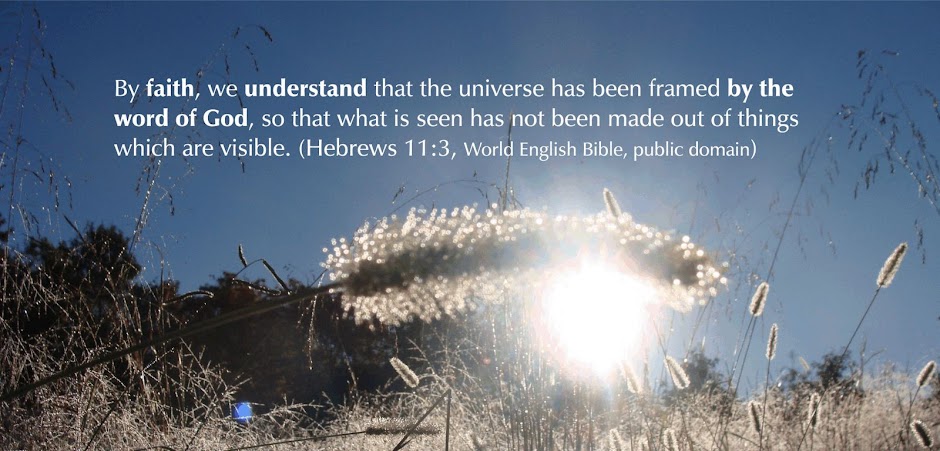
1. God is creator. There is no unassailable proof of this statement. The Bible, itself, does not attempt to prove it. It assumes it. The Bible starts out by saying that God created, in Genesis 1:1 In the beginning, God created the heavens and the earth. (All Bible quotations are from the World English Bible, which is in the public domain, and are in this color.) The Bible says that the best evidence that God is creator is our faith. (Hebrews 11:3 By faith, we understand that the universe has been framed by the word of God, so that what is seen has not been made out of things which are visible.) The Bible further points out that the principal agent in creation was God the Son:
John 1:1 In the beginning was the Word, and the Word was with God, and the Word was God. 2 The same was in the beginning with God. 3 All things were made through him. Without him was not anything made that has been made.

Colossians 1:14 in whom we have our redemption, the forgiveness of our sins; 15 who is the image of the invisible God, the firstborn of all creation.16 For by him all things were created, in the heavens and on the earth, things visible and things invisible, whether thrones or dominions or principalities or powers; all things have been created through him, and for him. 17 He is before all things, and in him all things are held together.

Christians have several views about the timing, and other details, of how things began. However, the most fundamental truth is that God created. Genesis 1:1 does not tell us why, when, or how God created. It does tell us that there was a Who involved in creation. There are people who believe that there is nothing but nature. They are called Naturalists. In other words, they do not believe that there is anything supernatural. To them, there is, and was, no Who. The Bible begins by assuming that that is a wrong belief. It does not attempt to prove this, except by telling us what God is like. (Some Christians mistakenly think that the idea of a Big Bang is a theory that claims that there is no God, or that claims there was no God involved in creation. That view is mistaken. A belief in the Big Bang can be compatible with belief in God as creator.)

Creation was called good, in Genesis 1. This does not necessarily mean that it was good in the sense that it is useful to humans. Goodness in God’s view is more important than usefulness to us!

Psalm 104:24 Yahweh, how many are your works!
In wisdom have you made them all.
The earth is full of your riches.
There is the sea, great and wide,
in which are innumerable living things,
both small and large animals. 
In this passage, we read about the marvelous diversity of creation. Humans have never yet seen many of the organisms that are alive on earth today, let alone found uses for them. They are still important, because God made them, or allowed them to come into existence.

2. God sustains the natural world. Colossians 1:16-17 (above) and Hebrews 1:3a (His Son is the radiance of his glory, the very image of his substance, and upholding all things by the word of his power) indicate that God not only created, but that Christ is presently involved in holding things together, including your body and the monitor you are reading this on. Do we understand this? No, and we aren’t capable of understanding it. God is omnipotent and omniscient. We aren’t. But we do understand, from these passages, that God, especially God the Son, has not gone away and left the world. He is sustaining it now.

3. Humans have responsibility for the world around them. Humans were put in charge of God’s “very good” creation.
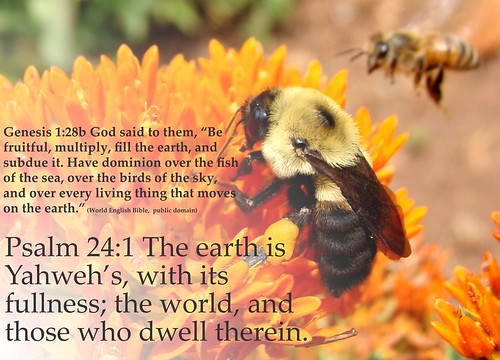
Genesis 1:26 God said, “Let us make man in our image, after our likeness: and let them have dominion over the fish of the sea, and over the birds of the sky, and over the livestock, and over all the earth, and over every creeping thing that creeps on the earth.” 28 God blessed them. God said to them, “Be fruitful, multiply, fill the earth, and subdue it. Have dominion over the fish of the sea, over the birds of the sky, and over every living thing that moves on the earth.”

Since the Fall, there have been problems with the natural world, but scripture teaches that it is still important to God, so it should be to us, as well:
Psalm 24:1 The earth is Yahweh’s, with its fullness;
the world, and those who dwell therein.

Psalm 50:10 For every animal of the forest is mine,
and the livestock on a thousand hills.
11 I know all the birds of the mountains.
The wild animals of the field are mine.
[God speaking] 


The Israelites were supposed to take care of their land by letting it lie fallow every seventh year:
Leviticus 25:3 You shall sow your field six years, and you shall prune your vineyard six years, and gather in its fruits; 4 but in the seventh year there shall be a Sabbath of solemn rest for the land, a Sabbath to Yahweh. You shall not sow your field or prune your vineyard. 5 What grows of itself in your harvest you shall not reap, and you shall not gather the grapes of your undressed vine. It shall be a year of solemn rest for the land.

Their failure to obey this command was one reason for their captivity:
II Chronicles  36:20 He carried those who had escaped from the sword away to Babylon, and they were servants to him and his sons until the reign of the kingdom of Persia, 21 to fulfill Yahweh’s word by Jeremiah’s mouth, until the land had enjoyed its Sabbaths. As long as it lay desolate, it kept Sabbath, to fulfill seventy years. [“He” is the king of the Chaldeans.]

Proverbs 12:10a says “A righteous man respects the life of his animal.”

4. God is revealed to us through nature. Here are Bible passages that say that we ought to learn something of what God is, and how God works, through a study of nature.

Job 12:7 “But ask the animals, now, and they will teach you;
the birds of the sky, and they will tell you.
8 Or speak to the earth, and it will teach you.
The fish of the sea will declare to you.
9 Who doesn’t know that in all these,
Yahweh’s hand has done this,
10 in whose hand is the life of every living thing,
and the breath of all mankind?


Psalm 19:1 The heavens declare the glory of God.
The expanse shows his handiwork.
Day after day they pour out speech,
and night after night they display knowledge.
There is no speech nor language,
where their voice is not heard.
Their voice has gone out through all the earth,
their words to the end of the world. 

Acts 14:17 Yet he didn’t leave himself without witness, in that he did good and gave you rains from the sky and fruitful seasons, filling our hearts with food and gladness.

Romans 1:20 For the invisible things of him since the creation of the world are clearly seen, being perceived through the things that are made, even his everlasting power and divinity; that they may be without excuse.

Revelation of God though nature includes knowledge gained through science. Some of the greatest scientists of all time, like Johannes Kepler, have believed that God is revealed through nature:
I give thanks to Thee, O Lord Creator, Who hast delighted me with Thy makings and in the works of Thy hands have I exulted. Behold! now, I have completed the work of my profession, having employed as much power of mind as Thou didst to me; to the men who are going to read those demonstrations I have made manifest the glory of Thy works . . .
From The Harmonies of the World by Johannes Kepler, 1619, translated by Charles Glenn Wallis. (The Great Books, Chicago: Encyclopedia Brittanica, 1952, volume 16, Ptolemy, Copernicus, Kepler, p. 1080.)

Science is not God’s only, or main, means of revelation. (Others include the Bible, our consciences, the Holy Spirit in our lives, the church -- those who believe in Christ as savior and Lord, and, most importantly, the incarnation of Jesus Christ.) But it is one means. Properly understood, scientific findings and scripture do not conflict. However, humans don’t completely understand either scientific or scriptural revelation.

5. God is a God of order. The Bible begins with a portrayal of God’s orderliness in creation. Literal or not, the description in Genesis 1 describes order and sequence. The Ten Commandments, the covenants established with Abraham, and with the Israelites, and God’s promise, (Genesis 8:22) after Noah’s flood, declare that God is a God of order. Some historians of science have written that, without the Judeo-Christian concept of God as a God of order, the development of science would have been impossible. (There were other influences, including Greek and Arab thought, in the development of science, so that science is not a strictly Judeo-Christian enterprise, but it developed among countries where most of the people were at least nominally believers.) There were some technological developments in China before similar ones in Europe, but science doesn’t seem to have developed there as a discipline, perhaps because this sense of order wasn’t part of the prevailing world-view there at that time.

6. The responsibility that humans have for nature (principle 3, above) includes responsibility to learn how it works.
Psalm 111:2 Yahweh’s works are great,
pondered by all those who delight in them

There is delight in such learning (See also principle 4) and it is our responsibility, as good stewards, to learn about God’s works. Some individuals are specially gifted in the area of learning about God’s creation -- in other words, God gives some gifts that help people be scientists.

In a previous post, I listed some scientific principles that tell us about God.

Thanks for reading!

Thursday, February 24, 2011

Why did God create things?

I am, of course, assuming that God did create.

I have occasionally remarked, in this blog, that the Bible doesn't tell us why God created, or how, or when, but it does tell us Who. I was wrong. We do know something of why God created.

Some people believe that we do know why, and that Revelation 4:11 tells us why: "Thou art worthy, O Lord, to receive glory and honour and power: for thou hast created all things, and for thy pleasure they are and were created." (KJV. The song "Thou Art Worthy" is based on this verse.) However, that translation is probably misleading. Here's a compilation of several translations of that verse. The majority, including the New KJV, render that phrase as "by your will," rather than "for your pleasure." In fact, the Greek word θέλημα, thelema, translated as "for thy pleasure" in this case, is translated as "at your will" in the 59 other verses where it occurs, in the KJV.

I have now read an article that claims to give reasons why God created. Here are the reasons presented:

1) To show God's glory. Bishop, the author, quotes Romans 1:20 in support of that: "For the invisible things of him since the creation of the world are clearly seen, being perceived through the things that are made, even his everlasting power and divinity; that they may be without excuse." (All Bible quotations are from the WEB) He could have quoted Psalm 19:
1 The heavens declare the glory of God.
    The expanse shows his handiwork. 

2 Day after day they pour forth speech,
    and night after night they display knowledge. 

3 There is no speech nor language,
    where their voice is not heard. 

4 Their voice has gone out through all the earth,
    their words to the end of the world.  


2) To serve as God's temple. (The author quotes Psalm 78:69, Psalm 93:1-2, and Isaiah 66:1.) I have some problems with this, or at least with the scripture taken to support it. I'm not sure that it does. Psalm 93:1-2 says:
93:1 Yahweh reigns!
He is clothed with majesty!
Yahweh is armed with strength.
The world also is established.
It can’t be moved.
2 Your throne is established from long ago.
You are from everlasting. (WEB)

We aren't to take the last part of verse 1 literally, surely. Why should we take the rest of it as literal, rather than poetic?
Hebrews speaks of a temple of God in the heavens. Why did God need a temple on earth, then? I'm not convinced.

3) Bishop writes: "Another of God’s purposes, that we’ve already seen, is for creation to become uniquely what it is called to be in Christ." OK. I can see that one, even though there's not explicit scripture cited for it. Bishop might have used Romans 8:18-25. (See below)

4)Bishop's next reason is that God wanted to populate the earth with life. He uses Isaiah 45:18 as part of his justification. Here it is:
45:18 For thus says Yahweh who created the heavens,
the God who formed the earth and made it,
who established it and didn’t create it a waste,
who formed it to be inhabited: (WEB)

5) The author's last reason is this: ". . . God intends for creation to be an arena for comprehensive redemption . . ." He uses Romans 8 as his Biblical justification.

In summary, after reading Bishop, I conclude that, while we can't understand all of God's purposes, we can grasp, from the Bible, that God's plans were to create beings for His glory, and to redeem creation.

Thanks for reading.


Sunday, November 15, 2009

Romans 1:20b poster: God's revelation through nature

Romans 1:20 poster

This is an attempt to illustrate Romans 1:20b (ESV), wherein God indicates that He reveals Himself to us through nature.

That's not the only way God is revealed. I would say that Christ, Himself, is the most important way, and that the Holy Spirit, the Bible, our conscience, and the church, are other ways that God is revealed.

The original photo is on our Flickr photostream. ESV copyright information is here.

I have previously blogged about this verse. One such attempt is here. In that post, I argue that, if God reveals Himself through nature, it is important that we keep nature as beautiful and diverse as possible, because, if we don't, we are making it more difficult for God to reveal Himself to us.

Thanks for reading, and looking.

Thursday, July 16, 2009

Additional Biblical reasons for environmental stewardship

I have previously posted on "Environmental Stewardship in the Bible," and, in fact, this is one of what I consider to be one of my most significant posts (out of about 1,200!). I freely confess that the Biblical reasons for trying to keep the environment around us in as good a condition as we can were mostly, maybe totally, not original.

In this post, I wish to put forward two new arguments from the Bible, in favor of trying to preserve endangered species, and endangered ecosystems or communities. As far as I know, they are original. Perhaps that is so because they aren't very good reasons. I don't know.

Psalm 19:1-4 and Romans 1:20 tell us that observing and learning about nature are part of God’s revelation to humans. If that is so, isn’t that another reason to try to preserve nature as well as we can? The Bible is one of the ways that God reveals Himself to us. For a long time, Christians have believed that the Bible should be translated into the language people are most familiar with, so that that revelation may be as clear as possible. Similarly, it would seem that God's revelation through nature should be as clear as possible. A person is more likely to see God in a pristine stream than in a polluted river. Probably seeing bison herds roam freely in Western North America gave people a glimpse of one aspect of God’s power and majesty that they can’t really get now. Therefore, helping to preserve nature in as good a condition as we can is one way to bring people to a saving knowledge of Christ. Not the most direct way, and probably not the most effective, for many people, but it is still a way to do this.

2) Colossians 1:15-20 says, of Christ, that “in Him all things hold together.” (ESV -- other versions have similar language. See here for the ESV policy on electronic use of this version of the Bible.) That passage also says that He is working to reconcile all things to Himself, and that He is working to make peace through the blood of the cross. As Christians, we believe that it is our duty to be His instruments in reconciling sinners to Christ, and to help Him in the ministry of making peace. In fact, 2 Corinthians 5:18-19, tell us that:  18 But all things are of God, who reconciled us to himself through Jesus Christ, and gave to us the ministry of reconciliation; 19 namely, that God was in Christ reconciling the world to himself, not reckoning to them their trespasses, and having committed to us the word of reconciliation.

Doesn’t it follow that we should also participate in Christ’s work of sustaining “all things,” including endangered species and ecosystems or biological communities? (I realize that there are other places in the New Testament where reconciliation and peacemaking are mentioned, or implied, and this is probably the only one that mentions Christ's sustaining work. But that doesn't mean that His sustaining work can be dismissed, or that we have no responsibility to be His instruments in doing it.)

What do you think?

Thanks for reading. (This post was edited on October 16, 2009. I attempted to enhance the arguments, without changing them. On September 26, 2013, I added the quotation from 2 Corinthians, and the introduction to it.)

Wednesday, December 24, 2008

Science and the Bible

Some Christians reject science, in general, as anti-God. Although the charge is not without some foundation, it is an oversimplification, at best, and short-sighted and unbiblical.
Why an oversimplification? Because many important scientists, from, say, Copernicus through Francis Collins, head of the US human genome project, have been believers.

Why short-sighted? Because rejecting scientific findings unnecessarily alienates potential followers of Christ. "If they are so wrong about the science, why should they be right about salvation?"

Why unbiblical? Because God reveals Himself in more than one way, according to the Bible itself. Psalm 19:1-4 tells us that God is revealed through nature, which means that scientific findings can tell us something of God's nature and power. Romans 1 says: "20 For his invisible attributes, namely, his eternal power and divine nature, have been clearly perceived, ever since the creation of the world, in the things that have been made. So they are without excuse." (ESV, which version allows quotation for uses such as this, if properly cited.) Does that mean that scientists are always right? Of course not. There was a time, in the previous century, when the scientific consensus was that genes were made of protein, not DNA. That was wrong. Scientists have made other mistakes, and will continue to make some. But that doesn't mean that consensus science should be rejected out of hand. It's usually right, and its findings are part of God's revelation to us. Mistakes have been made, and will be made, in the interpretation of the Bible, too. That doesn't mean that we should ignore it. The Bible is always right, and our understanding of it usually is.

If both are properly understood, there should be no conflict between the Bible and scientific findings. (I realize that our understanding of both is imperfect, at best.)

This is the fourth anniversary of this blog. Thanks for reading!

*  *  *  *  *

Note added, January 26, 2012: Acts 14 also indicates that God has revealed Himself through nature:
14 But when the apostles, Barnabas and Paul, heard of it, they tore their clothes, and sprang into the multitude, crying out, 15 “Men, why are you doing these things? We also are men of like passions with you, and bring you good news, that you should turn from these vain things to the living God, who made the sky and the earth and the sea, and all that is in them; 16 who in the generations gone by allowed all the nations to walk in their own ways. 17 Yet he didn’t leave himself without witness, in that he did good and gave you rains from the sky and fruitful seasons, filling our hearts with food and gladness.”(World English Bible, public domain)

Friday, October 10, 2008

The Bible and the Global Warming petition

I saw a brief excerpt from a political rally, featuring Republican Vice-Presidential candidate Sarah Palin, on a TV news program a few days ago. When global warming was mentioned, at least some people in the crowd booed loudly. Palin apparently expected this reaction. I sometimes get e-mails or other indications from fellow Christians, questioning global warming, which usually means that they doubt that humans have, or can, influence climate. Sometimes, they even doubt that global temperatures are increasing.

Perhaps the most obvious questioning of the validity of human effects on climate is the Global Warming Petition Project, which claims that there:
". . . is no convincing scientific evidence that human release of carbon dioxide, methane, or other greenhouse gases is causing or will, in the forseeable future, cause catastrophic heating of the Earth's atmosphere and disruption of the Earth's climate." (All web sources in this document were consulted on October 9th, 2008. I expect that there will be additional signatures on the Global Warming Petition, and other changes in the information given below, as time passes.)

The Project says that 31,072 American scientists have signed the petition. Less than one-third of these have an earned doctorate, according to the petition's own web site. There doesn't seem to be a breakdown by academic field. There is a breakdown by state. There are 351 signers who are from South Carolina. I am from South Carolina, so I am especially interested in that state. The SC State Climatology Office has five persons on its staff. None of them have signed. The Natural Science Faculty of Bob Jones University, a conservative Christian institution which is in South Carolina, has sixteen faculty listed, apparently none with degrees in climate or weather studies. Of these, the chair (who has a doctorate in analytical chemistry) and other faculty have signed, including a microbiologist with a Ph. D., a field biologist with a Ph. D, and a person whose highest degree is a bachelor's in broadcast engineering from BJU*, making 25% of the listed faculty. Is petition-signing a religious right conspiracy of some sort? If so, it's not very effective. I checked Liberty University. That school has no weather-related department, but there are 22 faculty in the combined biology-chemistry unit. Of these, none have signed the petition. I also checked a Southern Baptist college from South Carolina. 2 of their 19 faculty had signed the petition. Both had a Ph. D. in chemistry.

Neither Clemson University (in South Carolina) or the University of South Carolina have a department of climate or weather studies, so far as I can determine, and I didn't check their faculties against the list. Nor does Georgia or the University of North Carolina. So I looked at Florida. 1502 persons from Florida signed the petition. Florida State University has a meteorology department, with 16 faculty. None of them have signed the petition.

There aren't many scientists with advanced degrees in meteorology, and not many academic departments in that subject, at all. Apparently few, if any, academics with credentials in climate and weather studies have signed the petition. Scientists with degrees in other types of science, including many without advanced degrees, and a few whose academic credentials in the sciences are suspect, probably make up the vast majority of signers.

From the Wikipedia article:
The text of the petition is often misrepresented: for example, until recently the petition's website stated that the petition's signatories "declare that global warming is a lie with no scientific basis whatsoever."[4] The two-paragraph petition used the terms catastrophic heating and disruption , not "global warming." The original article associated with the petition . . . defined "global warming" as "severe increases in Earth's atmospheric and surface temperatures, with disastrous environmental consequences".[5] This differs from both scientific usage and dictionary definitions, in which "global warming" is an increase in the global mean atmospheric temperature[6][7] without implying that the increase is "severe" or will have "disastrous environmental consequences." (emphasis and links in the original)

The McCain-Palin campaign page does not explicitly say that humans contribute to climate change, but it assumes it. The page has a plan for mitigating emission of greenhouse gases. The GOP platform says explicitly that climate change is caused by human activity ("The same human economic activity that has brought freedom and opportunity to billions has also increased the amount of carbon in the atmosphere.") Sarah Palin is on record as doubting, or denying, that humans are responsible, for climate change. This, of course, is not the first time that a national candidate has disagreed with a running mate, or with the party platform, on all sorts of issues.

Why is there such widespread doubt of the conclusions of scientific experts, who say that humans have and are contributing to climate change? I am not sure of all of the reasons. One reason, I suspect, is the involvement of Al Gore, who was the Democratic presidential candidate in 2000, in this field. (He won a Nobel Prize for his involvement.) A lot of Republicans, and others, don't much like Mr. Gore. (Many people do, of course!) Ideally, it doesn't matter who is responsible for bringing a message, but what should matter is whether the message is valid, but it doesn't always work that way.

Another reason, of course, is that we usually don't want to hear bad news, if that news means that we will have to change our habits and thinking. Doing something about global warming would also mean changes in many industries.

What does the Bible have to do with all this?
Well, in the first place, some Christians believe that Revelation 16:8-9 may refer to global warming. Maybe. It's difficult to know what just about any particular passage in Revelation means.


Second, some Christians invoke Genesis 8:22, part of God's promise to Noah, that day and night, and the seasons, would continue, as meaning that there can be no global warming. But that verse doesn't say that the seasons will always be identical. There is considerable evidence of an ice age, although perhaps that was before the time of Noah. There was apparently a Little Ice Age since the time of Christ. There have been times in the past, in various parts of the world, when the climate was significantly warmer than usual for that area, or colder, or drier, or wetter. The passage doesn't rule out times when it will get warmer than we are used to.

Third, and, I believe, most important, some Christians reject science in general, as anti-God. Although the charge is not without some foundation, it is an oversimplification, at best, and short-sighted and unbiblical.

Why an oversimplification? Because many important scientists, from, say, Copernicus through Francis Collins, head of the US human genome project, have been believers.

Why short-sighted? Because rejecting scientific findings unnecessarily alienates potential followers of Christ. "If they are so wrong about the science, why should they be right about salvation?"

Why unbiblical? Because God reveals Himself in more than one way, according the the Bible. Psalm 19:1-4 tells us that God is revealed through nature, which means that scientific findings can tell us something of God's nature and power. Romans 1 says: "20 For his invisible attributes, namely, his eternal power and divine nature, have been clearly perceived, ever since the creation of the world, in the things that have been made. So they are without excuse." (ESV, which version allows quotation for uses such as this, if properly cited.) Does that mean that scientists are always right? Of course not. There was a time, in the previous century, when the scientific consensus was that genes were made of protein, not DNA. That was wrong. Scientists have made other mistakes, and will continue to make some. But that doesn't mean that consensus science should be rejected out of hand. It's usually right, and its findings are part of God's revelation to us. Mistakes have been made, and will be made, in the interpretation of the Bible, too. That doesn't mean that we should ignore it. The Bible is always right, and our understanding of it usually is.

Am I absolutely certain that there is real global warming, and that humans are partly or entirely causing it? No. But the overwhelming consensus of scientists in the field, around the world, is that there is, and that we are acting such as to accelerate it. Christians, and others, should take the warnings about global warming seriously. We have responsibility, under God, for the world around us, and for the well-being of our own offspring.

*This statement, based on Bob Jones University's own web site, is not meant to disparage that institution, or this particular faculty member. I have no advanced degree in physics, but taught that subject at two accredited institutions of higher education, as justified by my experience in the field. This experience was accepted by the Southern Association of Colleges and Schools, the accrediting agency,for both of these institutions. Probably this faculty member is a similar situation, and has significant experience not indicated by his degree. Or it is possible that BJU has included broadcast engineering in their science department. But I should not be taken as seriously as an expert on physics. Or at least not as seriously as a person with an advanced degree in the field would be. It wouldn't seem that a person with a bachelor's in broadcast engineering as his highest degree would have anything very authoritative to say about climate change, either.

Thanks for reading!

Saturday, March 17, 2007

What I believe about origins

Some time ago, someone asked me what I believed about origins. What the individual wanted was to see which of several categories of belief I fell into. I didn't exactly answer him on that, and I'm sure I told him more than he wanted to hear, but here's part of my answer.

Then, yesterday, a commenter was surprised that I didn't think purposeless chance was the main creative agent.

So I'm posting this on St. Patrick's Day, even though it's not particularly green.

What do I believe?
1) I believe that God was involved in the planning and execution of the origin of matter, the universe, and life.
2) I believe that the Son had the most important role in this (John 1, and other scriptures, teach this), but the Father and the Holy Spirit must have also been involved.
3) I believe that the Son not only created, but that He somehow is maintaining things. (Colossians 1:14-17)
4) I believe that things changed, due to a deliberate sin by human beings, such that God's original plan is not now completely expressed. How much the Fall has changed things, I'm not sure. Probably a lot. Christ came to redeem us, and the rest of creation, from the effects of that sin.
5) I believe that God's design allowed for emergent properties, that is, for example, Carbon was created so that life, as we know it, could be based on it, when life appeared.
6) I believe that God's design for life was comprehensive enough that He allowed what appear to us to be chance processes to work in carrying it out. However, He may also be actually selecting and directing which sperms succeed, which spores germinate, etc.
7) I believe that God somehow created humans specially. We are especially in His image, we have dominion over other living things, and Christ appeared on earth in human form.

* * * * *
Added July 23, 2007: See here for more on the topic of item 7.
8) I'm not sure exactly what the "image of God" means. I believe that all of God's creation, such as a stone, has some of the image of the creator in it. We have more of it than stones, of course. Presumably the image includes things like the capacity to love, to reason, to communicate, and to create (on a much smaller scale). Perhaps the soul (whatever that is) is God's image in us.
9) I don't know if there are living things on other planets or not. The Bible is silent on the subject, and proving that there are such living things wouldn't bother me. (It is impossible to scientifically prove that there aren't living things on some other planet.) The same holds true for alternate universes. God is big enough to be the God of all the universes, however many there are. We only know of one for sure, though, and of one place in it where there is life.
10) I believe that God used the Big Bang to begin the universe as we know it, and that the Bible does not rule this out. Furthermore, I believe that science has no good explanation for what caused the Big Bang, or came before it, while Christianity and Judaism do have such an explanation -- God planned and created the Big Bang.
11) I believe that I don't have all the answers on this subject, and don't think anyone else does, either.
12) I believe that the most commonly held theories, or at least the ones that are heard about most, namely young-earth creationism (YEC) and intelligent design (ID), are not the same. There are serious differences between them.
13) I believe that God has revealed Himself to us in several ways, including through the Bible, the church, and the work of the Holy Spirit, and that of our own consciouses, in our lives, and also through nature. (Psalm 19, Acts 14:17, Romans 1:20) I believe that we, fallen beings that we are, can and do make mistakes in our interpretation of all of these revelations, but that, nonetheless, they are all legitimate.
14) I believe that God did deliberately design the natural world. (He included the capacity for chance processes, such as natural selection, as part of the design, so that they influence the way living things appear.) However, I don't believe that it is possible to prove (or disprove) God's creative activity in the past (or in the present, for that matter) scientifically. Hebrews 11:3 seems to indicate this.
15) I believe that demanding that the public schools teach that science has proved that YEC, or ID, are true, is a serious mistake, not least because there is no such proof.
16) I believe that science has not, and can not, rule out God's creative activity, in at least the following: the origin of the universe, the origin of living things, the origin of human beings. Scientists (and others) may sincerely doubt that God did any or all of these things, but they have no right to claim that science has ruled them out. It hasn't. No public school or university class, or textbook, should make such claims, and, if such claims are made, they should be strongly fought.
17) I believe that some people, perhaps well-meaning, perhaps not, have screamed loud and long about some view of origins, (usually YEC, but, lately, also ID) and gotten many Christians, or the world at large, to believe that all Christians believe as they do. This is most unfortunate. I believe that some intelligent people have been lost to the kingdom because of militant YEC views.
18) I believe that Christians can legitimately hold any of several views on origins, including YEC or ID, but also others, and should respect the right of other Christians to hold differing views, and welcome them into fellowship. There are a number of views, all held by Christians, and all of them have strengths, and all of them have weaknesses. The only view that all Christians must reject is the naturalistic view, namely that we are here solely because of purposeless chance. If the Bible means anything, this view is false.
19) I believe that many students who are home-schooled, or who attend private Christian schools, are being seriously short-changed, because they are taught that YEC, or ID, is what the Bible teaches, or even what science has proved. They should also be presented with a fair view of other interpretations. Not only are they being short-changed, but future generations of Christian leaders are being misled, and, in turn, misleading others.

Addendum, July 19, 2007: As this post indicates, the Bible tells us that God created because of His love.

Addendum, January 27, 2012: I added some labels/tags, and one bible verse.

Addendum, December 20, 2012: Here's a link to a post from BioLogos on the impossibility of disproving the existence of God. (We can't prove it scientifically, either.)

Addendum, January 29, 2013: I added point 10, above, and modified point 15.

Addendum, April 8, 2015: I made three minor editorial changes.

Addendum, May 26, 2016: I have discovered a consensus statement on origins, produced by some prominent Christian scientists with different views on the matter, but which they all agree on. I agree with them. (The consensus statement is followed by a listing of points that they don't agree on.)

Thanks for reading.