License

I have written an e-book, Does the Bible Really Say That?, which is free to anyone. To download that book, in several formats, go here.
Creative Commons License
The posts in this blog are licensed under a Creative Commons Attribution-NonCommercial-ShareAlike 3.0 Unported License. You can copy and use this material, as long as you aren't making money from it. If you give me credit, thanks. If not, OK.
Showing posts with label fire. Show all posts

Monday, December 01, 2014

I'm thankful for Oxygen

Thankful for Oxygen

I'm thankful for Oxygen. You should be, too.

Oxygen is found in most of the important molecules in our bodies. Water, proteins, DNA, fats, carbohydrates, vitamins, hormones, and others. That, alone, would be cause for gratitude. But there's more.

Oxygen, well, oxidizes. So? Oxidation means that Oxygen has the power to combine with other atoms and give off energy in the process. Some such reactions are slow -- rusting of iron, for instance. But some are rapid. Fire is an oxidation reaction. (The sun is not on fire, in this sense. There's very little oxygen in it, and the energy from the sun comes from another source.)

Most of us burn gasoline in our cars. Gasoline is mostly a mixture of hydrocarbons, a molecule, for instance, such as octane, with eight Carbons and eighteen Hydrogens. When a mixture of octane and Oxygen is ignited, the resulting products are carbon dioxide and water. The production of water in this way releases energy, which is used to cause gas to expand, thus moving the pistons, which motion, with the proper apparatus, causes the wheels of the automobile to turn.

In living things, a somewhat similar process takes place, not in the cylinders, but in tiny energy converters called mitochondria. The process is called cellular respiration, and the reason we require Oxygen, and breathe air to get it, is because Oxygen is needed in our mitochondria, so that energy may be released. Red blood cells use hemoglobin to carry Oxygen from our lungs to all the cells in our bodies. Each cell uses that Oxygen to release energy.

Fuel, in this case food, is oxidized rapidly, and the energy given off is used to produce adenosine triphosphate. Most of the energy given off comes from the oxidation of Hydrogen, which produces water, one of the byproducts of the processes taking place in the mitochondria. The other byproduct is carbon dioxide. To summarize, food is oxidized, releasing energy and giving off carbon dioxide and water. There are a few living things that use different methods to get energy. Yeasts, for example, use a different process. But even green plants, which make their own food by photosynthesis, need to carry on cellular respiration when it is dark, in order to provide themselves with energy, which means that they need Oxygen.

Fire is important to humans. It has many uses -- in manufacturing, in providing light and heat. Fire requires Oxygen. The atmosphere is about 21% Oxygen. It has been suggested that that is enough so that Oxygen is readily available for breathing, and to keep fires burning, but that if the amount of Oxygen was much higher, fires would become harder to put out.

Here's a statement about the significance of fire as part of the worship of the Israelites:
Leviticus 6:12 The fire on the altar shall be kept burning on it, it shall not go out; and the priest shall burn wood on it every morning: and he shall lay the burnt offering in order upon it, and shall burn on it the fat of the peace offerings. 13 Fire shall be kept burning on the altar continually; it shall not go out. (World English Bible, public domain)

God appeared to Moses in the form of a burning bush, and to the Israelites as a column of fire. Were these fires caused by oxidation, or was this some supernatural appearance of fire? We don't know.

We need Oxygen, for many of the molecules that allow us to live, for fire, and to provide our own bodies with usable energy. I believe, but cannot prove, that God designed Oxygen so that this would be possible. It can't be disproved, either. Thanks for reading!

Monday, December 07, 2009

Fire at McDonald Hall, Southern Wesleyan University (Used to be Central Wesleyan College) in 1962, 47 years ago today

My wife and I attended the annual employees' Christmas dinner at Southern Wesleyan University recently. (See also Wikipedia article on the institution, here.) I no longer teach there, being retired, but retired employees and their spouses are invited to this event.

I first came to the campus on Labor Day weekend in 1964, under contract to teach science at what was then Central Wesleyan College. At that time, the largest, and newest, building on the campus was Stuart-Bennett hall, a girls' dormitory. The main reason that I applied to CWC was that I was a Wesleyan Methodist (Now The Wesleyan Church), and this institution, like three others in the US, was a college operated by my denomination, and I wanted to serve my Lord through my church. One thing that brought CWC to my mind when I was finishing my graduate work, and looking for the next phase of my life, was that, on the night of December 7, 1962, this small institution had made national headlines. McDonald Hall, the girl's dormitory, burned to the ground that night, and two girls died. I heard about this on the radio in Madison, Wisconsin. Hearing about this event made an impression on me, and that was one of the reasons I applied for a job there.

While my wife and I were on the way to the evening event, I began to think a little about the history of this Christmas meal. The annual Christmas Dinner began, I was told soon after I began to work at CWC, after the fire. The reason for it was that the college wanted to thank the community for their support. Before the fire, CWC wasn't well known, even in the small town of Central, South Carolina. The College pretty much kept to itself. The fire awakened the community, and there were many gestures of support. The College community reciprocated, as they had not before. Since that time, the Christmas Dinner has evolved into a meal to thank the employees, partly, of course, because the fire was so long ago, and also because there are now so many employees that it is impossible to feed them and community representatives at the same time. SWU has other ways of thanking the community, such as a Donors' Banquet.

I also thought about those who worked at CWC during the fire. There are three people who were employees at that time who are still alive -- all of them, like me, retired. I spoke to all three of them in the course of the Dinner. I spoke to two of them about the fire. One of them told me that she was so traumatized by this tragedy that she didn't snap out of it until a few days later, when she and her family attended the annual performance of Messiah at Furman University, which is in the next county. (Christmas traditions change at other institutions, too. Furman no longer holds this performance.) She said that she went to sleep during the performance, and, when she awoke, she was much better.

The other employee, who was Dean of Students during the fire, told me a couple of more dramatic and remarkable things. He had actually gone into the building, with at least one other employee, to try to get anyone out that he could. While he was in there, he said, he was pretty sure that two girls were dead -- they were -- and was complaining to God about how He could let such a thing happen. He said that he had seldom heard God speak to him, but, on this occasion, he did. God told him, he said, to "Shut up. I'll take care of this." And, as we agreed, He had.

The other thing that he told me was one example of how the community helped. He said that, at that time, there was an important apparel manufacturer with a plant near the town, but he hadn't even realized this fact. After the fire, the plant manager sent over a truck full of women's clothes. Of course, the girls in the dormitory had lost all of their clothing except what they had on at the time. This was one example -- there were many others, many lost even to memory by now -- of how the community rallied behind CWC.

God's care was evident materially. Although two girls were lost, the College was able to rally, and seek community and government assistance as they never had before. By the time I came, less than two years later, there was a new dormitory, named for the two young women who died in the fire. (A few years later, that three-story building had two more stories added. It is still a dormitory.) There was a new fine arts building, named for the parents of a wealthy resident of Central, who had donated a significant portion of the funds needed, in their honor. The college was beginning to think about getting accredited, and building some more buildings. Enrollment was increasing. It was about 200 when I came, and is well over ten times that many, including students at other campuses in South Carolina.

The two of us, talking together, agreed that, if the fire hadn't happened, it is very possible that CWC would have soon gone out of existence, and there would be no Southern Wesleyan University today. God used this terrible tragedy for good.

Thanks for reading.

Saturday, October 27, 2007

County size in California vs. South Carolina

A little geography, gentle reader.

Much has been made of the recent fires in San Diego County and other California counties, and I certainly have no desire to complain about such coverage -- we have family members living there. However, perhaps some South Carolina readers, and other readers from the eastern US, may not realize that counties are not the same sorts of things in all parts of the US.

San Diego County
has a large geographic area, namely 4,526 square miles/11,721 square kilometers. In contrast, the combined area of Pickens, Oconee, Greenville, Laurens, Abbeville, Greenwood, and Anderson counties of South Carolina is 4,436 square miles. San Diego County is not the largest county in the US, or in California. Counties in the western US tend to be larger. Although the population of San Diego County is nearly 3,000,000, which is the third largest population of any county in the US, much of the large area is relatively unpopulated. Many of the fires in that county are in such relatively unpopulated areas.

Some are warning that development of such areas is asking for trouble -- fires have apparently been part of the chaparral ecosystem for a long time, and the recently developed areas, left to themselves, would mostly be chaparral.

Just as the southeastern part of the US is subject to coastal hurricanes, and some parts of the US are at risk for earthquakes, some of the US is at risk for wildfires. There doesn't seem to be much that we can do about this. We live in a fallen world, and we humans are in tension with the communities where we live and move, and this tension will, if anything, become larger as we expect to own more and more possessions, and as there are more and more of us.

God help us all!

Thanks for reading.

Tuesday, October 23, 2007

Pray for Southern California, USA

Pray for Southern California, USA


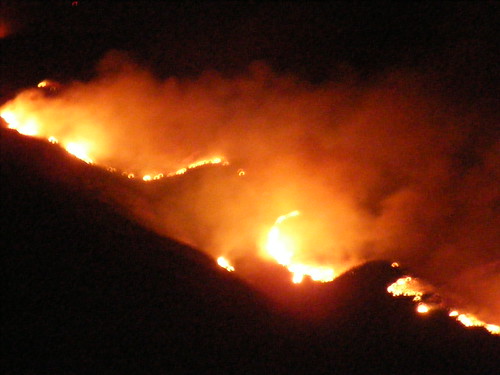
This is Mt. San Miguel, in San Diego County, California, taken today.

This photo was taken by a relative who lives in San Diego County. It isn't the best quality ever, but it makes a point. You can get some idea of the height of those flames from the distance -- he was perhaps 4 miles/6 km away when he took the photo. (May have used the zoom function.) Radio stations, and public safety, have towers on this mountain. At least some of these have stopped functioning. Our relative may be evacuating soon.

People in Southern California need prayer. The Santa Ana winds are supposed to gust up to over 30 mph/40 kph today. The humidity is less than 5%. Over 250,000 people have been evacuated in San Diego County alone. Many roads are closed, because of the fires.

There are other fires in Southern California, too.

Thanks to another relative, for suggesting that I post this, and ask for prayer.