It's always a good idea to reflect on what God has done for us. This post, taken from a previous post, December 11, 2006, is such reflection. I was a college science teacher for over 40 years.
The best experiences I had in the classroom all involved (duh!)
students. As a biologist, these were often on field trips, where we saw
things that the textbooks (or I) could only describe. Sometimes they
were in the lab, when something actually worked as they were supposed
to(!). Once, an African-American student with sickle-cell anemia
saw her own red blood cells sickle under the microscope (I got to see
this, too) for the first, and, I suppose, the only time. (Red blood
cells are normally circular. The cells of someone with sickle cell
anemia assume an elongated shape when they become deprived of Oxygen.) I
am sorry to say that this young lady didn't live long after this
experience. She died from the complications of this terrible disease.
Often
the most memorable experiences are one-time things, and happen when
something goes wrong, or at least not according to plan. I will relate
two of mine. Once, a few students and I were injecting a rabbit. The
rabbit died, for some reason. (Today, I would have insisted on more protection for rabbits, although they might still die of unknown causes, as this one did.) One of the students suggested that we
dissect the rabbit, so we did. We had never seen the insides of a
just-dead rabbit before, and seeing this was amazing. A rabbit's intestines include an (for a rabbit) enormous caecum, quite different from human anatomy.
Another
such experience was when a student came in late for a bioethics class. I
knew what had happened, because she had called and told me -- the class
and I had been praying. Her father had just gotten a liver transplant. I
had her sit on the table in front of the class and talk about it, and
the rest of us asked her questions. Organ transplantation, of course,
has some important ethical implications.
I have also had
experiences where a student asked me a question that changed my way of
thinking. One of my students asked me about human cloning, back in the
middle 1970's. I hadn't thought much about it before, but decided that I
should. Partly because of his question, the U. S. taxpayer supported my
attendance at a six week conference on bioethics in 1979 at Indiana
University. I was the only person in the group of a dozen or so who was
trained as a biologist, and the only one from an evangelical Christian
college/university. All of this resulted in a change in direction. I
developed a new class at my school, and published a paper (the article is not available on-line, so far as I know -- the link is to a listing) on the subject.
Sometimes
a student made a comment that changed my thinking. One once said "the
Bible is inerrant, but our interpretation of it isn't." How right he was, and is.
I am glad
to say that, sometimes, I could see students learn. Sometimes I could
see that they had, when I graded their tests, quizzes, and papers.
Some
of the greatest experiences came outside of class, when students came
to talk to me about something unrelated to their class work, or I got to
interact with, or observe them, in other settings.
I confess -- I married a student. (She came to college after being in the workplace for three years, so I didn't rob the cradle. We have now been married over a half century.)
Thank God for all of this, and so much more! Thanks for reading.
Musings on science, the Bible, and fantastic literature (and sometimes basketball and other stuff).
God speaks to us through the Bible and the findings of science, and we should listen to both types of revelation.
The title is from Psalm 84:11.
The Wikipedia is usually a pretty good reference. I mostly use the World English Bible (WEB), because it is public domain. I am grateful.
License
I have written an e-book, Does the Bible Really Say That?, which is free to anyone. To download that book, in several formats, go here.

The posts in this blog are licensed under a Creative Commons Attribution-NonCommercial-ShareAlike 3.0 Unported License. You can copy and use this material, as long as you aren't making money from it. If you give me credit, thanks. If not, OK.
The posts in this blog are licensed under a Creative Commons Attribution-NonCommercial-ShareAlike 3.0 Unported License. You can copy and use this material, as long as you aren't making money from it. If you give me credit, thanks. If not, OK.
Showing posts with label thankfulness. Show all posts
Showing posts with label thankfulness. Show all posts
Saturday, February 23, 2019


Wednesday, January 09, 2019
Sunspots 710
Things I have recently spotted that may be of interest to someone else:

Christianity: (and Sports) Relevant reports that a Chicago Bears kicker did not make a field goal that would have won the game, but thanked God, anyway.
Education: NPR reports on poor reading scores, which are widespread, and a fundamental reason for them -- educators aren't using scientific findings on learning to read. In some places, this is being remedied.
Food: (and Health) Gizmodo reports that millions of Americans think they have a food allergy, but don't.
Health: NPR reports that increases in drug prices are primarily due to drug company attempts to make more money, rather than research costs.
Humor: (or Food) A sculpture, constructed of a half ton* of butter, has been produced in Pennsylvania, according to NPR.
Politics: NPR reports that the acting Secretary of the Interior may be worse than his predecessor at protecting the environment.
(or possibly, humor) A few days ago, President Trump said that he knew more about drones than anyone. The Washington Post has compiled a list of things the President claims to know more about than anyone else. The list also includes people (not him) that Mr. Trump says are the world expert on various topics.
It's almost that time again, I'm afraid. But FiveThirtyEight analyzes Presidential primary debates, and finds that they are important.
Science: Gizmodo tells us (with pictures) that some hummingbird species have beaks specialized for aggression toward rivals.
(and food) NPR reports on granary weevils, insects that have been eating our stored grain throughout human history.
Scientific American on how the part of the border wall already built is damaging habitat and migration routes for animals, and how adding to the wall will make things worse.
The graphic used in these posts is from NASA, hence, I believe, it is public domain.
Thanks for looking!
*When this was posted, I had carelessly said a half-pound of butter, not a half ton. I thank one of my brothers for bringing this error to my attention.
Monday, October 01, 2018
How God recently helped me, involving our computers
A few days ago, we were visiting some of our family. Part of the visit was to see one of our grandsons, who plays water polo with his high school team. We were glad to have seen that, more than once. We had never that game before.
I'm not as spry as I once was, and am not always as balanced (physically!) as I should be, I guess. A couple of years ago, I managed to fall while walking along a wide concrete walk around a harbor. During last Thanksgiving season, I walked over to a neighbor's in the dark, and forgot that he had put some loose bricks at the end of a wall. I stepped on one or two of them as I went around the wall's end, and fell, landing on his concrete driveway. While at one of the water polo games, I stepped on some miscellaneous stuff, a couple of meters from the pool, and down I went. I thank God that I took no injury in any of these accidents -- not a bruise, not sore a bit. That's one praise.
During the last fall, I lost my grip on my Android tablet, and it fell into the swimming pool. The referee stopped the game while one of the players dove down and got it. But the tablet would not come on. As far as I can tell, it's dead for good. It served me well. I had used it for various kinds of reading, including devotional reading, and for other purposes.
We like Coldstone ice cream. There is a store near where the games were being played, and we went there. Ice cream stores, and other small fast food franchises, in California, usually don't have restrooms. I discovered that I needed one. I was directed to a public restroom, but it was padlocked. There is a Target store near the ice cream store, and I decided that was my best bet for a restroom. While at this Target, it occurred to me that I might purchase a new tablet there, which is another praise. (Otherwise, I would have had to find another store, or go on-line to order one, and not gotten one for a day or so.) So I went back to the electronics section. I asked the clerk how much storage a tablet, for sale, had, and she pointed out something that I had forgotten, namely that this new tablet had a spot for a memory card. I suddenly recalled that my damaged tablet had had a memory card in it. I bought the tablet, and, as soon as I could, placed the memory chip from the damaged device into the new one. It worked! I didn't have to copy files from our computer to the new tablet! That's another praise. If she hadn't reminded me of that, it would have taken hours to copy the files I wanted on the tablet from our computer.
We got home, a couple of days later. A few hours after we did, our laptop computer would not access the internet. We got it with a protection plan, so I took the laptop to the store where I got it in the first place. I first copied all of our data files -- photos, spreadsheets, etc., to an external hard drive, in case the laptop was no longer usable. After less than 24 hours, I was able to pick up the computer. The repair person said that something had gone wrong with a Windows 10 update, which is plausible, and that I could not have fixed this without special software. He accessed the internet, using our computer, from the store, to show that the problem was fixed. But when I got home, I discovered that our graphics programs, and Microsoft Office, were no longer accessible. I could get on the internet, which is another praise, but I couldn't get along without a spreadsheet, a word processor, nor that graphics program, and, of course, I had already paid for them. I got in contact with the store's on-line repair people, through chatting (I couldn't have done that without internet access), and having her take control of the machine, from wherever she was. In a couple of hours or so, Office, and the graphics suite, were again usable. There was no charge for the repairs, other than the original purchase of the protection plan. Those are also both cause for praise. I'm now using this laptop to write this, and expect to post it on the internet, as this blog post, in a little bit. I thank God for his goodness!
I needed to back up our files, anyway.
Thanks for reading!
I'm not as spry as I once was, and am not always as balanced (physically!) as I should be, I guess. A couple of years ago, I managed to fall while walking along a wide concrete walk around a harbor. During last Thanksgiving season, I walked over to a neighbor's in the dark, and forgot that he had put some loose bricks at the end of a wall. I stepped on one or two of them as I went around the wall's end, and fell, landing on his concrete driveway. While at one of the water polo games, I stepped on some miscellaneous stuff, a couple of meters from the pool, and down I went. I thank God that I took no injury in any of these accidents -- not a bruise, not sore a bit. That's one praise.
During the last fall, I lost my grip on my Android tablet, and it fell into the swimming pool. The referee stopped the game while one of the players dove down and got it. But the tablet would not come on. As far as I can tell, it's dead for good. It served me well. I had used it for various kinds of reading, including devotional reading, and for other purposes.
We like Coldstone ice cream. There is a store near where the games were being played, and we went there. Ice cream stores, and other small fast food franchises, in California, usually don't have restrooms. I discovered that I needed one. I was directed to a public restroom, but it was padlocked. There is a Target store near the ice cream store, and I decided that was my best bet for a restroom. While at this Target, it occurred to me that I might purchase a new tablet there, which is another praise. (Otherwise, I would have had to find another store, or go on-line to order one, and not gotten one for a day or so.) So I went back to the electronics section. I asked the clerk how much storage a tablet, for sale, had, and she pointed out something that I had forgotten, namely that this new tablet had a spot for a memory card. I suddenly recalled that my damaged tablet had had a memory card in it. I bought the tablet, and, as soon as I could, placed the memory chip from the damaged device into the new one. It worked! I didn't have to copy files from our computer to the new tablet! That's another praise. If she hadn't reminded me of that, it would have taken hours to copy the files I wanted on the tablet from our computer.
We got home, a couple of days later. A few hours after we did, our laptop computer would not access the internet. We got it with a protection plan, so I took the laptop to the store where I got it in the first place. I first copied all of our data files -- photos, spreadsheets, etc., to an external hard drive, in case the laptop was no longer usable. After less than 24 hours, I was able to pick up the computer. The repair person said that something had gone wrong with a Windows 10 update, which is plausible, and that I could not have fixed this without special software. He accessed the internet, using our computer, from the store, to show that the problem was fixed. But when I got home, I discovered that our graphics programs, and Microsoft Office, were no longer accessible. I could get on the internet, which is another praise, but I couldn't get along without a spreadsheet, a word processor, nor that graphics program, and, of course, I had already paid for them. I got in contact with the store's on-line repair people, through chatting (I couldn't have done that without internet access), and having her take control of the machine, from wherever she was. In a couple of hours or so, Office, and the graphics suite, were again usable. There was no charge for the repairs, other than the original purchase of the protection plan. Those are also both cause for praise. I'm now using this laptop to write this, and expect to post it on the internet, as this blog post, in a little bit. I thank God for his goodness!
I needed to back up our files, anyway.
Thanks for reading!
Thursday, May 10, 2018
Some of the things you and I probably ought to be thankful for
1) Salvation
– Christ offers unmerited forgiveness for sin.
2) Guidance
in the Christian life, from the Bible, other Christians, in groups, or
one-on-one, and in various media. Guidance from the Holy Spirit. Chances to
guide others, as God has led you.
3) The
ability to think reasonably clearly, to learn new things, and to read and hear
new information.
4) Living in
a country where many things are available to us, which are not available to
many others in the world, such as being able to speak, assemble, and worship
freely. A political system, that, with all its faults, is better than that of
most of the people in the world.
5) Your
family, with all of its faults.
6) The
ability to earn a living, or to retire in reasonable comfort, especially in
comparison to most of the people in the world.
7) A good
church, with good fellowship, opportunity to worship, serve, give and receive good
teaching.
8) Good
health. If we become disabled tomorrow, or already are, we’ve probably had many
years of good health, more than some people ever have. Even if we’ve always
been disabled, we’ve had health enough for some life.
9)
Possessions which help keep us sheltered and safe, fed, clothed, and allow us
to go places, and communicate with others, as necessary, or as desired, even at
great distances.
10) Opportunity
to minister through my church, and as I am able, in my own circumstances,
outside the church.
11)
Innocence, beauty, humor and fun, intimacy, holiness, and other good things
that God invented.
12) A good
and diverse world, well-planned, with energy, Oxygen, water, DNA, RNA, protein,
the other elements and compounds we need to live, and beauty and variety of
form, sound, color, taste, smell and action.
May God forgive me for not being thankful enough.
Thursday, March 26, 2015
Psalm 66:20 poster
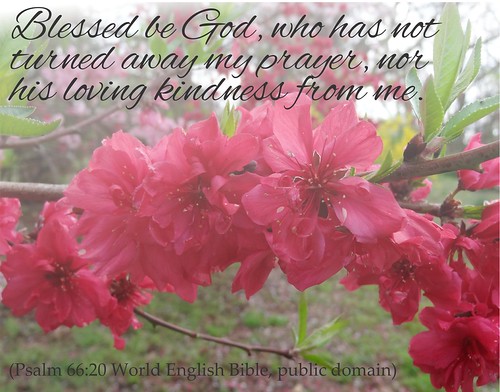
The above poster is an attempt to do justice to Psalm 66:20, which says "Blessed be God, who has not turned away my prayer, nor his loving kindness from me." (World English Bible, public domain.)
The photo is some member of the rose family, perhaps a crabapple. I'm not good at distinguishing between peaches, pears, apples, cherries, and the like.
Thanks for looking! Blessed be God.
Saturday, December 06, 2014
I'm thankful for Glucose! You should be, too.
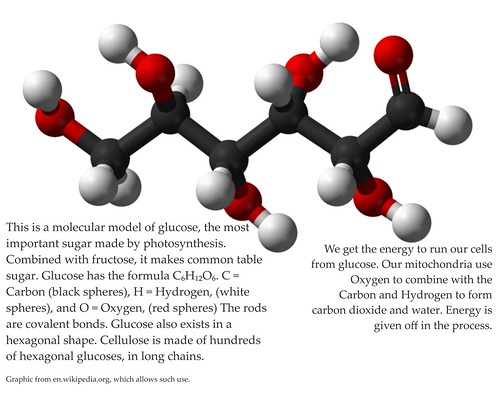
I'm thankful for glucose. Why? It's the most important product of photosynthesis. In other words, all food comes from glucose, somehow. If you are hospitalized, and need to be given nutrition intravenously, you'll get glucose. That makes sense, because glucose is the main source of energy in our cells. It's absolutely important.
The figure above shows a molecule of glucose in one configuration, a chain of six Carbon atoms. There is another configuration, namely hexagonal. In this picture, you can see a chain of these hexagons, each made of 5 Carbon molecules and 1 Oxygen molecule, with other atoms, including 1 Carbon, attached to the central hexagon. That picture is of a molecular model of cellulose, which is a critical component of the structure of plants. That's another reason why glucose is important, besides its use as an energy source.
Common table sugar is made of a molecule of glucose and a molecule of fructose, which is quite similar to glucose, but not identical to it.
Sugar substitutes, or artificial sweeteners, contain a hexagon much like that in glucose. Presumably, the sweetness receptors in our tongues are stimulated by molecules closely resembling glucose in shape, that fit into the sweetness receptors.
Plants store chemical energy (food) as starch, which is made up of many glucose molecules. When we eat starchy foods, we break up the starch, into glucose. One enzyme that does that is amylase, which is secreted in our saliva. If you keep a starchy food, such as a soda cracker or a piece of raw potato, in your mouth, and keep chewing it, you will experience a sweet taste. That taste comes from glucose. Animals store glucose as glycogen.
The Wikipedia says: "It is unclear why glucose, as opposed to other hexose sugars, is so widely used in living organism." So far, anyway. It's not unclear to the Creator, who planned for a carbohydrate, made from Carbon, Hydrogen and Oxygen, with the formula C6H1206, and the shape of a hexagon, to be so important to us. I can't prove that, but no one can disprove it, either.
This is the last in a series, expressing gratitude for a few molecules or elements that are crucial for life on earth. This one is posted between Thanksgiving and Christmas, which is an appropriate time for posting about sugar.
Monday, December 01, 2014
I'm thankful for Oxygen

I'm thankful for Oxygen. You should be, too.
Oxygen is found in most of the important molecules in our bodies. Water, proteins, DNA, fats, carbohydrates, vitamins, hormones, and others. That, alone, would be cause for gratitude. But there's more.
Oxygen, well, oxidizes. So? Oxidation means that Oxygen has the power to combine with other atoms and give off energy in the process. Some such reactions are slow -- rusting of iron, for instance. But some are rapid. Fire is an oxidation reaction. (The sun is not on fire, in this sense. There's very little oxygen in it, and the energy from the sun comes from another source.)
Most of us burn gasoline in our cars. Gasoline is mostly a mixture of hydrocarbons, a molecule, for instance, such as octane, with eight Carbons and eighteen Hydrogens. When a mixture of octane and Oxygen is ignited, the resulting products are carbon dioxide and water. The production of water in this way releases energy, which is used to cause gas to expand, thus moving the pistons, which motion, with the proper apparatus, causes the wheels of the automobile to turn.
In living things, a somewhat similar process takes place, not in the cylinders, but in tiny energy converters called mitochondria. The process is called cellular respiration, and the reason we require Oxygen, and breathe air to get it, is because Oxygen is needed in our mitochondria, so that energy may be released. Red blood cells use hemoglobin to carry Oxygen from our lungs to all the cells in our bodies. Each cell uses that Oxygen to release energy.
Fuel, in this case food, is oxidized rapidly, and the energy given off is used to produce adenosine triphosphate. Most of the energy given off comes from the oxidation of Hydrogen, which produces water, one of the byproducts of the processes taking place in the mitochondria. The other byproduct is carbon dioxide. To summarize, food is oxidized, releasing energy and giving off carbon dioxide and water. There are a few living things that use different methods to get energy. Yeasts, for example, use a different process. But even green plants, which make their own food by photosynthesis, need to carry on cellular respiration when it is dark, in order to provide themselves with energy, which means that they need Oxygen.
Fire is important to humans. It has many uses -- in manufacturing, in providing light and heat. Fire requires Oxygen. The atmosphere is about 21% Oxygen. It has been suggested that that is enough so that Oxygen is readily available for breathing, and to keep fires burning, but that if the amount of Oxygen was much higher, fires would become harder to put out.
Here's a statement about the significance of fire as part of the worship of the Israelites:
Leviticus 6:12 The fire on the altar shall be kept burning on it, it shall not go out; and the priest shall burn wood on it every morning: and he shall lay the burnt offering in order upon it, and shall burn on it the fat of the peace offerings. 13 Fire shall be kept burning on the altar continually; it shall not go out. (World English Bible, public domain)
God appeared to Moses in the form of a burning bush, and to the Israelites as a column of fire. Were these fires caused by oxidation, or was this some supernatural appearance of fire? We don't know.
We need Oxygen, for many of the molecules that allow us to live, for fire, and to provide our own bodies with usable energy. I believe, but cannot prove, that God designed Oxygen so that this would be possible. It can't be disproved, either. Thanks for reading!
Saturday, November 29, 2014
I'm thankful for Hydrogen

Hydrogen is the most common element in the universe. About 75% of the mass of the universe is Hydrogen. That is even more remarkable, since Hydrogen is also the least massive of the kinds of atoms. It takes about 12 Hydrogens to have the same mass as Carbon, and over 200 Hydrogens to have the same mass as some of the heavier elements.
So why, other than that it is common, is Hydrogen important? For a number of reasons. The graphic says that Hydrogen makes up part of water, and water is a unique, and very important substance. The graphic also says that Hydrogen is important in photosynthesis. Photosynthesis uses light energy to split Hydrogen from water, and to attach that Hydrogen to Carbon. As a result of the process, glucose, C6H12O6, is produced. Glucose is the basic food molecule of the biosphere, and it has 12 Hydrogen atoms. The graphic says that Hydrogen is found in DNA. It is. It's also found in fats, sugars, proteins, vitamins, hormones, and more, all of them essential to living things, including us.
The graphic also says that Hydrogen can be said to be the ultimate source of the sun's energy. That is true. Four Hydrogen nuclei fuse, to make a Helium nucleus, and, in the process, a little of the mass of the four Hydrogens is changed to energy, according Einstein's E=mc2 equation. Since the mass is multiplied by the velocity of light, squared, that energy adds up. The sun is not burning, in the usual sense. It is changing its Hydrogen to Helium, nuclear fusion, and is releasing energy in the process. The sun is changing about 4.289x10¹² g of mass to energy every second. (source) That's about 5 million tons. But don't worry. Even at that rate, the sun isn't going to run out of Hydrogen for a very long time. There's a LOT of Hydrogen in the sun.
They aren't on the graphic, but I'll mention two other important things that Hydrogen is and does.
Hydrogen makes acids to be what they are. An acid is a substance that can release a charged Hydrogen atom. Some of us have too much acid in our digestive system, and take various antacids, or proton release inhibitors. (A proton makes up the nucleus of a Hydrogen atom.) But acids are very important. Stomach acid does a good job in digesting food, for one thing.
Hydrogen is an excellent fuel, in the sense that you can get a lot of energy from it when you burn it. Rockets blasting off into space use Hydrogen as their fuel. The chemical equation is very simple: 2 Hydrogens + 1 Oxygen = 1 water + energy. Recall that photosynthesis uses light energy to break up water. Burning Hydrogen does the opposite. It puts Hydrogen and Oxygen together, and gives up energy in the process. There is Hydrogen in most of the molecules in gasoline, and in kerosene, and in natural gas, coal and wood. When any of these burn, water is produced. (Check your exhaust pipe on a cold day.)
Hydrogen fuel, in various ways, may become more useful to us in the future. Hydrogen fuel cells for automobiles are being tested. Since Hydrogen is available in water, and there is plenty of water, we aren't going to run out of Hydrogen. However, like photosynthesis, to get Hydrogen out of water takes energy, which means that Hydrogen fuel cells will probably take more energy to produce than they make available. But they may still be used, because of convenience, and cutting down on the pollution from burning gasoline, if various developmental details can be worked out.
Thanks for reading! I believe, but cannot prove, that God planned for Hydrogen, the smallest nucleus, to have these important roles in our lives, and in the way the universe is. It can't be disproved, either.
Tuesday, November 25, 2014
I'm thankful for cellulose. You should be, too.
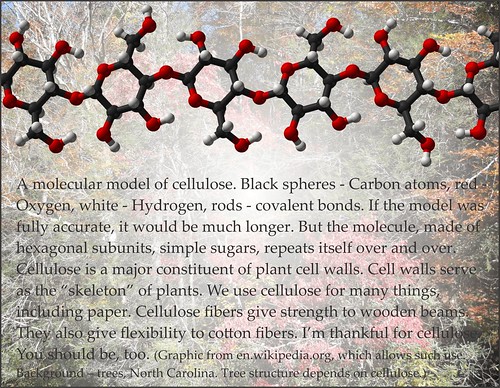
Why is cellulose important? The main reason is that it makes up most of the structure of plant cell walls. Without plants, we would have no food. The animals who are our companions, or help to make our lives easier, and who furnish us with meat, milk, eggs, leather, and many other products, wouldn't have food, either. Without plants, we would be missing building materials, cotton textiles, fuel (including fossil fuel), many medicines, special food substances like coffee, sugar, tea and chocolate, ornamental and shade plants, and many other useful, even necessary items.
Plant cell walls provide plants with their structure. Plants have no bones, but each cell, as it were, has its own skeleton. (That type of structure means that plants can't move around, whereas animals can. Although we have rigid bones, we also have flexible muscles, which allow us to walk, fly or swim. Plants are rigid all over.) Cellulose is used to make paper and cotton. It furnishes much of the fiber, which is important for our diet, even though we can't really use it for fuel. (Cows and termites have special microorganisms in their guts that can break down cellulose, so that these animals can get food energy from it. We don't.)
So. Consider a world with no paper. And no cotton. And no chocolate. And no flowers. And no food. It wouldn't be much of a world.
Cellulose, depending on how it is treated, and what's combined with it, can be the basis of wooden bridges that can hold freight trains, or flexible garments made of cotton.
In a previous post, the importance of the bonding of Carbon atoms was discussed. Because Carbon atoms can form four covalent bonds, complex structures like cellulose are possible. I believe, but cannot prove, that God designed Carbon in this way. (It can't be disproved, either.)
I'm thankful for cellulose. I hope you are, too.
Thursday, November 20, 2014
I'm thankful for water
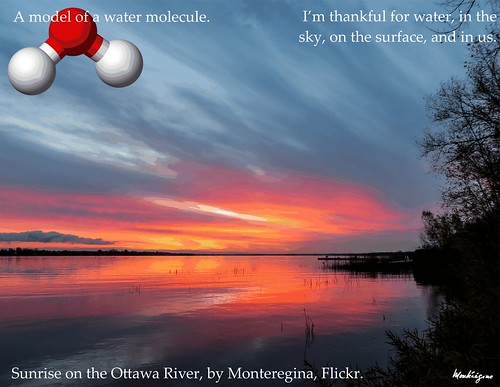
The graphic above is based on a photograph by Monteregina, on Flickr, and is used by permission. The model of the water molecule is from en.wikipedia.org, which allows such usage. I thank both of these.
I'm thankful for water. You should be, too. We are mostly made of water, after all.
Why else should we be thankful for water?
Water provides a great deal of beauty -- water drops on leaves, clouds, rainbows, waterfalls, reflections in pools, and in other ways. Indirectly, it provides more beauty, because most of the living things that we think of as beautiful, such as roses, or bluebirds, depend on water to live and grow. See the graphic above, which shows the beauty of water in cloud formation and reflection.
Water is an important solvent. It carries food molecules, hormones, and waste products throughout our bodies, and those of other organisms. It carries the ions that we use to cause signals in our brains, and in other nerve cells.
Water is the basis of a transport system in the body. It helps carry food through the gut, for digestion, and carries red blood cells, with their load of Oxygen, white blood cells, which fight infection, and platelets, which repair tissue damage, around the body. It helps our sperms and eggs get together. It does these things for many other organisms, too.
Water is one of the two raw materials of photosynthesis, the process which makes, directly or indirectly, almost all of our food, and that of most other organisms. In other words, our food, carbohydrates, proteins and fats, is partly constructed from atoms taken from water molecules.
Water serves as a habitat for many organisms. Some of them live in water and never come out of it. Some of these, such as some humans, alligators, herons, and beavers, can live near water, and depend on it, but don't live in it full-time. Some, like dragonflies and toads, live in water in part of their lives, but out of it in the rest. Some organisms use frozen water -- snow or ice -- to live in or on.
Water is responsible for shaping the land around us.
Water has been necessary for much of human transportation and exploration. It still serves in that way.
Water serves to moderate climate -- temperature fluctuations are usually less, near bodies of water. Although we don't hear much about it, water vapor in the atmosphere is the most important greenhouse gas. (We hear more about carbon dioxide because there isn't nearly as much of it in the atmosphere, thus significantly adding to it is much more likely than adding to the amount of water vapor.) Without greenhouse gases, the earth's temperature would be well below freezing -- not conducive to life.
Water is necessary for many manufacturing processes. Other such processes may not absolutely require water, but use it, because there is often a lot of it available, and it is inexpensive. For example, it is used in cleaning and cooling. We use it in our homes, to wash our bodies, our food, our dishes and clothes, and to carry off body waste.
Water is able to do some of these things because it has some remarkable, even unique, properties.
It is the only common substance which exists normally in all three states -- gas, liquid and solid. That makes living in snow or on ice possible. It also makes the water cycle possible. It rains!
Water is the only common substance which has a solid form which is less dense than the liquid form. In other words, ice floats. This makes it possible for fish and other organisms to live in bodies of water in the winter -- they live in liquid while there is a solid roof over them. It also gives polar bears a place to live.
Water is the only common substance which is most dense between the temperatures where it changes state. It is most dense at 4 degrees Celsius, which is about the temperature of a refrigerator. It becomes less dense as it cools from 4 degrees down to 0 degrees, where it freezes, and also as it warms from 4 degrees up to 100 degrees, where it boils. So what? That property makes it less likely that a body of water will freeze solidly, and also allows nutrients, which have sunk to the bottom of a body of water, to be recirculated. Bodies of water often are at 4 degrees on their bottom. See here for more information.
Water has a high heat of fusion, and a high heat of vaporization. This means that water moderates temperature, not only in weather and climate, but in us -- we can expose ourselves to temperatures significantly higher or lower than our own, and suffer no ill effects.
Water is transparent. Other substances are, too, but not as many as you might think. This transparency means that we can see -- light goes through the water-based fluids in our eyes, to hit the retina. Plants can carry on photosynthesis because light goes through parts of their cells, to reach the chloroplasts. Underwater plants can carry on photosynthesis because light comes through water to them.
Water is polar. See the model of the water molecule in the graphic. The two white spheres represent Hydrogens, the red sphere an Oxygen atom. Because they are arranged asymmetrically, there is more positive charge near the Hydrogens, more negative near the Oxygen. This makes water molecules attractive to one another -- they tend to hang together, the positive part of one attracted to the negative part of another. This makes water drops possible. It also allows some insects, and even birds and lizards, to walk on top of water -- the water, as it were, would rather hold on to itself than let the animal fall into it. This polarity makes it possible for plants to bring water up to their tops, so those cells can live. Plants don't have any pumping mechanism, like our hearts. Other substances are also polar.
Life on earth is often, with good reason, called Carbon-based. But it is also water-based.
Genesis 1:2 says, at the beginning of the creation story, "The earth was formless and empty. Darkness was on the surface of the deep and God’s Spirit was hovering over the surface of the waters." Revelation 22, the last chapter in the Bible, says "1 He showed me a river of water of life, clear as crystal, proceeding out of the throne of God and of the Lamb, 2a in the middle of its street. On this side of the river and on that was the tree of life, bearing twelve kinds of fruits, yielding its fruit every month." How to interpret Genesis 1, and Revelation, are matters of considerable controversy, but, however they are interpreted, water is mentioned as an integral part of creation, and of the Final Kingdom.
Clearly, water is important. I believe God planned it that way. I can't prove that He did, but it can't be disproved, either. I'm thankful for water, with all its characteristics. Thanks for reading.
Subscribe to:
Posts (Atom)