License

I have written an e-book, Does the Bible Really Say That?, which is free to anyone. To download that book, in several formats, go here.
Creative Commons License
The posts in this blog are licensed under a Creative Commons Attribution-NonCommercial-ShareAlike 3.0 Unported License. You can copy and use this material, as long as you aren't making money from it. If you give me credit, thanks. If not, OK.
Showing posts with label greenhouse gas. Show all posts

Wednesday, June 01, 2022

Sunspots 886

Things I have recently spotted that may be of interest to others*:


Christianity:  A document, "The Faith Once Delivered," developed by a group of Methodist (including several denominations and institutions, among them my own, The Wesleyan Church) theologians, which aims to say what Methodists, no matter their denomination, believe, about the essentials of the faith.

Computing: Business Insider reports on virtual rapes in the Metaverse.

Environment: Gizmodo reports that the US Supreme Court has upheld a ruling that holds back greenhouse gas release.

NPR reports that some states are taking steps to charge manufacturers for the use of plastics in packaging.

Politics: Gizmodo reports that several politicians have put out basically the same statement about the shooting in Uvalde, Texas.

The graphic used in these posts is from NASA, hence, it is free to use like this.

*I try not to include items that require a password or fee to view.

Thanks for reading.


Wednesday, May 18, 2022

Sunspots 884

Things I have recently spotted that may be of interest to others*:


Computing: Gizmodo reports on how often our presence is registered by someone we didn't ask to do this, on-line. (For example, how Google gets information on you, and shows you ads, when you do a search.) Normal internet users leak such information into the hundreds of times a day.

Environment: Gizmodo reports that major oil companies are selling off some of their structure to smaller companies, which are unregulated, and increase emitting greenhouse gases.

Politics: Relevant reports that Americans are a lot more interested in the Depp-Heard trial than in Roe vs. Wade.

Science: Gizmodo reports that NASA has detected a magnitude 5 earthquake on Mars.

A writer in The Scientist discusses sex, and argues that sex differences are much less binary than some would have us believe.

The graphic used in these posts is from NASA, hence, it is free to use like this.

*I try not to include items that require a password or fee to view.

Thanks for reading.

Thursday, December 04, 2014

I'm thankful for Carbon Dioxide. You should be, too.

Thankful for Carbon Dioxide

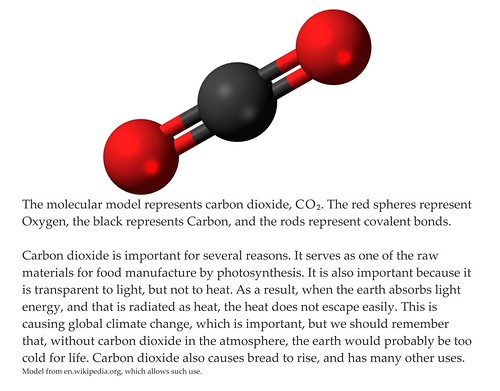
I'm thankful for carbon dioxide. You should be, too.

The most important reason is that carbon dioxide is one of the raw materials used in photosynthesis. This process, in green plants, makes all our food, directly or indirectly. (Food is something that humans or animals can get energy from. In other words, it has calories. Water, and some other substances we consume, are not food.) Some of our food comes from animals, but the food that these animals use to grow comes from plant sources. When living things get energy out of food, they give off carbon dioxide and water. We breathe out, and get rid of carbon dioxide.

Carbon dioxide is odorless, tasteless, and transparent to light. It is partly responsible for the Greenhouse Effect. Energy, as light, can come through the atmosphere. When it strikes something, some of that energy is converted to heat. Carbon dioxide, and other greenhouse gases, are not as transparent to heat as they are to light. The result is that heat builds up on the earth. We usually think of that effect as harmful, and it is becoming that way, but without greenhouse gases, the Wikipedia says that the earth's temperature would be well below freezing, in other words, not conducive to life.

There are many industrial, agricultural and household uses for carbon dioxide. Yeast uses sugars for energy, and gives off carbon dioxide as one of the byproducts. Since carbon dioxide is a gas at normal temperatures, that carbon dioxide makes bread rise. The holes in bread are due to carbon dioxide. (It's an odorless, tasteless, transparent gas, so you won't be able to detect it, except by what it does.)

Carbon dioxide dissolves readily in water. When it does, it combines with water to form carbonic acid, a weak acid. Carbonic acid helps water to eat away at certain kinds of rocks, forming various geological formation. Carbonic acid has other important effects. Carbonated drinks have a lot of carbon dioxide dissolved in them, under pressure.

It is possible to lower the temperature of carbon dioxide so that it becomes a solid, so-called dry ice. Dry ice has many uses. Two of these are in storing food, so that it won't spoil, and in creating special effects in theaters and the like -- the ice turns into a gas readily, producing what looks like fog.

Carbon dioxide is used as a refrigerant, and as a fire extinguisher. It has many other uses. See the Wikipedia article on the compound.

I believe, but cannot prove, that carbon dioxide does so many things, some essential to our lives, because God designed it to have the properties that it does. This cannot be disproved, either.

Thanks for reading. Breathe out. You will release carbon dioxide into the atmosphere.

Thursday, November 20, 2014

I'm thankful for water

Thankful for water

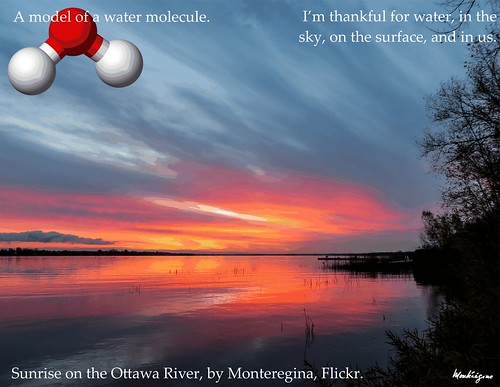
The graphic above is based on a photograph by Monteregina, on Flickr, and is used by permission. The model of the water molecule is from en.wikipedia.org, which allows such usage. I thank both of these.

I'm thankful for water. You should be, too. We are mostly made of water, after all.

Why else should we be thankful for water?
Water provides a great deal of beauty -- water drops on leaves, clouds, rainbows, waterfalls, reflections in pools, and in other ways. Indirectly, it provides more beauty, because most of the living things that we think of as beautiful, such as roses, or bluebirds, depend on water to live and grow. See the graphic above, which shows the beauty of water in cloud formation and reflection.

Water is an important solvent. It carries food molecules, hormones, and waste products throughout our bodies, and those of other organisms. It carries the ions that we use to cause signals in our brains, and in other nerve cells.

Water is the basis of a transport system in the body. It helps carry food through the gut, for digestion, and carries red blood cells, with their load of Oxygen, white blood cells, which fight infection, and platelets, which repair tissue damage, around the body. It helps our sperms and eggs get together. It does these things for many other organisms, too.

Water is one of the two raw materials of photosynthesis, the process which makes, directly or indirectly, almost all of our food, and that of most other organisms. In other words, our food, carbohydrates, proteins and fats, is partly constructed from atoms taken from water molecules.

Water serves as a habitat for many organisms. Some of them live in water and never come out of it. Some of these, such as some humans, alligators, herons, and beavers, can live near water, and depend on it, but don't live in it full-time. Some, like dragonflies and toads, live in water in part of their lives, but out of it in the rest. Some organisms use frozen water -- snow or ice -- to live in or on.

Water is responsible for shaping the land around us.

Water has been necessary for much of human transportation and exploration. It still serves in that way.

Water serves to moderate climate -- temperature fluctuations are usually less, near bodies of water. Although we don't hear much about it, water vapor in the atmosphere is the most important greenhouse gas. (We hear more about carbon dioxide because there isn't nearly as much of it in the atmosphere, thus significantly adding to it is much more likely than adding to the amount of water vapor.) Without greenhouse gases, the earth's temperature would be well below freezing -- not conducive to life.

Water is necessary for many manufacturing processes. Other such processes may not absolutely require water, but use it, because there is often a lot of it available, and it is inexpensive. For example, it is used in cleaning and cooling. We use it in our homes, to wash our bodies, our food, our dishes and clothes, and to carry off body waste.

Water is able to do some of these things because it has some remarkable, even unique, properties.

It is the only common substance which exists normally in all three states -- gas, liquid and solid. That makes living in snow or on ice possible. It also makes the water cycle possible. It rains!

Water is the only common substance which has a solid form which is less dense than the liquid form. In other words, ice floats. This makes it possible for fish and other organisms to live in bodies of water in the winter -- they live in liquid while there is a solid roof over them. It also gives polar bears a place to live.

Water is the only common substance which is most dense between the temperatures where it changes state. It is most dense at 4 degrees Celsius, which is about the temperature of a refrigerator. It becomes less dense as it cools from 4 degrees down to 0 degrees, where it freezes, and also as it warms from 4 degrees up to 100 degrees, where it boils. So what? That property makes it less likely that a body of water will freeze solidly, and also allows nutrients, which have sunk to the bottom of a body of water, to be recirculated. Bodies of water often are at 4 degrees on their bottom. See here for more information.

Water has a high heat of fusion, and a high heat of vaporization. This means that water moderates temperature, not only in weather and climate, but in us -- we can expose ourselves to temperatures significantly higher or lower than our own, and suffer no ill effects.

Water is transparent. Other substances are, too, but not as many as you might think. This transparency means that we can see -- light goes through the water-based fluids in our eyes, to hit the retina. Plants can carry on photosynthesis because light goes through parts of their cells, to reach the chloroplasts. Underwater plants can carry on photosynthesis because light comes through water to them.

Water is polar. See the model of the water molecule in the graphic. The two white spheres represent Hydrogens, the red sphere an Oxygen atom. Because they are arranged asymmetrically, there is more positive charge near the Hydrogens, more negative near the Oxygen. This makes water molecules attractive to one another -- they tend to hang together, the positive part of one attracted to the negative part of another. This makes water drops possible. It also allows some insects, and even birds and lizards, to walk on top of water -- the water, as it were, would rather hold on to itself than let the animal fall into it. This polarity makes it possible for plants to bring water up to their tops, so those cells can live. Plants don't have any pumping mechanism, like our hearts. Other substances are also polar.

Life on earth is often, with good reason, called Carbon-based. But it is also water-based.

Genesis 1:2 says, at the beginning of the creation story, "The earth was formless and empty. Darkness was on the surface of the deep and God’s Spirit was hovering over the surface of the waters."  Revelation 22, the last chapter in the Bible, says "1 He showed me a river of water of life, clear as crystal, proceeding out of the throne of God and of the Lamb, 2a in the middle of its street. On this side of the river and on that was the tree of life, bearing twelve kinds of fruits, yielding its fruit every month." How to interpret Genesis 1, and Revelation, are matters of considerable controversy, but, however they are interpreted, water is mentioned as an integral part of creation, and of the Final Kingdom.

Clearly, water is important. I believe God planned it that way. I can't prove that He did, but it can't be disproved, either. I'm thankful for water, with all its characteristics. Thanks for reading.