License

I have written an e-book, Does the Bible Really Say That?, which is free to anyone. To download that book, in several formats, go here.
Creative Commons License
The posts in this blog are licensed under a Creative Commons Attribution-NonCommercial-ShareAlike 3.0 Unported License. You can copy and use this material, as long as you aren't making money from it. If you give me credit, thanks. If not, OK.
Showing posts with label photosynthesis. Show all posts

Friday, June 17, 2022

Water, Hydrogen, and Oxygen, and where we get our energy


The above equation is a simple way of showing what happens during photosynthesis. There are more detailed ways to show it. Photosynthesis is a complicated process, or processes. But, at its heart, it may be summarized simply.

As you know, there's a lot of water on the earth. As you also know, water consists of two elements, Hydrogen and Oxygen. As you may not know, the energy you need is intimately connected to water. I'm using energy to type this, and you are using energy to move your eyes as you read it. What's that got to do with water?

Our food comes from photosynthesis. Green plants absorb light, and produce various molecules that we use as food, such as starches, sugars, several vitamins, and proteins.

 Light energy is used to split water, and the Hydrogen split off is then available for the manufacture of Carbon-containing molecules, like glucose, food molecules, which can be stored, broken down to release energy, or moved to parts of the organism where they are needed. Some of the need is to release energy. Most foods you buy at a grocery store, or a restaurant, come with a calorie number. That number indicates the amount of energy you would expect to get if you ate and digested that food. The energy comes from energy-storing molecules, like glucose. The Carbon-containing molecules, which have Hydrogen added to the Carbon, may also be used to produce important molecules like enzymes, vitamins, hormones and proteins. (Oxygen, Nitrogen, Sulfur and other elements may be added to a Carbon-based structure.)

Organic molecules, like glucose, will burn. Burning uses Oxygen to carry on combustion. There is a process, used by nearly all organisms, called cellular respiration. That process also uses Oxygen to create water, and, in the process, releases energy for use in our cells. So, putting it very simply, photosynthesis uses light energy to break water, and cellular respiration puts water back together, and releases energy.

I'm bald-headed. So lots of light hits my head. My cells, like yours, have lots of water. So why doesn't that light, on my scalp cells, split water and make glucose? The answer is that various helping molecules, molecular tools, as it were, are necessary for photosynthesis to occur. These include chlorophyll and several enzymes, which I don't have in my scalp cells.

Isn't God great? Thanks for reading.


Thursday, November 19, 2020

Let there be light! I'm thankful for the electromagnetic spectrum

Genesis 1:1 In the beginning, God created the heavens and the earth. 2 The earth was formless and empty. Darkness was on the surface of the deep and God’s Spirit was hovering over the surface of the waters. 3 God said, “Let there be light,” and there was light. 


There is controversy over whether Genesis 1 is to be taken as a sequential account of the creation, or should be interpreted in some other way, and over when and how long creation took place. Lets put those matters aside. They dont really matter for the topics of this post. The first reported created act (although the creation of the earth seems to have come first) is bringing light about. Thats important.

Light is important. The main source of usable energy on earth is light. Energy from light drives the water cycle. Light is absorbed by green plants, and almost all of the food we eat exists because of that. Light makes it possible for us to perceive where we are, where we are going, and who and what is around us. Light makes it possible for us to work, and to play. Without light, reading would be difficult or impossible. Except for those unfortunates of us who are blind, we live in a world perceived and navigated because light is present.

The Bible doesnt say let there be an electromagnetic spectrum. Such a term wouldnt have made sense to the ancient Israelis, and doesnt make sense to a lot of us today. See here for more about that spectrum. But I will say that visible light is a rather small part of a range of energy forms, ranging from gamma rays, X-rays and ultra-violet to infrared, microwaves and radio waves. The people living when Genesis was written, and when it became a part of their culture, had no way of detecting these other forms, or appreciating their importance. However, whenever and however light came to be, this whole family of energy must have accompanied it. I dont know about you, but I use WiFi every day. Im not sure whether my phone uses 5G or not, but, whether it does, or not, its using part of the electromagnetic spectrum to help me communicate.

I had a chest X-ray a few weeks ago. That part of the electromagnet spectrum allows us, as it were, to see parts of our bodies that we can't see with ordinary light.

We open our blinds frequently. This is partly so we can see our surroundings. It is also to help heat our home without adding to the utility bill. Light is reflected -- thats how we see, as light is reflected off of whatever we are looking at, and comes back, going through our pupils and striking our retinas. But it is also absorbed, for example by green plants that carry on photosynthesis. Some of the absorption is manifest in that light energy is converted to heat energy, which, when radiated, is another part of the electromagnetic spectrum. Without heat derived from the suns light, the earth would be uninhabitably cold.

Some other Biblical thoughts about the electromagnetic spectrum. Heres a quotation from 1 Timothy: “6:16 He alone has immortality, dwelling in unapproachable light, whom no man has seen, nor can see: to whom be honor and eternal power. Amen.” Unapproachable light? Yes, there is that, physically. We cant be exposed to parts of the electromagnetic spectrum, in any great amount, or for any great length of time, without suffering damage, or even death. Is the scripture talking about the electromagnetic spectrum, as physicists measure it, or is this symbolic of Gods great holiness and power? Or is it both? I dont know.

John 8:12 Again, therefore, Jesus spoke to them, saying, “I am the light of the world. [Perhaps referring to Isaiah 60:1] He who follows me will not walk in the darkness, but will have the light of life.” Christ, Himself, illuminates, warms, communicates. He is truly the light of the world. (See John 1:1-9.)

Finally, Revelation 22:4 They will see his face, and his name will be on their foreheads. 5 There will be no night, and they need no lamp light or sun light; for the Lord God will illuminate them. They will reign forever and ever. I don’t pretend to understand this, but its part of the Bible.

Thanks for reading. Image modified from Pixabay. Scripture in this color, from the World English Bible.

Wednesday, June 17, 2020

Sunspots 785


Things I have recently spotted that may be of interest to
someone else:

Christianity:The head of the Southern Baptist Convention made a speech praising diversity in his denomination, but pointed out that there was a lot of room for improvement, according to Christianity Today.

Relevant reports on a poll, which says that about one-fourth of Americans see President Trump as a man of faith.

Christianity Today goes back to the topic of Christians and conspiracy theories.

Computing: Gizmodo reports that Twitter recently deleted 170,000 accounts, because they were pumping out propaganda for the Chinese government. Apparently, however, not many people were paying attention.

Gizmo's Freeware points to a site with all sorts of free calendars.


Environment: Gizmodo reports that sea otter populations, in the Pacific Northwest, should be encouraged to increase.

Health: NPR reports that some experts believe that COVID-19 may be around for a long time.\
So does Gizmodo.

History: (or something) Listverse discusses some conspiracy theories that refuse to die.

Science: Science magazine reports that scientists have put various cell parts together to make an artificial system that carries out photosynthesis.

Sports: FiveThirtyEight says that Maya Moore, who left the WNBA of her own accord, to pursue social justice (overturning the conviction of an innocent man), gave up more than any other athlete gave up for a cause. (I have learned, from a reliable source, that Ms. Moore has been appointed head coach of the men's basketball team at a small college.)


The graphic used in these posts is from NASA, hence, it is free to use like this.

Thanks for looking!

Tuesday, May 07, 2019

Is the sun important to us? Absolutely

Why is the sun important to us?
 

For starters, the gravitational attraction of the sun holds the earth in a stable orbit, which is necessary for our very existence as living beings on this planet.

The sun is a giant source of energy. Einstein pointed out the relationship between energy and mass, in his famous e = m c-squared equation. Every second, thousands of tons of mass are turned into energy, by the sun. The process involves four Hydrogen nuclei fusing into a Helium nucleus, which has a little less mass than the Hydrogen nuclei. This fusion wouldn’t be possible without the extreme temperature in the core of the sun – millions of degrees. Temperature is a measurement of the velocity of molecules. At absolute zero, all motion ceases. In the core of the sun, the velocity of particles is so high that they can overcome natural forces of mutual repulsion, hence slamming together and fusing nuclei.


In case you didn’t know, the c in Einstein’s equation is the velocity of light, a large number, and it’s squared. That means that a little bit of mass can be converted to a lot of energy.


What happens to the sun’s radiated energy? Most of it goes off into space, perhaps eventually hitting something. The sun is about 93,000,000 miles away from us. Think of a giant sphere, with a diameter that large. The sun’s radiated energy goes off evenly in all directions. The earth occupies only a very small fraction of the surface of that imaginary sphere. But that very small fraction gets hit by a tiny bit of the sun’s emitted energy, and that is very important to us.


Energy from the sun keeps the earth at a temperature compatible with human, and other, life. It is possible that there is life elsewhere in the solar system, but not likely. Either conditions would be too hot for life, or too cold, in most planets and planetary moons, such as the moons of Saturn.
 

Energy from the sun, in the form of light, makes it possible for us to perceive the world around us, using vision. Most insects, most vertebrates, and some other animals use vision, which would be impossible without light from the sun. (Some animals can see types of light that we can’t, but that statement still applies.) We can perceive the world around us in other ways, to be sure, but vision is arguably more important than the other senses we have.

Energy from the sun makes the seasons possible, and also makes various critically important earthly phenomena, such as the water cycle, possible. Energy from the sun makes erosion and weathering of rocks possible.


Energy from the sun, in the form of light, makes photosynthesis possible. Essentially all of the food energy we take in came directly or indirectly from photosynthesis. In photosynthesis, light is captured by green plants, who use it to produce sugars and various other organic substances, that we need to build ourselves, and to release energy to keep us going.


Is the sun important to us? Absolutely. Yes, that’s the right word – absolutely.


Perhaps St. Paul was speaking of the critical importance of light, when, under the inspiration of the Holy Spirit, he wrote “1 Timothy 6:15b who is the blessed and only Ruler, the King of kings, and Lord of lords; 16 who alone has immortality, dwelling in unapproachable light; whom no man has seen, nor can see: to whom be honor and eternal power. Amen. (World English Bible, public domain.)

Saturday, December 06, 2014

I'm thankful for Glucose! You should be, too.

Thankful for glucose

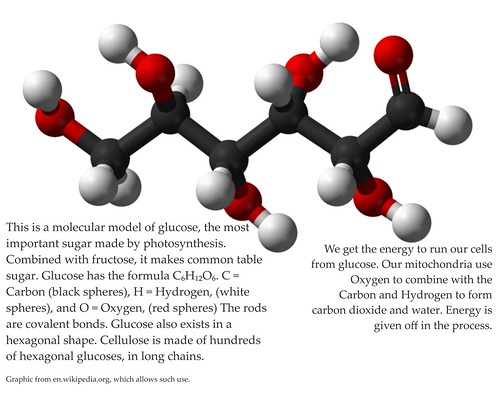
I'm thankful for glucose. Why? It's the most important product of photosynthesis. In other words, all food comes from glucose, somehow. If you are hospitalized, and need to be given nutrition intravenously, you'll get glucose. That makes sense, because glucose is the main source of energy in our cells. It's absolutely important.

The figure above shows a molecule of glucose in one configuration, a chain of six Carbon atoms. There is another configuration, namely hexagonal. In this picture, you can see a chain of these hexagons, each made of 5 Carbon molecules and 1 Oxygen molecule, with other atoms, including 1 Carbon, attached to the central hexagon. That picture is of a molecular model of cellulose, which is a critical component of the structure of plants. That's another reason why glucose is important, besides its use as an energy source.

Common table sugar is made of a molecule of glucose and a molecule of fructose, which is quite similar to glucose, but not identical to it.

Sugar substitutes, or artificial sweeteners, contain a hexagon much like that in glucose. Presumably, the sweetness receptors in our tongues are stimulated by molecules closely resembling glucose in shape, that fit into the sweetness receptors.

Plants store chemical energy (food) as starch, which is made up of many glucose molecules. When we eat starchy foods, we break up the starch, into glucose. One enzyme that does that is amylase, which is secreted in our saliva. If you keep a starchy food, such as a soda cracker or a piece of raw potato, in your mouth, and keep chewing it, you will experience a sweet taste. That taste comes from glucose. Animals store glucose as glycogen.

The Wikipedia says: "It is unclear why glucose, as opposed to other hexose sugars, is so widely used in living organism." So far, anyway. It's not unclear to the Creator, who planned for a carbohydrate, made from Carbon, Hydrogen and Oxygen, with the formula C6H1206, and the shape of a hexagon, to be so important to us. I can't prove that, but no one can disprove it, either.

This is the last in a series, expressing gratitude for a few molecules or elements that are crucial for life on earth. This one is posted between Thanksgiving and Christmas, which is an appropriate time for posting about sugar.

Thursday, December 04, 2014

I'm thankful for Carbon Dioxide. You should be, too.

Thankful for Carbon Dioxide

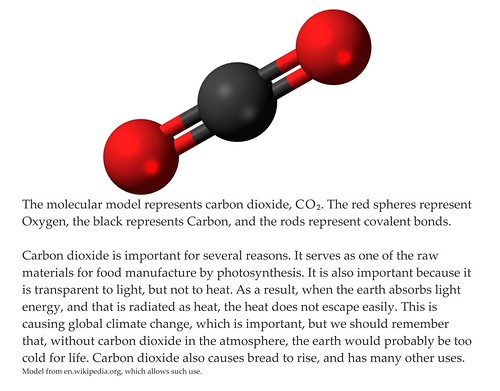
I'm thankful for carbon dioxide. You should be, too.

The most important reason is that carbon dioxide is one of the raw materials used in photosynthesis. This process, in green plants, makes all our food, directly or indirectly. (Food is something that humans or animals can get energy from. In other words, it has calories. Water, and some other substances we consume, are not food.) Some of our food comes from animals, but the food that these animals use to grow comes from plant sources. When living things get energy out of food, they give off carbon dioxide and water. We breathe out, and get rid of carbon dioxide.

Carbon dioxide is odorless, tasteless, and transparent to light. It is partly responsible for the Greenhouse Effect. Energy, as light, can come through the atmosphere. When it strikes something, some of that energy is converted to heat. Carbon dioxide, and other greenhouse gases, are not as transparent to heat as they are to light. The result is that heat builds up on the earth. We usually think of that effect as harmful, and it is becoming that way, but without greenhouse gases, the Wikipedia says that the earth's temperature would be well below freezing, in other words, not conducive to life.

There are many industrial, agricultural and household uses for carbon dioxide. Yeast uses sugars for energy, and gives off carbon dioxide as one of the byproducts. Since carbon dioxide is a gas at normal temperatures, that carbon dioxide makes bread rise. The holes in bread are due to carbon dioxide. (It's an odorless, tasteless, transparent gas, so you won't be able to detect it, except by what it does.)

Carbon dioxide dissolves readily in water. When it does, it combines with water to form carbonic acid, a weak acid. Carbonic acid helps water to eat away at certain kinds of rocks, forming various geological formation. Carbonic acid has other important effects. Carbonated drinks have a lot of carbon dioxide dissolved in them, under pressure.

It is possible to lower the temperature of carbon dioxide so that it becomes a solid, so-called dry ice. Dry ice has many uses. Two of these are in storing food, so that it won't spoil, and in creating special effects in theaters and the like -- the ice turns into a gas readily, producing what looks like fog.

Carbon dioxide is used as a refrigerant, and as a fire extinguisher. It has many other uses. See the Wikipedia article on the compound.

I believe, but cannot prove, that carbon dioxide does so many things, some essential to our lives, because God designed it to have the properties that it does. This cannot be disproved, either.

Thanks for reading. Breathe out. You will release carbon dioxide into the atmosphere.

Saturday, November 29, 2014

I'm thankful for Hydrogen

Thankful for Hydrogen

Hydrogen is the most common element in the universe. About 75% of the mass of the universe is Hydrogen. That is even more remarkable, since Hydrogen is also the least massive of the kinds of atoms. It takes about 12 Hydrogens to have the same mass as Carbon, and over 200 Hydrogens to have the same mass as some of the heavier elements.

So why, other than that it is common, is Hydrogen important? For a number of reasons. The graphic says that Hydrogen makes up part of water, and water is a unique, and very important substance. The graphic also says that Hydrogen is important in photosynthesis. Photosynthesis uses light energy to split Hydrogen from water, and to attach that Hydrogen to Carbon. As a result of the process, glucose, C6H12O6, is produced. Glucose is the basic food molecule of the biosphere, and it has 12 Hydrogen atoms. The graphic says that Hydrogen is found in DNA. It is. It's also found in fats, sugars, proteins, vitamins, hormones, and more, all of them essential to living things, including us.

The graphic also says that Hydrogen can be said to be the ultimate source of the sun's energy. That is true. Four Hydrogen nuclei fuse, to make a Helium nucleus, and, in the process, a little of the mass of the four Hydrogens is changed to energy, according Einstein's E=mc2 equation. Since the mass is multiplied by the velocity of light, squared, that energy adds up. The sun is not burning, in the usual sense. It is changing its Hydrogen to Helium, nuclear fusion, and is releasing energy in the process. The sun is changing about 4.289x10¹² g of mass to energy every second. (source) That's about 5 million tons. But don't worry. Even at that rate, the sun isn't going to run out of Hydrogen for a very long time. There's a LOT of Hydrogen in the sun.

They aren't on the graphic, but I'll mention two other important things that Hydrogen is and does.

Hydrogen makes acids to be what they are. An acid is a substance that can release a charged Hydrogen atom. Some of us have too much acid in our digestive system, and take various antacids, or proton release inhibitors. (A proton makes up the nucleus of a Hydrogen atom.) But acids are very important. Stomach acid does a good job in digesting food, for one thing.

Hydrogen is an excellent fuel, in the sense that you can get a lot of energy from it when you  burn it. Rockets blasting off into space use Hydrogen as their fuel. The chemical equation is very simple: 2 Hydrogens + 1 Oxygen = 1 water + energy. Recall that photosynthesis uses light energy to break up water. Burning Hydrogen does the opposite. It puts Hydrogen and Oxygen together, and gives up energy in the process. There is Hydrogen in most of the molecules in gasoline, and in kerosene, and in natural gas, coal and wood. When any of these burn, water is produced. (Check your exhaust pipe on a cold day.)

Hydrogen fuel, in various ways, may become more useful to us in the future. Hydrogen fuel cells for automobiles are being tested. Since Hydrogen is available in water, and there is plenty of water, we aren't going to run out of Hydrogen. However, like photosynthesis, to get Hydrogen out of water takes energy, which means that Hydrogen fuel cells will probably take more energy to produce than they make available. But they may still be used, because of convenience, and cutting down on the pollution from burning gasoline, if various developmental details can be worked out.

Thanks for reading! I believe, but cannot prove, that God planned for Hydrogen, the smallest nucleus, to have these important roles in our lives, and in the way the universe is. It can't be disproved, either.

Saturday, November 22, 2014

I'm thankful for Chlorophyll

Thankful for chlorophyll

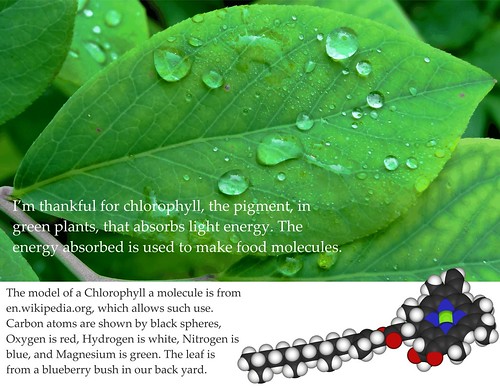
The picture above is of a blueberry leaf, and of one version of a  model of a Chlorophyll molecule.

A recent post attempted to explain why we should be thankful for Carbon atoms, which are able to form complex structures. A Chlorophyll molecule isn't nearly as complex as DNA, or as a protein, but it's pretty complex. The Wikipedia article on Chlorophyll says that Chlorophyll a has this chemical structure: C55H72O5N4Mg. That's 137 atoms, of 5 different elements. Without the capacity of Carbon to form such structures, life would be impossible. (Chlorophyll a is the most common Chlorophyll molecule. Chlorophyll b, which is very similar, is also found in green plants. Other similar molecules are found in other types of organisms.)

Life requires energy sources. For most living things, certainly including us, Chlorophyll is essential in making such energy available. How does it do this? It is a pigment. Like all pigments, it absorbs certain types of light. Light is a form of energy. Before we get to the energy, let's consider the color of Chlorophyll. It's green. So what? That means that it is not absorbing green light. Green light is being reflected from the leaves that contain Chlorophyll, or it is passing through them. It's other colors of light that Chlorophyll absorbs. (That's true of all pigments -- a red pigment, for example, does not absorb red light. It reflects it.) Chlorophyll absorbs the energy of blue and red, or far red, light.

What does Chlorophyll do with this energy? It makes it available to photosynthesis, the process, as the name suggests, whereby light energy is used to make things. What is made is simple sugars, which are used for food, and also as raw materials for making other types of molecules needed by living things.

Photosynthesis requires two raw materials, water (H2O) and Carbon dioxide (CO2). The energy absorbed by Chlorophyll is used to break water molecules, so that Hydrogen is available. In the process, Oxygen is given off. See here for the summary chemical equation for photosynthesis. It is only a summary. The process is complex. That Hydrogen becomes attached to Carbon, from the Carbon Dioxide, and the result is glucose (C6H12O6).

The food we eat, where food is an energy source usable by our body's metabolism, all comes from green plants, directly or indirectly. It comes from plants like beans and spinach, or from animals that eat green plants, like cows, or, rarely, from animals that eat animals that eat green plants, such as some fish.

The three-dimensional structure of Chlorophyll makes it possible for it to trap light energy, and divert it into chemical energy -- food. I believe, but cannot prove, that God designed Carbon atoms, and also Hydrogen, Oxygen, Nitrogen and Magnesium atoms, so that they could be assembled into Chlorophyll molecules, thus making it possible for green plants to get food, and for us to get food from them. I also believe that He planned and designed the complex enzymes that construct Chlorophyll, and that assist in transferring captured light energy to chemical bonds. As I say, I can't prove any of this, but no one can disprove it, either.

Thanks for reading. Be grateful for photosynthesis.

Friday, April 11, 2014

Trees and Oxygen

A recent letter to the editor, in our local paper, complained that we should be careful not to cut down trees, because we need them to provide Oxygen for us. The author was, no doubt, well-intentioned, but wrong.

It is true that photosynthesis, carried out by trees and other green plants, releases Oxygen. But, as the Wikipedia article on the Atmosphere of Earth tells us, about one-fifth of the earth's atmosphere is Oxygen. As this article tells us, it would take about 2,000 years for us to use up all the Oxygen in the atmosphere, if no more were released by photosynthesis. (We would become extinct much sooner than that, if photosynthesis ceased, because we would run out of food.) The article also tells us that the Oxygen released by forests is almost entirely used up by those same forests. This is because, to obtain energy from stored plant material, most organisms use cellular respiration, which takes up Oxygen, and generates Carbon Dioxide. Even trees use cellular respiration to release the energy they store through photosynthesis..

The letter might much better have warned us that indiscriminate tree-cutting would be expected to mean that less Carbon Dioxide was taken up by photosynthesis, and, hence, the amount of CO2 in the atmosphere would increase. The result would be that the atmosphere would be less likely to allow heat radiation to pass through it, which would contribute to global warming. (See this Wikipedia article on Carbon Dioxide in the atmosphere.) Burning fossil fuels is the main culprit in the recent increases in CO2 in the atmosphere, but cutting forests is the second largest contributor.

Thanks for reading. Be glad that there is Oxygen enough to breathe, and be careful to save as many green plants as possible, so that global climate change can be slowed down.


Wednesday, May 29, 2013

Sunspots 420

Things I have recently spotted that may be of interest to someone else:


Christianity: Todd Wood, a Young-Earth Creationist, but one who respects and is willing to listen to other views, examines the results of a poll of pastors, which indicates that over three-quarters of them are not convinced that their own view, whatever it is, is correct.

Computing: I am by no means a expert on Twitter, but Twitonomy seems to be a great tool for those who are, and it comes with a non-biased recommendation. Check it out!

Philosophy: He Lives quotes from rabid atheist Jerry Coyne, who admits that, in his own world view, there is no such thing as free choice.

Politics: An article, with photos, on the first integrated prom in a small Georgia town, in 2013. Not all proms are integrated yet.

Science: A site showing you how a dog's vision differs from that of most humans.

National Public Radio shows, and tells, about "pinkhouses," a high-tech way of growing plants efficiently indoors.


Image source (public domain)    

Tuesday, May 21, 2013

Lessons from grass, and green


Green* is one of the most common English surnames, and it was used in Scotland, too. People were named Green because they lived near a village green, or because they wore clothes of this color.

Green is the color of emeralds, jade, and growing grass. Green is the color most commonly associated with nature and the environmental movement, Ireland, spring, hope, greed, envy, youth, inexperience, health, sickness, Islam, Saint Patrick's Day, and money. In formal churches, Green symbolizes Ordinary Time (as opposed to Lent, Advent, and other special times), and Christian growth.

The word green comes from the Middle English and Old English word grene, which, like the German word grün, has the same root as the words grass and grow. The first recorded use of the word as a color term in Old English dates to about 14 centuries ago. A word for the color green was apparently invented several times, by different language speakers. In ancient Greek, chloros was the word for yellowish, pale green.

There are over 40 places where the Bible uses the word, green. Most of them are in the sense of "green plant," or related to that use. In some translations, Esther 1:6 uses green as a fabric color. Job 8:16 and 15:32 use green to refer to a favored person. One of the most familiar uses is in Psalm 23, where David says that he has laid down in green pastures. Here’s how Jeremiah described a righteous person, in 17:7 Blessed is the man who trusts in the Lord,
and whose confidence is in God.
8 For he shall be as a tree planted by the waters,
who spreads out its roots by the river,
and shall not fear when heat comes,
but its leaf shall be green;
and shall not be careful in the year of drought,
neither shall cease from yielding fruit. So, someone who trusts God is compared to a green tree – growing, alive, and fertile.

Here’s another passage:
Psalm 92:12 The righteous shall flourish like the palm tree.
He will grow like a cedar in Lebanon.
13 They are planted in the Lord’s house.
They will flourish in our God’s courts.
14 They will still produce fruit in old age.
They will be full of sap and green, Lesson 1: We can, and should, still be fruitful for God, and others, for all of our lives, including in our old age. Fruit? Probably two things: winning others to a relationship with Christ; showing the fruits of the Spirit, from Galatians 5:22-3, which are joy, peace, patience, kindness, goodness, faithfulness, gentleness, and self-control.

As I said, and as you can see all around us at this time of year, green is the color of plants, and of growth. Did you know that we wouldn't be here without green plants? They make food for us, and for animals. Every item of food on that table out there originated as a mostly green plant, whether it’s lettuce, tomatoes, sweet tea, butter, rolls, chicken, roast beef, ham or red velvet cake. Everything with calories in it, that you can buy at Ingles, Walmart, Bilo, Publix, or wherever you shop, started out as green plant material. Calories have a bad name, because some of us take in more of them than we should, but we need calories. Without green plants, there’d be no calories available in food.

The process that uses light energy to make food is photosynthesis, which is carried out by the chlorophylls in green plants. Remember the Greek word for light green? Chloros.

What makes plants green? Chlorophyll, which is a green pigment, named for chloros. What's a pigment? A pigment is a chemical that absorbs some colors, and reflects others, or just lets them go through. Why are leaves green? Because they absorb some of the sun’s light, and reflect, or transmit, green. Blue and red light, are mostly absorbed by chlorophyll**. The plants use the energy in that blue and red light to make food. Lesson 2: We need to be like pigments. We need to absorb the light that God makes available to us, through the Bible, the Holy Spirit, and through other godly people. We also need to reflect that light, so that others can profit from it.

This amazing system of capturing sunlight, and getting food from it, is one of the many things that we don’t thank God enough for.

Grass
Now, I’d like to change my subject a little, from green to grass. If I did a good job, and you were paying attention, you noticed that green and grass are closely related words, and no wonder. Grass is green, usually. A lot of what’s green is grass. There are about 60 references to grass in the Bible, beginning in Genesis 1, where grass is described as part of God’s good creation.

Based on other scripture, such as Psalm 104, God didn’t describe His creation as good just because it was and is good for humans. We’re far from discovering all of the galaxies, stars, and even planets in the universe. The ones yet discovered, and even most of those we know about, don’t seem to do us much good. But they can still be for God’s glory, even though we have never seen them. Has Pluto or Neptune ever helped you? Has a galaxy hundreds of light-years away ever helped you? Yet they are part of God’s good creation. We think that there are many types of living things that we haven’t discovered yet. If most of them disappeared today, it wouldn’t affect our lives. But they are still for God’s glory, too. What God has allowed to exist in the universe is good primarily because of God, not because it is good for humans.

What about grass?
In Matthew 6:30, Jesus said that grass exists today, but is just thrown into the oven tomorrow, apparently as cheap fuel. Lesson 3: We aren’t special, either. We attendees at this Green reunion are no better than people named Black, or Smith, or whatever.

We aren’t special even if we are rich, or well educated, or talented, or popular, we aren’t anything special:
James 1:11 For the sun arises with the scorching wind, and withers the grass, and the flower in it falls, and the beauty of its appearance perishes. So also will the rich man fade away in his pursuits.

Daniel told Nebuchadnezzar, ruler of the most powerful kingdom of his day, that he wasn’t anything special: Daniel 4:25b you shall be driven from men, and your dwelling shall be with the animals of the field, and you shall be made to eat grass as oxen, and shall be wet with the dew of the sky, and seven times shall pass over you; until you know that the Most High rules in the kingdom of men, and gives it to whomever he will.

Lesson 4: even though we aren’t any more special than anyone else, God cares for us! Matthew 6:30: But if God so clothes the grass of the field, which today exists, and tomorrow is thrown into the oven, won’t he much more clothe you, you of little faith? The God who clothes the grass in its beautiful green can clothe, and feed, and shelter, and heal us. We should never forget that.

Lesson 5: we are here for a purpose: 1 Kings 18:5 Ahab said to Obadiah, “Go through the land, to all the springs of water, and to all the brooks. Perhaps we may find grass and save the horses and mules alive, that we not lose all the animals.”

Grass does many things. One thing it does is provide food for grazing animals, and us. (You and I can’t really digest grass very well.) Plants of this type have always been important to humans. They have been grown as food for domesticated animals, and for other uses, for about 6,000 years. The most important food crops are the grains of grasses such as wheat, rice and barley. Remember the village green that the Green name may have come from? That was a place for the animals to graze.

We have a purpose, too. It’s not to provide food for animals. It’s a higher purpose. We are to be part of a new creation, begun as Christ’s kingdom. That means that we who believe on Christ as savior are not just given an escape route from hell. We are part of a kingdom that is working worldwide, to bring men and women, boys and girls, to abundant, infectious life in Christ. How well am I carrying out God’s purpose in me? How well are you?

Lesson 6: we need to stay connected. Grass that’s not connected to water dies. Grass that’s not connect to soil can’t get enough minerals. Grass that’s not connected to light stops making food for itself. We must continue to be connected to God, to a good church, to godly people.

Lesson 7: we shouldn’t let being clipped get us down. When Ahab and Obadiah were looking for grass to feed their animals, or when David was lying down in green pastures, they weren’t expecting the animals to eat the grass down to the roots. They expected it to be grazed, or clipped, and grow back.

My wife thinks I’m too old, or too feeble, or not competent enough to mow our grass. So we hire someone to do it. But guess what? He comes every two weeks, and Faye just asked him to come more often. Why? Because grass grows back when cut or clipped. So should we. There are going to be troubles and trials. Perhaps some of you had some just getting here. It’s not God’s plan that we won’t have troubles. But it is God’s plan that we can remain cheerful and obedient and loving when they come. We got an e-mail, last week, from a man whose wife has been diagnosed with Alzheimer’s. Most of the letter was things he was thankful for, concerning this experience.

Most of you don’t know [Jane Green's] father. He lost his wife to a heart attack, over 25 years ago. He hasn’t been able to hear anything less than a loud yell for years. He has trouble walking. I can’t imagine what any of these problems would be like. No wife, not able to carry on a normal conversation, or listen to the TV or the radio, not able to get around. I suppose his family has seen him grumpy, or even angry or depressed. But I never have. He’s always shown a remarkably good attitude, in spite of his circumstances. He’s stood up to clipping!

Lesson 8: There’s hope, even if we aren’t anything special, even if we have been clipped. There’s God!

Isaiah 40:8 The grass withers,
the flower fades;
but the word of our God stands forever.” And, thank God, we can stand forever, too!

*This post is modified slightly from a devotional talk given to the Green family, which my wife is related to, on April 27, 2013. Thanks for reading!

**(Added May 23, 2013) National Public Radio has posted a story, with photo, on "pinkhouses," a high-tech way to grow plants efficiently indoors. The pink is because these structures use only red and blue light, and the result looks pink. The red and blue light are the only colors necessary for photosynthesis.
Tuesday, September 14, 2010

Photosynthesis: What it does

Photosynthesis equations and descriptions

The above is a graphical depiction of two equations for photosynthesis, which, arguably, is the most important chemical process on earth. The importance has to do with the production of food. It is true that photosynthesis also releases Oxygen, but there's plenty of Oxygen already available in the atmosphere -- if photosynthesis stopped today, we would starve soon. We wouldn't run out of Oxygen for hundreds of years.

The second equation is balanced. (In case you are wondering why there is water on both sides, it's because radioactive tracing has shown that this is what actually happens. The six waters on the right are newly made in the process.)

As you can discover, if you don't already know it, photosynthesis is a complex process. Check the link. I just wanted to produce a chart of the basics. You should be able to access larger sizes of the chart by using it as a link.

Thank God for photosynthesis!

Monday, November 19, 2007

Dare I say it? I'm thankful for carbohydrates

I'm thankful for carbohydrates! I know, carbohydrates have gotten a rather bad reputation. There have been fashionable diets that tried to eliminate them. In fact, this Wikipedia article on carbohydrates says that they are not absolutely needed in our diet -- we can get the energy and nutrients we need entirely from other sources. So why be thankful for carbohydrates?

Well, for one thing, I like sugar and sweet things. Sugars are carbohydrates. So are starches, which are complex molecules made from many sugars. Starches are broken down into sugars as part of digestion. Some of that digestion takes place in the mouth, and mouth-digested starchy foods can taste sweet.

For another, much more important reason, carbohydrates are the first usable food products of the processes that make up photosynthesis, the amazing, and absolutely essential activity that turns water, carbon dioxide, and light into food. Carbohydrates are also turned into almost every other organic molecule in living things, by metabolism. The D in DNA stands for deoxyribose, a sugar. Amino acids, which make up protein, are synthesized, directly or indirectly, from molecules produced in making or breaking down sugars in our cells, or the cells of other organisms. Vitamins, steroids, and other critical cell components are made from carbohydrate raw materials. Plants use cellulose, a carbohydrate, for much of the structure of their cell walls. Lignin, synthesized from carbohydrates, makes up most of the rest. Without cell walls, plants wouldn't have the essential structures that they do, such as roots, stems, flowers and leaves. (Cell walls are also a major constituent of cotton and other natural fibers, and of paper.) In other words, without carbohydrates, life as we know it would be impossible.

Jesus said, in the Lord's prayer, "Give us our daily bread." Bread was an essential part of the diet of people of Bible times. David brought loaves of bread to the army. Bread was put out as a sort of offering in the Tabernacle. Bread contains carbohydrate. However, it also has protein, fiber, important minerals, and other things we ought to take in.

Sure, I can eat too many carbohydrates, and be a sugar glutton, but, all in all, I'm thankful to God for carbohydrates. Thanks for reading.

This post was expanded on November 24, 2018.

I have posted about other things I am thankful for, probably including carbohydrates, at other times. See here and here for links to these posts.

I'm also thankful to you, my reader!

Thursday, March 01, 2007

Hydrogen is NOT a practical source of energy

Hydrogen is not, repeat, not, a practical source of energy. The reason is plainly laid out in a recent article in The New Atlantis.

As the author says, almost all of the Hydrogen on earth is combined with some other element, and the only way Hydrogen can serve as a source of energy is if it is not so combined. In order to free it, it is necessary to apply energy, and, because of the second law of thermodynamics, it takes more energy to separate the Hydrogen from, say, Oxygen, than we would get back by re-combining the two in, say, an automobile.

The chemistry in what follows is simplified greatly.

Hydrogen + Oxygen gives off energy. Lots of it. But you have to have the reactants to carry out this equation.

Just in case anyone hasn't thought of it, it also takes energy to obtain energy from petroleum -- it must be found, tapped, shipped, refined, and stored. But we get more energy from petroleum than it takes us to do all of this. The reason is because the Hydrogen in hydrocarbons does not need to be free in order to serve as a fuel. It's the same Hydrogen, but combining Oxygen with the Hydrogen in hydrocarbons gives off energy. Not as much as if free Hydrogen were combined with Oxygen, but, with hydrocarbons, we don't have to free it. The fuel + Oxygen reaction gives off energy. Hydrogen in hydrocarbons is in a form that can combine with Oxygen without being freed first. Photosynthesis, done freely for us by plants, using the energy of the sun's light, combines Hydrogen with Carbon to make organic matter, which was the source of hydrocarbons and other fossil fuels.

Hydrogen, like gasoline, can be a carrier of energy -- stored until needed. But the article claims that it isn't even very good at that. (See also the Wikipedia article on the Hydrogen Economy.)

There are probably some uses of Hydrogen fuel cells that would be practical. But they won't solve our energy problems.

Hydrogen, used another way, might solve our fuel problems. That would be in a fusion reactor, a tamed Hydrogen bomb. We don't seem to be very close to making that practical yet, and, so far, we aren't using ordinary Hydrogen, but a heavy isotope thereof, in such reactors (and also in Hydrogen bombs.)

Thanks for reading.