License

I have written an e-book, Does the Bible Really Say That?, which is free to anyone. To download that book, in several formats, go here.
Creative Commons License
The posts in this blog are licensed under a Creative Commons Attribution-NonCommercial-ShareAlike 3.0 Unported License. You can copy and use this material, as long as you aren't making money from it. If you give me credit, thanks. If not, OK.
Showing posts with label plants. Show all posts

Wednesday, October 27, 2021

Sunspots 855

Things I have recently spotted that may be of interest to others*:


The Arts: (or something) Gizmodo reports on an esthetic advance in the design of screws.

Christianity: BioLogos has an article on whether anti-COVID vaccines are the mark of the beast.

A Relevant writer warns against bibliolatry, putting the Bible as equal to God.

Education:  Grammarphobia discusses the "boo" in peekaboo.

History: Gizmodo reports that Vikings had reached North America by 1021 AD.

Science: NPR reports that a pig kidney as been successfully attached to a human, and that it functioned as kidneys are supposed to.

The Scientist reports on another way that plants communicate with other plants.

Sports: (or something) NPR reports on cricket fighting in China.

The graphic used in these posts is from NASA, hence, it is free to use like this.

*I try not to include items that require a password or fee to view.

Thanks for reading.

Wednesday, May 24, 2017

Sunspots 627

Things I have recently spotted that may be of interest to someone else:


Christianity: Benjamin L. Corey argues that a Christian pacifist, and/or a Christian who refuses to use a gun on others, is not, therefore, a coward.

FiveThirtyEight reports on a study that says that as much as 25% of the US population may be atheists, although most of them don't identify themselves as such.

Christianity Today analyzes the influence of theologian Reinhold Niebuhr on James Comey, the recently fired head of the FBI, and on other prominent public figures.


Computing: Pro Publica reports that some Trump properties, including Mar-a-Lago, used by the President and other important figures, have networks that could easily be hacked. Wired has more on this.

Open Broadcaster Software is a free tool for recording and live streaming video.

The Conversation argues that banning laptops on airplanes would do little to increase security.

Listverse discusses the origin of 10 fonts currently in use.

Politics: Scientific American reports that the Republican governors of Vermont and Massachusetts are seriously concerned about the current and future effects of global warming, and are urging the Trump administration to continue trying to slow it down.

FiveThirtyEight gives a thorough analysis of the likelihood of President Trump being removed from office by the Congress.

Science: The History Blog reports on a fossil Nodosaur.

Scientific American reports that plants may be able to hear.

Scientific American also reports on an apple-picking robot. (With video)


Image source (public domain)

Tuesday, May 16, 2017

Sunspots 626


Things I have recently spotted that may be of interest to someone else:


Education: National Public Radio has published an in-depth report on the pluses and minuses of school voucher programs.

Ethics: Rerum Novarum, an encyclical issued in 1881, by Pope Leo XIII, on the treatment of laborers, and a lot more. Sample (from paragraph 28):
Neither must it be supposed that the solicitude of the Church is so preoccupied with the spiritual concerns of her children as to neglect their temporal and earthly interests. Her desire is that the poor, for example, should rise above poverty and wretchedness, and better their condition in life; and for this she makes a strong endeavor. By the fact that she calls men to virtue and forms them to its practice she promotes this in no slight degree.


Finance: Relevant reports on a study of repaying loans, which found that people who mentioned God when talking about paying back loans were less likely to pay them back.

Health: National Public Radio details two good methods for washing our hands. (Confession: I don't use either of them.)

History: Some historical facts you didn't learn in school, from Listverse.

Humor: (Sort of) Scientific American reports further on the question of why people take their empty shopping carts to a cart corral, or don't. The report is mostly interesting comments, from returners and non-returners.


Politics: Listverse tells us that free speech is being attacked from many sides, in many ways.

(And history) FiveThirtyEight discusses US political scandals of the past, and points out that even when Presidents were involved in some really bad stuff, many congresspeople stuck by them.

Science: (and Christianity) Relevant strongly defends the concept of human-caused climate change.

Wired reports that scientists have made functioning mouse ovaries with a 3-D printer. Really.

Listverse describes 10 fascinating facts about plants.


Image source (public domain)

Saturday, November 22, 2014

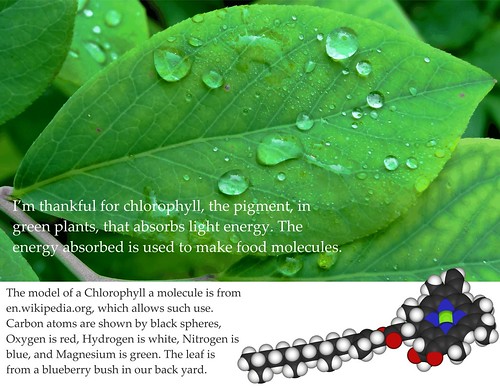
I'm thankful for Chlorophyll

Thankful for chlorophyll

The picture above is of a blueberry leaf, and of one version of a  model of a Chlorophyll molecule.

A recent post attempted to explain why we should be thankful for Carbon atoms, which are able to form complex structures. A Chlorophyll molecule isn't nearly as complex as DNA, or as a protein, but it's pretty complex. The Wikipedia article on Chlorophyll says that Chlorophyll a has this chemical structure: C55H72O5N4Mg. That's 137 atoms, of 5 different elements. Without the capacity of Carbon to form such structures, life would be impossible. (Chlorophyll a is the most common Chlorophyll molecule. Chlorophyll b, which is very similar, is also found in green plants. Other similar molecules are found in other types of organisms.)

Life requires energy sources. For most living things, certainly including us, Chlorophyll is essential in making such energy available. How does it do this? It is a pigment. Like all pigments, it absorbs certain types of light. Light is a form of energy. Before we get to the energy, let's consider the color of Chlorophyll. It's green. So what? That means that it is not absorbing green light. Green light is being reflected from the leaves that contain Chlorophyll, or it is passing through them. It's other colors of light that Chlorophyll absorbs. (That's true of all pigments -- a red pigment, for example, does not absorb red light. It reflects it.) Chlorophyll absorbs the energy of blue and red, or far red, light.

What does Chlorophyll do with this energy? It makes it available to photosynthesis, the process, as the name suggests, whereby light energy is used to make things. What is made is simple sugars, which are used for food, and also as raw materials for making other types of molecules needed by living things.

Photosynthesis requires two raw materials, water (H2O) and Carbon dioxide (CO2). The energy absorbed by Chlorophyll is used to break water molecules, so that Hydrogen is available. In the process, Oxygen is given off. See here for the summary chemical equation for photosynthesis. It is only a summary. The process is complex. That Hydrogen becomes attached to Carbon, from the Carbon Dioxide, and the result is glucose (C6H12O6).

The food we eat, where food is an energy source usable by our body's metabolism, all comes from green plants, directly or indirectly. It comes from plants like beans and spinach, or from animals that eat green plants, like cows, or, rarely, from animals that eat animals that eat green plants, such as some fish.

The three-dimensional structure of Chlorophyll makes it possible for it to trap light energy, and divert it into chemical energy -- food. I believe, but cannot prove, that God designed Carbon atoms, and also Hydrogen, Oxygen, Nitrogen and Magnesium atoms, so that they could be assembled into Chlorophyll molecules, thus making it possible for green plants to get food, and for us to get food from them. I also believe that He planned and designed the complex enzymes that construct Chlorophyll, and that assist in transferring captured light energy to chemical bonds. As I say, I can't prove any of this, but no one can disprove it, either.

Thanks for reading. Be grateful for photosynthesis.

Friday, June 27, 2014

Hyssop in the Bible

Exodus 12:21 Then Moses called for all the elders of Israel, and said to them, “Draw out, and take lambs according to your families, and kill the Passover. 22 You shall take a bunch of hyssop, and dip it in the blood that is in the basin, and strike the lintel and the two doorposts with the blood that is in the basin; and none of you shall go out of the door of his house until the morning. (All Bible quotations from the World English Bible, public domain)

Leviticus 14:2 “This shall be the law of the leper in the day of his cleansing. He shall be brought to the priest, 3 and the priest shall go forth out of the camp. The priest shall examine him, and behold, if the plague of leprosy is healed in the leper, 4 then the priest shall command them to take for him who is to be cleansed two living clean birds, and cedar wood, and scarlet, and hyssop. 5 The priest shall command them to kill one of the birds in an earthen vessel over running water. 6 As for the living bird, he shall take it, and the cedar wood, and the scarlet, and the hyssop, and shall dip them and the living bird in the blood of the bird that was killed over the running water. 7 He shall sprinkle on him who is to be cleansed from the leprosy seven times, and shall pronounce him clean, and shall let the living bird go into the open field.

Leviticus 14:33 Yahweh spoke to Moses and to Aaron, saying, 34 “When you have come into the land of Canaan, which I give to you for a possession, and I put a spreading mildew in a house in the land of your possession, 35 then he who owns the house shall come and tell the priest, saying, ‘There seems to me to be some sort of plague in the house.’ . . . 48 “If the priest shall come in, and examine it, and behold, the plague hasn’t spread in the house, after the house was plastered, then the priest shall pronounce the house clean, because the plague is healed. 49 To cleanse the house he shall take two birds, and cedar wood, and scarlet, and hyssop. 50 He shall kill one of the birds in an earthen vessel over running water. 51 He shall take the cedar wood, and the hyssop, and the scarlet, and the living bird, and dip them in the blood of the slain bird, and in the running water, and sprinkle the house seven times. 52 He shall cleanse the house with the blood of the bird, and with the running water, with the living bird, with the cedar wood, with the hyssop, and with the scarlet;

Numbers 19:1 Yahweh spoke to Moses and to Aaron, saying, 2 “This is the statute of the law which Yahweh has commanded: Speak to the children of Israel, that they bring you a red heifer without spot, in which is no blemish, and which was never yoked. 3 You shall give her to Eleazar the priest, and he shall bring her forth outside of the camp, and one shall kill her before his face: 4 and Eleazar the priest shall take of her blood with his finger, and sprinkle her blood toward the front of the Tent of Meeting seven times. 5 One shall burn the heifer in his sight; her skin, and her flesh, and her blood, with her dung, shall he burn: 6 and the priest shall take cedar wood, and hyssop, and scarlet, and cast it into the midst of the burning of the heifer. 7 Then the priest shall wash his clothes, and he shall bathe his flesh in water, and afterward he shall come into the camp, and the priest shall be unclean until the evening. 8 He who burns her shall wash his clothes in water, and bathe his flesh in water, and shall be unclean until the evening.

Numbers 19:16 “Whoever in the open field touches one who is slain with a sword, or a dead body, or a bone of a man, or a grave, shall be unclean seven days. 17 “For the unclean they shall take of the ashes of the burning of the sin offering; and running water shall be put thereto in a vessel: 18 and a clean person shall take hyssop, and dip it in the water, and sprinkle it on the tent, and on all the vessels, and on the persons who were there, and on him who touched the bone, or the slain, or the dead, or the grave:

1 Kings 4:30 Solomon’s wisdom excelled the wisdom of all the children of the east, and all the wisdom of Egypt. 31 For he was wiser than all men; than Ethan the Ezrahite, and Heman, and Calcol, and Darda, the sons of Mahol: and his fame was in all the nations all around. 32 He spoke three thousand proverbs; and his songs were one thousand five. 33a He spoke of trees, from the cedar that is in Lebanon even to the hyssop that springs out of the wall;

Psalm 51:1 Have mercy on me, God, according to your loving kindness.
    According to the multitude of your tender mercies, blot out my transgressions. 

2 Wash me thoroughly from my iniquity.
    Cleanse me from my sin. 

3 For I know my transgressions.
    My sin is constantly before me. 

4 Against you, and you only, have I sinned,
    and done that which is evil in your sight;
that you may be proved right when you speak,
    and justified when you judge. 

5 Behold, I was brought forth in iniquity.
    In sin my mother conceived me. 

6 Behold, you desire truth in the inward parts.
    You teach me wisdom in the inmost place.

7 Purify me with hyssop, and I will be clean.
    Wash me, and I will be whiter than snow.


John 19:28 After this, Jesus, seeing that all things were now finished, that the Scripture might be fulfilled, said, “I am thirsty.” 29 Now a vessel full of vinegar was set there; so they put a sponge full of the vinegar on hyssop, and held it at his mouth. 30 When Jesus therefore had received the vinegar, he said, “It is finished.” He bowed his head, and gave up his spirit.

Hebrews 9:18 Therefore even the first covenant has not been dedicated without blood. 19 For when every commandment had been spoken by Moses to all the people according to the law, he took the blood of the calves and the goats, with water and scarlet wool and hyssop, and sprinkled both the book itself and all the people, 20 saying, “This is the blood of the covenant which God has commanded you.”

The quotations above include most or all of the Biblical references to hyssop. Just from reading them, it seems clear that it had ritual uses in purifying, persons, houses, the nation as a whole, and other things. We aren't told why hyssop, but it seems to be a reasonable guess that its leaves, or stems, or both were able to retain fluid, at least blood fluid, fairly well. The Wikipedia article on hyssop tells us that we aren't sure what kind of plant it is, or was. There is uncertainty about the identity of almost all of the plants mentioned in the Bible, which is not surprising, since, in English, at least, it is common for one species of plant to have more than one common name.

We don't need hyssop for cleansing, as we are now under the second covenant, but we do need cleansing, and should welcome it, even if it is painful. Thanks for reading.

Monday, May 19, 2014

Two amazing organisms from South America

National Public Radio, and other news outlets, have reported on the discovery of bones from what seems to be the largest dinosaur ever found. The discovery was in Argentina.

NPR also reports on a living organism, a weird plant that looks like what would happen if you sprayed green shaving cream over one or more large beach balls. These slow-growing individuals could be the oldest higher plants on earth. They are related to carrots, but they certainly don't look like them in the photos. They are found in the Andes, including in Chile.

Amazing stuff! Read the articles, and look at the photos and videos.

Monday, December 30, 2013

Are there groups of organisms not mentioned in the Genesis 1 account of creation?

Genesis 1:1 In the beginning, God created the heavens and the earth.

9 God said, “Let the waters under the sky be gathered together to one place, and let the dry land appear”; and it was so. 10 God called the dry land “earth”, and the gathering together of the waters he called “seas”. God saw that it was good. 11 God said, “Let the earth yield grass, herbs yielding seeds, and fruit trees bearing fruit after their kind, with their seeds in it, on the earth”; and it was so. 12 The earth yielded grass, herbs yielding seed after their kind, and trees bearing fruit, with their seeds in it, after their kind; and God saw that it was good. 13 There was evening and there was morning, a third day.

20 God said, “Let the waters abound with living creatures, and let birds fly above the earth in the open expanse of the sky.” 21 God created the large sea creatures and every living creature that moves, with which the waters swarmed, after their kind, and every winged bird after its kind. God saw that it was good. 22 God blessed them, saying, “Be fruitful, and multiply, and fill the waters in the seas, and let birds multiply on the earth.” 23 There was evening and there was morning, a fifth day.

24 God said, “Let the earth produce living creatures after their kind, livestock, creeping things, and animals of the earth after their kind”; and it was so. 25 God made the animals of the earth after their kind, and the livestock after their kind, and everything that creeps on the ground after its kind. God saw that it was good.

26 God said, “Let us make man in our image, after our likeness: and let them have dominion over the fish of the sea, and over the birds of the sky, and over the livestock, and over all the earth, and over every creeping thing that creeps on the earth.” 27 God created man in his own image. In God’s image he created him; male and female he created them. 28 God blessed them. God said to them, “Be fruitful, multiply, fill the earth, and subdue it. Have dominion over the fish of the sea, over the birds of the sky, and over every living thing that moves on the earth.” 29 God said, “Behold, I have given you every herb yielding seed, which is on the surface of all the earth, and every tree, which bears fruit yielding seed. It will be your food. 30 To every animal of the earth, and to every bird of the sky, and to everything that creeps on the earth, in which there is life, I have given every green herb for food;” and it was so.

31 God saw everything that he had made, and, behold, it was very good. There was evening and there was morning, a sixth day.
(World English Bible, public domain. All scriptures quoted are from that version. I omitted days 1, 2, 4 and 7, as there is no indication of the creation of any living things on those days.)


I am assuming, for the purposes of this discussion, that creation took place in six literal, consecutive days. I am well aware that there are problems with that view, and am not convinced of it.

Are there large groups of organisms not mentioned here? Maybe. It depends on how inclusive the creation events described really were, and there is no way of being sure of that, so I'll just muse about these matters.

There is no direct mention of microorganisms, and it would have been amazing if there had been. They weren't discovered until less than 300 years ago. Mentioning them in Genesis 1 would mostly likely have seemed nonsensical to the ancient Israelites, and, presumably, to Moses.

There is no direct mention of underwater plants. Perhaps the Israelites weren't familiar with them.

There is no direct mention of flying insects. It is hard to imagine God's creation being completely good without butterflies, and, especially, bees. There are other kinds of flying insects, too. It is true that all of the flying insects have non-flying larvae, however. Most likely, in some cases, the Israelites and their contemporaries wouldn't have been aware of the connection between grubs, maggots or caterpillars and the adults.

Were mosquitoes and the flies that carry disease part of the original creation, or did they appear only after the Fall?

There are some non-flying birds, such as ostriches, which are mentioned elsewhere in the Old Testament, so the Israelites must have known about them. But they do have wings, although they don't fly much, or any.

There is no direct mention of several mostly non-moving, or at least non-swimming, water animals, including oysters and other shelled molluscs, sea anemones, sponges, and corals. Most likely, the Israelites weren't too familiar with these, anyway, and, besides, they probably wouldn't have been recognized as animals. They probably knew about oysters, or some of them did, since Jesus told a parable about a pearl in Matthew 13.

The scripture quoted at the beginning of this post was, perhaps, not meant to have been inclusive.

Genesis 1 doesn't tell us when, why, or how God created. It doesn't even tell us all of what God created. What it does, and what its main purpose is, is to tell us that there was a Who of creation. (There still is!)

Thanks for reading.