License

I have written an e-book, Does the Bible Really Say That?, which is free to anyone. To download that book, in several formats, go here.
Creative Commons License
The posts in this blog are licensed under a Creative Commons Attribution-NonCommercial-ShareAlike 3.0 Unported License. You can copy and use this material, as long as you aren't making money from it. If you give me credit, thanks. If not, OK.
Showing posts with label Chlorophyll. Show all posts

Friday, June 17, 2022

Water, Hydrogen, and Oxygen, and where we get our energy


The above equation is a simple way of showing what happens during photosynthesis. There are more detailed ways to show it. Photosynthesis is a complicated process, or processes. But, at its heart, it may be summarized simply.

As you know, there's a lot of water on the earth. As you also know, water consists of two elements, Hydrogen and Oxygen. As you may not know, the energy you need is intimately connected to water. I'm using energy to type this, and you are using energy to move your eyes as you read it. What's that got to do with water?

Our food comes from photosynthesis. Green plants absorb light, and produce various molecules that we use as food, such as starches, sugars, several vitamins, and proteins.

 Light energy is used to split water, and the Hydrogen split off is then available for the manufacture of Carbon-containing molecules, like glucose, food molecules, which can be stored, broken down to release energy, or moved to parts of the organism where they are needed. Some of the need is to release energy. Most foods you buy at a grocery store, or a restaurant, come with a calorie number. That number indicates the amount of energy you would expect to get if you ate and digested that food. The energy comes from energy-storing molecules, like glucose. The Carbon-containing molecules, which have Hydrogen added to the Carbon, may also be used to produce important molecules like enzymes, vitamins, hormones and proteins. (Oxygen, Nitrogen, Sulfur and other elements may be added to a Carbon-based structure.)

Organic molecules, like glucose, will burn. Burning uses Oxygen to carry on combustion. There is a process, used by nearly all organisms, called cellular respiration. That process also uses Oxygen to create water, and, in the process, releases energy for use in our cells. So, putting it very simply, photosynthesis uses light energy to break water, and cellular respiration puts water back together, and releases energy.

I'm bald-headed. So lots of light hits my head. My cells, like yours, have lots of water. So why doesn't that light, on my scalp cells, split water and make glucose? The answer is that various helping molecules, molecular tools, as it were, are necessary for photosynthesis to occur. These include chlorophyll and several enzymes, which I don't have in my scalp cells.

Isn't God great? Thanks for reading.


Wednesday, August 14, 2019

Sunspots 741

Things I have recently spotted that may be of interest to
someone else:

Health: Listverse tells us 10 interesting things about sweat.

Grammarphobia discusses the naming of Viagra and a number of other drugs.

History: NPR discusses the awful history of the idea of white supremacy, which idea has been, and is, all too popular, for decades.

Humor: (or something) Gizmodo reports on toilet explosions.


Politics: Relevant points out that video game playing doesn't seem to be responsible for mass shootings.

Relevant reports that Chaldean Christians have been sent back to Iraq, where some of them had never been before, with predictable awful consequences.

Relevant takes the Lt. Governor of Texas to task for tying the shooting in El Paso to removal of prayer from the public schools. Franklin Graham apparently agreed with the Lt. Governor.

Catherine Rampell discusses the meaning of "drain the swamp" under the Trump administration. It doesn't mean what most of us thought it did.

Rampell also writes about how President Trump treats former aides/lawyers/whatever who are less than completely adulatory about the President. Not very well.

Michael Gerson on conspiracy theories, and President Trump.
 
Science: The Scientist tells us that space exploration by Israel, and the US, may have left living organisms on the moon.

The Scientist also reports that lots of bacteria in the ocean capture light energy by using a pigment different from chlorophyll.

. . . and The Scientist, and many other outlets, report on the serious weakening, perhaps even nullification, of the Endangered Species Act

NPR reports on the discovery of a very large fossil parrot.

Sports: Simone Biles shows us amazing excellence in gymnastics.

The graphic used in these posts is from NASA, hence, it is free to use like this.
 
Thanks for looking!

Saturday, November 22, 2014

I'm thankful for Chlorophyll

Thankful for chlorophyll

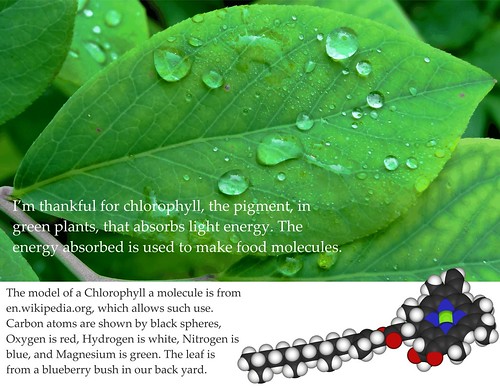
The picture above is of a blueberry leaf, and of one version of a  model of a Chlorophyll molecule.

A recent post attempted to explain why we should be thankful for Carbon atoms, which are able to form complex structures. A Chlorophyll molecule isn't nearly as complex as DNA, or as a protein, but it's pretty complex. The Wikipedia article on Chlorophyll says that Chlorophyll a has this chemical structure: C55H72O5N4Mg. That's 137 atoms, of 5 different elements. Without the capacity of Carbon to form such structures, life would be impossible. (Chlorophyll a is the most common Chlorophyll molecule. Chlorophyll b, which is very similar, is also found in green plants. Other similar molecules are found in other types of organisms.)

Life requires energy sources. For most living things, certainly including us, Chlorophyll is essential in making such energy available. How does it do this? It is a pigment. Like all pigments, it absorbs certain types of light. Light is a form of energy. Before we get to the energy, let's consider the color of Chlorophyll. It's green. So what? That means that it is not absorbing green light. Green light is being reflected from the leaves that contain Chlorophyll, or it is passing through them. It's other colors of light that Chlorophyll absorbs. (That's true of all pigments -- a red pigment, for example, does not absorb red light. It reflects it.) Chlorophyll absorbs the energy of blue and red, or far red, light.

What does Chlorophyll do with this energy? It makes it available to photosynthesis, the process, as the name suggests, whereby light energy is used to make things. What is made is simple sugars, which are used for food, and also as raw materials for making other types of molecules needed by living things.

Photosynthesis requires two raw materials, water (H2O) and Carbon dioxide (CO2). The energy absorbed by Chlorophyll is used to break water molecules, so that Hydrogen is available. In the process, Oxygen is given off. See here for the summary chemical equation for photosynthesis. It is only a summary. The process is complex. That Hydrogen becomes attached to Carbon, from the Carbon Dioxide, and the result is glucose (C6H12O6).

The food we eat, where food is an energy source usable by our body's metabolism, all comes from green plants, directly or indirectly. It comes from plants like beans and spinach, or from animals that eat green plants, like cows, or, rarely, from animals that eat animals that eat green plants, such as some fish.

The three-dimensional structure of Chlorophyll makes it possible for it to trap light energy, and divert it into chemical energy -- food. I believe, but cannot prove, that God designed Carbon atoms, and also Hydrogen, Oxygen, Nitrogen and Magnesium atoms, so that they could be assembled into Chlorophyll molecules, thus making it possible for green plants to get food, and for us to get food from them. I also believe that He planned and designed the complex enzymes that construct Chlorophyll, and that assist in transferring captured light energy to chemical bonds. As I say, I can't prove any of this, but no one can disprove it, either.

Thanks for reading. Be grateful for photosynthesis.