Watson continues to urge his readers to be contented with what they have. In particular, he warns of some dangers of being prosperous:
Sect. X. The tenth argument to contentation is, Consider seriously the nature of a prosperous condition. There are in a prosperous estate three things,
1. More trouble. Many who have abundance of all things to enjoy, yet have not so much content and sweetness in their lives, as some that go to their hard labour. Sad, solicitous thoughts do often attend a prosperous condition. Care is the evil spirit which haunts the rich man, and will not suffer him to be quiet. When his chest is full of gold, his heart is full of care, either how to manage, or how to increase, or how to secure what he hath gotten. O the troubles and perplexities that do attend prosperity! The world’s high seats are very uneasy; sunshine is pleasant, but sometimes it scorcheth with its heat; the bee gives honey, but sometimes it stings: prosperity hath its sweetness and also its sting; “competency with contentment is far more eligible.” Never did Jacob sleep better than when he had the heavens for his canopy, and a hard stone for his pillow. A large voluminous estate is but like a long trailing garment, which is more troublesome than useful.
Thomas Watson lived from 1620-1686, in England. He wrote several books which survive. This blog, God willing, will post excerpts from his The Art of Divine Contentment: An Exposition of Philippians 4:11, over a number of weeks, on Sundays.
My source for the text is here, and I thank the Christian Classics Ethereal Library for making this text (and many others) available. The previous excerpt is here.
Philippians
4:11 Not that I speak because of lack, for I have learned in whatever
state I am, to be content in it. (World English Bible, public domain.)

Musings on science, the Bible, and fantastic literature (and sometimes basketball and other stuff).
God speaks to us through the Bible and the findings of science, and we should listen to both types of revelation.
The title is from Psalm 84:11.
The Wikipedia is usually a pretty good reference. I mostly use the World English Bible (WEB), because it is public domain. I am grateful.
License
I have written an e-book, Does the Bible Really Say That?, which is free to anyone. To download that book, in several formats, go here.

The posts in this blog are licensed under a Creative Commons Attribution-NonCommercial-ShareAlike 3.0 Unported License. You can copy and use this material, as long as you aren't making money from it. If you give me credit, thanks. If not, OK.
The posts in this blog are licensed under a Creative Commons Attribution-NonCommercial-ShareAlike 3.0 Unported License. You can copy and use this material, as long as you aren't making money from it. If you give me credit, thanks. If not, OK.
Showing posts with label riches. Show all posts
Showing posts with label riches. Show all posts
Sunday, January 06, 2019


Sunday, September 02, 2018
The Art of Divine Contentment: An Exposition of Philippians 4:11 by Thomas Watson. Excerpt 42
Watson continues discussing reasons to be contented, or "contentation," as he puts it.
Sect. II. The second argument to contentment.
A Christian hath that which may make him content. 1. Hath not God given thee Christ? in him there are “unsearchable riches;” (Ep. 3. 8) he is such a golden mine of wisdom and grace, that all the saints and angels can never dig to the bottom. As Seneca said to his friend Polybius, never complain of thy hard fortune as long as Caesar is thy friend: so I say to a believer, never complain as long as Christ is thy friend; he is an enriching pearl, a sparkling diamond; the infinite lustre of his merits makes us shine in God’s eyes. (Ep. 1. 7) In him there is both fulness and sweetness; he is unspeakably good. Screw up your thoughts to the highest pinnacle, stretch them to the utmost period, let them expatiate to their full latitude and extent; yet they fall infinitely short of these ineffable and inexhaustable treasures which are locked up in Jesus Christ; and is not here enough to give the soul content? A Christian that wants necessaries, yet having Christ, he hath the “one thing needful.” 2. Thy soul is exercised and enamelled with the graces of the Spirit, and is not here enough to give contentment? Grace is of a divine birth, it is the new plantation, it is the flower of the heavenly paradise, it is the embroidery of the Spirit, it is the seed of God, (1 Jno. 3. 9) it is the sacred unction, (Jno. 2. 20) it is Christ’s portraiture in the soul; it is the very foundation on which superstructure of glory is laid. O, of what infinite value is grace! what a jewel is faith! Well may it be called “precious faith.” (2 Pe. 1. 1) What is love, but a divine sparkle in the soul? A soul beautified with grace, is like a room richly hung with arras, or tapestry, or the firmament bespangled with glittering stars. These are the “true riches,” (Lu. 16. 11) which cannot stand with reprobation: and is not here enough to give the soul contentment? what are all other things but like wings of a butterfly, curiously painted? but they defile our fingers.
Earthly riches, saith Augustine, are full of poverty; so indeed they are, for, they cannot enrich the soul: oftentimes under silken apparel there is a thread-bare soul. They are corruptible: “riches are not forever,” as the wise man saith. (Pr. 27. 24) Heaven is a place where gold and silver will not go. A believer is rich towards God: (Lu. 12. 21) why then are thou discontented? hath not God given thee that which is better than the world? What if he doth not give thee the box, if he gives thee the jewel? what if he denies thee farthings, if he pays thee in a better coin? he gives thee gold; spiritual mercies. What if the water in the bottle be spent? thou hast enough in the fountain. What need he complain of the world’s emptiness, that hath God’s fulness? The Lord is my portion, saith David, (Ps. 16. 5) then let the lines fall where they will, in a sick-bed or prison, I will say, “the lines are fallen unto me in pleasant places, yea, I have a goodly heritage.” Are thou not heir to all the promises? Hast thou not a reversion of heaven? When thou lettest go thy hold of natural life, art thou not sure of eternal life? Hath not God given thee the earnest and first fruits of glory? Is not here enough to work the heart to contentment?
Thomas Watson lived from 1620-1686, in England. He wrote several books which survive. This blog, God willing, will post excerpts from his The Art of Divine Contentment: An Exposition of Philippians 4:11, over a number of weeks, on Sundays.
My source for the text is here, and I thank the Christian Classics Ethereal Library for making this text (and many others) available. The previous excerpt is here.
Philippians 4:11 Not that I speak because of lack, for I have learned in whatever state I am, to be content in it. (World English Bible, public domain.)
Sect. II. The second argument to contentment.
A Christian hath that which may make him content. 1. Hath not God given thee Christ? in him there are “unsearchable riches;” (Ep. 3. 8) he is such a golden mine of wisdom and grace, that all the saints and angels can never dig to the bottom. As Seneca said to his friend Polybius, never complain of thy hard fortune as long as Caesar is thy friend: so I say to a believer, never complain as long as Christ is thy friend; he is an enriching pearl, a sparkling diamond; the infinite lustre of his merits makes us shine in God’s eyes. (Ep. 1. 7) In him there is both fulness and sweetness; he is unspeakably good. Screw up your thoughts to the highest pinnacle, stretch them to the utmost period, let them expatiate to their full latitude and extent; yet they fall infinitely short of these ineffable and inexhaustable treasures which are locked up in Jesus Christ; and is not here enough to give the soul content? A Christian that wants necessaries, yet having Christ, he hath the “one thing needful.” 2. Thy soul is exercised and enamelled with the graces of the Spirit, and is not here enough to give contentment? Grace is of a divine birth, it is the new plantation, it is the flower of the heavenly paradise, it is the embroidery of the Spirit, it is the seed of God, (1 Jno. 3. 9) it is the sacred unction, (Jno. 2. 20) it is Christ’s portraiture in the soul; it is the very foundation on which superstructure of glory is laid. O, of what infinite value is grace! what a jewel is faith! Well may it be called “precious faith.” (2 Pe. 1. 1) What is love, but a divine sparkle in the soul? A soul beautified with grace, is like a room richly hung with arras, or tapestry, or the firmament bespangled with glittering stars. These are the “true riches,” (Lu. 16. 11) which cannot stand with reprobation: and is not here enough to give the soul contentment? what are all other things but like wings of a butterfly, curiously painted? but they defile our fingers.
Earthly riches, saith Augustine, are full of poverty; so indeed they are, for, they cannot enrich the soul: oftentimes under silken apparel there is a thread-bare soul. They are corruptible: “riches are not forever,” as the wise man saith. (Pr. 27. 24) Heaven is a place where gold and silver will not go. A believer is rich towards God: (Lu. 12. 21) why then are thou discontented? hath not God given thee that which is better than the world? What if he doth not give thee the box, if he gives thee the jewel? what if he denies thee farthings, if he pays thee in a better coin? he gives thee gold; spiritual mercies. What if the water in the bottle be spent? thou hast enough in the fountain. What need he complain of the world’s emptiness, that hath God’s fulness? The Lord is my portion, saith David, (Ps. 16. 5) then let the lines fall where they will, in a sick-bed or prison, I will say, “the lines are fallen unto me in pleasant places, yea, I have a goodly heritage.” Are thou not heir to all the promises? Hast thou not a reversion of heaven? When thou lettest go thy hold of natural life, art thou not sure of eternal life? Hath not God given thee the earnest and first fruits of glory? Is not here enough to work the heart to contentment?
Thomas Watson lived from 1620-1686, in England. He wrote several books which survive. This blog, God willing, will post excerpts from his The Art of Divine Contentment: An Exposition of Philippians 4:11, over a number of weeks, on Sundays.
My source for the text is here, and I thank the Christian Classics Ethereal Library for making this text (and many others) available. The previous excerpt is here.
Philippians 4:11 Not that I speak because of lack, for I have learned in whatever state I am, to be content in it. (World English Bible, public domain.)
Wednesday, March 21, 2018
The Art of Divine Contentment: An Exposition of Philippians 4:11 by Thomas Watson. Excerpt 20
The second apology that discontent makes is, I have a great part of my estate strangely melted away, and trading begins to fail. God is pleased sometimes to bring his children very low, and cut them short in their estate; it fares with them as with that widow, who had nothing in her house, save a pot of oil: (2 Ki. 4. 2) but be content.
1. God hath taken away your estate, but not your portion. This is a sacred paradox, honour and estate are no part of a Christian’s jointure; they are rather luxuries than essentials, and are extrinsical and foreign; therefore the loss of those cannot denominate a man miserable, still the portion remains; “the Lord is my portion, saith my soul.” (La. 3. 24) Suppose one were worth a million of money, and he should chance to lose a pin off his sleeve, this is no part of his estate, nor can we say he is undone; the loss of sublunary comforts is not so much to a Christian’s portion, as the loss of a pin is to a million. “These things shall be added to you,” (Mat. 6. 33) they shall be cast in as overplus. When a man buys a piece of cloth he hath an inch or two given in to the measure; now, though he lose his inch of cloth, yet he is not undone, for still the whole piece remains: our outward estate is not so much in regard of the portion, as an inch of cloth is to the whole piece; why then should a Christian be discontented, when the title to his spiritual treasure remains? A thieve may take away all the money that I have about me, but not my land; still a Christian hath a title to the land of promise. Mary hath chosen the better part, which shall not be taken from her.
2. Perhaps, if thy estate had not been lost, thy soul had been lost; outward comforts do often quench inward heat. God can bestow a jewel upon us, but we fall so in love with it, that we forget Him that gave it. What pity is it that we should commit idolatry with the creature! God is forced sometimes to drain away an estate: the plate and jewels are often cast overboard to save the passenger. Many a man may curse the time that ever he had such an estate:
it hath been an enchantment to draw away his heart from God; “they that will be rich, fall into a snare:” are thou troubled that God hath prevented a snare? Riches are thorns; (Mat. 13. 7) art thou angry because God hath pulled away a thorn from thee? Riches are compared to “thick clay;” (Ha. 2. 6) perhaps thy affections, which are the feet of the soul, might have stuck so fast in this golden clay that they could not have ascended up to heaven. Be content; if God dam up our outward comforts, it is, that the stream of our love may run faster another
way.
3. If your estate be small, yet God can bless a little. It is not how much money we have, but how much blessing. He that often curseth the bags of gold, can bless the meal in the barrel, and the oil in the cruise. What if thou hast not the full fleshpots? yet thou hast a promise, “I will abundantly bless her provision,” (Ps. 132. 15) and then a little goes a great way. Be content thou hast the dew of a blessing distilled; a dinner of green herbs, where love is, is sweet; I may add, where the love of God is. Another may have more estate than you, but, more care; more riches, less rest; more revenues, but with all more occasions of expense; he hath a greater inheritance, yet perhaps God doth not give “him power to eat thereof” (Ec. 6. 2) he hath the dominion of his estate, not the use; he holds more but enjoys less; in a word,thou hath less gold than he, perhaps less guilt.
4. You did never so thrive in your spiritual trade; your heart was never so low, as since your condition was low; you were never so poor in spirit, never so rich in faith. You did never run the ways of God’s commandments so fast as since some of your golden weights were taken off. You never had such trading for heaven all your life; this is most abundant gain. You did never make such adventures upon the promise as since you left off your sea-adventures. This is the best kind of merchandise. O Christian, thou never hadst such incomes of the Spirit, such spring-tides of joy; and what though weak in estate, if strong in assurance?
Be content: what you have lost one way, you have gained another.
5. Be your losses what they will in this kind, remember in every loss there is only a suffering, but in every discontent there is a sin, and one sin is worse than a thousand sufferings. What! because some of my revenues are gone, shall I part with some of my righteousness? shall my faith and patience go too? Because I do not possess an estate, shall I not therefore possess my own spirit? O learn to be content.
Thomas Watson lived from 1620-1686, in England. He wrote several books which survive. This blog, God willing, will post excerpts from his The Art of Divine Contentment: An Exposition of Philippians 4:11, over a number of weeks, on Sundays.
My source for the text is here, and I thank the Christian Classics Ethereal Library for making this text (and many others) available. The previous excerpt is here.
Philippians 4:11 Not that I speak because of lack, for I have learned in whatever state I am, to be content in it. (World English Bible, public domain.)
1. God hath taken away your estate, but not your portion. This is a sacred paradox, honour and estate are no part of a Christian’s jointure; they are rather luxuries than essentials, and are extrinsical and foreign; therefore the loss of those cannot denominate a man miserable, still the portion remains; “the Lord is my portion, saith my soul.” (La. 3. 24) Suppose one were worth a million of money, and he should chance to lose a pin off his sleeve, this is no part of his estate, nor can we say he is undone; the loss of sublunary comforts is not so much to a Christian’s portion, as the loss of a pin is to a million. “These things shall be added to you,” (Mat. 6. 33) they shall be cast in as overplus. When a man buys a piece of cloth he hath an inch or two given in to the measure; now, though he lose his inch of cloth, yet he is not undone, for still the whole piece remains: our outward estate is not so much in regard of the portion, as an inch of cloth is to the whole piece; why then should a Christian be discontented, when the title to his spiritual treasure remains? A thieve may take away all the money that I have about me, but not my land; still a Christian hath a title to the land of promise. Mary hath chosen the better part, which shall not be taken from her.
2. Perhaps, if thy estate had not been lost, thy soul had been lost; outward comforts do often quench inward heat. God can bestow a jewel upon us, but we fall so in love with it, that we forget Him that gave it. What pity is it that we should commit idolatry with the creature! God is forced sometimes to drain away an estate: the plate and jewels are often cast overboard to save the passenger. Many a man may curse the time that ever he had such an estate:
it hath been an enchantment to draw away his heart from God; “they that will be rich, fall into a snare:” are thou troubled that God hath prevented a snare? Riches are thorns; (Mat. 13. 7) art thou angry because God hath pulled away a thorn from thee? Riches are compared to “thick clay;” (Ha. 2. 6) perhaps thy affections, which are the feet of the soul, might have stuck so fast in this golden clay that they could not have ascended up to heaven. Be content; if God dam up our outward comforts, it is, that the stream of our love may run faster another
way.
3. If your estate be small, yet God can bless a little. It is not how much money we have, but how much blessing. He that often curseth the bags of gold, can bless the meal in the barrel, and the oil in the cruise. What if thou hast not the full fleshpots? yet thou hast a promise, “I will abundantly bless her provision,” (Ps. 132. 15) and then a little goes a great way. Be content thou hast the dew of a blessing distilled; a dinner of green herbs, where love is, is sweet; I may add, where the love of God is. Another may have more estate than you, but, more care; more riches, less rest; more revenues, but with all more occasions of expense; he hath a greater inheritance, yet perhaps God doth not give “him power to eat thereof” (Ec. 6. 2) he hath the dominion of his estate, not the use; he holds more but enjoys less; in a word,thou hath less gold than he, perhaps less guilt.
4. You did never so thrive in your spiritual trade; your heart was never so low, as since your condition was low; you were never so poor in spirit, never so rich in faith. You did never run the ways of God’s commandments so fast as since some of your golden weights were taken off. You never had such trading for heaven all your life; this is most abundant gain. You did never make such adventures upon the promise as since you left off your sea-adventures. This is the best kind of merchandise. O Christian, thou never hadst such incomes of the Spirit, such spring-tides of joy; and what though weak in estate, if strong in assurance?
Be content: what you have lost one way, you have gained another.
5. Be your losses what they will in this kind, remember in every loss there is only a suffering, but in every discontent there is a sin, and one sin is worse than a thousand sufferings. What! because some of my revenues are gone, shall I part with some of my righteousness? shall my faith and patience go too? Because I do not possess an estate, shall I not therefore possess my own spirit? O learn to be content.
Thomas Watson lived from 1620-1686, in England. He wrote several books which survive. This blog, God willing, will post excerpts from his The Art of Divine Contentment: An Exposition of Philippians 4:11, over a number of weeks, on Sundays.
My source for the text is here, and I thank the Christian Classics Ethereal Library for making this text (and many others) available. The previous excerpt is here.
Philippians 4:11 Not that I speak because of lack, for I have learned in whatever state I am, to be content in it. (World English Bible, public domain.)
Sunday, October 25, 2015
Excerpts from Orthodoxy, by G. K. Chesterton, 44
Is there any answer to the proposition that those who have had the best opportunities will probably be our best guides? Is there any answer to the argument that those who have breathed clean air had
better decide for those who have breathed foul? As far as I know, there is only one answer, and that answer is Christianity. Only the Christian
Church can offer any rational objection to a complete confidence in the rich. For she has maintained from the beginning that the danger was not in
man’s environment, but in man. Further, she has maintained that if we come to talk of a dangerous environment, the most dangerous environment of all
is the commodious environment.
I know that the most modern manufacture has been really occupied in trying to produce an abnormally large needle. I know that the most recent biologists have been chiefly anxious to discover a very small camel. But if we diminish the camel to his smallest, or open the eye of the needle to its largest—if, in short, we assume the words of Christ to have meant the very least that they could mean, His words must at the very least mean this—that rich men are not very likely to be morally trustworthy. Christianity even when watered down is hot enough to boil all modern society to rags. The mere minimum of the Church would be a deadly ultimatum to the world. For the whole modern world is absolutely based on the assumption, not that the rich are necessary (which is tenable), but that the rich are trustworthy, which (for a Christian) is not tenable. You will hear everlastingly, in all discussions about newspapers, companies, aristocracies, or party politics, this argument that the rich man cannot be bribed. The fact is, of course, that the rich man is bribed; he has been bribed already. That is why he is a rich man. The whole case for Christianity is that a man who is dependent upon the luxuries of this life is a corrupt man, spiritually corrupt, politically corrupt, financially corrupt. There is one thing that Christ and all the Christian saints have said with a sort of savage monotony. They have said simply that to be rich is to be in peculiar danger of moral wreck. It is not demonstrably un-Christian to kill the rich as violators of definable justice. It is not demonstrably un-Christian to crown the rich as convenient rulers of society. It is not certainly un-Christian to rebel against the rich or to submit to the rich. But it is quite certainly un-Christian to trust the rich, to regard the rich as more morally safe than the poor. A Christian may consistently say, “I respect that man’s rank, although he takes bribes.” But a Christian cannot say, as all modern men are saying at lunch and breakfast, “a man of that rank would not take bribes.” For it is a part of Christian dogma that any man in any rank may take bribes. It is a part of Christian dogma; it also happens by a curious coincidence that it is a part of obvious human history. When people say that man “in that position” would be incorruptible, there is no need to bring Christianity into the discussion. Was Lord Bacon a bootblack? Was the Duke of Marlborough a crossing sweeper? In the best Utopia, I must be prepared for the moral fall of any man in any position at any moment; especially for my fall from my position at this moment.
Orthodoxy, first published in 1908, by G. K. Chesterton, is in the public domain, and available from Project Gutenberg. The previous post in this series is here. Thanks for reading! Read Chesterton.
I know that the most modern manufacture has been really occupied in trying to produce an abnormally large needle. I know that the most recent biologists have been chiefly anxious to discover a very small camel. But if we diminish the camel to his smallest, or open the eye of the needle to its largest—if, in short, we assume the words of Christ to have meant the very least that they could mean, His words must at the very least mean this—that rich men are not very likely to be morally trustworthy. Christianity even when watered down is hot enough to boil all modern society to rags. The mere minimum of the Church would be a deadly ultimatum to the world. For the whole modern world is absolutely based on the assumption, not that the rich are necessary (which is tenable), but that the rich are trustworthy, which (for a Christian) is not tenable. You will hear everlastingly, in all discussions about newspapers, companies, aristocracies, or party politics, this argument that the rich man cannot be bribed. The fact is, of course, that the rich man is bribed; he has been bribed already. That is why he is a rich man. The whole case for Christianity is that a man who is dependent upon the luxuries of this life is a corrupt man, spiritually corrupt, politically corrupt, financially corrupt. There is one thing that Christ and all the Christian saints have said with a sort of savage monotony. They have said simply that to be rich is to be in peculiar danger of moral wreck. It is not demonstrably un-Christian to kill the rich as violators of definable justice. It is not demonstrably un-Christian to crown the rich as convenient rulers of society. It is not certainly un-Christian to rebel against the rich or to submit to the rich. But it is quite certainly un-Christian to trust the rich, to regard the rich as more morally safe than the poor. A Christian may consistently say, “I respect that man’s rank, although he takes bribes.” But a Christian cannot say, as all modern men are saying at lunch and breakfast, “a man of that rank would not take bribes.” For it is a part of Christian dogma that any man in any rank may take bribes. It is a part of Christian dogma; it also happens by a curious coincidence that it is a part of obvious human history. When people say that man “in that position” would be incorruptible, there is no need to bring Christianity into the discussion. Was Lord Bacon a bootblack? Was the Duke of Marlborough a crossing sweeper? In the best Utopia, I must be prepared for the moral fall of any man in any position at any moment; especially for my fall from my position at this moment.
Orthodoxy, first published in 1908, by G. K. Chesterton, is in the public domain, and available from Project Gutenberg. The previous post in this series is here. Thanks for reading! Read Chesterton.
Tuesday, January 20, 2015
1 Timothy 6:17 poster
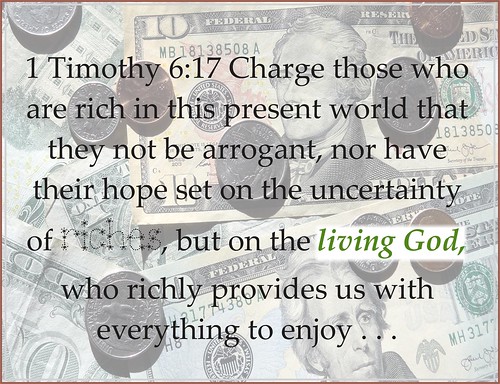
God is not a cosmic bully. He does provide for our needs, as He knows them, not necessarily as we do. It's a good thing He doesn't provide for them as we think of them -- some of them wouldn't be good for us. But He also provides for some of our wants, and, sometimes, surprises us with unexpected and unanticipated pleasures.
Thanks for reading and looking!
Thursday, April 03, 2014
Televangelists and how much they get paid
National Public Radio reported, yesterday and on April 1st (the link is to the combined report) about how some of the largest Christian entities take in millions of dollars, often with no accountability to anyone, except a controlling board, which may consist mostly, or entirely, of the leader's family. That's shameful. Some televangelists have lavish homes, fancy autos, and lots more. (scroll down in the report to see an aerial view of a "parsonage" valued at over six million dollars!) Apparently, based on NPR's research, at least one organization of this type gives viewers the impression that it gives much of the donations they receive to various charities, when, in fact, only about 5% of such money goes to hospitals, missions, and the like.
The Internal Revenue Service and the Congress have not cracked down on such behavior, and don't seem likely to do so in the future.
There are some prominent Christian organizations that are financially transparent, for example the Billy Graham Evangelistic Organization, Samaritan's Purse, and Charles Stanley's In Touch Ministries. See here for a chart of 30 prominent organizations, indicating which of them file with the IRS, and which don't, on the grounds that they are a church; which organizations have regular services - not all those who claim to be a church have regular services; which organizations are members of the Evangelical Council for Financial Accountability; and a summary of any financial information (if such is available at all).
There is information available as to which charities are transparent, and how much of what they take in is actually used for the purposes of the charity. The ECFA, above, is a good place to start. The Better Business Bureau has information on religious (and other) charities. Also, see CharityWatch.
Jesus said this:
Matthew 6:19 Don’t lay up treasures for yourselves on the earth, where moth and rust consume, and where thieves break through and steal; 6:20 but lay up for yourselves treasures in heaven, where neither moth nor rust consume, and where thieves don’t break through and steal; 6:21 for where your treasure is, there your heart will be also. (Scripture quotations from the World English Bible, public domain) Senator Grassley said, in the report, said something like "Christ came into Jerusalem on a donkey, so why do these preachers have to go places in their own luxury cars and jets?"
Some people, I hope Christians, don't seem to pay much attention to that idea. It is true that Paul said this: Philippians 1:15 Some indeed preach Christ even out of envy and strife, and some also out of good will. 1:16 The former insincerely preach Christ from selfish ambition, thinking that they add affliction to my chains; 1:17 but the latter out of love, knowing that I am appointed for the defense of the Good News.
1:18 What does it matter? Only that in every way, whether in pretense or in truth, Christ is proclaimed. I rejoice in this, yes, and will rejoice.
So, even if someone is making a fortune for him or herself out of preaching, Christ can be proclaimed through such a person. But I wouldn't want to be that person. It's not up to me to judge others, but it is up to me to be a wise steward of the money God has allowed me to have.
Thanks for reading. Read the NPR article.
The Internal Revenue Service and the Congress have not cracked down on such behavior, and don't seem likely to do so in the future.
There are some prominent Christian organizations that are financially transparent, for example the Billy Graham Evangelistic Organization, Samaritan's Purse, and Charles Stanley's In Touch Ministries. See here for a chart of 30 prominent organizations, indicating which of them file with the IRS, and which don't, on the grounds that they are a church; which organizations have regular services - not all those who claim to be a church have regular services; which organizations are members of the Evangelical Council for Financial Accountability; and a summary of any financial information (if such is available at all).
There is information available as to which charities are transparent, and how much of what they take in is actually used for the purposes of the charity. The ECFA, above, is a good place to start. The Better Business Bureau has information on religious (and other) charities. Also, see CharityWatch.
Jesus said this:
Matthew 6:19 Don’t lay up treasures for yourselves on the earth, where moth and rust consume, and where thieves break through and steal; 6:20 but lay up for yourselves treasures in heaven, where neither moth nor rust consume, and where thieves don’t break through and steal; 6:21 for where your treasure is, there your heart will be also. (Scripture quotations from the World English Bible, public domain) Senator Grassley said, in the report, said something like "Christ came into Jerusalem on a donkey, so why do these preachers have to go places in their own luxury cars and jets?"
Some people, I hope Christians, don't seem to pay much attention to that idea. It is true that Paul said this: Philippians 1:15 Some indeed preach Christ even out of envy and strife, and some also out of good will. 1:16 The former insincerely preach Christ from selfish ambition, thinking that they add affliction to my chains; 1:17 but the latter out of love, knowing that I am appointed for the defense of the Good News.
1:18 What does it matter? Only that in every way, whether in pretense or in truth, Christ is proclaimed. I rejoice in this, yes, and will rejoice.
So, even if someone is making a fortune for him or herself out of preaching, Christ can be proclaimed through such a person. But I wouldn't want to be that person. It's not up to me to judge others, but it is up to me to be a wise steward of the money God has allowed me to have.
Thanks for reading. Read the NPR article.
Subscribe to:
Posts (Atom)