In
a previous excerpt, Knapp stated that there are four features of
"impressions" from God. These are Scriptural; Right (consistent with
good morals); Providential (in harmony with God's will); and Reasonable.
His discussion of the result of living by "Convictions from Above," according to Christ's example, continues:
It is only those who suffer with Him who shall reign with Him.
Jesus was Possessed of a Deep Abiding joy. Though sorrowful He was always rejoicing. This joy He bequeaths to all His followers. He says: "That my joy may be in you that your joy may be full."
As near as we can learn the joy of Jesus consisted, as Adam Clark says, in "The fulfilling the will of the Father in tasting death for every man." This, with the anticipation of the rapture it would bring to countless multitudes, was His joy, or at least a fruitful source of it, and a kindred self sacrifice and anticipation of its results in blessing to others will possess all in whom the Spirit dwells. Its manifestation in the life of Jesus was hid beneath the agonizing efforts of pain and loss with which His life was filled in rescuing the race; but the consciousness of His Father's continual approbation and the success of His soul saving work, was a well-spring of joy even in His hours of deepest agony. "For the joy set before Him He endured the cross, despising the shame, and is now set down at the right hand of the throne of God."
Great Success was Preceded by Great Agony. His early ministry was preceded by His humble birth, misunderstood parentage, and the terrible temptation in the wilderness. His public efforts were opposed at every step by persistent and wily foes. Many of the ministry and church members of His day looked upon Him with suspicion and hatred. Even His "Own brethren did not believe on Him."
The resurrection and Pentecost were preceded by Gethsemane and the crucifixion. He endured untold agony upon the bloody battlefield before He should wear the victor's crown. Beloved, "Let this mind be in you that was also in Christ Jesus; who being in the form of God thought it not robbery to be equal with God, but made Himself of no reputation, and took upon Himself the form of a servant, and was made in the likeness of men, and being formed in fashion as a man, He humbled Himself and became obedient unto death, even the death of the cross. Wherefore, also, God hath highly exalted Him and given Him a name which is above every name; that at the name of Jesus every knee should bow . . . and that every tongue should confess that Jesus Christ is Lord to the glory of God the Father." -- Phil. 2:6-11.
Excerpted from Impressions, by Martin Wells Knapp. Original publication date, 1892. Public domain. My source is here. The previous post in the series is here.

Musings on science, the Bible, and fantastic literature (and sometimes basketball and other stuff).
God speaks to us through the Bible and the findings of science, and we should listen to both types of revelation.
The title is from Psalm 84:11.
The Wikipedia is usually a pretty good reference. I mostly use the World English Bible (WEB), because it is public domain. I am grateful.
License
I have written an e-book, Does the Bible Really Say That?, which is free to anyone. To download that book, in several formats, go here.

The posts in this blog are licensed under a Creative Commons Attribution-NonCommercial-ShareAlike 3.0 Unported License. You can copy and use this material, as long as you aren't making money from it. If you give me credit, thanks. If not, OK.
The posts in this blog are licensed under a Creative Commons Attribution-NonCommercial-ShareAlike 3.0 Unported License. You can copy and use this material, as long as you aren't making money from it. If you give me credit, thanks. If not, OK.
Showing posts with label joy. Show all posts
Showing posts with label joy. Show all posts
Sunday, October 01, 2017


Sunday, June 12, 2016
Excerpts from Orthodoxy by G. K. Chesterton, 74
The mass of men have been forced to be gay about the little things, but
sad about the big ones. Nevertheless (I offer my last dogma defiantly) it is not native to man to be so. Man is more himself, man is more manlike,
when joy is the fundamental thing in him, and grief the superficial.
Melancholy should be an innocent interlude, a tender and fugitive frame of mind; praise should be the permanent pulsation of the soul. Pessimism is at best an emotional half-holiday; joy is the uproarious labour by which all things live. Yet, according to the apparent estate of man as seen by the pagan or the agnostic, this primary need of human nature can never be fulfilled. Joy ought to be expansive; but for the agnostic it must be contracted, it must cling to one corner of the world. Grief ought to be a concentration; but for the agnostic its desolation is spread through an unthinkable eternity. This is what I call being born upside down. The sceptic may truly be said to be topsy-turvy; for his feet are dancing upwards in idle ecstacies, while his brain is in the abyss. To the modern man the heavens are actually below the earth. The explanation is simple; he is standing on his head; which is a very weak pedestal to stand on. But when he has found his feet again he knows it. Christianity satisfies suddenly and perfectly man’s ancestral instinct for being the right way up; satisfies it supremely in this; that by its creed joy becomes something gigantic and sadness something special and small. The vault above us is not deaf because the universe is an idiot; the silence is not the heartless silence of an endless and aimless world. Rather the silence around us is a small and pitiful stillness like the prompt stillness in a sick-room. We are perhaps permitted tragedy as a sort of merciful comedy: because the frantic energy of divine things would knock us down like a drunken farce. We can take our own tears more lightly than we could take the tremendous levities of the angels. So we sit perhaps in a starry chamber of silence, while the laughter of the heavens is too loud for us to hear. Joy, which was the small publicity of the pagan, is the gigantic secret of the Christian. And as I close this chaotic volume I open again the strange small book from which all Christianity came; and I am again haunted by a kind of confirmation. The tremendous figure which fills the Gospels towers in this respect, as in every other, above all the thinkers who ever thought themselves tall. His pathos was natural, almost casual. The Stoics, ancient and modern, were proud of concealing their tears. He never concealed His tears; He showed them plainly on His open face at any daily sight, such as the far sight of His native city. Yet He concealed something. Solemn supermen and imperial diplomatists are proud of restraining their anger. He never restrained His anger. He flung furniture down the front steps of the Temple, and asked men how they expected to escape the damnation of Hell. Yet He restrained something. I say it with reverence; there was in that shattering personality a thread that must be called shyness. There was something that He hid from all men when He went up a mountain to pray. There was something that He covered constantly by abrupt silence or impetuous isolation. There was some one thing that was too great for God to show us when He walked upon our earth; and I have sometimes fancied that it was His mirth.
Orthodoxy, by G. K. Chesterton, is in the public domain, and available from Project Gutenberg. This is my last post in the series of excerpts, as I have run out of Orthodoxy. It has been a pleasure to read, and publish, a little of that book for nearly a year and a half, and I thank God for the privilege. The previous post in this series is here. Thanks for reading! Read Chesterton.
Melancholy should be an innocent interlude, a tender and fugitive frame of mind; praise should be the permanent pulsation of the soul. Pessimism is at best an emotional half-holiday; joy is the uproarious labour by which all things live. Yet, according to the apparent estate of man as seen by the pagan or the agnostic, this primary need of human nature can never be fulfilled. Joy ought to be expansive; but for the agnostic it must be contracted, it must cling to one corner of the world. Grief ought to be a concentration; but for the agnostic its desolation is spread through an unthinkable eternity. This is what I call being born upside down. The sceptic may truly be said to be topsy-turvy; for his feet are dancing upwards in idle ecstacies, while his brain is in the abyss. To the modern man the heavens are actually below the earth. The explanation is simple; he is standing on his head; which is a very weak pedestal to stand on. But when he has found his feet again he knows it. Christianity satisfies suddenly and perfectly man’s ancestral instinct for being the right way up; satisfies it supremely in this; that by its creed joy becomes something gigantic and sadness something special and small. The vault above us is not deaf because the universe is an idiot; the silence is not the heartless silence of an endless and aimless world. Rather the silence around us is a small and pitiful stillness like the prompt stillness in a sick-room. We are perhaps permitted tragedy as a sort of merciful comedy: because the frantic energy of divine things would knock us down like a drunken farce. We can take our own tears more lightly than we could take the tremendous levities of the angels. So we sit perhaps in a starry chamber of silence, while the laughter of the heavens is too loud for us to hear. Joy, which was the small publicity of the pagan, is the gigantic secret of the Christian. And as I close this chaotic volume I open again the strange small book from which all Christianity came; and I am again haunted by a kind of confirmation. The tremendous figure which fills the Gospels towers in this respect, as in every other, above all the thinkers who ever thought themselves tall. His pathos was natural, almost casual. The Stoics, ancient and modern, were proud of concealing their tears. He never concealed His tears; He showed them plainly on His open face at any daily sight, such as the far sight of His native city. Yet He concealed something. Solemn supermen and imperial diplomatists are proud of restraining their anger. He never restrained His anger. He flung furniture down the front steps of the Temple, and asked men how they expected to escape the damnation of Hell. Yet He restrained something. I say it with reverence; there was in that shattering personality a thread that must be called shyness. There was something that He hid from all men when He went up a mountain to pray. There was something that He covered constantly by abrupt silence or impetuous isolation. There was some one thing that was too great for God to show us when He walked upon our earth; and I have sometimes fancied that it was His mirth.
Orthodoxy, by G. K. Chesterton, is in the public domain, and available from Project Gutenberg. This is my last post in the series of excerpts, as I have run out of Orthodoxy. It has been a pleasure to read, and publish, a little of that book for nearly a year and a half, and I thank God for the privilege. The previous post in this series is here. Thanks for reading! Read Chesterton.
Friday, April 15, 2016
Psalm 84:11 poster
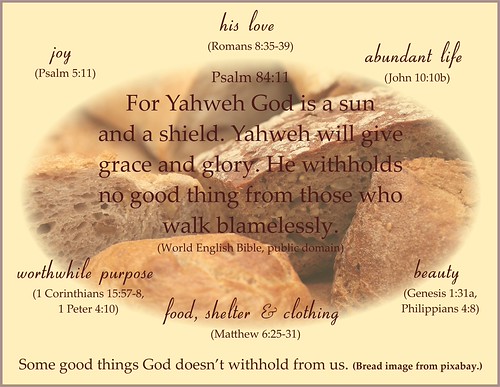
For Yahweh God is a sun and a shield. Yahweh will give grace and glory. He withholds no good thing from those who walk blamelessly. Psalm 84:11, World English Bible, public domain.
This blog gets its name from this verse.
Some of the "good things" that God will not withhold from us are these:
Joy: Psalm 5:11 But let all those who take refuge in you rejoice,
Let them always shout for joy, because you defend them.
Let them also who love your name be joyful in you.
Abundant life: John 10:10b I came that they may have life, and may have it abundantly. (And also see the next verse, below.)
Worthwhile purpose: 1 Corinthians 15:57 But thanks be to God, who gives us the victory through our Lord Jesus Christ. 58 Therefore, my beloved brothers, be steadfast, immovable, always abounding in the Lord’s work, because you know that your labor is not in vain in the Lord.
1 Peter 4:10 As each has received a gift, employ it in serving one another, as good managers of the grace of God in its various forms.
Beauty: Genesis 1:31a God saw everything that he had made, and, behold, it was very good.
Philippians 4:8 Finally, brothers, whatever things are true, whatever things are honorable, whatever things are just, whatever things are pure, whatever things are lovely, whatever things are of good report: if there is any virtue and if there is any praise, think about these things.
Food, clothing and shelter: Matthew 6:25 Therefore I tell you, don’t be anxious for your life: what you will eat, or what you will drink; nor yet for your body, what you will wear. Isn’t life more than food, and the body more than clothing? 26 See the birds of the sky, that they don’t sow, neither do they reap, nor gather into barns. Your heavenly Father feeds them. Aren’t you of much more value than they?
27 “Which of you, by being anxious, can add one moment to his lifespan? 28 Why are you anxious about clothing? Consider the lilies of the field, how they grow. They don’t toil, neither do they spin, 29 yet I tell you that even Solomon in all his glory was not dressed like one of these. 30 But if God so clothes the grass of the field, which today exists, and tomorrow is thrown into the oven, won’t he much more clothe you, you of little faith?
31 “Therefore don’t be anxious, saying, ‘What will we eat?’, ‘What will we drink?’ or, ‘With what will we be clothed?’ The passage quoted doesn't mention shelter, but it seems to be implied.
God's love: Romans 8:35 Who shall separate us from the love of Christ? Could oppression, or anguish, or persecution, or famine, or nakedness, or peril, or sword? 36 Even as it is written,
“For your sake we are killed all day long.
We were accounted as sheep for the slaughter.”*
37 No, in all these things, we are more than conquerors through him who loved us. 38 For I am persuaded that neither death, nor life, nor angels, nor principalities, nor things present, nor things to come, nor powers, 39 nor height, nor depth, nor any other created thing will be able to separate us from God’s love which is in Christ Jesus our Lord.
(*The quotation is from Psalm 44:22.)
This promise, and the "good things" that it was talking about, whatever they are, are God's general will for believers. That is not an endorsement for the Prosperity Gospel. And Psalm 84:11 doesn't mean that bad things, sometimes very bad things, won't happen. An internet source tells me that 322 Christians are martyred, around the world, every month. Paul listed some of the hardships he had gone through, in 2 Corinthians 11:21-32. The list of heroes of faith, in Hebrews 11, includes a list of anonymous followers of God who were tortured, neglected, and generally treated very badly. Christ, Himself, suffered a great deal, and was never well off. He apparently didn't own any shelter. according to Matthew 8:20 and Luke 9:58.
But forget the previous paragraph! God loves us, and wants the best for us. Don't forget the condition, however. This promise is for those who "walk blamelessly." It's possible to do that, with God's help.
Thanks for reading.
Tuesday, January 20, 2015
1 Timothy 6:17 poster
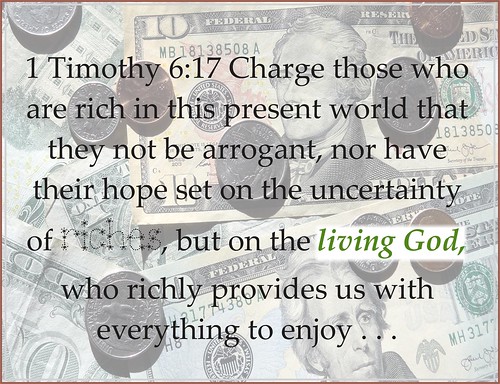
God is not a cosmic bully. He does provide for our needs, as He knows them, not necessarily as we do. It's a good thing He doesn't provide for them as we think of them -- some of them wouldn't be good for us. But He also provides for some of our wants, and, sometimes, surprises us with unexpected and unanticipated pleasures.
Thanks for reading and looking!
Thursday, May 30, 2013
God's creativity

God is unimaginably creative.
John 1,
Colossians 1, and other passages indicate that God the Son was and is the chief
agent in creation, and in sustaining it.
So what did
God create?
1. Substance (including energy, which is a
type of substance – e = mc2).
Matter and
energy are creations of God. He is outside of His created universe, and made it
come to be from nothing. However, He can and does enter it, as shown in the
miracles of the Old Testament, the Incarnation of God the Son, and the presence
of God the Holy Spirit. Ken Schenck, in this post, points out that God created the nothing, too. It wouldn't have been there without God.
It is
possible that all the types of sub-atomic particles, or even each and every
such particle, all the elements, all the types of heavenly bodies, the earth
itself, and the kinds of living things, were brought into being by individual
creative acts. It is also possible that God’s planning was so extensive and
complete that He created matter so that most or all of these things emerged,
over time, as a result of the Big Bang. Either way shows God’s limitless
intelligence and creativity, (See here for information on the suitability of sub-atomic particles for the existence of the universe.) and we don’t need to know which of these (or both)
has been true.
Satan probably has no power to create any kind of substance, but he can make use of created things.
Satan probably has no power to create any kind of substance, but he can make use of created things.
2. Time/Eternity
Substance has been created in time, which is another of God's creations. Since that is true, God is not in time, but outside of it, in eternity -- God can experience the past, present and future. Or, perhaps, God created eternity, too. All of the entities shown in the graphic play out in time, and in eternity. I'm not clear as to whether eternity is just time stretched out infinitely into the past and the future, or whether time somehow exists in eternity, and it doesn't matter what I think. I'll leave that question to God.
Satan apparently existed before the creation of substance, but probably not eternally into the past. Humans, and satan and other beings are going to exist eternally into the future.
Substance has been created in time, which is another of God's creations. Since that is true, God is not in time, but outside of it, in eternity -- God can experience the past, present and future. Or, perhaps, God created eternity, too. All of the entities shown in the graphic play out in time, and in eternity. I'm not clear as to whether eternity is just time stretched out infinitely into the past and the future, or whether time somehow exists in eternity, and it doesn't matter what I think. I'll leave that question to God.
Satan apparently existed before the creation of substance, but probably not eternally into the past. Humans, and satan and other beings are going to exist eternally into the future.
3. Beauty
All beauty, imagined*
or existent, of pattern, appearance, sound, and form, either:
was created
by God;
is a natural
emergence from what God created;
is based on
what God brought forth;
or is
possible because He gave humans the ability to be sub-creators.
(J. R. R.
Tolkien, who was a Christian, used the word sub-creation
about the fantastic worlds created by himself and others.)
*“Imagined,” because, for example, Beethoven was so deaf by the time his great
Ninth Symphony was performed that he could not hear it, and had not heard it,
except in his head, while he was composing it. Similar processes of imagination occur during
writing, painting, and other creative arts, and also in the sciences, even in
sports. Newton imagined his Law of Universal Gravitation – he didn’t develop
this from experiments. That Law’s simplicity is one of many scientific
phenomena that scientists sometimes say possess beauty, because of their
simplicity (at least to the scientists!) and explanatory power:
F = (g x m1 x m2)/r2
The scientific search for patterns in elementary particles, and for broadly applicable formulas and laws (such as the so-called theory of everything, or the “God particle”) is motivated by a belief that there is an underlying pattern and beauty in the way things are. Einstein, who was not a believer in a personal God, sometimes spoke as if there was a God who had arranged things in the way that they were, understandable, describable, and relatively simple.
Richard Feynman, Nobel laureate, said: “What is it about nature that lets this happen, that it is possible to guess from one part what the rest is going to do? That is an unscientific question: I do not know how to answer it, and therefore I am going to give an unscientific answer. I think it is because nature has a simplicity and therefore a great beauty.” “Seeking New Laws,” pp. 143-167, in Richard Feynman, The Character of Physical Law, New York: Modern Library, 1994. Quote is from p. 167. I have read most of Feynman's popular writing, and seen no evidence that he believed in God at all.
Naismith imagined a game involving tossing a ball into peach baskets.
F = (g x m1 x m2)/r2
The scientific search for patterns in elementary particles, and for broadly applicable formulas and laws (such as the so-called theory of everything, or the “God particle”) is motivated by a belief that there is an underlying pattern and beauty in the way things are. Einstein, who was not a believer in a personal God, sometimes spoke as if there was a God who had arranged things in the way that they were, understandable, describable, and relatively simple.
Richard Feynman, Nobel laureate, said: “What is it about nature that lets this happen, that it is possible to guess from one part what the rest is going to do? That is an unscientific question: I do not know how to answer it, and therefore I am going to give an unscientific answer. I think it is because nature has a simplicity and therefore a great beauty.” “Seeking New Laws,” pp. 143-167, in Richard Feynman, The Character of Physical Law, New York: Modern Library, 1994. Quote is from p. 167. I have read most of Feynman's popular writing, and seen no evidence that he believed in God at all.
Naismith imagined a game involving tossing a ball into peach baskets.
Satan probably
has no power to create beauty of any kind, although he can mimic God’s good
creation, and can use beauty as an evil force. (Pornography, for example.)
Perhaps Satan, as an angel, had creative powers that humans don’t. We don’t
know. Satan apparently can imagine events that have not happened yet, or that might never happen.
4. Relationship
The power to
form relationships with other sentient, responsive beings is possible because
God made it so.
A human who
is incapable of establishing relationships with others, or who does not want to
do so, is abnormal. Humans are constructed so that we form and maintain
relationships with others, from birth to death.
God also
desires relationships. The Three Persons of the Trinity apparently have a
relationship with one another. God wants to have a relationship with us. This
is not possible, or not nearly fully possible, unless the sin problem is fixed.
God loves us so much that He took care of the sin problem for us – we couldn’t
do that. In the life of Christ, in 1 Corinthians 13, and elsewhere, the proper
foundation for relationships is laid out. It is unselfish, Christ-like love. (Agape love.) Humans, and, to some
extent, animals, have some capacity to communicate, to empathize, to imagine
how to increase the well-being of others, and to do so. These all contribute to
the ability to form relationships. God wants us to use this ability to bring
others to a relationship with Him.
Satan is
incapable of forming a proper relationship with anyone. We aren’t, either,
without accepting Christ’s sacrifice for sin, and following His Lordship and
example.
5. Joy
God is
responsible for joy. We can, and should, be joyful in comprehending and
experiencing beauty and relationship, even substance. God made humor and
laughter possible. We should joy in contemplating God’s creativity and goodness.
“Joyful, joyful, we adore Thee” (based on Beethoven's Ninth Symphony) is found in many hymnals.
Satan has
lost any capacity for joy that he had originally, and wants to drive joy out of
the world.
6. Holiness
Holiness is
the opposite of evil and sin. Evil and sin are the absence of holiness. God is holy,
and good, and His creation started out that way. He wants us to be holy, and totally
good, too, and will eventually transform created things so that they, too, are
finally and eternally good. Because God is holy and good, He cannot abide sin.
Our relationship with Him should be such that we stop sinning, or at least do
it less frequently, and become more and more holy – more and more living a life
for God, and others, and less and less living for ourselves.
Satan is unholiness personified. Fallen, unredeemed humans are also unholiness personified.
7. Wisdom
Wisdom is “The ability to
discern or judge
what is true,
right, or lasting;
insight.” (The Free Dictionary). In other words, to have wisdom
is to act correctly on the things you know. God allows us to have knowledge, to
know things, but merely knowing things is not the same thing as wisdom.
Children know a lot, but they are often not wise. Presumably Satan also knows a
lot, but he has unwisely rejected God’s authority.
Thanks for reading, and thanks to my wife for suggestions.
This is the version of November 1, 2014, somewhat modified from previous versions.
Saturday, March 23, 2013
Beethoven's Ninth Symphony, celebrating the fall of the Berlin Wall
I recently heard, on Performance Today, the fourth movement of Beethoven's Ninth Symphony,
performed near the Berlin Wall, on Christmas Day, 1989,
by musicians from East and West Germany, as well as from the US,
Russia, and elsewhere in Europe, under the direction of Leonard
Bernstein. The Wall had not yet been destroyed, but, for the first time in decades, East and West Germans were allowed to cross between the divided halves of the city, beginning in November, 1989. This performance may be seen on YouTube: part one; part two. The text Beethoven used was from a poem by Schiller. Schiller used "Freude," (Joy), but Bernstein had "Freiheit," (Freedom) substituted for it. "Joyful, joyful, we adore Thee," found in many hymnals, is adapted from the Fourth Movement. See here and here for reports of the concert.
Beethoven was almost totally deaf when he wrote this symphony. According to accounts, he thought he was conducting the orchestra and chorus, but the musicians were instructed not to give him their full attention. The alto soloist turned him around to the audience when the first performance was over, so that Beethoven could see the crowd's reaction. The relaxation of the iron grip of communism in what was the Eastern Bloc was apparently precipitated by Christians in Hungary and elsewhere. It is possible that Mikhail Gorbachev, who was the leader of the Soviet Union, which controlled the Eastern Bloc, at the time of these events, was himself a Christian.
Thanks for reading. Listen, and watch.
Beethoven was almost totally deaf when he wrote this symphony. According to accounts, he thought he was conducting the orchestra and chorus, but the musicians were instructed not to give him their full attention. The alto soloist turned him around to the audience when the first performance was over, so that Beethoven could see the crowd's reaction. The relaxation of the iron grip of communism in what was the Eastern Bloc was apparently precipitated by Christians in Hungary and elsewhere. It is possible that Mikhail Gorbachev, who was the leader of the Soviet Union, which controlled the Eastern Bloc, at the time of these events, was himself a Christian.
Thanks for reading. Listen, and watch.
Sunday, August 05, 2012
Prayer and Trouble, Part 4, by E. M. Bounds
Three words practically the same in the processes of Divine discipline are found, temptation, trial and trouble, and yet there is a difference between them. Temptation is really a solicitation to evil arising from the devil or born in the carnal nature of man. Trial is testing. It is that which proves us, tests us, and makes us stronger and better when we submit to the trial and work together with God in it “My brethren, count it all joy when ye fall into divers temptations; knowing this, that the trying of your faith worketh patience.” [James 1:2-3]
Peter speaks along the same line:
“Wherein ye greatly rejoice, now for a season, if need be, ye are in heaviness through manifold temptations; that the trial of your faith being much more precious than that of gold that perisheth, though it be tried with fire, might be found unto praise, and honor and glory at the appearing of Jesus Christ.” [1 Peter 1:6-7]
The third word is trouble itself, which covers all the painful, sorrowing, and grievous events of life. And yet temptations and trials might really become troubles. So that all evil days in life might well be classed under the head of the “time of trouble.” And such days of trouble are the lot of all men. Enough to know that trouble, no matter from what source it comes; becomes in God’s hand His own agent to accomplish His gracious work concerning those who submit patiently to Him, who recognise Him in prayer, and who work together
with God.
with God.
Let us settle down at once to the idea that trouble arises not by chance, and neither occurs by what men call accident. “Although affliction cometh not forth of the dust, neither doth trouble spring out of the ground, yet man is born unto trouble as the sparks fly upward.” [Job 5:6-7] Trouble naturally belongs to God’s moral government, and is one of His invaluable agents in governing the world.
When we realise this, we can the better understand much that is recorded in the Scriptures, and can have a clearer conception of God’s dealings with His ancient Israel. In God’s dealings with them, we find what is called a history of Divine Providence, and providence always embraces trouble. No one can understand the story of Joseph and his old father Jacob unless he takes into the account trouble and its varied offices. - From The Essentials of Prayer, by E. M. Bounds.
Although E. M. Bounds died in 1913, this book was first published in 1925, by an admirer of the author's life. Bounds was known for praying from four until seven each morning.
This post is one of a series, taken from The Essentials of Prayer, by Bounds. Found through the Christian Classics Ethereal Library, here. The Essentials of Prayer is in the public domain. The previous post in the entire series on the book is here. Thanks for reading. Read this book, and, more importantly, practice, prayer.
Tuesday, November 15, 2011
E. Stephen Burnett on "safe" stories, and on story pointing us to God.
E. Stephen Burnett is always good reading. In this post at Speculative Faith, he says a couple of things that I would like to say myself, but he says better.
They are these:
Christians shouldn't confine themselves to reading, or watching, only "safe" stories. (This is not to say that we shouldn't be discriminating -- he's not advocating, for example, watching a movie which glorifies senseless violence against women.)
And the second main point is that reading, watching, or listening to good stories, or good art of all kinds, can give us an experience that brings us closer to God. See here for visual representation of Philippians 4:8, which bears on that point.
I've made Burnett's main points, but he makes them better, with discussion and illustration, and he has another point to make, too.
Thanks for reading!
They are these:
Christians shouldn't confine themselves to reading, or watching, only "safe" stories. (This is not to say that we shouldn't be discriminating -- he's not advocating, for example, watching a movie which glorifies senseless violence against women.)
And the second main point is that reading, watching, or listening to good stories, or good art of all kinds, can give us an experience that brings us closer to God. See here for visual representation of Philippians 4:8, which bears on that point.
I've made Burnett's main points, but he makes them better, with discussion and illustration, and he has another point to make, too.
Thanks for reading!
Tuesday, July 12, 2011
Thurber, Bunyan, Tolkien and MacDonald on odors
From The White Deer, by James Thurber (New York: Harcourt, Brace and Company, 1945):
You'll know the woods when you are still a long way off by virtue of a fragrance you can never quite forget and never quite remember. (3)
From all the trees a sticky thickish liquid dripped and oozed and gave or rather lent the air a heavy sweetish fragrance, for the sweetish heavy fragrance died and rose and died again and rose and died and rose again. (50)
Yet hints come to me from the realm unknown;
Airs drift across the twilight border land,
Odoured with life; and as from some far strand
Sea-murmured, whispers to my heart are blown
That fill me with a joy I cannot speak,
Yea, from whose shadow words drop faint and weak:
Thee, God, I shadow in that region grand.
A Book of Strife in the Form of The Diary of an Old Soul, by George MacDonald (public domain, entry for May 29.)
Ned's eyes were white with wonder. "May I look at it, Dad?" he said. He took it with careful fingers and peered into the flowers. "The work is a marvel!" he said. "And, Dad, there is a scent in the bells: a scent that reminds me of, reminds me, well, of something I've forgotten." J. R. R. Tolkien, Smith of Wootton Major & Farmer Giles of Ham (New York: Ballantine, 1972), p. 49. Smith, the Dad, has brought home a marvelous flowering head from fairyland.
Were I to adopt the figurative language of Bunyan, I might date this letter from the Land Beulah, of which I have been for some weeks a happy inhabitant. The Celestial City is full in my view. Its glories have been upon me, its breezes fan me, its odours are wafted to me, its sounds strike upon my ears, and its spirit is breathed into my heart. Nothing separates me from it but the River of Death, which now appears but as an insignificant rill, that may be crossed at a single step, whenever God shall give permission. Included in the on-line version, here, of John Bunyan's Pilgrim's Progress (public domain). This was not written by Bunyan, but in a letter from a Dr. Payson, near his death.
Thanks for reading!
You'll know the woods when you are still a long way off by virtue of a fragrance you can never quite forget and never quite remember. (3)
From all the trees a sticky thickish liquid dripped and oozed and gave or rather lent the air a heavy sweetish fragrance, for the sweetish heavy fragrance died and rose and died again and rose and died and rose again. (50)
Yet hints come to me from the realm unknown;
Airs drift across the twilight border land,
Odoured with life; and as from some far strand
Sea-murmured, whispers to my heart are blown
That fill me with a joy I cannot speak,
Yea, from whose shadow words drop faint and weak:
Thee, God, I shadow in that region grand.
A Book of Strife in the Form of The Diary of an Old Soul, by George MacDonald (public domain, entry for May 29.)
Ned's eyes were white with wonder. "May I look at it, Dad?" he said. He took it with careful fingers and peered into the flowers. "The work is a marvel!" he said. "And, Dad, there is a scent in the bells: a scent that reminds me of, reminds me, well, of something I've forgotten." J. R. R. Tolkien, Smith of Wootton Major & Farmer Giles of Ham (New York: Ballantine, 1972), p. 49. Smith, the Dad, has brought home a marvelous flowering head from fairyland.
Were I to adopt the figurative language of Bunyan, I might date this letter from the Land Beulah, of which I have been for some weeks a happy inhabitant. The Celestial City is full in my view. Its glories have been upon me, its breezes fan me, its odours are wafted to me, its sounds strike upon my ears, and its spirit is breathed into my heart. Nothing separates me from it but the River of Death, which now appears but as an insignificant rill, that may be crossed at a single step, whenever God shall give permission. Included in the on-line version, here, of John Bunyan's Pilgrim's Progress (public domain). This was not written by Bunyan, but in a letter from a Dr. Payson, near his death.
Thanks for reading!
Sunday, September 26, 2010
joy poster
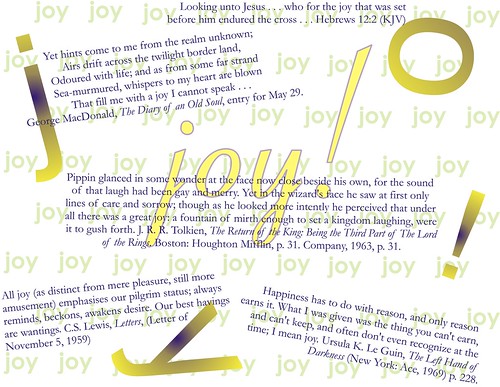
Some quotes, from some of my favorite authors, relating to the idea of joy. Larger sizes are available -- the photo is a live link to my Flickr photostream, where it originated.
Thanks for reading, and looking.
Saturday, February 09, 2008
Some quotes on joy: Tolkien, Lewis, and Le Guin
Pippin glanced in some wonder at the face now close beside his own, for the sound of that laugh had been gay and merry. Yet in the wizard's face he saw at first only lines of care and sorrow; though as he looked more intently he perceived that under all there was a great joy: a fountain of mirth enough to set a kingdom laughing, were it to gush forth. J. R. R. Tolkien, The Return of the King: Being the Third Part of The Lord of the Rings. Boston: Houghton Mifflin Company, 1963, p. 31.
From letter 89 by Tolkien:
"... I coined the word 'eucatastrophe': the sudden happy turn in a story which pierces you with a joy that brings tears (which I argued it is the highest function of fairy stories to produce). And I was there led to the view that it produces its peculiar effect because it is a sudden glimpse of truth.... It perceives-- if the story has literary 'truth'...--that this is indeed how things really do work in the Great World for which our nature is made. And I concluded by saying that the Resurrection was the greatest 'eucatastrophe' possible in the greatest fairy story-- and produces that essential emotion: Christian joy which produces tears because it is qualitatively so like sorrow, because it comes from those places where Joy and Sorrow are at one, reconciled, as selfishness and altruism are lost in Love..."
All joy (as distinct from mere pleasure, still more amusement) emphasises our pilgrim status; always reminds, beckons, awakens desire. Our best havings are wantings.
~C.S. Lewis, Letters, (Letter of November 5, 1959)
There are only two kinds of people in the end: those who say to God, "Thy will be done," and those to whom God says, in the end, "Thy will be done." All that are in Hell, choose it. Without that self-choice there could be no Hell. No soul that seriously and constantly desires joy will ever miss it. Those who seek find. To those who knock it is opened.'
~C.S. Lewis, The Great Divorce, Chapter 9 (1946)
Happiness has to do with reason, and only reason earns it. What I was given was the thing you can't earn, and can't keep, and often don't even recognize at the time; I mean joy. Ursula K. Le Guin, The Left Hand of Darkness (New York: Ace, 1969) p. 228.
* * * * *
On September 4, 2010, I'm adding this:
Yet hints come to me from the realm unknown;
Airs drift across the twilight border land,
Odoured with life; and as from some far strand
Sea-murmured, whispers to my heart are blown
That fill me with a joy I cannot speak . . .
George MacDonald, A Book of Strife in the form of the Diary of an Old Soul, entry for May 29. (public domain)
May you, and I, find eternal joy!
From letter 89 by Tolkien:
"... I coined the word 'eucatastrophe': the sudden happy turn in a story which pierces you with a joy that brings tears (which I argued it is the highest function of fairy stories to produce). And I was there led to the view that it produces its peculiar effect because it is a sudden glimpse of truth.... It perceives-- if the story has literary 'truth'...--that this is indeed how things really do work in the Great World for which our nature is made. And I concluded by saying that the Resurrection was the greatest 'eucatastrophe' possible in the greatest fairy story-- and produces that essential emotion: Christian joy which produces tears because it is qualitatively so like sorrow, because it comes from those places where Joy and Sorrow are at one, reconciled, as selfishness and altruism are lost in Love..."
All joy (as distinct from mere pleasure, still more amusement) emphasises our pilgrim status; always reminds, beckons, awakens desire. Our best havings are wantings.
~C.S. Lewis, Letters, (Letter of November 5, 1959)
There are only two kinds of people in the end: those who say to God, "Thy will be done," and those to whom God says, in the end, "Thy will be done." All that are in Hell, choose it. Without that self-choice there could be no Hell. No soul that seriously and constantly desires joy will ever miss it. Those who seek find. To those who knock it is opened.'
~C.S. Lewis, The Great Divorce, Chapter 9 (1946)
Happiness has to do with reason, and only reason earns it. What I was given was the thing you can't earn, and can't keep, and often don't even recognize at the time; I mean joy. Ursula K. Le Guin, The Left Hand of Darkness (New York: Ace, 1969) p. 228.
* * * * *
On September 4, 2010, I'm adding this:
Yet hints come to me from the realm unknown;
Airs drift across the twilight border land,
Odoured with life; and as from some far strand
Sea-murmured, whispers to my heart are blown
That fill me with a joy I cannot speak . . .
George MacDonald, A Book of Strife in the form of the Diary of an Old Soul, entry for May 29. (public domain)
May you, and I, find eternal joy!
Subscribe to:
Posts (Atom)