The He Lives blog is written by a physicist. Like me, he has some problems with one of the central ideas of the Intelligent Design (ID) movement, namely that it is possible to prove God's design scientifically.
In response to a post on his blog, a commenter asked him about ID astronomy. What would it be like?
He Lives made an insight-filled response. Among other things, he said that there should be the following difference between a Christian astronomer and a naturalist (atheist):
Atheistic Scientist: Isn't nature beautiful?
Theistic Scientist: Isn't creation beautiful?
Then, He Lives went further. Our blogger pointed out, quite correctly, that there have been a number of astronomers, some of them important, who were Christians, and statements like the second one above were accepted as routine, at least coming from Christians. But, because of the activity of the ID movement, most of the scientific establishment is no longer able to accept statements like the second one, because they see them as suggesting that astronomy proves God's existence.
Well, astronomy does prove God's existence, and so does genetics, and physical chemistry, but only to the committed believer. As Hebrews 11:3 puts it: "By faith we understand that the universe was created by the word of God, so that what is seen was not made out of things that are visible." (emphasis added) For another post on that verse, see here.
Thanks for reading.
Musings on science, the Bible, and fantastic literature (and sometimes basketball and other stuff).
God speaks to us through the Bible and the findings of science, and we should listen to both types of revelation.
The title is from Psalm 84:11.
The Wikipedia is usually a pretty good reference. I mostly use the World English Bible (WEB), because it is public domain. I am grateful.
License
I have written an e-book, Does the Bible Really Say That?, which is free to anyone. To download that book, in several formats, go here.

The posts in this blog are licensed under a Creative Commons Attribution-NonCommercial-ShareAlike 3.0 Unported License. You can copy and use this material, as long as you aren't making money from it. If you give me credit, thanks. If not, OK.
The posts in this blog are licensed under a Creative Commons Attribution-NonCommercial-ShareAlike 3.0 Unported License. You can copy and use this material, as long as you aren't making money from it. If you give me credit, thanks. If not, OK.
Tuesday, September 22, 2009


Monday, September 21, 2009
Cautions on interpreting what the Bible says about end times
I believe that you can get a larger version of the graphic below, by right-clicking on it. You may feel free to use the graphic, as long as you do not use it for any commercial purpose -- it must remain free for all to use.
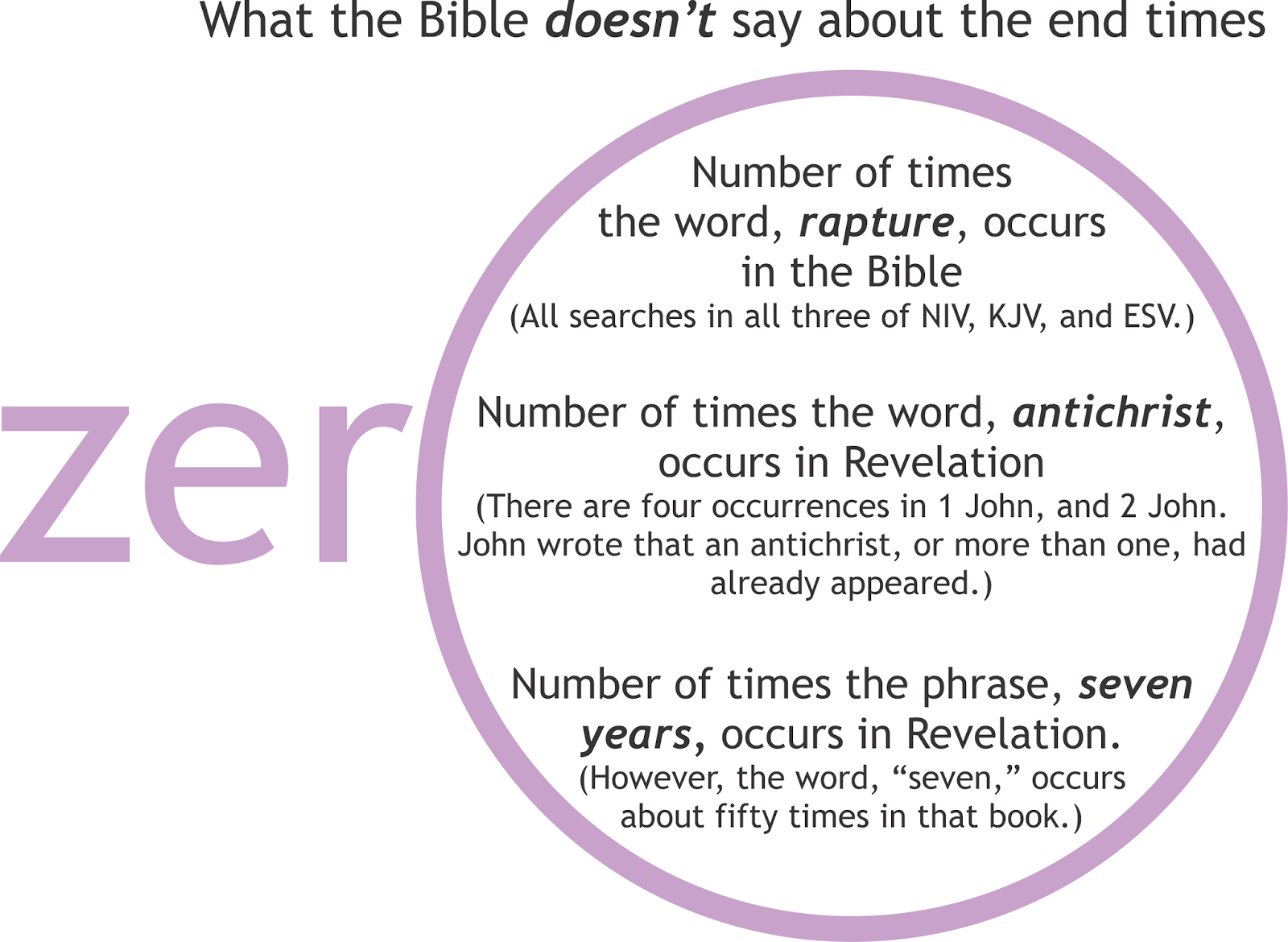
I don't have a lot of answers on end times. Some people seem to have answers, and they may be right. The above graphic illustrates reasons for caution. The Bible is not as clear about the end times as some people seem to believe that it is.
"Rapture" is not a word used in the Bible. The presentation of the idea of a rapture, a sudden removal of Christians from the world, that is most familiar to me is based on 1 Thessalonians 4:17. However, as you may learn from the comments on this post, below, that familiar presentation is probably mistaken, and a misinterpretation of scripture. (This paragraph was amended on September 28, 2009)
There are other reasons for caution. The Bible says this:
Matthew 24:36 “But concerning that day and hour no one knows, not even the angels of heaven, nor the Son, but the Father only. (All scripture from the ESV. See here for information on the ESV policy on on-line usage.)
and
Matthew 24:44 Therefore you also must be ready, for the Son of Man is coming at an hour you do not expect.
A serious warning, widely ignored, occurs in Revelation: 22:18 I warn everyone who hears the words of the prophecy of this book: if anyone adds to them, God will add to him the plagues described in this book, 19 and if anyone takes away from the words of the book of this prophecy, God will take away his share in the tree of life and in the holy city, which are described in this book.
Connie Willis, an author of fantastic literature, put it this way, probably a little too cynically, and, perhaps, even violating the warning above -- but she has a point -- in a short story:
The radio evangelists made it sound like the story of the Second Coming was a single narrative, but it was actually a hodgepodge of isolated scriptures -- Matthew 24 and sections of Isaiah and Daniel, verses out of Second Thessalonians and Joel, stray ravings from Revelation and Jeremiah, all thrown together by the evangelists as if the authors were writing at the same time. If they were even writing about the same thing. Connie Willis, "Epiphany," pp. 653-700, in The Winds of Marble Arch and Other Stories -- Burton, MI: Subterranean Press, 2007 -- p. 671. For similar thoughts, from an expert in Biblical interpretation, see here. (The expert doesn't call Revelation "ravings.") The expert, Kenneth Schenck, of Indiana Wesleyan University, is referring to the Dispensationalist view of end times, in particular the idea that there will be a seven year tribulation, and he points out that that view has, at best, very weak support in the Bible.
Thanks for reading. The Bible is clear on one idea about the end times: He is returning! We don't know when.
* * * * *
Added August 3, 2011: Here is a post, by me, on the first four prophecies mentioned by Matthew as being fulfilled by the coming, and early life, of Christ, and how difficult it must have been for those who first heard these prophecies, or even spoke and wrote them, to understand them as being about what actually happened.
Since these prophecies were difficult to interpret -- in some cases, impossible to interpret correctly until after the prediction came about -- why should we expect easy interpretations of prophecies about end times?
Added March 13, 2010:
David Heddle, of the He Lives blog, has recently posted on a particular word that occurs sometimes in prophecy, namely soon, and also this generation. He points out that some who claim to be interpreting the Bible very literally ignore, for example, part of the very first verse of Revelation, which says that Jesus told John that He was going to show him what would happen soon. Heddle doesn't seem to have a solution to how to deal with soon. I don't either. But, as I said in the title, it's best to be cautious, very cautious, about interpreting end times. Some people aren't very careful.
Added September 18, 2010:
Heddle has also posted on Armageddon, making a case for the idea that the Battle of Armageddon has already occurred.
Sunday, September 20, 2009
Strength in the New Testament
The New Testament mentions strength, and related words, a few times. I used the ESV search facility to find some of these (other versions may differ somewhat, and I may not have searched for all variants).
Here are some of the references, with remarks.
In Mark 12:28-30, Jesus told a questioner that the most important commandment was to love God with all your strength. Strength, then, must have to do, at least in this case, with resolve, will, determination, and the like.
In Luke 21:34-36, He warns the disciples about what is to come, and tells them to pray for strength, so strength, lest there be any doubt, can be divinely augmented. We should probably all pray for strength.
In Romans 1:11-12, Paul told the Romans that he wished he could impart a spiritual gift to them, to strengthen them. Spiritual gifts, then, apparently can add to the strength of a body of believers, and/or to individuals.
In Romans 4, Paul describes the faith of Abraham. He says, among other things, that ". . . he grew strong in his faith as he gave glory to God" (verse 20, last part).
In 1 Corinthians 16:13-14, Paul writes: "Be watchful, stand firm in the faith, act like men, be strong. 14 Let all that you do be done in love." I would judge that strength without the sort of love described in 1 Corinthians 13 isn't really the kind of strength that God wants us to have.
In 2 Corinthians 12:10, Paul says that he is strong when he is weak, one of the many paradoxes in the Bible. Most likely he was exalting the strength of God, which works when ours can't and doesn't. The author of Hebrews, in Hebrews 11:32-34, lists some of the heroes of faith, who were also made strong when they were weak in themselves.
Ephesians 6:10 and 1 Peter 4:10-11 also tell us that our strength must come from the Lord.
In 2 Timothy 2:1-3, Paul tells Timothy that he must be strengthened through Christ's grace.
And, finally, so does Phillipians 4:12-13, where Paul says, in verse 13: "I can do all things through him who strengthens me."
Be strong in Him!
Thanks for reading.
Friday, September 18, 2009
Why we really make decisions the way we do
John Stuart Mill had this (and a lot more) to say:
So long as opinion is strongly rooted in the feelings, it gains rather than loses instability by having a preponderating weight of argument against it. For if it were accepted as a result of argument, the refutation of the argument might shake the solidity of the conviction; but when it rests solely on feeling, worse it fares in argumentative contest, the more persuaded adherents are that their feeling must have some deeper ground, which the arguments do not reach; and while the feeling remains, it is always throwing up fresh intrenchments of argument to repair any breach made in the old. John Stuart Mill, The Subjection of Women, 1869, Chapter 1, 2nd paragraph. (Public Domain)
So what we argue for is mostly based on how we feel, not the validity of the position. Old news, but sobering.
Thanks for reading.
Thursday, September 17, 2009
The Morality of Richard Dawkins
I have read In Defence of the Soul, by Keith Ward. He argues that a completely materialistic view of life makes no sense, and points out that some of those who have argued for such a view are inconsistent:
When the destroyers of the soul have done their work, they usually turn back from the moral consequences of their theories, and end with a rather lame and totally unconvincing attempt to reinstate a modified version of traditional morality. We have seen this in Jacques Monod, in Erich Fromm and Karl Marx in slightly different ways. A particularly clear example can be found on the last page of Richard Dawkins' very entertaining book, The Selfish Gene. Having argued for 214 pages that human life is totally governed by the genes, 'unconscious, blind, replicators', he now says, in the last sentence or two, 'It is possible that yet another unique quality of man is a capacity for genuine disinterested, true altruism. I hope so, but I am not going to argue the case one way or another . . .' This is suitably tentative, but his last sentence reads: 'We, alone on earth, can rebel against the tyranny of the selfish replicators.'* The questions this raises are obvious. How can rational, responsible, altruistic, purposive, conscious conduct be accounted for on such a materialist theory? Why should he hope that altruism is possible, unless he really does have a basic sense of moral obligation? And isn't it odd to see morality as a rebellion against our true natures, instead of as a fulfilment of their potentialities? Keith Ward, In Defence of the Soul. Oxford, UK: Oneworld Publications, 1998. p. 161.
*cites Dawkins, The Selfish Gene (Oxford University Press, 1976) p. 215.
Thanks for reading.
Wednesday, September 16, 2009
Sunspots 228
Things I have recently spotted that may be of interest to someone else:

Science:
It looks like the USA is not sending anyone to the moon in the forseeable future.
Wired tells us that gecko tails, when detached from the lizard, exhibit some complex behavior. There's a video.
Wired also reports on the likely use of robots as aids in surgery .
Christianity:
Ken Schenck on the history of ordination in the church.
Image source (public domain)
Tuesday, September 15, 2009
More than one universe? Robert Mann's take.
As you may be aware, there are physicists who believe that there are multiple universes. They believe, for example, that the universe I am in somehow spawns two different ones, depending on whether or not I decide to pick up a pen or not -- it one, I did, in the other, I didn't. The Wikipedia article on the subject says that the concept goes back at least to the 19th century. Even though it is hard to imagine any possible experimental proof for this idea, it has a following. Some authors of fantastic literature have produced sub-creations, based on the concept. One such was Philip Pullman.
In the latest issue of Perspectives on Science and Christian Faith -- which is not yet available on-line -- Robert B. Mann discusses "The Puzzle of Existence," considering the interesting question of why some things exist, and some things don't. It is hard, for example, to believe that there couldn't have been more species of butterflies than there are and have been, or that the only possible asteroids were those that we have known about, or that our parents could not have had other children than us.
One reason that some things don't exist is that the laws of physics, or the properties of chemistry and biology, don't allow it. Water, in its solid form, does not float in the air. Rose plants won't grow on the planet Mercury (or on a diet of only the element Mercury). But there must be other reasons for nonexistence, for entities like the possibilities mentioned in the previous paragraph. Either God wanted only some types of butterflies, or chance determined who got born, or God uses what we call chance to determine that certain things will exist, and some not.
Mann closes by challenging the multiple universe idea. He points out that, if all possible universes exist, that would seem to make it possible for a universe with a fallen earth, but no redemption, to exist, which seems totally incompatible with God's love, omnipresence, and omnipotence. Interesting ideas.
Thanks for reading.
Monday, September 14, 2009
Norman Borlaug, Nobel prize winning botanist, dies
Norman Borlaug, architect of the Green Revolution, has passed away, at age 95.
The categories for the Nobel Prizes were mostly determined by the will of Alfred Nobel. A number of geneticists, such as Watson and Crick, have won or shared in the Nobel Prize for Physiology or Medicine, but there is no prize in genetics. There is no prize in zoology, or botany. A few zoologists have won the Prize in Physiology or Medicine. Borlaug, a botanist, made scientific and agricultural contributions of such importance that he won the Nobel Peace Prize in 1970.
What did Borlaug do? What is the Green Revolution? Put simply, Borlaug worked, for many years, on improving crop yields in third world countries. Much of his work was in the field in those countries. There is a chart included in the Wikipedia article on the man that dramatically shows the effect of the work of Borlaug and his colleagues. Wheat yields in Mexico, according to the chart, increased by more than four-fold since 1950. Borlaug's techniques involved increased fertilizer and other agricultural techniques which had not been used very much in third world countries, and breeding crops that could take advantage of these techniques. It seems clear that Borlaug's work kept many people, probably many millions, from starvation.
Borlaug's work has not been without controversy. Critics have claimed that Borlaug's techniques have worked to the advantage of agribusiness companies, made third world farmers too dependent on seed that they may not always be able to afford, and harmed the environment. There is some truth in all these claims, but Borlaug believed that producing more food was more important. He has also put forward the Borlaug Hypothesis, which states that improving crop yields makes deforestation less likely. He has stated that population growth is one of the important reasons why people don't have enough food.
Science is sometimes accused of being too divorced from people's real needs. Maybe so. What, if any, is the practical value of string theory? But discoveries that, at first, seem only interesting to specialists, or irrelevant to human physical or economic needs, often turn out to be of immense practical use. One example is Mendel's work in studying how some characteristics of peas were inherited. I doubt if Mendel, or Mendel's contemporaries, had any idea that his discoveries would make tremendous advances in agriculture and medicine possible. Without Mendel, no Borlaug. Science is also a way of learning about God. Psalm 19:1-4 and Romans 1:20 tell us that how nature works is one of the ways God is revealed to us.
I'm not sure Borlaug's work has helped us to know God better, but it has helped lots of people stay alive, so that they have a chance of learning about Him. We should be grateful for his work.
Thanks for reading.
Sunday, September 13, 2009
Some thoughts on church choirs
The entire range of human experiences is present in a church choir, including but not restricted to jealousy, revenge, horror, pride, incompetence (the tenors have never been on the right note in the entire history of church choirs, and the basses have never been on the right page), wrath, lust, and existential despair. Connie Willis, "An Introduction to This Book, or 'These Are a Few of My Favorite Things,'" in The Winds of Marble Arch and Other Stories -- Burton, MI: Subterranean Press, 2007 -- p. 14.
2 Chronicles 20:21 And when he had taken counsel with the people, he appointed those who were to sing to the Lord and praise him in holy attire, as they went before the army, and say,
“Give thanks to the Lord,
for his steadfast love endures forever.”
for his steadfast love endures forever.”
22 And when they began to sing and praise, the Lord set an ambush against the men of Ammon, Moab, and Mount Seir, who had come against Judah, so that they were routed. (ESV, as are all quotations from the Bible in this post. "he" was king Jehoshaphat. This may be the only time in history when a choir defeated an army. Of course, it was God who actually did it.)
2 Chronicles 29:27 Then Hezekiah commanded that the burnt offering be offered on the altar. And when the burnt offering began, the song to the Lord began also, and the trumpets, accompanied by the instruments of David king of Israel. 28 The whole assembly worshiped, and the singers sang, and the trumpeters sounded. All this continued until the burnt offering was finished. 29 When the offering was finished, the king and all who were present with him bowed themselves and worshiped. 30 And Hezekiah the king and the officials commanded the Levites to sing praises to the Lord with the words of David and of Asaph the seer. And they sang praises with gladness, and they bowed down and worshiped.
Colossians 3:14 And above all these put on love, which binds everything together in perfect harmony. 15 And let the peace of Christ rule in your hearts, to which indeed you were called in one body. And be thankful. 16 Let the word of Christ dwell in you richly, teaching and admonishing one another in all wisdom, singing psalms and hymns and spiritual songs, with thankfulness in your hearts to God.
Revelation 5:8 And when he had taken the scroll, the four living creatures and the twenty-four elders fell down before the Lamb, each holding a harp, and golden bowls full of incense, which are the prayers of the saints. 9 And they sang a new song, saying,
“Worthy are you to take the scroll
and to open its seals,
for you were slain, and by your blood you ransomed people for God
from every tribe and language and people and nation,
10 and you have made them a kingdom and priests to our God,
and they shall reign on the earth.”
and to open its seals,
for you were slain, and by your blood you ransomed people for God
from every tribe and language and people and nation,
10 and you have made them a kingdom and priests to our God,
and they shall reign on the earth.”
Sing on!
Saturday, September 12, 2009
Michael Jordan, David Robinson, John Stockton
Michael Jordan, David Robinson, and John Stockton were recently inducted into the National Basketball Association's Hall of Fame, and rightly so.
Jordan first gained national prominence as a member of the University of North Carolina Tar Heel men's team, in the early 80s. That team won the NCAA National Championship in 1982. The Wikipedia article on Jordan says that he led the team. That could be argued. (See here for a report on that team.) James Worthy and Sam Perkins were on that team. So were Matt Doherty and Jimmy Black. My recollection - I saw many of the team's games, including the championship game - is that Worthy was more the star than Jordan. This is borne out by Worthy's choice as most outstanding player of the 1982 NCAA tournament, and the fact that he was the first player chosen in the NBA draft. But it's a team game. They were all fine players.
Here's a CBS article on Jordan's induction speech. He said some wise things, mostly that he admonished the basketball world to stop looking for him. As he said, "You didn't find me." Jordan has had some bumps in his life. He hasn't been a hero in every way. But he was a great player, perhaps even the best ever. He could shoot, he could play defense. But his finest attribute, in his glory years in the NBA, was that he made other players better.
Robinson was a gentleman, through and through, and, I believe, he still is. He has been married only once, and he and his wife have given millions to charity. I have heard it said that Robinson is a Christian. He went to the US Naval Academy, and served two years in the Navy before entering the NBA.
Stockton, who, like Jordan and Robinson, was a member of the "Dream Team" of mostly NBA players that won the Olympic Gold medal in 1982, was said to be an invisible man in Barcelona, where the Olympics were held. For one thing, he is white, when fans were (rightly) expecting NBA stars to be mostly black. For another, he is only a little over six feet tall, and weighed less than 190 pounds during his career. Stockton is the NBA's all-time leader in career steals and assists. He was also a good shot.
Stockton and Robinson played for only one NBA team each during their entire careers, Utah and San Antonio, respectively. Jordan almost did, with Chicago. He probably played longer than he should have, and was less than world-class during his career with the Washington, DC, team. Jordan won championships with the Bulls, Robinson won one with the Spurs. Stockton's Jazz never won a championship, although they came close.
All three of these men deserve their honor. I am glad that I got to see them play on TV many times.
God gives some people ability. Some of us develop that, and some of us don't. Stockton, Jordan, and Robinson had God-given ability. They developed it. They all worked hard, and played and practiced when they'd probably rather have been doing something else.
Thanks for reading.
Friday, September 11, 2009
Musings on an anniversary
Today is a September eleventh. I am very sorry for what happened. Real people died, and real people who didn't die had their lives shattered -- loved ones gone, in a few cases jobs gone, nightmares endured for the rest of their lives. But, as always, we didn't react as wisely as we should have. I didn't, either.
When thousands of US residents die one by one, in gang warfare in our streets, in highway accidents, without proper medical care, we don't pay a lot of attention. When hundreds or thousands die at once, we do. Is that wise?
Our elected and appointed officials felt that they had to "do something." One thing has been to beef up airport security. Are we better off because of this? Maybe. Maybe not. Critics of airport security say that we are now very good at keeping small sharp objects off planes, but that it no longer matters, because of changes to how the cockpit is protected. And maintenance personnel could do things to blow up planes, and we don't check them.
Another thing that our leaders felt that they had to do -- a lot of us we wanted them to -- was to punish someone badly. They picked Iraq. Perhaps the world is better off for this, perhaps not. Some people think that Iraq is likely to turn into a bloodbath between Kurds, Sunnis, and Shiites. Some think that the Shiite part of it is going to become a satellite of Iran. Even if Iraq becomes a stable democracy, where freedom of religion (including for Christians) is allowed, it's not there yet. Osama bin Laden has yet to be caught. Iraq has been a breeding ground for new terrorists. We've lost lives, and taken them. There has been massive corruption and graft. We didn't plan for an occupation very well. Our troops lacked armor at first, and they often haven't been given the medical and psychological care that they need. We have sometimes been exposed as horribly immoral. We've spent vast amounts of our money, without (until recently) even putting the expense into the budget.
God says that vengeance belongs to Him. I should let Him take care of revenge on someone who harms me, if He chooses to. It's not my business. Does that apply to governments, especially governments which, like ours, are not theocracies? Perhaps not. But God is still the final authority.
I close with good news. Christ came to end all suffering and death. Whatever evil is now in the world, it will all be ended.
Thanks for reading.
Thursday, September 10, 2009
Proper hand-washing
Antibacterial soaps have become increasingly popular in recent years. However, these soaps are no more effective at killing germs than is regular soap. Using antibacterial soaps may lead to the development of bacteria that are resistant to the products' antimicrobial agents — making it even harder to kill these germs in the future. In general, regular soap is fine. - "Hand washing: an easy way to prevent infection," from the Mayo Clinic.
The same document suggests the use of alcohol-containing hand sanitizers.
The US Centers for Disease Control gives similar advice.
Flu is caused by a virus, not by bacteria. Antibiotics, and other anti-bacterial agents, have little or no effectiveness against viruses. As I understand it, alcohol can damage virus structure, hence has some effectiveness against these germs.
Wash often, using soap and water, or use alcohol-based hand sanitizers. The reason that washing is effective is that it removes the germs from your hands, so that you don't carry them to your nose or mouth. You can remove viruses and bacteria (and other things!) from your hands that way.
Bacterial resistance is all too common. It is often the result of natural selection -- exposure to an anti-bacterial agent kills susceptible bacteria, but leaves those that are resistant, which, as a result, means the the population at large is more resistant. As some of you know from unfortunate experience, it is now possible to get staphylococcus, and other infections, which are very difficult to fight with antibiotics. The same infection, a few decades ago, would probably have been easy to treat. Using antibiotics too often, in soap, in cattle feed, and probably in other ways, has selected for bacteria that are very hard to stop, and may kill us. (See Wikipedia article on antibiotic resistance.)
Keep clean! Thanks for reading.
Wednesday, September 09, 2009
Sunspots 228
Things I have recently spotted that may be of interest to someone else:

Science:
Microwave ovens heat things fast. So why don't we have some device that cools things that fast (or maybe even faster)? It may be on the way, says Wired.
Christianity:
David Heddle, of He Lives, blasts the Institute for Creation Research for self-defining orthodoxy, in particular for their criticism of Francis Collins.
Gegraptai tells us something I didn't know about the Star of Bethlehem, and something related I didn't know about Roman coins.
Carolinagator muses about prayer before sexual activity.
Image source (public domain)
Tuesday, September 08, 2009
My neighbor: on anonymity
Our neighbor of over four decades passed away (isn't that an interesting idiom?) on Sunday, two days ago. This was not totally unexpected, as he had been hospitalized numerous times within the past couple of years. I was computing away one morning a couple of months ago, and saw an ambulance come to pick him up. He was able to walk to it. However, he never returned to his earthly home. He had respiratory problems, and heart problems.
Some observations:
1) Even though his death was not a total surprise, it surprised, as death always does, by its finality. This man's life is over. He's never returning home.
2) Our neighbor had become a Christian.When we first knew him, he wasn't one. There were times when he didn't act like one, and he didn't talk like one -- his conversation wasn't about Christ, and the Bible, and about his church (he didn't have one). Then, perhaps twenty years ago, all of this changed. He talked about God, he went to church whenever it was open, he read his Bible, and he said that he prayed daily. He was kinder and gentler. He was living testimony to the fact that belief in Christ can change a person's life.
3) Our neighbor was very careful about a number of things, such as how he spent his money, and how his cars, equipment, and house were treated. The most peculiar thing about him, at least that I knew of, was his reaction to junk mail. I took his mail out of the mailbox, and took it to him, or gave it to someone from his church that would see him soon, over the last months, and also before, when he was hospitalized for shorter periods.
How was he peculiar about junk mail? The first thing he would do would be to tear his address off the envelope, shred that with his hands, and then throw the envelope, and the shreds, in the trash. Why? I'm not really sure. It made no sense to me. But I went along with it. I love my neighbor, and respected his wishes. My conclusion is that he was trying to protect his privacy. He somehow thought that having his name and address intact on an envelope in a trash was an invitation to burglars, or to other pests. So he destroyed these bits of evidence that he existed. It didn't stop him from getting junk mail. It didn't make him anonymous -- he was in the phone book. I don't think he had a concept of on-line searches, but, trust me, he could have been found. I just did a Google search for his name, and our town and state. His obituary came up, and there are two companies with ads on the search page that claim to know about him, and tell others. Whitepages.com (which was not one of the advertising companies) gave me his address, his phone number, and his approximate age.
The Bible says that there is one kind of anonymity that my neighbor didn't want, and didn't have:
1 Corinthians 8:3 But if anyone loves God, he is known by God. (ESV, as are other scripture quotations in this post.)
It also says that there is anonymity, even in heaven:
Revelation 2:17 He who has an ear, let him hear what the Spirit says to the churches. To the one who conquers I will give some of the hidden manna, and I will give him a white stone, with a new name written on the stone that no one knows except the one who receives it.’ My neighbor has that kind of anonymity. I hope and pray that I achieve the same.
Out of respect for this characteristic, I am not linking to his obituary, or giving his name.
4) He had a loving church family. He, with his wife, who preceded him in death, were faithful church attenders. His church loved him. We saw his pastor, and other church members, visit him. One of his church members, a woman who didn't work outside her home, cleaned his house, and did other chores for him. There were cards and "we miss you" handwork, from his church, on hospital room and nursing home walls. I don't agree with everything his church believes and teaches. They accept only the King James version of the Bible, and, although they don't say so, I think they only accept that if it's bound in black. I think they are wrong in that. But they display the main sign of Christianity. They love one another. (See John 17, and John 13:35)
5) The things he accumulated aren't permanent, and don't matter much. As I said, he loved his church, and they loved him. Even before the funeral, his pastor was taking some of his material possessions for himself, which was my neighbor's wish, and had the consent of his family. My wife, looking out our window, remarked about how impermanent material things are. How little they really matter. How true.
Rest in peace, neighbor.
Monday, September 07, 2009
Writing music for monkeys
On September 2nd, National Public Radio broadcast a story on an accomplished cello player who decided to see if he could compose music that would cause a reaction in tamarin monkeys. The first link in this post will send you to a description of what the composer did, and you can play music he composed (brief -- less than a minute total), and recorded, which was, indeed, said to cause a reaction in the monkeys.
One question brought up in the story was the question of what music is and isn't. You will understand why some might raise that question if you play the music. Don't ask me to sort that one out.
One question brought up in the story was the question of what music is and isn't. You will understand why some might raise that question if you play the music. Don't ask me to sort that one out.
Sunday, September 06, 2009
I am Christ's house
I am his house--for him to go in and out.
He builds me now--and if I cannot see
At any time what he is doing with me,
'Tis that he makes the house for me too grand.
The house is not for me--it is for him.
From A Book of Strife in the Form of The Diary of an Old Soul, 1880, by George MacDonald. The quote above is extracted from the entries for July 15 and 16.
Friday, September 04, 2009
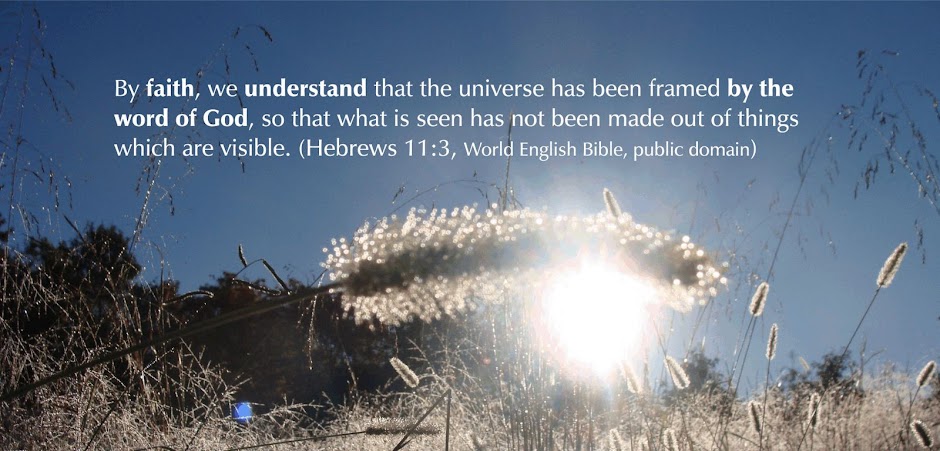
Hebrews 11:3, as an art object

This is an attempt, not as effective as I would have liked, to portray what, to me, is one of the most important verses in the Bible. The photo comes from our Flickr photostream, and you can get there by clicking on the graphic, which is a live link. No password is needed. I believe that you can get to larger versions of the graphic that way, also. (I'm logged in as a member when I go there, so I'm not certain what a non-member would experience.)
The typeface is Palatino Linotype. The graphic was created from a photo I took, in a vacant lot near our house. I used Corel Draw X4 to produce the graphic. I chose a photo which would show an extra-terrestrial body, the sun, and some common earth stuff, grasses, which most of us would treat as weeds.
It is my belief that we cannot prove that God created, but that we can, and should believe it -- accept it by faith. Hebrews 11:3 also teaches that God created ex nihilo, from nothing.
Thanks for looking. Isn't God a great artist?

This work is licensed under a Creative Commons Attribution-Noncommercial-Share Alike 3.0 United States License. This means that it may be freely used, so long as it is not used for any commercial purpose. I would appreciate being informed of any such use. Thanks.
Thursday, September 03, 2009
On being an information addict
I recently mused on the question of whether or not St. Paul was a multi-tasker. (The post contains a link to a report on research indicating that multitasking is bad for your thinking.) I'd like to muse, in this post, on the broader question of why anyone might want to be one.
One answer is that some of us have more to do than we really can do. So we feed the baby while we catch up on the news, or take phone calls while stirring the recipe, or checking the e-mail. That's an unfortunately legitimate reason for multitasking, provided, of course, that we haven't taken on more than we should have, doing things we really don't need to.
Another reason is that we have tools which enable us to multitask. I am using an information appliance to write this. You are using an information appliance to read this -- unless someone else has used an information appliance to print this out for you. We have this equipment, so we think we should use it. I didn't have many opportunities to multitask when I was a boy. Although I am not yet eighty years old, I did grow up in a home with no telephone, until I had been in college for a while. If I wanted to communicate with my parents from college, I wrote a post card. I also made sure that I had made future arrangements carefully, since I usually couldn't change them. We certainly had no computer, no television, and no newspaper. (We did have radios.) I couldn't multitask then like I can now, although my father set an example of how to multitask without a phone, TV, or computer, by listening to the radio in the barn, while he was milking cows, with a pulp magazine opened on one leg, pumping out the milk while reading and listening. (He read a lot of fantastic literature.) The radio was the only information appliance he had, and, except for being able to change stations, or the volume, it was a one-way appliance. We received. We didn't broadcast to anybody else.
Not only do some people almost have to multitask, because they have too much to do, and some because they have an information appliance which helps them multitask, but, I submit, there is a third reason -- all of us are information addicts, to a greater or less degree.
Babies show this by paying attention to all sorts of things. Some people show it by watching soap operas. Some show it by paying close attention to the minutiae of some sport, or some favorite team. Some show it by paying close attention to some politician, or to a performer, or even a person prominent because of their religion, or to our own little clique of friends or co-workers. I remember paying far more attention than I should have to the Watergate affair. If I'm not careful, I'll pay too much attention to the trials and tribulations of my current state governor. Some of us are news junkies, with CNN or some other such venue on the TV all the time, or sent regularly to another information appliance. Some of us have way too many Facebook or Twitter contacts, far more than we can reasonably keep up with. (One of my Facebook Friends once suggested -- on Facebook, of course -- that there should be a "Who Cares" button for new entries.) Some of us want to know and hear the latest music, or see the latest fashions, or the news from the markets, the latest recipes, or (oh-oh!) the latest gossip, pure and simple -- not that a lot of the other activities in this paragraph aren't also gossip.
Why do we do this? One reason is that we are suckers for anything new. I suspect that one reason that Eve listened to the serpent was that the serpent said something she hadn't heard or thought of before. Acts 17:21 gives us a description of the Athenians: "Now all the Athenians and the foreigners who lived there would spend their time in nothing except telling or hearing something new." (ESV) (Not to challenge the truth of the Bible, but surely there were slaves, and probably other working people in Athens who didn't have time to spend in such a pursuit.) But we like to do this. We are, to some extent, information addicts.
New isn't necessarily bad. The Gospel, after all, is Good News. To people who have never heard it, getting this new information, by whatever means, is critical. Do I still have that hunger to know what God wants to say to me? I hope so, but I fear not.
New can be bad, and the worst thing it can do is to distract from the timeless. There are truths we must not forget, that are far more important than the latest doings in the organizations that are important to us. What are these truths? The Gospel, for one. God's love, and His goodness and holiness, for another. The beauty we see, hear, feel, and smell, in flowers, sunsets, dewdrops, good food, music, children, and laughter. A grandchild's laugh is more important than a sports score or whatever the President may have said. The existence of butterflies, waterfalls, rainbows, and bird songs is far more important than our current bank balance or how our mutual fund is doing. Does this mean that we should never pay attention to the news? Of course not. But it does mean that we need to cut back on our information addiction, and pay attention to what those we love, especially God, are telling us in common, ordinary, slow ways. Perhaps we should be more like J. R. R. Tolkien's hobbits, who, he wrote, ". . . like to have books filled with things they already know, set out fair and square with no contradictions." (Prologue, The Fellowship of the Ring -- Boston: Houghton Mifflin, 1954, p. 18.)
The Gospel, God's love, God's creation, and the possibility of meaningful relationships with others, are things that no information appliance will ever give you, or me. May I not forget what's really important, and eternal.
Thanks for using your information appliance.
Jan has written a good, and shorter, post which overlaps with this one.
Wednesday, September 02, 2009
Sunspots 226
Things I have recently spotted that may be of interest to someone else:

Science:
Wired reports on a study that says that the tails of Ankylosaurus, a dinosaur, could be used as powerful weapons.
Wired also reports that establishing long-term colonies in spaceships may be difficult. Mice can conceive in space, but the embryos seem to need earth's gravity for normal development. This may also be true of humans.
(Or something) The American Heart Association has recently recommended that many of us cut back on our sugar intake.
Christianity:
Kerry I am makes a suggestion on how to pray.
Leonard Pitts, syndicated columnist, on what really killed Michael Jackson. Pitts doesn't speak of Christianity, or any other religion, but the implications are pretty obvious.
Image source (public domain)
Tuesday, September 01, 2009
Chimpanzees and Humans share a lot of genes: so what?
You may have read or heard that chimpanzees and humans share a lot of genetic material. The exact amount is not clear, but whether it's 97%, 99%, or something in between, doesn't really matter. It seems clear that our genetic material is quite similar, but, of course, not identical, to that of chimpanzees. So what?
There are, in fact, two different species of animals that have been called chimpanzees. One is Pan troglodytes, the other, first recognized as a separate species less than a hundred years ago, is Pan paniscus, the bonobo, sometimes called the pigmy chimpanzee. The fact that there are two species is not well understood by the general public.
Studies on the genetic diversity of chimpanzees and bonobos have been undertaken. See here and here for reports on one such study, from 1999. This research, based on a small portion of the DNA of chimpanzees, found that chimpanzees were more unlike each other than humans are. The report led at least some scientists to propose that humans were, as recently as 100,000 years ago, a very small population. (This is consistent with the descent of all humans from Adam and his family, and/or Noah and his family.)
A book reviewer in Spiked claims (based on a recent book that makes the same claim) that sharing 98.4% of our genes doesn't really make chimpanzees very human. The reviewer, and, apparently, the author (I have not read the book) say that much of that 1.6% is regulatory genes, which have profound effects, meaning, as it were, that humans and chimpanzees are less than 98.4% alike. (There is no way to quantify this, in reality, any more than, say, you could give an unambiguous quantitative answer to the question "How much like your spouse are you?")
For more on chimp DNA, see the Wikipedia article on the chimpanzee genome project. (Yes, there is such a thing. There are similar projects on several other organisms, each interesting in its own right.) That article says that 30% of human and chimp proteins are identical. (This doesn't necessarily mean that the DNA which coded for them is identical, as different combinations of DNA bases can lead to the same amino acid. It also doesn't mean that we are as much as 70% different from chimpanzees. It is likely that the differences between some of our proteins, compared to those of chimpanzees, are considerably less than 1%.)
Leaving aside the statistics, it is obvious to anyone that humans and chimpanzees are quite a bit alike. Facial expressions, body structure, and behavior show this. I have never read any credible source, from young-earth creationists to atheists, who would try to deny this similarity. No other animal, even gorillas and orangutans, seems to be so much like we are.
So what?
1) We did not descend from chimpanzees (or they from us). No reputable scientist believes that. Many reputable scientists believe that chimpanzees and humans share a common ancestor. Perhaps they are right, perhaps not.
2) Similarity does not prove that chimpanzees should be given the same rights as humans. A dead woman, or a convicted axe murderer, shares a lot of DNA with me, you, and President Obama. But neither of these should be given the right to vote, and one of them is not even alive, therefore they are not given the same rights as you, the President, and I. Chimpanzees, and other animals, should be cared for, under the God-given stewardship of human beings, and not treated cruelly, killed without reason, or deprived of their God-given habitat without very serious consideration. But they should not be given the right to hold office, or protected from killing at all costs. Early in Genesis, animals were killed for a cause, namely to provide clothing for Adam and Eve, by God Himself (Genesis 3:21). Also, in Genesis, animals were killed for another good reason, namely for sacrifices to God, which God accepted (Genesis 4:4).
(See here and here for posts on our responsibility for caring for nature.)
3) There are three possible reasons for the similarity between humans and chimpanzees.
One of them is that the two species have, indeed, come from a common ancestor.
The second is that God created the two species in separate creative acts, but chose to make them similar. (If that were the case, DNA similarity would cause and maintain other types of similarity.) A young-earth creationist would say that they were created a day or two apart. A believer in Intelligent design would say, I believe, that God designed them to be alike, even to using the same genes, or similar genes. A theistic evolutionist (this is too simple -- there are several categories of such) might say that God knew in advance what would happen, and designed the evolutionary mechanisms of living things so that humans would eventually come about, or that God took a pre-existing animal and specially endowed it with some special properties, that is, gave them a soul.
The third, which I don't think anyone really believes, is that the similarities are accidental.
4) Although we should understand that new findings may change scientific beliefs, we should also understand that there is a broad consensus among scientists about most of the fundamentals, in all fields of science, and Christians should not be anti-scientific. The consensus, for decades, has been that chimpanzees and humans share a common ancestor.
Just because there is consensus doesn't mean that the scientists are always right. There used to be consensus that protein was the genetic material, and that DNA wasn't. The consensus on the common ancestry of humans and chimps may also be wrong. The Bible seems to be unambiguous that humans are special -- Their origin is described separately, and in more detail, than that of all the other animals. They alone are singled out as being in the image of God. (Although, in some sense, all of His creation must have some of His image -- His characteristics.) Humans were given special responsibility for other organisms. To most Christians, this argues for a special creation of humans. I suppose most of them would suppose that God specially created them, body and soul, in one event. Some Christians (Billy Graham among them) are willing to accept that possibly God took a pre-existing human-like being, and endowed that creature with His image. (Graham is not wedded to that belief, but is willing to entertain the possibility, and doesn't believe that it would contradict scripture.) Science is never going to give clear answers on the origin of the God-like qualities of humans, and Christians will probably always disagree over the exact process used.
5) Nothing in these discoveries should pose a serious new challenge to Christian faith. It is true that the scientific evidence is overwhelmingly against young-earth creationism, but that was true before we had statistics on the similarity between humans and chimpanzees. A believer in Intelligent design would be unable to present scientific evidence proving that theory for the origin of humans, and a Christian who believed in an important role for natural selection would be unable to demonstrate that God had a hand in the way things are now, but these were true before DNA was even known to be the genetic material. It is also true that no scientific experiment has ruled out a role for God in creation, or in making or keeping things the way they are now, so an atheist, also, is on less than solid ground.
6) Can chimpanzees sin, or be converted? There is some evidence that chimpanzees have a moral sense, and understand that some things are right, and some wrong. There is no evidence in the Bible that chimpanzees, or any other animal, can sin, and be converted, except that the whole creation is said to be fallen, in Romans 8, and it needs redemption from the consequences of human sin.
Thanks for reading. Let's act more like Christ than chimpanzees do.
Note: A recent review (Perspectives on Science and Christian Faith, Sept 2009, pp. 201-203, by Darrel R. Falk, which is not yet available on-line) of More than a Theory: Revealing a Testable Model for Creation, by Hugh Ross, quotes Ross as being way off the mark on the amount of similarity between us and chimpanzees: ". . . the most complete analyses performed so far show that the similarity is closer to 85 to 90 percent." (Falk is quoting from pp. 183-4 of Ross.) Falk says that Ross, whose book was published in 2009 by Baker Books, wasn't even aware of the Chimpanzee Genome Project, which I referred to above. Ross, a prominent old-earth creationist, is, as Falk says, not a biologist. Even if Ross were right, it really wouldn't change the issues very much, if any.
Subscribe to:
Posts (Atom)