License

I have written an e-book, Does the Bible Really Say That?, which is free to anyone. To download that book, in several formats, go here.
Creative Commons License
The posts in this blog are licensed under a Creative Commons Attribution-NonCommercial-ShareAlike 3.0 Unported License. You can copy and use this material, as long as you aren't making money from it. If you give me credit, thanks. If not, OK.
Showing posts with label Kepler. Show all posts

Monday, February 04, 2013

Scriptural Principles that Relate to Science

Here are some scriptural principles that relate to science:

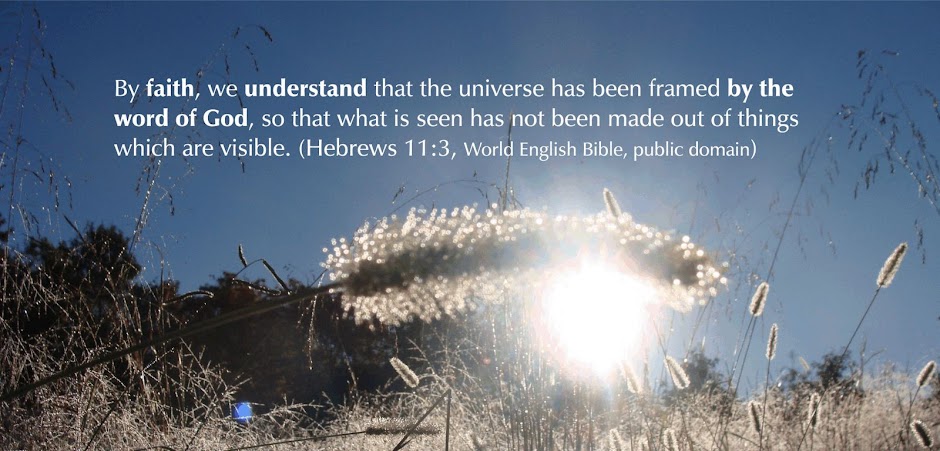
1. God is creator. There is no unassailable proof of this statement. The Bible, itself, does not attempt to prove it. It assumes it. The Bible starts out by saying that God created, in Genesis 1:1 In the beginning, God created the heavens and the earth. (All Bible quotations are from the World English Bible, which is in the public domain, and are in this color.) The Bible says that the best evidence that God is creator is our faith. (Hebrews 11:3 By faith, we understand that the universe has been framed by the word of God, so that what is seen has not been made out of things which are visible.) The Bible further points out that the principal agent in creation was God the Son:
John 1:1 In the beginning was the Word, and the Word was with God, and the Word was God. 2 The same was in the beginning with God. 3 All things were made through him. Without him was not anything made that has been made.

Colossians 1:14 in whom we have our redemption, the forgiveness of our sins; 15 who is the image of the invisible God, the firstborn of all creation.16 For by him all things were created, in the heavens and on the earth, things visible and things invisible, whether thrones or dominions or principalities or powers; all things have been created through him, and for him. 17 He is before all things, and in him all things are held together.

Christians have several views about the timing, and other details, of how things began. However, the most fundamental truth is that God created. Genesis 1:1 does not tell us why, when, or how God created. It does tell us that there was a Who involved in creation. There are people who believe that there is nothing but nature. They are called Naturalists. In other words, they do not believe that there is anything supernatural. To them, there is, and was, no Who. The Bible begins by assuming that that is a wrong belief. It does not attempt to prove this, except by telling us what God is like. (Some Christians mistakenly think that the idea of a Big Bang is a theory that claims that there is no God, or that claims there was no God involved in creation. That view is mistaken. A belief in the Big Bang can be compatible with belief in God as creator.)

Creation was called good, in Genesis 1. This does not necessarily mean that it was good in the sense that it is useful to humans. Goodness in God’s view is more important than usefulness to us!

Psalm 104:24 Yahweh, how many are your works!
In wisdom have you made them all.
The earth is full of your riches.
There is the sea, great and wide,
in which are innumerable living things,
both small and large animals. 
In this passage, we read about the marvelous diversity of creation. Humans have never yet seen many of the organisms that are alive on earth today, let alone found uses for them. They are still important, because God made them, or allowed them to come into existence.

2. God sustains the natural world. Colossians 1:16-17 (above) and Hebrews 1:3a (His Son is the radiance of his glory, the very image of his substance, and upholding all things by the word of his power) indicate that God not only created, but that Christ is presently involved in holding things together, including your body and the monitor you are reading this on. Do we understand this? No, and we aren’t capable of understanding it. God is omnipotent and omniscient. We aren’t. But we do understand, from these passages, that God, especially God the Son, has not gone away and left the world. He is sustaining it now.

3. Humans have responsibility for the world around them. Humans were put in charge of God’s “very good” creation.
Genesis 1:26 God said, “Let us make man in our image, after our likeness: and let them have dominion over the fish of the sea, and over the birds of the sky, and over the livestock, and over all the earth, and over every creeping thing that creeps on the earth.” 28 God blessed them. God said to them, “Be fruitful, multiply, fill the earth, and subdue it. Have dominion over the fish of the sea, over the birds of the sky, and over every living thing that moves on the earth.”

Since the Fall, there have been problems with the natural world, but scripture teaches that it is still important to God, so it should be to us, as well:
Psalm 24:1 The earth is Yahweh’s, with its fullness;
the world, and those who dwell therein.

Psalm 50:10 For every animal of the forest is mine,
and the livestock on a thousand hills.
11 I know all the birds of the mountains.
The wild animals of the field are mine.
[God speaking] 


The Israelites were supposed to take care of their land by letting it lie fallow every seventh year:
Leviticus 25:3 You shall sow your field six years, and you shall prune your vineyard six years, and gather in its fruits; 4 but in the seventh year there shall be a Sabbath of solemn rest for the land, a Sabbath to Yahweh. You shall not sow your field or prune your vineyard. 5 What grows of itself in your harvest you shall not reap, and you shall not gather the grapes of your undressed vine. It shall be a year of solemn rest for the land.

Their failure to obey this command was one reason for their captivity:
II Chronicles  36:20 He carried those who had escaped from the sword away to Babylon, and they were servants to him and his sons until the reign of the kingdom of Persia, 21 to fulfill Yahweh’s word by Jeremiah’s mouth, until the land had enjoyed its Sabbaths. As long as it lay desolate, it kept Sabbath, to fulfill seventy years. [“He” is the king of the Chaldeans.]

Proverbs 12:10a says “A righteous man respects the life of his animal.”

4. God is revealed to us through nature. Here are Bible passages that say that we ought to learn something of what God is, and how God works, through a study of nature.

Job 12:7 “But ask the animals, now, and they will teach you;
the birds of the sky, and they will tell you.
8 Or speak to the earth, and it will teach you.
The fish of the sea will declare to you.
9 Who doesn’t know that in all these,
Yahweh’s hand has done this,
10 in whose hand is the life of every living thing,
and the breath of all mankind?


Psalm 19:1 The heavens declare the glory of God.
The expanse shows his handiwork.
Day after day they pour out speech,
and night after night they display knowledge.
There is no speech nor language,
where their voice is not heard.
Their voice has gone out through all the earth,
their words to the end of the world. 

Acts 14:17 Yet he didn’t leave himself without witness, in that he did good and gave you rains from the sky and fruitful seasons, filling our hearts with food and gladness.

Romans 1:20 For the invisible things of him since the creation of the world are clearly seen, being perceived through the things that are made, even his everlasting power and divinity; that they may be without excuse.

Revelation of God though nature includes knowledge gained through science. Some of the greatest scientists of all time, like Johannes Kepler, have believed that God is revealed through nature:
I give thanks to Thee, O Lord Creator, Who hast delighted me with Thy makings and in the works of Thy hands have I exulted. Behold! now, I have completed the work of my profession, having employed as much power of mind as Thou didst to me; to the men who are going to read those demonstrations I have made manifest the glory of Thy works . . .
From The Harmonies of the World by Johannes Kepler, 1619, translated by Charles Glenn Wallis. (The Great Books, Chicago: Encyclopedia Brittanica, 1952, volume 16, Ptolemy, Copernicus, Kepler, p. 1080.)

Science is not God’s only, or main, means of revelation. (Others include the Bible, our consciences, the Holy Spirit in our lives, the church -- those who believe in Christ as savior and Lord, and, most importantly, the incarnation of Jesus Christ.) But it is one means. Properly understood, scientific findings and scripture do not conflict. However, humans don’t completely understand either scientific or scriptural revelation.

5. God is a God of order. The Bible begins with a portrayal of God’s orderliness in creation. Literal or not, the description in Genesis 1 describes order and sequence. The Ten Commandments, the covenants established with Abraham, and with the Israelites, and God’s promise, (Genesis 8:22) after Noah’s flood, declare that God is a God of order. Some historians of science have written that, without the Judeo-Christian concept of God as a God of order, the development of science would have been impossible. (There were other influences, including Greek and Arab thought, in the development of science, so that science is not a strictly Judeo-Christian enterprise, but it developed among countries where most of the people were at least nominally believers.) There were some technological developments in China before similar ones in Europe, but science doesn’t seem to have developed there as a discipline, perhaps because this sense of order wasn’t part of the prevailing world-view there at that time.

6. The responsibility that humans have for nature (principle 3, above) includes responsibility to learn how it works.
Psalm 111:2 Yahweh’s works are great,
pondered by all those who delight in them

There is delight in such learning (See also principle 4) and it is our responsibility, as good stewards, to learn about God’s works. Some individuals are specially gifted in the area of learning about God’s creation -- in other words, God gives some gifts that help people be scientists.

In a previous post, I listed some scientific principles that tell us about God.

Thanks for reading!

Sunday, January 17, 2010

Kepler's world view

Johannes Kepler was one of the greatest scientists of all time. He rose from humble beginnings, and had a hard time getting financial support throughout his career, but, probably more than any other person, even Galileo, was responsible for our current view of the arrangement of the solar system. I recently read Tycho and Kepler - The Unlikely Partnership That Forever Changed Our Understanding of the Heavens, by Kitty Ferguson. (New York: Walker and Company, 2002.) It was a longish book, with a lot of history, but I found it well worth the reading.

The first part of the book was mostly about Tycho Brahe. I won't add much to the one-sentence (if that much) that he gets in science courses, namely "he made very accurate observations of the movement of the planets, which were useful in overthrowing the geocentric view of the solar system," or something like that. I will say that Ferguson makes clear that these accurate observations were obtained purposefully, and that Brahe had to develop his own astronomical instruments in order to get them. She also discusses the difficulty of getting along with Brahe, who became, at least in his own mind, an astronomer equal in status to the rulers of his day. Kepler eventually became an employee, or associate, of Brahe's. (Kepler, unlike Brahe, was not born to a fortune, and his status, and where his support was coming from, were often unclear.)

Ferguson indicates clearly that Kepler's view of the solar system, and the universe at large, as a divinely ordered system, which was there to be understood, became the driving force behind his life's work. The one-phrase summary of Kepler's work is something like "he developed three laws of planetary motion." That is true, as far as it goes, and that alone would have been enough to assure him of scientific immortality, but Kepler did more.

Kepler has been called, with justification, "the world's first astro-physicist."

His story, Somnium, has been called the first work of science fiction ever written.

The Wikipedia article on Kepler, and Ferguson, agree that he was a pioneer in the science of optics, introducing the use of diagrams of light rays. Ferguson (292) also says that he discovered that the image on the retina is upside down and backwards. He was the first to believe that the intensity of light varies inversely as the square of the distance from the source.

Ferguson says that he was probably the first to incorporate logarithms into his astronomical tables. He almost discovered that gravity was a force. He didn't get so far as applying the inverse square relationship to gravity, as Newton came to do.

When Kepler was dying, a pastor asked him the basis of his hope for salvation. He responded, "Solely on the merit of our Savior Jesus Christ, in whom is found all refuge, solace, and salvation." (p. 356 of Ferguson)

He wrote his own epitaph, which said:
I measured the heavens, Now the earth's shadows I measure,
Skybound, my mind. Earthbound, my body rests. (p. 357)

In his most important book, he included this prayer:
It now remains that at last, with my eyes and hands removed from the tablet of demonstrations and lifted up towards the heavens, I should pray, devout and supplicating, to the Father of lights: O Thou Who dost by the light of nature promote in us the desire for the light of grace, that by its means Thou mayest transport us into the light of glory, I give thanks to Thee, O Lord Creator, Who hast delighted me with Thy makings and in the works of Thy hands have I exulted. Behold! now, I have completed the work of my profession, having employed as much power of mind as Thou didst give to me; to the men who are going to read those demonstrations I have made manifest the glory of Thy works, as much of its infinity as the narrows of my intellect could apprehend. My mind has been given over to philosophizing most correctly: if there is anything unworthy of Thy designs brought forth by me—a worm born and nourished in a wallowing place of sins—breathe into me also that which Thou dost wish men to know, that I may make the correction: If I have been allured into rashness by the wonderful beauty of Thy works, or if I have loved my own glory among men, while I am advancing in the work destined for Thy glory, be gentle and merciful and pardon me; and finally deign graciously to effect that these demonstrations give way to Thy glory and the salvation of souls and nowhere be an obstacle to that. Same prayer as above, from Harmonies of the World, by Johannes Kepler, tr. Charles Glenn Wallis [1939], at sacred-texts.com, which, as best I can determine, is copyright-free. The emphasis is in the original.This is from the end of the ninth section, or chapter, of Kepler's book.

Thanks for reading. Especially if you are a scientist, pray Kepler's prayer.

Thursday, May 10, 2007

Kepler's prayer -- a prayer for scientists

In his God's Universe (Cambridge, Mass: Harvard University Press, 2006) Owen Gingerich, an astronomer and Kepler scholar, refers to Johannes Kepler, the great astronomer, more than once. He quotes Kepler thus:

If I have been enticed into brashness by the wonderful beauty of thy works, or if I have loved my own glory among men, while advancing in work destined for thy glory, gently and mercifully pardon me: and finally, deign graciously to cause that these demonstrations may lead to thy glory and to the salvation of souls, and nowhere be an obstacle to that. Amen. - The Harmony of the World, 1619, end of book 5, Chapter 9. Gingerich cites previous translators, which his own translation relied on.

All I can say is to repeat the last word of Kepler's prayer.

Thanks for reading.

Monday, March 26, 2007

Owen Gingerich on Copernicus

Owen Gingerich has written The Book Nobody Read: Chasing the Revolutions of Nicolas Copernicus. New York: Walker & Company, 2004. The title comes from Arthur Koestler's book, The Sleepwalkers, which was a popular book about early astronomy. According to Gingerich, Koestler claimed that nobody, or at least no important astronomers, read Copernicus' work, De revolutionibus (On the Revolutions of the Heavenly Spheres, 1543). Gingerich found most, or all, of the existing copies, and shows, from evidence such as annotations in the books by important astronomers, such as Kepler, that Koestler's claim was false. Gingerich is a professor of astronomy and the history of astronomy.

He writes: Today we admire Copernicus for having the audacity to introduce the heliocentric cosmology into Western culture, essentially triggering the Scientific Revolution. The Copernican cosmology did not just provide the modern blueprint for the solar system. It was a compelling unification of the disparate elements of the heavenly spheres. The greatest of scientists have been unifiers, men who found connections that had never before been perceived. Isaac Newton destroyed the dichotomy between celestial and terrestrial motions, forging a common set of laws that applied to the Earth and sky alike. James Clerk Maxwell connected electricity and magnetism, and showed that light was electromagnetic radiation. Charles Darwin envisioned how all living organisms were related through common descent. Albert Einstein tore asunder the separation between matter and energy, linking them through his famous E = mc2 equation.
Copernicus, too, was nothing if not a unifier. In the Ptolemaic astronomy each planet was a separate entity. True, they could be stacked one after another, producing a system of sorts, but their motions were each independent. The result, Copernicus wrote, was like a monster composed of spare parts, a head from here, the feet from there, the arms from yet another creature. Each planet in Ptolemy's system had a main circle and a subsidiary circle, the so-called epicycle. Mars with its epicycle was a prototype for each of the other planets, but because the frequency and size of the retrograde was different for each planet, an epicycle with an individual size and period was required for each planet. Copernicus discovered that he could eliminate one circle from each set by combining them all into a unified system. Owen Gingerich, The Book Nobody Read: Chasing the Revolutions of Nicolas Copernicus. New York: Walker & Company, 2004. pp. 53-4.


He presents evidence that ". . . neither Copernicus nor his predecessors were interested in adding extra circles just to make the predictions work a little better. Nevertheless, the legend of epicycles on epicycles has become so pervasive that barely a year passes without some author in the Physical Review or the Astronomical Journal remarking, apologetically, 'Maybe my theory has too many epicycles.'" Clearly, I haven't stamped out the myth. pp. 59-60.

And writes about Kepler:
In the Ptolemaic system, the Sun moved around its circle at a constant speed -- it just looked as if it moved at different speeds because it wasn't at the center of the Earth's circle.

And this, Kepler believed, had to be wrong. If Mercury, the planet closest to the Sun, moved fastest, and Saturn, the most distant planet, moved slowest, then this was because Mercury, being closer, soaked up more of the Sun's motive power and thus naturally moved faster. But in winter the Earth wasn't closer to the Sun than in summer, and Kepler reasoned that it should actually be going faster in its orbit in winter. That was physics, and Kepler, as the world's first astro-physicist, worked out the consequences. p. 168.

Thanks for reading.

Tuesday, April 12, 2005

Scriptural Principles that Relate to Science

In a previous post, I list some scientific principles that tell us about God.
Here are some scriptural principles that relate to science:
1. God is creator. There is no unassailable proof of this statement. The Bible, itself, does not attempt to prove it. It just starts out by saying that God created. Genesis 1:1 doesn’t say how, or why, or when, just who. The Bible, itself, says that the best evidence that God is creator is our faith (Hebrews 11:3). The Bible further points out that the principal agent in creation was God the Son (John 1:1-5, Colossians 1:16-17.)
Christians have several views about the timing, and other details, of how things began. However, the most fundamental truth is that God created.
Creation was called good as it was, not good as a tool for humans. Psalm 104:24-5 speaks of the marvelous diversity of creation. Humans have never yet seen many of the organisms that are alive on earth today, let alone found uses for them. They are still important, because God made them.
2. God sustains the natural world. Colossians 1:16-17 and Hebrews 1:3 indicate that God not only created, but that Christ is presently involved in holding things together, including your body and the monitor you are reading this on. Do we understand this? No, and we aren't capable of understanding it. God is omnipotent and omniscient. We aren’t.
3. Humans have some responsibility for the world around them. Humans were put in charge of God's "very good" creation. (Genesis 1:26, 28). Since the Fall, there have been problems with the natural world, but scripture teaches that it is still important to God, (Psalm 24:1, Psalm 50:10-11) so it should be to us, as well. The Israelites were supposed to take care of their land by letting it lie fallow every seventh year (Leviticus 25:4-7), and their failure to obey this command was one reason for their captivity (II Chronicles 36:21). Proverbs 12:10 says that a righteous man cares for the needs of his animal.
4. God is revealed to us through nature. Psalm 19:1-4, Acts 14:17, and Romans 1:20 say that we can learn something of what God is, and how God works, through a study of nature. In other words, through science. Some of the greatest scientists of all time, like Johannes Kepler, have believed this:
I give thanks to Thee, O Lord Creator, Who hast delighted me with Thy makings and in the works of Thy hands have I exulted. Behold! now, I have completed the work of my profession, having employed as much power of mind as Thou didst to me; to the men who are going to read those demonstrations I have made manifest the glory of Thy works . . .
From The Harmonies of the World by Johannes Kepler, 1619, translated by Charles Glenn Wallis. (The Great Books, Chicago: Encyclopedia Brittanica, 1952, volume 16, Ptolemy, Copernicus, Kepler, p. 1080.)
Science is not God’s only, or main, means of revelation. (Others include the Bible, our consciences, the Holy Spirit in our lives, and, most importantly, the incarnation of Jesus Christ.) But it is one means. Properly understood, scientific findings and scripture do not conflict. However, humans don't completely understand either scientific or scriptural revelation.
5. God is a God of order. The Bible begins with a portrayal of God’s orderliness in creation. Literal or not, the description describes order and sequence. The Ten Commandments, the covenants established with Abraham, and with the Israelites, and God’s promise, in Genesis 8:22, after Noah’s flood, declare that God is a God of order. Some historians of science have written that, without the Judeo-Christian concept of God as a God of order, the development of science would have been impossible. (There were other influences, including Greek and Arab thought, in the development of science.) There were some technological developments in China before similar ones in Europe, but science doesn’t seem to have developed there as a discipline, perhaps because this sense of order wasn’t part of the prevailing world-view there at that time.
6. The responsibility that humans have for nature (principle 3, above) includes responsibility to learn how it works.
Psalm 111:2 Great are the works of the Lord,
studied by all who delight in them. (ESV)
There is delight in such learning (See also principle 4) and it is our responsibility, as good stewards. Some individuals are specially gifted in the area of learning about God's creation -- in other words, God gives some gifts that help people be scientists.

Creative Commons License

This work is licensed under a Creative Commons License. My purpose is not to restrict use, but to prevent anyone else from restricting the use of this material by copyrighting it. Other uses are welcome!

* * * * *

On April 15, 2005, I fixed a link in this post (I hope). Thanks, John Dekker!

On May 15, 2007, I added principle 6.

On January 27, 2012, I added a scripture reference, and some tags.