
License

I have written an e-book, Does the Bible Really Say That?, which is free to anyone. To download that book, in several formats, go here.
Creative Commons License
The posts in this blog are licensed under a Creative Commons Attribution-NonCommercial-ShareAlike 3.0 Unported License. You can copy and use this material, as long as you aren't making money from it. If you give me credit, thanks. If not, OK.
Showing posts with label Hebrews 1:3. Show all posts

Monday, December 04, 2017

The magnificence of Christ, creator and sustainer

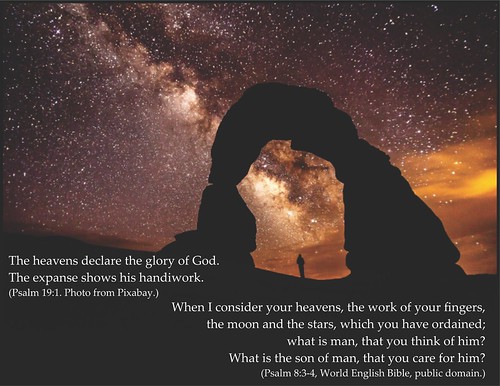
God revealed through the Milky Way


God the Son was important in the creation, and in sustaining that which He created!

John 1:1 In the beginning was the Word, and the Word was with God, and the Word was God. 2 The same was in the beginning with God. 3 All things were made through him. Without him, nothing was made that has been made. 10 He was in the world, and the world was made through him, and the world didn’t recognize him. 12a But as many as received him, to them he gave the right to become God’s children . . .

Colossians 1:14 in whom we have our redemption, the forgiveness of our sins. 15 He is the image of the invisible God, the firstborn of all creation. 16 For by him all things were created in the heavens and on the earth, visible things and invisible things, whether thrones or dominions or principalities or powers. All things have been created through him and for him. 17 He is before all things, and in him all things are held together.

Hebrews 1:3 His Son is the radiance of his glory, the very image of his substance, and upholding all things by the word of his power, who, when he had by himself purified us of our sins, sat down on the right hand of the Majesty on high ...

(Although the passages above indicate that God the Son was the most important agent in the creation, there are scriptural indications that God the Father and God the Holy Spirit were also involved.)

Perhaps you and I don't fully appreciate the magnificence of creation, and, therefore, we may not fully appreciate the magnificence of Christ.

Creation shows that God the son loves diversity. There are about 400,000 species of beetles, and probably at least a million yet to be discovered. (Psalm 104:24 Yahweh, how many are your works! In wisdom, you have made them all. The earth is full of your riches. 25 There is the sea, great and wide, in which are innumerable living things, both small and large animals.)

Creation is unimaginably large. “Recent estimates of the number of galaxies in the observable universe range from 200 billion [(2×10 to the 11th power) to 2 trillion (2×10 to the 12th power)] or more, … containing more stars than all the grains of sand on planet Earth.” (Wikipedia) And that’s only the observable universe.

Creation shows the power of God the Son. Most of the energy on earth comes from the sun. In the sun, Hydrogen nuclei bombard each other at several million degrees, and turn into Helium nuclei, releasing energy by e =m c-squared. The sun is about 93 million miles away. Since it is emitted in all directions, the vast majority of the sun’s emitted energy goes off into space, never hitting the earth, or any other body in the Solar System. But it’s warm enough for life on earth, and light enough for photosynthesis, just from the tiny fraction of the sun’s emitted energy that strikes it. We can scarcely imagine the power of the sun, and it’s a fairly small star.

Creation shows that God the Son likes beauty. He didn’t have to make the universe so that rainbows, or fall foliage, or butterflies, or eclipses, exist. But He did. Using scientific tools, such as microscopes and telescopes, we have found that there is amazing beauty, even in things we can’t get to, or can’t see with the naked eye.


The Creation is sustained by God the Son. How? By laws, like gravity, and created properties, such as that water can exist in three different forms at reasonably normal temperatures. The laws of gravity ensure, for example, that the planets continue to orbit the sun. The properties of water make rain possible, among many other things. God also sustains by processes, like erosion, plate tectonics, and natural selection. We can’t be sure if God is intimately involved in making every raindrop, or lets nature take its course to make each one, but He could make each and every one carefully and magnificently. 

God the Son can, and, at least sometimes, does, change the “normal” course of nature. We call that a miracle.


God, the Son’s, creation is beyond our imagination! He created time and space! God created matter and energy! God created the four fundamental forces, (also called the four interactions) – gravity, the electromagnetic force, the strong force and the weak force. God created the entire electromagnetic spectrum: light, radio waves, wi-fi, microwaves, X-rays, and more. God created the universe with appropriate physical properties for the existence of life

We should not forget that, even though He was largely responsible for the creation of the entire universe, He came to earth. Not as a baby, but as an embryo, a being with just a few cells, and hardly any connection to the world outside his mother’s womb. Then, of course, He became a fetus, and, after about nine months, a baby. Still helpless, dependent, and, presumably, severely limited in His ability to communicate.

And we should not forget what St. Paul said about the Creator and Sustainer of the universe:
5 Have this in your mind, which was also in Christ Jesus, 6 who, existing in the form of God, didn’t consider equality with God a thing to be grasped, 7 but emptied himself, taking the form of a servant, being made in the likeness of men. 8 And being found in human form, he humbled himself, becoming obedient to the point of death, yes, the death of the cross. 9 Therefore God also highly exalted him, and gave to him the name which is above every name, 10 that at the name of Jesus every knee should bow, of those in heaven, those on earth, and those under the earth, 11 and that every tongue should confess that Jesus Christ is Lord, to the glory of God the Father. (From Philippians 2)

Thanks for reading! To God be the glory!

Friday, May 11, 2012

Dembski and Falk: Is Darwin Theologically Neutral? Falk's position

There has recently been an exchange of views between some Southern Baptist theologians, and members of the BioLogos Foundation, on the question posed by the title. I have posted on the views of William Dembski, a Southern Baptist theologian, and a prominent member of the Intelligent Design movement (ID), expressed in two posts, which was published on the BioLogos blog, and on responses to those views, from Todd C. Wood, a young-earth creationist whose views I admire and respect, which were published independently on his own blog. The last post in this series was here. It has links to the previous posts, and related matters.

I now turn to the response of Darrel Falk, president of the BioLogos Foundation, whose views on origins are often called evolutionary creationism. Like Dembski, Falk first puts forth his own position. There is a second part to Falk's response, in which he sets forth some disagreement with Dembski, and I hope to muse about that at a later date.

Falk shares considerable common ground with Dembski. But he parts ways with him on the matter of God's activity. ID advocates argue that God's activity, in the development of living things, including humans, must have involved a number of supernatural, miraculous acts, and that, furthermore, in principle, it is possible for scientific analysis to show that such miraculous acts were necessary. Falk disagrees, in at least two important ways.

First, Falk does believe in the miraculous, events which are not explicable by science, not ordinary natural activity. (Christ's incarnation and resurrection are two such.) But he claims that God's activity is not usually what we would call miraculous, and, furthermore, that God's ordinary activity is necessary for the maintenance of the universe. He writes:

The Law of Gravity, for example, is not something that God set up in the beginning, thereafter recusing himself from further involvement and exiting from the scene. Instead, the Law of Gravity works as it does because of the ongoing activity of God’s Spirit in the universe. So consistent is that activity that it can be described mathematically through scientific analysis. If God ceased to be active, however, then not only would the matter of this universe no longer function in a way which enables a mathematical description of gravity, matter itself would cease to exist.

Falk goes on to say this:

Put another way, the activity of God is not restricted to that which we call the supernatural; it is all God’s activity. It is just that some aspects of God’s activity are so consistently repeatable that we can develop laws which describe the regularity of the divine activity which “holds” and “sustains” the universe. This latter type of activity is no less magnificent just because God does it continuously.

He cites Hebrews 1:3 and Colossians 1:17 in support of his position. (Unfortunately, he gives the reference as Colossians 1:16, not 1:17, but he quotes 1:17)

Second, Falk says that we are too prone to think miracles were necessary, when perhaps they weren't:

Given the many examples of supernatural activity in Scripture, we human beings tend to expect that for something as special as creation of stars or new species, supernatural activity would have been required. But we cannot derive this from the scriptural account and, therefore, it is wise not to second-guess how God might have worked based on the Scriptures. . . . When the Psalmist describes the heavens as being the work of his fingers (Psalm 8:3), this does not negate astronomy’s description of the regular and ongoing processes that give rise to stars in God’s universe. Those processes are natural, but they are every bit as much God’s activity as if he were to take huge balls of matter and miraculously fashion sparkling stars with his hands.

I believe that Falk is correct on these two points, and that I have been guilty of confusing miracles with ordinary activity at times. I wish that Dembski had responded to this post, but, as far as I know, he has not.

Thanks for reading. Read Falk.

Tuesday, April 12, 2005

Scriptural Principles that Relate to Science

In a previous post, I list some scientific principles that tell us about God.
Here are some scriptural principles that relate to science:
1. God is creator. There is no unassailable proof of this statement. The Bible, itself, does not attempt to prove it. It just starts out by saying that God created. Genesis 1:1 doesn’t say how, or why, or when, just who. The Bible, itself, says that the best evidence that God is creator is our faith (Hebrews 11:3). The Bible further points out that the principal agent in creation was God the Son (John 1:1-5, Colossians 1:16-17.)
Christians have several views about the timing, and other details, of how things began. However, the most fundamental truth is that God created.
Creation was called good as it was, not good as a tool for humans. Psalm 104:24-5 speaks of the marvelous diversity of creation. Humans have never yet seen many of the organisms that are alive on earth today, let alone found uses for them. They are still important, because God made them.
2. God sustains the natural world. Colossians 1:16-17 and Hebrews 1:3 indicate that God not only created, but that Christ is presently involved in holding things together, including your body and the monitor you are reading this on. Do we understand this? No, and we aren't capable of understanding it. God is omnipotent and omniscient. We aren’t.
3. Humans have some responsibility for the world around them. Humans were put in charge of God's "very good" creation. (Genesis 1:26, 28). Since the Fall, there have been problems with the natural world, but scripture teaches that it is still important to God, (Psalm 24:1, Psalm 50:10-11) so it should be to us, as well. The Israelites were supposed to take care of their land by letting it lie fallow every seventh year (Leviticus 25:4-7), and their failure to obey this command was one reason for their captivity (II Chronicles 36:21). Proverbs 12:10 says that a righteous man cares for the needs of his animal.
4. God is revealed to us through nature. Psalm 19:1-4, Acts 14:17, and Romans 1:20 say that we can learn something of what God is, and how God works, through a study of nature. In other words, through science. Some of the greatest scientists of all time, like Johannes Kepler, have believed this:
I give thanks to Thee, O Lord Creator, Who hast delighted me with Thy makings and in the works of Thy hands have I exulted. Behold! now, I have completed the work of my profession, having employed as much power of mind as Thou didst to me; to the men who are going to read those demonstrations I have made manifest the glory of Thy works . . .
From The Harmonies of the World by Johannes Kepler, 1619, translated by Charles Glenn Wallis. (The Great Books, Chicago: Encyclopedia Brittanica, 1952, volume 16, Ptolemy, Copernicus, Kepler, p. 1080.)
Science is not God’s only, or main, means of revelation. (Others include the Bible, our consciences, the Holy Spirit in our lives, and, most importantly, the incarnation of Jesus Christ.) But it is one means. Properly understood, scientific findings and scripture do not conflict. However, humans don't completely understand either scientific or scriptural revelation.
5. God is a God of order. The Bible begins with a portrayal of God’s orderliness in creation. Literal or not, the description describes order and sequence. The Ten Commandments, the covenants established with Abraham, and with the Israelites, and God’s promise, in Genesis 8:22, after Noah’s flood, declare that God is a God of order. Some historians of science have written that, without the Judeo-Christian concept of God as a God of order, the development of science would have been impossible. (There were other influences, including Greek and Arab thought, in the development of science.) There were some technological developments in China before similar ones in Europe, but science doesn’t seem to have developed there as a discipline, perhaps because this sense of order wasn’t part of the prevailing world-view there at that time.
6. The responsibility that humans have for nature (principle 3, above) includes responsibility to learn how it works.
Psalm 111:2 Great are the works of the Lord,
studied by all who delight in them. (ESV)
There is delight in such learning (See also principle 4) and it is our responsibility, as good stewards. Some individuals are specially gifted in the area of learning about God's creation -- in other words, God gives some gifts that help people be scientists.

Creative Commons License

This work is licensed under a Creative Commons License. My purpose is not to restrict use, but to prevent anyone else from restricting the use of this material by copyrighting it. Other uses are welcome!

* * * * *

On April 15, 2005, I fixed a link in this post (I hope). Thanks, John Dekker!

On May 15, 2007, I added principle 6.

On January 27, 2012, I added a scripture reference, and some tags.