License

I have written an e-book, Does the Bible Really Say That?, which is free to anyone. To download that book, in several formats, go here.
Creative Commons License
The posts in this blog are licensed under a Creative Commons Attribution-NonCommercial-ShareAlike 3.0 Unported License. You can copy and use this material, as long as you aren't making money from it. If you give me credit, thanks. If not, OK.
Showing posts with label eternity. Show all posts

Sunday, February 27, 2022

With Christ in the school of prayer, by Andrew Murray, excerpt 115

This post continues a series of excerpts from With Christ in the School of Prayer, by Andrew Murray. I thank the Christian Classics Ethereal Library for making this public domain work available. To see their post of the book, go here. The previous post in this series is here. As usual in this blog, long quotations are in this color. In this excerpt, Murray continues a discussion about prayer and the Trinity. His book is based on Mark 11:22-24.  

This may help us somewhat to understand how the prayer of man, coming through the Son, can have effect upon God. The decrees of God are not decisions made by Him without reference to the Son, or His petition, or the petition to be sent up through Him. By no means. The Lord Jesus is the first-begotten, the Head and Heir of all things: all things were created through Him and unto Him, and all things consist in Him. In the counsels of the Father, the Son, as Representative of all creation, had always a voice; in the decrees of the eternal purpose there was always room left for the liberty of the Son as Mediator and Intercessor, and so for the petitions of all who draw nigh to the Father in the Son.

And if the thought come that this liberty and power of the Son to act upon the Father is at variance with the immutability of the Divine decrees, let us not forget that there is not with God as with man, a past by which He is irrevocably bound. God does not live in time  with its past and future; the distinctions of time have no reference to Him who inhabits Eternity. And Eternity is an ever-present Now, in which the past is never past, and the future always present. To meet our human weakness, Scripture must speak of past decrees, and a coming future. In reality, the immutability of God’s counsel is ever still in perfect harmony with His liberty to do whatsoever He will. Not so were the prayers of the Son and His people taken up into the eternal decrees that their effect should only be an apparent one; but so, that the Father-heart holds itself open and free to listen to every prayer that rises through the Son, and that God does indeed allow Himself to be decided by prayer to do what He otherwise would not have done.

Tuesday, February 12, 2019

Jesus, Thy Blood and Righteousness, by Zinzendorf, translated by John Wesley

This source gives the text of the following hymn, "Jesus, Thy blood and righteousness," written in German by Count Nicholas von Zinzendorf, and translated into English by John Wesley, both in 1739:

1 Jesus, Thy blood and righteousness
my beauty are, my glorious dress;
'midst flaming worlds, in these arrayed,
with joy shall I lift up my head.


2 Bold shall I stand in that great day,
for who aught to my charge shall lay?
Fully absolved through these I am,
from sin and fear, from guilt and shame.


3 Lord, I believe Thy precious blood,
which, at the mercy seat of God,
forever doth for sinners plead,
for me, e'en for my soul, was shed.


4 Jesus, be endless praise to Thee,
whose boundless mercy hath for me,
for me a full atonement made,
an everlasting ransom paid.


5 When from the dust of death I rise
to claim my mansion in the skies,
e'en then this shall be all my plea,
Jesus hath lived, hath died, for me.


6 O let the dead now hear Thy voice;
now bid Thy ransomed ones rejoice;
their beauty this, their glorious dress,
Jesus, Thy blood and righteousness.


Here's a modified version, making the word use more current:

1 Jesus, Your blood and righteousness
my beauty are, my glorious dress;
'midst flaming worlds, in these arrayed,
with joy shall I lift up my head.


2 Bold shall I stand in that great day,
for who aught to my charge shall lay?
Fully absolved through these I am,
from sin and fear, from guilt and shame.


3 Lord, I believe Your precious blood,
which, at the mercy seat of God,
forever does for sinners plead,
for me, e'en for my soul, was shed.


4 Jesus, praise to You I sing,
Your mercy boundless, O my King,
for me a full atonement made,
an everlasting ransom paid.


5 When from the dust of death I rise
to claim my mansion in the skies,
e'en then this shall be all my plea,
Jesus has lived, has died, for me.


6 O let the dead now hear Thy voice;
now bid Your ransomed ones rejoice;
their beauty this, their glorious dress,
Jesus, Your blood and righteousness.


Thanks to Christ! Thanks for reading.

Thursday, May 30, 2013

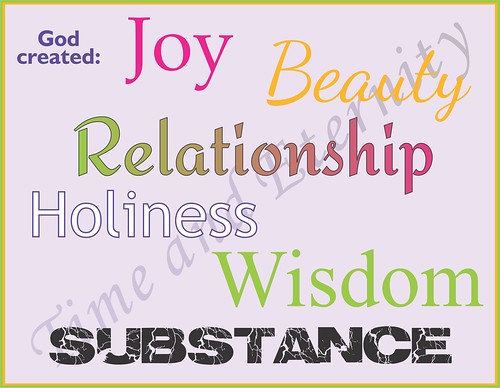
God's creativity

God's creativity

God is unimaginably creative.

John 1, Colossians 1, and other passages indicate that God the Son was and is the chief agent in creation, and in sustaining it.

So what did God create?
1. Substance (including energy, which is a type of substance – e = mc2).
Matter and energy are creations of God. He is outside of His created universe, and made it come to be from nothing. However, He can and does enter it, as shown in the miracles of the Old Testament, the Incarnation of God the Son, and the presence of God the Holy Spirit. Ken Schenck, in this post, points out that God created the nothing, too. It wouldn't have been there without God.

It is possible that all the types of sub-atomic particles, or even each and every such particle, all the elements, all the types of heavenly bodies, the earth itself, and the kinds of living things, were brought into being by individual creative acts. It is also possible that God’s planning was so extensive and complete that He created matter so that most or all of these things emerged, over time, as a result of the Big Bang. Either way shows God’s limitless intelligence and creativity, (See here for information on the suitability of sub-atomic particles for the existence of the universe.) and we don’t need to know which of these (or both) has been true.

Satan probably has no power to create any kind of substance, but he can make use of created things.

2. Time/Eternity
Substance has been created in time, which is another of God's creations. Since that is true, God is not in time, but outside of it, in eternity -- God can experience the past, present and future. Or, perhaps, God created eternity, too. All of the entities shown in the graphic play out in time, and in eternity. I'm not clear as to whether eternity is just time stretched out infinitely into the past and the future, or whether time somehow exists in eternity, and it doesn't matter what I think. I'll leave that question to God.

Satan apparently existed before the creation of substance, but probably not eternally into the past. Humans, and satan and other beings are going to exist eternally into the future.

3. Beauty
All beauty, imagined* or existent, of pattern, appearance, sound, and form, either:
was created by God;
is a natural emergence from what God created;
is based on what God brought forth;
or is possible because He gave humans the ability to be sub-creators.
(J. R. R. Tolkien, who was a Christian, used the word sub-creation about the fantastic worlds created by himself and others.)

*“Imagined,” because, for example, Beethoven was so deaf by the time his great Ninth Symphony was performed that he could not hear it, and had not heard it, except in his head, while he was composing it. Similar processes of imagination occur during writing, painting, and other creative arts, and also in the sciences, even in sports. Newton imagined his Law of Universal Gravitation – he didn’t develop this from experiments. That Law’s simplicity is one of many scientific phenomena that scientists sometimes say possess beauty, because of their simplicity (at least to the scientists!) and explanatory power:
F = (g x m1 x m2)/r2
The scientific search for patterns in elementary particles, and for broadly applicable formulas and laws (such as the so-called theory of everything, or the “God particle”) is motivated by a belief that there is an underlying pattern and beauty in the way things are. Einstein, who was not a believer in a personal God, sometimes spoke as if there was a God who had arranged things in the way that they were, understandable, describable, and relatively simple.

Richard Feynman, Nobel laureate, said: “What is it about nature that lets this happen, that it is possible to guess from one part what the rest is going to do? That is an unscientific question: I do not know how to answer it, and therefore I am going to give an unscientific answer. I think it is because nature has a simplicity and therefore a great beauty.” “Seeking New Laws,” pp. 143-167, in Richard Feynman, The Character of Physical Law, New York: Modern Library, 1994. Quote is from p. 167. I have read most of Feynman's popular writing, and seen no evidence that he believed in God at all.

Naismith imagined a game involving tossing a ball into peach baskets.

Satan probably has no power to create beauty of any kind, although he can mimic God’s good creation, and can use beauty as an evil force. (Pornography, for example.) Perhaps Satan, as an angel, had creative powers that humans don’t. We don’t know. Satan apparently can imagine events that have not happened yet, or that might never happen.

4. Relationship
The power to form relationships with other sentient, responsive beings is possible because God made it so.
A human who is incapable of establishing relationships with others, or who does not want to do so, is abnormal. Humans are constructed so that we form and maintain relationships with others, from birth to death.
God also desires relationships. The Three Persons of the Trinity apparently have a relationship with one another. God wants to have a relationship with us. This is not possible, or not nearly fully possible, unless the sin problem is fixed. God loves us so much that He took care of the sin problem for us – we couldn’t do that. In the life of Christ, in 1 Corinthians 13, and elsewhere, the proper foundation for relationships is laid out. It is unselfish, Christ-like love. (Agape love.) Humans, and, to some extent, animals, have some capacity to communicate, to empathize, to imagine how to increase the well-being of others, and to do so. These all contribute to the ability to form relationships. God wants us to use this ability to bring others to a relationship with Him.

Satan is incapable of forming a proper relationship with anyone. We aren’t, either, without accepting Christ’s sacrifice for sin, and following His Lordship and example.

5. Joy
God is responsible for joy. We can, and should, be joyful in comprehending and experiencing beauty and relationship, even substance. God made humor and laughter possible. We should joy in contemplating God’s creativity and goodness. “Joyful, joyful, we adore Thee” (based on Beethoven's Ninth Symphony) is found in many hymnals.

Satan has lost any capacity for joy that he had originally, and wants to drive joy out of the world.

6. Holiness
Holiness is the opposite of evil and sin. Evil and sin are the absence of holiness. God is holy, and good, and His creation started out that way. He wants us to be holy, and totally good, too, and will eventually transform created things so that they, too, are finally and eternally good. Because God is holy and good, He cannot abide sin. Our relationship with Him should be such that we stop sinning, or at least do it less frequently, and become more and more holy – more and more living a life for God, and others, and less and less living for ourselves.

Satan is unholiness personified. Fallen, unredeemed humans are also unholiness personified.

7. Wisdom

Wisdom is “The ability to discern or judge what is true, right, or lasting; insight.” (The Free Dictionary). In other words, to have wisdom is to act correctly on the things you know. God allows us to have knowledge, to know things, but merely knowing things is not the same thing as wisdom. Children know a lot, but they are often not wise. Presumably Satan also knows a lot, but he has unwisely rejected God’s authority.
 
Thanks for reading, and thanks to my wife for suggestions.

This is the version of November 1, 2014, somewhat modified from previous versions.
Thursday, November 29, 2012

Predestination, foreknowledge and choice

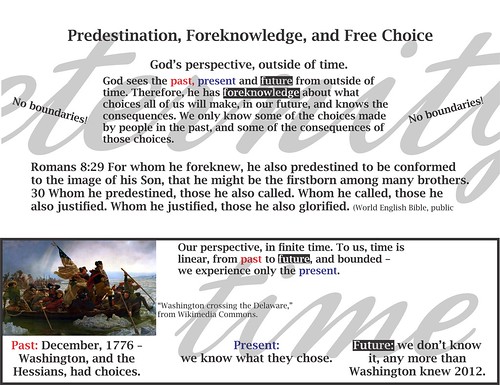
Predestination, foreknowledge, and free choice
The above graphic is an attempt to illustrate a controversial and complex subject, predestination, foreknowledge, and free choice. (The word, eternity, isn't completely shown in the illustration, on purpose, to symbolize the boundlessness of eternity.) The graphic should serve as a link to the original graphic on Flickr. Flickr members, at least, and perhaps others -- I'm not sure -- can see larger sizes of the graphic, by clicking on the magnifying glass icon above the graphic on its Flickr page. There is no password required to view Flickr pictures.

I believe that the Bible teaches that people have the ability to choose, at least in some areas. Here's some of the evidence.

The Bible also teaches predestination, for example in the verses quoted above, which are from Romans 8:
28 For whom he foreknew, he also predestined to be conformed to the image of his Son, that he might be the firstborn among many brothers. 29 Whom he predestined, those he also called. Whom he called, those he also justified. Whom he justified, those he also glorified. (World English Bible, public domain)

As I understand things, God is outside of time. Consider this: I think that Jane Smith is going to enter a situation that I wish to pray about, at two in the afternoon, and pray for this at that time. However, without my knowledge, the situation actually occurred three hours earlier. God could have taken my praying into account when influencing the situation, even though I hadn't prayed yet when it happened, because God knew that I would, and, in fact, God had experience my prayer when the event happened. God's knowledge, or foreknowledge, doesn't mean that I didn't have a choice about whether to pray. I did. But God knew that I would.

The graphic incorporates an image of General George Washington crossing the Delaware. I modified it by rotating it horizontally.

Thanks for looking! Make right choices.

Sunday, October 10, 2010

Alive when the sun has cease to provide energy

The fires of the sun shall be quenched at last,
And the steadfast stars be gone;
But souls of the ransomed shall live in strength,
And they still shall be going on.

Refrain:
Going on, going on,
They still shall be going on;
Forever and aye, through eternal day,
They still shall be going on.

As souls that remember and feel and thrill,
We shall live when seas are dry;
As separate beings, to love and will,
We shall live, nevermore to die.

From glory to glory our path shall be,
And from grace to perfect grace;
Through all the wide years of eternity,
We shall look on our dear Lord’s face.

Refrain revised: Going on, going on,
We still shall be going on;
Forever and aye, through eternal day,
We still shall be going on.

- "Going On," by Jessie Brown Pounds, public domain, written about 1900.

At this time, of course, it was impossible for Ms. Pounds to know about the nuclear reactions that provide the energy that we rely on so much. But no matter -- that first verse is a remarkable thought!

Thursday, April 22, 2010

Eternity, how long is it?

blogger i am grateful -- Kerry i am asked for a definition of forever.

This is not a definition, and it's not original with me. I don't know where I heard or read it, (probably in a sermon) but I think it bears repeating, so here goes.

Suppose that there is a ball of iron, as large as the earth.


Suppose that, every 100 years, a bird flies past this ball, and barely touches it with a wing tip.


When that bird has finally worn away the entire ball, eternity will have just begun.

Thanks for reading. Perhaps you have a better definition/example. If you know a source, I'd appreciate it.

Thursday, December 18, 2008

We don't have time for eternity

. . .the mismatch between our modern lives and ancient brains is most evident in the problems of working memory and attention, but another culprit may be at work. We are easily distracted also because we vastly overvalue what happens to us right now compared with what comes in the future and because novelty is intrinsically rewarding. So whatever we are supposed to be focusing on has to compete with every new email, new task, new blog post and new conversation that wanders into our information sphere. These biases may have served us well in our species' evolutionary past, when the future was uncertain and the new could well be a threat that deserved immediate attention. But nowadays the new is more often trivial than essential, and sacrificing immediate rewards can yield greater ones in the future. From a review, in the Dec 14, 2008, Wall Street Journal, of The Overflowing Brain, by Torkel Klingberg. The review was written by Christopher F. Chabris. (Emphasis in original.)

In other words, we don't have time for eternity.

Whether you are comfortable with the reviewer's view of human prehistory doesn't really matter here -- we are, indeed, too concerned with the Now and the New.

Thanks for reading. Consider the past and the future a little more today.