If I am asked, as a purely intellectual question, why I believe in Christianity, I can only answer, “For the same reason that an intelligent agnostic disbelieves in Christianity.” I believe in it quite
rationally upon the evidence. But the evidence in my case, as in that of the intelligent agnostic, is not really in this or that alleged
demonstration; it is in an enormous accumulation of small but unanimous facts. The secularist is not to be blamed because his objections to
Christianity are miscellaneous and even scrappy; it is precisely such scrappy evidence that does convince the mind. I mean that a man may well
be less convinced of a philosophy from four books, than from one book, one battle, one landscape, and one old friend. The very fact that the things
are of different kinds increases the importance of the fact that they all point to one conclusion. Now, the non-Christianity of the average educated
man today is almost always, to do him justice, made up of these loose but living experiences.
I can only say that my evidences for Christianity are
of the same vivid but varied kind as his evidences against it. For when I look at these various anti-Christian truths, I simply discover that none
of them are true. I discover that the true tide and force of all the facts flows the other way. Let us take cases. Many a sensible modern man must
have abandoned Christianity under the pressure of three such converging convictions as these: first, that men, with their shape, structure, and
sexuality, are, after all, very much like beasts, a mere variety of the animal kingdom; second, that primeval religion arose in ignorance and
fear; third, that priests have blighted societies with bitterness and gloom. Those three anti-Christian arguments are very different; but they
are all quite logical and legitimate; and they all converge. The only objection to them (I discover) is that they are all untrue.
If you leave off looking at books about beasts and men, if
you begin to look at beasts and men then (if you have any humour or imagination, any sense of the frantic or the farcical) you will observe
that the startling thing is not how like man is to the brutes, but how unlike he is. It is the monstrous scale of his divergence that requires an
explanation.
That man and brute are like is, in a sense, a truism; but that being so like they should then be so insanely unlike, that is the
shock and the enigma. That an ape has hands is far less interesting to the philosopher than the fact that having hands he does next to nothing with
them; does not play knuckle-bones or the violin; does not carve marble or carve mutton. People talk of barbaric architecture and debased art. But
elephants do not build colossal temples of ivory even in a rococo style; camels do not paint even bad pictures, though equipped with the material
of many camel’s-hair brushes. Certain modern dreamers say that ants and bees have a society superior to ours. They have, indeed, a civilization;
but that very truth only reminds us that it is an inferior civilization. Who ever found an ant-hill decorated with the statues of celebrated ants?
Who has seen a bee-hive carved with the images of gorgeous queens of old? No; the chasm between man and other creatures may have a natural
explanation, but it is a chasm. We talk of wild animals; but man is the only wild animal. It is man that has broken out. All other animals are
tame animals; following the rugged respectability of the tribe or type. All other animals are domestic animals; man alone is ever undomestic,
either as a profligate or a
monk. So that this first superficial reason for materialism is, if anything, a reason for its opposite; it is exactly where biology leaves
off that all religion begins.
It would be the same if I examined the second of the three chance rationalist arguments; the argument that all that we call divine began in
some darkness and terror. When I did attempt to examine the foundations of this modern idea I simply found that there were none. Science knows
nothing whatever about prehistoric man; for the excellent reason that he is prehistoric. A few professors choose to conjecture that such things as
human sacrifice were once innocent and general and that they gradually dwindled; but there is no direct evidence of it, and the small amount of
indirect evidence is very much the other way. In the earliest legends we have, such as the tales of Isaac and of Iphigenia, human sacrifice is not
introduced as something old, but rather as something new; as a strange and frightful exception darkly demanded by the gods. History says nothing; and
legends all say that the earth was kinder in its earliest time. There is no tradition of progress; but the whole human race has a tradition of the
Fall.
And if we took the third chance instance, it would be same; the view that priests darken and embitter the world. I look at the world and simply
discover that they don’t. Those countries in Europe which are still influenced by priests, are exactly the countries where there is still
singing and dancing and coloured dresses and art in the open-air. Catholic doctrine and discipline may be walls; but they are the walls of a
playground.
Thus these three facts of experience, such facts as go to make an agnostic, are, in this view, turned totally round. I am left saying, “Give
me an explanation, first, of the towering eccentricity of man among the brutes; second, of the vast human tradition of some ancient happiness;
third, of the partial perpetuation of such pagan joy in the countries of the Catholic Church.” One explanation, at any rate, covers all three: the
theory that twice was the natural order interrupted by some explosion or revelation such as people now call “psychic.” Once Heaven came upon the
earth with a power or seal called the image of God, whereby man took command of Nature; and once again (when in empire after empire men had
been found wanting) Heaven came to save mankind in the awful shape of a man. This would explain why the mass of men always look backwards; and why
the only corner where they in any sense look forwards is the little continent where Christ has His Church.
Orthodoxy, first published in 1908, by G. K. Chesterton, is in the public domain, and available from Project Gutenberg. The previous post in this series is here. Thanks for reading! Read Chesterton.

Musings on science, the Bible, and fantastic literature (and sometimes basketball and other stuff).
God speaks to us through the Bible and the findings of science, and we should listen to both types of revelation.
The title is from Psalm 84:11.
The Wikipedia is usually a pretty good reference. I mostly use the World English Bible (WEB), because it is public domain. I am grateful.
License
I have written an e-book, Does the Bible Really Say That?, which is free to anyone. To download that book, in several formats, go here.

The posts in this blog are licensed under a Creative Commons Attribution-NonCommercial-ShareAlike 3.0 Unported License. You can copy and use this material, as long as you aren't making money from it. If you give me credit, thanks. If not, OK.
The posts in this blog are licensed under a Creative Commons Attribution-NonCommercial-ShareAlike 3.0 Unported License. You can copy and use this material, as long as you aren't making money from it. If you give me credit, thanks. If not, OK.
Showing posts with label evidence. Show all posts
Showing posts with label evidence. Show all posts
Sunday, March 06, 2016


Saturday, August 11, 2012
Evidence for being a Christian: What the Bible says
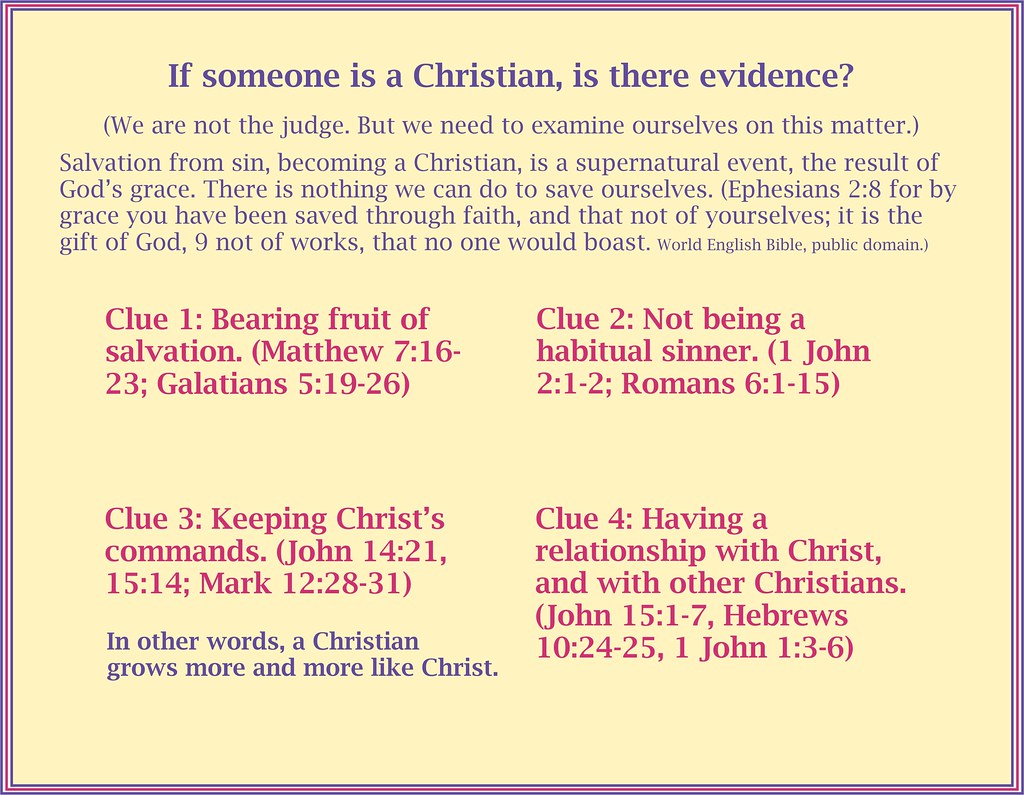
(The graphic above is a link to a larger version, which you are free to use for non-commercial purposes.)
Who is saved?
We cannot save ourselves, and the church cannot save us.
Salvation from sin is a supernatural event, the result of God’s grace. We can ask forgiveness for sin, and accept Christ’s atoning sacrifice, and the power of the resurrection. We need to do these things. But salvation is God’s work in us. (Ephesians 2:8 for by grace you have been saved through faith, and that not of yourselves; it is the gift of God, 9 not of works, that no one would boast. (Scripture quotations from the World English Bible, public domain)
Furthermore, raising our hands, saying a prayer, kneeling at a mourner’s bench, shaking a preacher’s hand, testifying to being saved, being baptized, having our names on a church roll do not and cannot save us, in and of themselves. (There is nothing wrong with these acts, or similar ones, and most converts ought to do most or all of them, especially baptism, but they don’t save us.) In other words, no one is saved because she thinks she is, or because he joined the church 15 years ago. If she or he is saved, it is because of God’s forgiveness. Whether we are saved or not is ultimately a question that only God can really answer. I once heard a Southern Baptist pastor say that about 50% of the people on the rolls of his church weren’t really saved. Why did he say that? Because, although they had participated in one or more of the acts listed above, they showed no evidence of salvation. (Southern Baptists are by no means alone in this!)
A person who is saved bears fruit of salvation
Matthew 13:18 “Hear, then, the parable of the farmer. 19 When anyone hears the word of the Kingdom, and doesn’t understand it, the evil one comes, and snatches away that which has been sown in his heart. This is what was sown by the roadside. 20 What was sown on the rocky places, this is he who hears the word, and immediately with joy receives it; 21 yet he has no root in himself, but endures for a while. When oppression or persecution arises because of the word, immediately he stumbles. 22 What was sown among the thorns, this is he who hears the word, but the cares of this age and the deceitfulness of riches choke the word, and he becomes unfruitful. 23 What was sown on the good ground, this is he who hears the word, and understands it, who most certainly bears fruit, and produces, some one hundred times as much, some sixty, and some thirty.”
Matthew 7:16 By their fruits you will know them. Do you gather grapes from thorns, or figs from thistles? 17 Even so, every good tree produces good fruit; but the corrupt tree produces evil fruit. 18 A good tree can’t produce evil fruit, neither can a corrupt tree produce good fruit. 19 Every tree that doesn’t grow good fruit is cut down, and thrown into the fire. 20 Therefore by their fruits you will know them. 21 Not everyone who says to me, ‘Lord, Lord,’ will enter into the Kingdom of Heaven; but he who does the will of my Father who is in heaven. 22 Many will tell me in that day, ‘Lord, Lord, didn’t we prophesy in your name, in your name cast out demons, and in your name do many mighty works?’ 23 Then I will tell them, ‘I never knew you. Depart from me, you who work iniquity.’
John 15:1 “I am the true vine, and my Father is the farmer. 2 Every branch in me that doesn’t bear fruit, he takes away. Every branch that bears fruit, he prunes, that it may bear more fruit. 3 You are already pruned clean because of the word which I have spoken to you. 4 Remain in me, and I in you. As the branch can’t bear fruit by itself, unless it remains in the vine, so neither can you, unless you remain in me. 5 I am the vine. You are the branches. He who remains in me, and I in him, the same bears much fruit, for apart from me you can do nothing. 6 If a man doesn’t remain in me, he is thrown out as a branch, and is withered; and they gather them, throw them into the fire, and they are burned. 7 If you remain in me, and my words remain in you, you will ask whatever you desire, and it will be done for you.
Jesus does not explain what “fruit” is. But He calls it “good fruit,” and says that we must remain in Him in order to produce it. The fruit is probably two related things: influencing people to be converted, and the Fruits of the Spirit, described in Galatians 5, which also describes bad fruit:
Galatians 5:19 Now the deeds of the flesh are obvious, which are: adultery, sexual immorality, uncleanness, lustfulness, 20 idolatry, sorcery, hatred, strife, jealousies, outbursts of anger, rivalries, divisions, heresies, 21 envy, murders, drunkenness, orgies, and things like these; of which I forewarn you, even as I also forewarned you, that those who practice such things will not inherit the Kingdom of God.
22 But the fruit of the Spirit is love, joy, peace, patience, kindness, goodness, faith, 23 gentleness, and self-control. Against such things there is no law. 24 Those who belong to Christ have crucified the flesh with its passions and lusts. 25 If we live by the Spirit, let’s also walk by the Spirit. 26 Let’s not become conceited, provoking one another, and envying one another.
A person who is saved is not a
habitual sinner.
(Note: To some people, sin is anything short of perfection – to them, honest mistakes, and
memory lapses, are sin. However, I am using a more restrictive definition, from
the Free Dictionary:
1. A transgression of a religious or moral law, especially when
deliberate.
2. Theology
a. Deliberate disobedience to the known will of God. b. A condition of estrangement from God resulting from such disobedience.
We should remember that there are sins of omission – things that we should do, but don’t – as well as sins of commission. See James 4:17 and Matthew 25:40-25.
Newly
saved people don't instantly become mature Christians. The Holy Spirit
works to develop us. Even mature Christians may newly realize some sin
as He reveals it to them. Psalm 86:11a Teach me your way, Yahweh.)
1 John 2:1 My little children, I write these things to you so that you may not sin. If anyone sins, we have a Counselor with the Father, Jesus Christ, the righteous. 2 And he is the atoning sacrifice for our sins, and not for ours only, but also for the whole world.
Romans 6:1 What shall we say then? Shall we continue in sin, that grace may abound? 2 May it never be! We who died to sin, how could we live in it any longer? 3 Or don’t you know that all we who were baptized into Christ Jesus were baptized into his death? 4 We were buried therefore with him through baptism to death, that just as Christ was raised from the dead through the glory of the Father, so we also might walk in newness of life. 5 For if we have become united with him in the likeness of his death, we will also be part of his resurrection; 6 knowing this, that our old man was crucified with him, that the body of sin might be done away with, so that we would no longer be in bondage to sin. 7 For he who has died has been freed from sin. 8 But if we died with Christ, we believe that we will also live with him; 9 knowing that Christ, being raised from the dead, dies no more. Death no more has dominion over him! 10 For the death that he died, he died to sin one time; but the life that he lives, he lives to God. 11 Thus consider yourselves also to be dead to sin, but alive to God in Christ Jesus our Lord. 12 Therefore don’t let sin reign in your mortal body, that you should obey it in its lusts. 13 Also, do not present your members to sin as instruments of unrighteousness, but present yourselves to God, as alive from the dead, and your members as instruments of righteousness to God. 14 For sin will not have dominion over you. For you are not under law, but under grace. 15 What then? Shall we sin, because we are not under law, but under grace? May it never be!
A person who is saved follows Christ’s commandments.
John 14:21
One who has my commandments, and keeps them, that person is one who loves me.
One who loves me will be loved by my Father, and I will love him, and will
reveal myself to him.”
23 Jesus
answered him, “If a man loves me, he will keep my word. My Father will love
him, and we will come to him, and make our home with him. 24 He who doesn’t
love me doesn’t keep my words.
John 15:14 You are my friends, if you do whatever I command you.
1 John 1:3 This is how we know that we know him: if we keep his commandments. 4 One who says, “I know him,” and doesn’t keep his commandments, is a liar, and the truth isn’t in him. 5 But whoever keeps his word, God’s love has most certainly been perfected in him. This is how we know that we are in him: 6 he who says he remains in him ought himself also to walk just like he walked.
Matthew 7:24 “Everyone therefore who hears these words of mine, and does them, I will liken him to a wise man, who built his house on a rock. 25 The rain came down, the floods came, and the winds blew, and beat on that house; and it didn’t fall, for it was founded on the rock. 26 Everyone who hears these words of mine, and doesn’t do them will be like a foolish man, who built his house on the sand. 27 The rain came down, the floods came, and the winds blew, and beat on that house; and it fell—and great was its fall.”
What are Christ’s commandments?
Many of them are found in the Sermon on the Mount (Matthew 5-7). Some of the commands in that Sermon are to keep our motives pure – don’t even want to commit adultery or murder; be reconciled to others, and forgive them; turn the other cheek; love even your enemies; don’t draw attention to your good deeds; don’t be anxious about worldly possessions; judge yourselves before judging others; beware of false prophets. He also told us to live the summary of the Old Testament Law:
Matthew 22:37 Jesus said to him, “‘You shall love the Lord your God with all your heart, with all your soul, and with all your mind.’ 38 This is the first and great commandment. 39 A second likewise is this, ‘You shall love your neighbor as yourself.’ 40 The whole law and the prophets depend on these two commandments.”
In Mark 12:14-19, Jesus commanded His listeners to honor the government, including paying taxes. We should remember that this was an occupying government, and its head was a Roman pagan emperor.
There are other commands, but one more is found in the last words of Matthew’s gospel: Matthew 28:19 Go, and make disciples of all nations, baptizing them in the name of the Father and of the Son and of the Holy Spirit, 20 teaching them to observe all things that I commanded you. Behold, I am with you always, even to the end of the age.” Amen.
A person who is saved continues in a relationship with Christ, and seeks the fellowship of other Christians.
John 15:1-7 (quoted above) uses the phrase “remain in me” or equivalent, seven times.
John 17:20 Not for these only do I pray, but for those also who believe in me through their word, 21 that they may all be one; even as you, Father, are in me, and I in you, that they also may be one in us; that the world may believe that you sent me. 22 The glory which you have given me, I have given to them; that they may be one, even as we are one; 23 I in them, and you in me, that they may be perfected into one; that the world may know that you sent me, and loved them, even as you loved me.
Hebrews 10:24 Let us consider how to provoke one another to love and good works, 25 not forsaking our own assembling together, as the custom of some is, but exhorting one another; and so much the more, as you see the Day approaching.
There are about 20 occurrences of groups of Christians being together in Acts. (See here.) Sometimes they met to worship, sometimes as a prayer meeting, sometimes to consider policy or doctrine. It was Paul’s practice to establish churches wherever he went as a missionary. Christ refers to seven churches in Revelation.
To summarize the evidences given above for being a Christian, a Christian becomes more and more like Christ. The Holy Spirit works in the life of a believer to bring these things about.
My conclusion is that as long as we remain in good relationship with God, we will keep Christ’s commandments, our lives will bear fruit, and we will not lose our salvation. Perhaps I ought to stop there, but the original question still remains. There are at least two views of the answer, both with Biblical support, but the question, and its answers, are trivial beside the more important question – am I saved now? Unfortunately, some people, who don't follow Christ's commandments, who do not have a relationship with Christ, who are persistent and unrepentant sinners, and whose lives show the wrong kind of fruit, are deluded by Satan into thinking that they are saved when they are not.
Thanks for reading!
Added October 26, 2012: You may want to see this post, on the warning passages in the book of Hebrews.
Added June 9, 2015: Neither the chart, nor the above discussion, consider baptism as evidence that one is a Christian. In Acts, baptism was perhaps the most important sign of being converted. Jesus commanded the church to baptize new believers. It's important! But what the chart and discussion are really about is ongoing evidence, up-to-date evidence. Baptism, for most believers, is a one-time event. The four evidences above are about our continuing life in Christ.
Tuesday, July 24, 2012
Is there evidence of conversion?
Is there evidence of conversion? I believe so. It's not up to me to judge, and the person I need to be most concerned about is me, not someone else, but here's some of what the Bible says on the subject:
Matthew 13:18 “Hear, then, the parable of the farmer. 19 When anyone hears the word of the Kingdom, and doesn’t understand it, the evil one comes, and snatches away that which has been sown in his heart. This is what was sown by the roadside. 20 What was sown on the rocky places, this is he who hears the word, and immediately with joy receives it; 21 yet he has no root in himself, but endures for a while. When oppression or persecution arises because of the word, immediately he stumbles. 22 What was sown among the thorns, this is he who hears the word, but the cares of this age and the deceitfulness of riches choke the word, and he becomes unfruitful. 23 What was sown on the good ground, this is he who hears the word, and understands it, who most certainly bears fruit, and produces, some one hundred times as much, some sixty, and some thirty.” (Scripture quotations from the World English Bible, public domain)
Matthew 7:16 By their fruits you will know them. Do you gather grapes from thorns, or figs from thistles? 17 Even so, every good tree produces good fruit; but the corrupt tree produces evil fruit. 18 A good tree can’t produce evil fruit, neither can a corrupt tree produce good fruit. 19 Every tree that doesn’t grow good fruit is cut down, and thrown into the fire. 20 Therefore by their fruits you will know them. 21 Not everyone who says to me, ‘Lord, Lord,’ will enter into the Kingdom of Heaven; but he who does the will of my Father who is in heaven. 22 Many will tell me in that day, ‘Lord, Lord, didn’t we prophesy in your name, in your name cast out demons, and in your name do many mighty works?’ 23 Then I will tell them, ‘I never knew you. Depart from me, you who work iniquity.’
John 15:1 “I am the true vine, and my Father is the farmer. 2 Every branch in me that doesn’t bear fruit, he takes away. Every branch that bears fruit, he prunes, that it may bear more fruit. 3 You are already pruned clean because of the word which I have spoken to you. 4 Remain in me, and I in you. As the branch can’t bear fruit by itself, unless it remains in the vine, so neither can you, unless you remain in me. 5 I am the vine. You are the branches. He who remains in me, and I in him, the same bears much fruit, for apart from me you can do nothing. 6 If a man doesn’t remain in me, he is thrown out as a branch, and is withered; and they gather them, throw them into the fire, and they are burned. 7 If you remain in me, and my words remain in you, you will ask whatever you desire, and it will be done for you.
Jesus does not explain what “fruit” is. But He calls it “good fruit,” and says that we must remain in Him in order to produce it. The fruit is probably two related things: influencing people to be converted, and the Fruits of the Spirit, described in Galatians 5, which also describes bad fruit:
Galatians 5:19 Now the deeds of the flesh are obvious, which are: adultery, sexual immorality, uncleanness, lustfulness, 20 idolatry, sorcery, hatred, strife, jealousies, outbursts of anger, rivalries, divisions, heresies, 21 envy, murders, drunkenness, orgies, and things like these; of which I forewarn you, even as I also forewarned you, that those who practice such things will not inherit the Kingdom of God.
22 But the fruit of the Spirit is love, joy, peace, patience, kindness, goodness, faith, 23 gentleness, and self-control. Against such things there is no law. 24 Those who belong to Christ have crucified the flesh with its passions and lusts. 25 If we live by the Spirit, let’s also walk by the Spirit. 26 Let’s not become conceited, provoking one another, and envying one another.
A person who is saved is not a habitual sinner.
(Note: To some people, sin is anything short of perfection – to them, honest mistakes, and memory lapses, are sin. However, I am using a more restrictive definition, from the Free Dictionary:
1. A transgression of a religious or moral law, especially when deliberate.
2. Theology
a. Deliberate disobedience to the known will of God.
b. A condition of estrangement from God resulting from such disobedience.We should remember that there are sins of omission – things that we should do, but don’t – as well as sins of commission. See James 4:17 and Matthew 25:40-25.)
1 John 1:1 My little children, I write these things to you so that you may not sin. If anyone sins, we have a Counselor with the Father, Jesus Christ, the righteous. 2 And he is the atoning sacrifice for our sins, and not for ours only, but also for the whole world.
Romans 6:1 What shall we say then? Shall we continue in sin, that grace may abound? 2 May it never be! We who died to sin, how could we live in it any longer? 3 Or don’t you know that all we who were baptized into Christ Jesus were baptized into his death? 4 We were buried therefore with him through baptism to death, that just as Christ was raised from the dead through the glory of the Father, so we also might walk in newness of life. 5 For if we have become united with him in the likeness of his death, we will also be part of his resurrection; 6 knowing this, that our old man was crucified with him, that the body of sin might be done away with, so that we would no longer be in bondage to sin. 7 For he who has died has been freed from sin. 8 But if we died with Christ, we believe that we will also live with him; 9 knowing that Christ, being raised from the dead, dies no more. Death no more has dominion over him! 10 For the death that he died, he died to sin one time; but the life that he lives, he lives to God. 11 Thus consider yourselves also to be dead to sin, but alive to God in Christ Jesus our Lord.
12 Therefore don’t let sin reign in your mortal body, that you should obey it in its lusts. 13 Also, do not present your members to sin as instruments of unrighteousness, but present yourselves to God, as alive from the dead, and your members as instruments of righteousness to God. 14 For sin will not have dominion over you. For you are not under law, but under grace. 15 What then? Shall we sin, because we are not under law, but under grace? May it never be!
A person who is saved follows Christ’s commandments.
John 14:21 One who has my commandments, and keeps them, that person is one who loves me. One who loves me will be loved by my Father, and I will love him, and will reveal myself to him.”
23 Jesus answered him, “If a man loves me, he will keep my word. My Father will love him, and we will come to him, and make our home with him. 24 He who doesn’t love me doesn’t keep my words.
John 17:15 I pray not that you would take them from the world, but that you would keep them from the evil one. 16 They are not of the world even as I am not of the world. 17 Sanctify them in your truth. Your word is truth. 18 As you sent me into the world, even so I have sent them into the world.
1 John 2:3 This is how we know that we know him: if we keep his commandments. 4 One who says, “I know him,” and doesn’t keep his commandments, is a liar, and the truth isn’t in him. 5 But whoever keeps his word, God’s love has most certainly been perfected in him. This is how we know that we are in him: 6 he who says he remains in him ought himself also to walk just like he walked.
Matthew 7:24 “Everyone therefore who hears these words of mine, and does them, I will liken him to a wise man, who built his house on a rock. 25 The rain came down, the floods came, and the winds blew, and beat on that house; and it didn’t fall, for it was founded on the rock. 26 Everyone who hears these words of mine, and doesn’t do them will be like a foolish man, who built his house on the sand. 27 The rain came down, the floods came, and the winds blew, and beat on that house; and it fell—and great was its fall.”
For more on what Christ's commandments are, see here.
A person who is saved continues in a relationship with Christ, and seeks the fellowship of other Christians.
John 15:1-7 (quoted above) uses the phrase “remain in me” or equivalent, seven times.
John 17:20 Not for these only do I pray, but for those also who believe in me through their word, 21 that they may all be one; even as you, Father, are in me, and I in you, that they also may be one in us; that the world may believe that you sent me. 22 The glory which you have given me, I have given to them; that they may be one, even as we are one; 23 I in them, and you in me, that they may be perfected into one; that the world may know that you sent me, and loved them, even as you loved me.
Hebrews 10:24 Let us consider how to provoke one another to love and good works, 25 not forsaking our own assembling together, as the custom of some is, but exhorting one another; and so much the more, as you see the Day approaching.
There are about 20 occurrences of groups of Christians being together in Acts. Sometimes they met to worship, sometimes as a prayer meeting, sometimes to consider policy or doctrine. It was Paul’s practice to establish churches wherever he went as a missionary. Christ speaks to seven churches, not individuals, in Revelation.
To summarize the evidences given above for being a Christian, a Christian becomes more and more like Christ. The Holy Spirit works in the life of a believer to bring these things about.
Thanks for reading!
August 19, 2012: This document, slightly modified, was re-posted, with a graphic at the beginning, a few days later, here.
August 19, 2012: This document, slightly modified, was re-posted, with a graphic at the beginning, a few days later, here.
Friday, October 01, 2010
Science relies on objective knowledge; religion on subjective faith
There is at least a grain of truth in the title of this post, I believe. But perhaps things aren't quite that simple.
Karl Giberson, a scientist with solid credentials, as well as a writer with considerable background in philosophy and Christianity, argues that at least some of those who make such claims (among them, the so-called New Atheists) are not being fair. Some scientific truths are well known, and generally accepted, but some aren't, at least not yet. Giberson gives examples.
He also says that:
Science purchases its great success by choosing easy problems and thus will always provide a clearer model for thinking than, say theology, or literary criticism, or sociology, or aesthetics. But it does suggest that we should not be exclaiming about how much clearer our understanding of penicillin is than our understanding of the Incarnation.
In other words, no wonder science has achieved objective agreement on lots of things -- it deals with simpler questions!
Thanks for reading. Read Giberson's essay -- it's brief.
Karl Giberson, a scientist with solid credentials, as well as a writer with considerable background in philosophy and Christianity, argues that at least some of those who make such claims (among them, the so-called New Atheists) are not being fair. Some scientific truths are well known, and generally accepted, but some aren't, at least not yet. Giberson gives examples.
He also says that:
Science purchases its great success by choosing easy problems and thus will always provide a clearer model for thinking than, say theology, or literary criticism, or sociology, or aesthetics. But it does suggest that we should not be exclaiming about how much clearer our understanding of penicillin is than our understanding of the Incarnation.
In other words, no wonder science has achieved objective agreement on lots of things -- it deals with simpler questions!
Thanks for reading. Read Giberson's essay -- it's brief.
Subscribe to:
Posts (Atom)