License

I have written an e-book, Does the Bible Really Say That?, which is free to anyone. To download that book, in several formats, go here.
Creative Commons License
The posts in this blog are licensed under a Creative Commons Attribution-NonCommercial-ShareAlike 3.0 Unported License. You can copy and use this material, as long as you aren't making money from it. If you give me credit, thanks. If not, OK.
Showing posts with label fruit. Show all posts

Sunday, July 30, 2023

With Christ in the school of prayer, by Andrew Murray, excerpt 189

This post continues a series of excerpts from With Christ in the School of Prayer, by Andrew Murray. I do this, not because I'm a powerful prayer warrior, but because I'm not. Murray was. I thank the Christian Classics Ethereal Library for making this public domain work available. To see their post of the book, go hereHis book is based on Mark 11:22-24. The previous post in this series is here. As usual in this blog, long quotations are in this color. Murray's book is based on Mark 11:22-24.

The one thing He commands us as His branches is to bear fruit. Let us live to bless others, to testify of the life and the love there is in Jesus. Let us in faith and obedience give our whole life to that which Jesus chose us for and appointed us to—fruit-bearing. As we think of His electing us to this, and take up our appointment as coming from Him who always gives all He demands, we shall grow strong in the confidence that a life of fruit-bearing, abounding and abiding, is within our reach. And we shall understand why this fruit-bearing alone can be the path to the place of all prevailing prayer. It is the man who, in obedience to the Christ of God, is proving that he is doing what his Lord wills, for whom the Father will do whatsoever he will: ‘Whatsoever we ask we receive, because we keep His commandments, and do the things that are pleasing in His sight.’

Sunday, December 11, 2022

With Christ in the School of Prayer, by Andrew Murray, excerpt 156

This post continues a series of excerpts from With Christ in the School of Prayer, by Andrew Murray. I do this, not because I'm a powerful prayer warrior, but because I'm not. Murray was. I thank the Christian Classics Ethereal Library for making this public domain work available. To see their post of the book, go hereHis book is based on Mark 11:22-24. The previous post in this series is hereAs usual in this blog, long quotations are in this color. Murray's book is based on Mark 11:22-24. 

‘Bear fruit, that the Father may give what ye ask;’ Or, Obedience the Path to Power in Prayer.

‘Ye did not choose me, but I chose you, and appointed you, that ye should go and bear fruit, and that your fruit should abide: that whatsoever ye shall ask the Father in my name, He may give it you.’—John xv. 16. ‘The fervent effectual prayer of a righteous man availeth much.’—James. v. 16.


THE promise of the Father’s giving whatsoever we ask is here once again renewed, in such a connection as to show us to whom it is that such wonderful influence in the council chamber of the Most High is to be granted. ‘I chose you,’ the Master says, ‘and appointed you that ye should go and bear fruit, and that your fruit should abide;’ and then He adds, 
to the end ‘that whatsoever ye,’ the fruit-bearing ones, ‘shall ask of the Father in my name, He may give it you.’ This is nothing but the fuller expression of what He had spoken in the words, ‘If ye abide in me.’ He had spoken of the object of this abiding as the bearing ‘fruit,’ ‘more fruit,’ ‘much fruit;’ in this was God to be glorified, and the mark of discipleship seen. No wonder that He now adds, that where the reality of the abiding is seen in fruit abounding and abiding, this would be the qualification for praying so as to obtain what we ask. Entire consecration to the fulfilment of our calling is the condition of effectual prayer, is the key to the unlimited blessings of Christ’s wonderful prayer-promises.

Wednesday, August 16, 2017

Sunspots 639

Things I have recently spotted that may be of interest to someone else:


Christianity: Christianity Today reports that Perry Noble, recently fired as senior pastor of the largest church in South Carolina, NewSpring, is thinking strongly about starting another church.

A Relevant writer says that Jesus didn't need the approval of others.

Ed Stetser warns against overemphasizing patriotism in church services, here and here. He cites evidence that 53% of protestant pastors think that their congregations sometimes love America more than they love God.


Computing: I haven't used it yet, but Firefox Send is said to be a free, safe way to send large files to other users.

Wired has a thorough article on how the Russians are viewing and waging warfare. Scary, and it's doubtful if our government really understands.

The Guardian reports on a man who "married" a robot. CNN reports on a man who "married" a video game character.

Food: Listverse lists 10 ice cream flavors that are popular outside of the continental United States, but you probably can't find in the US at all.

Health: Scientific American reports that women with insomnia are more likely to give birth to premature babies.

History: (or botany) Listverse on the history of 10 commonly consumed fruits.

Humor: (or botany) Wired has posted a photo of a man trimming the world's largest hedge. It's really tall.


Politics: A Christianity Today writer argues that the use of nuclear weapons is inherently, and always, evil.

Listverse reminds us of times when the press made us aware of scandalous uses of power.

The Barna group reports on what Americans think makes America great. Different groups responded differently.

Science: A Clemson University professor has spent more time in the shadow of total solar eclipses than anyone else on earth.

FiveThirtyEight reminds us that there will be less solar-powered electricity during the upcoming solar eclipse.


Image source (public domain)

Tuesday, October 07, 2014

Pomegranates in the Bible

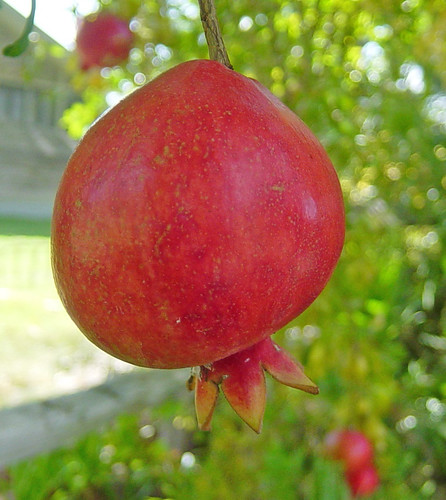
Pomegranate
A few years ago, I did a post on places in the Bible where figs were mentioned. A commenter suggested that I also do one on apples. I did so recently. One of the passages included also mentioned pomegranates, so I am also doing a post on pomegranates, as mentioned in the Bible. I used a search in the King James Version, and also one in the English Standard Version. The searches gave the same results.

Pomegranates are native to what is now Iran, and have been cultivated since the Bronze Age, according to the Wikipedia.

 Here are the references that I found, given in the World English Bible, which is public domain:

Exodus 28:31 “You shall make the robe of the ephod all of blue. 32 It shall have a hole for the head in the middle of it. It shall have a binding of woven work around its hole, as it were the hole of a coat of mail, that it not be torn. 33 On its hem you shall make pomegranates of blue, and of purple, and of scarlet, around its hem; and bells of gold between and around them: 34 a golden bell and a pomegranate, a golden bell and a pomegranate, around the hem of the robe. (Exodus 28 has a similar passage.)

1 Samuel 14:2 Saul stayed in the uttermost part of Gibeah under the pomegranate tree which is in Migron: and the people who were with him were about six hundred men;

Song of Solomon  4:3 Your lips are like scarlet thread.
Your mouth is lovely.
Your temples are like a piece of a pomegranate behind your veil. (Song of Solomon 6:7 is similar.)

Song of Solomon 8:2 I would lead you, bringing you into my mother’s house,
who would instruct me.
I would have you drink spiced wine,
of the juice of my pomegranate.

Joel 1:12 The vine has dried up, and the fig tree withered;
the pomegranate tree, the palm tree also, and the apple tree,
even all of the trees of the field are withered;
for joy has withered away from the sons of men.

Haggai “‘... 2:19  Is the seed yet in the barn? Yes, the vine, the fig tree, the pomegranate, and the olive tree haven’t produced. From today I will bless you.’”


Thanks for reading.


Monday, October 06, 2014

Apples in the Bible

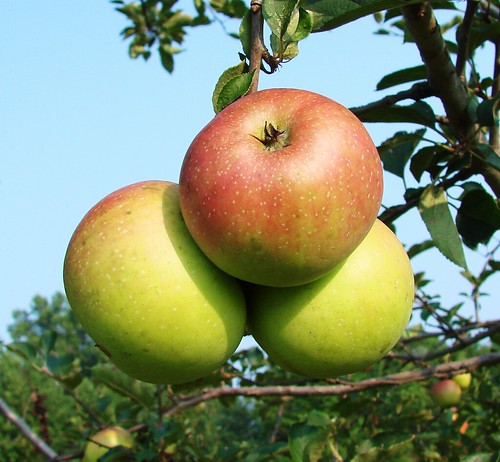
Apples on tree

A few years ago, I posted on figs, as mentioned in the Bible. A commenter suggested that I do the same for apples.

The Wikipedia says that apples were originally domesticated in what is now Turkey, some thousands of years ago.

I did a search, using the King James Version, and another, using the English Standard Version. A few references, in the KJV, to the apple of one's eye, were not included. The results are given below. The two versions gave the same results, which are given from the World English Bible, which is in the public domain. I thank the commenter.

Genesis does not specify that the forbidden fruit was an apple. Perhaps, perhaps not. Revelation 22:2 mentions fruit trees, in the Final Kingdom, but does not say what kind of fruit these might be.

Song of Solomon 2:3a As the apple tree among the trees of the wood,
so is my beloved among the sons.

Song of Solomon 8:5b Under the apple tree I aroused you.
There your mother conceived you.
There she was in labor and bore you.

Joel 1:12 The vine has dried up, and the fig tree withered;
the pomegranate tree, the palm tree also, and the apple tree,
even all of the trees of the field are withered;
for joy has withered away from the sons of men.

Sunday, May 18, 2014

Does the Bible really say that? Excerpt from my book, 35

A person who is saved bears fruit of salvation
Matthew 13:18 “Hear, then, the parable of the farmer. 19 When anyone hears the word of the Kingdom, and doesn’t understand it, the evil one comes, and snatches away that which has been sown in his heart. This is what was sown by the roadside. 20 What was sown on the rocky places, this is he who hears the word, and immediately with joy receives it; 21 yet he has no root in himself, but endures for a while. When oppression or persecution arises because of the word, immediately he stumbles. 22 What was sown among the thorns, this is he who hears the word, but the cares of this age and the deceitfulness of riches choke the word, and he becomes unfruitful. 23 What was sown on the good ground, this is he who hears the word, and understands it, who most certainly bears fruit, and produces, some one hundred times as much, some sixty, and some thirty.”

Matthew 7:16 By their fruits you will know them. Do you gather grapes from thorns, or figs from thistles? 17 Even so, every good tree produces good fruit; but the corrupt tree produces evil fruit. 18 A good tree can’t produce evil fruit, neither can a corrupt tree produce good fruit. 19 Every tree that doesn’t grow good fruit is cut down, and thrown into the fire. 20 Therefore by their fruits you will know them. 21 Not everyone who says to me, ‘Lord, Lord,’ will enter into the Kingdom of Heaven; but he who does the will of my Father who is in heaven. 22 Many will tell me in that day, ‘Lord, Lord, didn’t we prophesy in your name, in your name cast out demons, and in your name do many mighty works?’ 23 Then I will tell them, ‘I never knew you. Depart from me, you who work iniquity.’

John 15:1 “I am the true vine, and my Father is the farmer. 2 Every branch in me that doesn’t bear fruit, he takes away. Every branch that bears fruit, he prunes, that it may bear more fruit. 3 You are already pruned clean because of the word which I have spoken to you. 4 Remain in me, and I in you. As the branch can’t bear fruit by itself, unless it remains in the vine, so neither can you, unless you remain in me. 5 I am the vine. You are the branches. He who remains in me, and I in him, the same bears much fruit, for apart from me you can do nothing. 6 If a man doesn’t remain in me, he is thrown out as a branch, and is withered; and they gather them, throw them into the fire, and they are burned. 7 If you remain in me, and my words remain in you, you will ask whatever you desire, and it will be done for you.

Jesus does not explain what “fruit” is. But He calls it “good fruit,” and says that we must remain in Him in order to produce it. The fruit is probably two related things: 1) influencing people to be converted, (See Chapter Three) and 2) the Fruits of the Spirit, described in Galatians 5, which also describes bad fruit:

Galatians 5:19 Now the deeds of the flesh are obvious, which are: adultery, sexual immorality, uncleanness, lustfulness, 20 idolatry, sorcery, hatred, strife, jealousies, outbursts of anger, rivalries, divisions, heresies, 21 envy, murders, drunkenness, orgies, and things like these; of which I forewarn you, even as I also forewarned you, that those who practice such things will not inherit the Kingdom of God.
22 But the fruit of the Spirit is love, joy, peace, patience, kindness, goodness, faith, 23 gentleness, and self-control. Against such things there is no law. 24 Those who belong to Christ have crucified the flesh with its passions and lusts. 25 If we live by the Spirit, let’s also walk by the Spirit. 26 Let’s not become conceited, provoking one another, and envying one another.


The above material is an excerpt from my recently self-published e-book, Does the Bible Really Say That?, which may be obtained free of charge, or purchased from Amazon for $0.99, which is the lowest price Amazon lets an author set. Scripture quotations are from the World English Bible, which is in the public domain.

The previous post in this series, which began this topic, is here. God willing, the next post in this series will continue the topic of this post. Thanks for reading.

Sunday, May 11, 2014

Does the Bible really say that? Excerpt from my book, 34

Are there clues to help decide whether someone is a Christian or not?
Clue 1: Bearing fruit of salvation
Matthew 7:16 By their fruits you will know them.

Galatians 5:22 But the fruit of the Spirit is love, joy, peace, patience, kindness, goodness, faith, 23 gentleness, and self-control. Against such things there is no law.

Clue 2: Keeping Christ’s commandments
John 14:21 One who has my commandments, and keeps them, that person is one who loves me. One who loves me will be loved by my Father, and I will love him, and will reveal myself to him.”

John 15:14 You are my friends, if you do whatever I command you.

1 John 1:3 This is how we know that we know him: if we keep his commandments. 4 One who says, “I know him,” and doesn’t keep his commandments, is a liar, and the truth isn’t in him.

Clue 3: Not being a habitual sinner
1 John 2:1 My little children, I write these things to you so that you may not sin. If anyone sins, we have a Counselor with the Father, Jesus Christ, the righteous.

Romans 6:1 What shall we say then? Shall we continue in sin, that grace may abound? 2 May it never be! We who died to sin, how could we live in it any longer?

Clue 4: Keeping a relationship with Christ, and with other Christians
John 15:4 Remain in me, and I in you. As the branch can’t bear fruit by itself, unless it remains in the vine, so neither can you, unless you remain in me. 5 I am the vine. You are the branches. He who remains in me, and I in him, the same bears much fruit, for apart from me you can do nothing.

Hebrews 10:24 Let us consider how to provoke one another to love and good works, 25 not forsaking our own assembling together, as the custom of some is, but exhorting one another; and so much the more, as you see the Day approaching.

In other words, a Christian grows to be more and more like Christ.

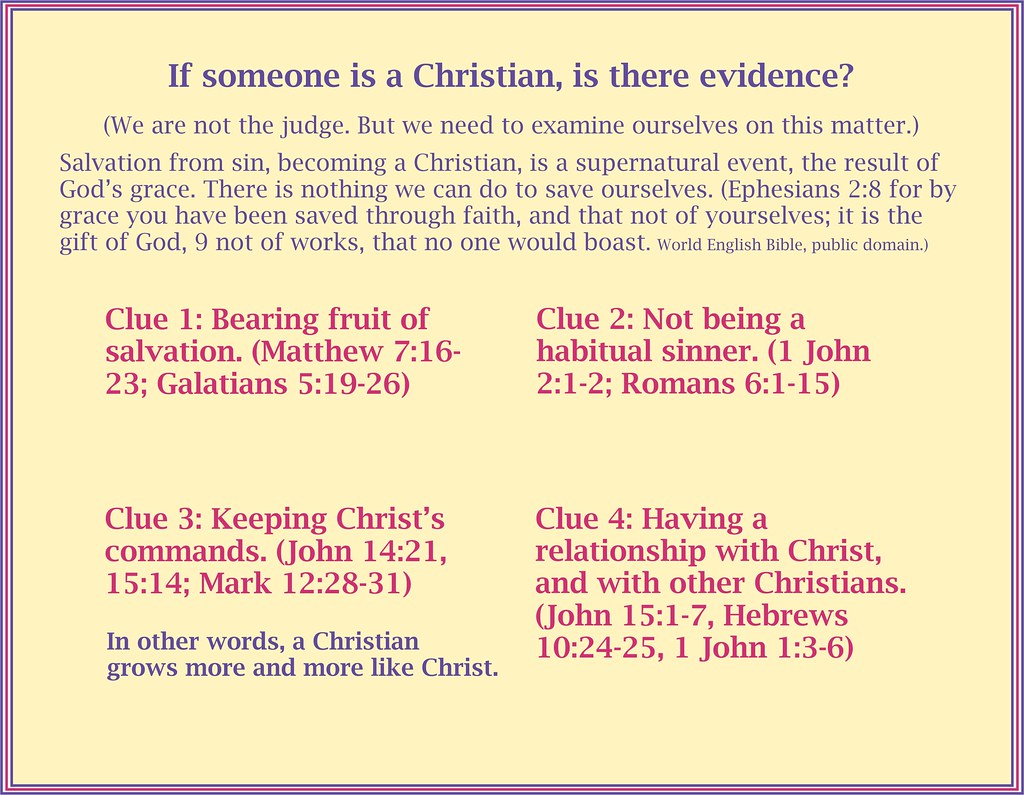
The material above is shown in the following graphic. You are free to use that graphic for any non-commercial use.


Evidence for Being a Christian

The above material, except for the graphic, which was not in the book, is an excerpt from my recently self-published e-book, Does the Bible Really Say That?, which may be obtained free of charge, or purchased from Amazon for $0.99, which is the lowest price Amazon lets an author set. Scripture quotations are from the World English Bible, which is in the public domain.

The previous post in this series, which began this topic, is here. God willing, the next post in this series will continue the topic of this post. Thanks for reading.

Saturday, August 11, 2012

Evidence for being a Christian: What the Bible says

Evidence for Being a Christian
(The graphic above is a link to a larger version, which you are free to use for non-commercial purposes.)


Who is saved?

We cannot save ourselves, and the church cannot save us.
Salvation from sin is a supernatural event, the result of God’s grace. We can ask forgiveness for sin, and accept Christ’s atoning sacrifice, and the power of the resurrection. We need to do these things. But salvation is God’s work in us. (Ephesians 2:8 for by grace you have been saved through faith, and that not of yourselves; it is the gift of God, 9 not of works, that no one would boast. (Scripture quotations from the World English Bible, public domain)

Furthermore, raising our hands, saying a prayer, kneeling at a mourner’s bench, shaking a preacher’s hand, testifying to being saved, being baptized, having our names on a church roll do not and cannot save us, in and of themselves. (There is nothing wrong with these acts, or similar ones, and most converts ought to do most or all of them, especially baptism, but they don’t save us.) In other words, no one is saved because she thinks she is, or because he joined the church 15 years ago. If she or he is saved, it is because of God’s forgiveness. Whether we are saved or not is ultimately a question that only God can really answer. I once heard a Southern Baptist pastor say that about 50% of the people on the rolls of his church weren’t really saved. Why did he say that? Because, although they had participated in one or more of the acts listed above, they showed no evidence of salvation. (Southern Baptists are by no means alone in this!)

A person who is saved bears fruit of salvation 
Matthew 13:18 “Hear, then, the parable of the farmer. 19 When anyone hears the word of the Kingdom, and doesn’t understand it, the evil one comes, and snatches away that which has been sown in his heart. This is what was sown by the roadside. 20 What was sown on the rocky places, this is he who hears the word, and immediately with joy receives it; 21 yet he has no root in himself, but endures for a while. When oppression or persecution arises because of the word, immediately he stumbles. 22 What was sown among the thorns, this is he who hears the word, but the cares of this age and the deceitfulness of riches choke the word, and he becomes unfruitful. 23 What was sown on the good ground, this is he who hears the word, and understands it, who most certainly bears fruit, and produces, some one hundred times as much, some sixty, and some thirty.”

Matthew 7:16 By their fruits you will know them. Do you gather grapes from thorns, or figs from thistles? 17 Even so, every good tree produces good fruit; but the corrupt tree produces evil fruit. 18 A good tree can’t produce evil fruit, neither can a corrupt tree produce good fruit. 19 Every tree that doesn’t grow good fruit is cut down, and thrown into the fire. 20 Therefore by their fruits you will know them. 21 Not everyone who says to me, ‘Lord, Lord,’ will enter into the Kingdom of Heaven; but he who does the will of my Father who is in heaven. 22 Many will tell me in that day, ‘Lord, Lord, didn’t we prophesy in your name, in your name cast out demons, and in your name do many mighty works?’ 23 Then I will tell them, ‘I never knew you. Depart from me, you who work iniquity.’

John 15:1 “I am the true vine, and my Father is the farmer. 2 Every branch in me that doesn’t bear fruit, he takes away. Every branch that bears fruit, he prunes, that it may bear more fruit. 3 You are already pruned clean because of the word which I have spoken to you. 4 Remain in me, and I in you. As the branch can’t bear fruit by itself, unless it remains in the vine, so neither can you, unless you remain in me. 5 I am the vine. You are the branches. He who remains in me, and I in him, the same bears much fruit, for apart from me you can do nothing. 6 If a man doesn’t remain in me, he is thrown out as a branch, and is withered; and they gather them, throw them into the fire, and they are burned. 7 If you remain in me, and my words remain in you, you will ask whatever you desire, and it will be done for you.

Jesus does not explain what “fruit” is. But He calls it “good fruit,” and says that we must remain in Him in order to produce it. The fruit is probably two related things: influencing people to be converted, and the Fruits of the Spirit, described in Galatians 5, which also describes bad fruit:

Galatians 5:19 Now the deeds of the flesh are obvious, which are: adultery, sexual immorality, uncleanness, lustfulness, 20 idolatry, sorcery, hatred, strife, jealousies, outbursts of anger, rivalries, divisions, heresies, 21 envy, murders, drunkenness, orgies, and things like these; of which I forewarn you, even as I also forewarned you, that those who practice such things will not inherit the Kingdom of God.
22 But the fruit of the Spirit is love, joy, peace, patience, kindness, goodness, faith, 23 gentleness, and self-control. Against such things there is no law. 24 Those who belong to Christ have crucified the flesh with its passions and lusts. 25 If we live by the Spirit, let’s also walk by the Spirit. 26 Let’s not become conceited, provoking one another, and envying one another.

A person who is saved is not a habitual sinner.
(Note: To some people, sin is anything short of perfection – to them, honest mistakes, and memory lapses, are sin. However, I am using a more restrictive definition, from the Free Dictionary: 1. A transgression of a religious or moral law, especially when deliberate.  
2. Theology
a. Deliberate disobedience to the known will of God. b. A condition of estrangement from God resulting from such disobedience.
We should remember that there are sins of omission – things that we should do, but don’t – as well as sins of commission. See James 4:17 and Matthew 25:40-25.
Newly saved people don't instantly become mature Christians. The Holy Spirit works to develop us. Even mature Christians may newly realize some sin as He reveals it to them. Psalm 86:11a Teach me your way, Yahweh.)

1 John 2:1 My little children, I write these things to you so that you may not sin. If anyone sins, we have a Counselor with the Father, Jesus Christ, the righteous. 2 And he is the atoning sacrifice for our sins, and not for ours only, but also for the whole world.

Romans 6:1 What shall we say then? Shall we continue in sin, that grace may abound? 2 May it never be! We who died to sin, how could we live in it any longer? 3 Or don’t you know that all we who were baptized into Christ Jesus were baptized into his death? 4 We were buried therefore with him through baptism to death, that just as Christ was raised from the dead through the glory of the Father, so we also might walk in newness of life. 5 For if we have become united with him in the likeness of his death, we will also be part of his resurrection; 6 knowing this, that our old man was crucified with him, that the body of sin might be done away with, so that we would no longer be in bondage to sin. 7 For he who has died has been freed from sin. 8 But if we died with Christ, we believe that we will also live with him; 9 knowing that Christ, being raised from the dead, dies no more. Death no more has dominion over him! 10 For the death that he died, he died to sin one time; but the life that he lives, he lives to God. 11 Thus consider yourselves also to be dead to sin, but alive to God in Christ Jesus our Lord. 12 Therefore don’t let sin reign in your mortal body, that you should obey it in its lusts. 13 Also, do not present your members to sin as instruments of unrighteousness, but present yourselves to God, as alive from the dead, and your members as instruments of righteousness to God. 14 For sin will not have dominion over you. For you are not under law, but under grace. 15 What then? Shall we sin, because we are not under law, but under grace? May it never be!

A person who is saved follows Christ’s commandments.
John 14:21 One who has my commandments, and keeps them, that person is one who loves me. One who loves me will be loved by my Father, and I will love him, and will reveal myself to him.”
23 Jesus answered him, “If a man loves me, he will keep my word. My Father will love him, and we will come to him, and make our home with him. 24 He who doesn’t love me doesn’t keep my words.

John 15:14  You are my friends, if you do whatever I command you.

1 John 1:3 This is how we know that we know him: if we keep his commandments. 4 One who says, “I know him,” and doesn’t keep his commandments, is a liar, and the truth isn’t in him. 5 But whoever keeps his word, God’s love has most certainly been perfected in him. This is how we know that we are in him: 6 he who says he remains in him ought himself also to walk just like he walked.

Matthew 7:24 “Everyone therefore who hears these words of mine, and does them, I will liken him to a wise man, who built his house on a rock. 25 The rain came down, the floods came, and the winds blew, and beat on that house; and it didn’t fall, for it was founded on the rock. 26 Everyone who hears these words of mine, and doesn’t do them will be like a foolish man, who built his house on the sand. 27 The rain came down, the floods came, and the winds blew, and beat on that house; and it fell—and great was its fall.”

What are Christ’s commandments?
Many of them are found in the Sermon on the Mount (Matthew 5-7). Some of the commands in that Sermon are to keep our motives pure – don’t even want to commit adultery or murder; be reconciled to others, and forgive them; turn the other cheek; love even your enemies; don’t draw attention to your good deeds; don’t be anxious about worldly possessions; judge yourselves before judging others; beware of false prophets. He also told us to live the summary of the Old Testament Law:

Matthew 22:37 Jesus said to him, “‘You shall love the Lord your God with all your heart, with all your soul, and with all your mind.’ 38 This is the first and great commandment. 39 A second likewise is this, ‘You shall love your neighbor as yourself.’ 40 The whole law and the prophets depend on these two commandments.”

In Mark 12:14-19, Jesus commanded His listeners to honor the government, including paying taxes. We should remember that this was an occupying government, and its head was a Roman pagan emperor.

There are other commands, but one more is found in the last words of Matthew’s gospel: Matthew 28:19 Go, and make disciples of all nations, baptizing them in the name of the Father and of the Son and of the Holy Spirit, 20 teaching them to observe all things that I commanded you. Behold, I am with you always, even to the end of the age.” Amen.

A person who is saved continues in a relationship with Christ, and seeks the fellowship of other Christians. 
John 15:1-7 (quoted above) uses the phrase “remain in me” or equivalent, seven times.

John 17:20 Not for these only do I pray, but for those also who believe in me through their word, 21 that they may all be one; even as you, Father, are in me, and I in you, that they also may be one in us; that the world may believe that you sent me. 22 The glory which you have given me, I have given to them; that they may be one, even as we are one; 23 I in them, and you in me, that they may be perfected into one; that the world may know that you sent me, and loved them, even as you loved me.

Hebrews 10:24 Let us consider how to provoke one another to love and good works, 25 not forsaking our own assembling together, as the custom of some is, but exhorting one another; and so much the more, as you see the Day approaching.

There are about 20 occurrences of groups of Christians being together in Acts. (See here.) Sometimes they met to worship, sometimes as a prayer meeting, sometimes to consider policy or doctrine. It was Paul’s practice to establish churches wherever he went as a missionary. Christ refers to seven churches in Revelation.

To summarize the evidences given above for being a Christian, a Christian becomes more and more like Christ. The Holy Spirit works in the life of a believer to bring these things about.

My conclusion is that as long as we remain in good relationship with God, we will keep Christ’s commandments, our lives will bear fruit, and we will not lose our salvation. Perhaps I ought to stop there, but the original question still remains. There are at least two views of the answer, both with Biblical support, but the question, and its answers, are trivial beside the more important question – am I saved now? Unfortunately, some people, who don't follow Christ's commandments, who do not have a relationship with Christ, who are persistent and unrepentant sinners, and whose lives show the wrong kind of fruit, are deluded by Satan into thinking that they are saved when they are not.

Thanks for reading!

Added October 26, 2012: You may want to see this post, on the warning passages in the book of Hebrews.

Added June 9, 2015: Neither the chart, nor the above discussion, consider baptism as evidence that one is a Christian. In Acts, baptism was perhaps the most important sign of being converted. Jesus commanded the church to baptize new believers. It's important! But what the chart and discussion are really about is ongoing evidence, up-to-date evidence. Baptism, for most believers, is a one-time event. The four evidences above are about our continuing life in Christ.

Tuesday, July 24, 2012

Is there evidence of conversion?

Is there evidence of conversion? I believe so. It's not up to me to judge, and the person I need to be most concerned about is me, not someone else, but here's some of what the Bible says on the subject:

A person who is saved bears fruit of salvation.

Matthew 13:18 “Hear, then, the parable of the farmer. 19 When anyone hears the word of the Kingdom, and doesn’t understand it, the evil one comes, and snatches away that which has been sown in his heart. This is what was sown by the roadside. 20 What was sown on the rocky places, this is he who hears the word, and immediately with joy receives it; 21 yet he has no root in himself, but endures for a while. When oppression or persecution arises because of the word, immediately he stumbles. 22 What was sown among the thorns, this is he who hears the word, but the cares of this age and the deceitfulness of riches choke the word, and he becomes unfruitful. 23 What was sown on the good ground, this is he who hears the word, and understands it, who most certainly bears fruit, and produces, some one hundred times as much, some sixty, and some thirty.” (Scripture quotations from the World English Bible, public domain)

Matthew 7:16 By their fruits you will know them. Do you gather grapes from thorns, or figs from thistles? 17 Even so, every good tree produces good fruit; but the corrupt tree produces evil fruit. 18 A good tree can’t produce evil fruit, neither can a corrupt tree produce good fruit. 19 Every tree that doesn’t grow good fruit is cut down, and thrown into the fire. 20 Therefore by their fruits you will know them. 21 Not everyone who says to me, ‘Lord, Lord,’ will enter into the Kingdom of Heaven; but he who does the will of my Father who is in heaven. 22 Many will tell me in that day, ‘Lord, Lord, didn’t we prophesy in your name, in your name cast out demons, and in your name do many mighty works?’ 23 Then I will tell them, ‘I never knew you. Depart from me, you who work iniquity.’

John 15:1 “I am the true vine, and my Father is the farmer. 2 Every branch in me that doesn’t bear fruit, he takes away. Every branch that bears fruit, he prunes, that it may bear more fruit. 3 You are already pruned clean because of the word which I have spoken to you. 4 Remain in me, and I in you. As the branch can’t bear fruit by itself, unless it remains in the vine, so neither can you, unless you remain in me. 5 I am the vine. You are the branches. He who remains in me, and I in him, the same bears much fruit, for apart from me you can do nothing. 6 If a man doesn’t remain in me, he is thrown out as a branch, and is withered; and they gather them, throw them into the fire, and they are burned. 7 If you remain in me, and my words remain in you, you will ask whatever you desire, and it will be done for you.

Jesus does not explain what “fruit” is. But He calls it “good fruit,” and says that we must remain in Him in order to produce it. The fruit is probably two related things: influencing people to be converted, and the Fruits of the Spirit, described in Galatians 5, which also describes bad fruit:

Galatians 5:19 Now the deeds of the flesh are obvious, which are: adultery, sexual immorality, uncleanness, lustfulness, 20 idolatry, sorcery, hatred, strife, jealousies, outbursts of anger, rivalries, divisions, heresies, 21 envy, murders, drunkenness, orgies, and things like these; of which I forewarn you, even as I also forewarned you, that those who practice such things will not inherit the Kingdom of God.

22 But the fruit of the Spirit is love, joy, peace, patience, kindness, goodness, faith, 23 gentleness, and self-control. Against such things there is no law. 24 Those who belong to Christ have crucified the flesh with its passions and lusts. 25 If we live by the Spirit, let’s also walk by the Spirit. 26 Let’s not become conceited, provoking one another, and envying one another.

A person who is saved is not a habitual sinner.

(Note: To some people, sin is anything short of perfection – to them, honest mistakes, and memory lapses, are sin. However, I am using a more restrictive definition, from the Free Dictionary:

1. A transgression of a religious or moral law, especially when deliberate.
2. Theology
a. Deliberate disobedience to the known will of God.
b. A condition of estrangement from God resulting from such disobedience.

We should remember that there are sins of omission – things that we should do, but don’t – as well as sins of commission. See James 4:17 and Matthew 25:40-25.)

1 John 1:1 My little children, I write these things to you so that you may not sin. If anyone sins, we have a Counselor with the Father, Jesus Christ, the righteous. 2 And he is the atoning sacrifice for our sins, and not for ours only, but also for the whole world.

Romans 6:1 What shall we say then? Shall we continue in sin, that grace may abound? 2 May it never be! We who died to sin, how could we live in it any longer? 3 Or don’t you know that all we who were baptized into Christ Jesus were baptized into his death? 4 We were buried therefore with him through baptism to death, that just as Christ was raised from the dead through the glory of the Father, so we also might walk in newness of life. 5 For if we have become united with him in the likeness of his death, we will also be part of his resurrection; 6 knowing this, that our old man was crucified with him, that the body of sin might be done away with, so that we would no longer be in bondage to sin. 7 For he who has died has been freed from sin. 8 But if we died with Christ, we believe that we will also live with him; 9 knowing that Christ, being raised from the dead, dies no more. Death no more has dominion over him! 10 For the death that he died, he died to sin one time; but the life that he lives, he lives to God. 11 Thus consider yourselves also to be dead to sin, but alive to God in Christ Jesus our Lord.

12 Therefore don’t let sin reign in your mortal body, that you should obey it in its lusts. 13 Also, do not present your members to sin as instruments of unrighteousness, but present yourselves to God, as alive from the dead, and your members as instruments of righteousness to God. 14 For sin will not have dominion over you. For you are not under law, but under grace. 15 What then? Shall we sin, because we are not under law, but under grace? May it never be!

A person who is saved follows Christ’s commandments.

John 14:21 One who has my commandments, and keeps them, that person is one who loves me. One who loves me will be loved by my Father, and I will love him, and will reveal myself to him.”

23 Jesus answered him, “If a man loves me, he will keep my word. My Father will love him, and we will come to him, and make our home with him. 24 He who doesn’t love me doesn’t keep my words.

John 17:15 I pray not that you would take them from the world, but that you would keep them from the evil one. 16 They are not of the world even as I am not of the world. 17 Sanctify them in your truth. Your word is truth. 18 As you sent me into the world, even so I have sent them into the world.

1 John 2:3 This is how we know that we know him: if we keep his commandments. 4 One who says, “I know him,” and doesn’t keep his commandments, is a liar, and the truth isn’t in him. 5 But whoever keeps his word, God’s love has most certainly been perfected in him. This is how we know that we are in him: 6 he who says he remains in him ought himself also to walk just like he walked.

Matthew 7:24 “Everyone therefore who hears these words of mine, and does them, I will liken him to a wise man, who built his house on a rock. 25 The rain came down, the floods came, and the winds blew, and beat on that house; and it didn’t fall, for it was founded on the rock. 26 Everyone who hears these words of mine, and doesn’t do them will be like a foolish man, who built his house on the sand. 27 The rain came down, the floods came, and the winds blew, and beat on that house; and it fell—and great was its fall.”


For more on what Christ's commandments are, see here.

A person who is saved continues in a relationship with Christ, and seeks the fellowship of other Christians.

John 15:1-7 (quoted above) uses the phrase “remain in me” or equivalent, seven times.

John 17:20 Not for these only do I pray, but for those also who believe in me through their word, 21 that they may all be one; even as you, Father, are in me, and I in you, that they also may be one in us; that the world may believe that you sent me. 22 The glory which you have given me, I have given to them; that they may be one, even as we are one; 23 I in them, and you in me, that they may be perfected into one; that the world may know that you sent me, and loved them, even as you loved me.

Hebrews 10:24 Let us consider how to provoke one another to love and good works, 25 not forsaking our own assembling together, as the custom of some is, but exhorting one another; and so much the more, as you see the Day approaching.

There are about 20 occurrences of groups of Christians being together in Acts. Sometimes they met to worship, sometimes as a prayer meeting, sometimes to consider policy or doctrine. It was Paul’s practice to establish churches wherever he went as a missionary. Christ speaks to seven churches, not individuals, in Revelation.

To summarize the evidences given above for being a Christian, a Christian becomes more and more like Christ. The Holy Spirit works in the life of a believer to bring these things about.


Thanks for reading!

August 19, 2012: This document, slightly modified, was re-posted, with a graphic at the beginning, a few days later, here.

Wednesday, October 05, 2011

Sunspots 334

Things I have recently spotted that may be of interest to someone else:

 
Science: National Public Radio reports on the paw paw, a fruit native to North America that you may have never heard of.

Wired reports on a possible case of human change in response to natural selection, namely lowering of the age when women had their first child, within the past 200 years.

Christianity: E Stephen Burnett points out that our own fallen human nature is never a movie villain. It's usually some monster, or some monstrous human.

Image source (public domain)

Friday, July 20, 2007

Pomegranates in the Bible

Pomegranate flower buds

The photo above is of a pomegranate flower bud, about to open, taken in Southern California. The color is natural. The largest bud in the photo was about 2 inches/7 cm long. The photo is a live link to our Flickr photos.

Based on the Bible, pomegranates must have been important in the culture of the Middle East.

Exodus 28 and 39 say that the garment worn by the priest was to be decorated with blue, purple and scarlet pomegranates, made of yarn.

When the spies came back from Israel to Moses and the people, they brought samples of the fruit of the land, including pomegranates.

To the ancient Israelites, and to God, one of the signs that a land was good was that it was able to grow pomegranates. (Deuteronomy 8) In the desert, they complained to Moses that they would rather have stayed in Egypt, because there were no pomegranates in the desert. (Numbers 20)

Solomon's temple had bronze pillars, decorated with pomegranates. (I Kings 7)

The Song of Solomon, that great poem to erotic love, describes a beautiful woman's cheeks as being like the halves of a pomegranate.

Here's a photo of a more mature pomegranate fruit. Here's the Wikipedia article on pomegranates.

Thanks for reading!