License

I have written an e-book, Does the Bible Really Say That?, which is free to anyone. To download that book, in several formats, go here.
Creative Commons License
The posts in this blog are licensed under a Creative Commons Attribution-NonCommercial-ShareAlike 3.0 Unported License. You can copy and use this material, as long as you aren't making money from it. If you give me credit, thanks. If not, OK.
Showing posts with label predestination. Show all posts

Sunday, June 22, 2014

Does the Bible really say that? Excerpt from my book, 40


The previous chapter of my book dealt with the question of who is saved, and pointed out that the Bible describes some characteristics of such a person -- not everyone who believes she has been redeemed really is. The next topic follows:

Nine: Can a believer lose salvation?

In this chapter, I’m going to present the Biblical evidence for both a “yes” and a “no” answer to that question – there’s a lot of evidence supporting both sides. I have my beliefs, but this study has been instructive in helping me to realize that the people who disagree with me on this issue have some good reasons for doing so. I hope this study does the same for you, the reader.

Eternal Security

Does the Bible say that, once a person becomes a believer, they cannot be lost? I will call a belief that answers “yes” to that question a belief in eternal security.

There is a related topic, Predestination. A particular doctrinal outlook, related to predestination, namely Calvinism, is related to eternal security. But there are many Christians who do not believe all of Calvinism to be correct, but still believe in eternal security. This is true of many Southern Baptists, for example. Article Nine of this statement of traditional Southern Baptist belief says:

We affirm that when a person responds in faith to the Gospel, God promises to complete the process of salvation in the believer into eternity. This process begins with justification, whereby the sinner is immediately acquitted of all sin and granted peace with God; continues in sanctification, whereby the saved are progressively conformed to the image of Christ by the indwelling Holy Spirit; and concludes in glorification, whereby the saint enjoys life with Christ in heaven forever.

We deny that this Holy Spirit-sealed relationship can ever be broken. We deny even the possibility of apostasy. (Emphasis in original.)

Note - “Apostasy: Abandonment of one’s religious faith, a political party, one’s principles, or a cause.” (The Free Dictionary)
The word, apostasy, occurs only twice in the New Testament, in Acts 21:21 and 2 Timothy 2:3. Most English versions of the Bible do not use apostasy in translating from the Greek, probably because readers might not be familiar with it.

Clearly, many Southern Baptists (and others) do believe in eternal security. But there are also Christians who do not believe in eternal security. What does the Bible say about the question of the chapter?


The above material is an excerpt from my self-published e-book, Does the Bible Really Say That?, which may be obtained free of charge, or purchased from Amazon for $0.99, which is the lowest price Amazon lets an author set. Scripture quotations are from the World English Bible, which is in the public domain.

The previous post in this series, on the characteristics of a true Christian, is here. God willing, the next post in this series will consider a new topic. Thanks for reading.

Thursday, November 29, 2012

Predestination, foreknowledge and choice

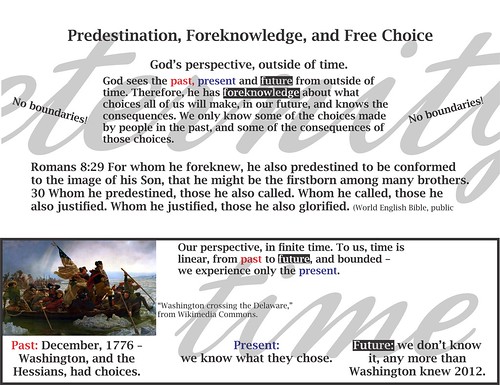
Predestination, foreknowledge, and free choice
The above graphic is an attempt to illustrate a controversial and complex subject, predestination, foreknowledge, and free choice. (The word, eternity, isn't completely shown in the illustration, on purpose, to symbolize the boundlessness of eternity.) The graphic should serve as a link to the original graphic on Flickr. Flickr members, at least, and perhaps others -- I'm not sure -- can see larger sizes of the graphic, by clicking on the magnifying glass icon above the graphic on its Flickr page. There is no password required to view Flickr pictures.

I believe that the Bible teaches that people have the ability to choose, at least in some areas. Here's some of the evidence.

The Bible also teaches predestination, for example in the verses quoted above, which are from Romans 8:
28 For whom he foreknew, he also predestined to be conformed to the image of his Son, that he might be the firstborn among many brothers. 29 Whom he predestined, those he also called. Whom he called, those he also justified. Whom he justified, those he also glorified. (World English Bible, public domain)

As I understand things, God is outside of time. Consider this: I think that Jane Smith is going to enter a situation that I wish to pray about, at two in the afternoon, and pray for this at that time. However, without my knowledge, the situation actually occurred three hours earlier. God could have taken my praying into account when influencing the situation, even though I hadn't prayed yet when it happened, because God knew that I would, and, in fact, God had experience my prayer when the event happened. God's knowledge, or foreknowledge, doesn't mean that I didn't have a choice about whether to pray. I did. But God knew that I would.

The graphic incorporates an image of General George Washington crossing the Delaware. I modified it by rotating it horizontally.

Thanks for looking! Make right choices.

Friday, November 16, 2012

Bible passages indicating that humans can choose salvation (or not)

I am aware that there are those, and they may be right, who believe that we can't really choose whether ot not to accept Christ's resurrected sacrifice for our sins, and His lordship. However, there are some Bible passages that indicated that we do have a choice in the matter. I will give them below, without presenting the Biblical evidence to the contrary -- and there is such evidence. See the Wikipedia article on predestination.

All quotations are from the World English Bible, which is public domain.

Some of these passages don't seem to say anything directly about free choice, but I have also included passages that indicate that salvation is for all people.

John 3:16 For God so loved the world, that he gave his one and only Son, that whoever believes in him should not perish, but have eternal life.

Acts 2:21 It will be that whoever will call on the name of the Lord will be saved.

Romans 5:17 For if by the trespass of the one, death reigned through the one; so much more will those who receive the abundance of grace and of the gift of righteousness reign in life through the one, Jesus Christ. 18 So then as through one trespass, all men were condemned; even so through one act of righteousness, all men were justified to life.

Romans 10:13 For, “Whoever will call on the name of the Lord will be saved.” (This quotes Leviticus 18:5, as does Acts 2:21.)

1 Timothy 2:5 For there is one God, and one mediator between God and men, the man Christ Jesus, 6 who gave himself as a ransom for all; the testimony in its own times;

1 Timothy 4:10 For to this end we both labor and suffer reproach, because we have set our trust in the living God, who is the Savior of all men, especially of those who believe.

1 John 2:2 And he is the atoning sacrifice for our sins, and not for ours only, but also for the whole world.

Revelation 3:20 Behold, I stand at the door and knock. If anyone hears my voice and opens the door, then I will come in to him, and will dine with him, and he with me.

Revelation 22:17 The Spirit and the bride say, “Come!” He who hears, let him say, “Come!” He who is thirsty, let him come. He who desires, let him take the water of life freely.

Thanks for reading!

* * * * *
Added November 29, 2012: I have now posted a graphic attempt to explain predestination, foreknowledge and choice, with some explanation.


Monday, October 29, 2012

Scripture that indicates that humans can choose salvation

This is a thorny topic, and one that I'm not expecting to settle. There are intelligent, Bible-believing people who disagree with the title of this post. See the Wikipedia articles on Free Will, Free will in theology, and Predestination for good treatment of this subject, including views opposed to mine. Now to what the title says, below. Some of these verses don't say anything directly about free choice, but these were chosen because they indicate that anyone may accept Christ's sacrifice for sin, thus implying that they may choose it:

John 3:16 For God so loved the world, that he gave his one and only Son, that whoever believes in him should not perish, but have eternal life. (All scripture quotations from the World English Bible, which is public domain.)

Acts 2:20 The sun will be turned into darkness,
and the moon into blood,
before the great and glorious day of the Lord comes.
21 It will be that whoever will call on the name of the Lord will be saved.’
(quoting Joel 2)

Romans 5:17 For if by the trespass of the one, death reigned through the one; so much more will those who receive the abundance of grace and of the gift of righteousness reign in life through the one, Jesus Christ. 18 So then as through one trespass, all men were condemned; even so through one act of righteousness, all men were justified to life.

Romans 10:12 For there is no distinction between Jew and Greek; for the same Lord is Lord of all, and is rich to all who call on him. 13 For, “Whoever will call on the name of the Lord will be saved.” (quoting Joel 2)

1 Corinthians 15:22 For as in Adam all die, so also in Christ all will be made alive.

1 Timothy 2:5 For there is one God, and one mediator between God and men, the man Christ Jesus, 6a who gave himself as a ransom for all; 

1 Timothy 4:10 For to this end we both labor and suffer reproach, because we have set our trust in the living God, who is the Savior of all men, especially of those who believe.

1 John 2:2 And he is the atoning sacrifice for our sins, and not for ours only, but also for the whole world.

Revelation 3:20 Behold, I stand at the door and knock. If anyone hears my voice and opens the door, then I will come in to him, and will dine with him, and he with me.

Revelation 22:17 The Spirit and the bride say, “Come!” He who hears, let him say, “Come!” He who is thirsty, let him come. He who desires, let him take the water of life freely.
 
Thanks for reading, whether you did it by a free choice, or not!

Thursday, May 21, 2009

Predestination and Intelligent Design

The Free Dictionary begins its definition of predestination thus:

"The doctrine that God has foreordained all things, especially that God has elected certain souls to eternal salvation."

On April 19, 2009, the Wikipedia article on predestination says "Predestination: The Divine foreordaining of all that will happen; with regard to the salvation of some and not others. It has been particularly associated with the teachings of St. Augustine of Hippo and of John Calvin."

In Ephesians 1 and Romans 8, predestination is mentioned, in the above senses.

As I understand the doctrine, it holds that some individuals are fore-ordained to eternal salvation, and some are not. There are differences of opinion about the doctrine among theologians, which are not pertinent to this post.

I pose a question: If God is capable of planning and ordaining, in advance, that some persons will gain salvation, and some won't, wasn't God also capable of planning, and ordaining, in advance, that, say, the Big Bang would produce sub-atomic particles that He knew would spontaneously assemble themselves into atoms, then, molecules? Wasn't God also capable of making things such that natural selection, once living things appeared, would select for complex molecules, structures, and processes?

Sometimes, a belief in intelligent design seems to imply that somehow God didn't get things right in the first place.

God is able, of course, to use His own methods and timetable, but perhaps God's creative activity involved such planning and forethought that little or no further miraculous intervention would be necessary.

I am aware that suggesting such a creation, with extensive emergent properties, might involve considerable death and suffering. I refer to this web page, by Glenn R. Morton, where Morton argues, using scripture, that death and suffering might well have occurred before the Fall. David Snoke has also made such an argument, using scripture. See here and here.

Thanks for reading.