License

I have written an e-book, Does the Bible Really Say That?, which is free to anyone. To download that book, in several formats, go here.
Creative Commons License
The posts in this blog are licensed under a Creative Commons Attribution-NonCommercial-ShareAlike 3.0 Unported License. You can copy and use this material, as long as you aren't making money from it. If you give me credit, thanks. If not, OK.
Showing posts with label time. Show all posts

Wednesday, December 21, 2022

Sunspots 915

Things I have recently spotted that may be of interest to others*:


Christianity: (and Politics) A Christianity Today article strongly argues against Christian Nationalism.

Computing: (or Health) Gizmodo reports that Google is developing software to read the handwriting of doctors.

Education: (and Computing) NPR reports on ChatGPT, which will write your papers for you, among other things.

Environment: Coyotes almost never attack adult humans. There is now an explanation for the death of a hiker, by coyotes, on Cape Breton Island, according to Gizmodo.

NPR reports that Louisiana is about to replace land lost to washing away with sediment from the Mississippi River.

NPR reports on a mountain lion in the Los Angeles area, which has been there for about ten years. It was subsequently euthanized.

Humor: (and Weather) NPR reports on how some snow removal equipment is getting goofy names, and is being followed on-line.

Politics: The Conversation on bipartisan bills to upgrade the way elections are counted and reported.

NPR on how Russia has been trying to ingest Ukraine for a century.

Science: According to NPR, some scientists think that time is an illusion.

The Conversation discusses stuttering.

*I try not to include items that require a password or fee to view.

Thanks for reading.


Sunday, February 27, 2022

With Christ in the school of prayer, by Andrew Murray, excerpt 115

This post continues a series of excerpts from With Christ in the School of Prayer, by Andrew Murray. I thank the Christian Classics Ethereal Library for making this public domain work available. To see their post of the book, go here. The previous post in this series is hereAs usual in this blog, long quotations are in this color. In this excerpt, Murray continues a discussion about prayer and the Trinity. His book is based on Mark 11:22-24.  

This may help us somewhat to understand how the prayer of man, coming through the Son, can have effect upon God. The decrees of God are not decisions made by Him without reference to the Son, or His petition, or the petition to be sent up through Him. By no means. The Lord Jesus is the first-begotten, the Head and Heir of all things: all things were created through Him and unto Him, and all things consist in Him. In the counsels of the Father, the Son, as Representative of all creation, had always a voice; in the decrees of the eternal purpose there was always room left for the liberty of the Son as Mediator and Intercessor, and so for the petitions of all who draw nigh to the Father in the Son.

And if the thought come that this liberty and power of the Son to act upon the Father is at variance with the immutability of the Divine decrees, let us not forget that there is not with God as with man, a past by which He is irrevocably bound. God does not live in time  with its past and future; the distinctions of time have no reference to Him who inhabits Eternity. And Eternity is an ever-present Now, in which the past is never past, and the future always present. To meet our human weakness, Scripture must speak of past decrees, and a coming future. In reality, the immutability of God’s counsel is ever still in perfect harmony with His liberty to do whatsoever He will. Not so were the prayers of the Son and His people taken up into the eternal decrees that their effect should only be an apparent one; but so, that the Father-heart holds itself open and free to listen to every prayer that rises through the Son, and that God does indeed allow Himself to be decided by prayer to do what He otherwise would not have done.

Saturday, January 26, 2019

Some important uses of the number twelve

12, highlighting 12 
Some important uses of the number twelve

This is the last of a series, attempting to show some of the most important uses of the numbers two through twelve (except eleven) in our culture. It is obvious that twelve has been, and is, culturally important. I did not include the twelve tribes of Israel, but they weren't exactly twelve -- Jacob had twelve sons, but the tribe of Levi was not included, for some purposes, in national matters, and Joseph's two sons, Ephraim and Manasseh, each founded a tribe. Further, Manasseh's offspring ended up living in two areas, one on each side of the Jordan River.

Thanks for looking!

Monday, September 18, 2017

Genesis 1:1 in terms of today's science

Genesis was communicated for the culture of its time. It says nothing about bacteria, cells, atoms, or galaxies. That doesn't mean, of course, that God didn't know about these things!

Ken Schenck has reverently re-written Genesis 1:1 in terms of modern science. (The result will be more meaningful, the better science background you have. Schenck, who is Dean of a School of Theology, has a fine background in science.) In case you are wondering, Schenck's essay says nothing about how old the earth is, nor about the origin of humans. It's about the origin of everything, from nothing.

Thanks for reading. Read Schenck!

Thursday, October 15, 2015

Tenses in the book of Revelation

Revelation 1:4 John, to the seven assemblies that are in Asia: Grace to you and peace from God, who is and who was and who is to come; and from the seven Spirits who are before his throne;
 

1:7 Behold, he is coming with the clouds, and every eye will see him, including those who pierced him. All the tribes of the earth will mourn over him. Even so, Amen.
 

3:11a I am coming quickly!
 

3:15 “I know your works, that you are neither cold nor hot. I wish you were cold or hot. 16  So, because you are lukewarm, and neither hot nor cold, I will vomit you out of my mouth.
 

4:1 After these things I looked and saw a door opened in heaven, and the first voice that I heard, like a trumpet speaking with me, was one saying, “Come up here, and I will show you the things which must happen after this.”
 
4:8 The four living creatures, each one of them having six wings, are full of eyes around and within. They have no rest day and night, saying, “Holy, holy, holy is the Lord God, the Almighty, who was and who is and who is to come!”
9 When the living creatures give glory, honor, and thanks to him who sits on the throne, to him who lives forever and ever, 10a the twenty-four elders fall down before him who sits on the throne, and worship him who lives forever and ever...


5:3 No one in heaven above, or on the earth, or under the earth, was able to open the book or to look in it. 4 Then I wept much, because no one was found worthy to open the book or to look in it. 5 One of the elders said to me, “Don’t weep. Behold, the Lion who is of the tribe of Judah, the Root of David, has overcome: he who opens the book and its seven seals.” 6a I saw in the middle of the throne and of the four living creatures, and in the middle of the elders, a Lamb standing, as though it had been slain ...


6:1 I saw that the Lamb opened one of the seven seals, and I heard one of the four living creatures saying, as with a voice of thunder, “Come and see!”
 

7:13 One of the elders answered, saying to me, “These who are arrayed in the white robes, who are they, and where did they come from?”
14 I told him, “My lord, you know.”
He said to me, “These are those who came out of the great tribulation. They washed their robes, and made them white in the Lamb’s blood. 15a Therefore they are before the throne of God, they serve him day and night in his temple. 


11:3 I will give power to my two witnesses, and they will prophesy one thousand two hundred sixty days, clothed in sackcloth.” 4 These are the two olive trees and the two lamp stands, standing before the Lord of the earth. 5 If anyone desires to harm them, fire proceeds out of their mouth and devours their enemies. If anyone desires to harm them, he must be killed in this way. 6 These have the power to shut up the sky, that it may not rain during the days of their prophecy. They have power over the waters, to turn them into blood, and to strike the earth with every plague, as often as they desire. 7 When they have finished their testimony, the beast that comes up out of the abyss will make war with them, and overcome them, and kill them. 8 Their dead bodies will be in the street of the great city, which spiritually is called Sodom and Egypt, where also their Lord was crucified. 9 From among the peoples, tribes, languages, and nations, people will look at their dead bodies for three and a half days, and will not allow their dead bodies to be laid in a tomb. 10 Those who dwell on the earth rejoice over them, and they will be glad. They will give gifts to one another, because these two prophets tormented those who dwell on the earth. 11 After the three and a half days, the breath of life from God entered into them, and they stood on their feet. Great fear fell on those who saw them.
 

14:17 Another angel came out of the temple which is in heaven. He also had a sharp sickle. 18 Another angel came out from the altar, he who has power over fire, and he called with a great voice to him who had the sharp sickle, saying, “Send your sharp sickle, and gather the clusters of the vine of the earth, for the earth’s grapes are fully ripe!” 19 The angel thrust his sickle into the earth, and gathered the vintage of the earth, and threw it into the great wine press of the wrath of God. 20 The wine press was trodden outside of the city, and blood came out of the wine press, even to the bridles of the horses, as far as one thousand six hundred stadia.

Revelation 17:8 The beast that you saw was, and is not; and is about to come up out of the abyss and to go into destruction. Those who dwell on the earth and whose names have not been written in the book of life from the foundation of the world will marvel when they see that the beast was, and is not, and shall be present.
 

20:7 And after the thousand years, Satan will be released from his prison, 8 and he will come out to deceive the nations which are in the four corners of the earth, Gog and Magog, to gather them together to the war; the number of whom is as the sand of the sea. 9 They went up over the width of the earth, and surrounded the camp of the saints, and the beloved city. Fire came down out of heaven from God and devoured them. 10 The devil who deceived them was thrown into the lake of fire and sulfur, where the beast and the false prophet are also. They will be tormented day and night forever and ever. 

21:1 I saw a new heaven and a new earth: for the first heaven and the first earth have passed away, and the sea is no more. 2 I saw the holy city, New Jerusalem, coming down out of heaven from God, prepared like a bride adorned for her husband.


21:5 He who sits on the throne said, “Behold, I am making all things new.” He said, “Write, for these words of God are faithful and true.” 6 He said to me, “I have become the Alpha and the Omega, the Beginning and the End. I will give freely to him who is thirsty from the spring of the water of life. 7  He who overcomes, I will give him these things. I will be his God, and he will be my son.
 

22:12 “Behold, I come quickly. My reward is with me, to repay to each man according to his work. 13 I am the Alpha and the Omega, the First and the Last, the Beginning and the End.

All Bible quotations above, from Revelation, are from the World English Bible, public domain. I am grateful. Emphasis added. These quotations are among many which have some indication of tense -- whether things have already happened, or will happen in the future. There are many other such passages in Revelation. I make no claim to be an expert on Revelation, which is, to say the least, a difficult book to understand, and have seldom posted on that book. (But see here.)

One thing that Revelation indicates is that Christ is eternal, as in 1:4, 21:6, and 22:12-13. He was, and is, and will be. Another truth is that He is returning in triumph. See the first three quotations above, and the last one, and many others throughout the book. Whatever the beast of Revelation 17 represents, is almost eternal -- was, is not, and is again, long enough to be destroyed.

Chapters 2 and 3 are, apparently, messages to seven churches. (They are probably also meant as messages to subsequent readers, including us.) Verses 3:15-16 are an example that seems to say that Christ is going to judge these churches, in the future, perhaps in the near future.

4:1 introduces us to the rest of the book, which is apocalyptic and prophetic, and, based on that verse, is about things which are to come.

4:8-10 reiterate that the triumphant Christ is eternal -- He was victorious before the earth appeared, and will be victorious for eternity.

John's narrative is not entirely linear. There are some cases where he says something like "xyz is going to happen," then describes the results of xyz, after it has happened. 5:3-6 may be an example of this. It starts out by saying that no one can open the book (or scroll, in some versions) then we are told that the Lamb is honored as one who "opens the book." But 6:1 describes what happened, as if John had just seen it, when one of the seals is, in fact, opened.

11:3-11 is a better example of the "xyz phenomenon". The beast will kill the two witnesses, but then John tells us that they have already been killed, and have been resurrected. 14:17-20 is another example. An angel is told to act, then John writes as if the action had already taken place. 20:7-10 is an especially good example. We are told that Satan will be released from prison, then John tells us what happened when he was released. 21:5-7 may be another example. God is making all things new, but the rewards will come later, as if He hasn't done so yet.

21:1-2 seem to be about after the Final Kingdom is established, which, to us at least, is some time in the future, and was also even further into John's future. But John describes it as if he has seen it. 7:13-15 seem to be about what happened in the Great Tribulation, but also about the reward for those who went through it, after Christ's triumph.

Conclusion? God is outside of our time. To him, the past, the present, and the future are all accessible. John was given a vision of the present and the future, and did his best to describe it, but it was probably impossible for him to explain what he experienced in such a way that we can fully understand it.

What is the message of Revelation? There are at least two messages for us, related ones. "Be faithful" is one such, especially in the second and third chapters. "Christ is triumphant" is another one. These messages are more important than having a bullet-proof timetable for future events, events that are in our past, our present, and our future.

Thanks for reading!


Wednesday, October 15, 2014

Sunspots 492

Things I have recently spotted that may be of interest to someone else:
Christianity: A post in Relevant magazine, on how many Christians do not accept the End Times view that the Left Behind movie is based on.
Also in Relevant, a post on why Christians should have Muslim friends, real ones.

And, also from Relevant, a great post on the uses and misuses of anger.

In Christianity Today, an article about the first Protestant missionary to India (you've never heard of him).

Computing: Gizmo's Freeware has a free anti-virus utility that they rate highly.
Science:  In Wired, video of an Icelandic volcano, erupting, taken with a drone.
From the BBC, a good article on keeping very accurate time. (A second is no longer a fraction of a day, by the way.) Thanks to one of my brothers for the link.

NPR interviews an expert on teenage brain development, who has some radical suggestions for high school (and later) education.


Image source (public domain)

Thursday, May 30, 2013

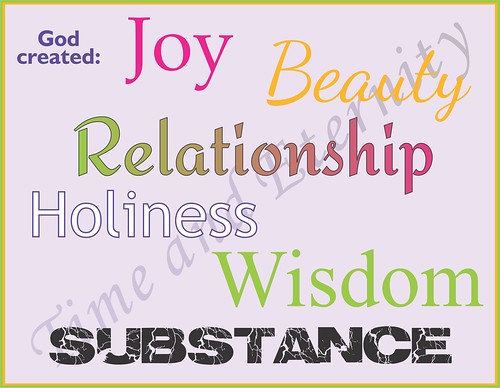
God's creativity

God's creativity

God is unimaginably creative.

John 1, Colossians 1, and other passages indicate that God the Son was and is the chief agent in creation, and in sustaining it.

So what did God create?
1. Substance (including energy, which is a type of substance – e = mc2).
Matter and energy are creations of God. He is outside of His created universe, and made it come to be from nothing. However, He can and does enter it, as shown in the miracles of the Old Testament, the Incarnation of God the Son, and the presence of God the Holy Spirit. Ken Schenck, in this post, points out that God created the nothing, too. It wouldn't have been there without God.

It is possible that all the types of sub-atomic particles, or even each and every such particle, all the elements, all the types of heavenly bodies, the earth itself, and the kinds of living things, were brought into being by individual creative acts. It is also possible that God’s planning was so extensive and complete that He created matter so that most or all of these things emerged, over time, as a result of the Big Bang. Either way shows God’s limitless intelligence and creativity, (See here for information on the suitability of sub-atomic particles for the existence of the universe.) and we don’t need to know which of these (or both) has been true.

Satan probably has no power to create any kind of substance, but he can make use of created things.

2. Time/Eternity
Substance has been created in time, which is another of God's creations. Since that is true, God is not in time, but outside of it, in eternity -- God can experience the past, present and future. Or, perhaps, God created eternity, too. All of the entities shown in the graphic play out in time, and in eternity. I'm not clear as to whether eternity is just time stretched out infinitely into the past and the future, or whether time somehow exists in eternity, and it doesn't matter what I think. I'll leave that question to God.

Satan apparently existed before the creation of substance, but probably not eternally into the past. Humans, and satan and other beings are going to exist eternally into the future.

3. Beauty
All beauty, imagined* or existent, of pattern, appearance, sound, and form, either:
was created by God;
is a natural emergence from what God created;
is based on what God brought forth;
or is possible because He gave humans the ability to be sub-creators.
(J. R. R. Tolkien, who was a Christian, used the word sub-creation about the fantastic worlds created by himself and others.)

*“Imagined,” because, for example, Beethoven was so deaf by the time his great Ninth Symphony was performed that he could not hear it, and had not heard it, except in his head, while he was composing it. Similar processes of imagination occur during writing, painting, and other creative arts, and also in the sciences, even in sports. Newton imagined his Law of Universal Gravitation – he didn’t develop this from experiments. That Law’s simplicity is one of many scientific phenomena that scientists sometimes say possess beauty, because of their simplicity (at least to the scientists!) and explanatory power:
F = (g x m1 x m2)/r2
The scientific search for patterns in elementary particles, and for broadly applicable formulas and laws (such as the so-called theory of everything, or the “God particle”) is motivated by a belief that there is an underlying pattern and beauty in the way things are. Einstein, who was not a believer in a personal God, sometimes spoke as if there was a God who had arranged things in the way that they were, understandable, describable, and relatively simple.

Richard Feynman, Nobel laureate, said: What is it about nature that lets this happen, that it is possible to guess from one part what the rest is going to do? That is an unscientific question: I do not know how to answer it, and therefore I am going to give an unscientific answer. I think it is because nature has a simplicity and therefore a great beauty. Seeking New Laws, pp. 143-167, in Richard Feynman, The Character of Physical Law, New York: Modern Library, 1994. Quote is from p. 167. I have read most of Feynman's popular writing, and seen no evidence that he believed in God at all.

Naismith imagined a game involving tossing a ball into peach baskets.

Satan probably has no power to create beauty of any kind, although he can mimic God’s good creation, and can use beauty as an evil force. (Pornography, for example.) Perhaps Satan, as an angel, had creative powers that humans don’t. We don’t know. Satan apparently can imagine events that have not happened yet, or that might never happen.

4. Relationship
The power to form relationships with other sentient, responsive beings is possible because God made it so.
A human who is incapable of establishing relationships with others, or who does not want to do so, is abnormal. Humans are constructed so that we form and maintain relationships with others, from birth to death.
God also desires relationships. The Three Persons of the Trinity apparently have a relationship with one another. God wants to have a relationship with us. This is not possible, or not nearly fully possible, unless the sin problem is fixed. God loves us so much that He took care of the sin problem for us – we couldn’t do that. In the life of Christ, in 1 Corinthians 13, and elsewhere, the proper foundation for relationships is laid out. It is unselfish, Christ-like love. (Agape love.) Humans, and, to some extent, animals, have some capacity to communicate, to empathize, to imagine how to increase the well-being of others, and to do so. These all contribute to the ability to form relationships. God wants us to use this ability to bring others to a relationship with Him.

Satan is incapable of forming a proper relationship with anyone. We aren’t, either, without accepting Christ’s sacrifice for sin, and following His Lordship and example.

5. Joy
God is responsible for joy. We can, and should, be joyful in comprehending and experiencing beauty and relationship, even substance. God made humor and laughter possible. We should joy in contemplating God’s creativity and goodness. “Joyful, joyful, we adore Thee” (based on Beethoven's Ninth Symphony) is found in many hymnals.

Satan has lost any capacity for joy that he had originally, and wants to drive joy out of the world.

6. Holiness
Holiness is the opposite of evil and sin. Evil and sin are the absence of holiness. God is holy, and good, and His creation started out that way. He wants us to be holy, and totally good, too, and will eventually transform created things so that they, too, are finally and eternally good. Because God is holy and good, He cannot abide sin. Our relationship with Him should be such that we stop sinning, or at least do it less frequently, and become more and more holy – more and more living a life for God, and others, and less and less living for ourselves.

Satan is unholiness personified. Fallen, unredeemed humans are also unholiness personified.

7. Wisdom

Wisdom is “The ability to discern or judge what is true, right, or lasting; insight.” (The Free Dictionary). In other words, to have wisdom is to act correctly on the things you know. God allows us to have knowledge, to know things, but merely knowing things is not the same thing as wisdom. Children know a lot, but they are often not wise. Presumably Satan also knows a lot, but he has unwisely rejected God’s authority.
 
Thanks for reading, and thanks to my wife for suggestions.

This is the version of November 1, 2014, somewhat modified from previous versions.
Thursday, November 29, 2012

Predestination, foreknowledge and choice

Predestination, foreknowledge, and free choice
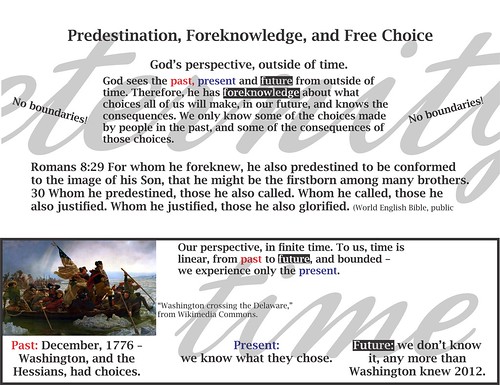
The above graphic is an attempt to illustrate a controversial and complex subject, predestination, foreknowledge, and free choice. (The word, eternity, isn't completely shown in the illustration, on purpose, to symbolize the boundlessness of eternity.) The graphic should serve as a link to the original graphic on Flickr. Flickr members, at least, and perhaps others -- I'm not sure -- can see larger sizes of the graphic, by clicking on the magnifying glass icon above the graphic on its Flickr page. There is no password required to view Flickr pictures.

I believe that the Bible teaches that people have the ability to choose, at least in some areas. Here's some of the evidence.

The Bible also teaches predestination, for example in the verses quoted above, which are from Romans 8:
28 For whom he foreknew, he also predestined to be conformed to the image of his Son, that he might be the firstborn among many brothers. 29 Whom he predestined, those he also called. Whom he called, those he also justified. Whom he justified, those he also glorified. (World English Bible, public domain)

As I understand things, God is outside of time. Consider this: I think that Jane Smith is going to enter a situation that I wish to pray about, at two in the afternoon, and pray for this at that time. However, without my knowledge, the situation actually occurred three hours earlier. God could have taken my praying into account when influencing the situation, even though I hadn't prayed yet when it happened, because God knew that I would, and, in fact, God had experience my prayer when the event happened. God's knowledge, or foreknowledge, doesn't mean that I didn't have a choice about whether to pray. I did. But God knew that I would.

The graphic incorporates an image of General George Washington crossing the Delaware. I modified it by rotating it horizontally.

Thanks for looking! Make right choices.

Thursday, September 13, 2012

Looking back to the good old days

Ecclesiastes 7:10 Don’t say, “Why were the former days better than these?” For you do not ask wisely about this. (World English Bible, public domain)

We often say, or think, about the "good old days," before there was so much traffic, or when money was worth more, or our health was better, and when, we often think, people were less nasty and sinful. I've done it myself.

I'm not sure how far to take the advice of the writer of Ecclesiastes, whoever that may have been, to stop doing that. It's pretty clear that the book takes a dim view of a lot of things! It is also true that the Israelites were often reminded, in various ways, that they were better off when they were worshiping God as they should have, and that they should return to that attitude. But at least one aspect of the statement quoted is true. We can't go back. Even if the old days were better than our present circumstances, we aren't going to be able to live in them again. Things and people decay and disappear. Things and people change. We change. We can learn from the past, we are deeply influenced by it, we can even be inspired by it, but we live in the present, for the future.

Thanks for reading! Enjoy your present, and live for your future.

Tuesday, May 22, 2012

How to love God, continued

I recently mused about the matter of how we can, and should, love God.

I later brought up the subject in a small group. The group had several good ideas about how to love God, such as:

Obey His commandments (See John 14:15-24.)
Imitate Christ.
Worship God.
Put God first.
Take care of other people.
Love other people.
Love the Bible.
Spend time with God.
Be thankful for what God has done.

Thanks for reading.

Monday, January 18, 2010

Christopher Robin and time travel

"But wherever they go, and whatever happens to them on the way, in that enchanted place on the top of the Forest, a little boy and his bear will always be playing." A. A. Milne, Chapter Ten, "In Which Christopher Robin and Pooh Come to an Enchanted Place, and We Leave Them There," from The House at Pooh Corner.

Thanks for reading! Read Milne. Today would have been his 118th birthday.

Monday, November 02, 2009

Life is short

James 4:14 yet you do not know what tomorrow will bring. What is your life? For you are a mist that appears for a little time and then vanishes. (ESV. See here for ESV copyright information.)

My mother lived over 99 years. But that was a short time, measured against eternity.

I have mused a lot on many things in the past couple of weeks. One of those things is the passing of time. One of our nephews, and his wife, put together a slide show, which was available to visitors at the funeral home. It's a good job, and I'm glad they put it together. But it shows that time passes, and we can't bring it back. There were photos of ancestors of mine that died before I was born. I never knew them.

One photo that particularly interested me was one of the brother next in age to me, with me, messing around on the rocks in a stream near where we once lived. I don't remember the occasion, and I doubt if my brother does, either. But it looks like we were having fun, and I'm sure that we were, some six plus decades ago. I can't go back there. I'm not sure I can find the place, I can't play on rocks quite as well as I used to, and if I do find it and go back, most likely my brother won't be there with me. That experience is gone.

There was a lot of stuff in the old house. We took some of it, and others did, too. That's fine. Some of these things are nice to have, some may be valuable, some bring back memories. But none of that really matters. Sooner or later it will all be forgotten and worthless, or just lost. Things don't last, any more than experiences do. A lot of that stuff is gone, and the rest will be, eventually.

I was happy that a friend of ours came to the funeral. I hadn't seen her for fifteen years, since my Dad's funeral. Being able to talk with her reminded me that relationships are very important, more important than experiences. I should have gone to the funerals of her parents. My relationships with my extended family, with friends, and, above all, with Christ, are the only things that really matter.

Thanks for reading.

Thursday, December 18, 2008

We don't have time for eternity

. . .the mismatch between our modern lives and ancient brains is most evident in the problems of working memory and attention, but another culprit may be at work. We are easily distracted also because we vastly overvalue what happens to us right now compared with what comes in the future and because novelty is intrinsically rewarding. So whatever we are supposed to be focusing on has to compete with every new email, new task, new blog post and new conversation that wanders into our information sphere. These biases may have served us well in our species' evolutionary past, when the future was uncertain and the new could well be a threat that deserved immediate attention. But nowadays the new is more often trivial than essential, and sacrificing immediate rewards can yield greater ones in the future. From a review, in the Dec 14, 2008, Wall Street Journal, of The Overflowing Brain, by Torkel Klingberg. The review was written by Christopher F. Chabris. (Emphasis in original.)

In other words, we don't have time for eternity.

Whether you are comfortable with the reviewer's view of human prehistory doesn't really matter here -- we are, indeed, too concerned with the Now and the New.

Thanks for reading. Consider the past and the future a little more today.

Tuesday, December 09, 2008

Ravi Zacharias on Past, Present and Future

Some time ago, I read Can Man Live Without God, by Ravi Zacharias. (Dallas: Word Publishing, 1994) Zacharias is a Christian apologist, who knows philosophy, and knows non-Christian religions, at least some of them. (He was born in India. This is the biography page from the ministry that he heads.) Here's what he said about time in this book:

According to Christ's teaching, history is not just one event after another. Not only the present moment, nor only the past, nor only the future,but all of time is important to God. That is why the genuine Christian does not take it upon himself or herself to avenge the past. That is why the genuine Christian does not make this earthly kingdom into God's kingdom by way of the sword. That is why the genuine Christian transcends present disaster or immediate success. For him or for her, history is the arena in which God unfolds His plan and the individual is the microcosm in whom God does His work. I suggest that if you contrast this with every other world-view, you will see the striking difference in Christianity. What reassurance this brings to every individual life -- yours and mine -- to know that God is involved with us personally! The ultimate coherence that God brings is not only in the history that we see within our three-score and ten years, but for life beyond the grave itself. (p. 166)

Thanks for reading.

Thursday, June 05, 2008

Genesis and the Big Bang, by Gerald L. Schroeder

At the suggestion of Tap, I recently read parts of Gerald L. Schroeder's Genesis and the Big Bang. (New York: Bantam, 1990). Other people have mentioned the book from time to time.

Schroeder is clearly intelligent, and a good writer. I found some parts of particular interest.

Schroeder is a working scientist, and therefore writes with some authority. He appears, throughout, to be attempting a reconciliation of the Bible with the findings of modern science, a laudable goal, indeed, as both of them are part of God's revelation to us.

One way that he tries to do this is by using relativistic time. Einstein did not see time as constant, but flexible, depending on the physical system. Schroeder points out that God is outside of time, and that observed time depends on the motion of the observer and the observed, and that the apparent duration of an event won't be the same for two observers who are moving relative to one another. All this (which he explains at some length, with diagrams) leads him to conclude that the six days of Genesis might be the same as the billions of years that modern scientists believe is the age of the universe.

That's an interesting conclusion. However, no matter how good his science, I have trouble believing that this will be acceptable to young-earth creationists. I have trouble accepting it, myself, because it seems too complex and convoluted to me. Also, there is another question. Does Genesis really describe the creation of the earth, the solar system, or the universe, or all three?

Thanks, Tap. I believe Schroeder's heart is in the right place, and he may even be correct about creation week -- God may have observed the same events as a single week, and we (speaking of a hypothetical observer -- there were no humans in existence at the beginning) as billions of years, or the reverse. But I think he's working too hard here.

Maybe my problem is that, like almost all of us, I really think of time as a universal, constant, flow, no matter what Einstein said.

Thanks for reading.