We are told that we should pray according to God's will, and that He will answer if we are doing so. What, then, is God's will? What are the things that are in God's will? Here's the result of a search for the phrase "will of God," using the English Standard Version for the search. The results are quoted from the public domain World English Bible. There are, no doubt, other things that are also in God's will, but which do not have that phrase associated with them, in the Bible. And, of course, there are situations which are not in the Bible at all where we can be pretty sure of God's will, but the list is just as indicated, with some annotation.
It is God's will that some Christians be called to special service:
2 Corinthians 1:1 Paul, an apostle of Christ Jesus through the will of
God, and Timothy our brother, to the assembly of God which is at
Corinth, with all the saints who are in the whole of Achaia:
1 Corinthians 1:1a Paul, called to be an apostle of Jesus Christ through the will of God
Ephesians
1:1 Paul, an apostle of Christ Jesus through the will of God, to the
saints who are at Ephesus, and the faithful in Christ Jesus:
Colossians 1:1 Paul, an apostle of Christ Jesus through the will of God,
2 Timothy 1:1a Paul, an apostle of Jesus Christ through the will of God,
It is God's will that Christians live godly, holy, sanctified lives, and it is appropriate to pray that other Christians do this:
Romans 12:2 Don’t be conformed to this world, but be transformed by the renewing of your mind, so that you may prove what is the good, well-pleasing, and perfect will of God.
1 Thessalonians 4:3 For this is the will of God: your sanctification,
that you abstain from sexual immorality, 4 that each one of you know how
to possess himself of his own vessel in sanctification and honor, 5 not
in the passion of lust, even as the Gentiles who don’t know God;
Colossians 4:12 Epaphras, who is one of you, a servant of Christ,
salutes you, always striving for you in his prayers, that you may stand
perfect and complete in all the will of God.
1 Peter 4:1 Forasmuch then as Christ suffered for us in the flesh, arm
yourselves also with the same mind; for he who has suffered in the flesh
has ceased from sin; that you no longer should live the rest of your
time in the flesh for the lusts of men, but for the will of God.
It is God's will that Christians do God's will. The last entry in this group indicates that we can receive divine help:
Mark 3:35 For whoever does the will of God, the same is my brother, and my sister, and mother.
Ephesians
6:5 Servants, be obedient to thosing to the flesh are your masters,
with fear and trembling, in singleness of your heart, as to Christ; 6
not in the way of service only when eyes are on you, as men pleasers;
but as servants of Christ, doing the will of God from the heart;
1 John 2:17 The world is passing away with its lusts, but he who does God’s will remains forever.
1 Peter 2:15 For this is the will of God, that by well-doing you should put to silence the ignorance of foolish men:
2 Corinthians 8:3 For according to their power, I testify, yes and beyond their power, they gave of their own accord, 4 begging us with much entreaty to receive this grace and the fellowship in the service to the saints. 5 This was not as we had hoped, but first they gave their own selves to the Lord, and to us through the will of God.
Romans 8:27 He who searches the hearts knows what is on the Spirit’s
mind, because he makes intercession for the saints according to God.
[other versions use something like "according to the will of God"]
It is God's will that we be thankful for what God does:
1 Thessalonians 5:18 In everything give thanks, for this is the will of God in Christ Jesus toward you.
It is God's will that we be redeemed:
Hebrews 10:36 For you need endurance so that, having done the will of God, you may receive the promise.
You may be interested in this post on what the New Testament Christians prayed for. Thanks for reading!

Musings on science, the Bible, and fantastic literature (and sometimes basketball and other stuff).
God speaks to us through the Bible and the findings of science, and we should listen to both types of revelation.
The title is from Psalm 84:11.
The Wikipedia is usually a pretty good reference. I mostly use the World English Bible (WEB), because it is public domain. I am grateful.
License
I have written an e-book, Does the Bible Really Say That?, which is free to anyone. To download that book, in several formats, go here.

The posts in this blog are licensed under a Creative Commons Attribution-NonCommercial-ShareAlike 3.0 Unported License. You can copy and use this material, as long as you aren't making money from it. If you give me credit, thanks. If not, OK.
The posts in this blog are licensed under a Creative Commons Attribution-NonCommercial-ShareAlike 3.0 Unported License. You can copy and use this material, as long as you aren't making money from it. If you give me credit, thanks. If not, OK.
Saturday, May 03, 2014


Thursday, May 01, 2014
Hawking's Grand Design and God's Not Dead
Stephen Hawking is one of the best-known scientists of our time. When he retired, he was occupying the same professorial chair that Isaac Newton once did. He is also an outspoken atheist.
In 2010, Hawking, in collaboration with Leonard Mlodinow, wrote The Grand Design, which became a best-seller, in spite of its non-fiction status and scientific content. The book argues that it is not necessary to suppose that God created the universe. It also says that "philosophy is dead," and suggests that the search for a unified field theory is futile, so it isn't exactly shy about attacking significant ideas. What they seem to mean by "philosophy is dead" is that some philosophers are not willing to agree with them on all points.
The Grand Design was referred to in the recent movie, God's Not Dead. (See here for my review of that film. That review includes the pivotal quotation from The Grand Design, which was used in the movie. That quotation is the second and third sentences from the second quotation from the book, below.) God's Not Dead did not claim that the existence of God can be proved, but that His existence cannot be disproved. The Grand Design doesn't disprove God's existence, although the authors seem to think that it does, or that it almost does.
As indicated above, Hawking and Mlodinow weren't bashful. They claim, on page 32, that "recent experiments" have shown that our brains operate according to physical laws. There are no notes in the book, so I don't know what experiments they were referring to, but never mind. What other laws would our brains operate by? They claim that, because our brains operate by physical laws, "[f]ree will is an illusion," (p. 32) but are willing for us to act as if we really did have free will. That's a good thing, because if we don't have free will, Hawking and Mlodinow didn't, either, and they therefore believe the things that they do, not because they are true, but because of the physical laws operating in their brains. (And, by the way, if that discussion isn't a matter for philosophy, I don't know what is.)
The fundamental argument of The Grand Design is that there are really many, very many universes, according to M-theory, and that we exist in one of those that is compatible with life. All those universes came into being somehow, and here we are, in this one, the result of a cosmic accident. There are some serious problems with this notion. One of them is that even Hawking and Mlodinow aren't sure what M-theory is:
No one seems to know what the "M" stands for, but it may be "master," "miracle," or "mystery." It seems to be all three. People are still trying to decipher the nature of M-theory, but that may not be possible. It could be that the physicist's traditional expectation of a single theory of nature is untenable, and there exists no single formulation. It might be that to describe the universe, we have to employ different theories in different situations. Each theory may have its own version of reality, but according to model-dependent realism, that is acceptable so long as the theories agree in their predictions whenever they overlap, that is, whenever they can both be applied. (p. 117)
The above is a quotation from the book. That quotation indicates that, whatever M-theory might be, if it is true here, it isn't true elsewhere. That, and their fuzzy description, don't inspire confidence in science based on M-theory.
Another serious problem is that there is no experimental proof for M-theory and its relatives. Granted, a few decades ago, there was no experimental proof for quarks, which were proposed as a way of making sense out of the many types of sub-atomic particles then thought to exist, and, hence, there was skepticism about their existence. But that skepticism has largely disappeared, and there is experimental evidence for the existence of quarks. However, quarks, so far as we know, are the same everywhere in the universe. Quark theory didn't propose that there were different kinds of quarks, or no quarks at all, in other universes. It's not clear that, even if other universes exist, we can access them in any way, which would be necessary, I think, to vindicate M-theory.
Then there's the matter of gravity.
Because there is a law like gravity, the universe can and will create itself from nothing in the manner described in Chapter 6. [Chapter Title - "Choosing Our Universe."] Spontaneous creation is the reason there is something rather than nothing, why the universe exists, why we exist. It is not necessary to invoke God to light the blue touch paper and set the universe going. (p. 180.)
But why is there gravity? If they explain that, I missed it, or didn't understand it. And even if gravity had the power to make the universe create itself from nothing, wouldn't the powers of gravity be different in all the other different universes, according to their own thesis? So why should other universes exist?
Another serious problem is that scientists, and others, are not universally in agreement with Hawking and Mlodinow's central idea, mostly because of the first two serious problems indicated above.
Peter Woit, of Columbia University, has written a severely critical review of The Grand Design. Woit wrote:
I’m in favor of naturalism and leaving God out of physics as much as the next person, but if you’re the sort who wants to go to battle in the science/religion wars, why you would choose to take up such a dubious weapon as M-theory mystifies me. . . . [T]hinking about it, [I] have to admit that the kind of pseudo-science going on here and being promoted in this book isn’t obviously any better than the faith-based explanations of how the world works favored by conventional religions.
Well put, except that there shouldn't be "science/religion wars." If we really understood God's revelation in Christ, in the Bible, through the church, and in nature (which science unfolds for us) we would see that our existence is best explained by accepting, by faith, that God planned for our universe, and us, to exist. See Hebrews 11:3, which is quoted in the graphic at the top of this post.
I know of no evidence that Woit is a Christian. For other criticisms of the book, see its Wikipedia article.
See also the recent opinion piece in Time, "Why Science Does Not Disprove God."
Thanks for reading!
In 2010, Hawking, in collaboration with Leonard Mlodinow, wrote The Grand Design, which became a best-seller, in spite of its non-fiction status and scientific content. The book argues that it is not necessary to suppose that God created the universe. It also says that "philosophy is dead," and suggests that the search for a unified field theory is futile, so it isn't exactly shy about attacking significant ideas. What they seem to mean by "philosophy is dead" is that some philosophers are not willing to agree with them on all points.
The Grand Design was referred to in the recent movie, God's Not Dead. (See here for my review of that film. That review includes the pivotal quotation from The Grand Design, which was used in the movie. That quotation is the second and third sentences from the second quotation from the book, below.) God's Not Dead did not claim that the existence of God can be proved, but that His existence cannot be disproved. The Grand Design doesn't disprove God's existence, although the authors seem to think that it does, or that it almost does.
As indicated above, Hawking and Mlodinow weren't bashful. They claim, on page 32, that "recent experiments" have shown that our brains operate according to physical laws. There are no notes in the book, so I don't know what experiments they were referring to, but never mind. What other laws would our brains operate by? They claim that, because our brains operate by physical laws, "[f]ree will is an illusion," (p. 32) but are willing for us to act as if we really did have free will. That's a good thing, because if we don't have free will, Hawking and Mlodinow didn't, either, and they therefore believe the things that they do, not because they are true, but because of the physical laws operating in their brains. (And, by the way, if that discussion isn't a matter for philosophy, I don't know what is.)
The fundamental argument of The Grand Design is that there are really many, very many universes, according to M-theory, and that we exist in one of those that is compatible with life. All those universes came into being somehow, and here we are, in this one, the result of a cosmic accident. There are some serious problems with this notion. One of them is that even Hawking and Mlodinow aren't sure what M-theory is:
No one seems to know what the "M" stands for, but it may be "master," "miracle," or "mystery." It seems to be all three. People are still trying to decipher the nature of M-theory, but that may not be possible. It could be that the physicist's traditional expectation of a single theory of nature is untenable, and there exists no single formulation. It might be that to describe the universe, we have to employ different theories in different situations. Each theory may have its own version of reality, but according to model-dependent realism, that is acceptable so long as the theories agree in their predictions whenever they overlap, that is, whenever they can both be applied. (p. 117)
The above is a quotation from the book. That quotation indicates that, whatever M-theory might be, if it is true here, it isn't true elsewhere. That, and their fuzzy description, don't inspire confidence in science based on M-theory.
Another serious problem is that there is no experimental proof for M-theory and its relatives. Granted, a few decades ago, there was no experimental proof for quarks, which were proposed as a way of making sense out of the many types of sub-atomic particles then thought to exist, and, hence, there was skepticism about their existence. But that skepticism has largely disappeared, and there is experimental evidence for the existence of quarks. However, quarks, so far as we know, are the same everywhere in the universe. Quark theory didn't propose that there were different kinds of quarks, or no quarks at all, in other universes. It's not clear that, even if other universes exist, we can access them in any way, which would be necessary, I think, to vindicate M-theory.
Then there's the matter of gravity.
Because there is a law like gravity, the universe can and will create itself from nothing in the manner described in Chapter 6. [Chapter Title - "Choosing Our Universe."] Spontaneous creation is the reason there is something rather than nothing, why the universe exists, why we exist. It is not necessary to invoke God to light the blue touch paper and set the universe going. (p. 180.)
But why is there gravity? If they explain that, I missed it, or didn't understand it. And even if gravity had the power to make the universe create itself from nothing, wouldn't the powers of gravity be different in all the other different universes, according to their own thesis? So why should other universes exist?
Another serious problem is that scientists, and others, are not universally in agreement with Hawking and Mlodinow's central idea, mostly because of the first two serious problems indicated above.
Peter Woit, of Columbia University, has written a severely critical review of The Grand Design. Woit wrote:
I’m in favor of naturalism and leaving God out of physics as much as the next person, but if you’re the sort who wants to go to battle in the science/religion wars, why you would choose to take up such a dubious weapon as M-theory mystifies me. . . . [T]hinking about it, [I] have to admit that the kind of pseudo-science going on here and being promoted in this book isn’t obviously any better than the faith-based explanations of how the world works favored by conventional religions.
Well put, except that there shouldn't be "science/religion wars." If we really understood God's revelation in Christ, in the Bible, through the church, and in nature (which science unfolds for us) we would see that our existence is best explained by accepting, by faith, that God planned for our universe, and us, to exist. See Hebrews 11:3, which is quoted in the graphic at the top of this post.
I know of no evidence that Woit is a Christian. For other criticisms of the book, see its Wikipedia article.
See also the recent opinion piece in Time, "Why Science Does Not Disprove God."
Thanks for reading!
Wednesday, April 30, 2014
Sunspots 468

Christianity: We are less religious than we used to be, and National Public Radio reports on a study that says that the Internet is partly to blame.
Computing: Gizmo's Freeware recommends SeriesGuide, an Android app that gives information about upcoming TV shows, and more.
USA Today reports that cheerful posts on Facebook affect others positively, and the effect is unexpectedly large.
Are you storing your files in the cloud? Be careful out there, says NPR.
Wired on how the stock market is rigged in favor of traders with lots of resources, and access to superfast information feeds, and on what one man is doing about this.
Health: Studying the genetics of the whooping cough (pertussis) germ has led to an understanding of how it became a dangerous disease, according to a report by National Public Radio.
Humor: (or something -- this is real) Wired reports on 21st century California gold miners, who are doing things the old-fashioned way.
Science: Wired reports on the Absurd Creature of the Week, in this case an axolotl, which can re-grow limbs, and never outgrows its larval gills. We may learn how we can regenerate lost body parts by studying these animals.
New Scientist reports that pregnant mice with damaged hearts (artificially damaged) may be helped to recover with the help of fetal-derived stem cells. Interesting.
Image source (public domain)
Tuesday, April 29, 2014
Natural selection is a fact
Today's Greenville News, in an article on page 7a, has published a report from the Associated Press. That report says that South Carolina State Senator Mike Fair "says natural selection should not be taught as fact." Mr. Fair has made more news on this sort of topic recently, as he at first opposed the adoption of a South Carolina State Fossil, because of his belief in a six-day creation a few thousand years ago. He withdrew his opposition, because the proposer was an eight-year-old girl.
Mr. Fair is entitled to his beliefs, and they are, perhaps, more nuanced than suggested by the nine words quoted in the report, but this post takes them at face value, and refutes them.
Natural selection is a fact! Why is that so?
First, artificial selection works. Humans have selected breeds of dogs for various traits, and done similar selection with other animals. Plants, grown as crops or ornamentals, have also responded to the selective work of humans.
It is true that keeping track of butterfat production by cows, and deciding which bull to use in fathering the next generation, based on the production record of his daughters, is not exactly natural selection. But much selection of animals and plants, over the millennia of domestication, was simply looking at various characteristics, and deciding which seed to plant, or which animal to use in breeding. It was very low-tech, presumably operating without even written breeding or production records, and, we have reason to believe, worked very much like natural selection has.
Second, natural selection works in humans. No doubt Mr. Fair believes that all humans descended from an ancestral couple. If that was the case, how can we explain the differences between various groups of humans? Some of the differences may be due to chance, but some of them, probably most of them, are due to natural selection. The Wikipedia article on "Human skin color" begins with these two sentences: "Human skin color ranges in variety from the darkest brown to the lightest pinkish-white hues. Human skin pigmentation is the result of natural selection." The article refers to solid scientific evidence for that second statement.
Third, and less obvious, but more compelling, natural selection works in the ordinary reproduction of organisms, including humans. Not in selecting for new forms, but in selecting so that current well-adapted forms persist. You may have seen an albino animal in the wild. I have. They are rare, but they do exist. Why are they so rare? Because Darwin's common-sense description of natural selection does, indeed, make sense. Organisms that have a tendency to have offspring that differ much from the norm are less likely to have their genes passed on to succeeding generations. A rabbit, in the wild, that can produce an albino offspring, is a rabbit that is less likely to produce surviving offspring than a similar rabbit that cannot produce such offspring.
God may, indeed, have created the first humans from scratch, or created the "kinds" of living things in separate special creative acts. But, even if both of those are true, He built natural selection into the system, just like He built gravity into the system, and natural selection, like gravity, influences the way things are, and serves to maintain God's good creation.
Mr. Fair should have read this post by a committed Young-earth creationist with solid scientific credentials, who says that evolution (by which he means natural selection) is not up for scientific dispute.
Thanks for reading.
Mr. Fair is entitled to his beliefs, and they are, perhaps, more nuanced than suggested by the nine words quoted in the report, but this post takes them at face value, and refutes them.
Natural selection is a fact! Why is that so?
First, artificial selection works. Humans have selected breeds of dogs for various traits, and done similar selection with other animals. Plants, grown as crops or ornamentals, have also responded to the selective work of humans.
It is true that keeping track of butterfat production by cows, and deciding which bull to use in fathering the next generation, based on the production record of his daughters, is not exactly natural selection. But much selection of animals and plants, over the millennia of domestication, was simply looking at various characteristics, and deciding which seed to plant, or which animal to use in breeding. It was very low-tech, presumably operating without even written breeding or production records, and, we have reason to believe, worked very much like natural selection has.
Second, natural selection works in humans. No doubt Mr. Fair believes that all humans descended from an ancestral couple. If that was the case, how can we explain the differences between various groups of humans? Some of the differences may be due to chance, but some of them, probably most of them, are due to natural selection. The Wikipedia article on "Human skin color" begins with these two sentences: "Human skin color ranges in variety from the darkest brown to the lightest pinkish-white hues. Human skin pigmentation is the result of natural selection." The article refers to solid scientific evidence for that second statement.
Third, and less obvious, but more compelling, natural selection works in the ordinary reproduction of organisms, including humans. Not in selecting for new forms, but in selecting so that current well-adapted forms persist. You may have seen an albino animal in the wild. I have. They are rare, but they do exist. Why are they so rare? Because Darwin's common-sense description of natural selection does, indeed, make sense. Organisms that have a tendency to have offspring that differ much from the norm are less likely to have their genes passed on to succeeding generations. A rabbit, in the wild, that can produce an albino offspring, is a rabbit that is less likely to produce surviving offspring than a similar rabbit that cannot produce such offspring.
God may, indeed, have created the first humans from scratch, or created the "kinds" of living things in separate special creative acts. But, even if both of those are true, He built natural selection into the system, just like He built gravity into the system, and natural selection, like gravity, influences the way things are, and serves to maintain God's good creation.
Mr. Fair should have read this post by a committed Young-earth creationist with solid scientific credentials, who says that evolution (by which he means natural selection) is not up for scientific dispute.
Thanks for reading.
Sunday, April 27, 2014
Does the Bible really say that? Excerpt from my book, 32
[Concluding a discussion on end times prophecy]
Some people think that the time, times, and a half in Daniel
12:7 means one year, plus two years, plus a half a year, making three and a
half years, which would be forty-two months. But, as Ken Schenck, Dean of
Wesley Seminary at Indiana Wesleyan University, has
written, the idea of a seven year tribulation rests on very slim
foundations:
Revelation speaks of “the great
tribulation,” but it doesn’t assign any number of years to it. A figure of 3
1/2 years appears several places in the middle of Revelation, but they all, in
my opinion, refer to the same symbolic period . . .
So to get to 7 years,
dispensationalists (shorthand here for the Darby-Lindsey-LaHaye end times
scheme) have to add two of these 3 1/2’s together. The “mid-trib” rapture
option comes straight from this section too, since the persecution of the
church (the woman) is then understood to be for half of the seven year period.
But these are all the same, most likely
symbolic 3 1/2 year period of persecution. Taking it as a calendar period goes
against the nature of apocalyptic imagery, which if anything, is not meant to
be taken literally any more than the idea that the beast will really have ten horns
and seven heads.
Schenck points out that the places where three and a half
years is referred to are in Revelation 11:2-3, 12:6, 12:14, and 13:5.
Revelation 12:14 uses times, time and half a time, not forty-two months or
three and a half years. Revelation 11:3 uses 1260 days, which is the number of
days in forty-two months of thirty days.
Although the word
“seven” occurs in Revelation over fifty times, the phrase “seven years” does
not occur there even once.
Christians do not agree on what the Bible says about end
times, and no wonder! The writing is prophetic or apocalyptic, or both, and
difficult to understand. Dispensationalism, a view common among conservative
Christians, has shaky scriptural support.
Matthew 24:44
Therefore also be ready, for in an hour that you don’t expect, the Son of Man
will come.
The above is an excerpt from my recently self-published e-book, Does the Bible Really Say That?, which may be obtained free of charge, or purchased from Amazon
for $0.99, which is the lowest price Amazon lets an author set.
Scripture quotations are from the World English Bible, which is in the public domain.
The previous post in this series is here. God willing, the next post in this series will begin a new topic. Thanks for reading.
The previous post in this series is here. God willing, the next post in this series will begin a new topic. Thanks for reading.
Thursday, April 24, 2014
The Bible and protecting the environment
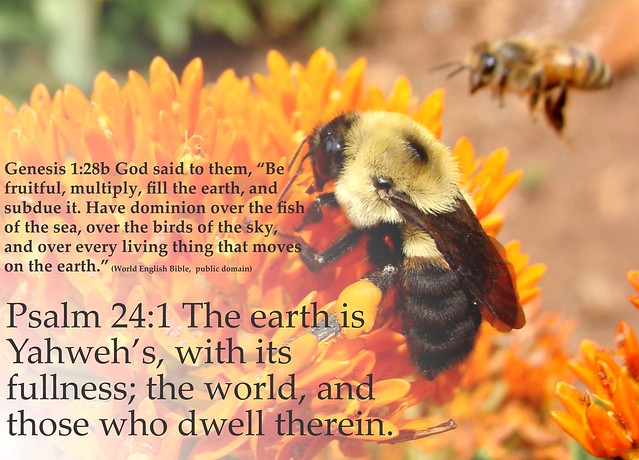 This blog didn't have any Earth Day post this year. Sorry. The above graphic is an attempt to make up for that failure. But, just as Christ is risen every day of the year, the earth should be cared for every day of the year.
For an essay on what the Bible says about caring for the environment, and it says a lot, see here.
Thanks for looking!
Wednesday, April 23, 2014
Sunspots 467

Christianity: A blog post on why it matters that women discovered the empty tomb.
Computing: Gizmo's Freeware reports on Browser Extensions (to Firefox and Chrome) that check for the Heartbleed problem.
Humor: (or something) Wired reports on a couple who are using a 3-D printer to make candy, wedding cakes, and the like.
From The Onion: wasting money on an app, and the results.
Science: Wired reports on a scientist who has studied psychopaths for 20 years. They're different . . .
Image source (public domain)
Sunday, April 20, 2014
Easter graphic
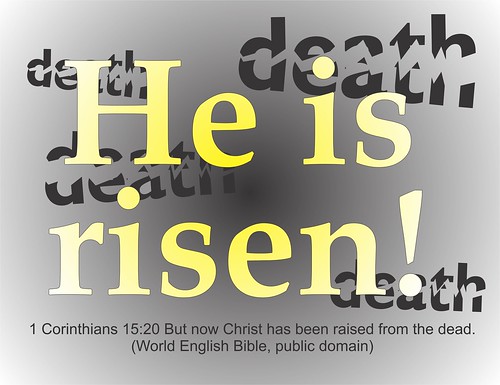
This graphic tries to show that the resurrection of Christ conquered death, for all who believe. Thanks for looking! He is risen!
Saturday, April 19, 2014
The Resurrection: What it did and does
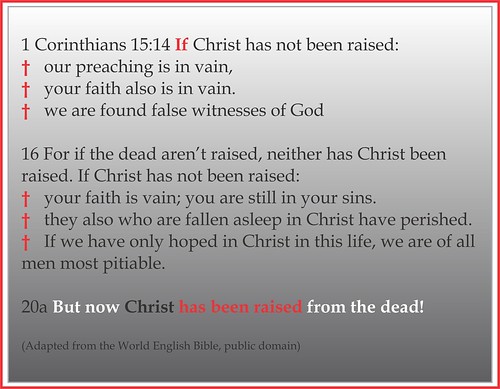
The graphic above is an attempt to illustrate, as a bullet chart, part of what Paul said about the importance of the resurrection, in 1 Corinthians 15.
For more on what the New Testament says about the resurrection, see here. For what N. T. Wright said about the believability of the resurrection, see here.
Thanks for reading, and looking.
Wednesday, April 16, 2014
Sunspots 466
Things I have recently spotted that may
be of interest to someone else:

Health: From the Guardian, an article about how homeopathy, and various other non-traditional medications, may not work, but they give patients the feeling that someone is paying attention, and cares, which they may not get from the regular medical community.
Science: From Science, a report on how an amoeba, or ameba, can live inside you and eat your cells.
From US News and other outlets, a report on how women who "lacked or had an underdeveloped vagina and uterus" were treated with a lab-grown replacement, cultured from their own tissue, and the resulting replacement vaginas worked normally. Amazing.
Yes, your eyes (and brain) do influence how much you eat, and National Public Radio reports on some experimental evidence for that.
Wired sets forth the case for the earth revolving around the sun, rather than the reverse. (Lest you think than no one acts like the earth is the center of the universe, how long has it been since you said that the sun "rises?" (or "sets?") That's language suggesting that the sun travels around the earth.
Sports: Sports Illustrated notes that Breanna Stewart, perhaps the best player in women's college basketball, signed her letter of intent to play at Connecticut (who just finished an undefeated season, including the national title) on the hood of her car in a parking lot. She's not one for fanfare, for sure.
Image source (public domain)
Health: From the Guardian, an article about how homeopathy, and various other non-traditional medications, may not work, but they give patients the feeling that someone is paying attention, and cares, which they may not get from the regular medical community.
Science: From Science, a report on how an amoeba, or ameba, can live inside you and eat your cells.
From US News and other outlets, a report on how women who "lacked or had an underdeveloped vagina and uterus" were treated with a lab-grown replacement, cultured from their own tissue, and the resulting replacement vaginas worked normally. Amazing.
Yes, your eyes (and brain) do influence how much you eat, and National Public Radio reports on some experimental evidence for that.
Wired sets forth the case for the earth revolving around the sun, rather than the reverse. (Lest you think than no one acts like the earth is the center of the universe, how long has it been since you said that the sun "rises?" (or "sets?") That's language suggesting that the sun travels around the earth.
Sports: Sports Illustrated notes that Breanna Stewart, perhaps the best player in women's college basketball, signed her letter of intent to play at Connecticut (who just finished an undefeated season, including the national title) on the hood of her car in a parking lot. She's not one for fanfare, for sure.
Image source (public domain)
Tuesday, April 15, 2014
N. T. Wright -- Can a Scientist Believe the Resurrection?
N. T. Wright, Bible scholar and communicator of the Gospel, presented a lecture on May 15, 2007, entitled "Can a Scientist Believe the Resurrection?" I recommend it.
The lecture has several important features.
First, Wright points out that he is by no means a scientist.
Second, Wright sets forth the beliefs common to Jews, in the time of Christ, about death and resurrection.
Then, he points out several important features of early Christian belief that are radically different from current Jewish belief.
He examines the resurrection stories from the Gospels, and indicates why there are differences between them. He also says, correctly, that there is not very much about Jesus' birth in the New Testament, but that the New Testament is full of the Resurrection. (See here.)
He points out that the only sensible explanation for the behavior of the early Christians was that they believed that Christ had been raised from the dead, and was the first example of a resurrection which is to come, in the future, for believers.
Finally, Wright says that what happened to Thomas was a Gospel of Faith, to Paul a Gospel of Hope, and to Peter, a Gospel of love. It takes agape love to believe and act on the Resurrection.
Thanks for reading. Read Wright!
The lecture has several important features.
First, Wright points out that he is by no means a scientist.
Second, Wright sets forth the beliefs common to Jews, in the time of Christ, about death and resurrection.
Then, he points out several important features of early Christian belief that are radically different from current Jewish belief.
He examines the resurrection stories from the Gospels, and indicates why there are differences between them. He also says, correctly, that there is not very much about Jesus' birth in the New Testament, but that the New Testament is full of the Resurrection. (See here.)
He points out that the only sensible explanation for the behavior of the early Christians was that they believed that Christ had been raised from the dead, and was the first example of a resurrection which is to come, in the future, for believers.
Finally, Wright says that what happened to Thomas was a Gospel of Faith, to Paul a Gospel of Hope, and to Peter, a Gospel of love. It takes agape love to believe and act on the Resurrection.
Thanks for reading. Read Wright!
Monday, April 14, 2014
Some blog posts on chance versus God's omnipotence
Are there things that an omnipotent God leaves to chance? Or is every change in every particle in the universe ordered and directed by God? Clearly, the answer has to be that we do not know, but it's an interesting question. Here are some blog posts by other people on this subject:
Henry Neufeld believes that perhaps God used pure chance to get to where the universe is now, and he includes humans, and their intelligence. He isn't even sure that God directed things at the sub-atomic level. Interesting. I'll have to think about that one.
Here's one from a Christian involved in forecasting the weather, who says that it makes sense to pray for particular kinds of weather (and other things) in spite of God's omnipotence. Weather, of course, is notoriously unpredictable.
Thanks for reading. For more on what I think about these matters, click on the "randomness" or "chance" in the tags at the end of this post. Let's put it this way -- I haven't solved the problem.
Henry Neufeld believes that perhaps God used pure chance to get to where the universe is now, and he includes humans, and their intelligence. He isn't even sure that God directed things at the sub-atomic level. Interesting. I'll have to think about that one.
Here's one from a Christian involved in forecasting the weather, who says that it makes sense to pray for particular kinds of weather (and other things) in spite of God's omnipotence. Weather, of course, is notoriously unpredictable.
Thanks for reading. For more on what I think about these matters, click on the "randomness" or "chance" in the tags at the end of this post. Let's put it this way -- I haven't solved the problem.
Sunday, April 13, 2014
Does the Bible really say that? Excerpt from my book, 31
[Continuing a discussion of End Times prophecy.]
The above is an excerpt from my recently self-published e-book, Does the Bible Really Say That?, which may be obtained free of charge, or purchased from Amazon for $0.99, which is the lowest price Amazon lets an author set. Scripture quotations are from the World English Bible, which is in the public domain.
The previous post in this series is here. God willing, the next post in this series will continue a discussion of this topic, prophecy. Thanks for reading.
In his reference to Daniel in verse 14, Jesus was probably
referring to one or all of these three sections of that book:
Daniel 9:27 He shall make a firm covenant with many for one week: and in the middle of the week
he shall cause the sacrifice and the offering to cease; and on the wing of
abominations shall come one who makes desolate; and even to the full end, and
that determined, shall wrath be poured out on the desolate.
Some people get the idea of a seven-year tribulation, with a
rapture at the halfway point, from this verse. (They take a week, seven days,
as standing for a seven year period.) If that idea is correct, it would seem to
be a second meaning, with the first one being the destruction of the temple,
referred to by Christ (see above). It would also mean that a day is a symbol
for a year. Perhaps. Perhaps not.
Daniel 11:16 But he who comes against him shall do according
to his own will, and no one shall stand before him; and he shall stand in the
glorious land, and in his hand shall be destruction. 17 He shall set his face
to come with the strength of his whole kingdom, and with him equitable
conditions; and he shall perform them: and he shall give him the daughter of
women, to corrupt her; but she shall not stand, neither be for him. 18 After
this shall he turn his face to the islands, and shall take many: but a prince
shall cause the reproach offered by him to cease; yes, moreover, he shall cause
his reproach to turn on him. 19 Then he shall turn his face toward the
fortresses of his own land; but he shall stumble and fall, and shall not be
found. 20 Then shall stand up in his place one who shall cause a tax collector
to pass through the kingdom to maintain its glory; but within few days he shall
be destroyed, neither in anger, nor in battle. 21 In his place shall stand up a
contemptible person, to whom they had not given the honor of the kingdom: but
he shall come in time of security, and shall obtain the kingdom by flatteries.
22 The overwhelming forces shall be overwhelmed from before him, and shall be
broken; yes, also the prince of the covenant. 23 After the treaty made with him
he shall work deceitfully; for he shall come up, and shall become strong, with
a small people. 24 In time of security shall he come even on the fattest places
of the province; and he shall do that which his fathers have not done, nor his
fathers’ fathers; he shall scatter among them prey, and plunder, and substance:
yes, he shall devise his devices against the strongholds, even for a time. 25
He shall stir up his power and his courage against the king of the south with a
great army; and the king of the south shall war in battle with an exceeding great
and mighty army; but he shall not stand; for they shall devise devices against
him. 26 Yes, they who eat of his dainties shall destroy him, and his army shall
overflow; and many shall fall down slain. 27 As for both these kings, their
hearts shall be to do mischief, and they shall speak lies at one table: but it
shall not prosper; for yet the end shall be at the time appointed. 28 Then he
will return into his land with great substance; and his heart will be against
the holy covenant; and he will take action, and return to his own land. 29 At
the time appointed he shall return, and come into the south; but it shall not
be in the latter time as it was in the former. 30 For ships of Kittim shall
come against him; therefore he shall be grieved, and shall return, and have
indignation against the holy covenant, and shall take action: he shall even
return, and have regard to those who forsake the holy covenant. 31 Forces shall stand on his part, and they
shall profane the sanctuary, even the fortress, and shall take away the
continual burnt offering, and they shall set up the abomination that makes
desolate. 32 Such as do wickedly against the covenant shall he pervert by
flatteries; but the people who know their God shall be strong, and take action.
33 Those who are wise among the people shall instruct many; yet they shall fall
by the sword and by flame, by captivity and by plunder, many days. 34 Now when
they shall fall, they shall be helped with a little help; but many shall join
themselves to them with flatteries. 35 Some of those who are wise shall fall,
to refine them, and to purify, and to make them white, even to the time of the
end; because it is yet for the time appointed. 36 The king shall do according
to his will; and he shall exalt himself, and magnify himself above every god,
and shall speak marvelous things against the God of gods; and he shall prosper
until the indignation be accomplished; for that which is determined shall be
done. 37 Neither shall he regard the gods of his fathers, nor the desire of women,
nor regard any god; for he shall magnify himself above all. 38 But in his place
shall he honor the god of fortresses; and a god whom his fathers didn’t know
shall he honor with gold, and silver, and with precious stones, and pleasant
things. 39 He shall deal with the strongest fortresses by the help of a foreign
god: whoever acknowledges him he will increase with glory; and he shall cause
them to rule over many, and shall divide the land for a price. 40 At the time
of the end shall the king of the south contend with him; and the king of the
north shall come against him like a whirlwind, with chariots, and with
horsemen, and with many ships; and he shall enter into the countries, and shall
overflow and pass through. 41 He shall enter also into the glorious land, and
many countries shall be overthrown; but these shall be delivered out of his
hand: Edom, and Moab, and the chief of the children of Ammon. 42 He shall
stretch out his hand also on the countries; and the land of Egypt shall not
escape. 43 But he shall have power over the treasures of gold and of silver,
and over all the precious things of Egypt; and the Libyans and the Ethiopians
shall be at his steps. 44 But news out of the east and out of the north shall
trouble him; and he shall go out with great fury to destroy and utterly to
sweep away many. 45 He shall plant the tents of his palace between the sea and
the glorious holy mountain; yet he shall come to his end, and no one shall help
him.
This may be about the end times, but that’s not the mostly
likely meaning, since Jesus seems to have referred to this passage in relation
to the destruction of Jerusalem in the first century A. D. The original meaning
of Daniel was also probably as a prophecy of the destruction of the temple
before the time of Christ. (See the Wikipedia article
on Antiochus Epiphanes.) It is possible that God intended these prophecies to
be about both the destruction of Jerusalem and the end times. The prophecies
about Christ’s early life, discussed above, all seem to have had at least two
meanings.
There’s also this passage:
Daniel 12:7 I heard the man clothed in linen, who was above
the waters of the river, when he held up his right hand and his left hand to
heaven, and swore by him who lives forever that it shall be for a time, times, and a half; and when they
have finished breaking in pieces the power of the holy people, all these things
shall be finished. 8 I heard, but I didn’t understand: then I said, my lord,
what shall be the issue of these things? 9
He said, Go your way, Daniel; for the words are shut up and sealed until the time
of the end. 10 Many shall purify themselves, and make themselves white, and be
refined; but the wicked shall do wickedly; and none of the wicked shall
understand; but those who are wise shall understand. 11 From the time that the
continual burnt offering shall be taken away, and the abomination that makes
desolate set up, there shall be one thousand two hundred ninety days. 12
Blessed is he who waits, and comes to the one thousand three hundred
thirty-five days. 13 But go you your way until the end; for you shall rest,
and shall stand in your lot, at the end of the days.
These writings of Daniel, and the statements by Jesus in
Matthew, are apocalyptic. Perhaps they are prophetic, also. We should always be
careful in interpreting these kinds of Biblical literature.
The above is an excerpt from my recently self-published e-book, Does the Bible Really Say That?, which may be obtained free of charge, or purchased from Amazon for $0.99, which is the lowest price Amazon lets an author set. Scripture quotations are from the World English Bible, which is in the public domain.
The previous post in this series is here. God willing, the next post in this series will continue a discussion of this topic, prophecy. Thanks for reading.
Subscribe to:
Posts (Atom)