Bonnie wrote a comment to a post of mine, some time ago. Here's what she said (I added the emphasis):
Wow. Very interesting, Martin, thanks for posting this.
It seems that Ford's whole argument is based on differentiation, or lack thereof.
I've never considered the fact that the precursors of both the embryo and placental material are present in the zygote to be relevant to the question of when a human life begins, nor have I considered the ontology of the twinning process to be relevant either. I still see the differentiation process as irrelevant to when life begins.
Before embryonic/placental differentiation has occurred, the cells that will become the baby are still there. Even if the differentiation that will reveal twins doesn't occur before a certain number of days has passed, the cells that will so differentiate (euphemistically referred to as "potential") are still there. They are still part of the developmental continuum. I wouldn't think that they change ontologically any more than any future differentiation changes the ontology of the developing human individual.
Unless I'm missing something?
She probably didn't miss a lot. However, I shall respond.
The real question, of course, is when life begins, or, really, when an individual human life begins. To Ford, (see previous post) a biologist, such life begins when, as he says, there is "a distinct living ontological individual with a truly human nature that retains the same ontological identity throughout successive stages of development." Since the earliest human embryos can become more than one adult, through twinning, and since the cells of the very earliest embryos are not yet part of a coherent individual, dependent on each other, or, probably, even all necessary for normal further development, the earliest human embryos don't meet his criteria.
He also points out that, in very early mouse embryos, embryos may fuse, so that what was originally as many as three embryos becomes a single individual. (We don't know if this is true with humans, and Ford, nor I, am suggesting that we try the experiment.)
Other thinkers might argue that it makes no sense to suppose that an early embryo has a soul, until it has a nervous system sufficent to "hold" one, and that a human life really begins when that occurs. (As I understand it, however, no one really knows what a soul is, or how a soul interacts with the nervous system, or even, for certain, if it does.) Historically, there were some apparently pretty orthodox believers who thought that the soul, and the beginning of human life, happened at quickening, when the fetus could be felt by the mother.
The question of when an individual human life begins is one that God knows, of course. However, humans should want to determine God's answer, using all the evidence available. As a human question, it is not strictly biological, although biology, including neurobiology and embryology, may help to answer it. It is a theological, philosophical, legal and political question. I am personally unclear about when individual human lives begin. Bonnie, and many others, have a clear position. For them, the answer is that individual human life begins at conception. She holds consistently to that position regardless of what is going on with the cells involved, and she may be right to do so. (I don't believe that everyone who holds that position has considered arguments like Ford's, and some of them may not have even considered that identical twins come from a single fertilized egg.) I don't think that there is clear scriptural evidence for this position. Therefore, I believe that it is possible to be a Christian, and disagree, for biological, and even scriptural, reasons, or at least to question begins-at-conception belief. Ford, apparently a practicing Roman Catholic who agrees with his church's position on abortion, is one such Christian. I believe that scripture, itself, leaves some room for doubt on the matter. I also believe that it is possible to oppose most or all abortions without agreeing with the begins-at-conception argument.
It is unfortunate, but true, that, in many cases, people come to the Bible looking for support for a position they have already taken. I guess I'm glad I don't know how many times I have done it myself, God forgive me. We also do the same thing with science (consider some of the claims made for embryonic, or adult, stem cells, for example). I am not accusing Bonnie of this, and I am confident that she hasn't done it, but would cite one unfortunate example. "Choose life" is the motto of many organizations that oppose abortion. That's scriptural, indeed. But it comes from Deuteronomy 30:19, which says "I call heaven and earth to witness against you this day, that I have set before thee life and death, the blessing and the curse: therefore choose life, that thou mayest live, thou and thy seed; (ASV)." That verse is about choosing to follow God fully, in all aspects of life. The passage says nothing directly about pregnancy, abortion, or any such thing. I believe that believers should be very careful not to attribute things to scripture that it doesn't say, and this strikes me as one such example. It seems to be the result of looking for support for a pre-existing position. See here for another example. (In this example, I refer to the results of a Google search a couple of years ago. Such a search today gives significantly different results.)
Christians can, and, I think, should, oppose most or all abortions. I don't believe that you can find a rock-solid case against slavery in scripture (I have found only one verse in the NT that clearly opposes it, and there are some passages that seem to allow it), but Christians years ago were 100% correct in opposing slavery, and working for its abolition. I'm glad to say that my own denomination was involved in that opposition, when it mattered. In a similar way, I don't believe that you have to be convinced that scripture teaches that individual human life begins at conception to oppose abortions.
In summary, to quote myself, quoting Ford: ". . . the Catholic Church's well-known opposition to abortion, at any stage of development, is on ethical grounds, not on the grounds that a zygote or very early embryo is philosophically equal to a baby or adult."
Ford, or I, may, of course, be wrong, either about when individual human life begins, or, in Ford's case, about whether the Catholic Church believes that a zygote is the philosophical equal of a baby.
Thanks, Bonnie, for the comment!
Musings on science, the Bible, and fantastic literature (and sometimes basketball and other stuff).
God speaks to us through the Bible and the findings of science, and we should listen to both types of revelation.
The title is from Psalm 84:11.
The Wikipedia is usually a pretty good reference. I mostly use the World English Bible (WEB), because it is public domain. I am grateful.
License
I have written an e-book, Does the Bible Really Say That?, which is free to anyone. To download that book, in several formats, go here.

The posts in this blog are licensed under a Creative Commons Attribution-NonCommercial-ShareAlike 3.0 Unported License. You can copy and use this material, as long as you aren't making money from it. If you give me credit, thanks. If not, OK.
The posts in this blog are licensed under a Creative Commons Attribution-NonCommercial-ShareAlike 3.0 Unported License. You can copy and use this material, as long as you aren't making money from it. If you give me credit, thanks. If not, OK.
Saturday, September 17, 2005


Friday, September 16, 2005
I believe in evolution. So do you! part 3
I didn't know there was going to be a part 3, but I think there should be. While mowing the grass, which helps me to think, it occurred to me that some further definitions of terms, concerning origins, might help somebody. At least they might help me.
The first post in this series is here, and the second is here. In them, I tried to say that people who think seriously about origins should be careful to say what they mean by "evolution," because there are multiple meanings. At least some evolution, in the sense of environmentally selected inherited changes in living things over time, has occurred. The Bible indicates that, as does scientific evidence. (As I indicated, this does not prove that, for example, living things came from non-living things by chance.) I also tried to say that the Who of origins is the most fundamental question about it. Naturalists believe that there wasn't any. Supernaturalists disagree. I believe I disagree for two reasons, which are related. First, it doesn't make much sense to believe in a God who is so deeply involved in the life of humans that He became one, and so powerful that He could be the sacrifice for everybody's sin, and be resurrected, who wouldn't have been involved, powerfully, in the beginning of things. Second, the Bible teaches God's involvement, and not just in the first part of Genesis. John 1 and Colossians 1 are important New Testament passages on this topic.
Now, some observations.
1) Everyone doesn't need to have a definite view of origins. It's OK to be ignorant, or to have honest questions, about what happened when. (I've got a few) However, it seems to me that those who do have a definite view of origins should be as clear as possible about what it is.
2) Christians may sincerely disagree on this matter. They disagree about almost everything else, so why not this?
3) Intelligent Design (ID) is a popular belief among Christians today, and it has attracted lots of attention from the media and others. Twenty or so years ago, if there had been a Google, a search for the phrase "intelligent design" would not have turned up many hits. In September 2005, there are nearly seven million Google hits returned for it.
4) Young-earth creationists (examples here and here) agree on most things about origins. Stating that you are a young-earth creationist pretty well identifies you on the subject.
[Note added Jan 3, 2008: See here for differences between ID and Young Earth Creationism.]
5) It is unfortunate that "creationist," in the minds of many, means "young-earth creationist." Many people who believe that the earth is much more than a few thousand years old can, and do, believe in a Creator.
6) Those who believe in Intelligent Design don't all agree on all points. Some who say they believe in ID believe that the earth is no more than a few thousand years old. Others have no difficulty believing that the earth is millions or billions of years old. Some who say they believe in ID are convinced that the scientific evidence shows, or can be made to show, proof of a designer. Others believe in a designer, but not that He can be scientifically demonstrated. Many IDers explicitly believe that the Judaeo-Christian God was the designer. A few say, and, I suppose, believe, simply that some important things may have been designed, without necessarily believing in a God who did it. Then, I suppose, there is a multiplicity of beliefs over exactly what was designed, and what, if anything, wasn't. We would all be better off if committed IDers would indicate their beliefs on these topics explicitly.
7) There are other views of origins beside the two mentioned above, including at least theistic evolution, gap theory, progressive creation, (which three views, held by some Christians, are not nearly as common as young-earth creationism and the various flavors of ID) and naturalism, and there is variety within these views. All views of origins have serious problems. If you don't believe this, just read what those who disagree with them have said about them!
8) This trio of posts has been fairly dense, and I thank anyone who has read even part of them!
* * * *
Added April 25, 2008. I have also posted on why I don't believe there should be conflict between Christian beliefs and science.
Added August 2, 2014: A link to a good blog post, by somebody else, on "So, do you believe in evolution?". I also increased the font size, for readability, and fixed one link.
The first post in this series is here, and the second is here. In them, I tried to say that people who think seriously about origins should be careful to say what they mean by "evolution," because there are multiple meanings. At least some evolution, in the sense of environmentally selected inherited changes in living things over time, has occurred. The Bible indicates that, as does scientific evidence. (As I indicated, this does not prove that, for example, living things came from non-living things by chance.) I also tried to say that the Who of origins is the most fundamental question about it. Naturalists believe that there wasn't any. Supernaturalists disagree. I believe I disagree for two reasons, which are related. First, it doesn't make much sense to believe in a God who is so deeply involved in the life of humans that He became one, and so powerful that He could be the sacrifice for everybody's sin, and be resurrected, who wouldn't have been involved, powerfully, in the beginning of things. Second, the Bible teaches God's involvement, and not just in the first part of Genesis. John 1 and Colossians 1 are important New Testament passages on this topic.
Now, some observations.
1) Everyone doesn't need to have a definite view of origins. It's OK to be ignorant, or to have honest questions, about what happened when. (I've got a few) However, it seems to me that those who do have a definite view of origins should be as clear as possible about what it is.
2) Christians may sincerely disagree on this matter. They disagree about almost everything else, so why not this?
3) Intelligent Design (ID) is a popular belief among Christians today, and it has attracted lots of attention from the media and others. Twenty or so years ago, if there had been a Google, a search for the phrase "intelligent design" would not have turned up many hits. In September 2005, there are nearly seven million Google hits returned for it.
4) Young-earth creationists (examples here and here) agree on most things about origins. Stating that you are a young-earth creationist pretty well identifies you on the subject.
[Note added Jan 3, 2008: See here for differences between ID and Young Earth Creationism.]
5) It is unfortunate that "creationist," in the minds of many, means "young-earth creationist." Many people who believe that the earth is much more than a few thousand years old can, and do, believe in a Creator.
6) Those who believe in Intelligent Design don't all agree on all points. Some who say they believe in ID believe that the earth is no more than a few thousand years old. Others have no difficulty believing that the earth is millions or billions of years old. Some who say they believe in ID are convinced that the scientific evidence shows, or can be made to show, proof of a designer. Others believe in a designer, but not that He can be scientifically demonstrated. Many IDers explicitly believe that the Judaeo-Christian God was the designer. A few say, and, I suppose, believe, simply that some important things may have been designed, without necessarily believing in a God who did it. Then, I suppose, there is a multiplicity of beliefs over exactly what was designed, and what, if anything, wasn't. We would all be better off if committed IDers would indicate their beliefs on these topics explicitly.
7) There are other views of origins beside the two mentioned above, including at least theistic evolution, gap theory, progressive creation, (which three views, held by some Christians, are not nearly as common as young-earth creationism and the various flavors of ID) and naturalism, and there is variety within these views. All views of origins have serious problems. If you don't believe this, just read what those who disagree with them have said about them!
8) This trio of posts has been fairly dense, and I thank anyone who has read even part of them!
* * * *
Added April 25, 2008. I have also posted on why I don't believe there should be conflict between Christian beliefs and science.
Added August 2, 2014: A link to a good blog post, by somebody else, on "So, do you believe in evolution?". I also increased the font size, for readability, and fixed one link.
Thursday, September 15, 2005
I believe in evolution. So do you! part 2
Some people call the meanings of evolution given in the first part -- namely change, natural selection, and speciation -- microevolution. Many Christians believe that all of these occurred by natural processes, although they usually believe that humans are not here solely because of natural processes. They also believe that these processes, like gravity, were designed -- built into the universe by an intelligent Creator, who had foreknowledge of the consequences. Other Christians would disagree, believing that most or all speciation was not the result of natural processes, but of miracles. However, I think all Christians who have honestly thought about it would agree that at least a little change and natural selection have occurred, and probably that at least some species might have arisen by natural selection. There doesn't seem to be any doubt that varieties have so arisen. Therefore, in at least one of these senses, all people believe in evolution.
Even if life really did originate naturalistically, it would be hard to be able to prove this, or to determine exactly how this came about, because of the immense span of time between now and then, and the difficulty of knowing exactly what the conditions were at that time.
One reason for making evolution a big deal is that it's easier to get people to pay attention to you, even support you financially, if you polarize a topic. (Just look at our political process.) Concerning evolution, it's easier to get an audience if you say something extreme, such as that all the science professors at a nearby university are atheists, or that all the conservative preachers in the county are ignorant, anti-scientific yahoos. Both things are said, sometimes because the speaker genuinely believes them, but, I am afraid, sometimes because the speaker wants to attract a following, knowing full well that there are believing scientists at many universities, and intelligent, open-minded (about scientific matters) preachers in conservative churches.
Now, what about macroevolution? There are at least three types of this.
Most biologists believe that phylogeny occurred, by natural processes. If pressed, such people would probably agree that it is more difficult to imagine, say, how feathers arose from reptilian scales, than to imagine a scenario for dogs to have arisen from wolves. It is more difficult to believe that natural selection was solely responsible for phylogeny than for speciation. The amount of change needed is considerably greater, and perhaps ordinary mutations could not have produced the variety necessary. It is difficult to produce a scenario that would explain how an organism that had a skin structure intermediate between a scale and a feather would gain any advantage from having such over a relative with scales. In fact, half-feathers might well have been a disadvantage.
There is some fossil evidence for phylogeny by natural means.
Some Christians who do think so say that the days of Genesis 1 were really long periods of time. Maybe so, but, if that's true, it's more complicated than that. Why? Land animals appeared during the sixth day. Birds and water animals appeared on the fifth. Most biologists believe that birds evolved from reptiles, which were land animals. Genesis 1:21 says ". . . God created the great creatures of the sea . . ." on the fifth day. This sounds like it includes whales. However, most biologists believe that whales are descendants of land-living mammals. In both cases, we have something appearing after its descendant. So, although it is possible that the days of Genesis 1 are meant to represent long periods of time, either there are problems with the scientific evidence, or the long periods of time aren't given in consecutive order, and may even have overlapped.
Most biologists believe that life emerged from non-living things. This could not have happened by natural selection, at least not until the first living things reproduced. Darwinian natural selection relies on differential reproduction of selected types, and you can't have that without reproduction. Therefore, if life originated without God's miraculous intervention, it wasn't by evolution in the usual sense. What those who doubt God's work in life's origin really believe in is a naturalistic, as opposed to supernaturalistic, origin of life.
Also notice that, contrary to an apparently impossible to eradicate creationist belief, the theory (in the technical sense) of evolution is most definitely NOT a theory of how life originated. The latter is a matter for biophysics and biochemistry, not evolutionary biology. Evolution (in the neo-Darwinian sense) started after the origin of life on earth, and cannot therefore possibly be invoked to explain such origin. Nor do scientists ever use the theory for that purpose! - Massimo Pigliucci, entry, "Creation, Evolution, and the Nature of Science," of Jan 16, 2005, in his (mostly) Rationally Speaking blog, emphasis in original.
Even if life really did originate naturalistically, it would be hard to be able to prove this, or to determine exactly how this came about, because of the immense span of time between now and then, and the difficulty of knowing exactly what the conditions were at that time.
Most Christians have difficulty believing that life arose by natural means. I suppose that any who do would say that God created atoms with emergent properties. That is, He planned how life would arise by chance processes, because of the way He designed atoms, and the way He designed the early earth.
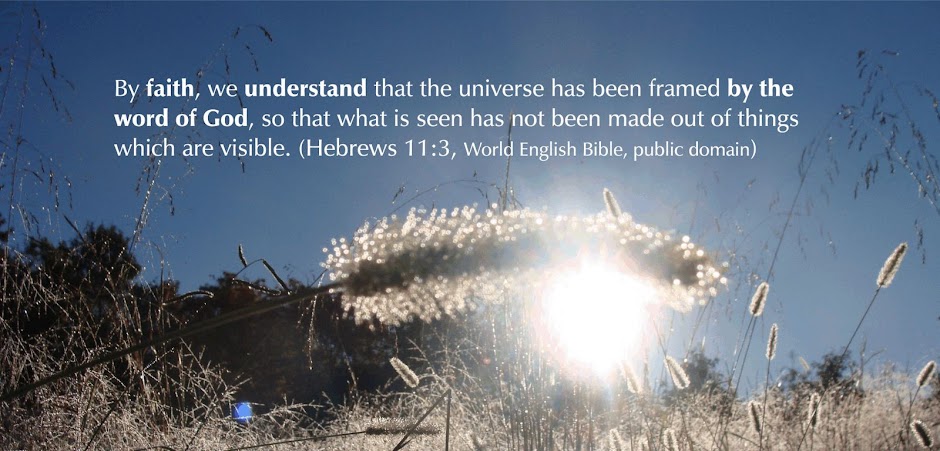
If Genesis 1 means anything, it means that God began the universe. Genesis 1:1 doesn't say when this was, or how or why it happened. It does say Who did it. That fact must be more important than when, how, or why. However the universe arose, we would not expect there to be much, if any, scientific evidence for the means by which it appeared. It is possible to believe that everything somehow began to be something. However, it takes an act of faith, just as believing in a supernatural Creator does. (Hebrews 11:3) Most people don't seem to recognize this. Some do. As Michael Shermer, frequent critic of supernatural beliefs, put it: "In conclusion, I believe, but cannot prove...that reality exists and science is the best method for understanding it, there is no God, the universe is determined but we are free, morality evolved as an adaptive trait of humans and human communities, and that ultimately all of existence is explicable through science." This is one of many responses to Edge's World Question for 2005, which was: "What do you Believe is True Even Though You Cannot Prove it?"
Schermer, a prominent self-confessed atheist, is to be commended for his honesty. He can't prove his world-view. He just believes it. As I understand Hebrews 11:3, I'm in the same position, and so are you, although our world-views may not be the same as Schermer's. So why does Schermer believe as he does? I think Ian Barbour put it very well, and honest naturalists (he uses materialists, instead) would agree with him (I have read statements by naturalists which show this.):
…both scientific materialists and biblical literalists have failed to recognize significant distinctions between scientific and religious assertions. The scientific materialists have promoted a particular philosophical commitment as if it were a scientific conclusion, and the biblical literalists have promoted a prescientific cosmology as if it were an essential part of religious faith. Ian G. Barbour, When Science Meets Religion: Enemies, Strangers, or Partners? San Francisco: Harper San Francisco, 2002, p. 36.
The philosophical commitment of the naturalist is that there is no God, no design, no plan, no pattern. They can believe it, but they can't prove it. I believe that there is a God, a design, a plan, and a pattern. I can't prove it, either. Hebrews 11:3 says that I can believe it, and I do.One reason for making evolution a big deal is that it's easier to get people to pay attention to you, even support you financially, if you polarize a topic. (Just look at our political process.) Concerning evolution, it's easier to get an audience if you say something extreme, such as that all the science professors at a nearby university are atheists, or that all the conservative preachers in the county are ignorant, anti-scientific yahoos. Both things are said, sometimes because the speaker genuinely believes them, but, I am afraid, sometimes because the speaker wants to attract a following, knowing full well that there are believing scientists at many universities, and intelligent, open-minded (about scientific matters) preachers in conservative churches.
Such extremism does not help anyone, except maybe the extremists. Saying "I don't believe in evolution" is seldom, if ever, completely true. It isn't a clear statement, and may indicate ignorance or muddy thinking, or even deliberate obfuscation. It would be better to say "I believe that humans were specially created," or "I don't believe in macroevolution," or "I'm a young-earth creationist," or exactly whatever the speaker or writer does believe, or not believe. Not everyone is a naturalist -- I'm not -- but everyone believes in at least some evolution.
Wednesday, September 14, 2005
Sunspots 22
Things I have recently spotted that may be of interest to someone else:
* * * * *
Interview with author of Lost Women of the Bible, which is, as I understand it (I haven't read it) about how God's plan for persons with two X chromosomes is more important than some people seem to think it is.
* * * * *
Katherine has moved to France, and it's not the same (not all bad, though!)
* * * * *
Nessa, the Smite Faerie, posts lots of brief, but insightful book reviews, often on fantastic fiction. She (?) must read fast.
* * * * *
Article in The Journal of Religion and Popular Culture, on using the Web to teach a comparative religions class, which gets into some deep territory. Sample:
[¶ 18] There is much debate about what it means to “enter cyberspace.” Do we enter a space of “no relation” to embodiment in ways that leave the body behind completely? Or does digital technology simply make evident what psychoanalysis has argued all along: that the body is constituted not purely organically but also psychically (through imaginary, or arbitrary, relations)? My contention in this essay is that both these interpretations, in their rush to “tidy up” the messiness of the emerging scenes of digital communication, miss something crucial: the complex sorts of subject constitution that can arise when language is practiced through, and as, multiple media.
* * * * *
For you Firefox users, a weather forecast extension.
* * * * *
IceRocket, a blog search tool that does more than, say, Google. Among other features, posts in the return list are sorted by post date, and the number of links from other blogs is shown. In the page of returns, There are Focus, Exclude and Subscribe links for each return. I think the first one narrows the responses to one blog. The second, I think, gives returns not including the blog in question. The third lets you subscribe to the blog returned. It's not perfect. For one thing, it didn't return this blog in the one search I did, even though an attempt to register my blog with IceRocket got the response that it was already registered. For another, while testing it, the server timed out once. Shows promise, but may need some work.
* * * * *
Scholar's Blog, by Michele, describes itself as a "Blog for an English independent scholar of fantasy fiction." The posts fit that description, except that they are readable by non-scholars.
* * * * *
It's been a while since I looked up a book on Amazon. There have been some helpful changes. At least for some books, there are now listings of Statistically Improbable Phrases (SIPs), that is, phrases found in this book that are found significantly more often than in "normal" books. This gives clues to what the book is actually about, and, since the SIPs are also hyperlinks to other books with the same SIPs, helps you to find similar ones. Capitalized Phrases works similarly. The site also gives the number of books that the book in question cites, which is an indicator of how scholarly it is, and a list of these books. Don't forget the "Look Inside the Book" feature, too (not available for all works) which has been around for a while.
* * * * *
My apologies to Bloglines. They are now searching within the text of my blog, (In my next-to-last post, I said that they weren't) and, presumably, those of many others that they hadn't been for some months. Thanks!
* * * * *
American Eagle (I have no financial interest in this clothing chain, so far as I know, and have never bought anything from them) had some fake books in its store displays for the back-to-school season. One of these was entitled Classics of Twenty-first Century Literature. Thanks for a good laugh!
* * * * *
"Harry Potter and the Half-Stumped Critics" claims that, although postmodernists and conservative Christians (some, not all, of each, I suppose) have embraced the Harry Potter books, they don't exactly support either type of view.
* * * * *
Wired says that a good new browser is coming soon.
I am aware, at least somewhat, of Hurricane Katrina's aftermath (of many kinds), that the U. S. Senate Judiciary Committee is examining Judge Roberts, and that there are various other important events, some of which we probably haven't heard of, transpiring now. Other sources are covering these matters. I guess I won't.
As of posting time, I have no information on this week's Christian Carnival.
Tuesday, September 13, 2005
I believe in evolution. So do you!, part 1
I believe in evolution. So do you!
I hope that got your attention. Please read on.
A statement like the first sentence in the title should force the reader to ask a question: "What do you mean by evolution?" (The same question should have been asked, if that first sentence had said: "I don't believe in evolution.") All too often, the question isn't asked, and confusion results. This topic has generated a lot of discussion, and will generate more after I am long gone. Some of the discussion is because of genuine disagreements. But, unfortunately, some of it is because people aren't careful to define their terms.
One meaning of the word, evolution, is change. If that's the meaning, everybody believes in it. Transportation, for example, has evolved from walking and being pulled, or carried, by beasts of burden to bicycles, scooters, trains, automobiles and airplanes. No doubt there will be further evolution, in this sense.
The Bible indicates that all humans descended from a single couple, Adam and Eve, or from a single family, that of Noah and his sons and their wives. Humans are not nearly as homogeneous as they were in the time of Adam and Eve, or of Noah and his wife. That means that humans have evolved into various racial groups.
Another meaning is natural selection. Charles Darwin proposed the notion of natural selection. He noted that there was considerable variety in the offspring of a single pair, and that there weremore offspring born (or hatched, or sprouted) than survived. He also noted that offspring resemble their parents. Those facts led him to propose that there is a struggle for existence, that the most fit survive, and that they leave more offspring in the next generation than those who aren't so fit. I have never read anyone who understood it who doubted Darwin's facts, or his conclusion. Natural selection is a fact. It is probably at least partly responsible for the variety of humankind. It is almost certainly responsible for the frequencies of the sickle-cell anemia gene in various populations. It is responsible for antibiotic-resistant bacteria, and insecticide-resistant insects.
Artificial selection is when humans decide what individual domestic animal or plant is going to reproduce, because they want to get a certain type of offspring. Selection by humans works, and works well. An enormous variety of selective experiments have been done, sometimes by scientists, sometimes by farmers, or people raising animals or growing plants. You can select just about any species for just about anything. The mechanism of artificial selection isthe same as that proposed by Darwin for natural selection.
Darwin himself didn't seem to realize it, but the most important result of natural selection isn't change, it's stability. Organisms don't change very much over time, not because their offspring are all alike, but because departures from the norm are selected against.
So if everybody believes in selection, what's the big deal? Well, one reason is that there are other things people sometimes mean when they use the word,evolution.
Yet another meaning is speciation. The short title of Darwin's book was The Origin of Species. Speciation is those processes which lead to the appearance of new species. Here's where we hit a couple of the big deals. One big deal is the use, in the King James Bible, of the phrase, "after his kind." Some people think that that rules out speciation, the creation of new species. The fact is that, whatever "kind" meant, it is a concept of God, and we aren't sure what it meant. Species, and other categories of taxonomy, are human constructs, and don't necessarily correspond with "kind." (For all we know, cat kind included lions, leopards, and domestic cat-like animals.) Since these are human constructs, they are changeable. Darwin believed, and most biologists also do, that the mechanisms of natural selection, as described above, are responsible for the development of new species.
Can a Christian believe that new species arise by natural selection? Clearly, some do, and some don't. If the world is only about 6,000 years old, there hasn't been enough time for much speciation. If God created the variety of living things by miracles, then they didn't get here by natural selection operating on previous forms. There are Christians who believe that the world is about 6,000 years old, and some who believe that it is much older. Even if it is very old, of course, that doesn't prove that the species we have arose by natural selection, but it would make that possible. There are Christians who believe that God created basically all the species we have now, during a short period of time. There are Christians who don't. All flavors of belief about these matters can be found, although most people don't realize this.
My own view is that at least some speciation has occurred since the beginning. Even the most literal interpretations of Genesis don't rule all speciation out, in my opinion. However, they rule out the possibility that most species arose in this way. Therefore, many Christians do not believe in evolution, if by evolution is meant speciation.
The second big deal relates to humans. Did we arise from some previous species by natural selection? The Bible seems to indicate that humans were created by a miraculous process. The Bible indicates that humans are different, and the God treats them differently, from other organisms. God gave us dominion over the rest of them (Genesis 1:26, 28) and God came as a human,Jesus Christ.
(Lest there be any doubt, no reputable scientist believes that humans evolved from chimpanzees. Many scientists believe that humans and chimpanzees share a common ancestor.)
Some Christians believe that the first part of Genesis is not meant to be taken literally. They can accept that God may have used some process to produce humans out of non-humans, and that our bodies, at least, evolved from some pre-human stock. Many Christians do not accept this, and, therefore, do not believe in evolution, if by evolution is meant the origin of humans from non-humans by partly or entirely natural processes.
The scientific evidence for speciation, including that of humans, is, in a word, similarity. All animals have cells, and are alike in other ways. All mammals, including humans, are similar in several ways. Chimpanzees and humans look enough alike that chimps are sometimes dressed in human clothing. The two species share 96% or more of their DNA. I believe that the Bible teaches that evidence from nature, including the findings of science, must be taken into account. (Psalm 19, Romans 1:20, Acts 14:17) If we knew how to correctly interpret the Bible, and how to correctly interpret scientific findings, there would be no conflicts. We don't know how to correctly do either, and sometimes there are conflicts.
To be continued, God willing. (See here for the second part, here for the third.) If you really have too much time on your hands, click on the origins label at the end of this post!
Thanks for reading.
I hope that got your attention. Please read on.
A statement like the first sentence in the title should force the reader to ask a question: "What do you mean by evolution?" (The same question should have been asked, if that first sentence had said: "I don't believe in evolution.") All too often, the question isn't asked, and confusion results. This topic has generated a lot of discussion, and will generate more after I am long gone. Some of the discussion is because of genuine disagreements. But, unfortunately, some of it is because people aren't careful to define their terms.
One meaning of the word, evolution, is change. If that's the meaning, everybody believes in it. Transportation, for example, has evolved from walking and being pulled, or carried, by beasts of burden to bicycles, scooters, trains, automobiles and airplanes. No doubt there will be further evolution, in this sense.
The Bible indicates that all humans descended from a single couple, Adam and Eve, or from a single family, that of Noah and his sons and their wives. Humans are not nearly as homogeneous as they were in the time of Adam and Eve, or of Noah and his wife. That means that humans have evolved into various racial groups.
Another meaning is natural selection. Charles Darwin proposed the notion of natural selection. He noted that there was considerable variety in the offspring of a single pair, and that there weremore offspring born (or hatched, or sprouted) than survived. He also noted that offspring resemble their parents. Those facts led him to propose that there is a struggle for existence, that the most fit survive, and that they leave more offspring in the next generation than those who aren't so fit. I have never read anyone who understood it who doubted Darwin's facts, or his conclusion. Natural selection is a fact. It is probably at least partly responsible for the variety of humankind. It is almost certainly responsible for the frequencies of the sickle-cell anemia gene in various populations. It is responsible for antibiotic-resistant bacteria, and insecticide-resistant insects.
Artificial selection is when humans decide what individual domestic animal or plant is going to reproduce, because they want to get a certain type of offspring. Selection by humans works, and works well. An enormous variety of selective experiments have been done, sometimes by scientists, sometimes by farmers, or people raising animals or growing plants. You can select just about any species for just about anything. The mechanism of artificial selection isthe same as that proposed by Darwin for natural selection.
Darwin himself didn't seem to realize it, but the most important result of natural selection isn't change, it's stability. Organisms don't change very much over time, not because their offspring are all alike, but because departures from the norm are selected against.
So if everybody believes in selection, what's the big deal? Well, one reason is that there are other things people sometimes mean when they use the word,evolution.
Yet another meaning is speciation. The short title of Darwin's book was The Origin of Species. Speciation is those processes which lead to the appearance of new species. Here's where we hit a couple of the big deals. One big deal is the use, in the King James Bible, of the phrase, "after his kind." Some people think that that rules out speciation, the creation of new species. The fact is that, whatever "kind" meant, it is a concept of God, and we aren't sure what it meant. Species, and other categories of taxonomy, are human constructs, and don't necessarily correspond with "kind." (For all we know, cat kind included lions, leopards, and domestic cat-like animals.) Since these are human constructs, they are changeable. Darwin believed, and most biologists also do, that the mechanisms of natural selection, as described above, are responsible for the development of new species.
Can a Christian believe that new species arise by natural selection? Clearly, some do, and some don't. If the world is only about 6,000 years old, there hasn't been enough time for much speciation. If God created the variety of living things by miracles, then they didn't get here by natural selection operating on previous forms. There are Christians who believe that the world is about 6,000 years old, and some who believe that it is much older. Even if it is very old, of course, that doesn't prove that the species we have arose by natural selection, but it would make that possible. There are Christians who believe that God created basically all the species we have now, during a short period of time. There are Christians who don't. All flavors of belief about these matters can be found, although most people don't realize this.
My own view is that at least some speciation has occurred since the beginning. Even the most literal interpretations of Genesis don't rule all speciation out, in my opinion. However, they rule out the possibility that most species arose in this way. Therefore, many Christians do not believe in evolution, if by evolution is meant speciation.
The second big deal relates to humans. Did we arise from some previous species by natural selection? The Bible seems to indicate that humans were created by a miraculous process. The Bible indicates that humans are different, and the God treats them differently, from other organisms. God gave us dominion over the rest of them (Genesis 1:26, 28) and God came as a human,Jesus Christ.
(Lest there be any doubt, no reputable scientist believes that humans evolved from chimpanzees. Many scientists believe that humans and chimpanzees share a common ancestor.)
Some Christians believe that the first part of Genesis is not meant to be taken literally. They can accept that God may have used some process to produce humans out of non-humans, and that our bodies, at least, evolved from some pre-human stock. Many Christians do not accept this, and, therefore, do not believe in evolution, if by evolution is meant the origin of humans from non-humans by partly or entirely natural processes.
The scientific evidence for speciation, including that of humans, is, in a word, similarity. All animals have cells, and are alike in other ways. All mammals, including humans, are similar in several ways. Chimpanzees and humans look enough alike that chimps are sometimes dressed in human clothing. The two species share 96% or more of their DNA. I believe that the Bible teaches that evidence from nature, including the findings of science, must be taken into account. (Psalm 19, Romans 1:20, Acts 14:17) If we knew how to correctly interpret the Bible, and how to correctly interpret scientific findings, there would be no conflicts. We don't know how to correctly do either, and sometimes there are conflicts.
To be continued, God willing. (See here for the second part, here for the third.) If you really have too much time on your hands, click on the origins label at the end of this post!
Thanks for reading.
Monday, September 12, 2005
Milestone (I think)
According to Blogger, my free host (and my fallible arithmetic) this is the 200th existing post to this blog. Thank God! (I also thank Blogger)
The hardest thing about blogging is having something worthwhile to say, and time to say it properly. Has what I posted always been worthwhile? I guess not. Sorry, if that's true.
This post, from Jan 29th, mostly a quote of C. S. Lewis, who had a lot of worthwhile somethings to say, got the most comments. This one, from Jan 28th, summarizes my view of what a Christian should think of science and the bible. (That was back when Bloglines actually searched my blog, and, perhaps, when I had more worthwhile things to say!) This one, from April 24th, lays forth my guidelines for this blog. This one, two observations from our recent trip, probably got the most important response (it was an e-mail, not a comment).
I have not posted any photos here recently. If you are interested in our public photos, many of them by my wife, they can be found here, on my Flickr site. We do have photos of scenery, and one of the two of us, from our recent trip, posted there.
Another (unfortunate) milestone was passed a couple of days ago--I got a spam comment.
I plan to post on basketball rules, when human life begins, the places we went on our recent trip, Lee Strobel's Case for Creation, the Hyperion Cantos by Dan Simmons, whether it would be a good thing to bring fictional characters to life, C. S. Lewis's mostly poor biology and his great Till We Have Faces, Hannah Whitall Smith's The Christian's Secret of a Happy Life, Kinsler and Kinsler's The Biblical Jubilee and the Struggle for Life and some other stuff, not necessarily in that order, in the near future, God willing. For links on most of these topics, see this post.
I haven't kept a hit counter, or kept track of those who have contacted me in some way, but there are probably 50 or more who have done so, and, I suppose, some readers who have never contacted me. Of those who have contacted me, a substantial portion are persons I have never had previous contact with. The new contacts, and this new way to keep some old contacts, or to deepen the relationships, make the whole process worthwhile. Thanks to all of those who have looked at this blog, including you.
The hardest thing about blogging is having something worthwhile to say, and time to say it properly. Has what I posted always been worthwhile? I guess not. Sorry, if that's true.
This post, from Jan 29th, mostly a quote of C. S. Lewis, who had a lot of worthwhile somethings to say, got the most comments. This one, from Jan 28th, summarizes my view of what a Christian should think of science and the bible. (That was back when Bloglines actually searched my blog, and, perhaps, when I had more worthwhile things to say!) This one, from April 24th, lays forth my guidelines for this blog. This one, two observations from our recent trip, probably got the most important response (it was an e-mail, not a comment).
I have not posted any photos here recently. If you are interested in our public photos, many of them by my wife, they can be found here, on my Flickr site. We do have photos of scenery, and one of the two of us, from our recent trip, posted there.
Another (unfortunate) milestone was passed a couple of days ago--I got a spam comment.
I plan to post on basketball rules, when human life begins, the places we went on our recent trip, Lee Strobel's Case for Creation, the Hyperion Cantos by Dan Simmons, whether it would be a good thing to bring fictional characters to life, C. S. Lewis's mostly poor biology and his great Till We Have Faces, Hannah Whitall Smith's The Christian's Secret of a Happy Life, Kinsler and Kinsler's The Biblical Jubilee and the Struggle for Life and some other stuff, not necessarily in that order, in the near future, God willing. For links on most of these topics, see this post.
I haven't kept a hit counter, or kept track of those who have contacted me in some way, but there are probably 50 or more who have done so, and, I suppose, some readers who have never contacted me. Of those who have contacted me, a substantial portion are persons I have never had previous contact with. The new contacts, and this new way to keep some old contacts, or to deepen the relationships, make the whole process worthwhile. Thanks to all of those who have looked at this blog, including you.
Sunday, September 11, 2005
Teaching was important in the early church
Teaching was an important part of the work of the early church, perhaps the most important part. Being a good teacher was part of the qualifications for leadership. Knowing how to, and being able to teach was considered part of being a mature Christian.
A few verses (all KJV) that use the word, teach:
Matthew 28:19 Go ye therefore, and teach all nations, baptizing them in the name of the Father, and of the Son, and of the Holy Ghost:
[Comment: Jesus commanded His followers to teach.]
A few verses (all KJV) that use the word, teach:
Matthew 28:19 Go ye therefore, and teach all nations, baptizing them in the name of the Father, and of the Son, and of the Holy Ghost:
[Comment: Jesus commanded His followers to teach.]
Acts 4:18 And they called them, and commanded them not to speak at all nor teach in the name of Jesus.
Acts 5:28 Saying, Did not we straitly command you that ye should not teach in this name? and, behold, ye have filled Jerusalem with your doctrine, and intend to bring this man's blood upon us.
[Comment: In the two verses above, the Sanhedrin recognized the importance of teaching, and hoped to muzzle it.]
Acts 5:42 And daily in the temple, and in every house, they ceased not to teach and preach Jesus Christ.
[Comment: Peter and John, and the other apostles, didn't obey!]
1 Timothy 4:11 These things command and teach.
2 Timothy 2:2 And the things that thou hast heard of me among many witnesses, the same commit thou to faithful men, who shall be able to teach others also.
1 Corinthians 14:19 Yet in the church I had rather speak five words with my understanding, that [by my voice] I might teach others also, than ten thousand words in an [unknown] tongue.
[Comment: Paul thought teaching was important.]
1 Timothy 3:2 A bishop then must be blameless, the husband of one wife, vigilant, sober, of good behaviour, given to hospitality, apt to teach;
2 Timothy 2:24 And the servant of the Lord must not strive; but be gentle unto all [men], apt to teach, patient,
[Comment: in the two verses above, Paul made clear that the ability to teach was important in leaders.]
Hebrews 5:12 For when for the time ye ought to be teachers, ye have need that one teach you again which [be] the first principles of the oracles of God; and are become such as have need of milk, and not of strong meat.
[Comment: mature Christians should be able to teach, and not need as much instruction as immature ones.]
Notes: 1) I did not include any verses--there are quite a few--referring to Jesus as teaching.
2) Generally, I am reluctant to use the KJV in this blog, because of the changes in the language since it was produced, preferring the ASV, which is nearly three centuries newer, and also in the public domain, but in this case I have used the KJV, because it uses the word "teach" in all of these passages. The ASV doesn't.
* * * *
October 9th. Found two typos and corrected them.
Saturday, September 10, 2005
Travel West, 2
There's another feature of traveling west, namely the people. The Southwest, of course, has lots of Hispanics, but it was a pleasant eye-opener for a person like me, who has always lived East of the Mississippi, to see so many Japanese- and Chinese- (and probably other varieties) Americans in California, Washington, and Oregon. We also saw lots of Native Americans. Thanks in part to the Indian Gaming Act, which provides special status for casinos owned by tribes, there are tribes, with visible presences, that most people have never heard of. (See here for a picture of such a casino--there are many.) There is also Native American influence in place names. Seattle, WA, is named for a chief. I suspect that Puyallup and Enumclaw, WA, and lots of other places, have names relating to Native Americans.
The Gaming Act didn't produce the tribes, of course, but it gave many of them a reason to come together, so that they could profit from a vice shared, evidently, by lots of other people. It's too bad that we couldn't have found some other way to put tribes in business. It appears that the Indians haven't always been the main ones to profit from the casinos. There is, no doubt, an awful human cost to some patrons of these casinos, whatever their ethnicity.
The people we saw, whatever their ethnicity, are people, just like us. I had the opportunity to converse with some Native Americans while we were jointly waiting for a ferry. The conversation, with me, and between them, could have been identical if all of us had been of purely European ancestry. We flew back East across the aisle from an Asian-American couple with a small girl, and their parenting issues, and solutions, were just the same as anyone else's would have been. We're all in this together, and Christ died for all of us.
The Gaming Act didn't produce the tribes, of course, but it gave many of them a reason to come together, so that they could profit from a vice shared, evidently, by lots of other people. It's too bad that we couldn't have found some other way to put tribes in business. It appears that the Indians haven't always been the main ones to profit from the casinos. There is, no doubt, an awful human cost to some patrons of these casinos, whatever their ethnicity.
The people we saw, whatever their ethnicity, are people, just like us. I had the opportunity to converse with some Native Americans while we were jointly waiting for a ferry. The conversation, with me, and between them, could have been identical if all of us had been of purely European ancestry. We flew back East across the aisle from an Asian-American couple with a small girl, and their parenting issues, and solutions, were just the same as anyone else's would have been. We're all in this together, and Christ died for all of us.
Friday, September 09, 2005
Travel West
We flew to Southern California by way of Chicago. Two impressions from the flight:
1) The mid-West (Indiana, Illinois, Iowa, Ohio) is pretty flat. That often makes for good farming. You don't have to be far from Chicago to see farm-land.
2) There are huge chunks of land in the southwest (AZ, NM, CO, CA) where there's no sign of human habitation or vegetation as far as the eye can see. An occasional line indicates a seldom-used road, and there may be houses and plants, maybe even trees, too small to see from a few kilometers up, but there aren't many. This area, although seemingly barren land, is beautiful. There are textures and geological features all over the place. Most of it isn't flat. If you've never done it, get a window seat (I always let my wife have those, but I can see over her) on a commercial flight over this area, during the day, so you can see, and spend a quarter of an hour or more just looking out.
Some observations (based on a few days near San Diego, CA, and a few days driving around Washington and Oregon--I'm not an expert):
The West isn't the East. One aspect of that is mountains. There are lots of high mountains in CA, WA, and OR--mountains that have glaciers on them. This creates ecological niches (such as for mountain goats, but also for less obvious organisms) that don't exist in Eastern North America.
Another aspect, related to the first, is the prevalence of conifers, cone-bearing trees like pines, firs, hemlocks, redwoods, spruce and others, in the West. A couple from Seattle who were familiar with South Carolina and Virginia told us that the leaf changes in the autumn were much less showy in the West. The reason is that most of the trees are not deciduous--they don't lose their leaves in the fall. Conifers tend to be taller, and perhaps closer together, than deciduous trees.
Organisms are different. In the East, there are blue jays, noisy but showy birds. We saw no such bird in the West. We did see other jays, including Steller's Jay, a noisy bird that is also blue, but clearly different.
Why the desert in so much of the Southwest? Climate is always a complex matter, but the simple answer is ocean currents, prevailing winds, and mountains. The California Current is cold. Prevailing winds, in this area, blow from West to East. Hence the air coming onto the land usually warms up as it comes onto Southern California. Warm air holds more moisture than cold. Air cooled by moving over the California Current does not pick up a lot of moisture. When it comes over the usually warmer land, it warms, so becomes able to hold even more moisture, hence there is seldom rain in Southen California. The mountains (considerably higher than those in Eastern North America) cause the air to rise, and as it rises, it cools, and so it can hold less water than when it first came to land. As a result, it may dump moisture it can no longer hold. Then when this air comes down on the Eastern side of these mountains, it warms up again, and so holds more water, so it seldom rains in Arizona, New Mexico, and Nevada.
Even though San Diego, Los Angeles, and other Southwestern cities are in deserts, they are green. They are green because they are artificially watered. Where does this water come from? It comes from the water in the ground, or from rivers elsewhere in North American. The water table in most of the Southwest is dropping, and, if something isn't done, eventually there will be little or no water underground to tap. This problem, like others that experts know exist, is one that is only going to get worse, and that not enough is being done about. If a brave politician should tell us about this problem (or some of the others coming in the future), he or she probably would not be elected. We don't want to hear about trouble, and tend to "shoot the messenger."
For pictures of some Southern California plants, check out the Walk in Southern California set in our photos on Flickr. It also shows that, if not watered, this area is desert--rocks, bare soil, and a few hardy plants. For photos from Oregon and Washington, including mountains, check out the Washington & Oregon Trip set. If you like a particular photo, and want to see it at highest quality, click on it. There is an All Sizes icon above the picture, which allows access to the highest resolution.
Thanks for reading.
Note: I added the next-to-last link, on water problems, nearly 12 hours after the original posting.
1) The mid-West (Indiana, Illinois, Iowa, Ohio) is pretty flat. That often makes for good farming. You don't have to be far from Chicago to see farm-land.
2) There are huge chunks of land in the southwest (AZ, NM, CO, CA) where there's no sign of human habitation or vegetation as far as the eye can see. An occasional line indicates a seldom-used road, and there may be houses and plants, maybe even trees, too small to see from a few kilometers up, but there aren't many. This area, although seemingly barren land, is beautiful. There are textures and geological features all over the place. Most of it isn't flat. If you've never done it, get a window seat (I always let my wife have those, but I can see over her) on a commercial flight over this area, during the day, so you can see, and spend a quarter of an hour or more just looking out.
Some observations (based on a few days near San Diego, CA, and a few days driving around Washington and Oregon--I'm not an expert):
The West isn't the East. One aspect of that is mountains. There are lots of high mountains in CA, WA, and OR--mountains that have glaciers on them. This creates ecological niches (such as for mountain goats, but also for less obvious organisms) that don't exist in Eastern North America.
Another aspect, related to the first, is the prevalence of conifers, cone-bearing trees like pines, firs, hemlocks, redwoods, spruce and others, in the West. A couple from Seattle who were familiar with South Carolina and Virginia told us that the leaf changes in the autumn were much less showy in the West. The reason is that most of the trees are not deciduous--they don't lose their leaves in the fall. Conifers tend to be taller, and perhaps closer together, than deciduous trees.
Organisms are different. In the East, there are blue jays, noisy but showy birds. We saw no such bird in the West. We did see other jays, including Steller's Jay, a noisy bird that is also blue, but clearly different.
Why the desert in so much of the Southwest? Climate is always a complex matter, but the simple answer is ocean currents, prevailing winds, and mountains. The California Current is cold. Prevailing winds, in this area, blow from West to East. Hence the air coming onto the land usually warms up as it comes onto Southern California. Warm air holds more moisture than cold. Air cooled by moving over the California Current does not pick up a lot of moisture. When it comes over the usually warmer land, it warms, so becomes able to hold even more moisture, hence there is seldom rain in Southen California. The mountains (considerably higher than those in Eastern North America) cause the air to rise, and as it rises, it cools, and so it can hold less water than when it first came to land. As a result, it may dump moisture it can no longer hold. Then when this air comes down on the Eastern side of these mountains, it warms up again, and so holds more water, so it seldom rains in Arizona, New Mexico, and Nevada.
Even though San Diego, Los Angeles, and other Southwestern cities are in deserts, they are green. They are green because they are artificially watered. Where does this water come from? It comes from the water in the ground, or from rivers elsewhere in North American. The water table in most of the Southwest is dropping, and, if something isn't done, eventually there will be little or no water underground to tap. This problem, like others that experts know exist, is one that is only going to get worse, and that not enough is being done about. If a brave politician should tell us about this problem (or some of the others coming in the future), he or she probably would not be elected. We don't want to hear about trouble, and tend to "shoot the messenger."
For pictures of some Southern California plants, check out the Walk in Southern California set in our photos on Flickr. It also shows that, if not watered, this area is desert--rocks, bare soil, and a few hardy plants. For photos from Oregon and Washington, including mountains, check out the Washington & Oregon Trip set. If you like a particular photo, and want to see it at highest quality, click on it. There is an All Sizes icon above the picture, which allows access to the highest resolution.
Thanks for reading.
Note: I added the next-to-last link, on water problems, nearly 12 hours after the original posting.
Thursday, September 08, 2005
A Few Young Adult Books
Over the past few months, I have read a few young adult books, most of them for the first time.
Norton Juster's The Phantom Tollbooth was a re-read. This one's been around for decades, and it's still a good read, if you can stand lots of puns and wordplays. Basically, a boy proves, with quite a bit of help, that mere knowledge is not enough. Rhyme and Reason, i.e., an appreciation of beauty, and wisdom, are also necessary.
Several months ago, National Public Radio recommended The Eye, The Ear, and The Arm, by Nancy Farmer, as a good fantasy for middle-schoolers. It is good, and it's also a Newbery Honor book. It's about Africa, in a century or two. Pollution has gotten worse (the Eye, the Ear, and the Arm are mutant detectives). There's a sanctuary for the old African ways, but you can't go there and come back to the modern world. The head of security of an African country has not trained his own children in how to get around and along in a dangerous city, so when they enter it, they are kidnapped. They get out, having many adventures, and meeting some memorable characters.
NPR also recommended Gregor the Overlander in the same report. I read this, and enjoyed it, but, to a biologist, it has a huge flaw. A boy enters an underground world, with intelligent humans, rats, and cockroaches, the latter two species both about the size of humans. That's the biological flaw--rats can't be as big as humans, The Princess Bride notwithstanding, without so many necessary changes in their anatomy that they wouldn't be rats. The same is even more true of cockroaches.
The Upstairs Room, by Johanna Reiss, deserved its Newbery Honor. It's about a Jewish girl being hidden from the Nazis in Holland. Everybody should read The Hiding Place, of course, but this was also good.
I Am Regina, by Sally M. Keehn, is also historical, not exactly fiction, let's say speculation about a real situation, namely that a white girl was captured by Indians and lived among them for several years before being reunited with her mother. Christian faith was essential to her survival, and to her reunion.
Back to fantasy. Dave Barry and Ridley Pearson wrote Peter and the Starcatchers, a retelling of Peter Pan. It has most of the elements of the old story, but they're all a little different. There is a material that occasionally drops from space, and imparts amazing power to animals and humans that contact it. Thereby hang orphans, a giant crocodile, pirates (including a Smee), an island, and Peter, who will never grow up. It was a good read. Dave Barry's humor was muted. I knew he was a good writer, from reading his syndicated humor columns. This book explains some of what he's been writing since he stopped doing the columns.
Gary Paulsen is a prolific, and good, author. Sarny is a follow-up to Nightjohn, which was about black slaves learning to read. Sarny portrays the life of one such learner over 94 years. I've never been black, or female, or lived in the 19th century, and neither has Paulsen, but my view is that he did an outstanding job of telling what such a life might have been like, in less than 200 pages.
Norton Juster's The Phantom Tollbooth was a re-read. This one's been around for decades, and it's still a good read, if you can stand lots of puns and wordplays. Basically, a boy proves, with quite a bit of help, that mere knowledge is not enough. Rhyme and Reason, i.e., an appreciation of beauty, and wisdom, are also necessary.
Several months ago, National Public Radio recommended The Eye, The Ear, and The Arm, by Nancy Farmer, as a good fantasy for middle-schoolers. It is good, and it's also a Newbery Honor book. It's about Africa, in a century or two. Pollution has gotten worse (the Eye, the Ear, and the Arm are mutant detectives). There's a sanctuary for the old African ways, but you can't go there and come back to the modern world. The head of security of an African country has not trained his own children in how to get around and along in a dangerous city, so when they enter it, they are kidnapped. They get out, having many adventures, and meeting some memorable characters.
NPR also recommended Gregor the Overlander in the same report. I read this, and enjoyed it, but, to a biologist, it has a huge flaw. A boy enters an underground world, with intelligent humans, rats, and cockroaches, the latter two species both about the size of humans. That's the biological flaw--rats can't be as big as humans, The Princess Bride notwithstanding, without so many necessary changes in their anatomy that they wouldn't be rats. The same is even more true of cockroaches.
The Upstairs Room, by Johanna Reiss, deserved its Newbery Honor. It's about a Jewish girl being hidden from the Nazis in Holland. Everybody should read The Hiding Place, of course, but this was also good.
I Am Regina, by Sally M. Keehn, is also historical, not exactly fiction, let's say speculation about a real situation, namely that a white girl was captured by Indians and lived among them for several years before being reunited with her mother. Christian faith was essential to her survival, and to her reunion.
Back to fantasy. Dave Barry and Ridley Pearson wrote Peter and the Starcatchers, a retelling of Peter Pan. It has most of the elements of the old story, but they're all a little different. There is a material that occasionally drops from space, and imparts amazing power to animals and humans that contact it. Thereby hang orphans, a giant crocodile, pirates (including a Smee), an island, and Peter, who will never grow up. It was a good read. Dave Barry's humor was muted. I knew he was a good writer, from reading his syndicated humor columns. This book explains some of what he's been writing since he stopped doing the columns.
Gary Paulsen is a prolific, and good, author. Sarny is a follow-up to Nightjohn, which was about black slaves learning to read. Sarny portrays the life of one such learner over 94 years. I've never been black, or female, or lived in the 19th century, and neither has Paulsen, but my view is that he did an outstanding job of telling what such a life might have been like, in less than 200 pages.
Wednesday, September 07, 2005
Sunspots 21
Things I have recently spotted, over the last month, that may be of interest to someone else:
* * * * *
The Wikipedia continues to impress me. I found their article on Hurricane Katrina to be the best single source of information on the subject. Each day, there is a list of selected anniversaries, a featured article, news, and (some days) a featured picture.
* * * * *
Article by William Dembski, one of the most vocal advocates of Intelligent Design, commending President Bush for his words on the subject, and making clear that he, Dembski, is not a young-earth creationist.
* * * * *
Pastor Perry Noble on living within the culture. Sample:
One of the things that I love about Jesus is that He was never an opponent of the culture He lived in. He never staged a protest in regards to the Roman occupation of His country. He never rallied the religious to begin to picket the local prostitutes. He never asked people to write a letter complaining about the illegal practices of local tax collectors. He never longed for "the good 'ole days" when so & so was king. Nope--He simply started where His culture was...and instead of working against it--He used it to reach and minister to the masses that had been neglected by the Pharisees of the day.
* * * * *
Sir Tim Berners-Lee, who, more than anyone else, invented the Web, interviewed on subjects like blogging and the reliability of Web information.
* * * * *
This admonition from Proverbs: 21:13 Whoever closes his ear to the cry of the poor will himself call out and not be answered. (ESV)
* * * * *
Caitlin Andrews and friends throw a thrift store ball.
* * * * *
Articles attacking Intelligent Design are abundant (there are also articles defending it!). This one argues that "Intelligent Design has no Place in the Science Curriculum." Another argues that certain aspects of human anatomy display a lack of design.
* * * * *
Catez has some thoughts for those who think Hurricane Katrina was God's special judgment on that area, or the US.
* * * * *
The latest Christian Carnival is somewhere out there, but I don't know where. (Addendum: It's here. The theme involves icons, no less. I haven't read any of the entries yet.)
Tuesday, September 06, 2005
Travel hiatus over
Thank God, we have returned home, although we enjoyed our trip immensely. (You can see some of the photographic highlights here.)
Two thoughts came to me while travelling.
One: We were not reluctant to talk to total strangers about interesting sights, and some of the strangers, like the man who told my wife that there was a gray whale in the ocean at a wayside where we stopped, felt the same way. Why am I so reluctant to tell others about Christ?
Two: We tried to get as close as possible to sights, driving, walking, or climbing so that we could see (and sometimes smell and hear). We drove several miles along mountain roads, with few barricades, to get a better view of Mount St. Helens, for example. Why am I so reluctant to get closer to God?
We thank our children, who gave us the impetus, did most of the planning and financing, for us to take a retirement trip to Washington and Oregon, where we had never been before. We also enjoyed staying with a daughter, her husband, and our grandson. I expect to say more about this trip in future posts, and also to comment on most or all of the books mentioned in the most recent post. I also note that I was, back over a month ago, planning to do some more things. Will probably get around to most of them. Thanks for reading this far!
Two thoughts came to me while travelling.
One: We were not reluctant to talk to total strangers about interesting sights, and some of the strangers, like the man who told my wife that there was a gray whale in the ocean at a wayside where we stopped, felt the same way. Why am I so reluctant to tell others about Christ?
Two: We tried to get as close as possible to sights, driving, walking, or climbing so that we could see (and sometimes smell and hear). We drove several miles along mountain roads, with few barricades, to get a better view of Mount St. Helens, for example. Why am I so reluctant to get closer to God?
We thank our children, who gave us the impetus, did most of the planning and financing, for us to take a retirement trip to Washington and Oregon, where we had never been before. We also enjoyed staying with a daughter, her husband, and our grandson. I expect to say more about this trip in future posts, and also to comment on most or all of the books mentioned in the most recent post. I also note that I was, back over a month ago, planning to do some more things. Will probably get around to most of them. Thanks for reading this far!
Friday, August 05, 2005
Travel hiatus coming
Our daughters (and their husbands) are staking us to most of a retirement trip to various parts of Western North America. We expect to be gone for about a month, God willing. I don't plan to post during this trip. I didn't do so during our last one. I expect to check (and maybe even answer some) e-mail, and occasionally check my blog subscriptions, perhaps including yours, if you have a blog.
Those who may check this blog after early September will probably see, not necessarily in that order, a response to Bonnie's comment on this post. I also hope to post on a book by Patricia A. McKillip, and expect to post a few pictures from our trip. I have in mind a few suggestions for changing basketball rules.
I plan to take along, and read: some of the Hyperion quartet by Dan Simmons; a book on British poet John Keats, who is almost a major character in the Hyperion books; Till We Have Faces by C. S. Lewis; The Case for a Creator by Strobel, a graduation gift (to me!) from a student; The Biblical Jubilee and the Struggle for Life by Kinsler and Kinsler; The Christian's Secret of a Happy Life, by Smith, and my Bible.
Thanks for reading.
Those who may check this blog after early September will probably see, not necessarily in that order, a response to Bonnie's comment on this post. I also hope to post on a book by Patricia A. McKillip, and expect to post a few pictures from our trip. I have in mind a few suggestions for changing basketball rules.
I plan to take along, and read: some of the Hyperion quartet by Dan Simmons; a book on British poet John Keats, who is almost a major character in the Hyperion books; Till We Have Faces by C. S. Lewis; The Case for a Creator by Strobel, a graduation gift (to me!) from a student; The Biblical Jubilee and the Struggle for Life by Kinsler and Kinsler; The Christian's Secret of a Happy Life, by Smith, and my Bible.
Thanks for reading.
Sunspots 20
Things I have recently spotted that may be of interest to someone else:
Anyone interested in Christian fiction, by and about African-Americans, should probably check Christian Fiction, a blog by two (although I've only seen posts by one of them) African-American writers, and (sometimes) about such fiction.
* * * * *
From Harper's, a panel discussion on the state of the US economy, which, among other things, affects overseas missions, as US funds don't go nearly as far as they used to in many other countries. (The article doesn't mention that, but other aspects of the situation.) I was amazed to read that the panelists seemed to agree that something like Bush's private retirement savings accounts would be a good thing, although they were against paying for it by borrowing extensively.
* * * * *
I continue to use Bloglines for my RSS feeds, and it seems to work just fine for that. However, using it for searches within blogs is another matter. I subscribe to several searches, and occasionally use some of those keywords in my own posts. (Google does search within blogs--I use alerts--but it doesn't do a terrific job of that. Bloglines used to.) Bloglines isn't returning any of my own uses. It is returning some hits from other blogs, though. How many searchers would profit from my posts? How many posts I would profit from aren't being returned? I don't know.
* * * * *
Quote from an editorial in Christianity Today: All science is ultimately a matter of trust. The tools, methods, and mathematical skills scientists acquire over years of training are beyond the reach of the rest of us, even of scientists in different fields. Thanks to the creation-evolution debate, mistrust between scientists and conservative Christians runs deep. But those scarred by battles with evolutionists might still consider heeding the scientists who are warning us about climate change. As an evangelical scientist said to me recently, the debate over climate change is very much like Pascal's wager, that famous argument for belief in God.
Thursday, August 04, 2005
E=mc squared by David Bodanis
I'd like to thank one of our daughters, who urged me to purchase a used copy of this book at one of the bookstores in Stratford, ON. I'm glad she did.
David Bodanis begins E=mc2: A Biography of the World's Most Famous Equation (New York: Berkley Books, 2000) with a story that Cameron Diaz, the movie actress, was once asked, in an interview, if there was anything that she, Diaz, wanted to know. She supposedly replied that she would like to understand Einstein's famous equation. Perhaps she read this book. It doesn't impart complete understanding of the equation, but it helps.
Bodanis' book is about the history of science. He introduces a number of ideas, and some of the characters who were important in developing those ideas. He has written things about E, m, c, and 2 that I didn't know before I read the book, and about scientists that I had not heard of.
Here he is on the velocity of light:
Bodanis explains that celeritas, a Latin word meaning "swiftness," is the origin of the use of c for the velocity of light.
He told me some things about women scientists that I wish I had known before. One such woman was Emilie du Châtelet, who added to Newtonian physics the idea that there is such a thing as energy, which exists in many forms, one of them being kinetic energy (the energy an object possesses due to its motion) which, she found, is proportional to the mass of the moving object times its velocity squared. du Châtelet died in childbirth at 40. He also writes about Lise Meitner, who worked out the details of fission, and Cecelia Payne, who made fundamental discoveries about the composition of stars, but was not given a position at Harvard for many years, because of her sex. (Meitner now has an element named after her, so her achievement is recognized, but she was treated shamefully during her lifetime, by a co-worker.) Bodanis also writes about male scientists, lest there be any doubt.
Bodanis covers some interesting history. There are conflicting opinions about the role of Werner Heisenberg in the unsuccesful German atomic bomb program. Bodanis believes that he wanted to succeed, but was thwarted by allied sabotage. He also blames James F. Byrnes, a South Carolinian who advised Truman, for the fission bombing of Japan, when Japan was already close to surrender. There are alternative views on these opinions. He writes that Einstein's famous letter to President Roosevelt, urging US development of the bomb, was ignored. He credits Oppenheimer for his superb administration of the US atomic bomb program.
Most scientifically literate people understand that Einstein's famous equation is a by-product of his special theory of relativity, which is not principally about the equivalence of matter and energy, but about relative motion. I suspect that, like me, they might learn a great deal more about these matters, and other things, from Bodanis' book.
David Bodanis begins E=mc2: A Biography of the World's Most Famous Equation (New York: Berkley Books, 2000) with a story that Cameron Diaz, the movie actress, was once asked, in an interview, if there was anything that she, Diaz, wanted to know. She supposedly replied that she would like to understand Einstein's famous equation. Perhaps she read this book. It doesn't impart complete understanding of the equation, but it helps.
Bodanis' book is about the history of science. He introduces a number of ideas, and some of the characters who were important in developing those ideas. He has written things about E, m, c, and 2 that I didn't know before I read the book, and about scientists that I had not heard of.
Here he is on the velocity of light:
[Einstein's] new realization about light changed everything; for the speed of light becomes the fundamental speed limit in our universe: nothing can go faster. . . . light isn't just a number, it is a physical process. There's a big difference. If I say that -273 . . . is the lowest number that there is, you could rightly answer that I'm wrong: that -274 is lower, and -275 is lower yet, and that you can keep on going forever. But suppose we are dealing with temperatures. The temperature of a substance is a readout of how much its inner parts are moving, and at some point they're going to stop vibrating entirely. That happens at about -273 degrees on the centigrade scale, and that's why -273 degrees is said to be "absolute zero" when you're talking about temperature. Pure numbers might be able to go lower, but physical things can't: a coin or a snowmobile or a mountain can't vibrate any less than not vibrating at all.
So it is with light. The 670,000,000 mph figure that Roemer measured for the light speeding down from Jupiter is a statement about what that light is like. It's a physical "thing." (p. 50)
Bodanis explains that celeritas, a Latin word meaning "swiftness," is the origin of the use of c for the velocity of light.
He told me some things about women scientists that I wish I had known before. One such woman was Emilie du Châtelet, who added to Newtonian physics the idea that there is such a thing as energy, which exists in many forms, one of them being kinetic energy (the energy an object possesses due to its motion) which, she found, is proportional to the mass of the moving object times its velocity squared. du Châtelet died in childbirth at 40. He also writes about Lise Meitner, who worked out the details of fission, and Cecelia Payne, who made fundamental discoveries about the composition of stars, but was not given a position at Harvard for many years, because of her sex. (Meitner now has an element named after her, so her achievement is recognized, but she was treated shamefully during her lifetime, by a co-worker.) Bodanis also writes about male scientists, lest there be any doubt.
Bodanis covers some interesting history. There are conflicting opinions about the role of Werner Heisenberg in the unsuccesful German atomic bomb program. Bodanis believes that he wanted to succeed, but was thwarted by allied sabotage. He also blames James F. Byrnes, a South Carolinian who advised Truman, for the fission bombing of Japan, when Japan was already close to surrender. There are alternative views on these opinions. He writes that Einstein's famous letter to President Roosevelt, urging US development of the bomb, was ignored. He credits Oppenheimer for his superb administration of the US atomic bomb program.
Most scientifically literate people understand that Einstein's famous equation is a by-product of his special theory of relativity, which is not principally about the equivalence of matter and energy, but about relative motion. I suspect that, like me, they might learn a great deal more about these matters, and other things, from Bodanis' book.
Wednesday, August 03, 2005
Sunspots 19
Things I have recently spotted that may be of interest to someone else:
If you use G-Mail, it may not be as private as you think it is, and the reason isn't because of Google--it has to do with RSS feeds. See here for a warning and a solution.
* * * * *
Written before the Internet, or blogging, but still relevant, perhaps:
"But why do only unimportant things?" asked Milo, who suddenly remembered how much time he spent each day doing them. "Think of all the trouble it saves," the man explained . . . "If you only do the easy and useless jobs, you'll never have to worry about the important ones which are so difficult. You just won't have the the time. For there's always something to do to keep you from what you really should be doing . . . ." Norton Juster, The Phantom Tollbooth, p. 213. (New York: Random House, 1996, Special 35th Anniversary Edition)
* * * * *
A post on whether Snape is really evil or not, and a long web page by John Granger on Rowling's Half-Blood Prince release interviews.
* * * * *
I have finally placed a Flickr photo badge on my blog (scroll down). You can't see it if you are going to a particular post, just from the main blog. Thumbnail pictures, from my photos, randomly appear and disappear. Thanks, Brandy!
* * * * *
Joe Carter's post on the improbability of life having risen by chance, and the extensive discussion, generally well-mannered and thoughtful, following it, make for some thought-provoking reading.
* * * * *
The latest Christian Carnival is here. Be prepared to see a brown background!
What must be Christian about a Christian Novel?
There are, I am sure, many others who have written on this topic. I am aware of a few of them. Over a year ago, Jared wrote "Drawing Lines in the Matter of Christian Content," which is as good as anything I have read on the subject. He wrote:
In an earlier post, I have listed three aspects of a novel that aren't necessary, in my opinion, to make it Christian. I also list four criteria that Angela Hunt suggests are necessary for faith fiction, which is a sub-category of Christian fiction, but, unfortunately, one that is often assumed to be all of Christian fiction. It isn't. Dee, herself an author of Christian fiction, was kind enough to comment on my post. She has a blog, which will, like Hunt's and Jared's, give you more opinions on the subject of my title.
I am not an expert in the writing, or even the reviewing, of Christian fiction. Let me get back to my own musing. Hunt, who is an expert, in that she is a much-published author of Christian fiction, in a different post, says: "As a book without plot and characters can hardly be called a novel, a novel without plot, characters, and some element of Christianity can hardly be called a Christian novel, right?" As I said in my previous post on this subject, I agree. Let me muse about some elements of Christianity that might be found in novels, especially novels in fantastic fiction. To me, to be a Christian element, it should be reasonably clear that the element was put it deliberately--the reader isn't finding something that the author didn't intend that way.
1) A Christ-figure. Aslan, from C. S. Lewis's Narnia books, is an obvious example. The Lion is a character who willingly offers his life for the guilt of another, in an effective sacrifice, and returns to life. It seems to me that a character can be a Christ-figure without doing all that. Gandalf, in Tolkien's trilogy, died to protect the rest of the Fellowship, and was resurrected. I would list him as a Christ-figure, even though he didn't die for the guilt of another. Willingly offering her life to protect others, by a good character, would often be enough to make one a Christ-figure for me, at least in fiction.
Unselfish giving, of resources, or of the self, for example in giving care to others, could make a character a Christ-figure.
2) Belief in important orthodox Christian doctrine, on the part of a narrator or character, would be a Christian element. Although they have a distorted view of it, the Underpeople in Cordwainer Smith's books believe in a Trinity, so that (and other things) would lead me to consider his works as Christian novels.
3) Practicing monotheistic prayer to a divine being. The attempts to seek guidance, usually accompanied by animal sacrifices, in Gene Wolfe's Long Sun books are Christian elements, in my opinion. Zenna Henderson's books on the People have this element, without the sacrifices.
Tolkien's work is missing some interesting things. There is little or no worship of a creator, or prayer or religious ceremony of any kind, in the trilogy or The Hobbit. Many writers of fantastic literature have included worship, of some being or beings, in their books, which is not surprising, since worship is an important part of human life.
Jack Vance frequently has some type of religious practice in his novels. All such practice in them is farcical, or obviously evil, or both. I appreciate his fiction, but find no Christian elements in it.
Just having worship or prayer doesn't make something Christian. The sacrifice of a rational creature as part of such a prayer would make such a prayer a non-Christian element. Juliet Marillier has stated that she has tried to create a Pictish, and non-Christian religion in at least some of her work. Ursula K. Le Guin has similarly stated that some of her works are Taoist. I find Le Guin, especially, well worth reading, and I'm certainly not alone in that, but her work, to my mind, nor, I think, to hers, can be called Christian.
*(This paragraph was added, on the same day, several hours after the original post. The rest of the post remains as it was) Le Guin hasn't restricted herself to Taoism. Much of her The Tombs of Atuan depends on what, for want of a better name, I shall call a pagan religion--worship of powerful, but localized spirits. These spirits are represented as real, even to persons, like Ged, who don't worship them. The religion is one of ritual and fear. There is no love or goodness, just power and jealousy. The same book has another religion, worship of the god-brothers, which isn't as well described. C. S. Lewis, often considered one of the most important Christian writers of the previous century, constructed a pagan religion with a description, like that of Le Guin's, that seems authentic in Till We Have Faces. I suppose that he was, in part, illustrating his belief that other religions (the setting is pre-Christian, in or near what is now Greece) may point their sincere adherents toward Christianity. As he said, "If you are a Christian you do not have to believe that all the other religions are simply wrong all through." Mere Christianity: What One Must Believe to Be a Christian. New York: Macmillan, 1952. p. 30. Or, in fiction, it is illustrated by the experience of a Calormene on meeting Aslan:
5) A consciousness of supernatural guidance, or divine providence, benevolent in character, strikes me as a Christian element. This occurs in Tolkien, in, for example, the Council of Elrond, where Elrond remarks that those attending are not there by chance.
6) An explicit rejection of evil personified, or a decision to turn away from evil acts by a character, is a Christian element. Patricia McKillip's characters often decide not to take personal vengeance, for example. Bilbo's decision not to kill Gollum is a Christian element. Perhaps even the realization of one's own evil nature, and a desire to change, should be considered a Christian element. Attempting to live righteously would also be a Christian element.
It seems to me that a novel which meets Hunt's other three criteria, and includes one of the first four elements above in a non-trivial way, would necessarily be legitimate faith fiction, because it would "illustrate some aspect of Christian faith." A novel could have the fifth, or sixth, or both, and not really do so.
I don't know how comfortable most readers or publishers of faith fiction would be with fantastic faith fiction, or fantastic Christian fiction. As Jared said, they might find it "too edgy." Maybe not. The only recent example of an attempt to write fantastic faith fiction that I can think of is Stephen R. Lawhead**.
There are, no doubt, other Christian elements, that could legitimately cause a novel to be labeled Christian. If you think of any, please comment.
* * * * *
**Addition, August 28, 2006: I have discovered that there is a lot more of what I called "fantastic faith fiction" than I thought there was. There is at least one blog, Speculative Faith, devoted exclusively to the subject. (That blog mentions three other blogs on the subject in a sidebar. I'm familiar with one of them, Claw of the Conciliator, which frequently, but not always, writes about "Christian Speculative Fiction.") One post from Speculative Faith defines such literature. The blog has a sidebar list of 25 authors, including Lawhead.
Addition, April 5, 2007: A newer, related post is "Christian aspects of fantastic literature." I have also mused about "Christian themes in Patricia A. McKillip's Riddle-Master Trilogy."
Edited slightly, March 13, 2007.
Thanks for reading.
* * * *
June 14, 2007:
Here's my post on the question of whether Elizabeth Moon's trilogy, The Deed of Paksenarrion, consists of Christian novels.
August 19, 2007:
Here's my post on Moon's Surrender None, which includes a Christ-figure who dies to keep others from doing wrong.
September 14, 2007:
Here's my post on whether the Harry Potter books are Christian novels.
November 22, 2007: In a shameless attempt to pick up more Google search hits, I am adding these terms: novel, book, aspects, characteristics, attributes, properties, Christian, literature, religion, fantasy, science fiction, story, atonement.
October 2, 2008:
Here's my post on the question of whether Lois McMaster Bujold's The Curse of Chalion is a Christian novel.
October 31, 2008:
Here's my post on Sherri S. Tepper's Grass. The book, and the post, include religious aspects as a major feature.
* * * * *
On April 2, 2009, E Stephen Burnett wrote an essay, asking questions about how far a Christian author could go in writing fiction which has a God who is significantly different from the Christian God, and whether a Christian could legitimately create a fictional character who is in defiance of God. I posted tentative answers to these questions, which are related to the subject of the post above, on April 13, 2009.
* * * * *
On August 7th, 2009, I considered the question of whether the Sharing Knife novels, by Lois McMaster Bujold, are Christian, using the items above in my analysis. I concluded that they are not. However, as I indicated in that post, Bujold does have a character who is a Christian in one of her other books, in the Miles Vorkosigan series. In this post, I note that I personally found illustrations of matters central to Christianity in the Sharing Knife books, whether or not Bujold meant for them to be found there.
* * * * *
On August 18th, 2009, I considered the question of whether The Spirit Ring, also by Bujold, is a Christian novel, and concluded that it was. Bujold is an important writer, the only one who has won Hugo, Nebula, and Mythopoeic Awards for her fiction.
* * * * *
Added February 8, 2011. I have condensed my thoughts on this topic, and changed my views a little, since this was originally posted. See here for the update.
* * * * *
Added February 7th, 2012: Rachelle Gardner, a literary agent, apparently one who serves authors of Faith Fiction, argues that "Christian Fiction" should be so labeled, as part of honesty in marketing. Mike Duran, who uses Gardner as his agent, begs to differ. There are many comments on both posts.
So Dostoyevsky, not really a "Christian author," would be too Christian for the mainstream. [C. S.] Lewis, most certainly a Christian author, would be too edgy for the Christian publishers.
This is precisely the predicament many aspiring Christian writers find themsevles [sic] in these days. They often find their works caught in some literary limbo. Mainstream publishers don't want them because they are too obviously Christian, and Christian publishers don't want them because they deal honestly and authentically with the stuff of the world.
Jared mentions, as examples of edginess in the writing of C. S. Lewis, some of Uncle Andrew's language in The Magician's Nephew, Mr. Beaver's beer-drinking and pipe-smoking in The Lion, the Witch, and the Wardrobe, and some sexual references in That Hideous Strength. (He could have mentioned that Lewis, himself, smoked a pipe, drank alcoholic beverages, and married a divorced woman.) The entire post, which isn't very long, is required reading on this topic.This is precisely the predicament many aspiring Christian writers find themsevles [sic] in these days. They often find their works caught in some literary limbo. Mainstream publishers don't want them because they are too obviously Christian, and Christian publishers don't want them because they deal honestly and authentically with the stuff of the world.
In an earlier post, I have listed three aspects of a novel that aren't necessary, in my opinion, to make it Christian. I also list four criteria that Angela Hunt suggests are necessary for faith fiction, which is a sub-category of Christian fiction, but, unfortunately, one that is often assumed to be all of Christian fiction. It isn't. Dee, herself an author of Christian fiction, was kind enough to comment on my post. She has a blog, which will, like Hunt's and Jared's, give you more opinions on the subject of my title.
I am not an expert in the writing, or even the reviewing, of Christian fiction. Let me get back to my own musing. Hunt, who is an expert, in that she is a much-published author of Christian fiction, in a different post, says: "As a book without plot and characters can hardly be called a novel, a novel without plot, characters, and some element of Christianity can hardly be called a Christian novel, right?" As I said in my previous post on this subject, I agree. Let me muse about some elements of Christianity that might be found in novels, especially novels in fantastic fiction. To me, to be a Christian element, it should be reasonably clear that the element was put it deliberately--the reader isn't finding something that the author didn't intend that way.
1) A Christ-figure. Aslan, from C. S. Lewis's Narnia books, is an obvious example. The Lion is a character who willingly offers his life for the guilt of another, in an effective sacrifice, and returns to life. It seems to me that a character can be a Christ-figure without doing all that. Gandalf, in Tolkien's trilogy, died to protect the rest of the Fellowship, and was resurrected. I would list him as a Christ-figure, even though he didn't die for the guilt of another. Willingly offering her life to protect others, by a good character, would often be enough to make one a Christ-figure for me, at least in fiction.
Unselfish giving, of resources, or of the self, for example in giving care to others, could make a character a Christ-figure.
2) Belief in important orthodox Christian doctrine, on the part of a narrator or character, would be a Christian element. Although they have a distorted view of it, the Underpeople in Cordwainer Smith's books believe in a Trinity, so that (and other things) would lead me to consider his works as Christian novels.
3) Practicing monotheistic prayer to a divine being. The attempts to seek guidance, usually accompanied by animal sacrifices, in Gene Wolfe's Long Sun books are Christian elements, in my opinion. Zenna Henderson's books on the People have this element, without the sacrifices.
Tolkien's work is missing some interesting things. There is little or no worship of a creator, or prayer or religious ceremony of any kind, in the trilogy or The Hobbit. Many writers of fantastic literature have included worship, of some being or beings, in their books, which is not surprising, since worship is an important part of human life.
Jack Vance frequently has some type of religious practice in his novels. All such practice in them is farcical, or obviously evil, or both. I appreciate his fiction, but find no Christian elements in it.
Just having worship or prayer doesn't make something Christian. The sacrifice of a rational creature as part of such a prayer would make such a prayer a non-Christian element. Juliet Marillier has stated that she has tried to create a Pictish, and non-Christian religion in at least some of her work. Ursula K. Le Guin has similarly stated that some of her works are Taoist. I find Le Guin, especially, well worth reading, and I'm certainly not alone in that, but her work, to my mind, nor, I think, to hers, can be called Christian.
*(This paragraph was added, on the same day, several hours after the original post. The rest of the post remains as it was) Le Guin hasn't restricted herself to Taoism. Much of her The Tombs of Atuan depends on what, for want of a better name, I shall call a pagan religion--worship of powerful, but localized spirits. These spirits are represented as real, even to persons, like Ged, who don't worship them. The religion is one of ritual and fear. There is no love or goodness, just power and jealousy. The same book has another religion, worship of the god-brothers, which isn't as well described. C. S. Lewis, often considered one of the most important Christian writers of the previous century, constructed a pagan religion with a description, like that of Le Guin's, that seems authentic in Till We Have Faces. I suppose that he was, in part, illustrating his belief that other religions (the setting is pre-Christian, in or near what is now Greece) may point their sincere adherents toward Christianity. As he said, "If you are a Christian you do not have to believe that all the other religions are simply wrong all through." Mere Christianity: What One Must Believe to Be a Christian. New York: Macmillan, 1952. p. 30. Or, in fiction, it is illustrated by the experience of a Calormene on meeting Aslan:
But the Glorious One bent down his golden head and touched my forehead with his tongue and said, Son, thou art welcome. But I said, Alas, Lord, I am no son of Thine but the servant of Tash. He answered, Child, all the service thou has done to Tash, I account as service done to me. Then . . . I overcame my fear and questioned the Glorious One and said, Lord, is it then true, as the Ape said, that thou and Tash are one? The Lion growled so that the earth shook . . . and said, it is false. Not because he and I are one, but because we are opposites, I take to me the services which thou hast done for him, for he and I are of such different kinds that no service which is vile can be done to me, and none which is not vile can be done to him.
. . .The Last Battle, New York: Macmillan, 1956, pp. 156-157.
4) Expressing a relationship with the God of Christianity as Lord would certainly be a Christian element. I can't think of any examples in fantastic fiction. There are plenty in faith fiction.. . .The Last Battle, New York: Macmillan, 1956, pp. 156-157.
5) A consciousness of supernatural guidance, or divine providence, benevolent in character, strikes me as a Christian element. This occurs in Tolkien, in, for example, the Council of Elrond, where Elrond remarks that those attending are not there by chance.
6) An explicit rejection of evil personified, or a decision to turn away from evil acts by a character, is a Christian element. Patricia McKillip's characters often decide not to take personal vengeance, for example. Bilbo's decision not to kill Gollum is a Christian element. Perhaps even the realization of one's own evil nature, and a desire to change, should be considered a Christian element. Attempting to live righteously would also be a Christian element.
It seems to me that a novel which meets Hunt's other three criteria, and includes one of the first four elements above in a non-trivial way, would necessarily be legitimate faith fiction, because it would "illustrate some aspect of Christian faith." A novel could have the fifth, or sixth, or both, and not really do so.
I don't know how comfortable most readers or publishers of faith fiction would be with fantastic faith fiction, or fantastic Christian fiction. As Jared said, they might find it "too edgy." Maybe not. The only recent example of an attempt to write fantastic faith fiction that I can think of is Stephen R. Lawhead**.
There are, no doubt, other Christian elements, that could legitimately cause a novel to be labeled Christian. If you think of any, please comment.
* * * * *
**Addition, August 28, 2006: I have discovered that there is a lot more of what I called "fantastic faith fiction" than I thought there was. There is at least one blog, Speculative Faith, devoted exclusively to the subject. (That blog mentions three other blogs on the subject in a sidebar. I'm familiar with one of them, Claw of the Conciliator, which frequently, but not always, writes about "Christian Speculative Fiction.") One post from Speculative Faith defines such literature. The blog has a sidebar list of 25 authors, including Lawhead.
Addition, April 5, 2007: A newer, related post is "Christian aspects of fantastic literature." I have also mused about "Christian themes in Patricia A. McKillip's Riddle-Master Trilogy."
Edited slightly, March 13, 2007.
Thanks for reading.
* * * *
June 14, 2007:
Here's my post on the question of whether Elizabeth Moon's trilogy, The Deed of Paksenarrion, consists of Christian novels.
August 19, 2007:
Here's my post on Moon's Surrender None, which includes a Christ-figure who dies to keep others from doing wrong.
September 14, 2007:
Here's my post on whether the Harry Potter books are Christian novels.
November 22, 2007: In a shameless attempt to pick up more Google search hits, I am adding these terms: novel, book, aspects, characteristics, attributes, properties, Christian, literature, religion, fantasy, science fiction, story, atonement.
October 2, 2008:
Here's my post on the question of whether Lois McMaster Bujold's The Curse of Chalion is a Christian novel.
October 31, 2008:
Here's my post on Sherri S. Tepper's Grass. The book, and the post, include religious aspects as a major feature.
* * * * *
On April 2, 2009, E Stephen Burnett wrote an essay, asking questions about how far a Christian author could go in writing fiction which has a God who is significantly different from the Christian God, and whether a Christian could legitimately create a fictional character who is in defiance of God. I posted tentative answers to these questions, which are related to the subject of the post above, on April 13, 2009.
* * * * *
On August 7th, 2009, I considered the question of whether the Sharing Knife novels, by Lois McMaster Bujold, are Christian, using the items above in my analysis. I concluded that they are not. However, as I indicated in that post, Bujold does have a character who is a Christian in one of her other books, in the Miles Vorkosigan series. In this post, I note that I personally found illustrations of matters central to Christianity in the Sharing Knife books, whether or not Bujold meant for them to be found there.
* * * * *
On August 18th, 2009, I considered the question of whether The Spirit Ring, also by Bujold, is a Christian novel, and concluded that it was. Bujold is an important writer, the only one who has won Hugo, Nebula, and Mythopoeic Awards for her fiction.
* * * * *
Added February 8, 2011. I have condensed my thoughts on this topic, and changed my views a little, since this was originally posted. See here for the update.
* * * * *
Added February 7th, 2012: Rachelle Gardner, a literary agent, apparently one who serves authors of Faith Fiction, argues that "Christian Fiction" should be so labeled, as part of honesty in marketing. Mike Duran, who uses Gardner as his agent, begs to differ. There are many comments on both posts.
Tuesday, August 02, 2005
When Did I Begin?
Catez, at AllThings2All, posted one of her usual thoughtful posts, on whether birth control pills are abortifacient. There have been several comments, including some by me, and she has been kind enough to comment back on the comments.
My comments were quotes (with a little explanation) from Norman M. Ford's When did I begin? Conception of the human individual in history, philosophy and science (Cambridge, UK: Cambridge University Press, 1988), the most thorough book on this question that I have been privileged to read. I am not, of course, certain that he is correct, but he at least deserves a reading. Ford is apparently a Catholic believer, with expertise in embryology, and also with knowledge of theology and philosophy. I'm going to repeat the quotes that I used in my comments here, in my own blog:
My comments were quotes (with a little explanation) from Norman M. Ford's When did I begin? Conception of the human individual in history, philosophy and science (Cambridge, UK: Cambridge University Press, 1988), the most thorough book on this question that I have been privileged to read. I am not, of course, certain that he is correct, but he at least deserves a reading. Ford is apparently a Catholic believer, with expertise in embryology, and also with knowledge of theology and philosophy. I'm going to repeat the quotes that I used in my comments here, in my own blog:
A human person cannot exist before the formation of a distinct living ontological individual with a truly human nature that retains the same ontological identity throughout successive stages of development. (xvi) (See the Wikipedia article on Ontology, if you need to.)
It should not be assumed that a genetically unique human zygote is the same ontological individual as the resulting blastocyst, definitive embryo proper, fetus and child, notwithstanding the continuity of the same biological identity at every stage of development. Human twins that are genetically identical are neverthless different ontological individuals. Furthermore, analysis of the evidence shows that early embryonic cells inside the zona pellucida lack the requisite unity to constitute a single ontological entity. Each is totipotent. They appear to have too much independence of behavior to constitute one individual. This alone would preclude them from being a human individual until the multiplying cells formed themselves into a single multicellular human body. Furthermore, experiments with mice show how single cells taken from three separate early mouse embryos can be aggregated to form a single viable chimaeric mouse embryo. In this case the resultant individual mouse certainly did not begin at the zygote stage. This suggests that perhaps in the normal situation the proliferating and developing cells amalgamate at a later stage to form the definitive individual body, be it that of a mouse or a human individual. (xvii)
With the appearance of the primitive streak after the completion of implantation and about 14 days after fertilization identical twinning can no longer occur. This is when the human body is first formed with a definite body plan and definitive axis of symmetry. Prior to this stage it would seem to be quite unreal to speak of the presence of a distinct human individual. This suggests that before this time genetically human embryonic cells could not develop into a human individual with a true human nature and a continuing ontological identity. If I am right, the early embryonic cells could not constitute an actual human individual. Instead they would have the potency to form one or more human individuals. It seems that the biological evidence leads to the philosophical conclusion that a human individual, our youngest neighbor and member of the human community, begins at the primitive streak stage and not prior to it, but most certainly by the stage of gastrulation when the human embryo's primitive cardiovascular system is already functioning and blood is circulating. (xviii)
In giving her moral teachings, which I personally accept, the Church generally refers to the zygote or the product of fertilization as a human being, a human subject with rights and even a human person but without intending to commit herself to a statement of philosophical character. In other words, the Church has gone as far as she possibly could without expressly declaring that the zygote is a human individual in the philosophical sense of a human being or human person, personally identical with the fetus, future infant, child and adult. Consequently though different stages of development of the human individual are recognized, the Church places them all on the one ethical level. . . . (p. 62) Ford is saying, here, that the Catholic Church's well-known opposition to abortion, at any stage of development, is on ethical grounds, not on the grounds that a zygote or very early embryo is philosophically equal to a baby or adult.
There's a lot more thought-provoking material in the book, but I don't think it's ethical for me to quote any more of it here.
Ford's answer to the question posed by his book's title, and that of this post, would be, "no earlier than about 14 days of development."
Monday, August 01, 2005
Angela Hunt on Christian Novels
Angela Hunt, the author of quite a few books, (as Angela Elwell Hunt--she blogs as Angela Hunt) wrote a post entitled "What Makes a Novel Christian." Hunt used a longish quotation from G. K. Chesterton's Orthodoxy, and wrote that:
An anonymous commenter appears to be considerably less broad-minded:
As a book without plot and characters can hardly be called a novel, a novel without plot, characters, and some element of Christianity can hardly be called a Christian novel, right?
I agree. Some element of Christianity should be present. Since she suggests that Irving's A Prayer for Owen Meany (detailed Barnes & Noble SparkNotes analysis of the book) might be considered a Christian novel, Hunt is apparently open to a relatively broad range of what an "element of Christianity" might be.An anonymous commenter appears to be considerably less broad-minded:
. . . a Christian novel cannot be Christian if there are no Christian principles invoked and hold the Christian theme throughout the entire book.
If I were to pick up a book that was "supposed" to be Christian fiction, and, after reading, I found the Christian principles not implemented, I would NO LONGER read that particular author. There is a certain standard that Christian novels must maintain.
If I were to pick up a book that was "supposed" to be Christian fiction, and, after reading, I found the Christian principles not implemented, I would NO LONGER read that particular author. There is a certain standard that Christian novels must maintain.
Hunt goes on to write that what a writer writes is necessarily colored by her worldview. (My wife wisely observed that the same is true of what a reader reads--it is likely that Christians often find Christian elements that were not intended by the authors, in novels they read.)
I appreciate Hunt's post, and would like to consider what makes a novel Christian in a post or two.
Let me start by suggesting some standards that novels shouldn't have to meet in order to be Christian, pointing out Biblical true stories that indicate that that standard is not required of Christian stories:
1) Main characters don't have to be, or become, Christian, or followers of God. (Examples: Jezebel, Cain)
2) Plots don't have to include an earthly reward for the just. Bad things happen to good people. They even die. (Example: John the Baptist)
3) Sexual relationships don't have to be only between a man and a woman who are married to each other. (Example: David) A Christian novel, in Hunt's sense, could involve other moral transgressions, such as thievery, lying, gossip, taking God's name in vain, or idol worship.
1) Main characters don't have to be, or become, Christian, or followers of God. (Examples: Jezebel, Cain)
2) Plots don't have to include an earthly reward for the just. Bad things happen to good people. They even die. (Example: John the Baptist)
3) Sexual relationships don't have to be only between a man and a woman who are married to each other. (Example: David) A Christian novel, in Hunt's sense, could involve other moral transgressions, such as thievery, lying, gossip, taking God's name in vain, or idol worship.
A Christian, probably including Hunt's anonymous commenter, might, of course, decide that she preferred not to read novels where the characters aren't Christian at the end, or have bad things happen to them, or engage in sexual or other sins.
Hunt has introduced a useful term (perhaps it's not original with her) in another post. That term is "faith fiction." (I'm not a frequent reader of faith fiction, hence certainly no expert in it.) Faith fiction, then, is a sub-category of Christian novels. She writes that faith fiction should have four characteristics:
1) it "should illustrate some aspect of Christian faith."
2) it should avoid the use of profanity or obscenity.
3) it should be an example of good writing.
4) it should offer hope.
1) it "should illustrate some aspect of Christian faith."
2) it should avoid the use of profanity or obscenity.
3) it should be an example of good writing.
4) it should offer hope.
I expect that the commenter quoted above wants to read faith fiction, but not other types of Christian fiction.
You may be surprised, as I was, but Hunt, who should know, says that faith fiction, to be publishable and readable, does not necessarily have to include a conversion scene, nor other aspects that some of us non-readers of such fiction might expect. She says it just has to meet the criteria above.
I was surprised to note that her second criterion did not mention the third of the Ten Commandments. Perhaps she is including it as profanity, but taking God's name in vain isn't the same as profanity to me. Nor am I clear on why avoiding profanity or obscenity is more important to publishers and readers of faith fiction than, say, not mentioning stealing or adultery.
Other than my questions about the second of them, her criteria seem quite reasonable for faith fiction. Christian fiction, as she described it, doesn't have to meet the same criteria. Some element of Christianity must be present, as she says, but the four criteria for the faith fiction category don't have to be met.
* * * * *
I subsequently have attempted to answer the question, "What must be Christian about a Christian novel?"
Subscribe to:
Posts (Atom)