License

I have written an e-book, Does the Bible Really Say That?, which is free to anyone. To download that book, in several formats, go here.
Creative Commons License
The posts in this blog are licensed under a Creative Commons Attribution-NonCommercial-ShareAlike 3.0 Unported License. You can copy and use this material, as long as you aren't making money from it. If you give me credit, thanks. If not, OK.

Wednesday, September 26, 2012

Sunspots 385

Things I have recently spotted that may be of interest to someone else:

Science: (not Science Fiction) Fox News reports that scientists are working on a real warp drive, which drive was popularized in the Star Trek TV series (all of them) and the Star Trek movies.

The cost of sequencing a person's genes is getting affordable, less than $5,000, and going down. National Public Radio reports that this has promise, and raises numerous ethical questions. Also practical ones -- will your doctor be able to interpret the results and explain them to you?

The Arts: The trailer for the soon-to-be-released Hobbit film.

Politics: National Public Radio has done a graphic analysis of candidate Romney's 47 percent who don't pay income taxes, showing why they don't.

Christianity: "This God of rough edges will not be smoothed out, neither by the fundamentalists who think he is mainly interested in populating hell, nor the liberals who imagine hell is empty." Mark Galli, reviewing the movie, Hellbound?, for Christianity Today.


Image source (public domain)

Tuesday, September 25, 2012

The glory of God's creation, from R. D. Blackmore's Lorna Doone

I recently re-read Lorna Doone, by R. D. Blackmore. I first read a condensed version of the book while I was in elementary school. The Wikipedia article on the book says that it was originally published anonymously in 1869, as a print run of only 300, because the author had difficulty finding a publisher, but that the book has never been out of print since. Here are a few excerpts from the book, all having to do with the glory found in the non-human world:

The rising of the sun was noble in the cold and warmth of it; peeping down the spread of light, he raised his shoulder heavily over the edge of grey mountain, and wavering length of upland. Beneath his gaze the dew-fogs dipped, and crept to the hollow places; then stole away in line and column, holding skirts, and clinging subtly at the sheltering corners, where rock hung over grass-land; while the brave lines of the hills came forth, one beyond other gliding. Then the woods arose in folds, like drapery of awakened mountains, stately with a depth of awe, and memory of the tempests. Autumn's mellow hand was on them, as they owned already, touched with gold, and red, and olive; and their joy towards the sun was less to a bridegroom than a father. Yet before the floating impress of the woods could clear itself, suddenly the gladsome light leaped over hill and valley, casting amber, blue, and purple, and a tint of rich red rose; according to the scene they lit on, and the curtain flung around; yet all alike dispelling fear and the cloven hoof of darkness, all on the wings of hope advancing, and proclaiming, "God is here." Then life and joy sprang reassured from every crouching hollow; every flower, and bud, and bird, had a fluttering sense of them; and all the flashing of God's gaze merged into soft beneficence. So perhaps shall break upon us that eternal morning, when crag and chasm shall be no more, neither hill and valley, nor great unvintaged ocean; when glory shall not scare happiness, neither happiness envy glory; but all things shall arise and shine in the light of the Father's countenance, because itself is risen.

R. D. Blackmore. Lorna Doone: A Romance of Exmoor (public domain). From Chapter XXXIII, "An Early Morning Call."

Now though it is part of my life to heed, it is no part of my tale to tell, how the wheat was coming on. I reckon that you, who read this story, after I am dead and gone (and before that none shall read it), will say, "Tush! What is his wheat to us? We are not wheat: we are human beings: and all we care for is human doings." This may be very good argument, and in the main, I believe that it is so. Nevertheless, if a man is to tell only what he thought and did, and not what came around him, he must not mention his own clothes, which his father and mother bought for him. And more than my own clothes to me, ay, and as much as my own skin, are the works of nature round about, whereof a man is the smallest.

R. D. Blackmore. Lorna Doone: A Romance of Exmoor (public domain). From Chapter L, "A Merry Meeting a Sad One."

God has made the earth quite large, with a spread of land large enough for all to live on, without fighting. Also a mighty spread of water, laying hands on sand and cliff with a solemn voice in storm-time; and in the gentle weather moving men to thoughts of equity. This, as well, is full of food; being two-thirds of the world, and reserved for devouring knowledge; by the time the sons of men have fed away the dry land. Yet before the land itself has acknowledged touch of man, upon one in a hundred acres; and before one mile in ten thousand of the exhaustless ocean has ever felt the plunge of hook, or combing of the haul-nets; lo, we crawl, in flocks together upon the hot ground that stings us, even as the black grubs crowd upon the harried nettle! Surely we are too much given to follow the tracks of each other.

R. D. Blackmore. Lorna Doone: A Romance of Exmoor (public domain). From Chapter LXIX, "Not to be Put up With." 

Sunday, September 23, 2012

Prayer and Trouble, part 11, by E. M. Bounds

In the New Testament there are three words used which embrace trouble. These are tribulation, suffering and affliction, words differing somewhat, and yet each of them practically meaning trouble of some kind. Our Lord put His disciples on notice that they might expect tribulation in this life, teaching them that tribulation belonged to this world, and they could not hope to escape it; that they would not be carried through this life on flowery beds of ease. How hard to learn this plain and patent lesson! “In the world ye shall have tribulation; but be of good cheer; I have overcome the world.” There is the encouragement.

As He had overcome the world and its tribulations, so might they do the same. Paul taught the same lesson throughout his ministry, when in confirming the souls of the brethren, and exhorting them to continue in the faith, he told them that “we must, through much tribulation, enter into the kingdom of God.” He himself knew this by his own experience, for his pathway was anything but smooth and flowery. He it is who uses the word “suffering” to describe the troubles of life, in that comforting passage in which he contrasts life’s troubles with the final glory of heaven, which shall be the reward of all who patiently endure the ills of Divine Providence:


“For I reckon that the sufferings of this present time are not worthy to be compared with the glory which shall be revealed in us.”


And he it is who speaks of the afflictions which come to the people of God in this world, and regards them as light as compared with the weight of glory awaiting all who are submissive, patient and faithful in all their troubles:
 

“For our light affliction, which is but for a moment, worketh for us a far more exceeding and eternal weight of glory.”

But these present afflictions can work for us only as we cooperate with God in prayer. As God works through prayer, it is only through this means He can accomplish His highest ends for us. His Providence works with greatest effect with His praying ones. These know the uses of trouble and its gracious designs. The greatest value in trouble comes to those who bow lowest before the throne.
- From The Essentials of Prayer, by E. M. Bounds.

Although E. M. Bounds died in 1913, this book was first published in 1925, by an admirer of the author's life. Bounds was known for praying from four until seven each morning.

This post is one of a series, taken from The Essentials of Prayer, by Bounds. Found through the Christian Classics Ethereal Library, here. The Essentials of Prayer is in the public domain. The previous post in the entire series on the book is here. Thanks for reading. Read this book, and, more importantly, practice, prayer.

Saturday, September 22, 2012

I'm an information junkie. Are you?

I confess. I'm an information junkie. If I see part of a sporting event on TV, I want to know who won it, even if I've never seen the team, or individual, before. I listen to National Public Radio news programs a lot, and I often stay in the car after arriving at my destination, because I want to hear the rest of the story. I read a lot, on-line and in classical media. When the Watergate Hearings were on TV, I watched a lot of them. I didn't need to, but I wanted to. My wife and I have four information appliances in our home. I don't think we are ever actively using all four at once, but we often use two at a time, and occasionally three. Maybe you are like that. Maybe not. In this day of Twitter, texting while driving, libraries, magazine sales at the checkout counter, GPS devices, walking with earbuds in your ears, hundreds of TV channels, and lots and lots of on-line sites, including some apparently important ones that I've never heard of, a lot of people out there must be like that.

I guess I should stop and say that "information" has a technical meaning, or several such. I used an information appliance to look that linked source up, by the way.

Why am I like this? Why are you? I'm not sure. Part of it is that we need to know things for various reasons, such as to rear our children, do our job, study the Bible, converse with other people. Some of it must be that wanting to know things must be part of the image of God in us. Unfortunately, some of our information searching is sinful, however. Seeking out pornography, stealing someone's identity, finding out about things that we covet, when we don't need them, being a fan of the wrong sort of celebrity, seeking out stuff to gossip about, in various ways, are bending information hunger into wrong directions.

Am I ever going to see all of the sports events on TV, no matter how many channels I have at my disposal? Am I ever going to know all of the news being pumped out? Am I ever going to read all the books I've thought about reading? No. Neither are you.

Is that bad? Not necessarily. Most of the stories I can look at, in all kinds of media, have little value now. Almost none of them will have much importance ten years from now. Very, very few of them will have any importance in 2112.

There's a moral in that last paragraph. I need to pay attention to it. What's that moral? Ultimately, there's only one story that's of eternal importance. That's the story of Christ. He created, He sustains, He lived for us, died for us, was resurrected for us, and, by His death and resurrection, paid the penalty for our sins. He is now waiting for us. That story makes the Southeast Conference, National Public Radio, NBC, the local newspaper, all the magazines available at the supermarket, all the sites on the Internet, all the books in the library, all the tweets in cyberspace seem so insignificant that it's hardly worth paying attention to them, in comparison.

Thanks for reading. I hope that wasn't too much information!

Friday, September 21, 2012

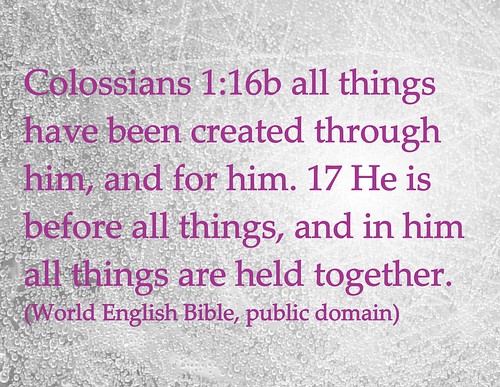
Colossians 1:16-17 poster

Colossians 1:16-17
A poster, attempting to portray Colossians 1:16-17, which says that "all things have been created through him, and for him. He is before all things, and in him all things hold together." (World English Bible, public domain)

This, as I see it, means two important things, for Christians. One is that God the Son was the most important agent of creation, whenever and however that occurred, and the other is that God hasn't gone off and left the universe alone -- it is continuously being held together. Don't ask me how.

I chose what I hope is a royal purple color for the text. I chose a spider web for the background, because it illustrates things being held together. I tweaked it a little in Corel Draw.

Thanks for looking, and reading. The graphic serves as a link to a larger version, posted to Flickr.

Wednesday, September 19, 2012

Sunspots 384

Things I have recently spotted that may be of interest to someone else:

Humor:  (or something). ThatOneRule has over 1800 rules for living, submitted by users. Sample: "Practice does not make perfect. Only perfect practice makes perfect." (Rule 1822)

Science: National Public Radio on a very blue berry, including how it gets so blue, and the probable function of its color.

Wired reports on population levels in lemmings, which seem to have significantly shrunk, as a result of climate change.

Computing: Beyond Google: BrainPickings.org has an annotated list of image search tools.


Image source (public domain)

Monday, September 17, 2012

The My America series

Some time ago, I read My Brother's Keeper: Virginia's Diary, by Mary Pope Osborne, and The Journal of C.J. Jackson: a Dust Bowl Migrant by William Durbin, and found them excellent. They are part of the My America and My Name is America series, a series of books about, and for young teens. Based on the two I read, the books are fictitious diaries about various troubled times in our history, from the viewpoints of various types of young people. I found them to be good reading, and, as far as I can tell, they are true to the facts. The Dust Bowl volume includes photos, and a map of the Southwest, featuring US highway 66.

Thanks for reading.

Sunday, September 16, 2012

Prayer and Trouble, part 10, by E. M. Bounds

As is the infinite variety of trouble, so also is there infinite variety in the relations of prayer to other things. How many are the things which are the subject of prayer! It has to do with everything which concerns us, with everybody with whom we have to do, and has to do with all times. But especially does prayer have to do with trouble. “This poor man cried and the Lord heard him, and saved him out of all his troubles.” O the blessedness, the help, the comfort of prayer in the day of trouble! And how marvelous the promises of God to us in the time of trouble!
“Because he hath set his love upon me, therefore will I deliver him; I will set him on high because he hath known my name. He shall call upon me, and I will answer him; I will be with him in trouble; I will deliver him and honor him.”
“If pain afflict, or wrongs oppress,
If cares distract, or fears dismay;
If guilt deject, if sin distress,
In every case, still watch and pray.”
How rich in its sweetness, how far-reaching in the realm of trouble, and how cheering to faith, are the words of promise which God delivers to His believing, praying ones, by the mouth of Isaiah:
“But now, thus saith the Lord that created thee, O Jacob, and he that formed thee, O Israel, Fear not: for I have redeemed thee, I have called thee by thy name; thou art mine. When thou passest through the waters, I will be with thee; and through the rivers, they shall not overflow thee: when thou walkest through the fire, thou shalt not be burned: neither shall the flame kindle upon thee . . . For I am the Lord thy God, the Holy One of Israel, thy Saviour.” From The Essentials of Prayer, by E. M. Bounds.

Although E. M. Bounds died in 1913, this book was first published in 1925, by an admirer of the author's life. Bounds was known for praying from four until seven each morning.

This post is one of a series, taken from The Essentials of Prayer, by Bounds. Found through the Christian Classics Ethereal Library, here. The Essentials of Prayer is in the public domain. The previous post in the entire series on the book is here. Thanks for reading. Read this book, and, more importantly, practice, prayer.

Saturday, September 15, 2012

Sins of omission; unintentional sin

James 4:17 To him therefore who knows to do good, and doesn’t do it, to him it is sin.

Matthew 25:26 “But his lord answered him, ‘You wicked and slothful servant. You knew that I reap where I didn’t sow, and gather where I didn’t scatter. 27 You ought therefore to have deposited my money with the bankers, and at my coming I should have received back my own with interest. . . .

41 Then he will say also to those on the left hand, ‘Depart from me, you cursed, into the eternal fire which is prepared for the devil and his angels; 42 for I was hungry, and you didn’t give me food to eat; I was thirsty, and you gave me no drink; 43 I was a stranger, and you didn’t take me in; naked, and you didn’t clothe me; sick, and in prison, and you didn’t visit me.’
44 “Then they will also answer, saying, ‘Lord, when did we see you hungry, or thirsty, or a stranger, or naked, or sick, or in prison, and didn’t help you?’
45 “Then he will answer them, saying, ‘Most certainly I tell you, because you didn’t do it to one of the least of these, you didn’t do it to me.’
(World English Bible, public domain)

We often think of sin as something bad that we do. Indeed, we shouldn't do bad things on purpose. But the Bible goes further than that. It indicates that, first, sins may be something we think, even though we don't do them (Matthew 5:21-30). Second, it indicates that there are sins of omission -- things we know that we should do, but don't do. The three passages quoted above are part of the evidence for that. Matthew 25 is not exactly factual -- Jesus was using imagination to make a point -- but there seems no good reason to doubt that He was condemning sins of omission.

The Catholic church has official doctrine on sins of omission, which is "a failure to do something one can and ought to do. . ."

As I understand it, to the New Testament writers, and to Christ, sin must be deliberate, on purpose. However, the Old Testament makes provision for unintentional sin. (see Numbers 15:27-30 and Leviticus 4) Sin, again as I understand it, in the Old Testament included a large number of possible transgressions against the ceremonial law -- not making prescribed sacrifices, eating the wrong kinds of food, or food prepared in the wrong way, and other possibilities. If I tell someone that the drugstore is South, when it is North, because I think it's South, that's not a sin. It's a mistake. If given the opportunity, I might correct this with the person I told, and I may be sorry for inconvenience, but I don't need to repent and ask forgiveness. But if I lived under Old Testament Law, and was supposed to avoid a certain kind of food, but didn't know it, I would still have broken the law, and, if I discovered my mistake, I would have needed to offer a sacrifice as penance. Thank God that Christ paid the penalty for all kinds of sin, deliberate, commission, omission, or unintentional.

For more on unintentional sins, see David Jamieson, Commentary on Leviticus 4, and also Matthew Henry's commentary on the same passage.


Thanks for reading. If you know of good to do, and can do it, do it.

Friday, September 14, 2012

Light, God's Light

I was invited to write an article for something called "Navigating the Heavens," on some subject related to light.

I responded, and the article, entitled "Light, God's Light," was published, but is no longer available. Most of it is based on posts in this blog, and the blog is why I was invited to write it, but the article is more thorough than any of my blog posts on light.

Thanks for reading.

Thursday, September 13, 2012

Looking back to the good old days

Ecclesiastes 7:10 Don’t say, “Why were the former days better than these?” For you do not ask wisely about this. (World English Bible, public domain)

We often say, or think, about the "good old days," before there was so much traffic, or when money was worth more, or our health was better, and when, we often think, people were less nasty and sinful. I've done it myself.

I'm not sure how far to take the advice of the writer of Ecclesiastes, whoever that may have been, to stop doing that. It's pretty clear that the book takes a dim view of a lot of things! It is also true that the Israelites were often reminded, in various ways, that they were better off when they were worshiping God as they should have, and that they should return to that attitude. But at least one aspect of the statement quoted is true. We can't go back. Even if the old days were better than our present circumstances, we aren't going to be able to live in them again. Things and people decay and disappear. Things and people change. We change. We can learn from the past, we are deeply influenced by it, we can even be inspired by it, but we live in the present, for the future.

Thanks for reading! Enjoy your present, and live for your future.

Wednesday, September 12, 2012

Sunspots 383

Things I have recently spotted that may be of interest to someone else:

Science: National Public Radio on the differences between "organic" food and non-organic food. Not much, maybe some.

Sports: (or something) Wired reports on a robot that is able to run faster than Usain Bolt.

Politics: A pastor (I don't know him) has written about how politics and Christianity should be related. (He doesn't endorse any candidate or party.)

Another pastor posted "7 things Christians Need to Remember About Politics," which is also not an endorsement.

A young woman (I don't know her) was asked to pray at the Democratic Convention. Here's her prayer. (Again, remarkably non-partisan.)

Image source (public domain)

Tuesday, September 11, 2012

Veiled Rose by Anne Elisabeth Stengl

I have recently read Veiled Rose by Anne Elisabeth Stengl. The book is the second in a series. Three have been published, and the fourth is due out next month. Here's my post on the first book, Heartless. There is not a Wikipedia article on Stengl, or her books, as yet. Here is the Amazon page for the author, and she has a blog, which sometimes includes material on her books.

Heartless was the author's first novel. There was no sign of her lack of experience in that book, and there is none in this one. The characters are three-dimensional, the plot is complex, and not easily predictable, there are a multitude of settings. The second book is mostly about events that took place before those in the first book, but they are told from a different viewpoint, and this unusual time sequence should not hinder readers. Either book should be enjoyable on its own.

I will try not to give away the plot in this post, but will muse on certain aspects of Veiled Rose.

First, a little about the world of Goldstone Wood. The land (perhaps a continent, perhaps an entire world) is divided into uplands, where humans live, by lowlands, where they don't. There are bridges between the uplands, not made by mortals. Stengl has also divided the lands into the Near World, which, as I understand it, contains the uplands, the Between, which contains the lowlands, and the Far World. (See here for more on this, from Stengl.) Fairies can enter the Near World, where mortals live, but they also live in the Between, and perhaps in the Far World. These three are perhaps three different dimensions, or three different universes, co-inhabiting the same space. Stengl doesn't make a huge deal of this -- her characters, and their lives, are more important -- but the idea of living in more than one world at once definitely adds to the book. Tolkien, for one, had a similar construction, as his elves and their evil adversaries lived in two worlds at the same time. But their appearance was different, depending on which world they were seen in. In Stengl, the appearance of a character seems to be the same in whichever World they are found. (Some characters, such as dragons and fairy knights, have two different forms, but they can take these without changing Worlds.)

There are Paths, made by the fairies, within the Near World, and, probably the other Worlds. Characters who can find those Paths can move rapidly between locations.

Stengl is a bit coy about these aspects of her sub-creation: "So we know of at least three realms of existence, three levels of reality. Might there be more?" Perhaps she didn't know, herself, when she wrote that, in June of 2011. Perhaps she did, but wasn't going to tell us yet.

Second, the characters. One of the main characters in the book is Lionheart, who is also known as Leo, and by other names. He is the crown prince of one of the realms in the Near World, and young enough to play in the woods, but old enough that he is allowed to play in them without supervision. The second main character is Rosie. Lionheart meets Rosie, a girl, perhaps human, perhaps not, while playing in the wood. Rosie's origin is uncertain, and she doesn't know it herself. She always wears a veil. Lionheart doesn't know why, but doesn't really care, as she becomes his best friend. But their friendship has restrictions. She doesn't come into the castle where he lives, and he can't always go into the woods to be with her. Their friendship, by the way, seems to be quite innocent. Perhaps they are somewhat in love with each other, but perhaps not. Very few people have seen Rosie, and when people do, many of them think she is some sort of monster. She can use the Paths, at least the ones in her area, and take Lionheart on them.

Third, evil beings. One type of evil beings is the dragons. The dragons are like dragons in many other books -- they can send fire out of their mouths, they can fly, they are intelligent and can speak, they can trap unwary humans who look into their eyes, or listen to them too willingly. But, like at least one of the dragons of Ursula Le Guin's Tehanu, they can exist in human form or dragon form.

There is some other sort of evil being, perhaps also a dragon, in the books. There are at least two of these, who have the power to tempt by speaking directly to the mind of mortals. The two are in some sort of competition. The theology, or whatever it should be called, of the Goldstone Wood books is complex, and much of it is not merely an imaginary replication of Christian theology, or any other kind that I am aware of. I do believe, as I indicated in the post on the previous work, that the Goldstone Wood books are written with a Christian world-view, but that the fact that it's only a world-view, not the message of the books, is a plus, as I see it.

Fourth, I will say this about the plot. Rosie and Lionheart do not get married in this book. There are other characters, one of them named Daylily, who has decided to do what her father wants her to, and get Lionheart to marry her. He doesn't do that, either. Daylily is a complex character, and a strong one, and there are things that she does that I didn't expect.

More could be said, but I'll stop. I will confess that I have already read the third book in the series. In fact, I've read all three books twice.

Thanks for reading.

Sunday, September 09, 2012

Prayer and Trouble, part 9, by E. M. Bounds

But when we survey all the sources from which trouble comes, it all resolves itself into two invaluable truths: First, that our troubles at last are of the Lord. They come with His consent He is in all of them, and is interested in us when they press and bruise us. And secondly, that our troubles, no matter what the cause, whether of ourselves, or men or devils, or even God Himself, we are warranted in taking them to God in prayer, in praying over them, and in seeking to get the greatest spiritual benefits out of them.
Prayer in the time of trouble tends to bring the spirit into perfect subjection to the will of God, to cause the will to be conformed to God’s will, and saves from all murmurings over our lot, and delivers from everything like a rebellious heart or a spirit critical of the Lord. Prayer sanctifies trouble to our highest good. Prayer so prepares the heart that it softens under the disciplining hand of God. Prayer places us where God can bring to us the greatest good, spiritual and eternal. Prayer allows God to freely work with us and in us in the day of trouble. Prayer removes everything in the way of trouble, bringing to us the sweetest, the highest and greatest good. Prayer permits God’s servant, trouble, to accomplish its mission in us, with us and for us.

The end of trouble is always good in the mind of God. If trouble fails in its mission, it is either because of prayerlessness or unbelief, or both. Being in harmony with God in the dispensations of His providence, always makes trouble a blessing. The good or evil of trouble is always determined by the spirit in which it is received. Trouble proves a blessing or a curse, just according as it is received and treated by us. It either softens or hardens us. It either draws us to prayer and to God or it drives us from God and from the closet. Trouble hardened Pharaoh till finally it had no effect on him, only to make him more desperate and to drive him farther from God. The same sun softens the wax and hardens the clay. The same sun melts the ice and dries out the moisture from the earth. From The Essentials of Prayer, by E. M. Bounds.

Although E. M. Bounds died in 1913, this book was first published in 1925, by an admirer of the author's life. Bounds was known for praying from four until seven each morning.

This post is one of a series, taken from The Essentials of Prayer, by Bounds. Found through the Christian Classics Ethereal Library, here. The Essentials of Prayer is in the public domain. The previous post in the entire series on the book is here. Thanks for reading. Read this book, and, more importantly, practice, prayer.

Friday, September 07, 2012

Christianity in the US - on the defensive

Henry Neufeld has written a good post on "Defensive Christianity," by which he means that Christianity, in the US, seems to be living in a state of fear, and shouldn't be. It's well done, and well worth reading.

Wednesday, September 05, 2012

Sunspots 382

Things I have recently spotted that may be of interest to someone else:

Science: The Atlantic has posted a page of 16 spectacular images, not widely released previously, from the Hubble telescope.

Wired reports that males of a species of snail take care of many developing young snails that aren't their own offspring.

Sports: In case you didn't know, and I certainly didn't, Wired tells us that there's competitive bog snorkeling.

Politics: Heart, Mind and Soul reports on how the KGB sowed discord in the US.

Computing: You've heard of software bugs, surely. Well, Wired tells us that there are hardware bugs, too.


Image source (public domain)

Sunday, September 02, 2012

Prayer and Trouble, part 8, by E. M. Bounds

Some troubles are human in their origin. They arise from second causes. They originate with others and we are the sufferers. This is a world where often the innocent suffer the consequences of the acts of others. This is a part of life’s incidents. Who has not at some time suffered at the hands of others? But even these are allowed to come in the order of God’s providence, are permitted to break into our lives for beneficent ends, and may be prayed over. Why should we not carry our hurts, our wrongs and our privations, caused by the acts of others, to God in prayer? Are such things outside of the realm of prayer? Are they exceptions to the rule of prayer? Not at all. And God can and will lay His hand upon all such events in answer to prayer, and cause them to work for us “a far more exceeding and eternal weight of glory.”

Nearly all of Paul’s troubles arose from wicked and unreasonable men. Read the story as he gives it in 2 Cor. 11:23-33.
 
So also some troubles are directly of Satanic origin. Quite all of Job’s troubles were the offspring of the devil’s scheme to break down Job’s integrity, to make him charge God foolishly and to curse God. But are these not to be recognised in prayer? Are they to be excluded from God’s disciplinary processes? Job did not do so. Hear him in those familiar words. “The Lord gave, and the Lord hath taken away. Blessed be the name of the Lord” From The Essentials of Prayer, by E. M. Bounds.

Although E. M. Bounds died in 1913, this book was first published in 1925, by an admirer of the author's life. Bounds was known for praying from four until seven each morning.

This post is one of a series, taken from The Essentials of Prayer, by Bounds. Found through the Christian Classics Ethereal Library, here. The Essentials of Prayer is in the public domain. The previous post in the entire series on the book is here. Thanks for reading. Read this book, and, more importantly, practice, prayer.


Friday, August 31, 2012

How to report a cybercrime

I have never been the victim of a cybercrime, and I hope you haven't, either, but some people have.

Gizmo's Freeware has detailed advice on how to report such crimes, to the FBI and others. The report is here. Stay safe, and thanks for reading.

Wednesday, August 29, 2012

Sunspots 381

Things I have recently spotted that may be of interest to someone else:

Humor:  Wired reports on vending machines that give people coffee (or some other item) if they, the people, follow instructions, shouted from the machine, or on-screen.

Science: Karl Zimmer, in Discover, on the amazing variety of fungi found in dead logs.


Computing: I'm a twitter member, and I think this post is cross-posted as a twitter feed, but I'm not sure of that, and that's all I know, or do, with Twitter. Maybe your experience/interest is similar. However, there's a web site that lets you enter a subject, and see what, and who, has been recently tweeted about it. No twitter membership needed.

Christianity: A good post by Greg Laurie, reminding us of why we do good.

Image source (public domain)

*  *  *  *

As of January 19, 2013, I am prohibiting comments on this post, as it is receiving spam comments too regularly. If you have a comment, please use a different post, and, if necessary, refer to this one, "Sunspots 381," so other readers, and I, will know what you are talking about. Thanks.

Tuesday, August 28, 2012

Assembling Together - Christians Gathering in Acts

I have previously indicated that the New Testament tells us four different ways that Christians, followers of Christ, should differ from others. One of those ways is that they should want to associate with other believers.

There are a number of occasions where we are told that the early Christians got together, for various reasons. I'm not sure that I have found them all, and I may have misinterpreted some, but here are brief descriptions of several times when the Christians joined together, or when people who were about to become Christians joined together, as found in Acts, and copied from the World English Bible, which is public domain:

1:15a In these days, Peter stood up in the middle of the disciples (and the number of names was about one hundred twenty)

2:1 Now when the day of Pentecost had come, they were all with one accord in one place.

2:46 Day by day, continuing steadfastly with one accord in the temple, and breaking bread at home, they took their food with gladness and singleness of heart, 47 praising God, and having favor with all the people. The Lord added to the assembly day by day those who were being saved.

4:23 Being let go, [from being arrested, Peter and John] . . . came to their own company, and reported all that the chief priests and the elders had said to them. 24a When they heard it, they lifted up their voice to God with one accord,

5:12b They were all with one accord in Solomon’s porch.

6:2 The twelve summoned the multitude of the disciples and said, “It is not appropriate for us to forsake the word of God and serve tables.

9:19 He took food and was strengthened. Saul stayed several days with the disciples who were at Damascus.

10:25 When Peter entered, Cornelius met him, fell down at his feet, and worshiped him. 26 But Peter raised him up, saying, “Stand up! I myself am also a man.” 27 As he talked with him, he went in and found many gathered together.

11:25 Barnabas went out to Tarsus to look for Saul. 26 When he had found him, he brought him to Antioch. For a whole year they were gathered together with the assembly, and taught many people. The disciples were first called Christians in Antioch.

12:12 Thinking about that, he came to the house of Mary, the mother of John who was called Mark, where many were gathered together and were praying. 

15:12 All the multitude kept silence, and they listened to Barnabas and Paul reporting what signs and wonders God had done among the nations through them.

16:13 On the Sabbath day we went outside of the city by a riverside, where we supposed there was a place of prayer, and we sat down, and spoke to the women who had come together. 14 A certain woman named Lydia, a seller of purple, of the city of Thyatira, one who worshiped God, heard us; whose heart the Lord opened to listen to the things which were spoken by Paul. 15 When she and her household were baptized, she begged us, saying, “If you have judged me to be faithful to the Lord, come into my house, and stay.” So she persuaded us.
16a As we were going to prayer, 

17:10 The brothers* immediately sent Paul and Silas away by night to Beroea. When they arrived, they went into the Jewish synagogue.
11 Now these were more noble than those in Thessalonica, in that they received the word with all readiness of the mind, examining the Scriptures daily to see whether these things were so. 12 Many of them therefore believed; also of the prominent Greek women, and not a few men.

18:1 After these things Paul departed from Athens, and came to Corinth. 2 He found a certain Jew named Aquila, a man of Pontus by race, who had recently come from Italy, with his wife Priscilla, because Claudius had commanded all the Jews to depart from Rome. He came to them, 3 and because he practiced the same trade, he lived with them and worked, for by trade they were tent makers. 4 He reasoned in the synagogue every Sabbath, and persuaded Jews and Greeks.

19:1 While Apollos was at Corinth, Paul, having passed through the upper country, came to Ephesus, and found certain disciples. 2 He said to them, “Did you receive the Holy Spirit when you believed?”
They said to him, “No, we haven’t even heard that there is a Holy Spirit.”
3 He said, “Into what then were you baptized?”
They said, “Into John’s baptism.”
4 Paul said, “John indeed baptized with the baptism of repentance, saying to the people that they should believe in the one who would come after him, that is, in Jesus.”
5 When they heard this, they were baptized in the name of the Lord Jesus. 6 When Paul had laid his hands on them, the Holy Spirit came on them, and they spoke with other languages and prophesied. 7 They were about twelve men in all. 8 He entered into the synagogue, and spoke boldly for a period of three months, reasoning and persuading about the things concerning God’s Kingdom. 

20:7 On the first day of the week, when the disciples were gathered together to break bread, Paul talked with them, intending to depart on the next day, and continued his speech until midnight.

21:17 When we had come to Jerusalem, the brothers* received us gladly.

28:30 Paul stayed two whole years in his own rented house, and received all who were coming to him, 31 preaching God’s Kingdom, and teaching the things concerning the Lord Jesus Christ with all boldness, without hindrance.

*A text note indicates that the word translated as "brothers," could have been translated as "brothers and sisters," or "men and women."

Thanks for reading. Read Acts.