License

I have written an e-book, Does the Bible Really Say That?, which is free to anyone. To download that book, in several formats, go here.
Creative Commons License
The posts in this blog are licensed under a Creative Commons Attribution-NonCommercial-ShareAlike 3.0 Unported License. You can copy and use this material, as long as you aren't making money from it. If you give me credit, thanks. If not, OK.
Showing posts with label Psalm 19:1-4. Show all posts

Monday, December 04, 2017

The magnificence of Christ, creator and sustainer

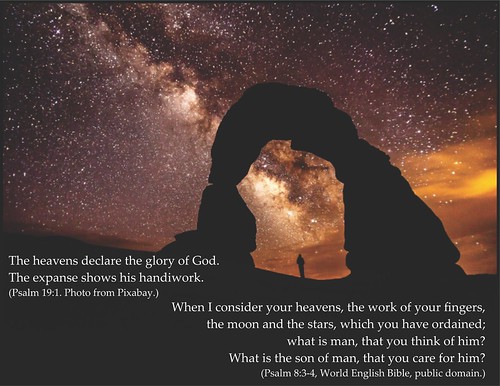
God revealed through the Milky Way


God the Son was important in the creation, and in sustaining that which He created!

John 1:1 In the beginning was the Word, and the Word was with God, and the Word was God. 2 The same was in the beginning with God. 3 All things were made through him. Without him, nothing was made that has been made. 10 He was in the world, and the world was made through him, and the world didn’t recognize him. 12a But as many as received him, to them he gave the right to become God’s children . . .

Colossians 1:14 in whom we have our redemption, the forgiveness of our sins. 15 He is the image of the invisible God, the firstborn of all creation. 16 For by him all things were created in the heavens and on the earth, visible things and invisible things, whether thrones or dominions or principalities or powers. All things have been created through him and for him. 17 He is before all things, and in him all things are held together.

Hebrews 1:3 His Son is the radiance of his glory, the very image of his substance, and upholding all things by the word of his power, who, when he had by himself purified us of our sins, sat down on the right hand of the Majesty on high ...

(Although the passages above indicate that God the Son was the most important agent in the creation, there are scriptural indications that God the Father and God the Holy Spirit were also involved.)

Perhaps you and I don't fully appreciate the magnificence of creation, and, therefore, we may not fully appreciate the magnificence of Christ.

Creation shows that God the son loves diversity. There are about 400,000 species of beetles, and probably at least a million yet to be discovered. (Psalm 104:24 Yahweh, how many are your works! In wisdom, you have made them all. The earth is full of your riches. 25 There is the sea, great and wide, in which are innumerable living things, both small and large animals.)

Creation is unimaginably large. “Recent estimates of the number of galaxies in the observable universe range from 200 billion [(2×10 to the 11th power) to 2 trillion (2×10 to the 12th power)] or more, … containing more stars than all the grains of sand on planet Earth.” (Wikipedia) And that’s only the observable universe.

Creation shows the power of God the Son. Most of the energy on earth comes from the sun. In the sun, Hydrogen nuclei bombard each other at several million degrees, and turn into Helium nuclei, releasing energy by e =m c-squared. The sun is about 93 million miles away. Since it is emitted in all directions, the vast majority of the sun’s emitted energy goes off into space, never hitting the earth, or any other body in the Solar System. But it’s warm enough for life on earth, and light enough for photosynthesis, just from the tiny fraction of the sun’s emitted energy that strikes it. We can scarcely imagine the power of the sun, and it’s a fairly small star.

Creation shows that God the Son likes beauty. He didn’t have to make the universe so that rainbows, or fall foliage, or butterflies, or eclipses, exist. But He did. Using scientific tools, such as microscopes and telescopes, we have found that there is amazing beauty, even in things we can’t get to, or can’t see with the naked eye.


The Creation is sustained by God the Son. How? By laws, like gravity, and created properties, such as that water can exist in three different forms at reasonably normal temperatures. The laws of gravity ensure, for example, that the planets continue to orbit the sun. The properties of water make rain possible, among many other things. God also sustains by processes, like erosion, plate tectonics, and natural selection. We can’t be sure if God is intimately involved in making every raindrop, or lets nature take its course to make each one, but He could make each and every one carefully and magnificently. 

God the Son can, and, at least sometimes, does, change the “normal” course of nature. We call that a miracle.


God, the Son’s, creation is beyond our imagination! He created time and space! God created matter and energy! God created the four fundamental forces, (also called the four interactions) – gravity, the electromagnetic force, the strong force and the weak force. God created the entire electromagnetic spectrum: light, radio waves, wi-fi, microwaves, X-rays, and more. God created the universe with appropriate physical properties for the existence of life

We should not forget that, even though He was largely responsible for the creation of the entire universe, He came to earth. Not as a baby, but as an embryo, a being with just a few cells, and hardly any connection to the world outside his mother’s womb. Then, of course, He became a fetus, and, after about nine months, a baby. Still helpless, dependent, and, presumably, severely limited in His ability to communicate.

And we should not forget what St. Paul said about the Creator and Sustainer of the universe:
5 Have this in your mind, which was also in Christ Jesus, 6 who, existing in the form of God, didn’t consider equality with God a thing to be grasped, 7 but emptied himself, taking the form of a servant, being made in the likeness of men. 8 And being found in human form, he humbled himself, becoming obedient to the point of death, yes, the death of the cross. 9 Therefore God also highly exalted him, and gave to him the name which is above every name, 10 that at the name of Jesus every knee should bow, of those in heaven, those on earth, and those under the earth, 11 and that every tongue should confess that Jesus Christ is Lord, to the glory of God the Father. (From Philippians 2)

Thanks for reading! To God be the glory!

Friday, April 22, 2016

The New Testament teaches that Christians should be stewards of the environment.

Psalm 19:1-4 and Romans 1:20 tell us that observing and learning about nature are part of God’s revelation to humans. If that is so, isn’t that a reason to try to preserve nature as well as we can?

The Bible is one of the ways that God reveals Himself to us. Christians believe that the Bible should be translated into the language people are most familiar with, so that that revelation may be as clear as possible. Similarly, it would seem that God’s revelation through nature should be as clear as possible. A person is more likely to see God in a beautiful clear stream than in a polluted river, or in a clear sky than in a smog-filled atmosphere. Seeing bison herds roam freely in Western North America, or immense flocks of passenger pigeons, gave people a glimpse of aspects of God’s power and majesty that they can’t get now. Helping to preserve nature in as good a condition as we can is one way to bring people to a saving knowledge of Christ. Not the most direct way, and perhaps not the most effective, but it is still a way to do this.
 
Colossians 1:15-20 says, of Christ, that “in Him all things are held together.” That passage also says that He is working to reconcile all things to Himself, and that He is working to make peace through the blood of the cross. As Christians, we believe that it is our duty to be His instruments in reconciling sinners to Christ, and to help Him in the ministry of making peace. 2 Corinthians 5:18-19 tells us that: 18 But all things are of God, who reconciled us to himself through Jesus Christ, and gave to us the ministry of reconciliation; 19 namely, that God was in Christ reconciling the world to himself, not reckoning to them their trespasses, and having committed to us the word of reconciliation.

(Hebrews 1:3 also tells us that Christ is holding all things together.)  
Christians believe they should participate in Christ’s work of reconciliation. Shouldn’t they also participate in His work of holding all things together, including endangered species, ecosystems and biological communities?

What do you think? (See here for Old Testament teaching on environmental stewardship. There is lots of it!)

Thanks for reading. This post was modified from this one.

Monday, July 08, 2013

Beauty and science: quotations from others

The quotations below are about the relationship between beauty and science. They were written, or said, by a variety of people, some overtly Christian, such as John C. Polkinghorne, some not, such as Einstein or Feynman. Most of the publications are secular, including those from Yale University Press and Cambridge University Press, Physics Today, and the New York Times.

Richard Feynman, Nobel laureate, wrote: “What is it about nature that lets this happen, that it is possible to guess from one part what the rest is going to do? That is an unscientific question: I do not know how to answer it, and therefore I am going to give an unscientific answer. I think it is because nature has a simplicity and therefore a great beauty.” “Seeking New Laws,” pp. 143-167, in Richard Feynman, The Character of Physical Law, New York: Modern Library, 1994. Quote is from p. 167. I have read all, or nearly all, of Feynman’s popular writing, and seen no evidence that he believed in God at all.

The world, you might argue, does not need yet another subatomic particle. But even particle physics has not been about particles for a long time, physicists say. Rather it is about the relationships between particles, the symmetries that nature seems to respect, in short, about the beauty that physical laws seem to embody. Dennis Overbye, "After Triumph and Disillusionment, Wonder Re-enters the Story," New York Times, July 27, 2004

The scientist does not study nature because it is useful to do so. He studies it because he takes pleasure in it; and he takes pleasure in it because it is beautiful. If nature were not beautiful, it would not be worth knowing and life would not be worth living. . . . I mean the intimate beauty which comes from the harmonious order of its parts and which a pure intelligence can grasp. Henri Poincaré, as quoted by S. Chandrasekar, "Beauty and the quest for beauty in science," Physics Today, July, 1979, pp. 25-30, p. 25. Source not given.

We live in a world whose physical fabric is endowed with transparent rational beauty. Attempts have been made to explain away this fact. No one would deny, of course, that evolutionary necessity will have moulded our ability for thinking in ways that will ensure its adequacy for understanding the world around us, at least to the extent that is demanded by pressures for survival. Yet our surplus intellectual capacity, enabling us to comprehend the microworld of quarks and gluons and the macroworld of big bang cosmology, is on such a scale that it beggars belief that this is simply a fortunate by-product of the struggle for life. Remember that Sherlock Holmes told a shocked Dr. Watson that he didn't care whether the Earth went around the Sun or vice versa, for it had no relevance to the pursuits of his daily life! John C. Polkinghorne, Belief in God in an Age of Science. New Haven, CT: Yale University Press, 1998. pp. 2-3.

Thus, the perception of the world's beauty as a reflection of God's glory is incomplete without the awareness that underlying the beauty and wonder of earthly nature is the omnipresent, restless operation of electromagnetic phenomena. These phenomena can be seen as a reflection, an analogue, of God's indwelling. This very thought, in itself, possesses an inherent aesthetic value.

Moreover, the appreciation of the beauty that the EMI [Electromagnetic Interaction] contributes to nature is wanting without the realization that the mathematical equations that describe the EMI have a timeless beauty. The elegant symmetry of Maxwell's equations and the inspired simplicity of Dirac's equation bestow an abiding aesthetic flavor to the texture of the microscopic underworld. Dirac and Heisenberg among many other theoretical physicists have throughout their careers expressed how they have been guided by the criteria of beauty and simplicity in their work.
- Lawrence W. Fagg, Electromagnetism and the Sacred: At the Frontier of Spirit and Matter (New York: Continuum, 1999) p. 120.

For the theist, the rational beauty of the physical world is not just a brute fact, but a reflection of the mind of the Creator. Aesthetic experience and ethical intuitions are not just psychological or social constructs, but intimations of God's joy in creation and of his just will. Religious experience is not illusory human projection, but encounter with divine reality. There is an integrating wholeness in the theistic account which I find intellectually satisfying, even though it must wrestle with the mystery of infinite Being.

The theist and the atheist alike survey the same world of human experience, but offer incompatible interpretations of it. My claim would be that theism has a more profound and comprehensive understanding to offer than that afforded by atheism. Atheists are not stupid, but they explain less.
- John C. Polkinghorne, The Faith of a Physicist: Reflections of a Bottom-Up Thinker. The Gifford Lectures for 1993-4, p. 70. Princeton, New Jersey: Princeton University Press, 1994

That seems even clearer to us when we recognize that it is mathematics which gives us the key to unlock the secrets of nature. Paul Dirac spent his life in the search for beautiful equations. That is a concept not all will find immediately accessible, but among those of us who speak the language of mathematics, mathematical beauty is a recognizable quality. It is hard to describe but easy to recognize -- like most other kinds of beauty. Its essence lies in a certain economy and elegance that leads to the mathematical property of being 'deep.'… Time and again we have found that it is equations with that indispensable character of mathematical beauty which describe the nature of the physical world. - John C. Polkinghorne, Beyond Science: The Wider Human Context. New York: Cambridge University Press, 1996, pp. 79-80.

I asked him once about a theory and he said, "when I am evaluating a theory, I ask myself, if I were God, would I have made the universe in that way." If the theory did not have the sort of simple beauty that would be demanded of a God, then the theory was at best only provisional. (Banesh Hoffman, "Working with Einstein," pp. 475-478, in Some Strangeness in the Proportion: A Centennial Symposium to Celebrate the Achievements of Albert Einstein, Harry Woolf, ed. Reading, MA: Addison-Wesley, 1980. Quote is from p. 476.) 


The Psalmist said:  1 The heavens declare the glory of God.
The expanse shows his handiwork.
2 Day after day they pour out speech,
and night after night they display knowledge.
3 There is no speech nor language,
where their voice is not heard.
4 Their voice has gone out through all the earth,
their words to the end of the world. (Psalm 19, Bible quotations from the World English Bible, public domain)


St. Paul said:  "For the invisible things of him since the creation of the world are clearly seen, being perceived through the things that are made, even his everlasting power and divinity . . ." Romans 1:20a.

As far as we can tell, God created a universe that is understandable, and beautiful. Physicists, and others, have understood part of the way in which that universe is put together, and what they understand reveals a universe of pattern, of beauty, of, if you please, design. Hebrews 11:3 says that we understand that God created the universe by faith, and it is true that there is no scientific proof for God's creation, but, for those of us who look, even some who have not believed in a personal Creator, the evidence is there.

Thanks for reading. We live in a beautiful universe!

Monday, February 04, 2013

Scriptural Principles that Relate to Science

Here are some scriptural principles that relate to science:

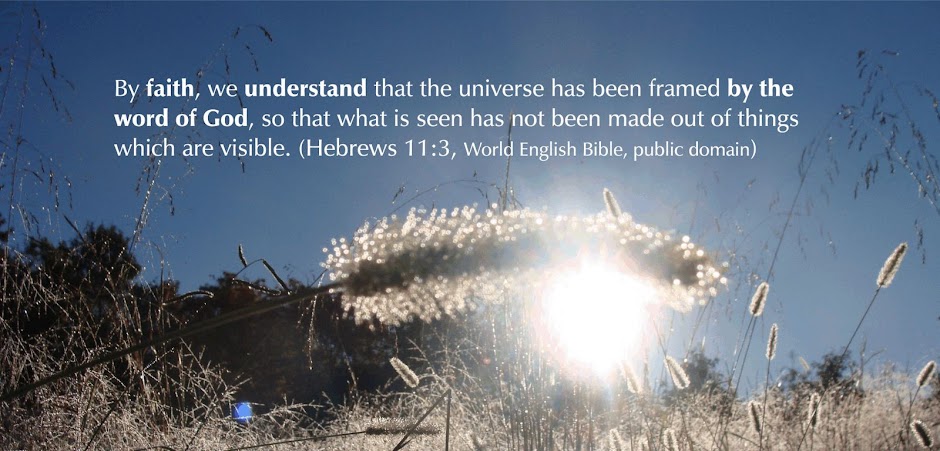
1. God is creator. There is no unassailable proof of this statement. The Bible, itself, does not attempt to prove it. It assumes it. The Bible starts out by saying that God created, in Genesis 1:1 In the beginning, God created the heavens and the earth. (All Bible quotations are from the World English Bible, which is in the public domain, and are in this color.) The Bible says that the best evidence that God is creator is our faith. (Hebrews 11:3 By faith, we understand that the universe has been framed by the word of God, so that what is seen has not been made out of things which are visible.) The Bible further points out that the principal agent in creation was God the Son:
John 1:1 In the beginning was the Word, and the Word was with God, and the Word was God. 2 The same was in the beginning with God. 3 All things were made through him. Without him was not anything made that has been made.

Colossians 1:14 in whom we have our redemption, the forgiveness of our sins; 15 who is the image of the invisible God, the firstborn of all creation.16 For by him all things were created, in the heavens and on the earth, things visible and things invisible, whether thrones or dominions or principalities or powers; all things have been created through him, and for him. 17 He is before all things, and in him all things are held together.

Christians have several views about the timing, and other details, of how things began. However, the most fundamental truth is that God created. Genesis 1:1 does not tell us why, when, or how God created. It does tell us that there was a Who involved in creation. There are people who believe that there is nothing but nature. They are called Naturalists. In other words, they do not believe that there is anything supernatural. To them, there is, and was, no Who. The Bible begins by assuming that that is a wrong belief. It does not attempt to prove this, except by telling us what God is like. (Some Christians mistakenly think that the idea of a Big Bang is a theory that claims that there is no God, or that claims there was no God involved in creation. That view is mistaken. A belief in the Big Bang can be compatible with belief in God as creator.)

Creation was called good, in Genesis 1. This does not necessarily mean that it was good in the sense that it is useful to humans. Goodness in God’s view is more important than usefulness to us!

Psalm 104:24 Yahweh, how many are your works!
In wisdom have you made them all.
The earth is full of your riches.
There is the sea, great and wide,
in which are innumerable living things,
both small and large animals. 
In this passage, we read about the marvelous diversity of creation. Humans have never yet seen many of the organisms that are alive on earth today, let alone found uses for them. They are still important, because God made them, or allowed them to come into existence.

2. God sustains the natural world. Colossians 1:16-17 (above) and Hebrews 1:3a (His Son is the radiance of his glory, the very image of his substance, and upholding all things by the word of his power) indicate that God not only created, but that Christ is presently involved in holding things together, including your body and the monitor you are reading this on. Do we understand this? No, and we aren’t capable of understanding it. God is omnipotent and omniscient. We aren’t. But we do understand, from these passages, that God, especially God the Son, has not gone away and left the world. He is sustaining it now.

3. Humans have responsibility for the world around them. Humans were put in charge of God’s “very good” creation.
Genesis 1:26 God said, “Let us make man in our image, after our likeness: and let them have dominion over the fish of the sea, and over the birds of the sky, and over the livestock, and over all the earth, and over every creeping thing that creeps on the earth.” 28 God blessed them. God said to them, “Be fruitful, multiply, fill the earth, and subdue it. Have dominion over the fish of the sea, over the birds of the sky, and over every living thing that moves on the earth.”

Since the Fall, there have been problems with the natural world, but scripture teaches that it is still important to God, so it should be to us, as well:
Psalm 24:1 The earth is Yahweh’s, with its fullness;
the world, and those who dwell therein.

Psalm 50:10 For every animal of the forest is mine,
and the livestock on a thousand hills.
11 I know all the birds of the mountains.
The wild animals of the field are mine.
[God speaking] 


The Israelites were supposed to take care of their land by letting it lie fallow every seventh year:
Leviticus 25:3 You shall sow your field six years, and you shall prune your vineyard six years, and gather in its fruits; 4 but in the seventh year there shall be a Sabbath of solemn rest for the land, a Sabbath to Yahweh. You shall not sow your field or prune your vineyard. 5 What grows of itself in your harvest you shall not reap, and you shall not gather the grapes of your undressed vine. It shall be a year of solemn rest for the land.

Their failure to obey this command was one reason for their captivity:
II Chronicles  36:20 He carried those who had escaped from the sword away to Babylon, and they were servants to him and his sons until the reign of the kingdom of Persia, 21 to fulfill Yahweh’s word by Jeremiah’s mouth, until the land had enjoyed its Sabbaths. As long as it lay desolate, it kept Sabbath, to fulfill seventy years. [“He” is the king of the Chaldeans.]

Proverbs 12:10a says “A righteous man respects the life of his animal.”

4. God is revealed to us through nature. Here are Bible passages that say that we ought to learn something of what God is, and how God works, through a study of nature.

Job 12:7 “But ask the animals, now, and they will teach you;
the birds of the sky, and they will tell you.
8 Or speak to the earth, and it will teach you.
The fish of the sea will declare to you.
9 Who doesn’t know that in all these,
Yahweh’s hand has done this,
10 in whose hand is the life of every living thing,
and the breath of all mankind?


Psalm 19:1 The heavens declare the glory of God.
The expanse shows his handiwork.
Day after day they pour out speech,
and night after night they display knowledge.
There is no speech nor language,
where their voice is not heard.
Their voice has gone out through all the earth,
their words to the end of the world. 

Acts 14:17 Yet he didn’t leave himself without witness, in that he did good and gave you rains from the sky and fruitful seasons, filling our hearts with food and gladness.

Romans 1:20 For the invisible things of him since the creation of the world are clearly seen, being perceived through the things that are made, even his everlasting power and divinity; that they may be without excuse.

Revelation of God though nature includes knowledge gained through science. Some of the greatest scientists of all time, like Johannes Kepler, have believed that God is revealed through nature:
I give thanks to Thee, O Lord Creator, Who hast delighted me with Thy makings and in the works of Thy hands have I exulted. Behold! now, I have completed the work of my profession, having employed as much power of mind as Thou didst to me; to the men who are going to read those demonstrations I have made manifest the glory of Thy works . . .
From The Harmonies of the World by Johannes Kepler, 1619, translated by Charles Glenn Wallis. (The Great Books, Chicago: Encyclopedia Brittanica, 1952, volume 16, Ptolemy, Copernicus, Kepler, p. 1080.)

Science is not God’s only, or main, means of revelation. (Others include the Bible, our consciences, the Holy Spirit in our lives, the church -- those who believe in Christ as savior and Lord, and, most importantly, the incarnation of Jesus Christ.) But it is one means. Properly understood, scientific findings and scripture do not conflict. However, humans don’t completely understand either scientific or scriptural revelation.

5. God is a God of order. The Bible begins with a portrayal of God’s orderliness in creation. Literal or not, the description in Genesis 1 describes order and sequence. The Ten Commandments, the covenants established with Abraham, and with the Israelites, and God’s promise, (Genesis 8:22) after Noah’s flood, declare that God is a God of order. Some historians of science have written that, without the Judeo-Christian concept of God as a God of order, the development of science would have been impossible. (There were other influences, including Greek and Arab thought, in the development of science, so that science is not a strictly Judeo-Christian enterprise, but it developed among countries where most of the people were at least nominally believers.) There were some technological developments in China before similar ones in Europe, but science doesn’t seem to have developed there as a discipline, perhaps because this sense of order wasn’t part of the prevailing world-view there at that time.

6. The responsibility that humans have for nature (principle 3, above) includes responsibility to learn how it works.
Psalm 111:2 Yahweh’s works are great,
pondered by all those who delight in them

There is delight in such learning (See also principle 4) and it is our responsibility, as good stewards, to learn about God’s works. Some individuals are specially gifted in the area of learning about God’s creation -- in other words, God gives some gifts that help people be scientists.

In a previous post, I listed some scientific principles that tell us about God.

Thanks for reading!

Tuesday, April 12, 2005

Scriptural Principles that Relate to Science

In a previous post, I list some scientific principles that tell us about God.
Here are some scriptural principles that relate to science:
1. God is creator. There is no unassailable proof of this statement. The Bible, itself, does not attempt to prove it. It just starts out by saying that God created. Genesis 1:1 doesn’t say how, or why, or when, just who. The Bible, itself, says that the best evidence that God is creator is our faith (Hebrews 11:3). The Bible further points out that the principal agent in creation was God the Son (John 1:1-5, Colossians 1:16-17.)
Christians have several views about the timing, and other details, of how things began. However, the most fundamental truth is that God created.
Creation was called good as it was, not good as a tool for humans. Psalm 104:24-5 speaks of the marvelous diversity of creation. Humans have never yet seen many of the organisms that are alive on earth today, let alone found uses for them. They are still important, because God made them.
2. God sustains the natural world. Colossians 1:16-17 and Hebrews 1:3 indicate that God not only created, but that Christ is presently involved in holding things together, including your body and the monitor you are reading this on. Do we understand this? No, and we aren't capable of understanding it. God is omnipotent and omniscient. We aren’t.
3. Humans have some responsibility for the world around them. Humans were put in charge of God's "very good" creation. (Genesis 1:26, 28). Since the Fall, there have been problems with the natural world, but scripture teaches that it is still important to God, (Psalm 24:1, Psalm 50:10-11) so it should be to us, as well. The Israelites were supposed to take care of their land by letting it lie fallow every seventh year (Leviticus 25:4-7), and their failure to obey this command was one reason for their captivity (II Chronicles 36:21). Proverbs 12:10 says that a righteous man cares for the needs of his animal.
4. God is revealed to us through nature. Psalm 19:1-4, Acts 14:17, and Romans 1:20 say that we can learn something of what God is, and how God works, through a study of nature. In other words, through science. Some of the greatest scientists of all time, like Johannes Kepler, have believed this:
I give thanks to Thee, O Lord Creator, Who hast delighted me with Thy makings and in the works of Thy hands have I exulted. Behold! now, I have completed the work of my profession, having employed as much power of mind as Thou didst to me; to the men who are going to read those demonstrations I have made manifest the glory of Thy works . . .
From The Harmonies of the World by Johannes Kepler, 1619, translated by Charles Glenn Wallis. (The Great Books, Chicago: Encyclopedia Brittanica, 1952, volume 16, Ptolemy, Copernicus, Kepler, p. 1080.)
Science is not God’s only, or main, means of revelation. (Others include the Bible, our consciences, the Holy Spirit in our lives, and, most importantly, the incarnation of Jesus Christ.) But it is one means. Properly understood, scientific findings and scripture do not conflict. However, humans don't completely understand either scientific or scriptural revelation.
5. God is a God of order. The Bible begins with a portrayal of God’s orderliness in creation. Literal or not, the description describes order and sequence. The Ten Commandments, the covenants established with Abraham, and with the Israelites, and God’s promise, in Genesis 8:22, after Noah’s flood, declare that God is a God of order. Some historians of science have written that, without the Judeo-Christian concept of God as a God of order, the development of science would have been impossible. (There were other influences, including Greek and Arab thought, in the development of science.) There were some technological developments in China before similar ones in Europe, but science doesn’t seem to have developed there as a discipline, perhaps because this sense of order wasn’t part of the prevailing world-view there at that time.
6. The responsibility that humans have for nature (principle 3, above) includes responsibility to learn how it works.
Psalm 111:2 Great are the works of the Lord,
studied by all who delight in them. (ESV)
There is delight in such learning (See also principle 4) and it is our responsibility, as good stewards. Some individuals are specially gifted in the area of learning about God's creation -- in other words, God gives some gifts that help people be scientists.

Creative Commons License

This work is licensed under a Creative Commons License. My purpose is not to restrict use, but to prevent anyone else from restricting the use of this material by copyrighting it. Other uses are welcome!

* * * * *

On April 15, 2005, I fixed a link in this post (I hope). Thanks, John Dekker!

On May 15, 2007, I added principle 6.

On January 27, 2012, I added a scripture reference, and some tags.