License

I have written an e-book, Does the Bible Really Say That?, which is free to anyone. To download that book, in several formats, go here.
Creative Commons License
The posts in this blog are licensed under a Creative Commons Attribution-NonCommercial-ShareAlike 3.0 Unported License. You can copy and use this material, as long as you aren't making money from it. If you give me credit, thanks. If not, OK.
Showing posts with label beauty. Show all posts

Friday, June 05, 2026

The beauty of nature

I haven't been blogging much lately. Maybe I should start again. What topic should I choose? Here's one: the beauty of nature. 

Nature is beautiful, and we should thank God for it. 

Jesus told us to consider the lilies:  Luke 12:27 Consider the lilies, how they grow. They don’t toil, neither do they spin; yet I tell you, even Solomon in all his glory was not arrayed like one of these.

He didn't say that Solomon was not gloriously arrayed. But He did say that lilies (and other flowers) were and are, and He implied that we humans are never going to surpass the beauty of nature.

I need to speak of God's work in nature more often.

Thanks for reading.

Wednesday, May 29, 2019

Sunspots 730

Things I have recently spotted that may be of interest to someone else:


Christianity: Relevant reports that a church has a standing offer to pay (at about $8000) for weddings of couples, in the church, who are living together without being married. About 60 couples have done this.

A pastor of a white congregation explains why ministering to African-Americans and whites at the same time is hard.

Computing: Gizmodo discusses some reasons for checking our smart phones a lot.

Education: Grammarphobia tells us that the meanings of  "emerge" and "emergency" are related.

Health: If you're a woman, you probably won't be surprised. NPR reports on a study indicating that women do better at clerical tasks when the room temperature is not so cold.

Humor: (or something) A Gizmodo article explains how some magic tricks are done.

(or something) Relevant reports that the Ark Encounter is suing because of rain damage.


Politics: Catherine Rampell on how the Trump Administration has tinkered with government statistics in various ways.

NPR reports that a lot of so-called American soil is actually owned by foreign entities.

FiveThirtyEight discusses the laws that state governments are seeking to have adopted, in states where the legislature and the governor are both from the same party.

Michael Gerson is not happy with the Trump Administration's decision to slow down the replacement of Andrew Jackson's picture, on $20 bills, by that of Harriet Tubman, and says that Tubman, even after death, makes her enemies look foolish.

Science: There's a lot of water on Mars, according to Gizmodo.

A Christianity Today writer discusses the question of whether non-human animals appreciate beauty.

Gizmodo discusses attempts to control monkey populations in India, where the animals have been responsible for several human deaths.

Listverse describes 10 organisms that don't seem to have any limits on their lifespan.

The graphic used in these posts is from NASA, hence, I believe, it is public domain. 

Thanks for looking!

Sunday, April 07, 2019

The Art of Divine Contentment: An Exposition of Philippians 4:11 by Thomas Watson. Excerpt 73

Toward the end of his book, Watson tells us how a Christian grows:

A true Christian grows in beauty. Grace is the best complexion of the soul; it is at the first plantation, like Rachel, fair to look upon; but still the more it lives, the more it sends forth its rays of beauty. Abraham’s faith was at first beautiful; but at last did shine in its orient colours, and grew so illustrious, that God himself was in love with it, and makes his faith a pattern to all believers.

A true Christian grows in sweetness. A poisonous weed may grow as much as the hyssop or rosemary, the poppy in the field as the corn, the crab as the pearmain; but the one hath a harsh sour taste, the other mellows as it grows: an hypocrite may grow in outward dimensions, as much as a child of God, he may pray as much, profess as much: but he grows only in magnitude, he brings forth only sour grapes, his duties are leavened with pride; the other ripens as he grows; he grows in love, humility, faith, which do mellow and sweeten his duties, and make them come off with a better relish. The believer grows as the flower, he casts a fragrancy and perfume.

A true Christian grows in strength: he grows still more rooted and settled. The more the tree grows, the more it spreads its root in the earth: a Christian who is a plant of the heavenly Jerusalem, the longer he grows, the more he incorporates into Christ, and sucks spiritual juice and sap from him; he is a dwarf in regard of humility, but a giant in regard of strength, — he is strong to do duties, to bear burdens, resist temptations.


Thomas Watson lived from 1620-1686, in England. He wrote several books which survive. This blog, God willing, will post excerpts from his The Art of Divine Contentment: An Exposition of Philippians 4:11, over a number of weeks, on Sundays.

My source for the text is here, and I thank the Christian Classics Ethereal Library for making this text (and many others) available. The previous excerpt is here.
  
Philippians 4:11 Not that I speak because of lack, for I have learned in whatever state I am, to be content in it. (World English Bible, public domain.)
  

Thursday, January 24, 2019

Why does the Bible say so little about nature's beauty?


orange bougainvillea
Bougainvillea flowers, with orange bracts

In an address a few years ago, Bible scholar N. T. Wright answered the question of the title of this post. His answer was that creation's beauty is an intrinsic property of nature, and, as such, not generally described just for itself.

God's creation surely is beautiful, and can be appreciated by anyone with normal or nearly normal vision.

I found a few Biblical references to the beauty of nature:
2 Chronicles 3:6a He garnished the house with precious stones for beauty:

Hosea 14:6 His branches will spread, and his beauty will be like the olive tree, and his fragrance like Lebanon. (Apparently referring to the fragrance of the plant life in Lebanon.)

Genesis 49:21 "Naphtali is a doe set free, who bears beautiful fawns. ..."

Ecclesiastes 3:11a He has made everything beautiful in its time.

Psalm 104:31 Doesn't mention beauty, but it sounds like it is there, in God's creation: Let Yahweh’s glory endure forever. Let Yahweh rejoice in his works.

James 1:11a For the sun arises with the scorching wind, and withers the grass, and the flower in it falls, and the beauty of its appearance perishes. (There are other verses which speak of plant life losing beauty, such as this one. But they do state that plant life has beauty, however temporary it may be. The Bible also speaks, in several places, about women's beauty, and Moses was said to be a beautiful child, but this post is about the beauty of non-human nature.)

Although the last chapter in the Bible doesn't specifically mention beauty, it's hard to read it without imagining great beauty in the new earth: Revelation 22:1 He showed me a river of water of life, clear as crystal, proceeding out of the throne of God and of the Lamb, 2 in the middle of its street. On this side of the river and on that was the tree of life, bearing twelve kinds of fruits, yielding its fruit every month. The leaves of the tree were for the healing of the nations. The first chapter in the Bible says that everything God created was good, implying that it was beautiful.

Thank God for the beauty of God's creation, from the sub-microscopic to the cosmic!

Wednesday, March 14, 2018

Sunspots 668


Things I have recently spotted that may be of interest to someone else:


The Arts: (And Christianity) A Christianity Today author, an expert on Madeleine L'Engle, discusses what she hopes is not lost in the film version of L'Engle's A Wrinkle in Time. (She had not seen the film, which opened on March 9.)

Christianity: A Relevant writer says that God takes happiness seriously, and that we should, too.

(and Computing) A blog post documents that some Christian (?) leaders are deliberately inflating their social media follower numbers.

(and politics) Relevant reports that officials of the National Association of Evangelicals, and of the Southern Baptist Convention, are urging Congress to adopt some solution for the so-called Dreamers.

Relevant also reported that Wayne State University has refused to allow Inter-Varsity Christian Fellowship on campus, because IVCF requires its leaders to be Christian. IVCF sued, and, two days later, Christianity Today reported that the ban was dropped.

Christianity Today reports that a Christian Canadian couple had their foster children removed because they wouldn't teach them about the Easter Bunny. But that decision was overturned.

Ken Schenck makes his annual Biblical argument for women in ministry.

"We truly ought to give thanks to God that we are not more gorgeous than we are—or more intelligent, or more creative, or more rich, or more influential, or more wise, or more whatever ..." from an article in Christianity Today.


He Lives discusses the history of sola scriptura, as part of a series on biblical inerrancy, what it is and what it means.


Politics: The New Scientist reports that fake news travels much faster than real news.

Science: Gizmodo reports that older termites are placed in more risky situations, including in battles.

Thanks for looking!

Image source (public domain)

Wednesday, January 17, 2018

Sunspots 660

Things I have recently spotted that may be of interest to someone else:


The Arts: (or something) Listverse describes, and shows, 10 beautiful natural  wonders.

Christianity: (and Computing) I don't use YouVersion, the free Bible app but lots and lots of other people do. Maybe you should.

He Lives on "Jacob's Genetic Engineering." (Commenting on Genesis 30.)

I have a post on how the Bible wants us to treat aliens, foreigners and strangers.

A Relevant writer tells us that helping the poor may be the least followed command (or commands) in the Bible.


Computing: FiveThirtyEight reports on a new computer chess program, which has used artificial intelligence to train. It seems to  be more aggressive than previous programs, and analyzes fewer possibilities.

Wired tells us what happens to our electronic waste (old phone, TVs, etc.). It's not pretty. Not at all.

Politics: (and computing) Wired reports on Russian trolls that are after Robert Mueller.

Science: FiveThirtyEight reports on personality tests that are better than the famous  (or infamous) Myers-Briggs instrument.

And FiveThirtyEight also reports on the discovery of the largest known prime number.

Scientific American reports on a poll about whether we approve of possible physical enhancement (improving muscles, eyes, and other parts and functions).

Sports: (and Health) FiveThirtyEight debunks Tom Brady's fitness books and products.

Thanks for looking!

Wednesday, January 10, 2018

Sunspots 659


Things I have recently spotted that may be of interest to someone else:


The Arts: (or something) Listverse describes, and shows, 10 beautiful natural  wonders.

Christianity: (and Computing) I don't use YouVersion, the free Bible app, but lots and lots of other people do. Maybe you should.

He Lives on "Jacob's Genetic Engineering." (Commenting on Genesis 30.)


Computing: FiveThirtyEight reports on a new computer chess program, which has used artificial intelligence to train. It seems to  be more aggressive than previous programs, and analyzes fewer possibilities.

Wired tells us what happens to our electronic waste (old phone, TVs, etc.). It's not pretty. Not at all.

Politics: (and computing) Wired reports on Russian trolls that are after Robert Mueller.

Science: FiveThirtyEight reports on personality tests that are better than the famous  (or infamous) Myers-Briggs instrument.

And FiveThirtyEight also reports on the discovery of the largest known prime number.

Sports: (and Health) FiveThirtyEight debunks Tom Brady's fitness books and products.

Thanks for looking!

Image source (public domain)

Friday, April 15, 2016

Psalm 84:11 poster


Good things Psalm 84:11 bread

For Yahweh God is a sun and a shield. Yahweh will give grace and glory. He withholds no good thing from those who walk blamelessly. Psalm 84:11, World English Bible, public domain.

This blog gets its name from this verse.

Some of the "good things" that God will not withhold from us are these:

Joy: Psalm 5:11 But let all those who take refuge in you rejoice,
Let them always shout for joy, because you defend them.
Let them also who love your name be joyful in you.


Abundant life: John 10:10b I came that they may have life, and may have it abundantly. (And also see the next verse, below.)

Worthwhile purpose: 1 Corinthians 15:57 But thanks be to God, who gives us the victory through our Lord Jesus Christ. 58 Therefore, my beloved brothers, be steadfast, immovable, always abounding in the Lord’s work, because you know that your labor is not in vain in the Lord.
1 Peter 4:10 As each has received a gift, employ it in serving one another, as good managers of the grace of God in its various forms. 


Beauty: Genesis 1:31a God saw everything that he had made, and, behold, it was very good.
Philippians 4:8 Finally, brothers, whatever things are true, whatever things are honorable, whatever things are just, whatever things are pure, whatever things are lovely, whatever things are of good report: if there is any virtue and if there is any praise, think about these things.


Food, clothing and shelter: Matthew 6:25 Therefore I tell you, don’t be anxious for your life: what you will eat, or what you will drink; nor yet for your body, what you will wear. Isn’t life more than food, and the body more than clothing? 26 See the birds of the sky, that they don’t sow, neither do they reap, nor gather into barns. Your heavenly Father feeds them. Aren’t you of much more value than they?
27 “Which of you, by being anxious, can add one moment to his lifespan? 28 Why are you anxious about clothing? Consider the lilies of the field, how they grow. They don’t toil, neither do they spin, 29 yet I tell you that even Solomon in all his glory was not dressed like one of these. 30 But if God so clothes the grass of the field, which today exists, and tomorrow is thrown into the oven, won’t he much more clothe you, you of little faith?
31 “Therefore don’t be anxious, saying, ‘What will we eat?’, ‘What will we drink?’ or, ‘With what will we be clothed?’ The passage quoted doesn't mention shelter, but it seems to be implied.


God's love: Romans 8:35 Who shall separate us from the love of Christ? Could oppression, or anguish, or persecution, or famine, or nakedness, or peril, or sword? 36 Even as it is written,
“For your sake we are killed all day long.
We were accounted as sheep for the slaughter.”*
37 No, in all these things, we are more than conquerors through him who loved us. 38 For I am persuaded that neither death, nor life, nor angels, nor principalities, nor things present, nor things to come, nor powers, 39 nor height, nor depth, nor any other created thing will be able to separate us from God’s love which is in Christ Jesus our Lord.

(*The quotation is from Psalm 44:22.)

This promise, and the "good things" that it was talking about, whatever they are, are God's general will for believers. That is not an endorsement for the Prosperity Gospel. And Psalm 84:11 doesn't mean that bad things, sometimes very bad things, won't happen. An internet source tells me that 322 Christians are martyred, around the world, every month. Paul listed some of the hardships he had gone through, in 2 Corinthians 11:21-32. The list of heroes of faith, in Hebrews 11, includes a list of anonymous followers of God who were tortured, neglected, and generally treated very badly. Christ, Himself, suffered a great deal, and was never well off. He apparently didn't own any shelter. according to Matthew 8:20 and Luke 9:58.

But forget the previous paragraph! God loves us, and wants the best for us. Don't forget the condition, however. This promise is for those who "walk blamelessly." It's possible to do that, with God's help.

Thanks for reading.

Tuesday, March 24, 2015

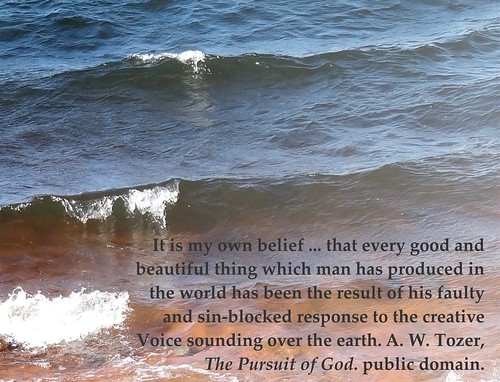
A. W. Tozer on beauty

Tozer on beauty 
Photo: waves on Lake Hartwell, off US 29, Anderson County, South Carolina. The picture is also a link to itself, on my Flickr photostream. If you wish, you can download a larger version of the graphic. Click on the down arrow, just below the picture, and at the right margin. My graphics are free to use, so long as the use is non-commercial, and doesn't significantly alter the message of the pictures.

A. W. Tozer was a pastor and author. The quote above is taken from his The Pursuit of God, which is in the public domain. (The book is available free, here, in several digital formats, and also available from Amazon, for 99 cents.) 

Tozer wrote, as follows:
It is my own belief ... that every good and beautiful thing which man has produced in the world has been the result of his faulty and sin-blocked response to the creative Voice sounding over the earth.

Thanks for reading, and looking. Read Tozer.

Monday, July 08, 2013

Beauty and science: quotations from others

The quotations below are about the relationship between beauty and science. They were written, or said, by a variety of people, some overtly Christian, such as John C. Polkinghorne, some not, such as Einstein or Feynman. Most of the publications are secular, including those from Yale University Press and Cambridge University Press, Physics Today, and the New York Times.

Richard Feynman, Nobel laureate, wrote: “What is it about nature that lets this happen, that it is possible to guess from one part what the rest is going to do? That is an unscientific question: I do not know how to answer it, and therefore I am going to give an unscientific answer. I think it is because nature has a simplicity and therefore a great beauty.” “Seeking New Laws,” pp. 143-167, in Richard Feynman, The Character of Physical Law, New York: Modern Library, 1994. Quote is from p. 167. I have read all, or nearly all, of Feynman’s popular writing, and seen no evidence that he believed in God at all.

The world, you might argue, does not need yet another subatomic particle. But even particle physics has not been about particles for a long time, physicists say. Rather it is about the relationships between particles, the symmetries that nature seems to respect, in short, about the beauty that physical laws seem to embody. Dennis Overbye, "After Triumph and Disillusionment, Wonder Re-enters the Story," New York Times, July 27, 2004

The scientist does not study nature because it is useful to do so. He studies it because he takes pleasure in it; and he takes pleasure in it because it is beautiful. If nature were not beautiful, it would not be worth knowing and life would not be worth living. . . . I mean the intimate beauty which comes from the harmonious order of its parts and which a pure intelligence can grasp. Henri Poincaré, as quoted by S. Chandrasekar, "Beauty and the quest for beauty in science," Physics Today, July, 1979, pp. 25-30, p. 25. Source not given.

We live in a world whose physical fabric is endowed with transparent rational beauty. Attempts have been made to explain away this fact. No one would deny, of course, that evolutionary necessity will have moulded our ability for thinking in ways that will ensure its adequacy for understanding the world around us, at least to the extent that is demanded by pressures for survival. Yet our surplus intellectual capacity, enabling us to comprehend the microworld of quarks and gluons and the macroworld of big bang cosmology, is on such a scale that it beggars belief that this is simply a fortunate by-product of the struggle for life. Remember that Sherlock Holmes told a shocked Dr. Watson that he didn't care whether the Earth went around the Sun or vice versa, for it had no relevance to the pursuits of his daily life! John C. Polkinghorne, Belief in God in an Age of Science. New Haven, CT: Yale University Press, 1998. pp. 2-3.

Thus, the perception of the world's beauty as a reflection of God's glory is incomplete without the awareness that underlying the beauty and wonder of earthly nature is the omnipresent, restless operation of electromagnetic phenomena. These phenomena can be seen as a reflection, an analogue, of God's indwelling. This very thought, in itself, possesses an inherent aesthetic value.

Moreover, the appreciation of the beauty that the EMI [Electromagnetic Interaction] contributes to nature is wanting without the realization that the mathematical equations that describe the EMI have a timeless beauty. The elegant symmetry of Maxwell's equations and the inspired simplicity of Dirac's equation bestow an abiding aesthetic flavor to the texture of the microscopic underworld. Dirac and Heisenberg among many other theoretical physicists have throughout their careers expressed how they have been guided by the criteria of beauty and simplicity in their work.
- Lawrence W. Fagg, Electromagnetism and the Sacred: At the Frontier of Spirit and Matter (New York: Continuum, 1999) p. 120.

For the theist, the rational beauty of the physical world is not just a brute fact, but a reflection of the mind of the Creator. Aesthetic experience and ethical intuitions are not just psychological or social constructs, but intimations of God's joy in creation and of his just will. Religious experience is not illusory human projection, but encounter with divine reality. There is an integrating wholeness in the theistic account which I find intellectually satisfying, even though it must wrestle with the mystery of infinite Being.

The theist and the atheist alike survey the same world of human experience, but offer incompatible interpretations of it. My claim would be that theism has a more profound and comprehensive understanding to offer than that afforded by atheism. Atheists are not stupid, but they explain less.
- John C. Polkinghorne, The Faith of a Physicist: Reflections of a Bottom-Up Thinker. The Gifford Lectures for 1993-4, p. 70. Princeton, New Jersey: Princeton University Press, 1994

That seems even clearer to us when we recognize that it is mathematics which gives us the key to unlock the secrets of nature. Paul Dirac spent his life in the search for beautiful equations. That is a concept not all will find immediately accessible, but among those of us who speak the language of mathematics, mathematical beauty is a recognizable quality. It is hard to describe but easy to recognize -- like most other kinds of beauty. Its essence lies in a certain economy and elegance that leads to the mathematical property of being 'deep.'… Time and again we have found that it is equations with that indispensable character of mathematical beauty which describe the nature of the physical world. - John C. Polkinghorne, Beyond Science: The Wider Human Context. New York: Cambridge University Press, 1996, pp. 79-80.

I asked him once about a theory and he said, "when I am evaluating a theory, I ask myself, if I were God, would I have made the universe in that way." If the theory did not have the sort of simple beauty that would be demanded of a God, then the theory was at best only provisional. (Banesh Hoffman, "Working with Einstein," pp. 475-478, in Some Strangeness in the Proportion: A Centennial Symposium to Celebrate the Achievements of Albert Einstein, Harry Woolf, ed. Reading, MA: Addison-Wesley, 1980. Quote is from p. 476.) 


The Psalmist said:  1 The heavens declare the glory of God.
The expanse shows his handiwork.
2 Day after day they pour out speech,
and night after night they display knowledge.
3 There is no speech nor language,
where their voice is not heard.
4 Their voice has gone out through all the earth,
their words to the end of the world. (Psalm 19, Bible quotations from the World English Bible, public domain)


St. Paul said:  "For the invisible things of him since the creation of the world are clearly seen, being perceived through the things that are made, even his everlasting power and divinity . . ." Romans 1:20a.

As far as we can tell, God created a universe that is understandable, and beautiful. Physicists, and others, have understood part of the way in which that universe is put together, and what they understand reveals a universe of pattern, of beauty, of, if you please, design. Hebrews 11:3 says that we understand that God created the universe by faith, and it is true that there is no scientific proof for God's creation, but, for those of us who look, even some who have not believed in a personal Creator, the evidence is there.

Thanks for reading. We live in a beautiful universe!

Thursday, May 30, 2013

God's creativity

God's creativity

God is unimaginably creative.

John 1, Colossians 1, and other passages indicate that God the Son was and is the chief agent in creation, and in sustaining it.

So what did God create?
1. Substance (including energy, which is a type of substance – e = mc2).
Matter and energy are creations of God. He is outside of His created universe, and made it come to be from nothing. However, He can and does enter it, as shown in the miracles of the Old Testament, the Incarnation of God the Son, and the presence of God the Holy Spirit. Ken Schenck, in this post, points out that God created the nothing, too. It wouldn't have been there without God.

It is possible that all the types of sub-atomic particles, or even each and every such particle, all the elements, all the types of heavenly bodies, the earth itself, and the kinds of living things, were brought into being by individual creative acts. It is also possible that God’s planning was so extensive and complete that He created matter so that most or all of these things emerged, over time, as a result of the Big Bang. Either way shows God’s limitless intelligence and creativity, (See here for information on the suitability of sub-atomic particles for the existence of the universe.) and we don’t need to know which of these (or both) has been true.

Satan probably has no power to create any kind of substance, but he can make use of created things.

2. Time/Eternity
Substance has been created in time, which is another of God's creations. Since that is true, God is not in time, but outside of it, in eternity -- God can experience the past, present and future. Or, perhaps, God created eternity, too. All of the entities shown in the graphic play out in time, and in eternity. I'm not clear as to whether eternity is just time stretched out infinitely into the past and the future, or whether time somehow exists in eternity, and it doesn't matter what I think. I'll leave that question to God.

Satan apparently existed before the creation of substance, but probably not eternally into the past. Humans, and satan and other beings are going to exist eternally into the future.

3. Beauty
All beauty, imagined* or existent, of pattern, appearance, sound, and form, either:
was created by God;
is a natural emergence from what God created;
is based on what God brought forth;
or is possible because He gave humans the ability to be sub-creators.
(J. R. R. Tolkien, who was a Christian, used the word sub-creation about the fantastic worlds created by himself and others.)

*“Imagined,” because, for example, Beethoven was so deaf by the time his great Ninth Symphony was performed that he could not hear it, and had not heard it, except in his head, while he was composing it. Similar processes of imagination occur during writing, painting, and other creative arts, and also in the sciences, even in sports. Newton imagined his Law of Universal Gravitation – he didn’t develop this from experiments. That Law’s simplicity is one of many scientific phenomena that scientists sometimes say possess beauty, because of their simplicity (at least to the scientists!) and explanatory power:
F = (g x m1 x m2)/r2
The scientific search for patterns in elementary particles, and for broadly applicable formulas and laws (such as the so-called theory of everything, or the “God particle”) is motivated by a belief that there is an underlying pattern and beauty in the way things are. Einstein, who was not a believer in a personal God, sometimes spoke as if there was a God who had arranged things in the way that they were, understandable, describable, and relatively simple.

Richard Feynman, Nobel laureate, said: “What is it about nature that lets this happen, that it is possible to guess from one part what the rest is going to do? That is an unscientific question: I do not know how to answer it, and therefore I am going to give an unscientific answer. I think it is because nature has a simplicity and therefore a great beauty.” “Seeking New Laws,” pp. 143-167, in Richard Feynman, The Character of Physical Law, New York: Modern Library, 1994. Quote is from p. 167. I have read most of Feynman's popular writing, and seen no evidence that he believed in God at all.

Naismith imagined a game involving tossing a ball into peach baskets.

Satan probably has no power to create beauty of any kind, although he can mimic God’s good creation, and can use beauty as an evil force. (Pornography, for example.) Perhaps Satan, as an angel, had creative powers that humans don’t. We don’t know. Satan apparently can imagine events that have not happened yet, or that might never happen.

4. Relationship
The power to form relationships with other sentient, responsive beings is possible because God made it so.
A human who is incapable of establishing relationships with others, or who does not want to do so, is abnormal. Humans are constructed so that we form and maintain relationships with others, from birth to death.
God also desires relationships. The Three Persons of the Trinity apparently have a relationship with one another. God wants to have a relationship with us. This is not possible, or not nearly fully possible, unless the sin problem is fixed. God loves us so much that He took care of the sin problem for us – we couldn’t do that. In the life of Christ, in 1 Corinthians 13, and elsewhere, the proper foundation for relationships is laid out. It is unselfish, Christ-like love. (Agape love.) Humans, and, to some extent, animals, have some capacity to communicate, to empathize, to imagine how to increase the well-being of others, and to do so. These all contribute to the ability to form relationships. God wants us to use this ability to bring others to a relationship with Him.

Satan is incapable of forming a proper relationship with anyone. We aren’t, either, without accepting Christ’s sacrifice for sin, and following His Lordship and example.

5. Joy
God is responsible for joy. We can, and should, be joyful in comprehending and experiencing beauty and relationship, even substance. God made humor and laughter possible. We should joy in contemplating God’s creativity and goodness. “Joyful, joyful, we adore Thee” (based on Beethoven's Ninth Symphony) is found in many hymnals.

Satan has lost any capacity for joy that he had originally, and wants to drive joy out of the world.

6. Holiness
Holiness is the opposite of evil and sin. Evil and sin are the absence of holiness. God is holy, and good, and His creation started out that way. He wants us to be holy, and totally good, too, and will eventually transform created things so that they, too, are finally and eternally good. Because God is holy and good, He cannot abide sin. Our relationship with Him should be such that we stop sinning, or at least do it less frequently, and become more and more holy – more and more living a life for God, and others, and less and less living for ourselves.

Satan is unholiness personified. Fallen, unredeemed humans are also unholiness personified.

7. Wisdom

Wisdom is “The ability to discern or judge what is true, right, or lasting; insight.” (The Free Dictionary). In other words, to have wisdom is to act correctly on the things you know. God allows us to have knowledge, to know things, but merely knowing things is not the same thing as wisdom. Children know a lot, but they are often not wise. Presumably Satan also knows a lot, but he has unwisely rejected God’s authority.
 
Thanks for reading, and thanks to my wife for suggestions.

This is the version of November 1, 2014, somewhat modified from previous versions.

Saturday, October 27, 2012

Beauty in the Bible

The word, "beauty" occurs in the Bible a number of times. The Hebrew word,  תִּפְאָרָה, which is rendered as tiph'arah in English, occurs over 40 times in the Old Testament. It is translated variously, depending on the context and the translation. According to the Blueletter Bible's page on this word, it is translated as glory, beauty, beautiful, honor, fair, glorious, bravery, comely, excellent, and perhaps other words. I will quote several occurrences of the word, using the World English Bible, which is in the public domain, below. I have also included an occurrence of the word "lovely," which has a related meaning, because the verse is important. (See here for a graphic presentation of that verse.)

Exodus 28:2 You shall make holy garments for Aaron your brother, for glory and for beauty. . . . 40 “You shall make coats for Aaron’s sons, and you shall make sashes for them and you shall make headbands for them, for glory and for beauty.

Psalm 27:4 One thing I have asked of Yahweh, that I will seek after,
that I may dwell in Yahweh’s house all the days of my life,
to see Yahweh’s beauty,
and to inquire in his temple.

Psalm 96:5 For all the gods of the peoples are idols,
but Yahweh made the heavens.
6 Honor and majesty are before him.
Strength and beauty are in his sanctuary.

Isaiah 33:15 He who walks righteously,
and speaks blamelessly;
He who despises the gain of oppressions,
who gestures with his hands, refusing to take a bribe,
who stops his ears from hearing of blood,
and shuts his eyes from looking at evil—
16 he will dwell on high.
His place of defense will be the fortress of rocks.
His bread will be supplied.
His waters will be sure.
17 Your eyes will see the king in his beauty.
They will see a distant land.

Isaiah 53:2b He has no good looks or majesty.
When we see him, there is no beauty that we should desire him.
3 He was despised,
and rejected by men;
a man of suffering,
and acquainted with disease.
He was despised as one from whom men hide their face;
and we didn’t respect him.
4 Surely he has borne our sickness,
and carried our suffering;
yet we considered him plagued,
struck by God, and afflicted.
5 But he was pierced for our transgressions.
He was crushed for our iniquities.
The punishment that brought our peace was on him;
and by his wounds we are healed. 

Ezekiel 16:11 I decked you with ornaments, and I put bracelets on your hands, and a chain on your neck. 12 I put a ring on your nose, and earrings in your ears, and a beautiful crown on your head. 13 Thus you were decked with gold and silver; and your clothing was of fine linen, and silk, and embroidered work; you ate fine flour, and honey, and oil; and you were exceeding beautiful, and you prospered to royal estate. 14 Your renown went out among the nations for your beauty; for it was perfect, through my majesty which I had put on you, says the Lord Yahweh. 15 But you trusted in your beauty, and played the prostitute because of your renown, and poured out your prostitution on everyone who passed by; his it was. 16 You took of your garments, and made for yourselves high places decked with various colors, and played the prostitute on them. This shall not come, neither shall it be. 17 You also took your beautiful jewels of my gold and of my silver, which I had given you, and made for yourself images of men, and played the prostitute with them; 18 and you took your embroidered garments, and covered them, and set my oil and my incense before them. 19 My bread also which I gave you, fine flour, and oil, and honey, with which I fed you, you even set it before them for a pleasant aroma; and so it was, says the Lord Yahweh. [God, prophesying against Israel, through Ezekiel]

Ezekiel 27:1 Yahweh’s word came again to me, saying, 2 You, son of man, take up a lamentation over Tyre; 3 and tell Tyre, you who dwell at the entry of the sea, who are the merchant of the peoples to many islands, thus says the Lord Yahweh: You, Tyre, have said, I am perfect in beauty. 4 Your borders are in the heart of the seas; your builders have perfected your beauty.
10 Persia and Lud and Put were in your army, your men of war: they hanged the shield and helmet in you; they showed your beauty. 11 The men of Arvad with your army were on your walls all around, and valorous men were in your towers; they hanged their shields on your walls all around; they have perfected your beauty.

Ezekiel 28:1 Yahweh’s word came again to me, saying, 2 Son of man, tell the prince of Tyre, Thus says the Lord Yahweh: Because your heart is lifted up, and you have said, I am a god, I sit in the seat of God, in the middle of the seas; yet you are man, and not God, though you set your heart as the heart of God—
6 therefore thus says the Lord Yahweh: Because you have set your heart as the heart of God, 7 therefore, behold, I will bring strangers on you, the terrible of the nations; and they shall draw their swords against the beauty of your wisdom, and they shall defile your brightness.
11 Moreover Yahweh’s word came to me, saying, 12 Son of man, take up a lamentation over the king of Tyre, and tell him, Thus says the Lord Yahweh: You seal up the sum, full of wisdom, and perfect in beauty.
17 Your heart was lifted up because of your beauty; you have corrupted your wisdom by reason of your brightness: I have cast you to the ground; I have laid you before kings, that they may see you.


Zechariah 9:16 Yahweh their God will save them in that day as the flock of his people;
for they are like the jewels of a crown,
lifted on high over his land.
17a For how great is his goodness,
and how great is his beauty!


Philippians 4:8 Finally, brothers, whatever things are true, whatever things are honorable, whatever things are just, whatever things are pure, whatever things are lovely, whatever things are of good report; if there is any virtue, and if there is any praise, think about these things. 

There are also a number of uses of the word, "beautiful" in the Bible. Genesis 12 refers to Sarai (later called Sarah), Abraham's wife, as beautiful. 1 Samuel 25:3 says that the woman, Abigail, was beautiful. Deuteronomy 12:11 speaks of the possibility of capturing a beautiful woman in war.  David, as a youth, was called beautiful in 1 Samuel 25:3. So was Moses, as a baby, in Acts 7:20 and Hebrews 11:23. Several women, including Bathsheba, David's daughter Tamar, and his granddaughter Tamar, Abishag, who took care of David in his last days, Esther, Job's daughters, the woman in Song of Solomon are called beautiful. Other entities are called beautiful, in both Testaments. Joshua 7:21 speaks of Achan, who took a beautiful cloak from Jericho, which he should not have done. Isaiah 52:7 says that the feet of those who bring good news are beautiful, and this is quoted in Romans 10:15. Ezekiel 16, 23 and 31 speak of beautiful things being taken away from people because of their misbehavior. Matthew 26:10 and Mark 14:6 quote Jesus, as saying that the woman who anointed him had done a beautiful thing. Acts 3 says that one of the gates of the Temple was named Beautiful. Ecclesiastes 3:11a says "He has made everything beautiful in its time."

Thanks for reading!

*  *  *  *  * 

Added October 30, 2012.

Note the number of women, some of them mature, designated as beautiful in the above list, compared to only two men, one a baby, and one a youth. I suppose this reflects the culture of Bible times. The same would be true of my own culture -- few men would be called beautiful, whereas many women are. Is this because of the way we perceive each other, in other words, is this cultural? Is it biological, somehow built in? I don't know. It is also possible that God, Himself, sees women as more beautiful than men.
Tuesday, September 25, 2012

The glory of God's creation, from R. D. Blackmore's Lorna Doone

I recently re-read Lorna Doone, by R. D. Blackmore. I first read a condensed version of the book while I was in elementary school. The Wikipedia article on the book says that it was originally published anonymously in 1869, as a print run of only 300, because the author had difficulty finding a publisher, but that the book has never been out of print since. Here are a few excerpts from the book, all having to do with the glory found in the non-human world:

The rising of the sun was noble in the cold and warmth of it; peeping down the spread of light, he raised his shoulder heavily over the edge of grey mountain, and wavering length of upland. Beneath his gaze the dew-fogs dipped, and crept to the hollow places; then stole away in line and column, holding skirts, and clinging subtly at the sheltering corners, where rock hung over grass-land; while the brave lines of the hills came forth, one beyond other gliding. Then the woods arose in folds, like drapery of awakened mountains, stately with a depth of awe, and memory of the tempests. Autumn's mellow hand was on them, as they owned already, touched with gold, and red, and olive; and their joy towards the sun was less to a bridegroom than a father. Yet before the floating impress of the woods could clear itself, suddenly the gladsome light leaped over hill and valley, casting amber, blue, and purple, and a tint of rich red rose; according to the scene they lit on, and the curtain flung around; yet all alike dispelling fear and the cloven hoof of darkness, all on the wings of hope advancing, and proclaiming, "God is here." Then life and joy sprang reassured from every crouching hollow; every flower, and bud, and bird, had a fluttering sense of them; and all the flashing of God's gaze merged into soft beneficence. So perhaps shall break upon us that eternal morning, when crag and chasm shall be no more, neither hill and valley, nor great unvintaged ocean; when glory shall not scare happiness, neither happiness envy glory; but all things shall arise and shine in the light of the Father's countenance, because itself is risen.

R. D. Blackmore. Lorna Doone: A Romance of Exmoor (public domain). From Chapter XXXIII, "An Early Morning Call."

Now though it is part of my life to heed, it is no part of my tale to tell, how the wheat was coming on. I reckon that you, who read this story, after I am dead and gone (and before that none shall read it), will say, "Tush! What is his wheat to us? We are not wheat: we are human beings: and all we care for is human doings." This may be very good argument, and in the main, I believe that it is so. Nevertheless, if a man is to tell only what he thought and did, and not what came around him, he must not mention his own clothes, which his father and mother bought for him. And more than my own clothes to me, ay, and as much as my own skin, are the works of nature round about, whereof a man is the smallest.

R. D. Blackmore. Lorna Doone: A Romance of Exmoor (public domain). From Chapter L, "A Merry Meeting a Sad One."

God has made the earth quite large, with a spread of land large enough for all to live on, without fighting. Also a mighty spread of water, laying hands on sand and cliff with a solemn voice in storm-time; and in the gentle weather moving men to thoughts of equity. This, as well, is full of food; being two-thirds of the world, and reserved for devouring knowledge; by the time the sons of men have fed away the dry land. Yet before the land itself has acknowledged touch of man, upon one in a hundred acres; and before one mile in ten thousand of the exhaustless ocean has ever felt the plunge of hook, or combing of the haul-nets; lo, we crawl, in flocks together upon the hot ground that stings us, even as the black grubs crowd upon the harried nettle! Surely we are too much given to follow the tracks of each other.

R. D. Blackmore. Lorna Doone: A Romance of Exmoor (public domain). From Chapter LXIX, "Not to be Put up With." 

Monday, July 30, 2012

Some quotations on fear

Genesis 3:9 Yahweh God called to the man, and said to him, “Where are you?”
10 The man said, “I heard your voice in the garden, and I was afraid, because I was naked; and I hid myself.” (All Bible quotations from the World English Bible, public domain)

As it was, she was surprised into looking into the Beast's face.
The contrasts she found there were too great: wisdom and despair, power and weakness, man and animal. These made him far more terrible than any hungry lion, any half-tamed hydra, any angry sorcerer, terrible as something that should not exist is terrible, because to recognize that it does exist shakes that faith in the foundations of the natural world which human beings must have to bear the burden of their rationality. Robin McKinley, Rose Daughter. New York: Ace, 1998, p. 87. ("she" is Beauty.)

1 Peter 3:13 Now who is he who will harm you, if you become imitators of that which is good? 14 But even if you should suffer for righteousness’ sake, you are blessed. “Don’t fear what they fear, neither be troubled.”


I was in the chapel over the burial-vault of my race.  I called aloud:  "If any of the dead are moving here, let
them take pity upon me, for I, alas! am still alive; and let some dead woman comfort me, for I am a stranger in the land of the dead, and see no light."  A warm kiss alighted on my lips through the dark.  And I said, "The dead kiss well; I will not be afraid."  And a great hand was reached out of the dark, and grasped mine for a moment, mightily and tenderly.  I said to myself:  "The veil between, though very dark, is very thin." (George MacDonald, Phantastes, public domain)


GHOST, n. The outward and visible sign of an inward fear.

. . . Accounting for the uncommon behavior of ghosts, Heine mentions somebody's ingenious theory to the effect that they are as much afraid of us as we of them. Not quite, if I may judge from such tables of comparative speed as I am able to compile from memories of my own experience.
There is one insuperable obstacle to a belief in ghosts. A ghost never comes naked: he appears either in a winding-sheet or "in his habit as he lived." To believe in him, then, is to believe that not only have the dead the power to make themselves visible after there is nothing left of them, but that the same power inheres in textile fabrics. Supposing the products of the loom to have this ability, what object would they have in exercising it? And why does not the apparition of a suit of clothes sometimes walk abroad without a ghost in it? These be riddles of significance. They reach away down and get a convulsive grip on the very tap-root of this flourishing faith. (Ambrose Bierce, The Devil's Dictionary, public domain)


LONGEVITY, n. Uncommon extension of the fear of death. (The Devil's Dictionary)

My first religion was pure Paganism, which among sincere men is more shortly described as extreme fear. Then there succeeded a state of mind which is quite real, but for which no proper name has ever been found. The ancients called it Stoicism, and I think it must be what some German lunatics mean (if they mean anything) when they talk about Pessimism. It was an empty and open acceptance of the thing that happens—as if one had got beyond the value of it. And then, curiously enough, came a very strong contrary feeling—that things mattered very much indeed, and yet that they were something more than tragic. It was a feeling, not that life was unimportant, but that life was much too important ever to be anything but life. I hope that this was Christianity. At any rate, it occurred at the moment when we went crash into the omnibus. (G. K. Chesterton, Tremendous Trifles, public domain)

Revelation 6:15 The kings of the earth, the princes, the commanding officers, the rich, the strong, and every slave and free person, hid themselves in the caves and in the rocks of the mountains. 16 They told the mountains and the rocks, “Fall on us, and hide us from the face of him who sits on the throne, and from the wrath of the Lamb, 17 for the great day of his wrath has come; and who is able to stand?” 

Thanks for reading.

Saturday, June 09, 2012

Deadheading flowers: musings

I'm going to muse about the topic of deadheading. Read on, if you wish.

My wife has a flower garden. She has a number of flowering plants in it. Generally, it's beautiful, especially when there are several flowers of various types showing themselves.

One practice that she has adopted (and I help with, or do) is deadheading. We cut off, or pull off, flowers that are past their peak, in hope that that plant will produce new flowers, more than it would have otherwise produced. My wife also thinks that removing flowers that have withered, or turned into fruits, makes the flower garden more beautiful. Many flower gardeners agree.

Scientists, and gardeners, have discovered that some kinds of plants will, indeed, produce more flowers if deadheaded, but that some won't.

Why does deadheading work? I have done a little searching, and not come up with a clear answer. My guess is that the flowering heads of some plants send chemical signals back to parts of the plant below them, which signals inhibit further flowering. When the flowering head is removed, the plant causes new flowers to develop. This would be similar to the way in which auxin, perhaps the best-understood plant hormone, inhibits the growth of parts of the plant below terminal buds, a phenomenon known as apical dominance. Most small trees have numerous buds along their stems, but only some of them grow into twigs and branches, and, generally, those buds that do have to be some distance from the terminal bud at the tip of the stem. This effect of auxin is a major influence on the way some plants are shaped as they grow. Apparently, such systems are not found in all types of plants, for flowering, but, probably, they are in some plants.

We don't know everything. One reason that we don't know as much as we would like to about flowering is that scientists still have not clearly identified the flowering hormone, or hormones. (Florigen is the name for such hypothesized hormones.) Not for lack of trying. A chemical called Flowering Locus T, or FT, is likely to be one of the flowering hormones, but almost certainly, there are several, with different roles in the flowering process.

Why is flowering important? Why should taxpayer dollars be spent on research on flowering? There are good answers. Flowers are beautiful. We should preserve and honor beauty for its own sake, and because it is part of the way God's goodness is expressed in the world. Also, flowers are a commercial product, so people make their living from them. A great deal of the food we eat would not exist without flowers. Think of the citrus fruits, of the Rose family (apples, strawberries, pears, peaches, almonds, and many more) of melons of all kinds, of squashes, of beans, peas, peanuts and their relatives, of tomatoes and peppers, to name a few.* Most of us can recognize some of these plants by their flowers, which are often quite prominent. We eat the fruit of these plants, which wouldn't exist without their flowers. (To botanist, a fruit is a ripened flower part, so that we eat bean fruit, even though it's commonly called a vegetable.) The more we can learn about flowering, the more likely we are to be able to continue to feed ourselves well.

Two lessons from deadheading
While deadheading recently, it occurred to me that I often forget the beauty of the flowers around me, in full bloom, while I look for the withered and less beautiful ones. That's a mistake! Similarly, I should concentrate on the good in my life, and put the bad, what little there is, in its proper place.

Jesus didn't speak of deadheading, but He did mention pruning, in a passage in John 15. I need to have the rotten, messy stuff taken out of me -- the parts that are unlike Christ. Why? So that, as my life resembles His more and more, I can bring help in the conversion and discipling of new Christ-followers, and so I can manifest the fruit of the Spirit.

Thanks for reading. Go and deadhead some plants, or seek pruning from God.


*The most important food plants are members of the grass family, corn or maize, rice and wheat. I'm not sure if the same flowering hormones that work on, say, roses, work on grasses, or not. I've never heard of deadheading such plants!

Tuesday, February 21, 2012

Human construction praised by God? Jeremiah 22:6

Jeremiah 22:1 Thus said Yahweh: Go down to the house of the king of Judah, and speak there this word, 2 Say, Hear the word of Yahweh, king of Judah, who sits on the throne of David, you, and your servants, and your people who enter in by these gates. 3 Thus says Yahweh: Execute justice and righteousness, and deliver him who is robbed out of the hand of the oppressor: and do no wrong, do no violence, to the foreigner, the fatherless, nor the widow; neither shed innocent blood in this place. 4 For if you do this thing indeed, then shall there enter in by the gates of this house kings sitting on the throne of David, riding in chariots and on horses, he, and his servants, and his people. 5 But if you will not hear these words, I swear by myself, says Yahweh, that this house shall become a desolation. 6 For thus says Yahweh concerning the house of the king of Judah: You are Gilead to me, the head of Lebanon. Yet surely I will make you a wilderness, cities which are not inhabited. 7 I will prepare destroyers against you, everyone with his weapons; and they shall cut down your choice cedars, and cast them into the fire. 8 Many nations shall pass by this city, and they shall say every man to his neighbor, Why has Yahweh done thus to this great city? 9 Then they shall answer, Because they forsook the covenant of Yahweh their God, and worshiped other gods, and served them. (World English Bible, public domain)

The Hebrew word, bayith, translated "house," occurs in verse 6, which I wish to focus on. It also occurs in verses 1, 4, and 5, and in verse 13 of the same chapter, which I did not quote above. As in English, there is some uncertainty about the meaning. House can mean a dwelling, or it can mean the people who are associated with a household. Since it seems pretty clear that Jeremiah was talking about the royal palace in verses 1, 4, and 5, I'm going to assume that he was also doing this in verse 6. (See here for a number of translations of this verse.)

It seems likely that this translation is correct: 'Now this is what the LORD says concerning Judah's royal palace: "I love you as much as fruitful Gilead and the green forests of Lebanon. But I will turn you into a desert, with no one living within your walls.' (New Living Translation) Other translations agree with this one, but not all do.

If that translation is correct, it means that a human creation is praised by God, Himself, as being as beautiful, as worth considering, as part of the natural world.

See Exodus 36, which describes the construction of the tent of meeting, and 1 Kings 10, which, to some extent, describes the palace, in the time of Solomon. I have previously posted on taking care of the environment, more than once. The most important of these posts is here. Thanks for reading.

Thursday, October 28, 2010

Affirmation is important!

Titus 1:15 To the pure, all things are pure; but to those who are defiled and unbelieving, nothing is pure; but both their mind and their conscience are defiled. (WEB)

I found this verse in my daily Bible reading, a few days ago. I think it relates to current popular culture, which often seems to find nothing pure, nothing good, nothing worth emulating.

The biggest problem with many current TV programs, movies, books, radio, and much popular music, is not fornication and adultery, or violence, or misuse of God's name (all of which occur, unfortunately). It is that they don't affirm anything.

For example, I sometimes watch "The Daily Show" and/or "The Colbert Report" on Comedy Central. (The early evening re-runs are before my bedtime!) These programs are funny. They feature good writing, and skilled actors, plus various celebrities, mostly politicians, who are often not so skilled. But there's a big problem. They make fun of things, often things that should have fun poked at them. But they don't generally affirm anything, or anybody. They just tear down.

Another example is the comic strips. Doonesbury and Dilbert are among the most popular of these. Doonesbury often makes fun of current events, up to and including the President. (It has not made much fun of the President now that the office is held by Mr. Obama, much less than it did when George W. Bush was President.) Dilbert makes fun of the pointy-haired boss. Again, they are well written efforts, and usually really funny. But they only tear down. They don't affirm anything.

Many movies -- not all -- and much "reality" TV -- I make no claim to be expert on either of these categories -- seem to be based on watching someone make a fool of him or herself. Reality TV does sometimes reward genuine talent, or achievement, I guess, but not often.

And then there are the TV political ads . . .

There's something wrong with a society where no one is honored, nothing is respected, where virtue is considered to be fake, or unimportant, or both. Either there's something wrong with the institutions that are being mocked, instead of honored, or there's something wrong with the mockers, or both.

The Bible also says: Finally, brothers, whatever things are true, whatever things are honorable, whatever things are just, whatever things are pure, whatever things are lovely, whatever things are of good report; if there is any virtue, and if there is any praise, think about these things. (Philippians 4:8, WEB)

I don't mean to say that some things, maybe even some people, should not be opposed. The Apostle Paul, who wrote both of the scripture sections, was opposed to gossip, for example. But that's not our problem. We oppose too much, and don't affirm enough.

God help us concentrate on the good, the pure, the noble, and to be good, pure and noble.

In a subsequent post, I muse on misplaced affirmation.

Tuesday, July 06, 2010

Science & the Search for God, part 2

I am attempting a series on Kitty Ferguson's book, The Fire in the Equations: Science, Religion & the Search for God. Here is the first post, in which Ferguson points out five assumptions which scientists have operated under for the last couple of centuries, at least, and which have been considered necessary to do science. She also points out that recent scientific thinking has indicated areas where each one of these assumptions may not hold.

In her third chapter, Ferguson considers us -- the observers. Some thinkers believe that modern physics tells us that the observer determines what reality is. Ferguson doesn't go nearly that far, but she does think that what is perceived is not merely an objective reality. She writes:

Can our point of view affect what we find? You don't have to believe things are as uncertain on all levels as they are on the quantum level to see that it can. Nor do you have to believe that a point of view changes objective reality. The choice of an experiment that is more likely to coax out one set of evidence than another; the choice based on a theory as to which evidence will be more significant and ought to be coaxed out; the choice of which theory we ought to take seriously . . . such choices don't change objective reality, but they do help determine what we perceive as reality and what will emerge as scientific knowledge. (p. 41, ellipsis in original)

She discusses the discovery of the W and Z bosons, and concludes, I believe correctly, that they could not have been discovered without the prior proposal of a theory that predicted them. In other words, the observers were, in large measure, determining what reality looked like.

Ferguson continues with a discussion of beauty in science, and the choice of theories. Ferguson does not quote Richard Feynman, but I will:
What is it about nature that lets this happen, that it is possible to guess from one part what the rest is going to do? That is an unscientific question: I do not know how to answer it, and therefore I am going to give an unscientific answer. I think it is because nature has a simplicity and therefore a great beauty. Richard Feynman, "Seeking New Laws," pp. 143-167, in Richard Feynman, The Character of Physical Law, New York: Modern Library, 1994. Quote is from p. 167.

I point out two things about that quotation. First, Feynman, one of the great scientists of the twentieth century, says that science can't explain why nature is susceptible to our examination. Second, scientists, especially in physics, are attracted by theories that have simplicity and beauty.

Ferguson briefly mentions some other ideas that bring the idea that scientific findings are especially objective, and unassailable, into question. One of them is that mathematics, on which the physical sciences depend, is a construct that has to be assumed -- it can't be shown, by mathematics, to be complete. Another idea is the importance of important scientists -- they can influence what is studied, or what is believed, even when they are wrong. Science is also influenced by the culture that surrounds it:
We're all to a certain extent prisoners of the mind-set of our culture and time in ways so inherently part of us that none of us can discern exactly how we and our science are influenced. It's easier to see biases in other cultures and historical eras than our own, but we can't look thoughtfully at human history and come away believing that our own culture is for some reason the exception -- free of biases that affect our perception of the world. (p. 73)

The author's third chapter is too complex to be summarized in a single quotation, but this one comes close:
The old, pre-Darwin 'natural theology' was a search for evidence of God in the works of his creation. Because science has found other explanations for the origin of so much that used to be considered explainable only as the work of God, there seems little basis for faith left in natural theology. We can no longer declare that nature points irresistibly beyond itself. However, the philosophical questions raised by science do irresistibly point beyond science. (p. 86) Here's the Wikipedia article on Natural Theology.

Thanks for reading. I hope to continue posting about this book soon.

*  *  *  *  *

A subsequent post deals with comments on this one.

Tuesday, March 30, 2010

Is Avatar better than reality?

Fern fiddleheads
A photograph of real fern fiddleheads in Oconee County, South Carolina.

To even ask the question of the title seems absurd. But an article in The New Atlantis indicates that the question has been asked, and, for some people, the answer is "yes!"

Ridiculous. How far have some of us come from experiencing real life? How far have we come from God's good, although admittedly sin-flawed, creation? Quite a ways, it seems.

This passage from the article struck me:
While on planet Earth half of the 6,500 languages spoken by actual people are expected to die out before the end of the century — the last native speaker of Bo, once spoken by tribesmen of the Andaman Islands in the Bay of Bengal, died just as Avatar was topping the all-time box-office charts — our popular culture triumphs in inventing an artificial language for a people who have never existed.

God's creation is beautiful. The ability to imagine unreal, or partly real, beauty, is part of the image of God in us.

Thanks for reading.

Tuesday, October 16, 2007

"The Inner Life of the Cell" video

"The Inner Life of the Cell" video, which, as I understand it, was created at Harvard, is available freely on the Internet, here, lasts perhaps 3 minutes, and is certainly well worth watching. It shows various animations of life processes involving molecules and cells, with no narration at all. Even if you don't know what process is being shown, it is an awesome piece of work, and gives some idea of the tremendous complexity and beauty of molecular and cellular structure. According to my sources, some people have used in devotional presentations. The sponsor, the Howard Hughes Medical Foundation, is not a religious organization.

Thanks for reading. Enjoy watching.