License

I have written an e-book, Does the Bible Really Say That?, which is free to anyone. To download that book, in several formats, go here.
Creative Commons License
The posts in this blog are licensed under a Creative Commons Attribution-NonCommercial-ShareAlike 3.0 Unported License. You can copy and use this material, as long as you aren't making money from it. If you give me credit, thanks. If not, OK.
Showing posts with label care of the environment. Show all posts

Sunday, June 14, 2026

Happy birthday, President Trump

Happy birthday to President Donald Trump!

I'm not a big fan of President Trump. But I believe that either God wanted him to be President, or God allowed him to be President.

Trump's biggest accomplishment? Getting the COVID vaccine produced in an amazingly short time. That was worth a Nobel Prize. (He didn't get one)

Why am I not a big fan? 

1. The Bible indicates that humans are to care for God's creation, The Trump administration, unfortunately, has treated the world around us as something to exploit, and has failed to protect non-human species, and the environment as a whole, with respect and care.

2. The Bible indicates that aliens and foreigners should be well treated. Trump has presided over treating them poorly.

3. Trump has supported racism in a number of ways.

4. Trump has done a lot of things that have been designed to glorify himself and his name. He's been proud. He has used his position to his own advantage. He has claimed expertise in areas where he is ignorant.

5. Trump keeps trying to erase history, for example of slavery, and of his lost election.

6. Trump told us, when running for the Presidency, that he would take vengeance on his perceived enemies. The Bible says that that is God's business.

7. Trump has ignored the Golden Rule, the heart of Christ's teaching.

All of what I see as Trump's failings have been supported by others, including many who claim they follow the Bible, but are going against Christ's teachings.

Thanks for reading.

Tuesday, September 02, 2025

New Testament teaching on care of the environment

 New Testament teaching on care of the environment

Most of the usual teaching on what the Bible says about care of the environment is from the Old Testament. However, there are two passages from the New Testament that also argue that we should be caring carefully for the environment. They are indirect, but their urgency is important.
Romans 1:20 tells us that observing and learning about nature are part of God’s revelation to humans. (So does Psalm 19:1-4). If that is so, isn’t that another reason to try to preserve nature as well as we can? The Bible is one of the ways that God reveals Himself to us. For a long time, Christians have believed that the Bible should be translated into the language people are most familiar with, so that that revelation may be as clear as possible. Similarly, it would seem that God's revelation through nature should be as clear as possible. A person is more likely to see God in a pristine stream than in a polluted river. Probably seeing bison herds roam freely in Western North America gave people a glimpse of one aspect of God’s power and majesty that they can’t really get now. Therefore, helping to preserve nature in as good a condition as we can is one way to bring people to a saving knowledge of Christ. Not the most direct way, and probably not the most effective, for many people, but it is still a way to do this.


Colossians 1:15-20 says, of Christ, that “in Him all things hold together.” (ESV -- other versions have similar language.) That passage also says that He is working to reconcile all things to Himself, and working to make peace through the blood of the cross. As Christians, we believe that it is our duty to be His instruments in reconciling sinners to Christ, and to help Him in the ministry of making peace. In fact, 2 Corinthians 5:18-19, tell us that:  18 But all things are of God, who reconciled us to himself through Jesus Christ, and gave to us the ministry of reconciliation; 19 namely, that God was in Christ reconciling the world to himself, not reckoning to them their trespasses, and having committed to us the word of reconciliation.

Doesn’t it follow that we should also participate in Christ’s work of sustaining, or holding “all things” together, including endangered species and ecosystems or biological communities? (I realize that there are other places in the New Testament where reconciliation and peacemaking are mentioned, or implied, and this is probably the only one that mentions Christ's sustaining work. But that doesn't mean that His sustaining work can be dismissed, or that we have no responsibility to be His instruments in doing it.)

This is an excerpt from a post on July 16, 2009, modified slightly.

Thanks for reading!

Wednesday, April 28, 2021

Sunspots 830

Things I have recently spotted that may be of interest to others: 

Environment: An environmental activist, writing in Gizmodo, says that it's time to "kill Earth Day."

Food: (and drink) The Scientist reports that a different species of coffee may be useful as a substitute for the species now commonly grown, which is susceptible to global warming. So susceptible that there's a coffee shortage coming.

Science: NPR reports on an experiment that has been going on for over 140 years.

Gizmodo reports on an Oxygen-generating device that NASA included in a recent Mars landing. The device, or something like it, may make it possible to return to earth from Mars (plus giving Mars scientists Oxygen to breathe.)

Gizmodo also reports that sponges can move.

The graphic used in these posts is from NASA, hence, it is free to use like this

Thanks for looking!

Wednesday, February 10, 2021

Sunspots 819

 Things I have recently spotted that may be of interest to someone else:


Christianity: (and politics) Relevant reports that the current President of the Southern Baptist Convention has attempted to stop some SBC pastors from calling Vice-President Kamala Harris a "Jezebel."

Christianity Today reports on congressional prayer meetings.

Computing: Gizmodo reports that iPhones are likely to prevent users from getting any meaningful results when their searches include the word "Asian." This was presumably done to prevent viewing pornography, but it also prevents looking for "Asian restaurant near me," and much more innocent material.

Education: (also health, science, and more) Gizmo's Freeware tells us about a site that connects to every kind of calculator you can think of.

Environment: Gizmodo reports on a book about various ways of engineering our way out of what we have done to the environment. (Example - speeding up evolution in corals, so they can survive in hotter ocean water.)

Food: Gizmodo reports on why food sticks to non-stick pans.

Listverse reports on 10 sausages that you've probably never eaten (and probably wouldn't want to).

Health: NPR reports that the infections from COVID-19 have probably been seriously undercounted.

NPR also reports on a patient who had COVID variants develop in his body, over a fairly short time.

And NPR discusses the question of whether it's safe to visit older relatives, if they have been vaccinated. Maybe, maybe not.

Science: The Scientist reports that Naked Mole Rats, which were interesting enough without this late study, have sound "dialects" different from other colonies of the animals.

The Scientist also reports that a mutation in fish activates other genes that cause the animals to add more bones to their fin structure.

And The Scientist (and other outlets) report that a WHO investigation indicates that the COVID-19 virus did not originate in a lab in China.

The graphic used in these posts is from NASA, hence, it is free to use like this.

Thanks for looking!

Friday, December 27, 2019

Environmental Stewardship in the Bible, re-post

Two Days late for Earth Day - Environmental stewardship

We have God-given responsibilities to non-human organisms
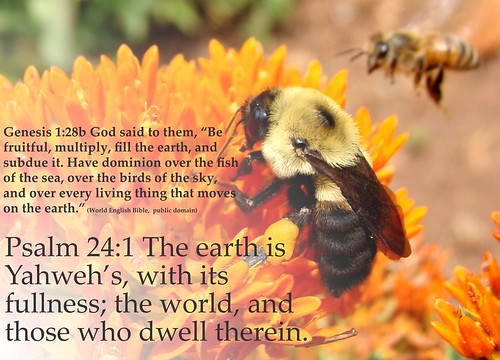
Genesis 1:26-28 seems to indicate clearly that humans were placed in charge of the non-human world. Psalm 8:6 reiterates that idea. Psalm 24:1 indicates that even though we are, in some sense, in charge, the world, and the things in it, are God’s. So does Psalm 50:10,11.* The story of Noah seems to indicate that, at one point, humans were directly responsible for the lives of many kinds of animals. Genesis 7:2-5, 14-16, Proverbs 12:10 and Proverbs 27:23 all have to do with caring for animals.

God seems to care not just for animals in general, but for kinds of animals. Psalms 104:24-25 praises God for the diversity of His creation, and His creatures. Since this explicitly includes the wide variety of ocean animals, it doesn’t seem possible that this praise is meant to be only because of their usefulness to humans. Genesis 7:3, 14-16 indicate God’s concern that the different kinds of animals would be preserved. Genesis 8:1 says that God had not forgotten Noah or the animals. Noah and his family were God’s agents in this care, of course, but they were God-directed agents. It would seem reasonable to argue that in our day, we also have responsibilities to the kinds of animals that exist in our time.

Does God care for individual non-human organisms? Perhaps. The question seems to be addressed in Matthew 10:29, which says that even individual sparrows do not fall without God’s knowledge. (Two verses later, Christ stated that the twelve were of more value than many sparrows. However, He didn’t say that sparrows were valueless.)

Does God’s care, and the care that humans are supposed to have, mean that we must refrain from killing animals deliberately? Apparently not. Jesus certainly condoned fishing (John 21:6Matthew 17:27Luke 5:4). He ate (Luke 24:36-43), and probably fished (John 21:9) even after His resurrection. Peter's vision, after the resurrection, and after Pentecost, used eating meat as a sign that God does not show favoritism (Acts 11:1-18). Paul referred disparagingly to people who forbid eating meat (I Timothy 4:1-3). There are no explicit commands forbidding the consumption of all meat in the Bible. This is not to say that the Bible condones killing of animals wantonly. That would be contradictory to benign dominion. Nor does the Bible condone consumption of animal flesh (or any other kind of food) selfishly, or to excess. But we are allowed to kill non-human organisms for cause, at least. Such causes include killing an animal because it threatens a human (Exodus 21:29), killing for meat (Genesis 9:2-3Leviticus 11:1-22) and killing an animal for its skin (Genesis 3:21). Exodus 12:21-23 and 12:46, and Mark 14:12, indicate clearly that the Passover, one of the most important ceremonies of the Jews, and the last ceremony Jesus performed with His disciples, involved eating meat. The Bible is very clear that humans and animals are not equals. Christ came in human form, principally to redeem humans, although the effects of redemption will be felt through all of creation. We have dominion over animals, not the reverse. That dominion implies responsible use, including research and killing for good cause. (Nothing in this paragraph rules out the practice of vegetarianism. Some Christians may decide, or God may reveal to them, that they shouldn't eat meat. But they cannot prove that Scripture demands that Christians don't eat meat.)

Does God’s care extend to plants? To non-living entities? (The Bible, like present-day people, is more concerned with some kinds of animals than others. There is little, if any, mention of mollusks in scripture, for instance.) The Bible mentions God’s care of plants (Psalm 104:16Matthew 6:30). It also states that everything He created was initially good (Genesis 1:31) and that creation as a whole, not just humans, groans, waiting for restoration (Romans 8:22). It is true that the Bible does not dwell on plants nearly as much as on animals. The creation of plants gets only one phrase in the Genesis account, whereas the creation of animals gets several. There is no mention of God’s concern for plants during the flood, nor are certain kinds of plants declared unclean in the Mosaic dietary laws. All this means that the Hebrews, like ourselves, were more interested in animals than in plants. Perhaps it means that God is also more interested.
From the above, we conclude that God’s care extends beyond humans, certainly to animals. Scripture is less explicit about God’s care for plants, and even less so about His care for rocks, streams, and clouds. However, there seems no reason to expect God to condone wanton destruction of any kind. If God cares for non-human creations, and we are responsible for His creation, then it behooves us to care for non-human creations as well. Proverbs 12:10 says that good people care for their domestic animals, and bad people are cruel to theirs. Caring for animals is usually consistent with caring for plants, or for rocks, streams and clouds. II Chronicles 36:21 tells us that the 70 years that the Israelites were to spend in captivity was not an arbitrary figure. God chose that because his people did not care for the land as he instructed them to. Jeremiah 2:7 and Habakkuk 2:17 condemn the Israelites because they hadn’t taken care of their land.

New Testament teaching on care of the environment
Most of the usual teaching on what the Bible says about care of the environment is from the Old Testament. However, there are two passages from the New Testament that also argue that we should be caring carefully for the environment. They are indirect, but their urgency is important. 
Romans 1:20 tells us that observing and learning about nature are part of God’s revelation to humans. (So does Psalm 19:1-4). If that is so, isn’t that another reason to try to preserve nature as well as we can? The Bible is one of the ways that God reveals Himself to us. For a long time, Christians have believed that the Bible should be translated into the language people are most familiar with, so that that revelation may be as clear as possible. Similarly, it would seem that God's revelation through nature should be as clear as possible. A person is more likely to see God in a pristine stream than in a polluted river. Probably seeing bison herds roam freely in Western North America gave people a glimpse of one aspect of God’s power and majesty that they can’t really get now. Therefore, helping to preserve nature in as good a condition as we can is one way to bring people to a saving knowledge of Christ. Not the most direct way, and probably not the most effective, for many people, but it is still a way to do this.
 
Colossians 1:15-20 says, of Christ, that “in Him all things hold together.” (ESV -- other versions have similar language.) That passage also says that He is working to reconcile all things to Himself, and working to make peace through the blood of the cross. As Christians, we believe that it is our duty to be His instruments in reconciling sinners to Christ, and to help Him in the ministry of making peace. In fact, 2 Corinthians 5:18-19, tell us that:  18 But all things are of God, who reconciled us to himself through Jesus Christ, and gave to us the ministry of reconciliation; 19 namely, that God was in Christ reconciling the world to himself, not reckoning to them their trespasses, and having committed to us the word of reconciliation. 
Doesn’t it follow that we should also participate in Christ’s work of sustaining “all things,” including endangered species and ecosystems or biological communities? (I realize that there are other places in the New Testament where reconciliation and peacemaking are mentioned, or implied, and this is probably the only one that mentions Christ's sustaining work. But that doesn't mean that His sustaining work can be dismissed, or that we have no responsibility to be His instruments in doing it.)

What must we do when our responsibilities seem to conflict?
One response is to ask, do they ever really conflict? We believe that our responsibilities do, in fact, appear to conflict, in these matters, and in others. As fallen, finite beings, we do not always interpret God’s directions correctly. We certainly do not know enough to always judge correctly. If we did possess the ability to decide correctly in all cases, perhaps God’s demands on us would never even seem to conflict. However, we can’t, and they do seem to conflict. Perhaps, this being a fallen world, they actually conflict.
The Bible does not present a formal hierarchy of principles to guide our behavior, in matters of environmental ethics, or in other matters. It does not tell us how to choose when, for instance, a decision we make will lead to either 5 minutes of misery for each of 2000 people, or 3 days of misery for a single individual. It does not tell us what to do when bringing a field under cultivation will help to feed hungry people, but also will kill native plants, deprive animals of homes, and use petroleum resources. As fallen beings in a fallen world, it is probably too much to expect that all our decisions will be correct.

Here are some attempts at principles which may be of help in making decisions about environmental matters:
This world is temporary. Temporal concerns of any kind should be carefully weighed against eternal values. The fossil record indicates that more species have become extinct than are now alive, and usually not because humans caused the extinction. This doesn’t excuse us from trying to save the organisms that live in our time, of course.

We should recognize that environmental concerns are sometimes overstated, not prioritized, or controversial. Some would have us believe that humans are choking to death and swimming in carcinogens. This is overstatement. The atmosphere may not be as clear as it ought to be, and we may indeed be exposed to cancer-causing substances, but people in North America are living longer than ever before. It seems certain that we can’t cure every ill, environmental or otherwise. Is it more important to try to stop global warming, to save the California condor, or to cut down on our consumption of fossil fuels? Is the cost, or risk, from pollution to landfills from disposable diapers more or less than the pollution to water from washing non-disposable ones? No one seems to know the answers. Solutions are not prioritized. We must be careful not to act precipitously just because someone has a concern.

Selfishness is wrong. Most North Americans seem to subconsciously believe that we are somehow entitled to more possessions than people in other parts of the world. Such a life style contributes to environmental degradation. It may also deprive people in other parts of the world, or future generations, of resources. It may mean that our church, and other charitable causes, do not have funds that we could well afford to give. We may not personally be able to change the way the world works very much. We can change it a little, and we should. We can avoid conspicuous consumption, we can avoid wanting things simply because they are newer than the things we already have. We can participate in recycling, even if it requires some effort on our part. We can think carefully about every purchase we make.
Isaiah 5:8-10 is a warning to the Hebrews. It tells them that God doesn’t condone selfishness in material things, including use of land. It predicts that the land will stop yielding enough, as God’s punishment for selfishness.

Knowledge is necessary. We are in God’s image. Part of the reflection of the omniscient God in us is the desire for knowledge. The Bible speaks approvingly of Solomon’s knowledge of the natural world (I Kings 4:32-33). We should learn to appreciate the world as God made it, and this requires knowledge of it. Knowledge is also necessary for wise alleviation of our own mistakes.

Unselfish love is a scriptural requirement. This unselfish love ought to color our relationships with others in every area, certainly including our environmental activities. It is not clear that we can, or ought, to have a relationship of unselfish love with non-human organisms, but it would seem consistent with God’s expectation of us that we act unselfishly toward non-human organisms.
We need guidance from God. All our important decisions need His help. Even with this guidance, we don’t always agree. God may well want some of us to be deeply involved in helping crisis pregnancies, but others to try to help clean up the environment. This doesn’t mean that both groups can’t assist in both efforts, but God may give our lives different emphases.

Having stated these principles, we realize anew that it is difficult to apply them to cases. In many cases, all we can say is “God help us.”

The Bible does not rule out the use of current technology, and the development of new technology
Since the development and use of technology has often been related to use of valuable resources, or contributed to greater “efficiency” in despoiling the landscape, we certainly need to be careful in developing and using technology, for our own sake, as well as that of the landscape. Is technology anti-God? The answer to that question seems to be “it depends.”
There are three biblical passages that indicate reasons why particular technological development may be wrong.
First, worshiping the results of our technology is clearly wrong, as well as just plain stupid (Isaiah 44:9-20).

Second, pride in our accomplishments is wrong (Daniel 4:30-32).

Third, supposing that there are no limits to human ability is wrong (Genesis 11:5-9).

On the other hand, there are biblical reasons for supposing that technological development is not always wrong, and, in fact, can sometimes glorify God. Noah’s ark, the tabernacle, and the temple, were technological constructs, and God gave instructions for the building of each of them. In fact, in the building of the temple, and other projects completed during the reign of Solomon, there was apparently extensive use of resources. Solomon sent 10,000 workers to Lebanon to cut down cedar trees each month (I Kings 5:14), in addition to the servants of King Hiram who helped them. They may have worked there for as long as seven (I Kings 6:38) or even twenty years (II Chronicles 8:1). All this was at least allowed by God, and some of it was directed by Him. Jeremiah 22:6 contains an amazing statement. This verse says that God finds the royal palace at Jerusalem as beautiful as the mountains of Lebanon. It would seem that technological development, by and of itself, is not wrong, although it may be done for wrong reasons, or with the wrong attitude.
Part of the image of God in humans is the desire to create things. The fact that we can create and use technology has certainly lead to some unfortunate consequences, such as deaths and injuries in highway accidents. However, it may also lead to some fortunate consequences, such as our being able to alleviate some of the consequences of our own mistakes of the past, or even some of the consequences of the fall.


+  +  +  +  +

April 23, 2011:

On an earlier date, links to all the scripture referenced in this post, using the English Standard Version, were added. (See here for the ESV policy on copyright.) The section on New Testament teaching on care of the environment was inserted on this date. It had been part of a previous post. That post is still on-line. I have not removed any of the comments from the previous version of this post.

Thanks for reading!

*Added October 15, 2014: More scripture on God's ownership, and our stewardship: Jeremiah 27:5 ‘I have made the earth, the men, and the animals that are on the surface of the earth by my great power and by my outstretched arm. I give it to whom it seems right to me. 6 Now I have given all these lands into the hand of Nebuchadnezzar the king of Babylon, my servant. I have also given the animals of the field to him to serve him. (World English Bible, public domain) 

Added April 20, 2017: E. Stephen Burnett has written a fine blog post on how care of the current earth relates to the New Earth.

Added December 27, 2019: Nancy Sleeth, in Relevantdemolishes some objections some Christians raise (such as "It's all going to be destroyed in the end, so why care for earth?")

This post originally appeared on April 22, 2006. I have re-posted it, after reading Sleeth's article. To see comments prior to December 2019, use the link in the previous sentence. Thanks for reading.

Wednesday, October 16, 2019

Sunspots 750

Things I have recently spotted that may be of interest to someone else:

The Arts: The History Blog reports that a painting by Agnolo Bronzini is being shown publicly for the first time in about five centuries.


Christianity: Christians can disagree, but they should observe these principles.

Todd Wood reflects on the forbidden fruit.

A Relevant writer tells us why Christians should care for the environment, even though the present earth may be drastically changed.


Education: Grammarphobia discusses the matter of being hoist by one's own petard.

Finance: Catherine Rampell points out that the deficit is getting much larger.

Politics: Relevant reports that a recent Fox news poll indicates that white evangelicals support for impeachment of President Trump is growing.

Relevant also reports that a female Kurdish official, who supported Kurdish Christians, has been executed by forces allied with the Turks.

FiveThirtyEight analyzes loss of Republican support for President Richard Nixon.

NPR has posted a timeline of events, some of which you probably didn't know about, related to Ukraine, Rudy Giuliani, and other matters related to the impeachment inquiry.

Joe Biden, and his son, or others, may or may not have been involved in corruption of some sort. But President Trump's record on corruption isn't exactly a great one, say reports by NPR, here and here.

FiveThirtyEight on where to find anti-Trump Republicans.


Science: Science News and other outlets tell us about the discovery of lots of new, small moons orbiting Saturn.

The graphic used in these posts is from NASA, hence, it is free to use like this.
Thanks for looking!

Wednesday, December 26, 2018

Sunspots 708


Things I have recently spotted that may be of interest to someone else:

Christianity: Michael Gerson on why all of us should care how prisoners are treated.

Christianity Today says that we should keep the X in Christmas/Xmas.

Education: Merriam-Webster has chosen its word of the year, based on use by the public. It's Justice.

Health: NPR reports on why some drug prices are so high in the US.

Humor: A Louisiana woman has placed large inflatable dragons on her lawn for Christmas. Not everyone was happy about that, says Relevant. So she added some more.


(or something) Think the US celebrates Christmas too much? NPR reports that the Philippines celebrates it for four months.


Politics: Alexandria Ocasio-Cortez, newly elected to the US House, has proposed a Green Deal -- aspirations on how we want to deal with the environment. A majority of people of all political affiliations like the idea, according to Earther.

Secretary of Commerce Wilbur Ross appears to have had as many, or more, shady dealings as some ex-members of the Trump administration.

(And Science) NPR reports that North Korean scientists may be learning how to produce weapons because of seemingly ordinary cooperation with scientists from other countries, especially China.

Science: NPR reports on a new largest prime number, a very large one, indeed.

NPR also reports on a study, published in the British Medical Journal, which showed, sort of, that jumping out of an airplane with a backpack is as safe as jumping out with a parachute. The study also shows some deeper truths about medical research.

The Trump administration is trying to open the last large chunk of undeveloped land in the US to oil and gas interests, without much concern for the environment, according to Earther. Sigh.


The graphic used in these posts is from NASA, hence, I believe, it is public domain. 

Thanks for looking!

Wednesday, December 12, 2018

Sunspots 706


Things I have recently spotted that may be of interest to
someone else:


Christianity: Comedian Stephen Colbert on how he found his faith again, through a New Testament (Gideon?) given to him on the street.
A BioLogos writer discusses how evil can be in the world, in spite of God's existence and power.

(And politics) Relevant reports on Pastor Tim Keller points out the dangers of nationalism, applying the book of Jonah.


Computing: Gizmodo reports on 22 apps for Android devices that drain batteries rapidly, and may contain malware.

Education: Grammarphobia explains the use of "clear" and "clearly."

Health: (And politics) Michael Gerson on the anti-vaccination movement in Italy (and the U.S.).

Humor: One of my Flickr contacts has been imagining really big helpings of several kinds of food.


Politics: Scientific American reports that the Department of Interior is not protecting the environment -- quite the opposite.

FiveThirtyEight asks whether the Republican Party has given up on attracting black voters, and discusses the history of the question.

Science: Relevant reports on studies that show that almost all old ice in the Arctic is gone.


The graphic used in these posts is from NASA, hence, I believe, it is public domain.

Thanks for looking!

Wednesday, April 26, 2017

Sunspots 623

Things I have recently spotted that may be of interest to someone else:


Christianity:  Christianity Today reports on a Gallup poll that says that the thing most churchgoers are really looking for is solid Bible teaching in the sermon.

Christianity Today also reports on how the Coptic Christians of Egypt have forgiven those responsible for deadly terrorist bombings of their places of worship.

A Relevant writer asks why so many Christians don't seem to be bothered by sexual harassment scandals.


Finance: Listverse on the unexpected origins of some famous companies. (Example: Samsung started as a grocery store!)

Health: Statnews on the care of Alzheimer's patients at home, with state assistance, in North Dakota (which has a high occurrence of Alzheimer's.)

National Geographic reports that Dubai is well on the way to becoming one of the greenest cities on earth.

National Public Radio examines the possibilities of getting hearing aids over the counter.

Politics: Listverse gives capsule biographies, and photos, of 10 important, powerful North Koreans, who aren't part of their leader's family. They are all male.

Science: The Principles and Goals of the March for Science.

A Scientific American writer tells how climate change is affecting Bangladesh, and how it will do so in the near future.

National Public Radio reports on developments that may lead to an artificial womb, and on some of the issues that would raise, if it came to be.

NPR also reports that a caterpillar may be able to consume plastic bags, so that they are biodegradable.

(or something) Wired reports that thieves with two $11 devices can fool your wireless car key system, and steal your vehicle.

Sports: FiveThirtyEight has studied NBA players who are slow to get back on defense. (Too often, because they are complaining about a foul call or no-call.)


Image source (public domain)

Friday, April 21, 2017

The New Earth and caring for the environment we have now

Tomorrow is Earth Day. E. Stephen Burnett has written a fine blog post, with plenty of scriptural material, on how care of the current earth relates to the New Earth.

You may also want to read my own post, more extensive, but not on the New Earth, about what the Bible says about environmental stewardship.

Thanks for reading. Read Burnett!

Friday, June 17, 2016

We can't see the Milky Way anymore


God revealed through the Milky Way

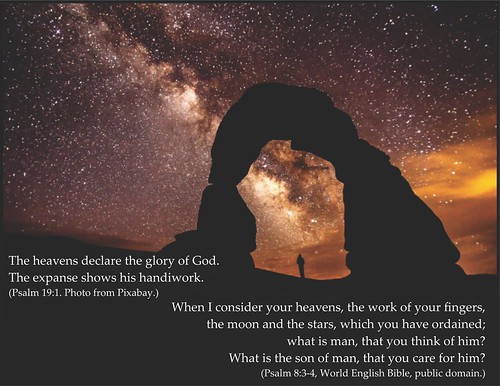
National Public Radio, and other news sources, have reported on a study which indicates that most North Americans (and others) cannot see the Milky Way, the galaxy that we are part of, because there is too much artificial light (light pollution) in the sky. That’s too bad, for two reasons, at least.

One reason that it’s too bad is aesthetic. The Milky Way is beautiful. Although it’s not extremely bright, it covers so much of the sky that, when visible, it’s the most obvious feature of the heavens above us. If we can’t see it, we are deprived of one of the most beautiful and majestic aspects of the creation. For comparison, consider your favorite wild flower, or wild bird, or mountain, and suppose that, for some reason, you were never going to see this flower or bird or mountain again. You would be deprived, of some of the beauty that inspires and comforts you, and that’s too bad.

The second reason is that the observation of nature is one of the ways that God is revealed to us. (It’s not the only one, or the most important, but it’s one way.) Because the Bible says so.

Psalm 8 tells us that we should praise God, and also indicates that considering the heavens informs us about our place in the creation:

1 Yahweh, our Lord, how majestic is your name in all the earth!
You have set your glory above the heavens!
3 When I consider your heavens, the work of your fingers,
the moon and the stars, which you have ordained;
4 what is man, that you think of him?
What is the son of man, that you care for him?
5 For you have made him a little lower than the angels,
and crowned him with glory and honor.
6 You make him ruler over the works of your hands.
You have put all things under his feet:

Psalm 97 repeats the first theme:
The heavens declare his righteousness.
All the peoples have seen his glory.

Psalm 19 explicitly says that nature reveals God to us:
1 The heavens declare the glory of God.
The expanse shows his handiwork.
2 Day after day they pour out speech,
and night after night they display knowledge.
3 There is no speech nor language,
where their voice is not heard.
4a Their voice has gone out through all the earth,
their words to the end of the world. 

Such statements are not confined to the Old Testament. Here’s a part of Romans 1:
20 For the invisible things of him since the creation of the world are clearly seen, being perceived through the things that are made, even his everlasting power and divinity, that they may be without excuse.

So, if we can’t see the Milky Way, we are a little less able to worship God, to understand His redemptive work, and to know our place in creation.

Am I advocating turning off all streetlights, or prohibiting driving after dark? No. That’s not my call, and I often use lights at night, sometimes in what I hope is God’s work. But I should realize that, by indiscriminate use of light, I am cutting myself, and others, off from part of my understanding of God. The Passenger Pigeon, once the most common bird in North America, became extinct a little over 100 years ago, due to human activity. We can no longer see huge, majestic flocks of these creatures, and so are also, by that lack, deprived of some once available knowledge of God’s power and majesty. The American Bison, and some rhino species, are not yet extinct, but we are never going to see them in the magnificent numbers that people once did, and the rhinos, at least, may really become extinct. Too bad.

We live in a fallen world, and, environmentally speaking, it seems to become less like God gave it to us by the day. As Paul said, in Romans 8:
19 For the creation waits with eager expectation for the children of God to be revealed. 20 For the creation was subjected to vanity, not of its own will, but because of him who subjected it, in hope 21 that the creation itself also will be delivered from the bondage of decay into the liberty of the glory of the children of God. 22 For we know that the whole creation groans and travails in pain together until now.

Thanks for reading. Look for the Milky Way!

The photo is from Pixabay, which allows such use.

Friday, April 22, 2016

The New Testament teaches that Christians should be stewards of the environment.

Psalm 19:1-4 and Romans 1:20 tell us that observing and learning about nature are part of God’s revelation to humans. If that is so, isn’t that a reason to try to preserve nature as well as we can?

The Bible is one of the ways that God reveals Himself to us. Christians believe that the Bible should be translated into the language people are most familiar with, so that that revelation may be as clear as possible. Similarly, it would seem that God’s revelation through nature should be as clear as possible. A person is more likely to see God in a beautiful clear stream than in a polluted river, or in a clear sky than in a smog-filled atmosphere. Seeing bison herds roam freely in Western North America, or immense flocks of passenger pigeons, gave people a glimpse of aspects of God’s power and majesty that they can’t get now. Helping to preserve nature in as good a condition as we can is one way to bring people to a saving knowledge of Christ. Not the most direct way, and perhaps not the most effective, but it is still a way to do this.
 
Colossians 1:15-20 says, of Christ, that “in Him all things are held together.” That passage also says that He is working to reconcile all things to Himself, and that He is working to make peace through the blood of the cross. As Christians, we believe that it is our duty to be His instruments in reconciling sinners to Christ, and to help Him in the ministry of making peace. 2 Corinthians 5:18-19 tells us that: 18 But all things are of God, who reconciled us to himself through Jesus Christ, and gave to us the ministry of reconciliation; 19 namely, that God was in Christ reconciling the world to himself, not reckoning to them their trespasses, and having committed to us the word of reconciliation.

(Hebrews 1:3 also tells us that Christ is holding all things together.)  
Christians believe they should participate in Christ’s work of reconciliation. Shouldn’t they also participate in His work of holding all things together, including endangered species, ecosystems and biological communities?

What do you think? (See here for Old Testament teaching on environmental stewardship. There is lots of it!)

Thanks for reading. This post was modified from this one.

Wednesday, April 01, 2015

Sunspots 515

Although this is posted on April 1, none of it is designed to be an April Fool's joke:

Things I have recently spotted that may be of interest to someone else:
Christianity: Christianity Today reports that so-called "Heaven Tourism" books will no longer be carried, or sold, by a major Christian bookstore chain, and why.

The Environment: Relevant discusses six commonly-used items that we shouldn't be using, because of their effect on the environment.

Health: Two articles on the dangers of loneliness: here and here.
(and geopolitics)


Michael Gerson warns that humanity is not ready for the next really big epidemic, and Ebola isn't it.

Politics: FiveThirtyEight has published an extensive analysis of the Republican candidates for US President, and concludes that Senator Ted Cruz cannot win. He will draw plenty of media attention, though.

Science:  From Science, an interesting study on how life may have originated from non-life.


Image source (public domain)

Saturday, April 22, 2006

Environmental Stewardship in the Bible: What the Bible says about care of the environment

Two Days late for Earth Day - Environmental stewardship

We have God-given responsibilities to non-human organisms
Genesis 1:26-28 seems to indicate clearly that humans were placed in charge of the non-human world. Psalm 8:6 reiterates that idea. Psalm 24:1 indicates that even though we are, in some sense, in charge, the world, and the things in it, are God’s. So does Psalm 50:10,11.* The story of Noah seems to indicate that, at one point, humans were directly responsible for the lives of many kinds of animals. Genesis 7:2-5, 14-16, Proverbs 12:10 and Proverbs 27:23 all have to do with caring for animals.

God seems to care not just for animals in general, but for kinds of animals. Psalms 104:24-25 praises God for the diversity of His creation, and His creatures. Since this explicitly includes the wide variety of ocean animals, it doesn’t seem possible that this praise is meant to be only because of their usefulness to humans. Genesis 7:3, 14-16 indicate God’s concern that the different kinds of animals would be preserved. Genesis 8:1 says that God had not forgotten Noah or the animals. Noah and his family were God’s agents in this care, of course, but they were God-directed agents. It would seem reasonable to argue that in our day, we also have responsibilities to the kinds of animals that exist in our time.

Does God care for individual non-human organisms? Perhaps. The question seems to be addressed in Matthew 10:29, which says that even individual sparrows do not fall without God’s knowledge. (Two verses later, Christ stated that the twelve were of more value than many sparrows. However, He didn’t say that sparrows were valueless.)

Does God’s care, and the care that humans are supposed to have, mean that we must refrain from killing animals deliberately? Apparently not. Jesus certainly condoned fishing (John 21:6, Matthew 17:27, Luke 5:4). He ate (Luke 24:36-43), and probably fished (John 21:9) even after His resurrection. Peter's vision, after the resurrection, and after Pentecost, used eating meat as a sign that God does not show favoritism (Acts 11:1-18). Paul referred disparagingly to people who forbid eating meat (I Timothy 4:1-3). There are no explicit commands forbidding the consumption of all meat in the Bible. This is not to say that the Bible condones killing of animals wantonly. That would be contradictory to benign dominion. Nor does the Bible condone consumption of animal flesh (or any other kind of food) selfishly, or to excess. But we are allowed to kill non-human organisms for cause, at least. Such causes include killing an animal because it threatens a human (Exodus 21:29), killing for meat (Genesis 9:2-3, Leviticus 11:1-22) and killing an animal for its skin (Genesis 3:21). Exodus 12:21-23 and 12:46, and Mark 14:12, indicate clearly that the Passover, one of the most important ceremonies of the Jews, and the last ceremony Jesus performed with His disciples, involved eating meat. The Bible is very clear that humans and animals are not equals. Christ came in human form, principally to redeem humans, although the effects of redemption will be felt through all of creation. We have dominion over animals, not the reverse. That dominion implies responsible use, including research and killing for good cause. (Nothing in this paragraph rules out the practice of vegetarianism. Some Christians may decide, or God may reveal to them, that they shouldn't eat meat. But they cannot prove that Scripture demands that Christians don't eat meat.)

Does God’s care extend to plants? To non-living entities? (The Bible, like present-day people, is more concerned with some kinds of animals than others. There is little, if any, mention of mollusks in scripture, for instance.) The Bible mentions God’s care of plants (Psalm 104:16, Matthew 6:30). It also states that everything He created was initially good (Genesis 1:31) and that creation as a whole, not just humans, groans, waiting for restoration (Romans 8:22). It is true that the Bible does not dwell on plants nearly as much as on animals. The creation of plants gets only one phrase in the Genesis account, whereas the creation of animals gets several. There is no mention of God’s concern for plants during the flood, nor are certain kinds of plants declared unclean in the Mosaic dietary laws. All this means that the Hebrews, like ourselves, were more interested in animals than in plants. Perhaps it means that God is also more interested.
From the above, we conclude that God’s care extends beyond humans, certainly to animals. Scripture is less explicit about God’s care for plants, and even less so about His care for rocks, streams, and clouds. However, there seems no reason to expect God to condone wanton destruction of any kind. If God cares for non-human creations, and we are responsible for His creation, then it behooves us to care for non-human creations as well. Proverbs 12:10 says that good people care for their domestic animals, and bad people are cruel to theirs. Caring for animals is usually consistent with caring for plants, or for rocks, streams and clouds. II Chronicles 36:21 tells us that the 70 years that the Israelites were to spend in captivity was not an arbitrary figure. God chose that because his people did not care for the land as he instructed them to. Jeremiah 2:7 and Habakkuk 2:17 condemn the Israelites because they hadn’t taken care of their land.

New Testament teaching on care of the environment
Most of the usual teaching on what the Bible says about care of the environment is from the Old Testament. However, there are two passages from the New Testament that also argue that we should be caring carefully for the environment. They are indirect, but their urgency is important.
Romans 1:20 tells us that observing and learning about nature are part of God’s revelation to humans. (So does Psalm 19:1-4). If that is so, isn’t that another reason to try to preserve nature as well as we can? The Bible is one of the ways that God reveals Himself to us. For a long time, Christians have believed that the Bible should be translated into the language people are most familiar with, so that that revelation may be as clear as possible. Similarly, it would seem that God's revelation through nature should be as clear as possible. A person is more likely to see God in a pristine stream than in a polluted river. Probably seeing bison herds roam freely in Western North America gave people a glimpse of one aspect of God’s power and majesty that they can’t really get now. Therefore, helping to preserve nature in as good a condition as we can is one way to bring people to a saving knowledge of Christ. Not the most direct way, and probably not the most effective, for many people, but it is still a way to do this.

Colossians 1:15-20 says, of Christ, that “in Him all things hold together.” (ESV -- other versions have similar language.) That passage also says that He is working to reconcile all things to Himself, and working to make peace through the blood of the cross. As Christians, we believe that it is our duty to be His instruments in reconciling sinners to Christ, and to help Him in the ministry of making peace. In fact, 2 Corinthians 5:18-19, tell us that:  18 But all things are of God, who reconciled us to himself through Jesus Christ, and gave to us the ministry of reconciliation; 19 namely, that God was in Christ reconciling the world to himself, not reckoning to them their trespasses, and having committed to us the word of reconciliation.
Doesn’t it follow that we should also participate in Christ’s work of sustaining “all things,” including endangered species and ecosystems or biological communities? (I realize that there are other places in the New Testament where reconciliation and peacemaking are mentioned, or implied, and this is probably the only one that mentions Christ's sustaining work. But that doesn't mean that His sustaining work can be dismissed, or that we have no responsibility to be His instruments in doing it.)

What must we do when our responsibilities seem to conflict?
One response is to ask, do they ever really conflict? We believe that our responsibilities do, in fact, appear to conflict, in these matters, and in others. As fallen, finite beings, we do not always interpret God’s directions correctly. We certainly do not know enough to always judge correctly. If we did possess the ability to decide correctly in all cases, perhaps God’s demands on us would never even seem to conflict. However, we can’t, and they do seem to conflict. Perhaps, this being a fallen world, they actually conflict.
The Bible does not present a formal hierarchy of principles to guide our behavior, in matters of environmental ethics, or in other matters. It does not tell us how to choose when, for instance, a decision we make will lead to either 5 minutes of misery for each of 2000 people, or 3 days of misery for a single individual. It does not tell us what to do when bringing a field under cultivation will help to feed hungry people, but also will kill native plants, deprive animals of homes, and use petroleum resources. As fallen beings in a fallen world, it is probably too much to expect that all our decisions will be correct.

Here are some attempts at principles which may be of help in making decisions about environmental matters:
This world is temporary. Temporal concerns of any kind should be carefully weighed against eternal values. The fossil record indicates that more species have become extinct than are now alive, and usually not because humans caused the extinction. This doesn’t excuse us from trying to save the organisms that live in our time, of course.

We should recognize that environmental concerns are sometimes overstated, not prioritized, or controversial. Some would have us believe that humans are choking to death and swimming in carcinogens. This is overstatement. The atmosphere may not be as clear as it ought to be, and we may indeed be exposed to cancer-causing substances, but people in North America are living longer than ever before. It seems certain that we can’t cure every ill, environmental or otherwise. Is it more important to try to stop global warming, to save the California condor, or to cut down on our consumption of fossil fuels? Is the cost, or risk, from pollution to landfills from disposable diapers more or less than the pollution to water from washing non-disposable ones? No one seems to know the answers. Solutions are not prioritized. We must be careful not to act precipitously just because someone has a concern.

Selfishness is wrong. Most North Americans seem to subconsciously believe that we are somehow entitled to more possessions than people in other parts of the world. Such a life style contributes to environmental degradation. It may also deprive people in other parts of the world, or future generations, of resources. It may mean that our church, and other charitable causes, do not have funds that we could well afford to give. We may not personally be able to change the way the world works very much. We can change it a little, and we should. We can avoid conspicuous consumption, we can avoid wanting things simply because they are newer than the things we already have. We can participate in recycling, even if it requires some effort on our part. We can think carefully about every purchase we make.
Isaiah 5:8-10 is a warning to the Hebrews. It tells them that God doesn’t condone selfishness in material things, including use of land. It predicts that the land will stop yielding enough, as God’s punishment for selfishness.

Knowledge is necessary. We are in God’s image. Part of the reflection of the omniscient God in us is the desire for knowledge. The Bible speaks approvingly of Solomon’s knowledge of the natural world (I Kings 4:32-33). We should learn to appreciate the world as God made it, and this requires knowledge of it. Knowledge is also necessary for wise alleviation of our own mistakes.

Unselfish love is a scriptural requirement. This unselfish love ought to color our relationships with others in every area, certainly including our environmental activities. It is not clear that we can, or ought, to have a relationship of unselfish love with non-human organisms, but it would seem consistent with God’s expectation of us that we act unselfishly toward non-human organisms.
We need guidance from God. All our important decisions need His help. Even with this guidance, we don’t always agree. God may well want some of us to be deeply involved in helping crisis pregnancies, but others to try to help clean up the environment. This doesn’t mean that both groups can’t assist in both efforts, but God may give our lives different emphases.

Having stated these principles, we realize anew that it is difficult to apply them to cases. In many cases, all we can say is “God help us.”

The Bible does not rule out the use of current technology, and the development of new technology
Since the development and use of technology has often been related to use of valuable resources, or contributed to greater “efficiency” in despoiling the landscape, we certainly need to be careful in developing and using technology, for our own sake, as well as that of the landscape. Is technology anti-God? The answer to that question seems to be “it depends.”
There are three biblical passages that indicate reasons why particular technological development may be wrong.
First, worshiping the results of our technology is clearly wrong, as well as just plain stupid (Isaiah 44:9-20).

Second, pride in our accomplishments is wrong (Daniel 4:30-32).

Third, supposing that there are no limits to human ability is wrong (Genesis 11:5-9).

On the other hand, there are biblical reasons for supposing that technological development is not always wrong, and, in fact, can sometimes glorify God. Noah’s ark, the tabernacle, and the temple, were technological constructs, and God gave instructions for the building of each of them. In fact, in the building of the temple, and other projects completed during the reign of Solomon, there was apparently extensive use of resources. Solomon sent 10,000 workers to Lebanon to cut down cedar trees each month (I Kings 5:14), in addition to the servants of King Hiram who helped them. They may have worked there for as long as seven (I Kings 6:38) or even twenty years (II Chronicles 8:1). All this was at least allowed by God, and some of it was directed by Him. Jeremiah 22:6 contains an amazing statement. This verse says that God finds the royal palace at Jerusalem as beautiful as the mountains of Lebanon. It would seem that technological development, by and of itself, is not wrong, although it may be done for wrong reasons, or with the wrong attitude.
Part of the image of God in humans is the desire to create things. The fact that we can create and use technology has certainly lead to some unfortunate consequences, such as deaths and injuries in highway accidents. However, it may also lead to some fortunate consequences, such as our being able to alleviate some of the consequences of our own mistakes of the past, or even some of the consequences of the fall.


+  +  +  +  +

April 23, 2011:

On an earlier date, links to all the scripture referenced in this post, using the English Standard Version, were added. (See here for the ESV policy on copyright.) The section on New Testament teaching on care of the environment was inserted on this date. It had been part of a previous post. That post is still on-line. I have not removed any of the comments from the previous version of this post.

Thanks for reading!

*Added October 15, 2014: More scripture on God's ownership, and our stewardship: Jeremiah 27:5 ‘I have made the earth, the men, and the animals that are on the surface of the earth by my great power and by my outstretched arm. I give it to whom it seems right to me. 6 Now I have given all these lands into the hand of Nebuchadnezzar the king of Babylon, my servant. I have also given the animals of the field to him to serve him. (World English Bible, public domain) 

Added April 20, 2017: E. Stephen Burnett has written a fine blog post on how care of the current earth relates to the New Earth.