Things I have recently spotted that may
be of interest to someone else:
The Arts: Left Behind is
going to be available through Netflix. E. Stephen Burnett does
not recommend it, from any source.
Christianity: The New
English Translation of the Bible, which can be downloaded free, in
various formats. It is not public domain.
A Christianity Today columnist has begun wearing the same outfit to work all week. (In this case, the columnist is a female.)
Computing: Metaflop is a web site that lets you create your own fonts by modifying a pre-existing one.
Wired says that Coolors
is a web site that lets you create your own color palettes, easily. It
works. I plan to post a poster, with colors selected from that site, tomorrow.
Gizmo's Freeware has a Free Windows Desktop Software Security list, annotated.
The History Blog tells us about the first selfie, taken in 1839.
Health: Christianity Today reviews a book that claims that Christians, historically, have embraced advancements in medicine, and should continue to do so.
Politics: Benjamin L. Corey gives statistics on how much (or little) Christians actually give that goes to help the poor,
and says that his support of government assistance isn't because he is a
socialist, but because, if the church isn't coming anywhere close to
meeting needs, then government should, by default.
Science: Time
reports on a baby, conceived in vitro, with mitochondria,
taken from the mother, and inserted into the egg.
National Public Radio reports on miscarriages.
They are more common than you think, and the most common cause is a
chromosomal abnormality. In other words, miscarriage prevents births of
severely abnormal babies.
Wired on why, and how, cats purr.
Image
source (public domain)
Musings on science, the Bible, and fantastic literature (and sometimes basketball and other stuff).
God speaks to us through the Bible and the findings of science, and we should listen to both types of revelation.
The title is from Psalm 84:11.
The Wikipedia is usually a pretty good reference. I mostly use the World English Bible (WEB), because it is public domain. I am grateful.
License
I have written an e-book, Does the Bible Really Say That?, which is free to anyone. To download that book, in several formats, go here.

The posts in this blog are licensed under a Creative Commons Attribution-NonCommercial-ShareAlike 3.0 Unported License. You can copy and use this material, as long as you aren't making money from it. If you give me credit, thanks. If not, OK.

The posts in this blog are licensed under a Creative Commons Attribution-NonCommercial-ShareAlike 3.0 Unported License. You can copy and use this material, as long as you aren't making money from it. If you give me credit, thanks. If not, OK.
Showing posts with label simplicity. Show all posts
Wednesday, May 13, 2015
Sunspots 521
Labels:
cats,
charity,
color schemes,
colors,
end times,
fonts,
IVF,
links,
medicine,
miscarriages,
mitochondria,
photography,
simplicity
Friday, November 08, 2013
Let me get this straight -- musing about lines in nature
Natural objects very seldom contain perfectly straight lines. Man-made objects often do.
True, there are some nearly straight lines in natural objects. Some tree trunks are almost perfectly straight. Still water has a flat surface, a straight line expanded to two dimensions, as it were. Salt crystals are sometimes nearly perfect cubes, or, at least, they often have one or more flat surfaces. Some leaf veins are almost perfectly straight. But these examples are rare.
Spider webs do have what appear to be straight lines, but they usually don't go very far before joining with another line, which goes in a different direction, and, like power lines, the threads usually sag in the middle. I am not sure that there are any really straight lines in the photo above. (The photo is from my Flickr photostream. If you want to see a larger version, go here.)
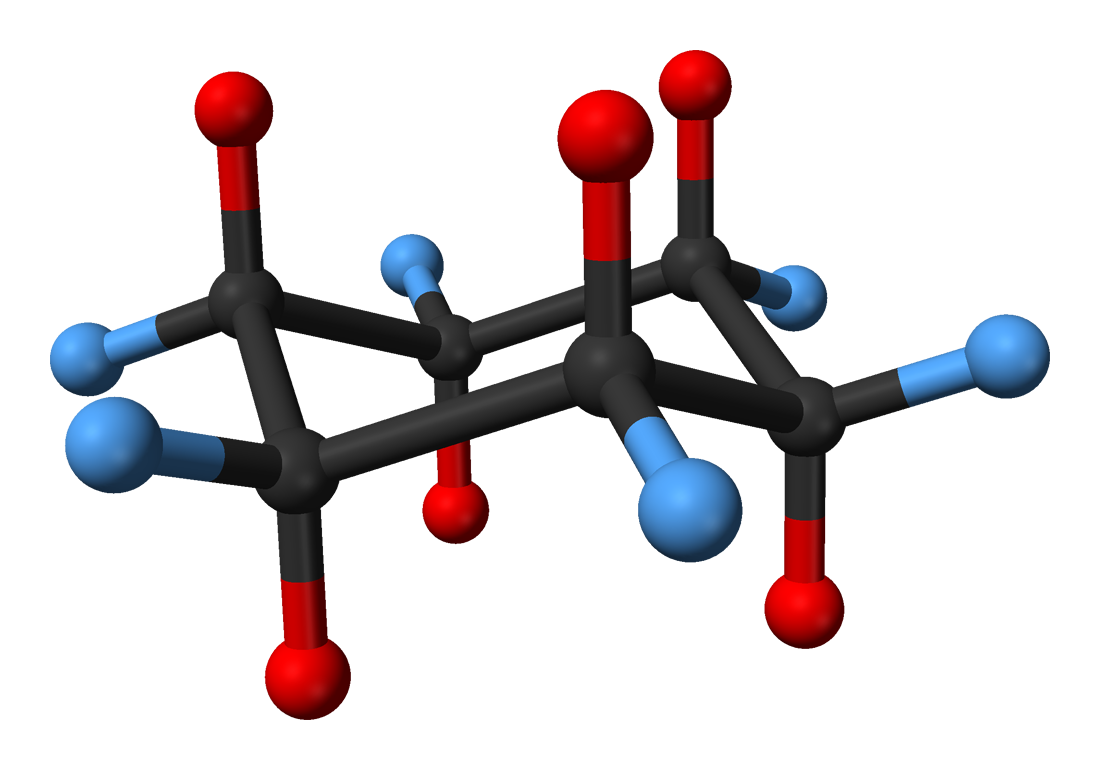
Covalent bonds, such as the 4 bonds that Carbon atoms can form

are depicted as straight, as in the image of cyclohexane, above, where the dark gray balls represent carbon atoms, and the rods between the balls represent covalent bonds. But the angles of the bonds are such that, even in this model, the straight lines can not continue in the same direction. Besides, the bonds aren't really little rods, any more than the atoms are little spheres. And, even if they were little straight rods, they are very short -- just the distance between two adjacent atoms in a tiny molecule.
The two examples above, and some tree trunks, are about as close to really straight lines as you are going to find, in natural objects. Look, for example, at the trees and leaves in the first photo, or at almost any natural scene. You will see all sorts of shapes, many of them difficult to describe, but you will almost never see straight lines.
Why is that? I don't know. But this fact suggests that it is very difficult to grasp nature clearly. In a way, our use of straight lines, angles, flat surfaces, and curves, in the things we build for ourselves, is a reflection of our power over such artifacts. But we have much less power over nature -- we can't create it. Its shapes are too complicated for us to easily duplicate, and comprehend.
The word, "straight," is used several times in the Bible. Of the twelve versions that the Blueletter Bible offers, the New International Version has the most occurrences, 40. Here they are.
I am not sure that any of these 40 refer to a straight line, as such. Most of them are used in the sense of going straight toward some destination.
Here's one instance of the use of "straight" in the Bible:
Matthew 3:3 For this is he who was spoken of by Isaiah the prophet, saying,
“The voice of one crying in the wilderness,
make ready the way of the Lord.
Make his paths straight.” (This is referring to Isaiah 40:3, which uses much the same wording.)
Did the people of Bible times understand the concept of straight lines, or straightness? Surely they did. In Acts 9:11, a street in Damascus is called Straight Street. 2 Kings 21:13 uses the concept of a plumb line as a measure of straightness.
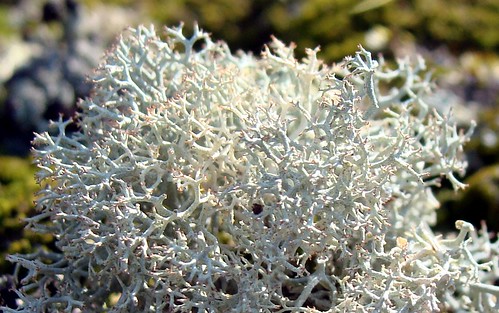
To sum it up, God, and God's nature, are more complex than we often like to make things. But that is not to say that God doesn't understand our simple patterns and constructions, often with straight lines all over the place. He does. He made straightness possible. We should see beauty in the seemingly complex, and difficult to describe, shapes that we find in nature, such as the lichen below:
True, there are some nearly straight lines in natural objects. Some tree trunks are almost perfectly straight. Still water has a flat surface, a straight line expanded to two dimensions, as it were. Salt crystals are sometimes nearly perfect cubes, or, at least, they often have one or more flat surfaces. Some leaf veins are almost perfectly straight. But these examples are rare.
Spider webs do have what appear to be straight lines, but they usually don't go very far before joining with another line, which goes in a different direction, and, like power lines, the threads usually sag in the middle. I am not sure that there are any really straight lines in the photo above. (The photo is from my Flickr photostream. If you want to see a larger version, go here.)
Covalent bonds, such as the 4 bonds that Carbon atoms can form

are depicted as straight, as in the image of cyclohexane, above, where the dark gray balls represent carbon atoms, and the rods between the balls represent covalent bonds. But the angles of the bonds are such that, even in this model, the straight lines can not continue in the same direction. Besides, the bonds aren't really little rods, any more than the atoms are little spheres. And, even if they were little straight rods, they are very short -- just the distance between two adjacent atoms in a tiny molecule.
The two examples above, and some tree trunks, are about as close to really straight lines as you are going to find, in natural objects. Look, for example, at the trees and leaves in the first photo, or at almost any natural scene. You will see all sorts of shapes, many of them difficult to describe, but you will almost never see straight lines.
Why is that? I don't know. But this fact suggests that it is very difficult to grasp nature clearly. In a way, our use of straight lines, angles, flat surfaces, and curves, in the things we build for ourselves, is a reflection of our power over such artifacts. But we have much less power over nature -- we can't create it. Its shapes are too complicated for us to easily duplicate, and comprehend.
The word, "straight," is used several times in the Bible. Of the twelve versions that the Blueletter Bible offers, the New International Version has the most occurrences, 40. Here they are.
I am not sure that any of these 40 refer to a straight line, as such. Most of them are used in the sense of going straight toward some destination.
Here's one instance of the use of "straight" in the Bible:
Matthew 3:3 For this is he who was spoken of by Isaiah the prophet, saying,
“The voice of one crying in the wilderness,
make ready the way of the Lord.
Make his paths straight.” (This is referring to Isaiah 40:3, which uses much the same wording.)
Did the people of Bible times understand the concept of straight lines, or straightness? Surely they did. In Acts 9:11, a street in Damascus is called Straight Street. 2 Kings 21:13 uses the concept of a plumb line as a measure of straightness.
To sum it up, God, and God's nature, are more complex than we often like to make things. But that is not to say that God doesn't understand our simple patterns and constructions, often with straight lines all over the place. He does. He made straightness possible. We should see beauty in the seemingly complex, and difficult to describe, shapes that we find in nature, such as the lichen below:
(Larger sizes here.)
Thanks for reading! Keep yourself straight, but appreciate complexity.
Labels:
2 Kings 21:13,
bonds,
Carbon,
complexity,
curves,
lichens,
lines,
Matthew 3:3,
shapes,
simplicity,
spider webs,
straight
Thursday, May 30, 2013
God's creativity
John 1,
Colossians 1, and other passages indicate that God the Son was and is the chief
agent in creation, and in sustaining it.
So what did
God create?
1. Substance (including energy, which is a
type of substance – e = mc2).
Matter and
energy are creations of God. He is outside of His created universe, and made it
come to be from nothing. However, He can and does enter it, as shown in the
miracles of the Old Testament, the Incarnation of God the Son, and the presence
of God the Holy Spirit. Ken Schenck, in this post, points out that God created the nothing, too. It wouldn't have been there without God.
It is
possible that all the types of sub-atomic particles, or even each and every
such particle, all the elements, all the types of heavenly bodies, the earth
itself, and the kinds of living things, were brought into being by individual
creative acts. It is also possible that God’s planning was so extensive and
complete that He created matter so that most or all of these things emerged,
over time, as a result of the Big Bang. Either way shows God’s limitless
intelligence and creativity, (See here for information on the suitability of sub-atomic particles for the existence of the universe.) and we don’t need to know which of these (or both)
has been true.
Satan probably has no power to create any kind of substance, but he can make use of created things.
2. Time/Eternity
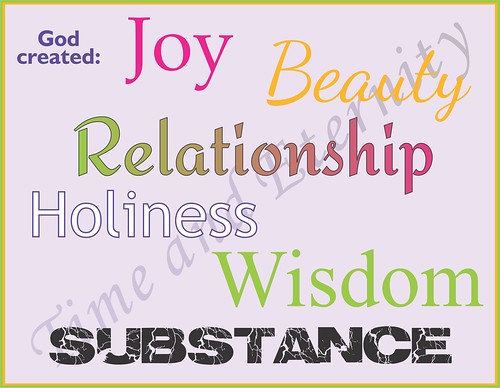
Substance has been created in time, which is another of God's creations. Since that is true, God is not in time, but outside of it, in eternity -- God can experience the past, present and future. Or, perhaps, God created eternity, too. All of the entities shown in the graphic play out in time, and in eternity. I'm not clear as to whether eternity is just time stretched out infinitely into the past and the future, or whether time somehow exists in eternity, and it doesn't matter what I think. I'll leave that question to God.
Satan apparently existed before the creation of substance, but probably not eternally into the past. Humans, and satan and other beings are going to exist eternally into the future.
Substance has been created in time, which is another of God's creations. Since that is true, God is not in time, but outside of it, in eternity -- God can experience the past, present and future. Or, perhaps, God created eternity, too. All of the entities shown in the graphic play out in time, and in eternity. I'm not clear as to whether eternity is just time stretched out infinitely into the past and the future, or whether time somehow exists in eternity, and it doesn't matter what I think. I'll leave that question to God.
Satan apparently existed before the creation of substance, but probably not eternally into the past. Humans, and satan and other beings are going to exist eternally into the future.
3. Beauty
All beauty, imagined*
or existent, of pattern, appearance, sound, and form, either:
was created
by God;
is a natural
emergence from what God created;
is based on
what God brought forth;
or is
possible because He gave humans the ability to be sub-creators.
(J. R. R.
Tolkien, who was a Christian, used the word sub-creation
about the fantastic worlds created by himself and others.)
*“Imagined,” because, for example, Beethoven was so deaf by the time his great
Ninth Symphony was performed that he could not hear it, and had not heard it,
except in his head, while he was composing it. Similar processes of imagination occur during
writing, painting, and other creative arts, and also in the sciences, even in
sports. Newton imagined his Law of Universal Gravitation – he didn’t develop
this from experiments. That Law’s simplicity is one of many scientific
phenomena that scientists sometimes say possess beauty, because of their
simplicity (at least to the scientists!) and explanatory power:
F = (g x m1 x m2)/r2
The scientific search for patterns in elementary particles, and for broadly applicable formulas and laws (such as the so-called theory of everything, or the “God particle”) is motivated by a belief that there is an underlying pattern and beauty in the way things are. Einstein, who was not a believer in a personal God, sometimes spoke as if there was a God who had arranged things in the way that they were, understandable, describable, and relatively simple.
Richard Feynman, Nobel laureate, said: “What is it about nature that lets this happen, that it is possible to guess from one part what the rest is going to do? That is an unscientific question: I do not know how to answer it, and therefore I am going to give an unscientific answer. I think it is because nature has a simplicity and therefore a great beauty.” “Seeking New Laws,” pp. 143-167, in Richard Feynman, The Character of Physical Law, New York: Modern Library, 1994. Quote is from p. 167. I have read most of Feynman's popular writing, and seen no evidence that he believed in God at all.
Naismith imagined a game involving tossing a ball into peach baskets.
F = (g x m1 x m2)/r2
The scientific search for patterns in elementary particles, and for broadly applicable formulas and laws (such as the so-called theory of everything, or the “God particle”) is motivated by a belief that there is an underlying pattern and beauty in the way things are. Einstein, who was not a believer in a personal God, sometimes spoke as if there was a God who had arranged things in the way that they were, understandable, describable, and relatively simple.
Richard Feynman, Nobel laureate, said: “What is it about nature that lets this happen, that it is possible to guess from one part what the rest is going to do? That is an unscientific question: I do not know how to answer it, and therefore I am going to give an unscientific answer. I think it is because nature has a simplicity and therefore a great beauty.” “Seeking New Laws,” pp. 143-167, in Richard Feynman, The Character of Physical Law, New York: Modern Library, 1994. Quote is from p. 167. I have read most of Feynman's popular writing, and seen no evidence that he believed in God at all.
Naismith imagined a game involving tossing a ball into peach baskets.
Satan probably
has no power to create beauty of any kind, although he can mimic God’s good
creation, and can use beauty as an evil force. (Pornography, for example.)
Perhaps Satan, as an angel, had creative powers that humans don’t. We don’t
know. Satan apparently can imagine events that have not happened yet, or that might never happen.
4. Relationship
The power to
form relationships with other sentient, responsive beings is possible because
God made it so.
A human who
is incapable of establishing relationships with others, or who does not want to
do so, is abnormal. Humans are constructed so that we form and maintain
relationships with others, from birth to death.
God also
desires relationships. The Three Persons of the Trinity apparently have a
relationship with one another. God wants to have a relationship with us. This
is not possible, or not nearly fully possible, unless the sin problem is fixed.
God loves us so much that He took care of the sin problem for us – we couldn’t
do that. In the life of Christ, in 1 Corinthians 13, and elsewhere, the proper
foundation for relationships is laid out. It is unselfish, Christ-like love. (Agape love.) Humans, and, to some
extent, animals, have some capacity to communicate, to empathize, to imagine
how to increase the well-being of others, and to do so. These all contribute to
the ability to form relationships. God wants us to use this ability to bring
others to a relationship with Him.
Satan is
incapable of forming a proper relationship with anyone. We aren’t, either,
without accepting Christ’s sacrifice for sin, and following His Lordship and
example.
5. Joy
God is
responsible for joy. We can, and should, be joyful in comprehending and
experiencing beauty and relationship, even substance. God made humor and
laughter possible. We should joy in contemplating God’s creativity and goodness.
“Joyful, joyful, we adore Thee” (based on Beethoven's Ninth Symphony) is found in many hymnals.
Satan has
lost any capacity for joy that he had originally, and wants to drive joy out of
the world.
6. Holiness
Holiness is
the opposite of evil and sin. Evil and sin are the absence of holiness. God is holy,
and good, and His creation started out that way. He wants us to be holy, and totally
good, too, and will eventually transform created things so that they, too, are
finally and eternally good. Because God is holy and good, He cannot abide sin.
Our relationship with Him should be such that we stop sinning, or at least do
it less frequently, and become more and more holy – more and more living a life
for God, and others, and less and less living for ourselves.
Satan is unholiness personified. Fallen, unredeemed humans are also unholiness personified.
7. Wisdom
Wisdom is “The ability to
discern or judge
what is true,
right, or lasting;
insight.” (The Free Dictionary). In other words, to have wisdom
is to act correctly on the things you know. God allows us to have knowledge, to
know things, but merely knowing things is not the same thing as wisdom.
Children know a lot, but they are often not wise. Presumably Satan also knows a
lot, but he has unwisely rejected God’s authority.
Thanks for reading, and thanks to my wife for suggestions.
This is the version of November 1, 2014, somewhat modified from previous versions.

Labels:
agape,
beauty,
creation,
energy,
eternity,
God's creation,
holiness,
imagination,
joy,
love,
matter,
origins,
relationship,
relationships,
satan,
simplicity,
substance,
time,
wisdom
Monday, August 24, 2009
Simplicity: a decision point
There is no article on "Simple," by and of itself, in the Wikipedia. Perhaps it's too simple? Dictionary.com, on the contrary, has no less than 24 meanings for the word. I'm going to continue, simply, if you please, as if meaning 13 is the only one. That meaning is "unlearned; ignorant."
Simplicity, in this sense, although perhaps not exactly a virtue in the Bible, may at least be a launching pad for maturity and wisdom.
The English Standard Version (All Bible quotations in this post are from that version.) has 20 verses containing the word, "simple." One of them is in Job, three are in Psalms, and the other sixteen are in Proverbs.
Psalm 116:6 indicates that God takes special care of the simple: "The Lord preserves the simple;
when I was brought low, he saved me."
Psalm 19:7 and Psalm 119:30 indicate that God provides ways for the simple to be made wise.
Proverbs 9 sets out a picture of a contrast. God invites the simple to partake of His wisdom, but the enemy invites them to partake of his folly.
If you are intelligent enough to read and understand the words of this post, you (and I) are intelligent enough to seek wisdom, not ignorance. We don't need to remain simple.
I posted later on what the New Testament says about this topic.
Thanks for reading.
Simplicity, in this sense, although perhaps not exactly a virtue in the Bible, may at least be a launching pad for maturity and wisdom.
The English Standard Version (All Bible quotations in this post are from that version.) has 20 verses containing the word, "simple." One of them is in Job, three are in Psalms, and the other sixteen are in Proverbs.
Psalm 116:6 indicates that God takes special care of the simple: "The Lord preserves the simple;
when I was brought low, he saved me."
Psalm 19:7 and Psalm 119:30 indicate that God provides ways for the simple to be made wise.
Proverbs 9 sets out a picture of a contrast. God invites the simple to partake of His wisdom, but the enemy invites them to partake of his folly.
If you are intelligent enough to read and understand the words of this post, you (and I) are intelligent enough to seek wisdom, not ignorance. We don't need to remain simple.
I posted later on what the New Testament says about this topic.
Thanks for reading.
Subscribe to:
Posts (Atom)